
PSW resume writing for personal support workers.
Long-term care homes, home care agencies, retirement homes and hospitals hire PSWs on training, compassion, safety and reliability. We write PSW resumes that show your certificate, clinical skills and the care you provide, so you get called for the right roles and shifts.
- Employers
- Long-term care, home care agencies, retirement homes, hospitals
- Where you apply
- Employer career sites, agency postings and job boards
- Typically required
- PSW certificateVulnerable sector checkFirst Aid and CPRHealth screening
- Ontario registration
- HSCPOA PSW registry; some employers require it
- Assets
- Dementia care trainingPalliative careCharting systemsSecond language
How employers hire PSWs, and where your resume matters.
PSW hiring moves quickly. Your resume decides whether you get a call, and employers check your training, registration and screening documents before your first shift.
Training
PSW certificate program with classroom and clinical placement hours.
Show program and hoursRegistration
In Ontario, registration with the HSCPOA, which some employers require.
Show statusApplication
Resume screened for training, experience, availability and certifications.
Resume decidesInterview
Questions on resident care, dementia, safety, teamwork and difficult situations.
Resume sets up your answersChecks
References, vulnerable sector check and health screening.
Details must matchOrientation
Employer orientation and shadow shifts before working independently.
Source: Ontario PSW registration is managed by the Health and Supportive Care Providers Oversight Authority (HSCPOA). Registration rules and deadlines can change, so confirm current requirements with the HSCPOA and your employer.
What employers look for on a PSW resume.
Hiring managers in care settings want to know you are trained, safe, kind and dependable. A strong PSW resume shows all four with real examples.
Must show clearly
- PSW certificate with the school, year and placement hours
- HSCPOA registration status, if you are registered
- Current First Aid and CPR, and a recent vulnerable sector check
- Personal care skills: bathing, dressing, feeding, toileting and mobility
- Safe transfers and lift use, with your safety record
- Availability for days, evenings, nights or weekends
Strong assets
- Dementia care training such as Gentle Persuasive Approaches
- Palliative and end-of-life care experience
- Charting in systems such as PointClickCare
- Infection prevention and control training
- Experience in both long-term care and home care
- A second language spoken by residents or clients
PSW resume keywords.
These are the words and phrases that appear again and again in personal support worker (psw) postings. Use the ones that are true for you, inside real examples.
Personal care
Safety and clinical
Care and communication
A PSW resume employers call back.
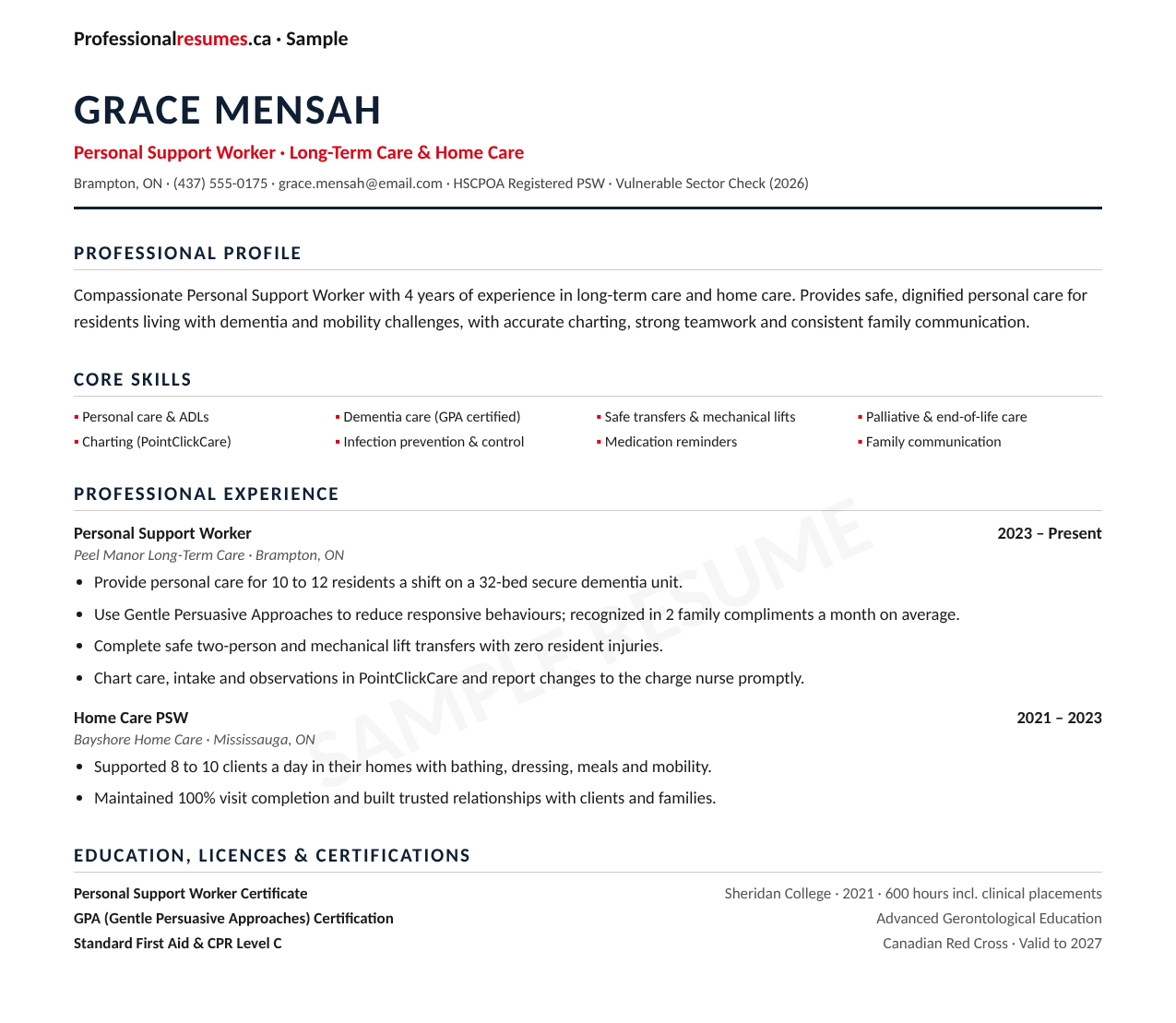
- 1Settings in the title
Long-Term Care and Home Care shows the employer types the candidate is ready for.
- 2Registration and screening up front
HSCPOA registration and a recent vulnerable sector check are easy to find.
- 3Caseload numbers
10 to 12 residents a shift on a 32-bed unit shows real workload.
- 4Dementia expertise
Gentle Persuasive Approaches and responsive behaviours show specialized skill.
- 5Safety record
Safe lift transfers with zero resident injuries shows safe practice.
- 6Training with hours
The PSW certificate includes the college, year and 600 hours with placements.
This sample uses a fictional candidate. Your resume is written from scratch around your own experience.
How to write each section.
Header
Name, city, phone, email, registration status and your most recent vulnerable sector check year.
Profile
Your years of experience, care settings and strongest skills, written warmly but professionally.
Skills
Eight clinical and care skills that match the posting, such as dementia care, safe transfers and charting.
Experience
Show the setting, number of residents or clients, types of care, safety record and recognition from families or supervisors.
Education and certifications
PSW certificate with school, year and hours, then First Aid and CPR, dementia care, IPAC and other training.
Availability
State the shifts and locations you can work. Many employers hire for specific shifts.
From care tasks to care you can see.
| Typical bullet | Rewritten by Professionalresumes.ca |
|---|---|
| Helped residents with daily activities. | Provided personal care for 10 to 12 residents a shift, including bathing, dressing, feeding and mobility support. |
| Worked with dementia patients. | Used Gentle Persuasive Approaches to reduce responsive behaviours on a 32-bed secure dementia unit. |
| Did home visits. | Supported 8 to 10 home care clients a day with 100% visit completion and consistent family feedback. |
| Followed safety rules. | Completed safe two-person and mechanical lift transfers with zero resident injuries. |
Mistakes that stop PSW applications.
Missing training details
Leaving out the school, year or placement hours for your PSW certificate.
No registration or screening info
Not stating registration status, First Aid and CPR or vulnerable sector check.
Only listing tasks
Describing tasks without caseload, setting or results.
Hiding dementia or palliative skills
Leaving out specialized training that many employers look for.
No availability
Not saying which shifts and locations you can work.
Unprofessional email or format
Casual email addresses, photos or long paragraphs.
Common backgrounds of new PSWs.
New PSW graduates
Recent graduates with clinical placements and their first job search.
Internationally trained caregivers
Nurses and caregivers trained abroad working as PSWs in Canada.
Family caregivers
People who cared for family members and completed PSW training.
PSWs moving up
PSWs moving into RPN programs, team lead or scheduling roles.
Hospitality and retail
Customer service workers moving into care.
Moving into transit
PSWs applying to roles such as TTC operator, where accessibility experience is an asset.
Ready for your next PSW role?
One writer, a one-on-one consultation and a first draft in 2 to 3 business days. Package deals add a matching cover letter and LinkedIn profile.
Personal Support Worker (PSW) resume FAQs
What should a PSW resume include?
Your PSW certificate with school, year and placement hours, registration status, First Aid and CPR, vulnerable sector check, care settings, caseload, specialized training and shift availability.
Do I need to be registered with the HSCPOA to work as a PSW in Ontario?
Registration is currently voluntary in general, but some employers require it, and rules for certain settings such as long-term care have deadlines. Confirm current requirements with the HSCPOA and your employer.
How long should a PSW resume be?
Usually one page, or two if you have several years of experience in different settings.
Should I include my clinical placement?
Yes, especially if you are a new graduate. List the setting, the number of hours and the care you provided.
What if I trained as a nurse outside Canada?
We present your nursing education and experience clearly while targeting PSW roles, and show any steps you are taking toward Canadian nursing registration.
Do PSW employers care about a cover letter?
Some do, especially for long-term care and hospital roles. Our package deals include a matching cover letter and LinkedIn profile.
Can you help me move from PSW into nursing or other healthcare roles?
Yes. We write resumes for PSWs applying to practical nursing programs, unit clerk, scheduling and team lead roles.
How quickly can I get my PSW resume?
Most first drafts arrive within 2 to 3 business days after your consultation.
Get your PSW resume ready to apply.
Send your current resume and, if you have one, the posting you are applying for. A writer will review it and tell you what to change, with no obligation.
Prefer to talk? Call (647) 819-2545 or email info@professionalresumes.ca.