
Engineering Resume Writing Services for Canada.
Resumes built around your licensure status, your discipline, and the projects you’ve actually delivered, positioned for how Canadian engineering employers hire.










Engineering hiring in Canada runs on licensure.
Whether you hold a Professional Engineer (PEng) designation through PEO, APEGA, EGBC, or another provincial regulator, or you’re working toward it as an Engineer-in-Training (EIT), that status shapes what roles you’re eligible for and how your resume needs to be positioned. A resume that buries or misrepresents licensure status gets screened out before a hiring manager ever reviews the actual engineering work.
At Professionalresumes.ca, we build resumes around your discipline, your licensure stage, and the actual scope of what you’ve engineered: systems designed, projects delivered, stamped deliverables, and measurable technical or cost outcomes. For engineers trained outside Canada, we also know how to position that experience toward provincial licensing pathways and Canadian equivalency so employers can see the relevance clearly.
Engineer, 6 years experience
AfterCivil Engineer, P.Eng. (EGBC) · Municipal water and wastewater
Worked on bridge rehabilitation projects.
AfterLed structural design for a $22M, 4-span bridge rehabilitation; delivered stamped drawings 3 weeks ahead of tender.
EIT (in progress)
AfterEngineer-in-Training, PEO · 36 of 48 months of qualifying experience logged · PPE passed
Large engineering employers screen through ATS platforms before a technical manager ever sees a resume.
Ours are built to clear both stages. Every resume is checked against the parsing logic used by major Canadian engineering and infrastructure employers, then reviewed again for whether a hiring manager or technical lead would actually want to interview you.
Built around licensure, not just job titles
A resume that treats EIT and PEng status as an afterthought is a resume that misrepresents what you’re actually qualified to do. We put licensure where it belongs. In practice, that means:
- Clear, accurate positioning of PEng licensure, EIT status, and the specific provincial regulator involved (PEO, APEGA, EGBC, and others)
- Correct handling of stamped/sealed deliverables and where professional responsibility applies
- Positioning built for how consulting firms, industrial employers, and infrastructure owners actually screen engineering candidates
Delivered projects over generic responsibilities
Most engineering resumes list responsibilities. The ones that get interviews show what was actually designed, built, or delivered. We build resumes around specifics like:
- Project scale: budget size, structure or system specifications, capacity or throughput delivered
- Technical outcomes: efficiency gains, cost savings, safety or code compliance achieved
- Leadership: teams managed, disciplines coordinated, client or regulatory relationships led
A real conversation, not an intake form
The distinction between a design role and a project management role, or the real story behind an EIT candidacy, rarely comes through in a form. Working directly with your writer means:
- Your licensure status and technical scope get represented accurately, not generalized
- Positioning is built around the specific discipline, sector, and employer type you’re targeting
- Nothing goes out the door until it reflects the engineering work you’ve actually done
Every stage of licensure reads differently. We write for yours.
Recruiters read an engineering resume against where you are on the path to PEng. Here’s what we put front and centre at each stage.
Graduate
Accredited degree, co-op terms, capstone design and the tools you can use from day one.
EIT
Registration with your regulator, months of qualifying experience logged, and the competencies you’re building.
Exams
Law and ethics exam status (such as the PPE) and any technical exams assigned, stated clearly.
P.Eng.
Licence, regulator and province up front, with stamped deliverables and professional responsibility shown accurately.
Leadership
Programs, budgets, multidisciplinary teams and client relationships, for engineering managers and directors.
Internationally trained? We position your experience toward your provincial regulator’s licensing pathway and Canadian equivalency. See our resume writing for newcomers to Canada.
Best Civil, Mechanical, Electrical & Structural Engineer Resume Writing Services in Canada.
Our resumes are built for civil, mechanical, electrical, structural, and geotechnical engineers, EITs, and internationally trained engineers across Canada’s consulting, industrial, and infrastructure sectors. Every resume is built around what employers actually screen for: licensure status, discipline-specific expertise, and delivered project outcomes, not generic engineering language. We support engineers at every stage of licensure across Canada’s engineering sector, including:
Civil Engineering
- Civil Engineers (municipal, transportation, water/wastewater)
- Structural Engineers
- Geotechnical Engineers
Mechanical Engineering
- Mechanical Engineers (buildings, industrial, manufacturing)
- HVAC & Building Systems Engineers
- Process & Manufacturing Engineers
Electrical Engineering
- Electrical Engineers (power, controls, systems)
- Instrumentation & Controls Engineers
- Power & Utility Engineers
Project & Consulting Engineering
- Project Engineers & Project Managers
- Consulting Engineers
- Engineering Managers & Directors
EITs & Internationally Trained Engineers
- EITs at Every Discipline
- New Graduate Engineers
- Internationally Trained Engineers Seeking Canadian Licensure
What you get.
| Specification | ProfessionalResumes.ca | Other companies |
|---|---|---|
| Canadian Engineering Sector Specialists | ✓ | ✕ |
| Deep Knowledge of PEng Licensing (PEO, APEGA, EGBC & Provincial Equivalents) | ✓ | ✕ |
| Experience Positioning EIT Status & In-Progress Licensure | ✓ | ✕ |
| Support for Internationally Trained Engineers Seeking Canadian Equivalency | ✓ | ✕ |
| Resumes Built Around Stamped Deliverables & Project Scope, Not Generic Duties | ✓ | ✕ |
| ATS Optimization for Canada’s Largest Engineering & Infrastructure Employers | ✓ | ✕ |
Your engineering experience is specific. Your resume should be too.
In Canadian engineering hiring, your resume has to prove technical depth and licensure standing in the same breath. Whether you’re an EIT early in your career, a licensed PEng with a decade of stamped deliverables, or an internationally trained engineer working toward Canadian equivalency, your work is specific, and your resume should read that way.
At Professionalresumes.ca, we build resumes around your discipline, your licensure stage, and the actual scale and outcomes of the projects you’ve delivered. Our goal is for a hiring manager or technical reviewer to understand your qualifications and fit within the first few lines. How we help you stand out:
- Personalized one-on-one session with a Canadian engineering resume expert
- Strategic positioning tailored to your discipline, licensure stage, and target employer type
- Optimized for the ATS platforms Canadian engineering and infrastructure employers actually use, without losing the technical detail that matters to a reviewer
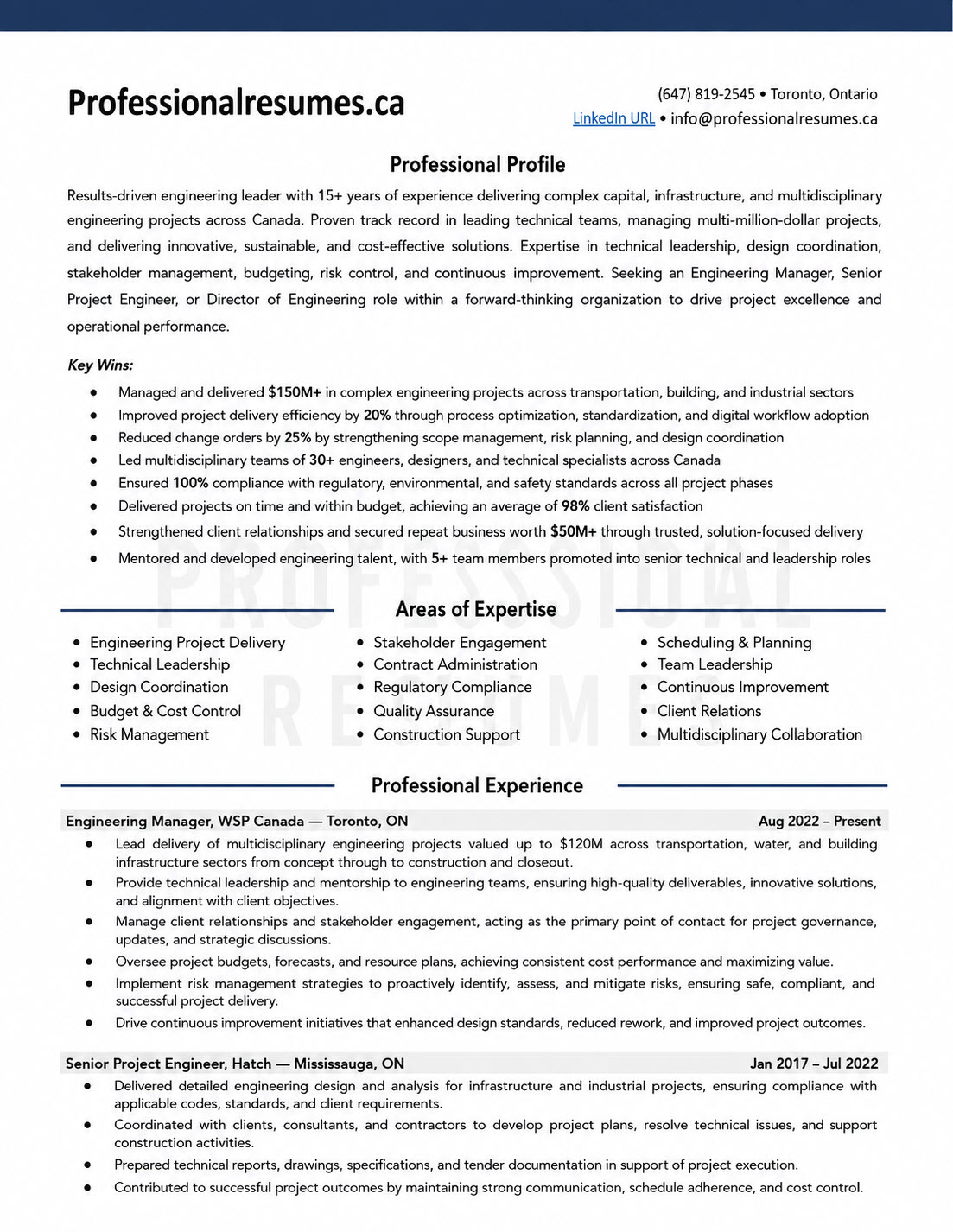
Choose the right resume package for your career.
Designed for new engineering graduates and Engineers-in-Training entering Canada’s workforce.
Buy now →Ideal for engineers advancing toward PEng licensure, moving into a specialized discipline, or targeting a new employer type.
Buy now →Tailored for licensed Professional Engineers and internationally trained engineers positioning international experience for Canadian equivalency.
Buy now →For Engineering Managers, Directors, and VPs of Engineering ready to highlight strategic and technical leadership impact at the leadership level.
Buy now →Your questions, answered.
What makes an engineering resume different from a standard resume?
An engineering resume has to clearly demonstrate licensure status, technical discipline, and delivered project outcomes, not just job duties. Employers are screening for PEng or EIT status, stamped or sealed deliverables where relevant, and project scale, not generic engineering language. We build resumes around exactly what a technical hiring manager is screening for.
I’m currently an EIT working toward my PEng. How should that show up on my resume?
This is one of the most common questions we get, and it matters a lot to get right. We position EIT status and progress toward PEng licensure accurately, including logged experience where relevant, so it reads as active progress rather than an incomplete qualification.
Do you write resumes for internationally trained engineers?
Yes. We regularly work with engineers whose training and experience were built outside Canada, and we know how to position that experience toward provincial licensing pathways and Canadian equivalency so employers can quickly see the relevance and scale of your background.
How should stamped or sealed deliverables be represented on my resume?
This matters and needs to be handled carefully, since professional responsibility and stamping authority are tied directly to your licensure status. We help position this accurately so it reflects your actual level of professional responsibility on a project.
Will my resume pass the ATS systems used by major Canadian engineering employers?
Yes. Resumes from Professionalresumes.ca are built to pass the applicant tracking systems used by major Canadian engineering, consulting, and infrastructure employers, using accurate technical terminology and formatting that parses cleanly.
Can you tailor my resume for a specific discipline, like civil, mechanical, or electrical engineering?
Absolutely. Whether you’re targeting civil, mechanical, electrical, structural, or another discipline, our team builds your resume around the specific technical language and project types that discipline is screened for, rather than a generic engineering template.
Do you provide guidance for cover letters and LinkedIn profiles too?
Yes. Alongside your resume, we offer matching cover letters and LinkedIn profile updates built for engineering recruiters and technical hiring managers, so your professional presence is consistent everywhere someone might look you up.
How long does it take, and is my information kept confidential?
Typical turnaround is 2 to 3 business days from when we receive your information, with unlimited revisions for up to 3 weeks. Your employment history and job search are kept confidential and used only to build your resume. If you’re on a tighter timeline, our express 24-hour service delivers a completed resume within a day.
Do you write resumes for engineers in every province?
Yes. We work with engineers licensed by, or applying to, every provincial and territorial regulator, from PEO in Ontario and OIQ in Quebec to APEGA in Alberta and EGBC in British Columbia. Everything is done by phone or video, wherever you’re based.
Should I list my engineering software and tools?
Yes, but selectively. We include the design, analysis and project tools that appear in your target postings, such as AutoCAD, Civil 3D, Revit, SolidWorks, ETABS or SAP2000, so you match the ATS without turning your resume into a software list.
Tell us about your engineering career goals.
Whether you need a new resume, a resume update, or LinkedIn optimization, tell us about your discipline, your licensure stage, and the roles you’re targeting. Our team will review your background and follow up with next steps.