A C-suite resume works when it uses a reverse-chronological, ATS-safe layout, saved as a DOCX, and runs two pages (three only for a sitting CEO with substantial board history). Three elements decide whether it lands an interview: a tight executive summary, quantified impact in every role, and enough depth on your last two positions to prove current relevance. Everything else is execution detail, covered role by role below.
TL;DR:
- Use a reverse-chronological, ATS-friendly layout saved as a DOCX, confined to two pages for most roles, with three only for sitting CEOs with extensive board work.
- Craft a concise executive summary that clearly states your industry context, pattern of success, key proof points with numbers, and target role, avoiding vague traits and scope-only descriptions.
- Ensure every achievement bullet pairs a power verb with a measurable result, especially from your last two positions, to demonstrate current relevance and create a compelling business case.
- Avoid formatting pitfalls like multi-column layouts, embedded graphics, or headers; stick with standard fonts, margins, and section labels, and prioritize plain text for ATS compatibility.
- Include only relevant education and certifications, omit references and GPA, and position board, publication, or speaking credentials in dedicated sections to support your leadership story.
Table of Contents
C-suite resume examples for CEO, CFO, and CTO roles
Search firms and boards read fast. They’re scanning for pattern recognition, not backstory. Below are three compact summary and bullet samples that show the formula in action. Adjust the numbers, not the structure.
CEO example
Summary: Growth-focused CEO with extensive experience leading mid-market industrial and consumer businesses through ownership transitions and category expansion. Known for rebuilding executive teams, resetting capital allocation, and restoring significant growth within a short period of taking the helm. Reports directly to private equity boards and has led successful business exits.
- Reversed several years of revenue decline at a mid-sized industrial distributor, delivering meaningful top-line growth through channel restructuring and SKU rationalization.
- Led a private equity-backed carve-out involving over a thousand employees across multiple countries, closing the transaction ahead of schedule.
This works for a CEO because it signals scale (revenue, headcount, geography), a repeatable pattern (turnaround, then growth), and board fluency in the same paragraph.
CFO example
Summary: Finance executive with a track record of building investor-grade reporting infrastructure and leading capital raises for venture-backed and private equity-owned companies. Combines FP&A rigour with hands-on treasury and M&A execution. Has presented to boards and lenders on quarterly cadence for over a decade.
- Raised substantial capital across multiple funding rounds, building the financial model and due diligence package that closed rounds within targeted valuation ranges.
- Cut days sales outstanding significantly by rebuilding the collections process and renegotiating payment terms with key accounts.
The CFO sample earns credibility through specificity: two rounds, a valuation range, a DSO figure with a before and after. Boards trust CFOs who quantify.
CTO example
Summary: Technology executive who has scaled engineering organizations from early-stage through later funding rounds, with deep experience in platform migrations and security compliance. Balances hands-on architecture decisions with the people leadership required to retain senior talent through hypergrowth.
- Migrated a legacy monolithic system to a microservices architecture, dramatically reducing deployment time without production outages.
- Grew the engineering organization significantly while keeping voluntary attrition well below sector averages.
Pro Tip: Every bullet above follows the same skeleton: power verb, method, measurable result. If a bullet doesn’t have a number, it’s a task description, not an achievement.
Each summary opens with a role identity, not a job title repeat, and each bullet pairs an action with a business outcome. That combination is what separates a C-suite job application that gets a callback from one that gets filed.
How do you write an executive summary that gets read?
Recruiters and search firm associates read the top third of page one before deciding whether the rest is worth their time. A four to six sentence executive summary has to do four jobs in that space: establish your operating context, name the pattern you repeat across roles, plant one or two anchor proof points, and signal the type of role you’re targeting next.
Here’s a template that holds up across functions:
[Role identity] with [X years] leading [industry/function context]. Known for [repeating pattern of success]. [Anchor proof point with a number]. [Second proof point or scope statement]. [Optional forward-looking line naming the type of mandate you’re seeking].
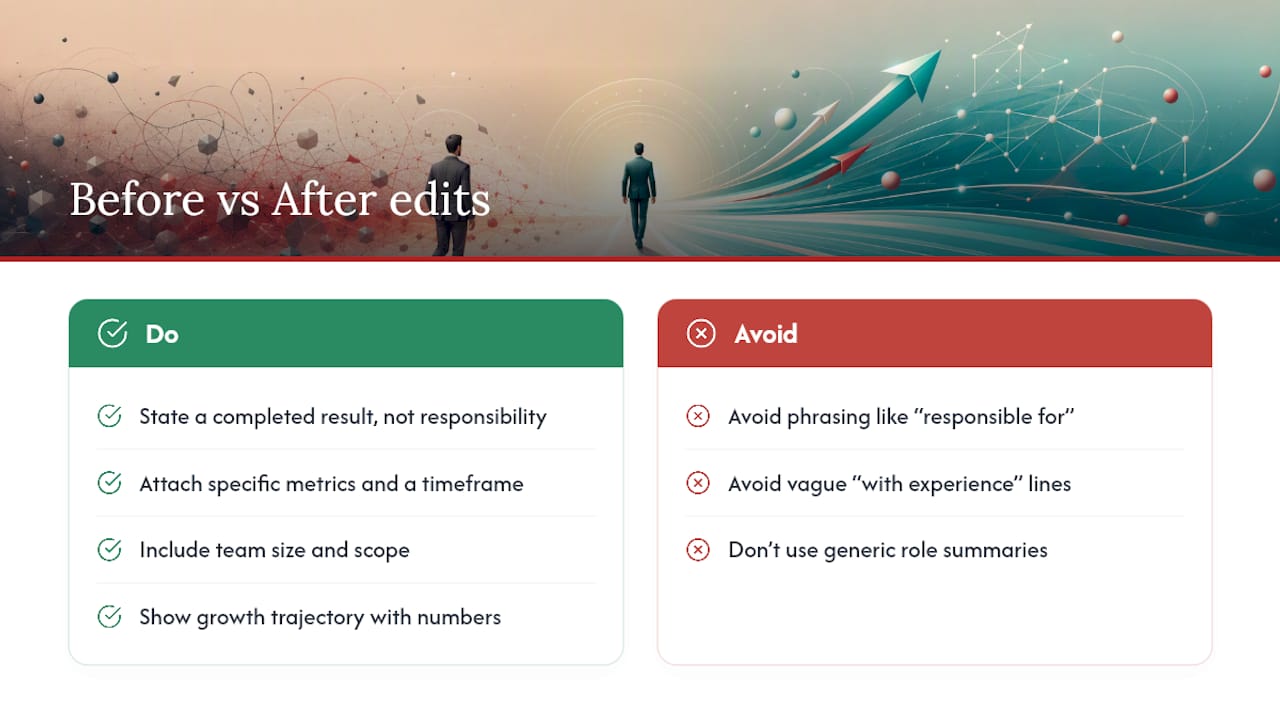
Before: “Results-oriented senior operations leader with extensive experience managing teams and driving efficiency across multiple business units. Strong background in process improvement and cross-functional collaboration.”
After: “Operations executive who has led manufacturing turnarounds for three private equity portfolio companies, consistently improving EBITDA margin within the first year of engagement. Seeking COO or division president mandates in industrial manufacturing.”
The difference isn’t polish. It’s specificity. The “after” version names an industry, a dollar figure, a percentage, and a target role. The “before” version could belong to almost anyone.
A second common failure: opening with a soft adjective instead of a role identity. “Dynamic, results-driven leader” tells a reader nothing they can act on. “Turnaround CEO for distressed industrial assets” tells them exactly what to expect from the rest of the page.
Common mistakes worth fixing before you send anything out:
- Opening with a personality trait instead of a functional identity (“passionate,” “dynamic,” “visionary”).
- Listing responsibilities instead of naming a pattern of outcomes across roles.
- Skipping the anchor number, which forces recruiters to hunt for proof further down the page.
- Writing six sentences of dense narrative with no proof point at all, just scope description.
If your summary reads the same as three other candidates for the same board member resume or executive role, it hasn’t done its job yet.
What keywords belong in an executive core competencies grid?
An ATS parses your resume before a human ever opens it, and at senior levels, the system is often screening for a specific mix of strategic, financial, technical, and governance terminology drawn from the job posting itself. A core competencies grid, usually placed just under the executive summary, gives the parser and the human reader a fast scan of your range.
Structure it as a labelled grid, four to six terms per row, organized by category rather than dumped as a single list:
- Strategic: Corporate strategy, market expansion, M&A integration, turnaround leadership, portfolio optimization
- Financial: P&L ownership, capital allocation, EBITDA improvement, investor relations, financial planning and analysis
- Technical/operational: Digital transformation, supply chain redesign, systems implementation, cybersecurity governance
- Governance: Board reporting, regulatory compliance, risk management, audit oversight, ESG strategy
Pull your specific terms directly from the job posting language, not from a generic list. If the posting says “organizational transformation” and your grid says “change management,” you’ve created a mismatch that some parsers won’t bridge.
The mistake to avoid is loading the grid with terms that never reappear in your experience bullets. If “P&L ownership” sits in your competencies grid but no bullet anywhere on the page mentions a revenue figure or a budget you controlled, a sharp reader notices the gap immediately. Every keyword in the grid needs at least one piece of supporting evidence elsewhere on the page. That’s what turns a keyword list into a credible signal rather than C level resume tips copied from a template.
How should you write professional experience entries?
This is the section where most executive resumes lose the reader. Not because the candidate lacks accomplishments, but because the entries read like job descriptions instead of business cases. Every role deserves a repeatable structure: one context line, then three to six achievement bullets.
The context line comes first, before any bullets, and orients the reader on scale before you ask them to care about results. A useful template: [Company, industry, and size] ($X revenue, X employees) [brief note on your mandate or the situation you inherited].
Example: “Regional logistics carrier ($140 million revenue, 600 employees) recruited to reverse two years of margin erosion following a leadership vacuum.”
That single line does work a job title alone can’t. It tells the reader the size of business you’re used to running and the type of situation you’re brought in to solve, before a single bullet appears.
From there, apply the same bullet formula across every function:
- Operations: “Redesigned the distribution network across 14 facilities, cutting average delivery time by 22% and reducing freight costs by $4.2 million annually.”
- Finance: “Restructured $60 million in debt across three lenders, extending maturity by three years and freeing $1.8 million in annual cash flow.”
- Technology: “Led the enterprise ERP replacement across 2,200 users in six countries, completing the rollout four months ahead of the original 18-month timeline.”
- People/HR: “Rebuilt the executive leadership team following a 40% turnover event, achieving full stabilization within nine months and improving engagement scores from 58 to 81.”
- Sales/commercial: “Opened three new international markets, growing export revenue from $6 million to $28 million over three years.”
- General management: “Took over a stalled product division, relaunching two flagship lines and returning the unit to profitability within five quarters.”
Pro Tip: If you can’t attach a number to a bullet, ask what changed because of your action. A time saved, a cost avoided, a headcount reduced, a deal closed. There’s almost always a metric hiding in the story.
For roles more than 10 to 12 years old, compress hard. A single line naming the title, company, and one standout result is usually enough. Boards and search firms care most about your last decade of decisions; older roles establish trajectory, not proof.
If you were promoted within the same company, list the company once with a nested breakdown of titles and dates, rather than repeating the employer name three times down the page. For a brief tenure, one honest line of context (a company-wide restructuring, an acquisition that eliminated the role) usually satisfies a curious reader without turning into a defensive paragraph. Directness reads as confidence; over-explaining reads as anxiety.
The reverse-chronological format remains the standard structure heading into 2026, and it’s the format both applicant tracking systems and retained search firms expect to see. Hybrid or functional formats, which group skills ahead of chronology, tend to confuse parsers and slow down human reviewers who are trained to scan for dates and titles first.
A short list of things to avoid entirely in the experience section: multi-column layouts, embedded images or headshots, text boxes, tables used to organize achievements, and graphics like skill bars or icons. Parsers frequently misread or drop content trapped inside these elements, and some formatting choices break ATS parsing outright.
On the technical side:
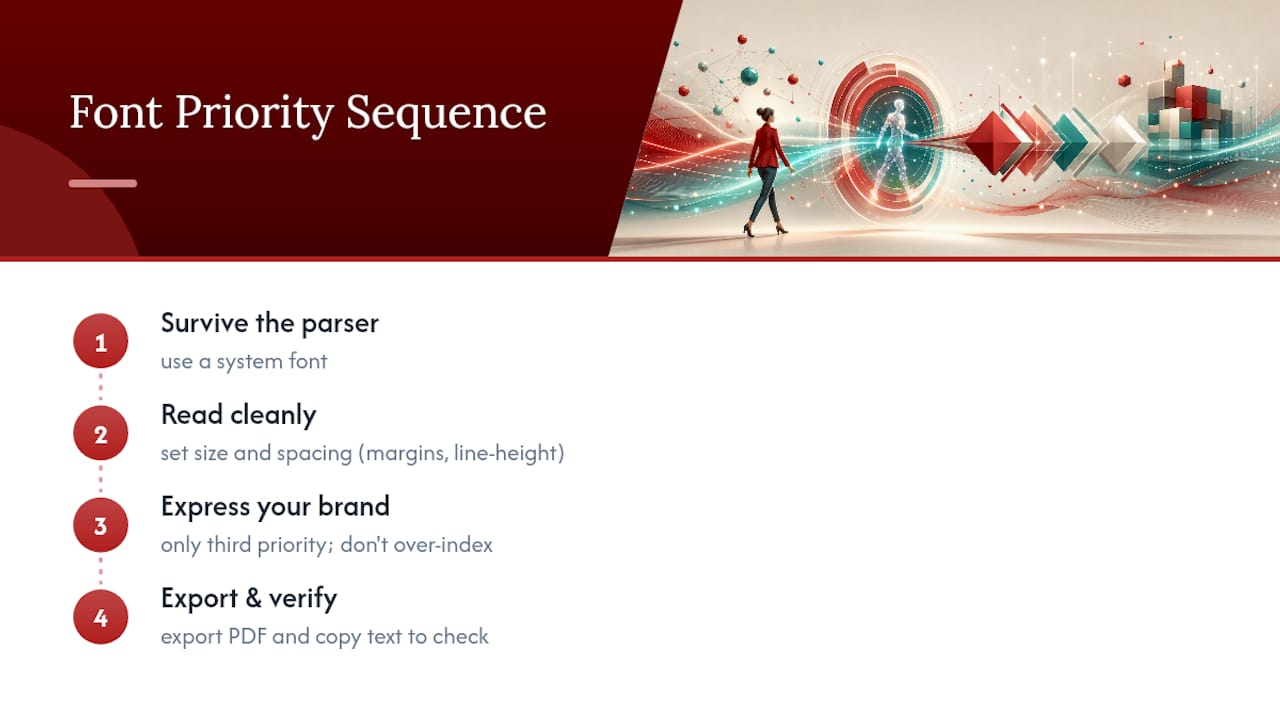
- Use a standard, widely supported font (Calibri, Arial, or Georgia) at 10.5 to 11.5 points for body text.
- Keep margins between 0.6 and 1 inch on all sides.
- Save and submit as a DOCX file unless the posting explicitly requests PDF; many enterprise ATS platforms parse DOCX more reliably than designed PDFs.
- Use conventional section headers: “Professional Experience,” “Education,” “Board and Advisory Roles.” Creative header names (“My Journey,” “Where I’ve Made an Impact”) can confuse parsing logic that’s looking for standard labels.
Before you submit anything, run a final sanity check: confirm your target keywords from the job posting appear in both the competencies grid and at least one bullet, confirm section headers use plain language, and confirm there are no embedded objects, headers/footers holding critical text, or hyperlinked graphics standing in for real content. A resume that looks sharp on screen but parses as a jumbled mess defeats its own purpose before a human ever sees it.
How many pages should a C-suite resume run?
Two pages is the norm for the overwhelming majority of executive resumes, and most guidance holds firm on that ceiling even at the senior-most levels. A third page becomes defensible only for a sitting CEO with extensive board seats, advisory roles, publications, or speaking history that a reader genuinely needs to evaluate the candidacy. Length has to be earned by relevance, not filled by habit.
Before you let a resume run past two pages, apply this trimming checklist:
- Cut any role older than 12 to 15 years down to a single line unless it directly supports your target role.
- Remove bullets that describe a responsibility rather than a result. If there’s no metric or outcome, it’s a candidate for deletion.
- Consolidate repetitive language across roles. If you’ve used “led cross-functional team” three times, it’s not adding new information the second and third time.
- Move committee memberships, minor certifications, and dated technical skills off the page entirely.
- Check whether two similar achievements from different years can be merged into one stronger bullet.
Anything that doesn’t survive the trim, but still adds value, belongs somewhere else: a fully built-out LinkedIn profile, a one-page board bio, or a portfolio link referenced in your summary. The resume’s job is to earn the conversation, not to document the entire career.
Two executive resume rewrites: before and after
Seeing the transformation in full context makes the bullet formula concrete. Below are two role rewrites, drawn from common patterns in real executive resumes, showing exactly what changes and why.
Rewrite 1: VP Operations to COO candidate
| Version |
Content |
| Before |
“Responsible for overseeing daily operations across multiple manufacturing facilities. Worked closely with senior leadership to improve efficiency and reduce costs. Managed a large team and was involved in various process improvement initiatives.” |
| After |
“Manufacturing operations executive overseeing four facilities and 850 employees for a $310 million industrial supplier. Cut unplanned downtime by 31% through a predictive maintenance program, saving $2.1 million annually. Consolidated two underperforming facilities into one, eliminating $1.4 million in redundant overhead within seven months.” |
Rewrite 2: Marketing director to CMO candidate
The metrics chosen in each rewrite aren’t arbitrary. They’re the numbers a board or a hiring committee would actually ask about in an interview: cost, headcount, timeline, revenue exposure. That’s the test for any metric you consider including. If it wouldn’t come up in a real conversation with a CFO or a board chair, it’s probably not worth the space it occupies.
The ATS benefit is a secondary win. Plain-text tables like the one above render cleanly. Standard section labels stay intact, and every claim ties to a number a parser can index alongside your keyword grid.
What does Professionalresumes’ executive service actually deliver?
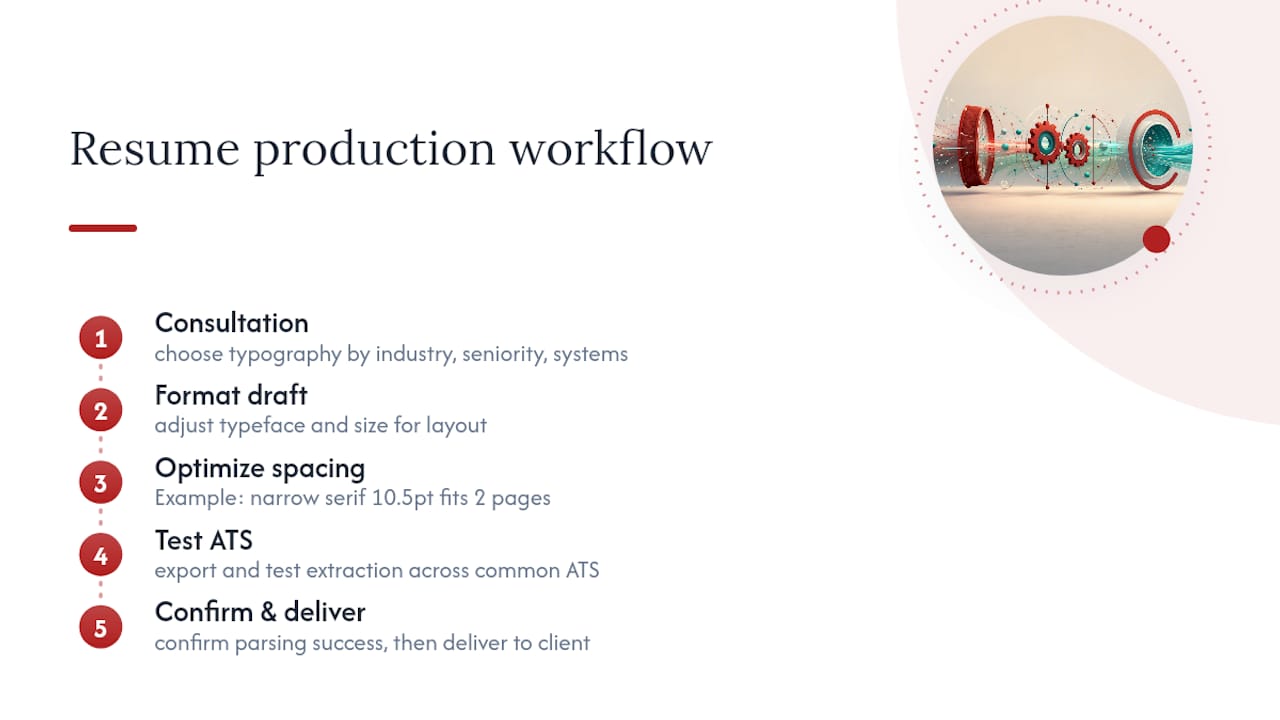
Professionalresumes builds each executive resume around direct consultation rather than a template pulled from a database. The process starts with a conversation about your target roles, the industries you’re moving between, and the proof points that need to anchor your summary, then moves into drafting with your writer, followed by structured revision rounds until the document reads as a genuine leadership brief.
That personalized approach matters most at the C-suite level, where a generic resume gets noticed for the wrong reasons. A writer who understands the difference between a turnaround narrative and a growth narrative can position the same career history two very different ways, depending on the mandate you’re chasing next.
Executive branding works only when the resume, the LinkedIn profile, and the board bio all tell the same story. A mismatch between those three assets is often the first thing a search firm associate notices, and it raises questions before a single interview happens.
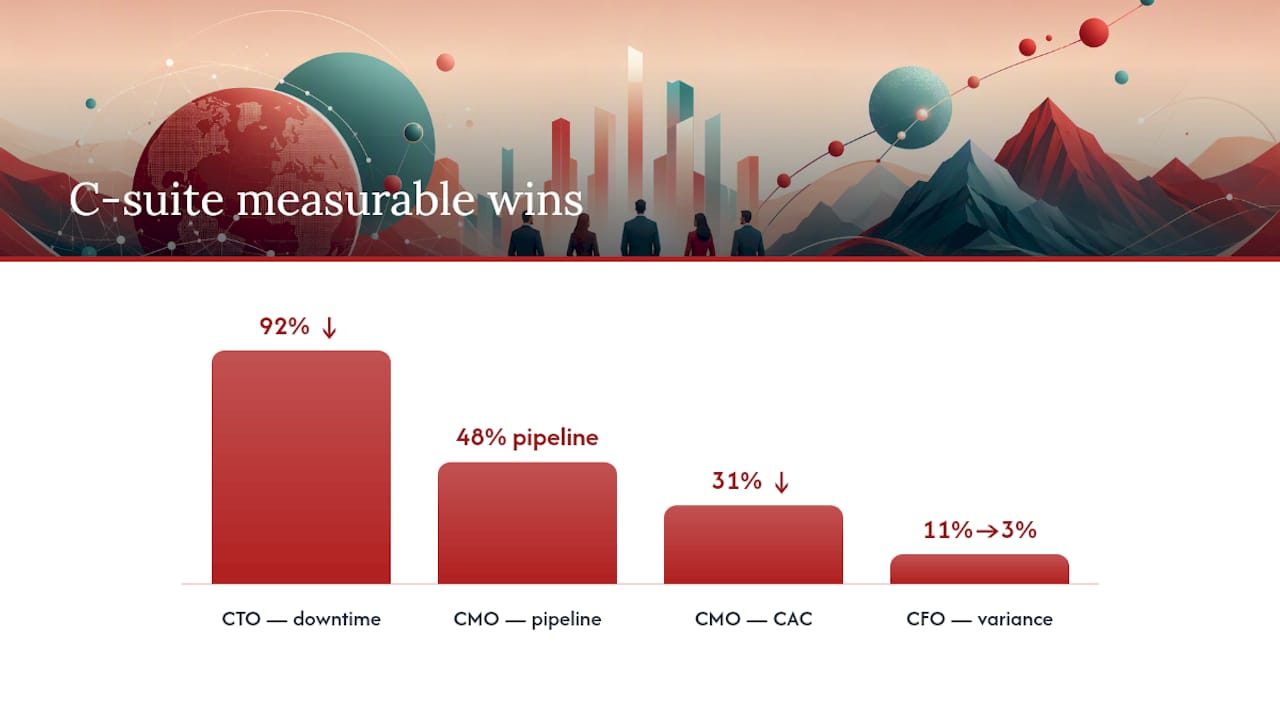
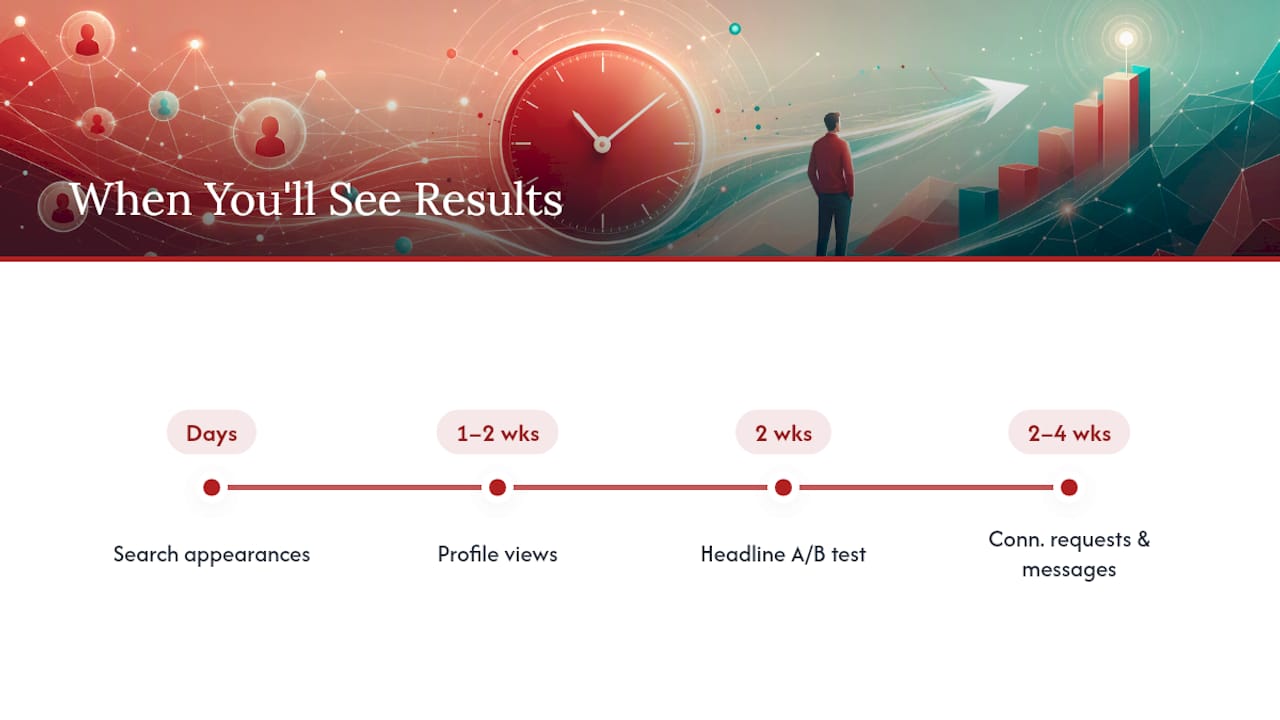
Documented client outcomes and case studies show the kind of measurable results this approach produces, including increased interview requests and stronger positioning against other shortlisted candidates.
If you have the time, the objectivity, and the writing discipline to self-edit ruthlessly, a strong DIY resume built on the frameworks above is entirely workable. If you’re managing a live search, a confidential transition, or simply don’t have the bandwidth to iterate through drafts, working with a professional writer typically compresses the timeline and closes gaps a candidate is often too close to their own story to see.
How do you handle employment gaps or career transitions at this level?
A gap or a pivot reads very differently at the executive level than it does earlier in a career, and the fix is almost always the same: context, not apology. One brief line explaining the circumstance, followed immediately by what you did with the time, neutralizes most concerns before a reader has a chance to speculate.

If the gap followed a company-wide restructuring, a private equity exit, or an acquisition that eliminated your role, say so plainly in a single clause. “Company acquired and executive team restructured” tells a reader everything they need without inviting further questions.
Use the gap period productively on the page. Board work, advisory engagements, executive education, or consulting projects during a transition all belong in the timeline as legitimate entries, not footnotes. A six-month advisory engagement with a portfolio company, even unpaid, demonstrates that you stayed engaged and relevant.
For a functional pivot, such as moving from CFO to CEO or from a regional role to a global mandate, use your executive summary to frame the transition as a deliberate expansion of scope rather than something to explain away. Name the skills that transfer directly (P&L ownership, board reporting, capital allocation) and let your most recent achievements carry the weight of proving you’re ready for the broader mandate.
What doesn’t work is silence. An unexplained twelve-month gap invites a reader to assume the worst; one honest sentence almost always outperforms no explanation at all.
Where do board seats, publications, and speaking engagements belong?
These credentials carry real weight at the C-suite level because they signal how the market outside your own company views your judgment. They belong in a dedicated section, positioned after your professional experience and before education, never buried inside a bullet under a job title.
Label the section clearly, something like “Board and Advisory Roles” or “Board Memberships and Affiliations,” and list each seat with the organization name, your role (director, audit committee chair, advisor), and the years served. If the board work ties directly to a measurable outcome, a successful exit, a turnaround, a capital raise, include a single line of context.
Publications and speaking engagements deserve a lighter touch unless they’re central to your personal brand, as they often are for a CTO known for thought leadership or a CFO who publishes on capital markets. List the two or three most relevant pieces by title and outlet, and skip the full bibliography. A hiring committee wants evidence of external credibility, not a complete list of every panel you’ve joined.
For a sitting CEO or someone targeting board director roles specifically, this section can justify the extra length that pushes a resume to three pages. For most other C-suite candidates, keep it to four to six lines total, prioritizing recency and relevance over volume. A single well-chosen board seat with real context outperforms five seats listed with no detail at all.
How much education and certification detail is appropriate?
At the C-suite level, education earns a brief, confident mention, not a detailed account. List your degree, institution, and graduation year (or omit the year if it’s more than 20 years past) in two lines near the bottom of the page, after professional experience and any board section.
Executive education programs deserve slightly more visibility if they’re recent and relevant. A completed program from a recognized business school executive program, an advanced leadership certificate, or a specialized credential tied directly to your target role can sit in the same section, listed by program name and institution.
Professional certifications follow the same rule that governs everything else on an executive resume: include only what supports your current narrative. A CPA designation matters enormously for a CFO candidate and far less for a CMO. A PMP certification earned 15 years ago as a project manager rarely adds value to a COO resume built around P&L ownership and organizational transformation.
Skip GPA, coursework lists, and undergraduate honours from decades ago. None of it moves the needle for a reader evaluating whether you can run a business unit or sit on an executive committee. What does move the needle is a clear signal that your formal education and continuing education track match the seniority of the role you’re pursuing now.
If you’re pivoting into a new function, such as moving from operations into a CFO-track role, a recent finance-focused executive program can help bridge the credibility gap faster than years of on-the-job experience alone can communicate on paper.
Should you include a personal brand statement or leadership philosophy?
A short, well-placed line about how you lead can strengthen a resume, but it works only when it’s specific and appears once. The best place for it is inside the executive summary itself, as the closing sentence, rather than as a separate section competing for space with your achievements.
The failure mode here is genericity. “I believe in empowering my team and leading with integrity” could describe almost any executive alive and adds nothing a reader can act on. A stronger version names your actual operating approach: “Leads through direct operator involvement in the first 90 days of any turnaround, then transitions to a coaching model once the team demonstrates independent judgment.”
That kind of statement works because it’s falsifiable. A reader can ask about it in an interview and expect a real answer grounded in a real situation, which is exactly what a leadership philosophy statement should invite.
Keep it to one sentence, and resist the urge to add a second one that restates the same idea with different words. If your philosophy needs three sentences to explain, it likely hasn’t been distilled into something a board could remember after the meeting ends. The strongest version of this statement also aligns with how you present yourself on LinkedIn and in a personal branding profile, since a mismatch between the two is one of the fastest ways to undercut your own credibility.
Do you need to list references on an executive resume?
No. References don’t belong on the page itself at any level, and the C-suite is no exception. The convention “references available upon request” is outdated and takes up space better used for another achievement bullet. Search firms and hiring committees will ask for references directly when they’re ready, usually late in the process, and they’ll want to choose which of your professional relationships to contact rather than being handed a pre-selected list.
Where references and endorsements do matter is in the assets that surround your resume. A LinkedIn profile with several substantive recommendations from former board members, direct reports, or peer executives adds real weight, particularly when those recommendations speak to the same leadership pattern your resume claims. If a search firm associate reads your resume and then checks LinkedIn, consistency between the two builds trust; a gap between the story your resume tells and the story your recommendations tell raises doubt.
If you’re asked to provide references formally, prepare a separate one-page reference sheet with names, titles, relationship context, and contact details, distinct from the resume, ready to send only when requested. Choose references who can speak to different facets of your leadership, one who saw your financial judgment, one who saw your people leadership, one who witnessed a specific turnaround or transaction, rather than three people who will all tell the same generic story about what a great leader you are.
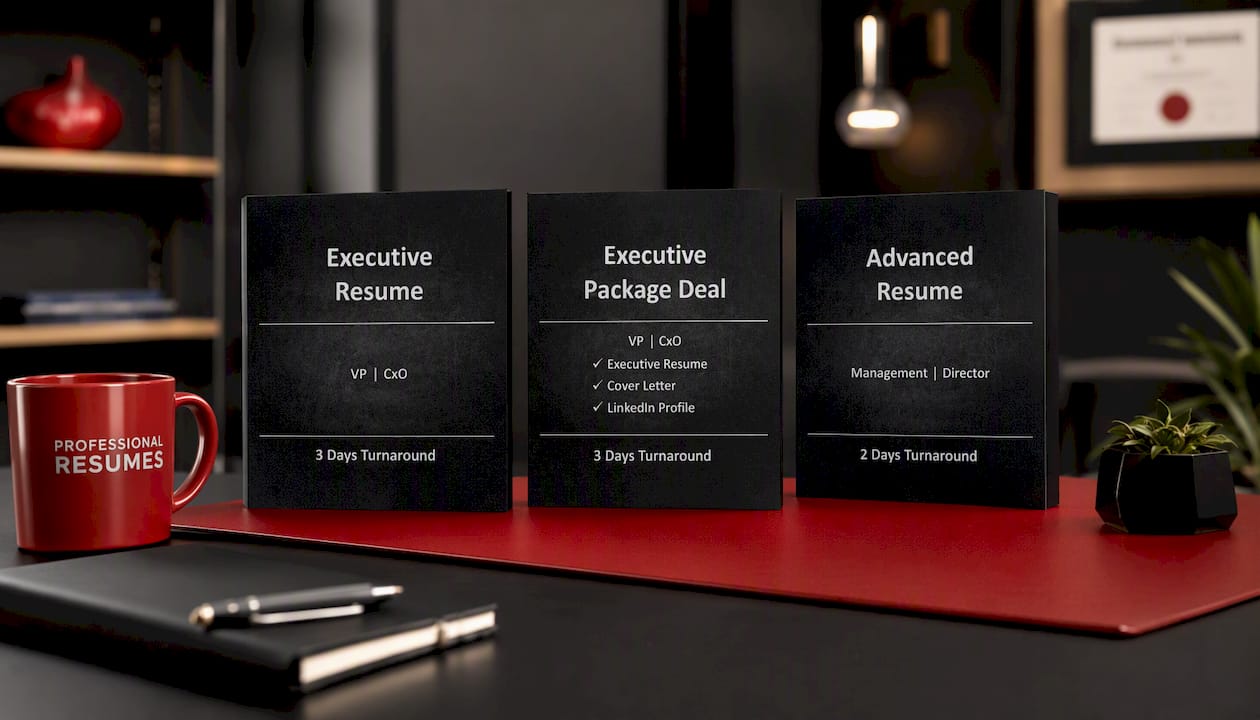
Which Professionalresumes package fits your executive search?
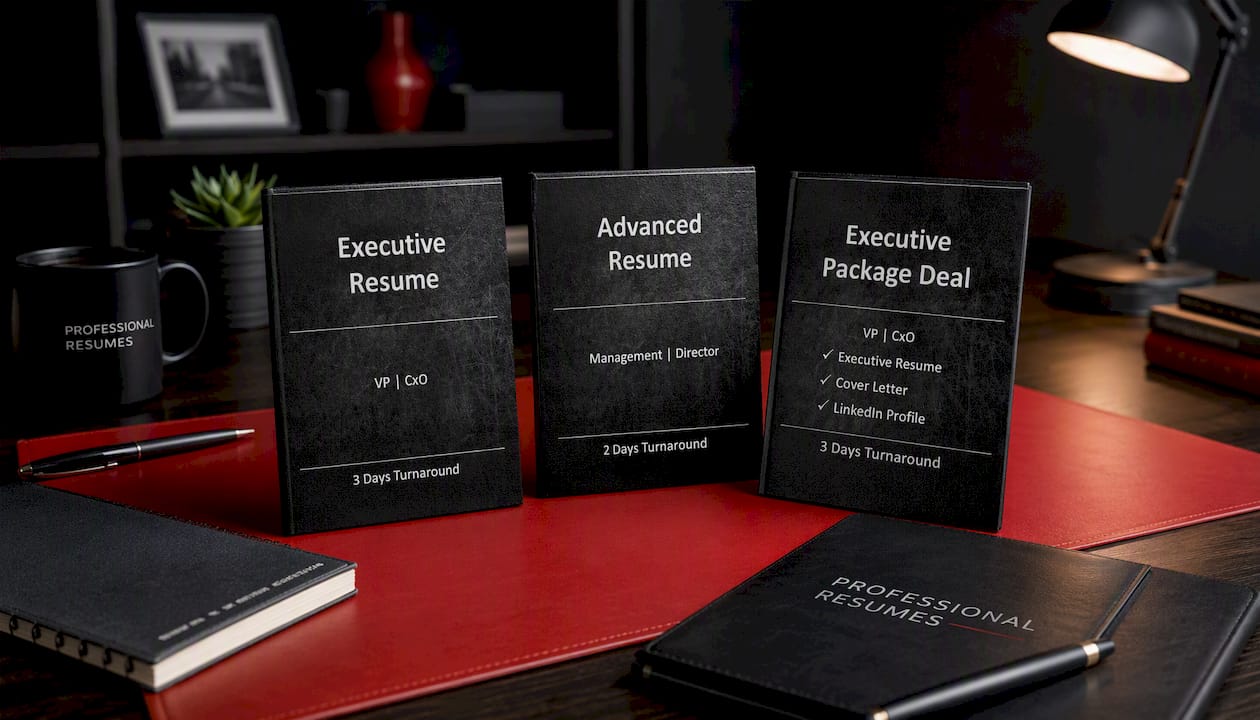
Once your resume needs a professional hand, Professionalresumes offers three ways to get there, each suited to a different stage of a search or transition.
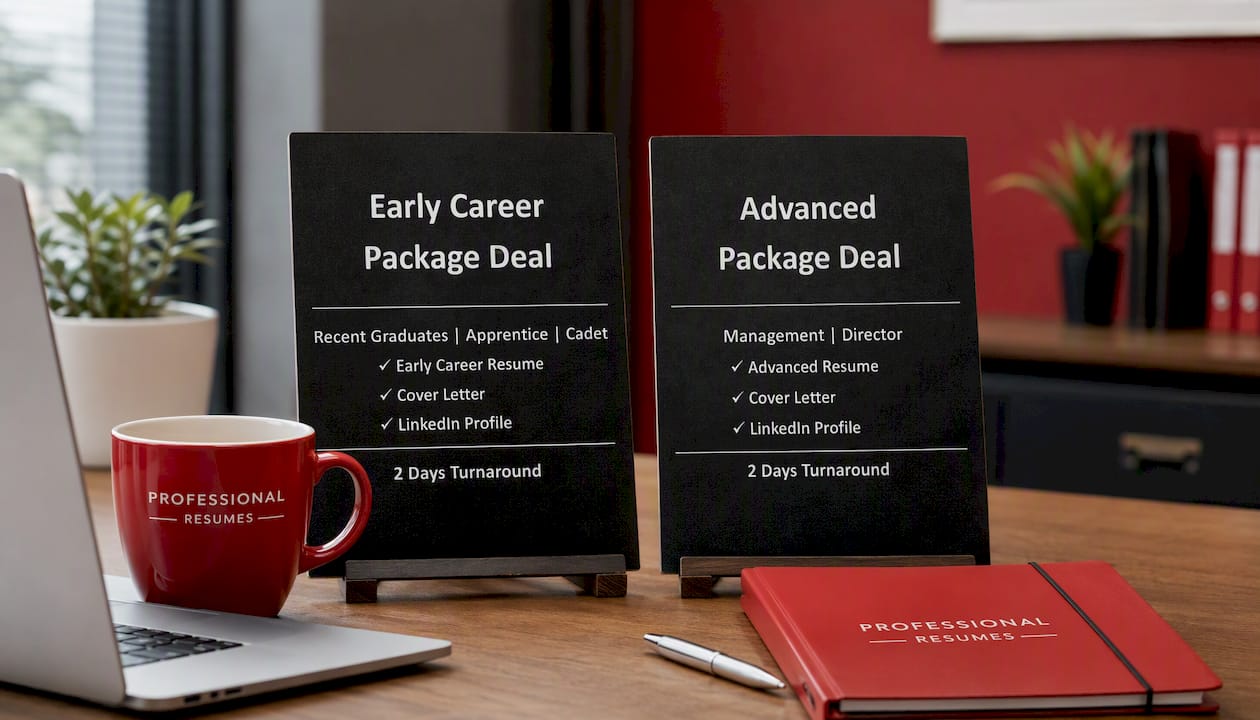
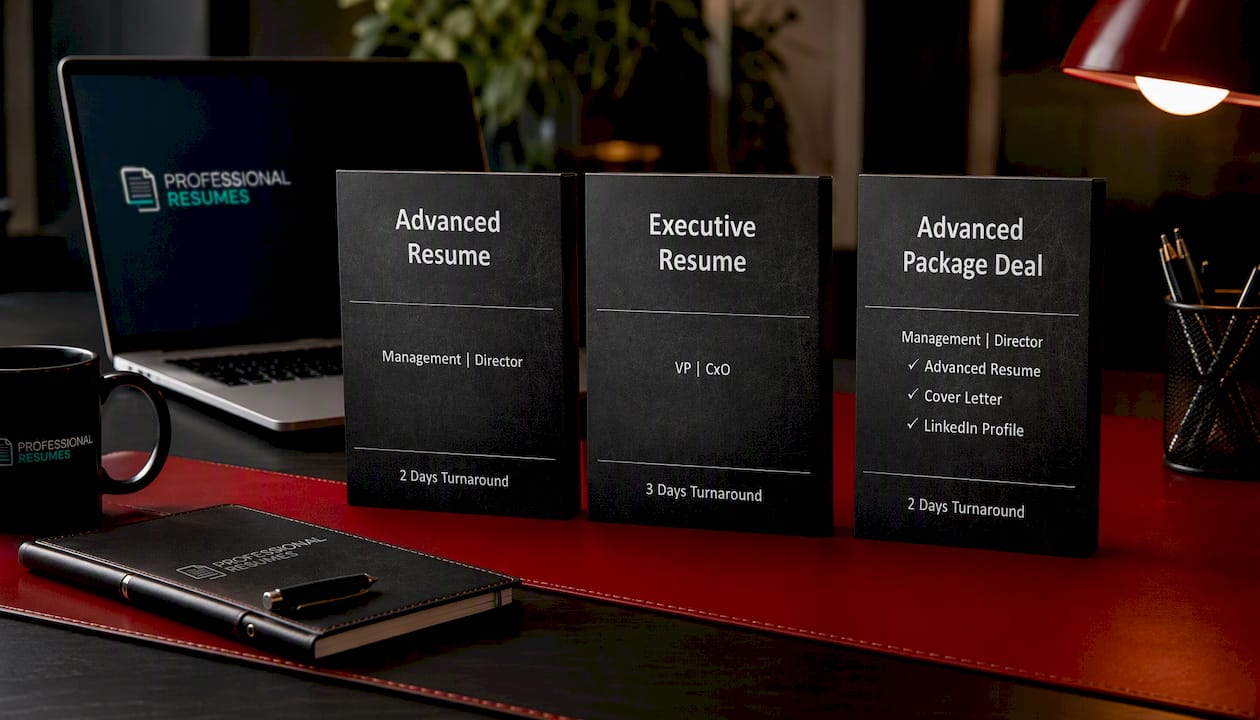
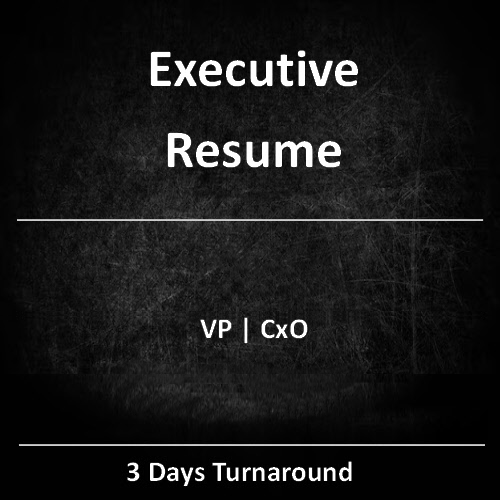
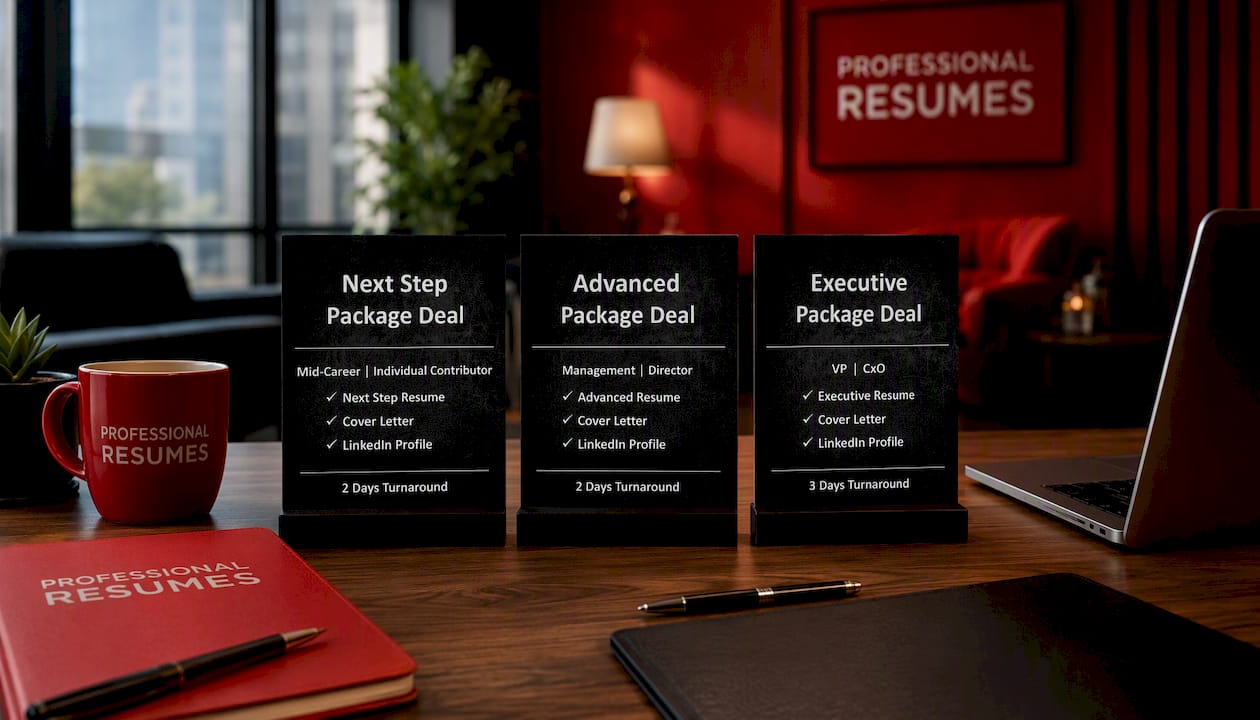
The Executive Resume service builds a complete leadership document from the ground up, working directly with a writer through consultation, drafting, and revision rounds until the summary, competencies, and achievement bullets all read as one cohesive business case. The Advanced Resume option suits a senior professional moving toward, but not yet fully inside, C-suite territory, offering the same rigour with a scope calibrated to that stage of a career. For a full asset overhaul, the Executive Package Deal bundles the resume with a matching cover letter and LinkedIn profile optimization, so every document a search firm or hiring committee encounters tells the same story.
Every engagement follows the same flow: an initial consultation to map your target roles and proof points, a full draft built around that conversation, structured revisions until the document is right, and a final deliverable ready to submit. Book a consultation or upload your current resume to get a targeted starting point for the rewrite.
An executive resume is a business case, not a biography
Most executives write their resume the way they’d write a performance review: comprehensive, fair, a little cautious. That instinct works against you. A board doesn’t hire based on a fair account of your career; it hires based on evidence that you’ll produce a specific outcome again. Treat every line as a data point in that argument, not a record of what you did.
Hire a professional writer when the stakes of a search outweigh the time it takes to get the framing right yourself. If a targeted conversation about your next move would help sharpen that argument, Professionalresumes is ready to have it with you.
— Professional
Sources
The formatting and structural guidance throughout this piece draws on established recruiting and career-services authorities. Monster’s Canadian resume format guide confirms reverse-chronological as the standard structure ATS platforms and search firms expect. Robert Half’s executive resume guidance shaped the executive summary framework. Indeed’s C-level resume guide informed the length and page-count recommendations. StylingCV’s 2026 executive resume guide supplied the ATS formatting rules and bullet-writing standards applied across the before and after examples.
Recommended
Built using BabyLoveGrowth