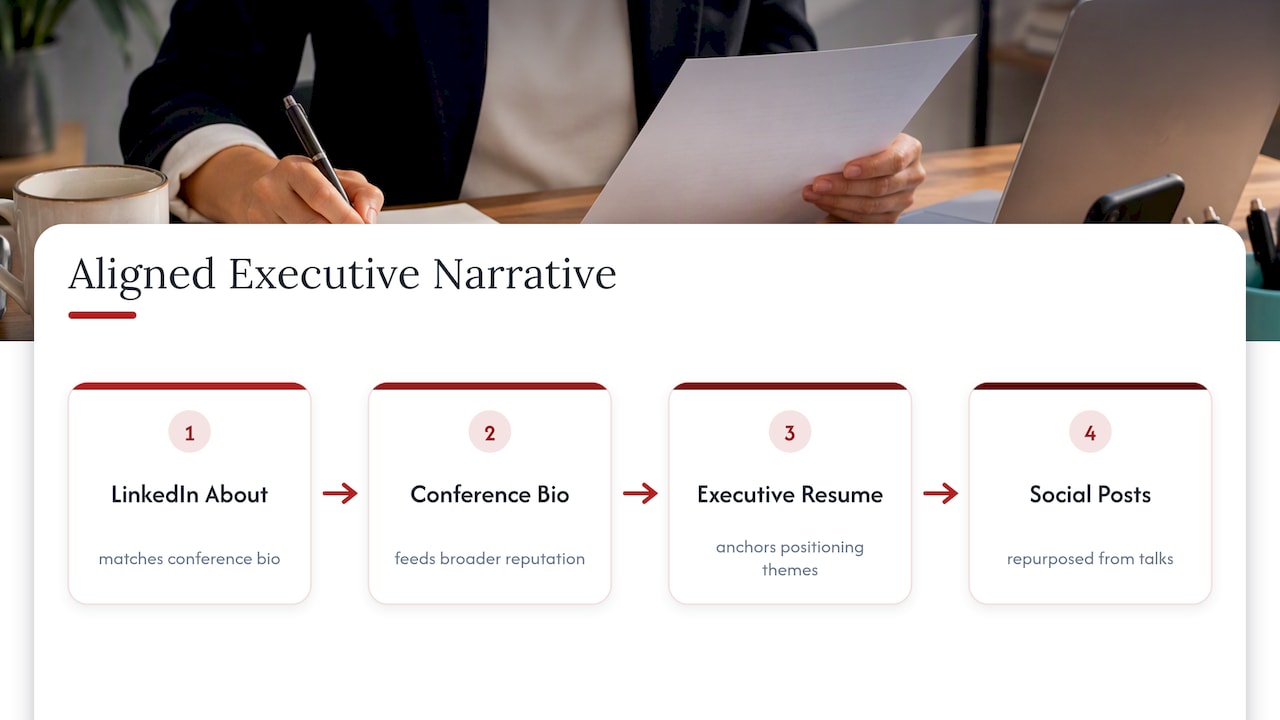
Hand-drawn internal resume title card

Internal Resume for Promotion: Map STAR Wins, Prep Plain Text

For internal job applications, submit a tailored internal resume that maps multiple STAR-formatted accomplishments to the role’s essential qualifications. Three priorities come first: match the posting’s own language, show measurable outcomes rather than duties, and prepare a plain-text version for application portals. This guide walks through the full process, with examples and a submission checklist.


TL;DR:

  • Tailor your internal resume to match the posting’s language, highlighting measurable outcomes and relevant accomplishments instead of listing duties.
  • Use specific company terminology, projects, and systems to demonstrate immediate fit, and focus on outcomes that show growth or scope.
  • Prepare a plain-text version of your resume and screening answers in advance to ensure compatibility with application portals and ATS systems.
  • Focus on recent, relevant STAR-formatted achievements that prove your readiness for the new role, emphasizing impact on efficiency, revenue, or risk reduction.
  • Follow organizational policies, verify all details are consistent with official records, and craft a concise letter of interest that explicitly connects your experience to the role’s core qualifications.

Professionalresumes
Present Your Promotion Case Clearly
Professional Resumes creates customized resumes and cover letters that connect your achievements, skills, and aspirations to your next career move.

Visit Professional Resumes

Table of Contents

What an internal resume is and why it matters

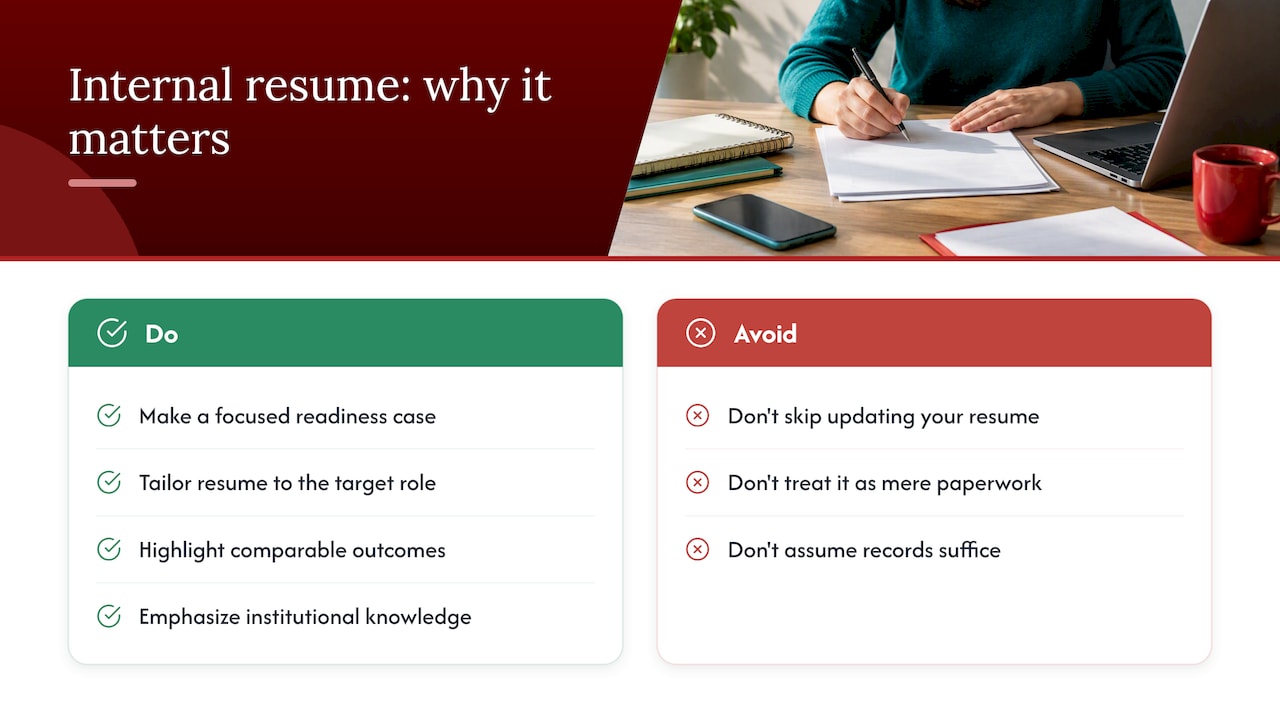
An internal resume is a resume submitted by an employee already working within an organization, written specifically to apply for a different role, a promotion or a lateral move inside that same company. It differs from a general resume in one essential way: the reader already has context on you, your conduct and your reputation, so the document carries a different burden. It must make a focused case for readiness rather than introduce you from scratch.

That focus pays off. A tailored internal resume demonstrates to the hiring manager that you understand the target role’s demands and have already produced comparable outcomes. It can also reduce the perceived onboarding period, since you bring institutional knowledge, existing relationships and familiarity with internal systems that an external candidate would need months to acquire. A large-scale study of career mobility found that moving into a new occupation within the same firm produces a stronger positive effect on upward mobility than either lateral internal moves or moves to a new employer, which makes the case for treating an internal application with the same rigour as an external one, not less, since intra-firm occupational change carries real weight for advancement.

Many employees assume that because HR or a hiring manager already has their file on record, updating the resume is optional. It is not. The file on record likely reflects the role you currently hold, not the one you want next, and it was never written to answer this posting’s specific qualifications. A stale resume signals, however unintentionally, that you have not thought carefully about the move. Treat the update as a deliberate act of positioning, not paperwork.
What an internal resume is and why it matters — overview diagram

How internal resumes differ from external resumes

An internal resume speaks in the company’s own language. Where an external candidate must explain acronyms, internal projects and team structures from scratch, you can name them directly: the system you administered, the initiative you led, the department you partnered with. That specificity does real work. It shows immediate fit and lets the reader picture you performing the new role without a translation step.

The structure shifts too. External resumes often carry a longer career narrative, since the reader needs the full arc to judge trajectory. An internal resume can compress that narrative and devote more space to mapped outcomes: what you did, under what constraints, with what measurable result, directly against the posting’s qualifications. Career experts frame this well, describing the internal resume as a focused case for promotion rather than a full life story.

Cross-functional or stakeholder-facing examples deserve a place when the target role involves influence beyond your current team. If you are moving from an individual contributor position into one with broader scope, show at least one example where you worked across departments or represented your team to leadership. That single data point often matters more to a hiring panel than several examples confined to your current reporting line.

Step-by-step process to write and tailor an internal resume

Start by parsing the job posting itself before writing a word. Pull out the essential qualifications verbatim, and pay close attention to connecting words: a posting that says “experience in budgeting and vendor management” expects evidence of both, while “experience in budgeting or vendor management” allows either. Mark every phrase that looks like it comes from a formal competency framework, since screening systems and panels often reuse that exact language.

  1. Highlight every essential qualification and note whether it requires “and” (both) or “or” (either).
  2. Rewrite your opening statement to position you as the internal solution to this specific posting, not a general summary of your career.
  3. Select several accomplishments that map most directly to the posting’s qualifications, prioritizing relevance over chronology.
  4. Choose format and length based on where the resume lands: a hiring-manager-only process can support more design, while a portal submission needs a clean, plain-text-ready structure.
  5. Prepare a plain-text copy and draft answers to any screening questions before the application window opens.

Your opening statement carries more weight on an internal resume than people expect. Instead of a generic summary of your background, write two or three sentences that state your current role, your years of relevant internal experience and the specific value you bring to the target position. A line like “Currently leads scheduling for the east region team; seeking to apply four years of process-improvement work to the Operations Manager role” does more work than a paragraph of soft skills.

When selecting your several accomplishments, resist the urge to include everything you are proud of. Choose the examples that answer the posting’s qualifications most directly, even if that means leaving out strong work from earlier in your tenure. A hiring panel reading dozens of applications will reward precision over volume.

Formatting choices depend entirely on the submission path. A resume reviewed directly by a hiring manager you already know can carry some visual structure: bolded headers, light use of colour, a clean one-page layout. A resume submitted through an application portal needs to survive text parsing, which brings us to the plain-text copy. Build it early rather than scrambling at the deadline, and test it by pasting it into a plain text editor to confirm nothing breaks.

Pro Tip: Keep a master version of your resume in a simple table of accomplishments, each tagged with the qualifications it proves, so you can rebuild a tailored version for any posting in under an hour.

Screening questions deserve the same preparation as the resume. Many internal postings, particularly in larger organizations, ask applicants to answer specific questions about each essential qualification before a resume is ever reviewed. Draft these answers alongside your resume, not after, since the strongest accomplishment statements often serve double duty in both places.

  • Pull exact qualification language from the posting before drafting anything.
  • Build four to eight STAR-based accomplishments mapped to that language.
  • Draft a plain-text version and screening-question answers in the same sitting.

How to write accomplishment statements: STAR and measurable results

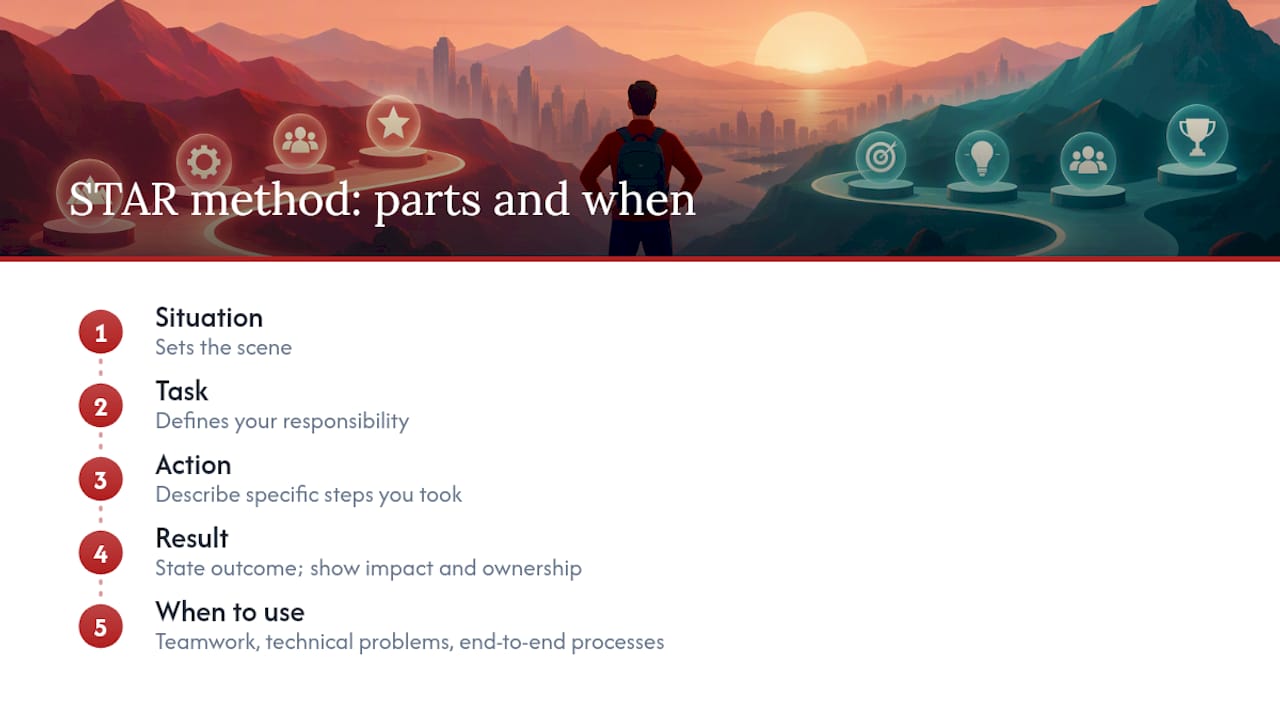
The STAR method, which stands for Situation, Task, Action, Result, turns a vague duty into verifiable proof. For an internal application, STAR statements work best when they isolate your individual contribution rather than describing what “the team” accomplished, since a hiring panel is evaluating you specifically.

Choosing the right metric matters as much as the structure. Internal stakeholders tend to respond to efficiency gains, revenue or cost impact, risk reduction and adoption or uptake of a process you introduced, since these map directly to what a manager has to defend to their own leadership. A plain-text research summary on internal mobility notes that career outcomes tied to internal moves are well studied, which supports treating a clear, quantified accomplishment as a credible signal rather than a nice-to-have.

Three paired examples show the shift from duty to proof:

  • Duty: Managed customer complaint intake. STAR achievement: Redesigned the complaint routing process (Situation and Task), built a triage checklist and trained three colleagues on it (Action), cutting average response time and reducing repeat complaints within the quarter (Result).
  • Duty: Assisted with budget tracking. STAR achievement: Identified a recurring reconciliation error across two cost centres (Situation and Task), built a cross-check spreadsheet and flagged discrepancies weekly (Action), preventing a repeat of the prior year’s year-end adjustment (Result).
  • Duty: Supported the onboarding process for new hires. STAR achievement: Noticed new hires were taking longer than expected to reach full productivity (Situation and Task), created a structured 30-60-90 day onboarding guide (Action), shortening ramp-up time for the next three cohorts (Result).

Internal mobility research shows that moving to a new occupation within the same firm has a measurably stronger link to upward progression than a lateral internal shift, which is one more reason to frame your statements around growth and scope, not just task completion, per this 2026 study.

Formatting rules, ATS and internal portal quirks, and public-sector application notes

Large organizations, and public-sector employers in particular, often route applications through portals that strip bolding, columns and special characters before a human ever sees the resume. Preparing a plain-text version in advance means you are never reformatting under deadline pressure. Draft your resume normally, then paste it into a plain text editor and clean up any line breaks, bullets or spacing that do not survive.

Government of Canada guidance for GC Jobs recommends creating an unformatted resume for portal submission and tailoring your screening answers using the STAR method to demonstrate each essential qualification. Shared Services Canada’s own application tips echo this, advising a simple resume kept current, with every required qualification addressed explicitly when a question uses “and.”

  • Use the exact keywords from the posting, not synonyms, since screening questions are often scored against specific phrases.
  • Write screening answers in first person (“I led,” “I reduced”), never “we,” so your individual contribution is unambiguous.
  • When a question lists two or more requirements joined by “and,” answer each one by name rather than assuming one example covers both.

Pro Tip: Save your plain-text resume and screening answers as a single reference document, since many internal postings reopen similar competitions within the same year.

Our ATS-friendly resume guidance covers formatting considerations that apply equally well to internal portal submissions, particularly around keyword matching and file structure.

Common mistakes to avoid and red flags for internal applicants

The most frequent mistake is assuming the hiring panel will read your personnel file or remember your past work. They will not, and the fix is straightforward: tailor the resume to this posting and foreground outcomes from the last 12 to 18 months rather than relying on reputation.

Vague team language is the second common trap. Phrases like “our team improved” leaves your personal contribution invisible. Replace them with first-person, concrete actions and specific results, the same discipline the STAR method demands.

Over-formatting for a portal submission causes otherwise strong resumes to arrive garbled or unreadable. Prepare the plain-text version early and test it, and draft direct answers to screening questions rather than relying on the panel to infer them from your resume.

  • Missing or inconsistent employment dates across internal documents can raise unnecessary questions during screening.
  • Inconsistent job titles between your resume and your official personnel record can slow or stall your candidacy.
  • Ignoring your organization’s manager-notification policy before applying can damage trust, even when the policy is informal.

Final checklist: what to send and what to check before you submit

Before you submit, confirm the fundamentals are in place rather than relying on memory.

  1. Confirm your opening statement names the target role and your most relevant internal experience directly.
  2. Verify you have multiple STAR-formatted accomplishments mapped to the posting’s essential qualifications.
  3. Check that keywords from the posting appear in your resume and screening answers using the same phrasing.
  4. Verify every date, title and team name is accurate and consistent with your official record.
  5. Prepare a plain-text copy and save your files with a clear naming convention, such as your name and the position title.
  6. Confirm whether your organization’s policy requires notifying your current manager before you apply.
  7. Attach a concise letter of interest that reinforces your fit without repeating the resume line by line.

Why professional help can help with internal applications

A second set of experienced eyes catches what familiarity hides, and that is often the real value of a professional rewrite for an internal candidate. Working directly with a writer who understands how to structure STAR accomplishments and align them to a posting’s essential qualifications can turn a serviceable resume into a genuinely competitive one, particularly when the stakes involve a meaningful step up in scope or compensation.

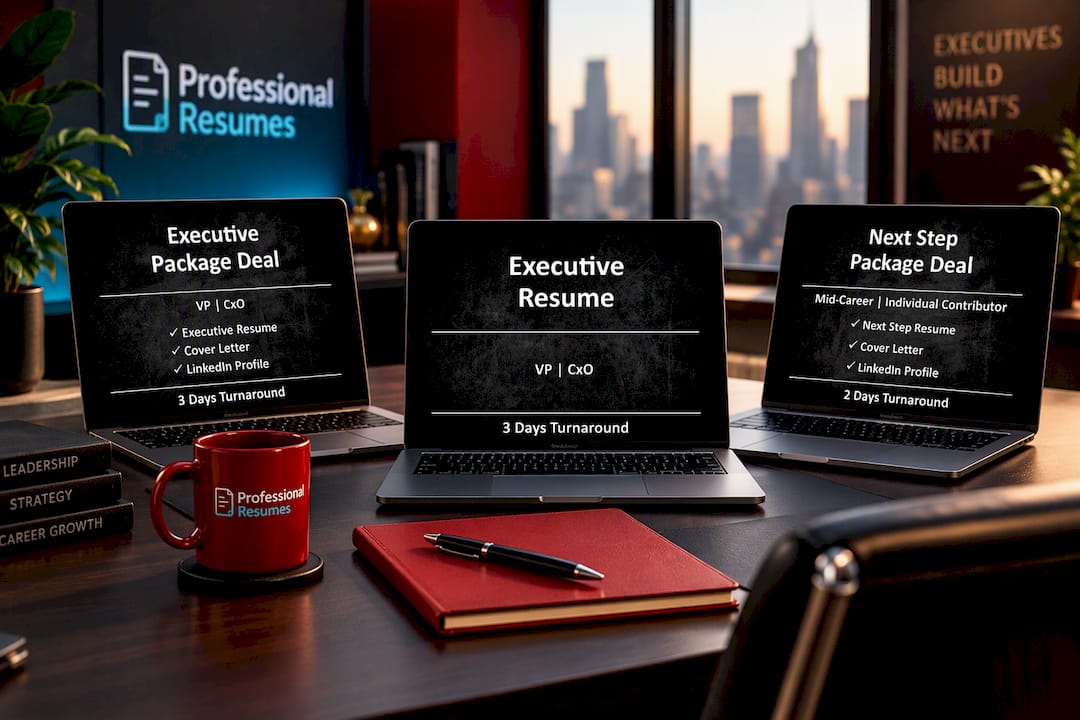
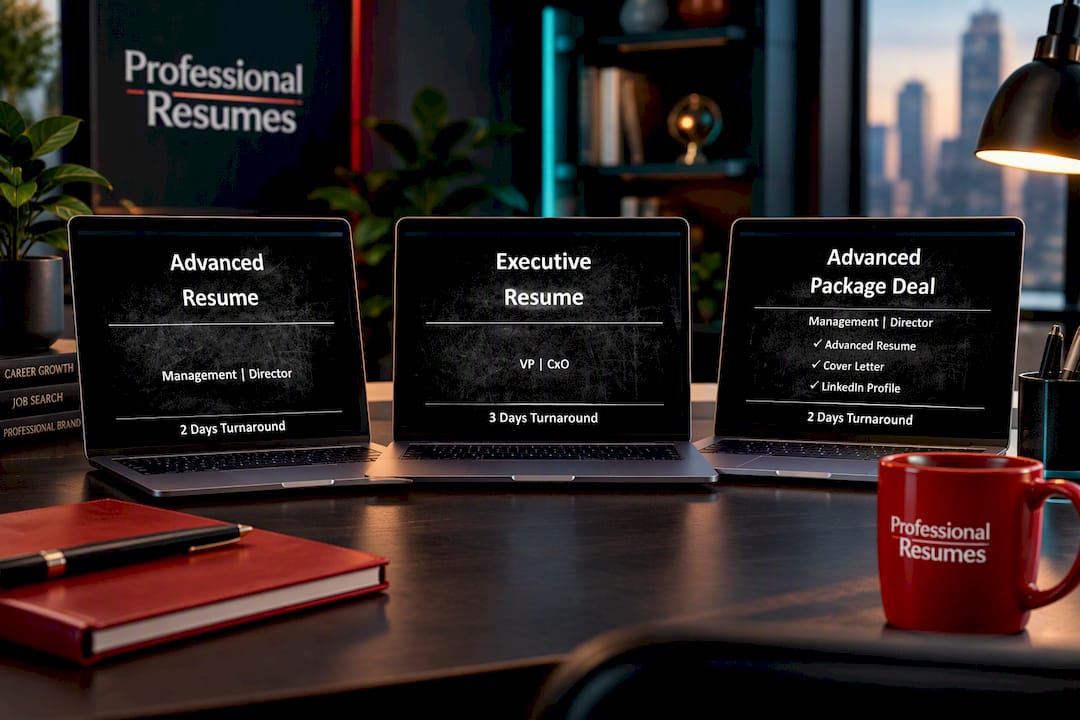
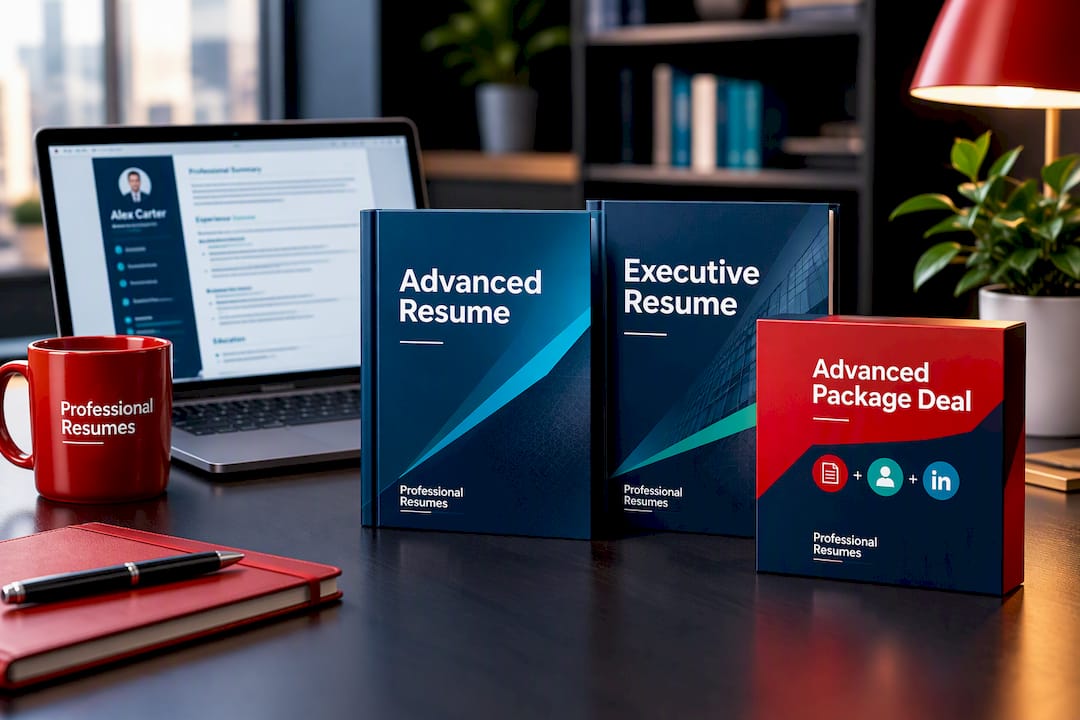
Our product lines are built around exactly this kind of situation; for those in regulated professions, you can find guidance to get your licence after LLQP in Canada to advance your career. The Advanced Resume suits employees applying for a significant step up in responsibility, while the Executive Resume is built for leadership-level internal moves where board-level or senior-stakeholder scrutiny is likely. The Advanced Package Deal bundles resume and complementary documents for candidates who want a complete, consistent application package.

Each service includes consultation, drafting, and revision processes to ensure the final document aligns with the target role and your experience, reflecting both the posting’s language and your personal voice.

Guidance on addressing potential concerns about changing roles within the same company

Hiring panels reviewing an internal candidate often carry questions that an external candidate would never face: will this move leave a gap on your current team, is this a lateral sidestep rather than genuine growth, and does your manager support the move. Address these directly rather than hoping they go unasked.

In your letter of interest, briefly acknowledge the transition and frame it in terms of growth and organizational benefit rather than dissatisfaction with your current role. A line that connects your current team’s needs to a reasonable transition timeline shows you have thought beyond your own interests.

If your organization has a policy on notifying your manager before applying, follow it before you submit, not after. Skipping this step is one of the fastest ways to damage trust, even when the policy is informal rather than written. When a move represents a lateral shift rather than a promotion, use your resume and letter to make the growth case explicit: new skills, broader scope or exposure to a function that supports a longer-term trajectory you can describe concretely.

Author perspective: practical, internal-mobility minded advice

The strongest internal resumes make a case for readiness, not a recap of history. Panels already know your past; they need proof you can do the next job. Seek a rewrite or coaching when the stakes are high enough that a generic update feels thin, and always respect your organization’s notification policies and the relationships that got you this far.

— Professional

How Professional Resumes can help

We build internal and promotion-focused resumes around the same discipline this guide describes: STAR-based accomplishments mapped directly to a posting’s essential qualifications, in language your hiring panel already recognizes. Working directly with your writer through a consultation and revision process means the final document reflects your actual contributions, not a generic template.
Advanced Resume

  • The Advanced Resume suits employees targeting a meaningful step up in scope or responsibility.
  • The Executive Resume is built for leadership-level internal moves facing senior-stakeholder scrutiny.
  • The Advanced Package Deal bundles your resume with complementary documents for a consistent application.

Browse our full range of resume packages to find the option that matches the scope of your next move, or get in touch to start a consultation.

FAQ

What should I put on my resume for an internal position?

Lead with an opening statement naming the target role and your relevant internal experience, then include multiple STAR-formatted accomplishments mapped to the posting’s essential qualifications. Use internal project names, systems and acronyms where they show immediate fit, and keep a plain-text version ready for portal submission.

What are four common resume mistakes to avoid?

Common mistakes include assuming the panel already knows your work instead of tailoring your resume, using vague team language like “we” instead of specific first-person actions, over-formatting a document meant for a text-stripping portal, and leaving dates or job titles inconsistent with your official record.

How do I write a strong letter of interest for an internal position?

A strong letter of interest names the specific role, briefly addresses why you are seeking the move, and connects one or two of your strongest accomplishments to the position’s core requirements. Keep it concise, acknowledge the transition from your current team constructively, and avoid repeating your resume line by line.

What are the five P’s of a resume?

Definitions of the “five P’s” vary by source and are not a standardized industry framework, so treat any specific list with some caution. A practical substitute for internal applicants is to prioritize purpose, relevant proof points, precise language matched to the posting, polish in formatting, and a plain-text version ready for portal submission.

Sources

Internal references carry particular weight because the person reading your application may already know or be able to reach the people you name. Choose references deliberately: a manager or senior colleague who can speak directly to the specific qualifications the new role requires will do more for your case than someone simply senior in title.

Where appropriate, weave a brief, specific endorsement into your letter of interest rather than your resume itself, since resume space is better spent on your own accomplishments. A short line such as noting that a cross-functional partner has already relied on your analysis for a recurring decision tells the reader your reputation is already established in a relevant area.

Always confirm with a reference before naming them, and tell them which role you are applying for so their account lines up with the qualifications you are trying to prove. An internal reference who is caught off guard, or who gives a generic answer, can undercut an otherwise strong application. If your organization has a formal endorsement or sponsorship process for internal moves, follow it precisely, since skipping a required step can raise a flag unrelated to your actual qualifications.

Decorative LinkedIn headline title card

Edit Ready LinkedIn Headlines With Quick Tests for Job Seekers

The highest-performing LinkedIn headline follows a simple structure: target role, two or three key skills, and the value or outcome you deliver, separated by vertical bars. This format gives recruiters a clear match for search terms while stating your worth in one glance, which drives stronger profile growth than a role-only line. The examples below show exactly how to adapt it.


TL;DR:

  • Using a targeted headline that includes your role, key skills, and measurable results increases visibility and relevance in recruiter searches.
  • Prioritize clarity by explicitly stating your role, mirror exact keywords from job postings, and highlight specific impact rather than generic duties.
  • Choose headline formulas based on your career stage and goal, such as role plus impact for mid-level professionals or transferables for career changers.
  • Avoid generic phrases, keyword stuffing, emojis, and listing job-seeking status directly in the headline; instead, leverage LinkedIn’s “Open to Work” feature.
  • Regularly test and refine your headline by changing one element at a time and monitoring profile views and recruiter responses.

Professionalresumes
professionalresumes.ca
Strengthen Your LinkedIn Presence
Professional Resumes tailors LinkedIn profiles to your aspirations, with personalized consultations and revisions that clarify your value to employers.

Explore LinkedIn profile services

Table of Contents

What makes a great LinkedIn headline

A headline earns its place at the top of your profile by doing three jobs at once: naming who you are, signalling what you know, and proving what you deliver. Recruiters scan dozens of profiles in a short window, and a headline that reads like a job title alone gives them nothing to act on.

The strongest headlines share a few traits. Clarity matters first: state your role or the audience you serve in plain terms, not internal jargon. Keywords matter next: mirror the exact phrasing used in job postings for the role you want, since that phrasing is what recruiter search strings are built on. Value matters most: name a result, not just a function, so the reader understands what changes when they hire you.

Tone and placement finish the job:

  • Keep the voice professional and specific rather than stacking adjectives or hashtags.
  • Put your most important words first, since LinkedIn search and mobile previews often truncate the rest.
  • Avoid comma-separated keyword piles; a short phrase in context reads better to both people and search algorithms.
  • Match the headline to one target role rather than trying to cover several unrelated ones at once.

Headline formulas and templates you can adapt

Most effective headlines follow one of a handful of repeatable patterns. Pick the one that fits your situation, then plug in your own role, skills, and outcome.

  1. Role | Skill stack | Value: “Senior Financial Analyst | FP&A, Forecasting, Power BI | Cutting reporting cycles from weeks to days.” This works when your title alone carries weight and you want to add proof of impact.
  2. I help X do Y: “I help early-stage startups build hiring processes that scale.” This pattern, highlighted as especially effective for freelancers and consultants, answers who you serve and what changes for them in one breath.
  3. Role, specialising in X for Y: “Marketing Manager, specialising in demand generation for B2B SaaS.” Use this when your niche, not your title, is what sets you apart.
  4. Career changer: target role + transferable skill + outcome: “Aspiring Product Manager | Former teacher, 8 years leading cross-functional teams | Building products people actually use.” This reframes past experience as proof you already have the core skill.
  5. Student or new grad: degree + skill + direction: “Computer Science Grad | Python, SQL, Machine Learning | Seeking entry-level data roles.”

Pro Tip: Lead with role when your title is in-demand and well recognized, lead with value when your title is vague or undervalued, and lead with skills when you are pivoting into a field where your title does not yet match your target.

Practical headline examples by role and situation

Illustration of headline examples branching by role

These are ready to copy and adjust. Swap in your own skills, industry, and numbers where they apply.

Mid-level professionals

  • “Project Manager | Agile, Stakeholder Management, Budget Oversight | Delivering projects on time and under budget.” Follows the Role | Skills | Value formula, with the outcome doing the heavy lifting.
  • “HR Business Partner | Talent Strategy, Employee Relations | Reducing turnover through better onboarding.” Names a specific, measurable-sounding result rather than a generic duty.

Senior and executive professionals

  • “VP of Operations | Supply Chain, P&L Ownership, Transformation Led | Scaling operations across three continents.” Works because executive searches reward specificity about scope and ownership, a point worth weighing alongside personal branding strategies for senior leaders.
  • “Chief Marketing Officer | Brand Strategy, Demand Gen, Board Reporting | Growing revenue through data-led campaigns.” Signals board-level fluency without listing every responsibility.

Students and recent graduates

  • “Marketing Student | Social Media, Content Strategy, Analytics | Seeking internship opportunities in consumer brands.” Compensates for limited experience with clear direction.
  • “Engineering Graduate | CAD, Thermodynamics, Project Design | Ready to contribute to sustainable infrastructure projects.” States interest area, which narrows recruiter search relevance.

Career changers

  • “Transitioning to UX Design | Former Nurse, 10 Years Patient-Centred Problem Solving | Designing with empathy.” Reframes an unrelated background as a direct asset, a technique covered further in guidance on refreshing a resume for a mid-career shift.
  • “Aspiring Data Analyst | Excel, SQL, Former Retail Manager | Turning operational experience into data-driven decisions.”

Freelancers and consultants

  • “I help small businesses fix cash flow problems before they become crises.” Pure I-help-X-do-Y, no title required.
  • “Freelance Copywriter | E-commerce, Email Marketing | Writing copy that converts browsers into buyers.”

Technical roles

  • “Backend Developer | Python, Django, AWS | Building scalable APIs for fintech products.” Technical keyword precision matters here, an approach detailed in resume tips for software industry roles.
  • “DevOps Engineer | CI/CD, Kubernetes, Terraform | Cutting deployment time from days to hours.”

Creative roles

  • “Graphic Designer | Branding, Illustration, Adobe Creative Suite | Helping startups build visual identities that stick.”

Managers

  • “Operations Manager | Process Improvement, Team Leadership | Reducing waste and improving on-time delivery.”

What to avoid: headline mistakes that reduce visibility or credibility

A headline that just says “Seeking new opportunities” wastes the most valuable text on your profile and tells recruiters nothing about what you offer. A value-led line outperforms it every time.

  • Fix a generic job title (such as plain “Manager”) by naming your specialty and the outcome you drive, since competitive roles need differentiation, not a label.
  • Fix keyword piles (“Leadership, Sales, Marketing, Finance, Strategy”) by rewriting them into a phrase with context, since disconnected buzzword stacks read worse to both people and search matching than a readable sentence fragment.
  • Fix emoji clutter by removing it entirely in professional and corporate fields, where it undercuts credibility.
  • Fix “Seeking Work” text by switching to LinkedIn’s official “Open to Work” profile feature instead, which signals availability without spending headline characters.

Checklist and quick testing routine

Treat your headline as a living element you test, not a line you set once and forget.

  1. Pick one target role and write it in the exact words used in job postings.
  2. Pull three to five keywords from three active job ads for that role.
  3. Apply one formula from the templates above and place the strongest words first.
  4. Use LinkedIn’s “Open to Work” feature rather than spelling out your job search in the headline itself.
  5. Publish, then track profile views and recruiter messages for a few weeks before changing anything else.
Step Action What to measure
1 Draft headline using a formula None yet, this is set up
2 Publish and wait Baseline profile views
3 Monitor for 2 to 4 weeks Profile views, recruiter messages
4 Swap one variable (role, skill, or value phrase) Change in views and messages versus baseline

For readers who want a second set of eyes on keyword choices and message alignment, our LinkedIn profile optimization service and packages such as the Executive Resume and Advanced Resume build this testing logic into the writing process from the start.

When to hire a professional vs DIY

A DIY headline works well for most early and mid-career searches. Consider bringing in outside help when strong experience is not converting into interviews, when you are navigating a complex pivot across industries, or when you are running an executive-level search where board-level scrutiny raises the stakes on every word. Professional input adds structured keyword research and messaging precision that is hard to self-assess.

— Professional

Our LinkedIn profile optimization service

We build LinkedIn headlines and full profiles around the same keyword research and messaging alignment we use in resume writing, so your headline, resume, and summary tell one consistent story to recruiters. For executive searches, our Executive Resume and Executive Package Deal pair resume strategy with LinkedIn messaging built for board-level scrutiny, while our Advanced Resume supports professionals targeting competitive mid-to-senior roles.

Executive Resume

Working directly with your writer, we extract keywords from the postings you are targeting and translate them into a headline that reads naturally rather than like a list. If you want a faster first draft to work from, tools like the LinkedIn Profile Generator from AmmarAI can help you sketch options before refining them with us. Browse our full range of resume packages on our shop page or start with a LinkedIn profile optimization review today.

FAQ

What is a good headline for LinkedIn?

A good headline names your target role, includes two or three keywords that match the job postings you want to appear in, and states a clear outcome or value you deliver. The format [target role] | [skills] | [value] covers all three in one line.

What is an example of a profile headline?

“Senior Financial Analyst | FP&A, Forecasting, Power BI | Cutting reporting cycles from weeks to days” is one working example. It names the role, lists relevant skills, and closes with a measurable-sounding result.

What are some headline examples?

Examples include “I help small businesses fix cash flow problems before they become crises” for consultants, “Backend Developer | Python, Django, AWS | Building scalable APIs for fintech products” for technical roles, and “Transitioning to UX Design | Former Nurse, 10 Years Patient-Centred Problem Solving | Designing with empathy” for career changers.

What should I avoid in my LinkedIn headline?

Avoid generic phrases like “Seeking new opportunities,” long comma-separated keyword piles, and emojis in professional fields, since all three reduce clarity and credibility. Use LinkedIn’s official “Open to Work” feature instead of writing your job search status directly into the headline text.

Useful sources and further reading

See the Forbes piece on headline formats below, plus our own LinkedIn optimization and resume pages for direct help.

Data analyst resume title card illustration

Win Interviews: Data Analyst Resume With XYZ Project Bullets for Canada

Hiring teams want impact, not duties: an interview-ready resume is one page, ATS-safe, and built around one to three projects with measurable outcomes. Draft two impact bullets for your strongest project right now, using the XYZ formula (accomplished X, measured by Y, by doing Z). That single exercise, grounded in the competencies Job Bank lists for data analyst roles and in Professional Resumes’ consultative approach, will tell you more about your resume’s gaps than another hour of formatting.


TL;DR:

  • Focus on 1 to 3 impactful projects highlighting specific results achieved with measurable outcomes using the XYZ formula.
  • Tailor keywords and tools in your resume to match each job posting’s top requirements, emphasizing relevant experience and skills.
  • Ensure your resume format is ATS-compatible by avoiding graphics, tables, and headers in favor of a single-column, plain-text layout in DOCX or text-based PDF.
  • Present experience in outcome-driven bullets that specify tools used, actions taken, and results, especially for early-career candidates emphasizing project achievements.
  • Use clear, concrete metrics and results to demonstrate judgment and impact, rather than listing duties or responsibilities to enhance recruiter interest.

Professionalresumes
professionalresumes.ca
Make Your Analyst Resume Stand Out
Professional Resumes crafts customized resumes, cover letters, and LinkedIn profiles through personalized consultations and revisions.

Visit Professional Resumes

Table of Contents

What to include on a data analyst resume

A data analyst resume earns attention in five sections, each doing a distinct job for the reader and for the applicant tracking system scanning it first.

The summary sits at the top and does the heaviest lifting in the fewest words. In two to three lines, it should name your title, your core technical stack, and the business value you bring. A line such as “Data analyst with three years in SQL, Python, and Tableau, specializing in turning retail transaction data into inventory decisions that cut waste” tells a recruiter what you do and why it matters before they read another word. For more on phrasing this section, see our guide to writing a career summary that impresses recruiters.

Skills deserve their own section, split into three groups so a scanning eye and an ATS parser both register relevance instantly:

  • Technical skills: SQL, Python or R, Excel, Tableau or Power BI, and any data warehouse tools you’ve used.
  • Analytical skills: statistical analysis, A/B testing, forecasting, data modelling.
  • Soft skills: stakeholder communication, cross-functional collaboration, data storytelling.

Place this block near the top, directly under the summary, where both a human reader and a parser will find it without scrolling.

Experience comes next, written in reverse-chronological order. The mistake most candidates make here is listing responsibilities instead of results. A data analyst’s experience section should show what changed because of the work: reporting time shortened, forecast accuracy improved, a dashboard adopted by three departments. Include the scale of stakeholder engagement too: did you present to a team lead, or did your analysis inform a decision a vice president signed off on? That detail tells a hiring manager how much responsibility you’ve already carried.

Projects belong above work experience for anyone early in their career, or in their own dedicated section for anyone with limited paid analyst experience. Each project entry should carry a title, your role, a rough timeframe, the tools used, and two to three outcome-focused bullets, exactly like a job entry. Hays Canada specifically recommends highlighting project work and naming the data tools involved rather than describing tasks in general terms.

Education and certifications close the resume, kept to a few lines unless you’re early in your career or hold a credential directly tied to the role (a Google Data Analytics Certificate, a SQL certification, a statistics minor). When education is your strongest asset, move it higher and expand it slightly; otherwise, it stays brief at the bottom.

Writing project and portfolio entries that prove competence

Treat every project the way you’d treat a job: give it a title, state your role, add a timeframe, list the tools, and write two to three bullets that show outcome rather than activity. This is where most data analyst resumes lose their edge, because candidates describe what the project involved instead of what it proved.

The XYZ formula fixes that. State what you accomplished (X), how you measured it (Y), and what you did to achieve it (Z). A few before-and-after examples show the shift:

  1. Before: “Analyzed customer churn data using Python.” After: “Identified the three strongest churn predictors by building a logistic regression model in Python on 18 months of customer data, giving the retention team a prioritized list of at-risk accounts.”
  2. Before: “Built dashboards in Tableau for the sales team.” After: “Built a Tableau dashboard that consolidated five regional sales reports into one view, cutting the sales team’s weekly reporting prep from half a day to under an hour.”
  3. Before: “Cleaned and organized a large dataset.” After: “Standardized a 50,000-row dataset with inconsistent date formats and duplicate entries, enabling accurate quarter-over-quarter trend analysis for the first time.”

Each “after” bullet names a tool, a method, and a result a hiring manager can picture.

Choose projects built on messy, real-world data over clean textbook datasets wherever you can. A project that required you to handle missing values, reconcile two inconsistent systems, or make a judgment call about outliers demonstrates the kind of thinking employers actually pay for. A Kaggle competition with a tidy CSV rarely does that, however polished the final chart looks.

Messy data cleaned for project decisions

Pro Tip: Pick the one project where you had to make a real decision under uncertainty, not just run a model. That’s the story a hiring manager remembers.

Surface your best work with links to GitHub or a live Tableau Public dashboard, placed under your name or within the relevant project entry. Keep the repository itself recruiter-ready: a clear README explaining the business question, the data source, your approach, and the result, written in plain language rather than code comments. A reviewer who can understand your project in ninety seconds is far more likely to call you than one who has to dig through your scripts to find the point.

Mapping your resume to the job description

Every job posting is a keyword map if you read it that way. Required skills usually appear in the first few bullet points of the “qualifications” section and repeat across multiple postings for similar roles; nice-to-have skills tend to appear once, often softened with language like “familiarity with” or “a plus.” Sort the posting’s language into those two buckets before you touch your resume.

Once you know the priority terms, place them deliberately rather than everywhere:

  • Put the one or two highest-priority tools or methods in your summary line.
  • List every specific tool named in the posting in your skills section, matching the posting’s exact terminology (SQL, not “database query language”).
  • Work the top keywords into your experience and project bullets naturally, attached to a real outcome rather than dropped in as a list.

The right keyword bundle shifts with seniority. A junior analyst posting often emphasizes SQL, Excel, basic statistics, and attention to detail. A mid-level posting adds Python or R, A/B testing, and dashboard tools like Tableau or Power BI. A senior posting layers in predictive modelling, stakeholder management, and sometimes a specific data warehouse platform like Snowflake or BigQuery. Matching your resume’s language to the right tier matters as much as having the skills themselves.

Keyword stuffing still backfires, even against an ATS, because most modern systems weigh keywords in context rather than counting repetitions. A skills section packed with forty tools you’ve touched once reads as noise to both the software and the recruiter who eventually opens the file. Name what you can speak to in an interview, and let the keywords live inside sentences that also tell a story.

ATS and formatting rules that keep your resume parsing cleanly

Formatting mistakes quietly disqualify strong candidates before a human ever sees their resume, because the applicant tracking system misreads the file before it reaches a desk.

Save your resume as a DOCX or a text-based PDF, never an image-based PDF or a design file exported as a flattened graphic. Most ATS platforms read DOCX most reliably, so when a posting doesn’t specify a format, DOCX is the safer default; a clean, text-based PDF works as the backup you send directly to a hiring manager.

Layout rules matter as much as file type:

  • Use a single-column layout; two-column resumes often get scrambled when the ATS reads across rows instead of down columns.
  • Stick to standard section headings (“Experience,” “Skills,” “Education”) rather than creative labels the parser won’t recognize.
  • Keep your name and contact details in the body of the document, never in a header or footer, because many parsers skip those fields entirely.

Parsing traps hide in details that look harmless on screen. Tables, text boxes, icons used in place of words, and graphics representing skill levels (a row of dots or a bar chart) often confuse ATS software or get dropped entirely, taking your contact information or job titles with them. Our guide to ATS-friendly resumes covers these traps in more detail for anyone building a resume from scratch.

A quick, free check matters more than most formatting advice: paste your exported resume into a plain-text file and confirm that your name, contact information, job titles, and dates all survive intact; if something shuffles or disappears, your layout is the cause.

One page remains the standard for anyone with under ten years of analyst experience; two pages become acceptable once you’re managing a team, leading cross-functional projects, or your role has grown senior enough that trimming further would cut real substance rather than filler.

Sample bullets and a one-page resume skeleton you can adapt

Seeing the difference between a duty and an outcome is easier with side-by-side examples, grouped by career stage so you can match your own experience level.

  1. Entry-level: “Automated a weekly sales report in Excel using VLOOKUP and pivot tables, reducing manual preparation time by roughly half.”
  2. Mid-level: “Built a customer segmentation model in Python using k-means clustering, giving the marketing team three distinct audience groups that improved campaign open rates in A/B tests.”
  3. Senior: “Led a cross-functional initiative to consolidate four regional reporting systems into one Power BI dashboard, cutting executive reporting turnaround from five days to one.”

Each example names a tool, an action, and a result, in that order, which is the shape every strong bullet should follow.

A one-page skeleton keeps the proportions right:

  • Header (2 to 3 lines): name, phone, e-mail, LinkedIn, portfolio or GitHub link.
  • Summary (2 to 3 lines): title, stack, value.
  • Skills (3 to 5 lines): technical, analytical, soft skills grouped.
  • Experience (12 to 16 lines): two to three roles, two to three bullets each.
  • Projects (6 to 10 lines): one to three entries, two to three bullets each.
  • Education (2 to 4 lines): degree, institution, relevant certifications.

If a current employer’s numbers are confidential, anonymize them without losing the impact: swap an exact dollar figure for a percentage, and state the baseline clearly, as in “reduced monthly reporting time by roughly a third versus the previous manual process.” The percentage carries the same weight as the raw figure without disclosing anything proprietary.

A short list of phrasing swaps turns most duty-based bullets into outcome-based ones almost mechanically: “responsible for reporting” becomes “delivered weekly reports that informed inventory decisions”; “worked with stakeholders” becomes “presented findings to the operations team, leading to a change in reorder thresholds”; “used SQL to query data” becomes “wrote SQL queries that identified a data entry error costing the team two hours of rework per week.” The pattern is always the same: name the tool, name the action, name what changed.

Common mistakes and quick fixes

Most data analyst resumes fail for a handful of repeat reasons, each fixable in under an hour.

  • Vague duty lists (“responsible for data analysis and reporting”) read as filler; rewrite each one using the XYZ formula so it names a tool, an action, and a result.
  • Design flourishes like graphics, icons, and two-column layouts often break ATS parsing; strip them out in favour of a single-column, text-based layout.
  • Missing metrics on projects and experience bullets leave a hiring manager guessing at your impact; add a number, a percentage, or a before-and-after comparison wherever you can.
  • Typos and inconsistent formatting (mixed date formats, uneven bullet punctuation) signal carelessness in a role where attention to detail is the job itself.

Before sending anything, read your resume once purely for ATS-breaking elements, then once for recruiter judgment: does each bullet show a result a stranger would understand in five seconds? Trim any line that doesn’t answer “so what,” and expand any project or role that’s doing real work but currently gets one thin sentence.

Pro Tip: Read your resume out loud. Any bullet that sounds like a job description rather than an accomplishment needs a rewrite.

Publisher perspective: how Professional Resumes approaches data analyst resumes

Each data analyst resume should be built through direct consultation rather than a template swap, matching the document to the candidate’s actual projects and the industry trends shaping the roles they’re targeting. A consultative process, paired with multiple rounds of revision, is designed to surface the kind of project detail and measurable outcome that a rushed self-written resume often leaves out.

Not every candidate needs that level of support. Someone comfortable rewriting their own bullets with the XYZ formula and confident in their formatting can often get a strong resume to a good place alone. The calculation changes for candidates switching industries, returning to the workforce after a gap, or applying to roles where the competition is deep enough that small phrasing and structure differences decide who gets a callback. In those cases, a second set of eyes trained on what hiring managers actually respond to tends to close gaps a candidate can’t see in their own work.

What actually moves the needle on a data analyst resume

Most resume advice overweights formatting polish and underweights proof. A resume with a clean template and vague bullets loses to a plainly formatted resume with two sharp, metric-backed projects almost every time, because hiring managers are screening for evidence of judgment, not design sense.

The XYZ formula gets recommended often, but its real value isn’t the structure, it’s the discipline it forces: you can’t finish the sentence without a number or a concrete result, which means a candidate who can’t fill in “Y” hasn’t actually measured their own work yet. That’s a more useful discovery than any formatting tip.

If you take one thing from this guide, make it this: pick your best project, not your longest list of tools, and tell its story with a number attached. Everything else on the resume, the summary, the skills section, the layout, exists to support that one strong proof point, not to replace it.

— Professional

Turn your resume into interview requests with Professional Resumes

A resume built on project proof still needs the formatting, phrasing, and positioning that get past the first screen, and that’s the gap Professional Resumes closes through a consultation-driven process rather than a generic template. The Advanced Resume package fits analysts with a few years of experience who need their project and work history reframed around measurable outcomes, while the Executive Resume is built for analysts moving into leadership roles where stakeholder scope and business impact carry more weight than tool lists.

Advanced Resume

For anyone who wants both a resume and a LinkedIn profile tightened at once, the Advanced Package Deal bundles the two, extending the same project-focused, ATS-aware approach across both documents. Every package includes direct consultation with your writer and multiple rounds of revision, so the final draft reflects your actual work rather than a generic template filled with your name. Browse the full lineup, including the Early Career Resume and Next Step Resume, or book a consultation to start turning your project history into interview requests.

FAQ

How do I write a good data analyst resume?

Lead with a short summary naming your stack and value, back it with a skills section split into technical, analytical, and soft skills, and anchor your experience and projects section in measurable outcomes rather than task lists. Keep the layout single-column and ATS-safe, and link to a GitHub or Tableau portfolio where a hiring manager can see your work directly.

What are the top three skills for a data analyst?

SQL, data visualization (Tableau or Power BI), and statistical or analytical thinking consistently top the skills employers expect, alongside the broader competencies Job Bank lists for the role, including digital literacy, critical thinking, and systems analysis. Communication and data storytelling matter just as much once you’re explaining findings to non-technical stakeholders.

Will AI tools for data analysis replace a data analyst?

AI tools are changing parts of the job, particularly routine cleaning and basic reporting, but the judgment required to frame a business question, choose the right analysis, and communicate results to stakeholders still remains a human skill. Analysts who show they can use AI tools to work faster, rather than resumes that ignore the shift entirely, tend to read as more current to hiring managers.

How do I put data analysis skills on a resume?

List specific tools and methods, SQL, Python, Excel, A/B testing, rather than the generic phrase “data analysis,” and show each one in action inside a project or experience bullet with a measurable result. Grouping skills into technical, analytical, and soft categories also helps both a recruiter and an ATS find them quickly.

Sources

Hand-drawn resume skills title card

4 Step Canadian Transferable Skills Resume Using Job Bank Terms

Pick the target job, map its three or four most repeated capability requests to your own evidence, then place that evidence in a targeted career summary, a selective skills section, and accomplishment bullets in your work history. That mapping, not a longer skills list, is what moves a resume from generic to credible. The sections below walk through the method and give sample bullets you can adapt.


TL;DR:

  • Listing transferable skills without supporting evidence makes a resume less credible; instead, include specific accomplishments that demonstrate each skill in context.
  • Focus on three to five key transferable skills that match the job posting’s repeated language, supporting each with one clear, result-oriented bullet.
  • Use a structured method to identify skills from job descriptions, your work history, and duties, then convert these into evidence-based accomplishment bullets.
  • Emphasize quantifiable results, such as managing budgets or reducing process times, to make skills verifiable and impactful to recruiters.
  • Adapt your resume’s summary, skills section, and achievement bullets around your strongest, most relevant transferable skills for better chances of success.

Professionalresumes
Turn Transferable Skills Into Evidence
Professional Resumes creates customized resumes, cover letters, and LinkedIn profiles tailored to your aspirations and informed by industry trends.

Explore resume services

Table of Contents

What transferable skills are and why they matter on a resume

Transferable skills are capabilities that carry across roles and industries: communication, problem solving, project coordination, people management. They differ from technical skills, which are tied to a specific tool, system, or certification. A financial analyst’s Excel modelling is technical; the stakeholder negotiation behind the model is transferable.

The Occupational and Skills Information System, built on the Skills and Competencies Taxonomy, separates occupation profiles into skills, abilities, and knowledge, each with its own rating scale. That distinction matters for resume writing because a hiring manager scanning for “problem solving” is looking for a specific ability applied in a specific context, not an adjective.

This is why evidence outperforms a list. A line that says “strong communicator” claims an attribute. A line that says a candidate prepared briefings that cut decision time demonstrates the same attribute through outcome. Employers reading dozens of resumes a day default to skepticism toward unsupported claims and attention toward specific, contextual proof. The goal of a transferable skills resume is to close that gap between claim and evidence before the reader has to ask for it.

A step-by-step method to identify your transferable skills

Most candidates already have the evidence. The problem is it’s buried in job descriptions, volunteer records, and memory rather than organized for a resume. This method surfaces it in four passes.

  1. Mine the job posting. List every capability word that appears more than once (coordination, stakeholder management, reporting) and treat those as your priority targets.
  2. Inventory your history. Go through each role, course, and volunteer commitment and note what you actually did, not your job title.
  3. Match duties to descriptors. Next to each inventory item, write the closest capability from your target list.
  4. Convert duties into accomplishment bullets. Use the pattern: action verb, task, result, context or stakeholders.

A duty like “responsible for team scheduling” becomes “coordinated weekly scheduling for a 12-person crew, reducing shift conflicts across two departments.” The second version proves coordination instead of naming it.

Job Bank recommends putting your strongest demonstrations in the work experience section and using plain, persuasive action verbs rather than jargon, since the person reading your resume may not know your previous field. That guidance is especially relevant for career changers translating industry-specific language into terms a new sector will recognize. Cross-reference your descriptors against the Skills and Competencies Taxonomy files for your target occupation to avoid generic labels and pick wording closer to what that field actually expects.

Pro Tip: Keep a running document of every accomplishment bullet you write, even the ones you don’t use. Most apply to more than one job posting with minor rewording.

High-value transferable skills and what evidence looks like

Not every transferable skill deserves equal space. Choose three to five that match the posting’s repeated language, then support each with one line of proof rather than listing a dozen unsupported traits.

  • Communication: prepared monthly briefings for senior leadership, shortening review cycles by surfacing key decisions early.
  • Problem solving: diagnosed a recurring order error, traced it to a mislabelled inventory code, and corrected the process.
  • Teamwork: partnered with three departments to launch a shared intake process adopted company-wide.
  • Adaptability: retrained on a new scheduling system within two weeks while maintaining full coverage.
  • Time management: managed overlapping deadlines for four concurrent projects without missing a delivery date.
  • Leadership: mentored two new hires through onboarding, both retained past the probation period.
  • Digital literacy: migrated a paper filing system to a shared digital tracker, cutting retrieval time.
  • Customer service: resolved escalated client complaints directly, reducing repeat calls to the support line.
  • Organization: restructured a shared drive used by twenty staff, improving document retrieval for the whole team.
  • Negotiation: renegotiated vendor terms that lowered supply costs for a recurring order.
  • Analytical thinking: built a tracking sheet that flagged budget overruns before month-end close.
  • Conflict resolution: mediated a scheduling dispute between two teams without escalation to management.

Statistic callout: Statistics Canada research on business conditions finds that recruitment difficulties are widespread and that employers value customer service, problem solving, and communication alongside technical ability. That means a resume leaning only on technical qualifications leaves value on the table, even in technical hiring.

Choosing which of these to feature comes back to the job posting. If the listing repeats “cross-functional” three times, your teamwork and communication evidence should lead; if it emphasizes “deadline-driven,” time management and organization take priority.

How to present transferable skills in each resume section

Three places carry the weight: the summary, the skills section, and the bullets underneath each job.

  1. Career summary. Name the capability and immediately back it with specific scope: “Operations coordinator with five years managing cross-departmental logistics for teams of 15 or more.” This gives the reader the claim and the proof in one breath, before they’ve read a single bullet.
  2. Skills section. Keep it short and selective, matching the posting’s own phrasing rather than a generic list. Every skill named here should have supporting evidence elsewhere on the page. A skill with no corresponding bullet reads as a claim without proof, which undercuts the rest of the resume.
  3. Accomplishment bullets. Use the action verb, task, result, context structure consistently: “Led a four-person team through a system migration, completing the transition two weeks ahead of schedule.”

For wording and layout, a career summary built around capability and evidence tends to outperform a generic objective statement, and ATS-friendly formatting keeps that evidence readable by the software that screens it before a person ever sees it. Mirror the job posting’s own terms where accurate: if it says “stakeholder management,” use that phrase rather than a synonym, since applicant tracking systems often match on exact or close phrasing.

Pro Tip: Read the job posting aloud and underline every verb. Those verbs, not adjectives, are usually the words the applicant tracking system is scanning for.

Choosing a resume format when you’re changing direction

The right structure depends on how far you’re moving from your last role, and Job Bank’s career-planning guidance points career changers toward chronological or combination formats rather than a skills-only layout, which can read as evasive to many recruiters.

  • A combination resume leads with a capability-focused summary and skills section, then follows with full chronological work history, which suits most career changers.
  • A straight chronological resume works when your most recent role already overlaps meaningfully with the target job.
  • A skills-based resume with minimal chronology is reserved for unusual gaps or very early-career applicants with little formal work history.

Relevant volunteer work, coursework, or side projects belong in a dedicated section rather than folded into employment dates, which keeps your timeline honest while still surfacing the evidence. For a structured approach to a mid-career pivot, order sections so the strongest, most relevant evidence appears before older, less relevant roles, regardless of date.

Sample summaries and bullets you can adapt

These examples show the conversion from duty to evidence. Adjust the numbers, context, and verbs to match your own history and the exact wording of your target posting.

  • Early-career summary: “Recent graduate with hands-on project coordination experience through two internships, comfortable managing competing deadlines across small teams.”
  • Mid-career pivot summary: “Customer service manager with eight years resolving escalated accounts, now applying that conflict-resolution and process background to operations roles.”
  • Returning-to-work summary: “Experienced administrator returning to the workforce after a caregiving leave, bringing prior budget-tracking and scheduling responsibility for a 20-person office.”
  • Coordinated onboarding for 15 new hires per quarter, cutting ramp-up time by standardizing training materials.
  • Tracked a $40,000 departmental budget, flagging two overspend risks before quarter-end.
  • Resolved an average of 25 customer escalations weekly, maintaining consistent service-level targets.
  • Built a shared project tracker adopted by three teams after its initial pilot.
  • Trained four part-time staff on new point-of-sale software within one week of rollout.
  • Negotiated a vendor contract renewal that held pricing flat for a second year.

Each sample should be rewritten around your target posting’s own language rather than copied directly.

How Professional Resumes translates transferable skills into interview-ready evidence

Professional Resumes works through consultation first: inventorying a client’s roles, education, and volunteer history before mapping that material against the target occupation’s language. The rewrite stage turns duties into accomplishment bullets, and the formatting stage checks that the result reads cleanly through applicant tracking systems. The process is the same one outlined above, applied with a second set of eyes and industry-specific phrasing, including for technical fields such as the approach used in a standout resume for IT professionals.

The strongest resumes read as evidence files, not as lists of claims.

Readers comfortable with the mapping method can run it themselves. Those short on time, or moving into an unfamiliar field where the right phrasing isn’t obvious, often find the consultation step shortens that learning curve considerably.

Common mistakes that weaken a transferable skills resume

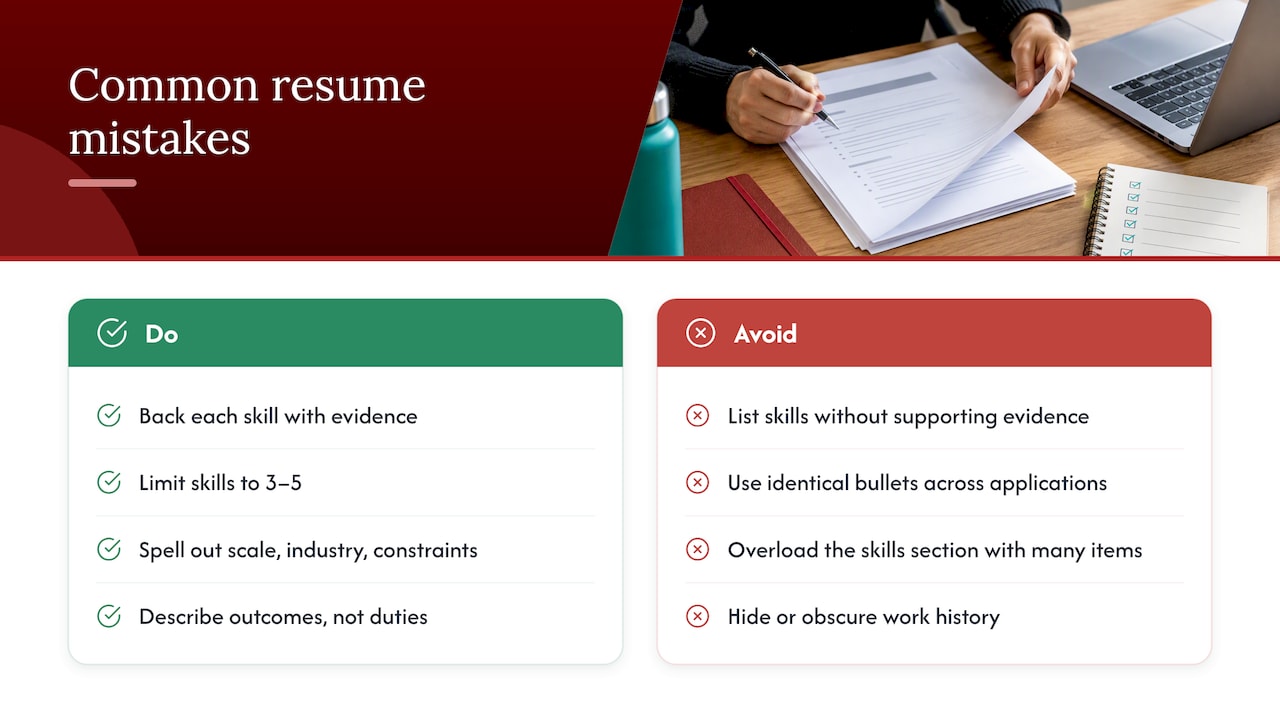
The most frequent error is listing skills without supporting evidence anywhere else on the page. A skills section with “leadership, communication, problem solving” and no bullet that demonstrates any of them reads as filler, and an attentive recruiter notices the gap immediately.

A second mistake is copying the same bullets across every application. Transferable skills only land when the surrounding context matches the posting, so a bullet about “managing a team” needs the scale, industry, and constraints spelled out, or it stays abstract. Generic phrasing like “excellent communicator” or “team player” with no context behind it tells the reader nothing they can verify.

Overloading the skills section is another common problem. Ten or fifteen skills crammed into a list dilutes the ones that actually matter for this posting. Choosing three to five and backing each with evidence does more work than a long list ever will.

Some candidates also hide their work history entirely in an effort to downplay an unrelated past role, which Job Bank’s guidance cautions against: a Canadian-style resume should stay straightforward about chronology rather than obscuring it. Trying to disguise a career change usually reads as evasive rather than strategic.

Finally, many resumes state duties instead of outcomes. “Responsible for customer service” describes a function; “resolved escalated complaints, maintaining service-level targets across a 300-call weekly volume” describes a result. The second version is the one that gets remembered.

Common mistakes that weaken a transferable skills resume — overview diagram

Quantifying transferable skills with measurable results

Numbers make evidence verifiable, and most roles generate more measurable detail than candidates initially think to include. Team sizes, dollar values, time saved, error rates, and volume handled are all fair game, even in non-sales roles.

Start by asking what changed because of what you did. If you trained new staff, how many, and how long did ramp-up take before and after your involvement? If you managed a budget, what was its size, and did you catch any overruns? If you resolved customer issues, what was the weekly or monthly volume?

Where an exact figure isn’t available, a defensible estimate is still more useful than no number at all, as long as it’s honest. “Reduced onboarding time by roughly one week” is credible if that’s genuinely your recollection; inventing a precise percentage you can’t support is not worth the risk if asked about it in an interview.

Pair the number with context so it means something to the reader. “Managed a team of six” is clearer than “managed a team,” and “cut processing time from five days to two” is clearer than “improved processing speed.” The context turns a bare number into a story the hiring manager can picture.

Not every bullet needs a number, and forcing one where none exists weakens credibility rather than strengthening it. Use measurable results where they exist and rely on clear scope and outcome language everywhere else.

Carrying transferable skills into your cover letter and interview

A resume states the evidence; a cover letter and an interview explain it. The cover letter is the place to pick one or two of your strongest transferable skills and walk through the specific situation behind them in a sentence or two, connecting that story directly to what the posting is asking for.

In an interview, the same accomplishment bullets become the backbone of behavioural answers. A bullet about coordinating a cross-departmental project turns naturally into a response to “tell me about a time you worked with a difficult team,” because the groundwork, the context, the action, and the result, is already written down.

Consistency matters across all three documents. If the resume claims problem-solving ability, the cover letter and interview answers should reinforce that same claim with different supporting detail rather than repeating the resume bullet word for word. Interviewers often ask follow-up questions that test whether the resume’s claims hold up under detail, so having two or three stories ready per skill, not just one, keeps answers from sounding rehearsed or thin.

Services that convert your transferable skills into a finished resume

Mapping your own evidence takes time and a second perspective helps when the right phrasing for a new field isn’t obvious. Three product lines are commonly available to suit candidates at different career stages.

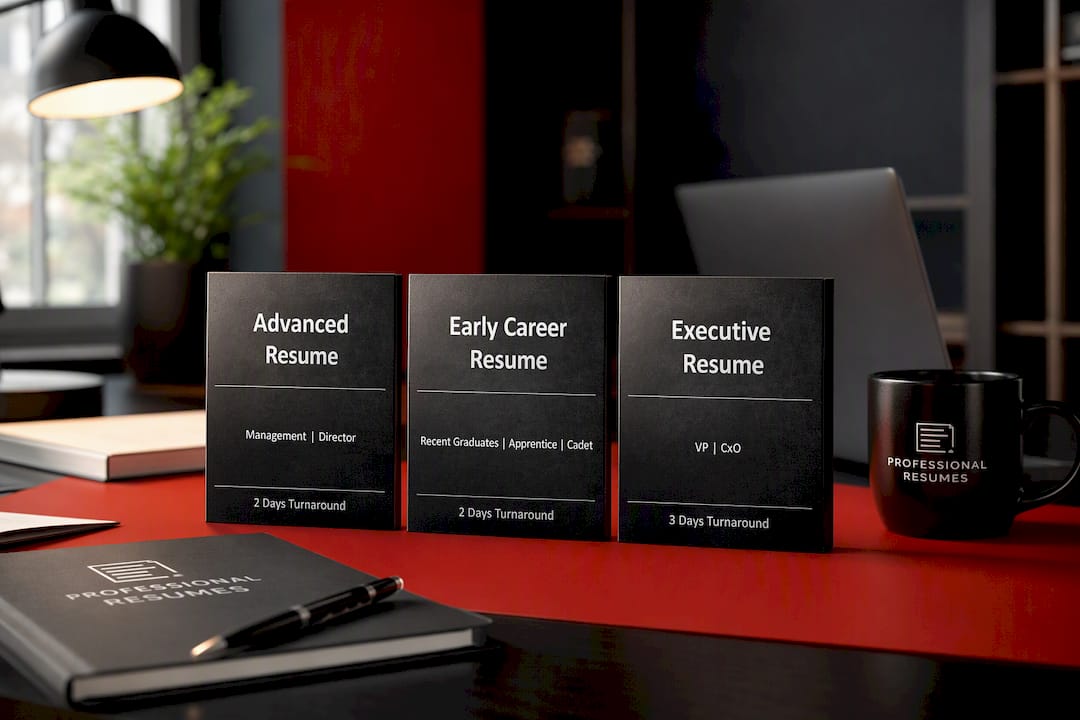
  • The Early Career Resume suits candidates with limited work history leaning on education, internships, and volunteer evidence, at $139.
  • The Advanced Resume fits established professionals pivoting industries or seniority levels, at $239.
  • The Executive Resume is built for senior leaders needing precise, outcome-driven language, at $289.

Advanced Resume

Each includes a consultation, targeted rewriting, and applicant tracking system formatting. Browse the full shop to compare options, or pair a resume with the LinkedIn profile optimization service for consistent evidence across both.

When hiring a writer makes more sense than doing it alone

Professional help tends to change outcomes most when you’re entering unfamiliar territory, an industry whose language you don’t yet speak fluently, or a senior role where every line faces close scrutiny. Reviewing your own career for the first time is harder than reviewing someone else’s, which is where outside input, including career coaching alongside a rewrite, often helps.

DIY works well when your target role sits close to your last one and you already know the field’s vocabulary. Either path can raise interview callbacks, though no approach guarantees a specific result.

— Professional

Sources

For occupation-specific descriptors and current formatting guidance, go to the primary sources rather than secondhand summaries.

FAQ

How do you describe transferable skills on a resume?

Name the skill and immediately back it with a specific accomplishment that proves it, rather than listing it as an adjective. For example, instead of writing “strong communicator,” write a bullet showing what you communicated, to whom, and what changed as a result.

What are five examples of transferable skills?

Common examples include communication, problem solving, teamwork, adaptability, and time management. Each should be paired with a specific accomplishment bullet rather than left as a standalone claim, since Job Bank recommends demonstrating qualifications through concrete, accomplishment-focused language.

What are seven transferable skills examples?

Beyond communication, problem solving, teamwork, adaptability, and time management, leadership and digital literacy round out a common list of seven. The right combination for your resume depends on which of these the target job posting repeats most often.

What are the top ten transferable skills?

Definitions vary slightly by source, but a common list spans communication, problem solving, teamwork, adaptability, time management, leadership, digital literacy, customer service, organization, and conflict resolution. Prioritize the three to five that match your target posting rather than trying to feature all ten.

Decorative salary expectations cover letter title card

Canada: Use Job Bank Data to State Cover Letter Salary Expectations

Only include salary expectations when the employer asks for them, or when leaving the figure out would put your application at a disadvantage. When a range is required, place a researched figure in the final paragraph, anchored to Job Bank wage data and your own experience, and pair it with a clear statement that you’re open to discussing the full compensation package.


TL;DR:

  • Only include salary expectations if explicitly requested in the job posting or application form.
  • Research occupation-specific wages in your region via Job Bank and adjust the range based on your experience and certifications.
  • Present a salary range rather than a fixed number, and phrase it to convey flexibility and support from market data.
  • Place your salary expectation at the end of the cover letter after establishing your fit and relevant achievements.
  • Avoid repeating published salary ranges and never state rigid or non-negotiable language to keep the conversation open.

Professionalresumes
Make Your Cover Letter Work Harder
Professional Resumes creates tailored cover letters that present your experience clearly and align your application with your career goals.

Explore resume services

Table of Contents

When to include salary expectations in your cover letter

Most cover letters should never mention a figure unless the job posting or application form asks for one directly. A direct request usually appears as a line in the posting itself, a mandatory field in an online application portal, or an explicit instruction such as “include salary expectations with your application.”

There are exceptions worth planning for. Time-limited postings with a hard deadline sometimes reward candidates who volunteer a range up front, since hiring managers are screening quickly and want to rule out mismatches early. Strict screening questions, particularly on government or large-employer portals, may block submission entirely without a number.

One error shows up more than any other: restating the range already published in the job posting. Employers read this as a signal that the candidate skimmed the posting rather than researched the role, and it wastes the one sentence you have to demonstrate judgment. If a posting already states a range, address your fit for the role instead and let the number stand.

  • Only state a figure when the posting, application form or recruiter explicitly asks for one.
  • Volunteer a range proactively only for time-sensitive postings or mandatory screening fields.
  • Never repeat a salary range the employer has already published, since it adds no information and can read as inattentive.

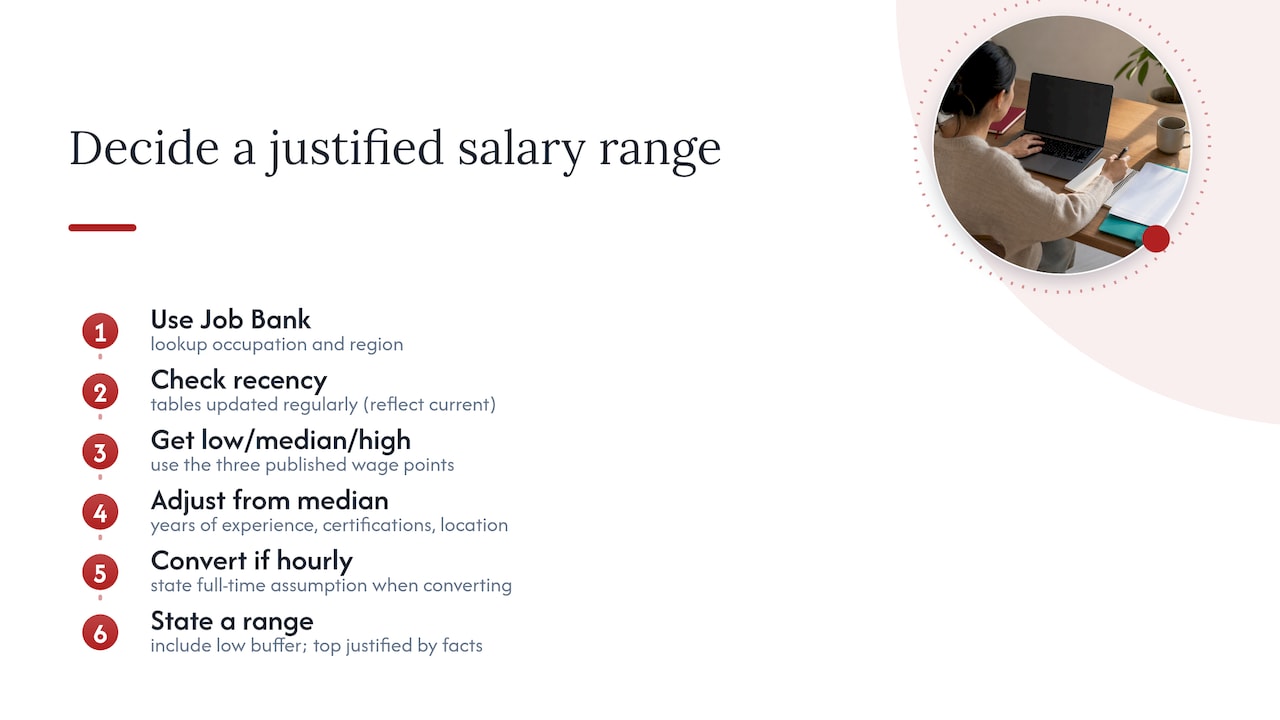
How to research and decide a justified salary range

A defensible range starts with the Job Bank wage methodology, which publishes low, median and high wages by occupation and region and explains how those figures are calculated. Look up the specific occupation and region that match the role you’re applying for, not a national average, since regional wage reports can differ substantially by market.

Job Bank updates its wage tables regularly and reports them by occupation and region. An accounting bookkeeper report, for instance, was last refreshed on November 19, 2025, which means the figures reflect current conditions rather than a stale snapshot from years earlier.

Once you have the low, median and high figures for your occupation, adjust from the median based on your years of experience, any relevant certifications, and whether the role is remote or tied to a specific city. A candidate with five years of specialized experience and a professional designation typically sits above the median; someone early in their career typically sits closer to the low end.

Job Bank wage range adjustment factors

If the wage data is quoted hourly, convert it to an annual figure using a standard full-time hours assumption, and say so plainly if you reference the conversion in your letter. Build in a buffer on the low end of your stated range so you have room to negotiate without appearing to undercut yourself, and set the top of the range at a level you can justify with specifics rather than optimism.

A range is almost always the better choice over a single number. It gives the employer room to place you within their internal bands and gives you room to negotiate once an offer is on the table, which a fixed figure does not.

How to phrase salary expectations in a cover letter

The tone matters as much as the number. A well-phrased sentence connects your range to research and experience, and signals that you’re flexible rather than fixed on a single outcome.

  • “Based on my research into [occupation] roles in this region and my [X years] of experience, my salary expectations fall between $X and $Y, and I’m open to discussing the full compensation package.”
  • “Given the scope of this role and current market data for similar positions, I’m targeting a salary in the range of $X to $Y, though I remain flexible based on the overall offer.”

Avoid absolute or rigid language: phrases like “I require,” “my minimum is,” or “non-negotiable” close the conversation before it starts and can remove you from consideration even when your range is reasonable. Career experts note that salary questions often function as a screening step rather than a final decision point, so language that keeps the door open tends to serve candidates better than language that shuts it.

When a form insists on a single number rather than a range, choose a figure from the middle to upper-middle portion of your researched range rather than the floor. That position reflects confidence in your value without pricing yourself out of an initial screen.

Pro Tip: Read the exact wording of the request before you write anything: “expected salary” invites a range, while “salary history” is asking for a different, more specific answer.

Where to place salary information and formatting tips

Salary details belong at the very end of your cover letter, after you’ve made the case for why you’re a fit for the role. Leading with a number before establishing your value invites the reader to evaluate you on price first and fit second.

  1. Write your opening and body paragraphs to establish fit, relevant achievements, and interest in the role.
  2. Place your salary range in the final paragraph, immediately before or alongside your closing line.
  3. Match that figure exactly to any number you’ve entered in a separate application portal field, since a mismatch between the two can trigger an automatic rejection in applicant tracking systems.
  4. State whether the figure is annual or hourly, and note the conversion basis if you’ve translated one into the other.

Consistency across every document in your application matters more than the specific wording you choose.

Short cover-letter examples and a fill-in template

Entry-level example: “As a recent graduate with hands-on training in [field], I’ve researched entry-level [occupation] wages through Job Bank and am targeting a salary range of $X to $Y, with flexibility as I learn more about the full role.”

Mid-career example: “With [X years] of experience in [field] and a track record of [specific accomplishment], my research into current market wages for this region places my expectations at $X to $Y, and I’m happy to discuss the complete compensation structure.”

Senior-level example: “Given the scope of this position and my background leading [specific responsibility], I’m looking at total compensation in the range of $X to $Y, inclusive of base salary, benefits and incentives, and I welcome a conversation about the full package.”

Fill-in template:
“Based on my research into [occupation] roles in [region] and my [X years] of experience in [relevant skill or industry], my salary expectations fall between $[low] and $[high]. I’m open to discussing the complete compensation package, including [benefits, bonus structure, or other relevant terms].”

  • Swap in the occupation and region to pull an accurate Job Bank baseline.
  • Adjust the range up or down based on certifications, specialized skills or remote work status.
  • Keep the closing sentence focused on flexibility rather than a fixed demand.

A note on tailored cover letters and negotiation outcomes

A cover letter that ties salary language to specific research and experience reads differently to a hiring manager than one with a generic figure attached. [brand_signal] Precision in this one paragraph often shapes how the rest of the negotiation unfolds, particularly at senior levels where compensation includes more than base pay. For roles carrying board-level visibility or complex total-rewards structures, working directly with a writer who can position that language strategically is worth the conversation.

— Professional

How Professional Resumes can help with salary language

Getting the wording right is one paragraph of a much larger document, and the rest of your cover letter has to earn the reader’s attention before that number ever lands. They build that case through a consultation-driven process, pairing tailored cover letter phrasing with ATS-friendly formatting so your application clears automated screens and reads well to a hiring manager.

Professionalresumes

The right product depends on where you sit in your career. New graduates typically start with the Early Career Resume, while professionals moving into a new role often choose the Next Step Resume or Advanced Resume for more developed positioning. Senior candidates preparing compensation-sensitive negotiations tend to work with the Executive Resume, which includes cover letter support built for that level of scrutiny. Readers who want resume and cover letter work handled together can review the full shop for package options.

Sources

The Job Bank wage methodology and its occupation-specific wage reports remain the most reliable starting point for building a defensible range, supported by practical cover letter templates from Isenberg’s career guidance and The Muse.

FAQ

How do I mention salary expectations in a cover letter?

State your expectation only in the final paragraph, after you’ve made your case for the role, and use a researched range rather than a single number. Tie the range to specific data, such as Job Bank figures for your occupation and region, and close with a line inviting further discussion about the full compensation package.

What is a good answer for salary expectations?

A good answer names a range, not a fixed figure, built from occupation and regional wage data adjusted for your experience level. It also signals flexibility, since career experts note that rigid or absolute wording can remove you from consideration at the screening stage.

What should I put as my expected salary?

Start with the median wage for your occupation and region from Job Bank’s occupation reports, then adjust upward for relevant experience, certifications or specialized skills. Present that adjusted figure as a range with a reasonable buffer on both ends rather than a single locked-in number.

How do you politely say the salary is too low?

Acknowledge the offer respectfully, then reference the market data and experience that support a higher figure, framing the conversation around the full package rather than base pay alone. Ask whether there’s room to revisit the number, or whether other elements of compensation, such as benefits or bonus structure, can close the gap.

Decorative resume length title card

One to Two Pages: Resume Length That Works for Canadian Job Seekers

Keep your resume to one or two pages: one if your relevant experience is limited, two when additional, recent accomplishments strengthen your case. Academic curricula vitae, certain funding applications, and select executive submissions are the main exceptions, each governed by its own rules rather than a generic page count. The deciding factor is never the page number itself: it is whether every line earns its place against the role you are targeting.


TL;DR:

  • A resume should be one to two pages long unless you have extensive, recent, and relevant achievements that justify a second page.
  • A single page suits early-career professionals or those with limited relevant experience, focusing on a targeted summary, key outcomes, skills, and measurable accomplishments.
  • A second page is justified when there are enough recent, relevant achievements, projects, or certifications that add value without repetition, typically for mid-career or senior professionals.
  • Longer resumes, such as three pages or more, are generally inappropriate for standard roles and reserved for academic CVs or specialized applications with specific page limits.
  • Focus on relevance when trimming your resume, discard outdated roles over 10 to 15 years old, and ensure formatting remains clear and ATS-friendly to maximize readability.

Professionalresumes
Make Every Resume Line Count
Professional Resumes creates customized resumes, cover letters, and LinkedIn profiles tailored to your aspirations and informed by industry trends.

Explore resume services

Table of Contents

How many pages should a resume be? An evidence-backed overview

Canadian guidance converges on a narrow range. Job Bank recommends limiting a standard resume to two pages and prioritizing experience that is both recent and relevant to the position. The University of Toronto’s resume toolkit gives the same range, one to two pages, and explains why the number matters less than what sits at the top.

That guidance rests on how resumes actually get read. Employers give a document a short initial scan before deciding whether it earns a closer look, which is why the strongest match signals belong on page one: job title, keywords from the posting, and a handful of measurable outcomes. A resume that buries its strongest match signals loses the reader before they get there.

Page count follows from this reality rather than setting it. A candidate with a decade of relevant, quantifiable achievements has earned a second page; a candidate without that history has not, and padding to fill it only dilutes what does matter.

One-page resumes: who should use them and how to make them effective

A single page suits students, recent graduates, early-career applicants, and some career changers whose most relevant experience is limited by definition, not by choice. Trying to stretch that experience across two pages usually adds noise rather than substance.

The page should carry only what moves the decision forward:

  • A targeted summary of two to three lines that names the role and your strongest fit for it.
  • The most relevant position or positions, described through outcomes rather than duties.
  • A core skills line matched to the posting’s language.
  • One to three quantified achievements that would survive a hiring manager’s brief scan.

Resist the instinct to shrink the font or compress the margins to fit more in. A one-pager that is hard to read defeats its own purpose.

Pro Tip: Cut a bullet entirely before you shrink the type below 11 point: a shorter, readable page beats a full, cramped one.

Two-page resumes: when a second page earns its place

A second page is justified when there is enough recent, relevant material to fill it without repetition. That typically describes professionals with several years of measurable achievements, technical specialists carrying certifications worth listing, and managers with real scope, team size, budget, or programs, to show.

Page two is where supporting evidence belongs:

  • Notable projects or initiatives that reinforce the page-one narrative.
  • Technical tools, platforms, or certifications relevant to the target role.
  • Earlier roles summarized in a line or two rather than described in full.

Keep the focus on the last 10 to 15 years of work, three to seven bullets per role, and every bullet built around a measured result rather than a listed responsibility. A second page that repeats page one in different words is not earning its space.

Three pages and the exceptions: academic CVs, funding applications and select executive submissions

Some documents are governed by rules unrelated to resume conventions. The SSHRC tri-agency CV sets a five-page limit in English for that specific funding application, with its own formatting requirements, and it is a CV in the academic sense, not a resume.

At the senior end, Public Service Commission guidance for executive CVs allows up to three pages but still directs candidates toward the most recent 10 to 15 years and away from a full biographical account. For a standard professional resume, two pages remains the practical ceiling.

Comparison of resume and CV page limits

If your material genuinely exceeds these formats, the answer is usually a different document altogether: an academic CV, a portfolio, or an appendix, not a longer resume.

How to decide what to keep, edit or remove: a trimming checklist

Most resumes that run long are carrying weight they no longer need. Work through the document in this order:

  1. Cut or summarize any role older than 10 to 15 years unless it directly supports the job you want.
  2. Rewrite duty statements as accomplishment statements: what you did, the context, and the measurable result.
  3. Cap bullets at four or five per role and keep each to two lines at most.
  4. For every remaining line, ask whether it helps this specific application, not your career story in general.
  5. Move anything interesting but non-essential, a side project, an older credential, a longer narrative, to LinkedIn or a portfolio instead of the resume itself.

Pro Tip: If you find yourself defending a bullet’s inclusion, that is usually the sign it belongs elsewhere.

Applying that discipline, drawn from the same principle that resume length should follow relevance rather than habit, tends to shorten a bloated two-page resume before it ever needs a third.

Formatting and ATS-safe basics that preserve readability

Length and formatting solve the same problem from different angles: both exist to help a reader find what matters fast. University of Toronto and UTM career centre guidance recommends body text at 11 to 12 point, margins between three quarters of an inch and one inch, and a single-column layout that both people and applicant tracking systems can parse cleanly.

A few habits protect that readability:

  • Avoid tables, icons, headers, and footers, which some applicant tracking systems misread or drop entirely.
  • Use one consistent date format throughout, rather than mixing styles.
  • Keep headings plain and bullets simple: no nested sub-bullets or decorative dividers.

Employers give a first pass to a resume in about 30 seconds, according to Job Bank, which is why the visual hierarchy matters as much as the words themselves. A clean, predictable layout lets that short window work in your favour rather than against you.

Publisher perspective: how Professional Resumes helps job seekers decide the right length

Deciding what belongs on page one versus page two is a judgment call, and it is where a consultation earns its value. Professional Resumes works with clients to map accomplishments against the target role before deciding whether a document needs one page or two, then applies ATS-friendly formatting so the structure holds up in both a hiring manager’s hands and a tracking system’s parser.

What the length debate misses

What the length debate misses — overview diagram

Most advice on this topic treats the page count as the variable worth arguing over, when the real variable is relevance. A one-page resume stuffed with generic duty statements is worse than a well-edited two-pager, and a two-page resume padded to look thorough is worse than a tight single page. The authoritative sources bear this out: Job Bank, the University of Toronto toolkit, and the Public Service Commission all frame their page guidance around what the reader needs to see quickly, not around a fixed number to hit.

What gets underestimated is how much damage a weak second page does. Adding length to appear more experienced usually signals the opposite: that the candidate could not decide what mattered. The reader should prioritize the exercise in the trimming checklist above before worrying about which side of the one-page or two-page line they land on. Get the content right first, and the correct length tends to reveal itself rather than needing to be chosen in advance.

— Professional

Service options: which Professional Resumes product fits your stage

Matching the document to the career stage is most of the work. Professional Resumes structures its product lines around exactly that distinction: the Early Career Resume is built for students and recent graduates working within a tight one-page format, the Advanced Resume suits mid-career professionals who have earned a well-supported second page, and the Executive Resume is written for senior leaders whose scope and strategic outcomes need room to land.

Advanced Resume

  • Browse the full shop to compare Early Career, Next Step, Advanced, and Executive options side by side.
  • Pair a new resume with a LinkedIn profile optimization service so both documents tell the same story.
  • Book a consultation directly through the product page that matches your current stage.

Sources

FAQ

Is a 2 page resume ok?

Yes, a two-page resume is appropriate once you have enough recent, relevant, and quantified achievements to fill it without repetition. Job Bank and university career centres both treat one to two pages as the standard range for most professional resumes.

Is a 3 page resume too long?

For a standard professional resume, yes, three pages generally exceeds what employers expect to scan. The main exception is senior executive CVs, where Public Service Commission guidance allows up to three pages, while academic CVs for funding applications follow entirely separate page limits.

Is a 7 page resume too long?

Yes, a resume of that length falls outside every standard guideline for a professional job application and would typically only suit an academic CV governed by its own field-specific conventions. Even the SSHRC tri-agency CV, a lengthy academic format, caps out at five pages in English.

How long should a 20 year resume be?

A career spanning two decades still fits comfortably into two pages if you focus on the last 10 to 15 years and summarize earlier roles briefly. This approach follows Public Service Commission guidance on emphasizing recent scope and achievement rather than a complete work history.

Executive LinkedIn profile title card

LinkedIn for Executives: High Impact Profile in 60 Minutes

The single most effective LinkedIn approach for executives combines a polished, outcome-focused profile with a low-volume, high-quality posting rhythm and selective networking. Prioritise the headline, About and Featured sections first, then commit to one or two strategic posts per week. Begin now: update your headline today and block 60 minutes this week for content planning.


TL;DR:

  • Executives should focus on a highly polished profile with a strong headline, about, and featured sections before posting regularly.
  • Updating key profile elements like the headline, photo, and banner can significantly improve visibility and should be tested one variable at a time.
  • Posting one to two high-value, outcome-focused posts weekly is more effective than high-frequency content, with formats including short essays, lessons, and brief videos.
  • Building a deliberate network of peers, recruiters, and board members through thoughtful connection requests and comments yields better results than large, unfocused networks.
  • Regular review of qualitative signals such as profile views and engagement quality helps refine content and targeting without relying on detailed analytics.

Professionalresumes
professionalresumes.ca
Shape Your Executive LinkedIn Presence
Professional Resumes tailors LinkedIn profiles to your aspirations, with personalised consultations and revisions that clarify your leadership experience.

Explore LinkedIn profile services

Table of Contents

Profile optimisation checklist for executives

An executive profile should read as a leadership brand statement, not an extended CV. Recruiters, board members and partners scan a handful of fields before deciding whether to read further, so those fields carry disproportionate weight.

Work through them in this order:

  • Photo and banner: a current, professional headshot paired with a banner that reinforces your mission or area of authority.
  • Headline: role, impact and niche combined into one scannable line rather than a job title alone.
  • About: a one-line positioning statement, two or three signature outcomes, and a note on your current agenda.
  • Featured: two or three pinned items, such as a keynote clip, a published article or a case study, that support your positioning.
  • Experience: outcome-focused bullets that read like board notes rather than duty lists.

This sequence matters because a scanning reader rarely reaches the experience section without first being persuaded by the top of the profile. Guides that outline these components consistently point back to the same logic: positioning first, proof second, detail third.

Pro Tip: Rewrite your headline and About section before touching anything else. Those two fields do most of the persuasive work.

For a deeper look at how LinkedIn positioning ties into your broader executive brand, see this piece on personal branding for executives.

Optimising visible fields: photo, headline and banner

These three elements determine the first impression before anyone reads a word of your About section.

  • Photo: a recent headshot, business or business-casual attire depending on your sector, shoulders up, cropped so your face fills roughly 60% of the frame.
  • Headline: use a role plus impact plus niche formula, such as “CFO | Scaling SaaS Revenue from $10M to $100M | Board Advisor.”
  • Banner: reserve this space for a mission statement, a still from a speaking engagement, or a link to a resource you want visitors to notice.
  • Testing: swap one variable at a time, such as the headline phrasing, and watch profile views over a few weeks before changing another element.

Small, deliberate changes let you isolate what actually moves the needle rather than guessing at a full overhaul.

The About section is where most executive profiles fail, either by repeating the resume or by drifting into vague mission language. A tighter structure fixes both problems.

  1. Open with positioning: one sentence naming your function, your scale and the outcome you are known for delivering.
  2. Prove it with two or three results: concise, outcome-oriented statements rather than a running list of responsibilities.
  3. Close with your current agenda: what you are focused on now, which signals relevance to recruiters and partners reading in real time.

Avoid restating your resume line by line. Convert each Experience entry into a short outcome statement: what changed, at what scale, under your leadership, rather than what your role entailed. Featured content should earn its place: a keynote, a published piece or a case study that reinforces the same one or two themes running through your About section, not a scattershot of unrelated links. Recommendations work the same way. A handful of targeted requests from people who can speak to a specific outcome will do more for your credibility than a long list of generic endorsements. For guidance on translating achievements into resume-ready language that mirrors this approach, see these executive resume writing tips.

Thought leadership and content rhythm for executives

A realistic cadence for a time-pressed executive is one to two strategic posts per week, not daily activity. Consistency and quality matter more than frequency, and a leader’s audience tends to reward substance over volume.

Common frameworks like the 3-2-1 and 4-1-1 models were built for high-volume creators and marketers, cycling through six posts with a mix of curated and original content. Executive guidance from LinkedIn’s own resources suggests adapting these frameworks into a lower-volume format that leans even more heavily toward value before promotion, closer to a five-to-one ratio of substantive insight to anything promotional. That shift reflects how leaders are read differently than creators: fewer posts, each expected to carry real weight.

High-value formats for this rhythm include:

  • Short essays on a decision you made and why it mattered.
  • Lessons from the boardroom, generalized enough to protect confidentiality.
  • Data-informed insights relevant to your sector or function.
  • Brief videos, a minute or two, sharing a single point clearly.

According to Sprout Social’s guide to executive presence, leaders who post strategically and authentically build trust that extends beyond individual engagement metrics into broader organisational reputation. To increase dwell time, open with a specific claim rather than a generic observation, and end with a genuine question rather than a call for likes.

Pro Tip: Batch a month of post ideas in a single sitting, then schedule the actual writing in short, weekly blocks so the habit survives a busy quarter.

Thought leadership and content rhythm for executives — overview diagram

Strategic networking and recruiter engagement

A high-signal network beats a large one. Executives benefit from connecting deliberately rather than accepting every request.

  • Who to prioritise: peers in your function, board members, analysts covering your sector and recruiters specializing in your level.
  • Weekly target: ten to fifteen new connections and five to ten thoughtful comments on posts from people in that circle.
  • Connection notes: a single sentence naming a shared context or a specific reason for reaching out works better than a generic invitation.
  • Comment strategy: a substantive comment on a well-placed post often earns more visibility than a standalone post of your own.
  • Premium and InMail: reserve InMail for warm, specific outreach, such as following up after a conference, rather than cold volume messaging.

Recruiters notice pattern and consistency more than any single post, so a steady rhythm of thoughtful engagement tends to outperform sporadic bursts of activity.

Measure impact: metrics and signals that matter

Executives do not need a marketing dashboard. A handful of qualitative signals, reviewed regularly, is enough to refine both content and targeting.

  • Profile views: a leading indicator of search visibility and headline effectiveness.
  • Post-level engagement quality: comments from relevant people matter more than raw like counts.
  • Search appearances: shows whether your keyword choices in the headline and About are working.
  • Connection request sources: reveals whether recruiters, peers or vendors are finding you.

Executives who focus on strategic, authentic posting can influence trust and pipeline outcomes rather than vanity metrics alone, according to Sprout Social. Third-party analytics tools add value when you need to track visibility trends over time or benchmark against peers, which native LinkedIn data does not do well. A simple monthly routine of reviewing these signals is enough to spot what to adjust before the next posting cycle.

Quick wins and delegation: what to do in under an hour and what to outsource

Time is the real constraint for most executives, not knowledge. A short list of quick wins and a clear delegation boundary solves most of the problem.

  1. Rewrite your headline using the role, impact, niche formula.
  2. Update your photo if it is more than two years old.
  3. Pin one Featured item that reflects your current priorities.
  4. Send five targeted connection requests with a one-line note each.
  5. Comment on three posts from people in your target network.

Tactical work, scheduling posts, formatting graphics, drafting first pass copy from your notes, is safe to delegate to an assistant or a vendor. Keep a single approval step: you supply the core insight in a sentence or two, the delegate builds it into a full post, and you give one consolidated sign-off before it publishes.

Pro Tip: A short hand-off brief, your key message, tone preferences and any names or numbers off-limits, saves more time than any scheduling tool.

How Professional Resumes helps executives with LinkedIn profiles

Professional Resumes offers a dedicated LinkedIn profile optimization service built around the same priorities outlined above: headline, About, Featured and experience narrative, refined through direct consultation. Case studies, including one detailing a VP-level ascent supported by a rewritten resume and an updated LinkedIn presence, illustrate the kind of outcome a coordinated approach can support. When evaluating any vendor, ask about deliverables, the number of revisions included and how client information is handled, since confidentiality matters more at the executive level than at any other stage of a career.

Executive branding strategies beyond profile optimization

A LinkedIn profile is one surface of a broader executive brand, not the whole of it. Speaking engagements, board appointments, bylined articles in trade publications and podcast appearances all feed the same reputation that your profile summarizes. The strongest executive brands treat LinkedIn as a distribution channel for work happening elsewhere, a conference talk repurposed into three posts, a board decision generalized into a lesson, rather than the sole source of original content.

Consistency across channels matters more than volume on any one of them. The language in your About section should match the bio you send to conference organizers, and the themes in your posts should echo the positioning in your executive resume. When those pieces align, a recruiter or board member encountering you in multiple places sees one coherent narrative instead of several disconnected impressions. For a broader view of how these pieces fit together, this guide to executive personal branding covers positioning beyond the profile itself.

Executive brand alignment across channels

Executives who under-invest in this wider view often find their LinkedIn presence feels disconnected from their actual reputation, polished on the surface but thin on the substance a serious buyer or board is looking for.

Using LinkedIn Groups and Events for executive networking

Groups and Events offer a lower-effort way to stay visible within a specific professional community without adding to your regular posting load. A well-moderated group in your sector surfaces conversations worth commenting on, which supports the comment-first networking strategy covered earlier without requiring original content.

Events, particularly LinkedIn Live sessions or panel discussions tied to your industry, work well for executives because attendance itself signals engagement, and a single thoughtful question or comment during the event can generate more visibility than a week of solo posts. Hosting or co-hosting an event ties naturally into thought leadership, giving you a reason to post a recap afterward that fits the value-first content rhythm already in place.

Choose groups and events selectively. Two or three active groups tied directly to your function or sector, checked briefly once a week, will do more for your network than a long list of memberships that go unread.

Author perspective: pragmatic trade-offs for leaders on LinkedIn

A quality-first approach suits executives better than high-volume tactics because your time is the scarcest resource in the equation, not your ideas. There will be weeks when board preparation or a transaction takes priority over any post, and that is the correct trade-off, not a lapse in discipline. The checklist that holds up under real pressure is short: is the headline current, is the About section still true, and has a genuine insight been shared in the last two weeks. Anything beyond that is optional polish.

— Professional

Service call-to-action: LinkedIn profile optimisation offering

Getting an executive profile right without losing a week of your own time is exactly what the LinkedIn profile optimization service from Professional Resumes is built to solve, working directly with your writer through a confidential consultation rather than a template.

Executive Package Deal

For candidates pairing a LinkedIn refresh with a resume rewrite, the Executive Package Deal bundles both, while the Executive Resume on its own covers the resume side at $289. Professionals moving into their next leadership step can also review the Next Step Package Deal or browse the full shop for other document options. Every engagement includes revisions and is handled in confidence, starting with a first consultation to map your positioning before any writing begins.

Sources

FAQ

What is the 3-2-1 rule on LinkedIn?

The 3-2-1 rule is a content mix guideline built around six posts per cycle, blending curated and original content in a set ratio. For executives, LinkedIn’s own guidance suggests adapting it into a lower-volume, value-first version rather than following the original ratio directly.

What are the best practices for executives on LinkedIn?

Best practice starts with a strong headline, About section and Featured content, followed by a steady rhythm of one or two high-value posts per week. Selective networking and thoughtful commenting matter more than high connection counts, and executive presence has been linked to measurable trust and reputation outcomes.

Why are people getting rid of LinkedIn?

Some professionals step back from LinkedIn because high-volume posting norms feel mismatched with their available time or their comfort with public self-promotion. A lower-volume, quality-first approach, focused on a polished profile and occasional strategic posts, addresses that concern without requiring a full exit from the platform.

What is the 4-1-1 rule on LinkedIn?

The 4-1-1 rule is another content ratio framework, mixing curated shares with original posts across a six-post cycle. As with the 3-2-1 model, executive guidance favours adapting it toward fewer, more substantive posts rather than following the ratio exactly as designed for high-frequency creators.

How much does LinkedIn profile optimisation cost?

Pricing for the LinkedIn profile optimization service from Professional Resumes is available on request through a confidential consultation. Bundled options like the Executive Package Deal combine it with resume writing for candidates who want both updated together.

Decorative sketch of resume format structures

ATS Safe Resumes: When to Use Chronological, Functional, or Hybrid

Reverse-chronological remains the default choice for most job seekers, and recruiters generally expect it. A functional, skills-first format earns its place only in specific situations: career changes, employment gaps, or scattered experience that a timeline undersells. For many candidates, a hybrid resume solves the underlying presentation problem better than either pure format, provided it stays readable to both applicant tracking systems and the person doing the screening.


TL;DR:

  • A hybrid resume often offers the best balance for job seekers with relevant experience and the need for both skills highlighting and timeline transparency.
  • Keeping dates, titles, and employers visible in a skills-based resume prevents it from appearing to hide gaps or unrelated experience.
  • For ATS compatibility, avoid using tables, columns, images, or creative section headers, and use straightforward terminology matching the job posting.
  • Candidates with a consistent, linear career mainly benefit from a chronological format, while career changers or those with scattered experience should consider a hybrid or functional approach.
  • Defaulting to a hybrid resume provides flexibility and mitigates the main weaknesses of purely functional or purely chronological formats.

Professionalresumes
Make Your Resume Fit Your Goals
Professional Resumes creates customized, ATS-friendly resumes tailored to your experience, aspirations, and the employers you want to reach.

Table of Contents

What a chronological resume is and how it’s structured

A reverse-chronological resume lists your most recent job first, with responsibilities and accomplishments organized under each dated role. It’s the format most employers prefer when your recent experience lines up closely with the job you want, and it’s built to answer the questions a recruiter asks first: what did you do, where, and how recently.

This structure works because it lets a recruiter validate scope and recency in seconds. Titles, employers, and dates sit exactly where a trained eye expects them, which builds a kind of quiet confidence before a single accomplishment is even read.

Build one with this checklist:

  • Contact details and a short targeted summary at the top.
  • Work history in reverse order, each entry showing employer, title, and dates.
  • Two to four accomplishment bullets per role, quantified where possible.
  • Education and certifications below the experience section.

What a functional (skills-based) resume is and how it’s structured

A functional resume leads with grouped skills and supporting examples rather than a job-by-job timeline. UC Davis recommends organizing around three to four skill areas, each backed by concrete proof, followed by a condensed employment history.

This layout suits career changers whose most relevant experience sits outside their most recent title, people returning after a gap, and applicants whose transferable skills are scattered across several roles or freelance work. It lets you put the strongest evidence first instead of burying it under an unrelated job title.

The trade-off is real: separating skills from the timeline can look like something is being hidden, even when nothing is. Guard against that with a few habits:

  • Keep a clearly labelled Experience section with employers, titles, and month or year dates.
  • Place a proof bullet directly under each skill heading, not just a claim.
  • Avoid vague headings like “Miscellaneous Skills” that read as filler.
  • Never omit dates entirely: that’s the detail that turns a skills-first resume into a red flag.

If you’re weighing this option because of a career pivot, our guide to refreshing a resume for a mid-career transition walks through the same decision in more detail. Recent graduates facing a similar structural question will find more specific direction in our early career resume tips.

Quick decision guide: which format to choose and when to prefer a hybrid

Three questions settle most format decisions:

  1. Does your most recent job match the role you want? If yes, chronological is almost always the stronger choice.
  2. Would a strict timeline bury your strongest, most relevant evidence? If yes, a skills-first section near the top starts solving the problem.
  3. Do you still need a recruiter to trust your dates and titles? If yes, and it’s almost always yes, keep a full Experience section visible.

That third question is why combination formats are so often the practical answer: they foreground targeted skills while preserving the reverse-chronological record recruiters rely on to verify your history.

A few situation-to-format mappings: a steady same-field applicant fits chronological; a career changer with strong transferable skills fits functional or, better, hybrid; someone with a short gap and otherwise strong tenure fits hybrid with a brief summary addressing the gap directly.

Pro Tip: When in doubt, default to hybrid: it costs you little and protects you from the main weakness of a pure functional layout.

ATS and recruiter readability: format features that matter more than labels

Applicant tracking systems parse headings, dates, job titles, and keywords to build a structured profile of your resume before a person sees it. What breaks that process is rarely the format label itself and almost always the layout: tables, headers and footers, images, and unusual section titles all interfere with parsing, according to UW’s guidance on ATS behaviour.

Illustration of ATS parsing resume elements

Recruiters and hiring managers may spend under 10 seconds on an initial scan of a resume, and ATS use is near-universal among large employers, according to UCI’s ATS career guide. That narrow window means your top third has to carry your strongest, most relevant evidence, regardless of which format you choose.

A short checklist keeps any resume friendly to both audiences:

  • Use standard section headings like “Experience” and “Skills,” not creative substitutes.
  • Save as a clean .docx or PDF, and skip tables, columns, and text boxes.
  • Match the job posting’s exact terminology; small differences in wording affect keyword matching.
  • Keep fonts simple and left-aligned, with consistent, real dates rather than vague ranges.

For a deeper look at formatting choices and screening mechanics, see our guide to ATS-friendly resumes.

Short examples and templates: what each format looks like on the page

Seeing the skeleton makes the choice concrete faster than any description does.

  • Chronological: Summary, then “Marketing Manager, Company X, 2022 to present,” followed by a bullet such as “Grew organic traffic 40% in 12 months by rebuilding the content calendar around search intent.”
  • Functional: A “Project Leadership” heading followed by a proof bullet like “Coordinated a five-person team across three departments to launch a product two weeks ahead of schedule,” then a condensed Experience list with employers and dates underneath.
  • Hybrid: Summary, a short “Core Skills” block with two or three proof-backed strengths, then a full reverse-chronological Experience section identical in structure to the pure chronological version.

The hybrid skeleton is the one most readers underestimate. It doesn’t require inventing new sections, it just moves the strongest two or three points above the timeline instead of asking a recruiter to find them.

Practical resume-writing tips that apply to any format

Format aside, certain habits raise interview odds on their own. Write accomplishment bullets in a Challenge-Action-Result pattern, and quantify wherever the number exists: percentage, dollar figure, headcount, timeline. Match your language to the job posting’s own terms rather than a synonym you prefer.

Trim anything that doesn’t serve the specific role you’re applying to. A resume that tries to represent your entire career usually undersells the parts that matter for this job.

  • Cut outdated jobs and skills unless they’re directly relevant.
  • Avoid decorative fonts, icons, or graphics that ATS software can’t parse.
  • Proofread for consistent verb tense, and read bullets aloud to catch missing words.
  • Check that every date range is accurate and consistent in format.

Pro Tip: Ask someone unfamiliar with your work to read your resume for 10 seconds and tell you what they remember. That’s close to what a recruiter actually retains.

How Professional Resumes applies these formats in real client work

When a background is assessed, the format decision comes from the same three questions any job seeker should ask: does the timeline help or hurt, is the strongest evidence buried, and can a hybrid structure preserve both. Someone changing industries after a decade in one field rarely benefits from a purely chronological layout, and a person with a clean, linear history rarely benefits from a skills-first one.

Working directly with a writer through consultation and revision means the format isn’t a guess. It’s matched to the individual’s specific history, and for many, that matched format, paired with ATS-aware formatting, is the fastest realistic path to more interview requests.

— Professional

Getting started: matching your situation to the right resume service

Format decisions matter, but execution is where most resumes fall short under real scrutiny. Early-career candidates weighing a functional layout often get more from our Early Career Resume, while candidates managing a career change or a complex history typically fit the Advanced Resume. Senior candidates facing board-level scrutiny should look at the Executive Resume, and those who also need a LinkedIn profile aligned to the same story can bundle both through the Advanced Package Deal.

Advanced Resume

Each option includes direct consultation with your writer, so the format applied to your resume is the one that fits your actual history, not a generic template. Browse the full lineup and start with the package that matches your stage.

Sources

The GW career services guide and UC Davis resume toolkit explain format fundamentals from a university career-centre perspective, while UCI’s ATS guide covers how screening software actually reads a resume. If a new role means a bigger financial decision on the horizon, Haven Mark Advisers’ guide to mortgages after a new job is worth a look too.

FAQ

What counts as a red flag on a resume?

Unexplained gaps with no context, missing dates, inconsistent job titles, and generic skill claims without proof all read as red flags to a recruiter. A functional resume that hides its Experience section entirely is a common version of this problem, since it can look like something is being concealed even when it isn’t.

Are functional resumes still used today?

Yes, functional resumes are still used, mainly by career changers, people returning after a gap, or applicants whose relevant experience spans freelance and varied roles. UC Davis recommends them specifically for these situations rather than as a general default.

What’s the difference between chronological, functional, and hybrid resumes?

A chronological resume lists jobs in reverse date order, a functional resume groups skills first with a condensed history below, and a hybrid or combination resume puts targeted skills near the top while keeping a full reverse-chronological Experience section intact. The hybrid is often the practical middle ground for readers who need both skills emphasis and timeline transparency.

What are the three main types of resumes?

The three main types are chronological, functional, and combination (or hybrid), each organizing the same underlying content in a different order and emphasis. Most career centres, including UC Davis, treat these as the standard categories job seekers choose between.

Decorative STAR and CAR interview title card

Cut Answers to 30–45s: Rules and Drills to Choose STAR or CAR

STAR gives an interviewer full context and detail; CAR skips the setup and leads with impact. As a rule of thumb, use STAR when a question calls for process, judgment, or team dynamics, and use CAR when time is short or the interviewer wants a leadership summary. Both are frameworks, not scripts, so the goal is to adapt each one to the story you are actually telling.


TL;DR:

  • Candidates should prioritize CAR for quick, high-level responses during time-constrained interviews, especially in early stages or on phone screens.
  • STAR is more suitable for detailed questions about processes, teamwork, or technical challenges, typically in later-stage or panel interviews.
  • Effective answers combine a brief reflection on outcomes or lessons learned, regardless of the chosen framework, to demonstrate growth or leadership.
  • Practicing conversion between STAR and CAR formats helps ensure preparedness for varying question types and time limits.
  • Avoid reciting answers word-for-word; instead, develop stories flexibly to sound natural, credible, and focused on personal ownership and measurable results.

Professionalresumes
Turn Career Wins Into Stronger Stories
Professional Resumes helps shape your experience into customized career documents that clearly showcase your skills and aspirations.

Explore Professional Resumes

Table of Contents

What is the STAR method and when should you use it

The STAR method breaks an answer into four parts: Situation sets the scene, Task defines what you were responsible for, Action describes the specific steps you took, and Result states the outcome. It is the standard structure for behavioural interviews because it forces a candidate to move from context to consequence instead of drifting into a general description of a job.

STAR works best when a question asks about teamwork, a technical problem you solved, or a process you managed end to end. Panel interviews and questions like “tell me about a time you resolved a conflict” reward the fuller picture STAR provides, since the interviewer is often assessing judgment as much as outcome.

The method has two common failure points. Candidates spend too long on Situation and Task, leaving barely a sentence for Result, and many default to “we” language that hides individual contribution. Recruiters and hiring managers consistently look for explicit ownership. Empirical work on how candidates actually answer STAR questions found that Situation appears in nearly all responses, while Task, Action, and Result are frequently underdeveloped or missing entirely.

A tight annotated example: “Our team’s release schedule was slipping every sprint (Situation), and I was asked to find the bottleneck (Task). I audited the deployment pipeline and moved code review earlier in the cycle (Action). Release delays dropped, and the process change is still in use today (Result).” That is roughly 55 words, close to the range most coaches recommend for a spoken answer of 60 to 90 seconds.

What is the STAR method and when should you use it — overview diagram

Key differences at a glance to help you choose quickly

STAR and CAR both structure a behavioural answer, but they put the emphasis in different places. STAR is built to show how you think and work; CAR is built to show what you achieved fast.

  • Focus: STAR emphasizes process and context; CAR compresses straight to challenge, action, and result.
  • Best for: STAR suits detailed process or teamwork questions; CAR suits phone screens, panel time limits, and senior-level summaries.
  • Length and pacing: STAR answers typically run around a minute; CAR answers usually last less than a minute.
  • Context: a first-round phone screen favours CAR’s speed, while a technical or panel round often has room for STAR’s detail.
  • Reflection line: either method benefits from a short closing sentence on what you learned or what changed, when the question invites growth or leadership insight.

The practical difference shows up under time pressure. A candidate who only knows STAR will either rush the ending or run over their allotted time. A candidate who only knows CAR risks sounding thin when a panel wants to hear how a decision was actually made.

How to choose between STAR and CAR: a short checklist and decision rules

Choosing a format under interview pressure is a snap judgment, not a research project. A short checklist, memorized in advance, removes the guesswork.

  1. Read the question’s verb. “Walk me through” or “describe a time” usually signals STAR; “tell me about a result you’re proud of” or “give me an example of your impact” signals CAR.
  2. Check the clock. If you have less than a minute, or the interviewer has already said they’re short on time, default to CAR and skip background detail.
  3. Match the interview format. Phone screens and early-stage panels tend to reward concise answers; a later-round interview with a hiring manager often has room for STAR’s fuller narrative.
  4. Consider seniority. Entry-level and mid-career questions often invite STAR because interviewers want to see how you approach problems; leadership interviews increasingly favour CAR because the panel is assessing outcomes and decision quality under board-level scrutiny.
  5. Use a ten-second script in the moment: silently ask “do they want my process or my result?” before you open your mouth, then commit to one structure and don’t switch mid-answer.
  6. Default to compression. When unsure, start with CAR’s brevity and add one sentence of context only if the interviewer’s face says they want more.

The safest habit is to over-prepare STAR versions of your best stories, then practise cutting each one down to a CAR version. That way you always have the longer answer ready and the shorter one rehearsed, rather than trying to invent either on the spot.

Templates and sample answers you can adapt across career stages

A reusable template beats a memorized script because it flexes with whatever question actually gets asked. Keep both versions of your best two or three stories ready.

  1. STAR template (60 to 90 seconds, roughly 90 to 130 words): Situation (one sentence, the context and stakes), Task (one sentence, your specific responsibility), Action (two to three sentences, what you actually did), Result (one to two sentences, the outcome and, where relevant, what changed afterward).
  2. CAR template (30 to 45 seconds, roughly 50 to 80 words): Challenge (one sentence combining situation and stakes), Action (two sentences, the decisive steps), Result (one sentence, the outcome plus a short reflection line).
  3. Early-career sample (STAR): “During a retail shift, our POS system went down during a rush (Situation), and as the senior person on the floor I had to keep the line moving (Task). I switched us to manual receipts and assigned two coworkers to bagging while I handled payments (Action). We cleared the backlog in under fifteen minutes with no walkouts, and I wrote a one-page backup procedure the store still uses (Result).”
  4. Mid-career sample (CAR): “A key client threatened to leave over missed deadlines (Challenge). I rebuilt our project timeline, added weekly check-ins, and personally owned the client’s next two deliverables (Action). The client renewed for another year and became one of our references (Result).”
  5. Senior sample (CAR with reflection): “Our division was losing margin on a legacy product line (Challenge). I led the pricing review, cut two underperforming SKUs, and renegotiated supplier terms (Action). Margin recovered within two quarters, and the pricing framework is now used across three other divisions (Result and reflection).”
  6. Conversion drill: take a STAR story you already have written and delete every Situation detail that isn’t necessary to understand the stakes; merge Task into the opening Challenge line; keep Action, tighten Result. Reverse the drill by taking a CAR answer and adding one sentence of Situation and one of Task before Action, to practise expanding under less time pressure.

Case studies of how real achievements turn into interview stories can help you see this conversion in practice, and our own case studies and samples page shows several worked examples.

Common mistakes and expert tips for making answers credible

Behavioural interviewing has measurable predictive validity for job performance, with research syntheses reporting correlations in the range of roughly 0.28 to 0.32. That validity depends on candidates giving specific, honest answers rather than generic ones, which is where most interviews go wrong.

The most common mistakes are over-rehearsal that makes an answer sound recited, a weak or vague Result, and “we” language that obscures individual ownership. Practitioners advise leading with stakes rather than setup, replacing “we” with “I” wherever you personally acted, and describing what changed as a result of your action instead of reaching for a big, unverifiable number.

Three drills fix most of this. Record yourself answering out loud and listen for filler words and passive phrasing. Time each answer against the 30 to 45 second CAR target and the 60 to 90 second STAR target. Ask a second person to check whether your Result sentence would survive a follow-up question, since a credible outcome is one you can defend, not just one that sounds impressive.

STAR and CAR timing comparison with practice drills

Pro Tip: Practise the decision, not the script: rehearse choosing between STAR and CAR on the fly, so your delivery stays natural even when the question surprises you.

Why frameworks fail candidates who recite them

STAR and CAR are tools for organizing a story, not scripts to perform word for word. The most common failure is treating either one as a memorized speech, which produces the flat, over-rehearsed delivery that experienced interviewers notice immediately.

The better habit is knowing your stories cold and deciding, in the moment, how much structure a given question actually needs. A senior candidate answering a rapid-fire panel question should feel free to open with the result and backfill context only if asked. A candidate who has practised converting the same story between formats will sound prepared rather than rehearsed, and that distinction is what separates a strong interview from a forgettable one. Working through this kind of story development is also where a second, professional set of eyes tends to sharpen an answer faster than solo practice does.

— Professional

How Professional Resumes helps you turn achievements into interview-ready stories

Professionalresumes

The hardest part of building STAR and CAR answers is usually not the format, it’s finding the achievements worth telling. Professional Resumes works through extensive consultation to pull the specific, results-driven accomplishments off your resume and reshape them into stories that hold up under interview follow-up questions, tailored to your career stage.

  • The Early Career Resume suits candidates building their first strong set of interview stories from limited experience.
  • The Next Step Resume fits mid-career professionals who need sharper, more results-focused narratives.
  • The Advanced Resume supports candidates moving into senior individual-contributor or management roles.
  • The Executive Resume is built for leadership-level candidates whose stories need to reflect organizational outcomes and board-level scrutiny.

Each package is paired with the LinkedIn profile optimization service so your online presence matches the stories you tell in the room. Visit the shop to choose the package that fits your career stage and start turning your resume achievements into answers you can defend under any format.

Sources

FAQ

Is the STAR method outdated?

No, the underlying structure still works, and structured behavioural interviews retain measurable predictive validity for job performance. What has changed is delivery: candidates now get better results adapting STAR with a brief reflection line, sometimes called STARR, rather than reciting it rigidly.

What are common mistakes with the STAR method?

The most frequent errors are spending too long on Situation and Task, leaving a thin or vague Result, and relying on “we” language instead of clear “I” statements. Practitioners also warn against reaching for unverifiable big numbers instead of describing what actually changed.

What is the STAR method good for?

STAR is best suited to questions about teamwork, technical problem-solving, and any question that asks you to “walk through” or “describe” a process. It gives an interviewer enough context to judge your reasoning, not just your outcome.

What are good examples of the STAR method?

A strong STAR example states the stakes in the Situation, names a specific personal responsibility in the Task, details two or three concrete actions, and closes with a measurable or clearly described Result. The retail and product-margin examples earlier in this article show the format applied at different career stages.

Decorative resume career gap title card

Research Backed Resume Fixes for Career Gaps in Canada, Use Years Only

Treat a career gap as a formatting decision, not a confession. Lead with a years-only or accomplishment-first layout that keeps recruiter attention on experience, and save any explanation for the cover letter or interview unless an application specifically requires exact dates. A field experiment on resume framing found this approach improves callback rates for candidates with gaps. Follow the employer’s format when one is specified.


TL;DR:

  • Using years-only dates and listing gaps as labeled activities helps keep a candidate’s experience the focus and reduces the visibility of employment gaps.
  • Leading with a concise career summary that highlights recent accomplishments and relevant skills can divert attention from the break for most recruiters.
  • Short gaps under a year often do not require explicit explanation if months are removed; longer gaps benefit from a labeled entry and brief, neutral context.
  • Tailoring the resume format to the gap length—chronological for short gaps, hybrid or functional for longer ones—improves readability and perception.
  • During interviews and cover letters, candidates should quickly address the gap with a factual reason and immediately shift to recent achievements to demonstrate readiness.

Professionalresumes
Present Your Career Story Clearly
Professional Resumes creates tailored resumes, cover letters, and LinkedIn profiles for job seekers navigating career gaps and changing markets.

Explore resume services

Table of Contents

Practical resume tactics to reduce the gap’s visibility

The goal is to shift a recruiter’s attention from when you worked to what you accomplished. A few structural choices do most of the work.

Use years instead of months wherever the application allows it. Listing “2021 to 2024” instead of “March 2021 to January 2024” removes the visual cue that flags a gap, without misrepresenting your history. This only works when the employer has not requested exact dates, so check the posting or portal instructions first.

Open with a career summary that reframes the break. Three or four lines at the top of the resume, written in the present tense, should state your target role, your strongest relevant skill, and one measurable result from your most recent position. This gives a reviewer something concrete before they reach the chronology.

Convert productive time into a labelled entry. If the gap involved study, freelancing, caregiving, or volunteering, give it a title and treat it like any other role: “Independent Consultant,” “Caregiver, Family Support,” or “Professional Development, Project Management Certificate.” Add two or three bullets that describe outcomes, not just activity: budgets managed, courses completed, projects delivered.

Choose your format based on gap length and role type. A gap under a year usually disappears inside a standard chronological resume once months are dropped. A gap of two to five years often reads better in a hybrid format, summary and skills first, chronology second. A gap longer than five years, or several gaps, may call for a functional resume that groups experience by skill area rather than by employer. For more on adapting structure to your situation, this guide to mid-career resume refreshes walks through the trade-offs.

Before sending anything out, run a short pass through what stays, what goes, and what moves:

  • Remove months from role dates when the application does not require them.
  • Keep any certification, course, or volunteer role that used skills relevant to the target job.
  • Move outdated roles or unrelated short-term jobs further down or into a condensed “Earlier Experience” line.

Pro Tip: Read your summary out loud. If it explains your gap instead of selling your skills, rewrite it.

Resume samples and short templates you can copy for common gap lengths

Different gap lengths call for different structures. These examples show the format, not the wording you have to use.

  1. Six-month gap, standard chronological format. Keep the layout exactly as it would look with no gap at all, dates in years only. Open with a two-line summary: “Marketing coordinator with six years of campaign management experience, including a 40% increase in email engagement at [Company].” No mention of the gap is needed.
  2. Two-year gap, labelled career break entry. Under your most recent role, add: “Career Break, Family Caregiving, 2022 to 2024. Managed household finances and coordinated medical appointments for a family member; completed an online project management certificate during this period.” Two bullets are enough; three is the ceiling.
  3. Five-plus year gap, hybrid or skills-led format. Lead with a “Core Skills” section listing four or five capabilities relevant to the target role, followed by a “Selected Achievements” block pulling your best two results from past positions. Chronology moves to the bottom, years only, no elaboration.

Keep summaries under 40 words, bullets under 20, and verb tense consistent: past tense for finished roles, present tense only for the summary line describing who you are now. A career summary guide covers wording choices in more depth if you want to sharpen that opening section further.

How to explain the gap in a cover letter and interview

The interview version of your explanation should take about ten seconds to say and end on your readiness, not your circumstances.

  • Use a neutral, factual opener: “I took time away from full-time work to [reason]. During that time, I [skill or activity], and I’m ready to bring that back to a full workload.”
  • Pivot immediately to a recent accomplishment, even one from the gap itself: a course finished, a volunteer project delivered, a freelance client retained.
  • Keep health or caregiving references general: “I stepped away for a family matter” is sufficient; no medical detail is expected or necessary.

Relaunch experts at Stanford Graduate School of Business advise being matter-of-fact about the break and moving quickly to why you’re the right fit, rather than over-explaining. Interviewers are generally checking for readiness and current capability, not looking for a detailed accounting of your time away.

For the cover letter, one short paragraph does the job: acknowledge the gap in a single sentence, then list what you did that keeps you current. “After a two-year career break for caregiving responsibilities, I completed a certificate in supply chain management and volunteered with a local logistics non-profit, both directly relevant to this role.” That’s the full explanation. No apology, no lengthy justification.

Rehearsal matters more than wording. Build two or three short anecdotes from your most recent role and from anything productive you did during the gap, then practise saying them aloud until they take under thirty seconds each. A resource with scripted examples offers additional phrasing if you want more models to adapt.

Pro Tip: Practise your explanation with a timer. If it runs past 20 seconds, cut it in half.

How to explain the gap in a cover letter and interview — overview diagram

Formatting for applications that require full timelines

Some systems override every tactic above. Government portals, regulated professions, and certain ATS platforms expect complete, verifiable dates, and no formatting trick should override an explicit instruction.

  • Follow the application’s own guidance first: Government of Canada resume guidance instructs applicants to tailor each submission and provide full dates when a portal or employer requests them.
  • For ATS-heavy applications, keep formatting simple: standard headings, no tables or text boxes, and keywords from the job posting placed in your summary and bullets. This ATS formatting guide covers the layout choices that keep a resume readable by both software and people.
  • When dates are mandatory, minimize gap salience with a short labelled explanation rather than leaving a blank line: a one-line “Career Break” entry with dates satisfies the requirement without drawing extra attention.
  • For regulated professions or licensing applications asking for a full timeline, list every period in order, including gaps, and use a brief neutral label for each rather than omitting anything.

What the research says about these tactics

A field experiment on resume formatting found that applicants with employment gaps who listed years of experience instead of exact employment dates received more employer callbacks than those using full dates. The format works by making experience the most visible detail on the page, rather than the timing of the gap.

That finding lines up with Government of Canada guidance, which recommends tailoring each resume to the posting and leading with the most recent, most relevant experience, while still supplying full dates whenever an employer or application system specifically asks for them. The practical rule follows from both: default to years-only for visibility, but treat explicit date requests as non-negotiable instructions rather than a formatting preference to override.

Resume date format decision flow

What actually changes when a returning candidate’s resume works

Generic templates hurt candidates with gaps because they present every date and every role with the same weight, leaving the gap as the most noticeable thing on the page. A few focused edits change what a recruiter’s eye lands on first: a rewritten summary, two or three achievement bullets pulled to the top, and a years-only date format. None of that requires reworking the whole document.

A quick review checklist covers most of what matters in five to ten minutes: does the summary lead with a result, not a job title; are dates in years unless the application says otherwise; does any gap period have a label and a bullet, not a blank space; are keywords from the target posting present in the top third; is the most relevant experience above older, unrelated roles; and does the whole document fit on one or two pages without crowding.

— Professional

How Professional Resumes can help you present your timeline

Professional Resumes builds resumes around the same principle covered above: experience first, gap second, and only as much explanation as the situation calls for. Which product fits depends on where you are in your career. The Early Career Resume at $139 suits someone re-entering the workforce after an early-career break, while the Advanced Resume at $239 fits a mid-career relaunch with a longer work history to reframe. Job seekers who want both a resume and a LinkedIn profile addressed together can look at the Early Career Package Deal, which bundles those documents for a single re-entry into the market.

Early Career Resume

Each engagement starts with a consultation to walk through your work history and the gap itself, followed by a draft built around a tailored summary and years-based formatting, then a revision round to sharpen wording and structure. To get the most out of the consultation, come with a rough list of what you did during the gap, whether that was study, freelance work, or caregiving, and a target role or two in mind. The full range of resume packages, including the Next Step Resume and Executive Resume, is available for comparison, and the LinkedIn profile optimization service is worth pairing with any resume order if your profile still reflects your timeline the old way.

Where these recommendations come from

The formatting advice above draws on Government of Canada resume guidance for application and dating requirements, a PMC field experiment on years-based resume formatting and callback rates, and practical scripts from Stanford Graduate School of Business relaunch guidance. Each link above leads to the original source for further reading.

Sources

FAQ

Is a two-year gap bad on a resume?

A two-year gap is common and not inherently damaging when the resume leads with years-based dates and a summary built around recent skills and results. What matters more than the length is whether the document shows what you did during that time and how it connects to the role you want.

How long of a gap is okay on a resume?

There’s no fixed cutoff; a short gap under a year typically needs no mention at all once months are removed from the dates. Longer gaps, several years or more, are best handled with a labelled entry describing relevant activity, paired with a brief, confident explanation kept for the cover letter or interview.

How do I explain a two-year resume gap?

Use a short, factual sentence naming the reason in general terms, then pivot immediately to a recent skill, course, or project that shows you’re current. Career experts note that interviewers are mainly checking for readiness, so a ten-second answer followed by evidence of capability is usually enough.

How can I justify my career gap?

The strongest justification is evidence, not explanation: a certificate finished, a freelance client served, a volunteer project delivered during the gap. Listing that activity as a labelled entry on the resume, with two or three outcome-focused bullets, does more to reassure an employer than any amount of wording in a cover letter.