
Your executive resume summary should run a few sentences and follow a fixed sequence: who you are and at what scope, the single quantified result that proves your calibre, and the forward-looking value you bring to the mandate at hand. Enterprise outcomes come first. Job titles and duties come last, if at all.
TL;DR:
- A strong executive resume summary must lead with a quantifiable achievement, such as revenue growth or cost reduction, to immediately capture attention.
- Tailor the scope and impact statements to the specific role, emphasizing enterprise-level authority for C-suite candidates and functional delivery for VPs.
- Quantify claims whenever possible with concrete numbers, avoiding vague adjectives or generic career descriptions that do not add value.
- Incorporate keywords from the target job description naturally into the summary to improve ATS ranking and relevance.
- Use a three-sentence structure: first state scope, second highlight a signature result, and third connect your value proposition to the next organizational challenge.
Table of Contents
- What is an executive resume summary and why does it matter?
- How do you structure an executive summary in three sentences?
- Should a C-suite summary read differently than a VP summary?
- What should you include and avoid in an executive summary?
- What do strong before-and-after executive summaries look like?
- How does a professional resume writer sharpen these summaries?
- An editor’s view on what most executives get wrong
- Executive resume packages built around this exact framework
- Sources
What is an executive resume summary and why does it matter?
An executive resume summary is the block of text sitting directly beneath your name and contact details, before any work history appears, and serves as a concise branding statement. It is the first, and sometimes only, section a recruiter or board member reads in full.
Recruiters and hiring committees scan resumes in under 10 seconds before deciding whether to keep reading. That window is not enough time to absorb a job history. It is enough time to register a business case: what scale you have operated at, what result you delivered, and what you would bring to this specific mandate.
Two audiences read this section for different reasons:
- Human reviewers are checking for peer-level credibility. Does this person’s scope match what we need?
- Applicant tracking systems are scanning for role-specific keywords pulled from the job posting.
That is why the summary cannot read like a biography. It has to function as a positioning statement built for speed. A resume summary for executives that opens with “results-driven leader with a passion for excellence” fails both audiences at once. It gives the ATS nothing to match, and it tells a recruiter nothing they could not have guessed.
How do you structure an executive summary in three sentences?
The three-sentence architecture is the closest thing this format has to a proven template, and it works because each sentence does one job.
- Identity and scope. State your functional area, sector, and the size of what you have run. “Global finance executive with $500M+ P&L oversight across three business units” tells a reader everything they need about your altitude before they read a single accomplishment.
- Signature quantified impact. This is the sentence that separates a strong resume summary for executives from a forgettable one. Pick your single best result. A turnaround that moved EBITDA from negative to positive. A revenue line you grew by a specific multiple. A merger you integrated on schedule.
- Forward-looking value. Close by connecting your track record to what the hiring organization needs next, not what you have already proven. This sentence is where alignment to the job description usually lives.
Here is what that looks like assembled: “Global finance executive with $500M+ P&L oversight across three business units. Returned an underperforming division to profitability within 18 months, improving EBITDA from a $12M loss to $8M in earnings. Brings proven turnaround discipline to organizations preparing for a capital raise or acquisition.”
Pro Tip: Write your signature impact sentence first, before the identity sentence. Executives who start with title and tenure tend to bury their best number three lines down. Lead with the number, then build the scope sentence around it.
Should a C-suite summary read differently than a VP summary?
Yes, and the difference is altitude, not effort. A CEO or CFO candidate should emphasize enterprise-wide authority: P&L ownership at the corporate level, board reporting relationships, and the geographic or organizational footprint under their control. A VP candidate should anchor on functional mastery and delivery at scale within a single domain.
The practical adjustments differ by target:
- C-suite summaries foreground board and investor engagement, total enterprise revenue or P&L size, and strategic outcomes like market entry, restructuring, or successful capital events.
- VP summaries foreground team size, budget under management, and cross-functional delivery, such as launching a product line across four regions or rebuilding a supply chain function.
- Turnaround and scale mandates, regardless of title, should reorder the summary so the relevant metric (margin recovery or growth rate) appears in the second sentence rather than buried after tenure details.
A leadership resume summary aimed at a private equity portfolio company should read differently than one aimed at a publicly traded enterprise, even for the same person. The board exposure and the stakeholder language shift. Rewriting these two or three details per application takes minutes and materially changes how a recruiter reads your fit.
What should you include and avoid in an executive summary?
Get the mechanics right and the summary does the work; get them wrong and even a strong career gets lost in vague language.
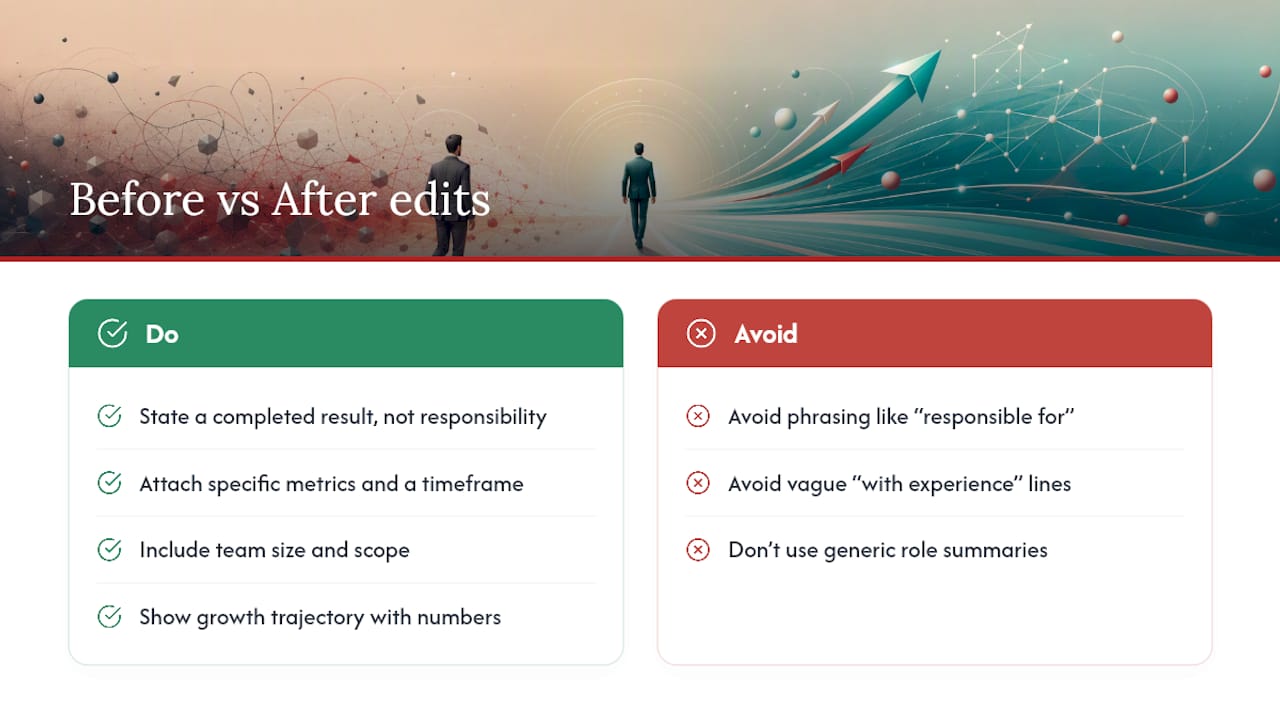
Do this:
- Quantify every claim you can. Percentages, dollar figures, headcount, and timeframes carry more weight than adjectives.
- Lead each sentence with scope or result, not with your job title.
- Pull two or three exact phrases from the target job description and tailor accordingly.
- Write in third person, without “I” or “my.”
Avoid this:
- Vague adjectives like “dynamic,” “passionate,” or “results-oriented” with nothing behind them.
- A condensed career history instead of a focused business case.
- Early-career detail that has no bearing on the role you want now.
For keywords, work backward from the posting: extract the three or four terms that describe outcomes or scope (such as “digital transformation,” “multi-site operations,” or “post-merger integration”), then fold each one into a quantified phrase rather than listing it on its own.
Pro Tip: If a keyword from the job description does not fit naturally into a sentence that already contains a number, it does not belong in the summary. Save it for the core competencies section instead.
What do strong before-and-after executive summaries look like?
Seeing the edit in action clarifies the pattern faster than any rule list.
Turnaround example.
Before: “Experienced operations leader with a strong background in manufacturing and process improvement.”
Scale and revenue example.
Before: “Sales leader responsible for growing revenue and managing a national team.”
After: “Sales executive who scaled annual revenue from $40M to $110M over four years while building a 60-person national team across five regions.” The after version replaces “responsible for” with a completed result and attaches a specific growth trajectory.
Operational transformation example.
Before: “COO with experience leading digital transformation initiatives across the organization.”
You can review additional paired examples built the same way.
How does a professional resume writer sharpen these summaries?
The process starts with a consultation focused on your career’s decisive numbers, not just your title history. From there, a writer drafts a summary using the three-sentence architecture, then revises it against the specific mandate you are targeting.
What typically changes in a professional edit: burying an impressive result behind three sentences of tenure, replacing generic language with the single metric that matters most, and reformatting for ATS parsing so the keywords a system scans for sit inside sentences a human still wants to read. Client feedback consistently points to the same shift: fewer words, more evidence, faster recruiter response.
An editor’s view on what most executives get wrong
The most common misstep is treating the summary as a career recap instead of a pitch. The second is choosing a strong metric but burying it in sentence three, after two sentences of throat-clearing. The third is writing one summary and reusing it for every application, which flattens exactly the alignment that makes a summary work.
Before sending anything, check it against four questions: Is it under 120 words? Does sentence two contain a number a stranger could verify? Does the scope match the role you are applying for, not the one you last held? And does it use language from this specific job posting? If any answer is no, revise before you submit.
— Professional
Executive resume packages built around this exact framework
Writing a strong three-sentence summary is one skill. Applying it consistently across a CFO application, a board deck, and a LinkedIn profile is another, and it’s where most executives lose momentum on their own.
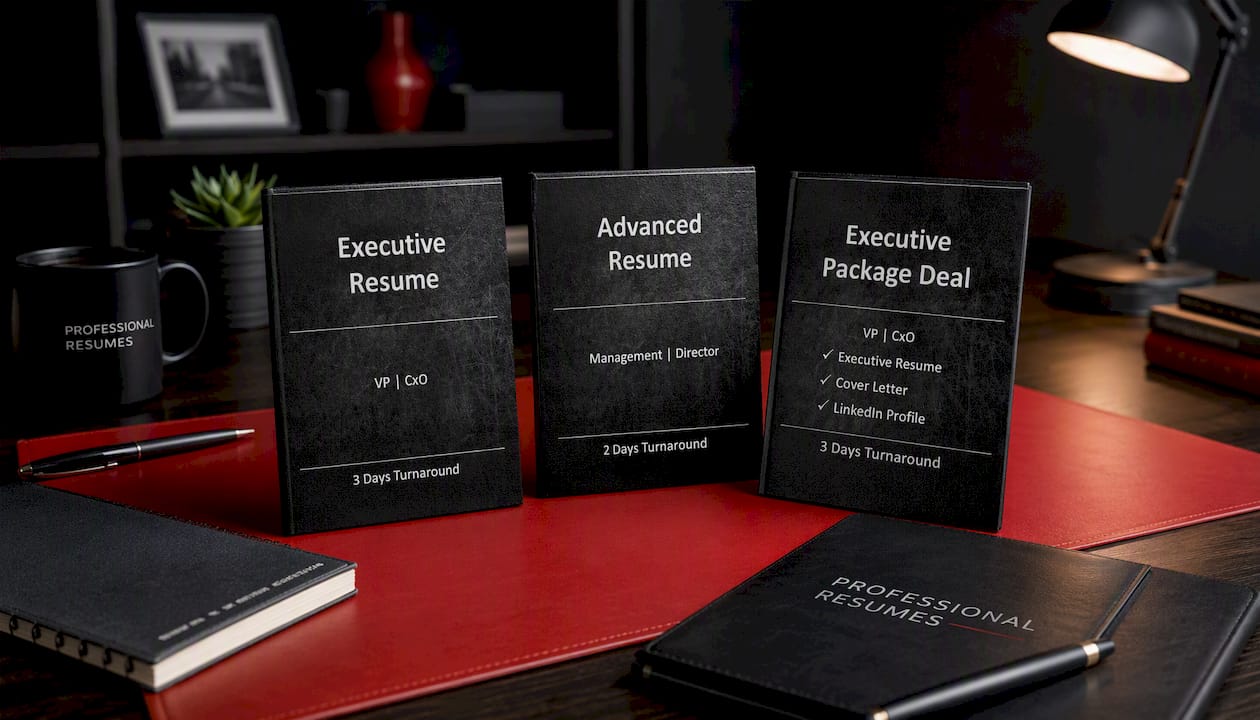
Each executive document is built around the same architecture covered here: enterprise scope first, one signature quantified result, then forward-looking value tied to the mandate you are pursuing. The Executive Resume package includes a full consultation, a tailored draft, and ATS-ready formatting built specifically for senior mandates. The Advanced Resume option extends that work for candidates who need broader document support. For leaders who want their resume, cover letter, and LinkedIn profile aligned under one consistent positioning, the Executive Package Deal bundles all three. Start by reviewing the executive resume services overview and booking a consultation to talk through your own signature metric.
Sources
- Executive Resume Summary Guide & C-Suite Examples for 2026
- How to write an executive summary on your resume