
Use a reverse-chronological, one-page, ATS-friendly resume built around three quantified impact bullets for your most recent role. Skip the objective statement, skip the skills-only wall of text, and lead with results a recruiter can verify in seconds. Choose your template first, then write those three bullets before touching anything else. If you want a second opinion, Professionalresumes reviews developer resumes for exactly this kind of gap.
TL;DR:
- Listing only recent impact-driven bullets with measurable outcomes is essential; avoid using generic duty descriptions or irrelevant frameworks.
- Keep your resume to one page unless you have extensive leadership or cross-team responsibilities, focusing on the most recent roles first.
- Use a simple, ATS-friendly format with clear section order, no headers or footers, and well-placed keywords directly from the job posting.
- Tailor each application by mirroring the job’s language in your skills and top bullet points, and reorder achievements to align with employer priorities.
- Focus on impact and scope in your bullets, shifting from task lists at lower levels to system-scale decisions and outcomes at senior levels.
Table of Contents
- How long should a software developer resume be?
- What goes in each section of a software engineer CV?
- How do you write resume bullets that actually show impact?
- What ATS formatting rules should you never break?
- Which resume template fits your experience level?
- How do you tailor a resume to each job posting?
- What mistakes get a developer resume rejected fast?
- When does it make sense to get professional help with your resume?
- Get a resume that matches where your career is actually headed
- Sources
- FAQ
How long should a software developer resume be?
One page is standard unless you have extensive experience or substantial technical leadership responsibilities across multiple teams or systems. That’s the standard guidance for developer resumes, and it holds up because recruiters and applicant tracking systems both reward density over volume. A crowded two-page resume from a three-year developer signals padding, not experience.
The section order matters as much as the length. Recruiters expect a predictable sequence, and so does ATS parsing logic:
- Header with name, title, and contact links
- Professional summary (three lines, no more)
- Technical skills, grouped by category
- Work experience with quantified bullets
- Projects (especially valuable if experience is thin)
- Education and certifications
Build the file in Word or Google Docs, then export to PDF. Keep the final file under 2MB, and confirm the text stays selectable rather than flattened into an image. That combination of section order and file size is what separates a resume that parses cleanly from one that lands in a rejection queue before a human ever opens it.
What goes in each section of a software engineer CV?
Every section on a software engineer CV has a job to do, and vague content in any of them costs you screen time. Here’s what each one needs:
- Header: full name, phone, email, city and province (no full street address), plus links to LinkedIn and GitHub. Skip the “objective” line entirely.
- Professional summary: two to three lines matched to seniority. An entry-level version might read, “Computer science graduate with three shipped side projects in Python and React, seeking backend roles.” A senior version reads more like, “Backend engineer with seven years leading distributed systems teams, specializing in payment infrastructure at scale.”
- Technical skills: grouped by category, not alphabetized alone. Separate languages, frameworks, cloud/DevOps tools, and databases so a recruiter scanning for “Kubernetes” or “TypeScript” finds it in two seconds.
- Work experience: company, title, dates, then three to five bullets per role, newest job first.
- Projects: for early-career candidates, this section often carries more weight than work history. Name the project, the stack, your specific role, and the outcome.
- Education/certifications: degree, institution, grad year. Certifications only if relevant to the target role.
How do you write resume bullets that actually show impact?
The formula is short: action verb, plus the task, plus the technology, plus a measurable result or scope. Skip anything that reads like a job description and start writing what actually changed because you did the work.
Compare these across levels:
- Intern: “Built a REST API endpoint in Node.js that reduced manual data entry for the support team by 40%.”
- Mid-level: “Migrated a monolithic billing service to microservices using Docker and Kubernetes, cutting deployment time from 45 minutes to 6.”
- Senior: “Led architectural redesign of a payments platform processing 2 million transactions daily, reducing p99 latency by 35% and mentoring a team of six engineers.”
Notice the shift: junior bullets emphasize a task completed, senior bullets emphasize scope and decisions owned. Recruiters and hiring managers scan for exactly this progression, and the metrics that matter change with seniority, from efficiency percentages early on to system-scale and deployment frequency later.
Run every bullet through one test: does it name a technology, and does it end in a number or a concrete outcome? If not, rewrite it.
Pro Tip: *If you’re five or more years in, stop listing frameworks and start naming decisions.
What ATS formatting rules should you never break?
Applicant tracking systems reject clean resumes constantly, usually over formatting choices that look fine to a human eye but confuse a parser. The fix list is short and mechanical:
- Draft in Word or Google Docs, then export to PDF with selectable text, never a scanned image.
- Keep the file under 2MB, a practical threshold most portals expect.
- Never put your name, contact details, or job titles inside a header or footer; many ATS parsers skip those fields entirely.
- Use a single-column layout with standard fonts (Calibri, Arial, Georgia) rather than multi-column templates with graphics or tables.
- Place keywords from the job posting directly in your skills and experience sections, not just in a hidden list.
Before you send anything, run two quick tests. Copy your resume text into a plain notepad file. If the words come out scrambled or out of order, an ATS will read it the same way. Then run it through a free ATS preview tool to confirm your skills section is actually machine-readable. For a deeper formatting walkthrough specific to Canadian applicant systems, see how ATS parsing affects Canadian job seekers.
Which resume template fits your experience level?
Templates should scale with your career stage, not just your taste in fonts. A junior developer resume needs a projects section to carry weight that work history can’t yet provide; a senior resume needs less summary and more scope.
- Entry level: Header → Summary → Skills → Projects (2 to 3, with GitHub links) → Education → any internships.
- Mid-level: Header → Summary → Skills → Work Experience (2 to 3 roles) → Projects (optional) → Education.
- Senior/full stack developer resume: Header → Summary → Skills → Work Experience (leadership and ownership framing) → Education/certifications.
An annotated example bullet for a full stack role: “Redesigned checkout flow across React frontend and Node.js backend, increasing conversion rate by 12% over two quarters.” That single line names both ends of the stack and closes with a number, which is exactly what distinguishes senior framing from a task list. Host code samples on GitHub with clear READMEs, and link only the two or three repositories that best represent your strongest work, not your entire commit history.
How do you tailor a resume to each job posting?
Skip the instinct to send one resume everywhere.
- Paste the job posting into a document and highlight every technical skill, tool, and soft skill mentioned more than once.
- Mirror that exact phrasing in your skills section and at least one bullet, since matching a posting’s language directly improves ATS pass rates.
- Reorder your top three bullets per role so the achievement closest to the posting’s priorities sits first, not buried third.
- Rewrite only your summary line for each application. Everything else usually needs no more than a word swap.
Keep two or three pre-written bullet variations for your biggest project or role, one framed around scale, one around speed, one around cost savings. Swap in whichever matches the posting instead of rewriting from scratch every time. This same instinct, matching what the employer already asked for, is why tailored resumes for the software industry consistently outperform generic ones in response rates.
What mistakes get a developer resume rejected fast?
The most common failure isn’t a typo. It’s a resume that lists technologies without ever showing what you did with them, or one that buries your best line at the bottom of a second page nobody reaches.
- Listing every framework you’ve touched instead of the ones relevant to the role.
- Writing duty-based bullets (“Responsible for backend development”) instead of outcome-based ones.
- Career gaps left unexplained; a one-line note (“Career break for caregiving, 2024 to 2025”) reads better than silence.
- Career changers burying transferable skills instead of leading with them.
- Soft skills asserted rather than shown (“strong communicator” with no example of leading a standup or writing documentation others relied on).
Run this checklist before you send anything: contact links work, file opens correctly on a second device, top three bullets contain numbers, summary matches the target job title, and the resume passes a plain-text paste test.
Recruiters often scan a resume in under 10 seconds. Whatever sits in the top half of the page, your most recent role and its strongest metric, is very likely all that gets read before a decision is made.
That’s the entire argument for front-loading impact. Nothing below the fold does much work.
When does it make sense to get professional help with your resume?
DIY works fine when you’re applying within the same track you’ve already held, and your biggest problem is just wording. It stops working when you’re pivoting from, say, backend development into engineering management, or aiming at a senior architecture role where the story needs restructuring, not line edits.
That’s the gap some professional resume services exist to close. The approach centres on extensive consultation, understanding your actual scope of ownership before a single bullet is written, followed by multiple rounds of revision until the document reflects decisions you made, not tasks you completed. For developers making a real pivot or targeting leadership roles, that kind of structural rework tends to matter more than polish. A guide like crafting a standout IT resume walks through the same thinking in more depth.

Get a resume that matches where your career is actually headed
If you’re a mid-to-senior developer whose resume still reads like a junior task list, the Advanced Resume service rebuilds it around ATS-ready formatting and impact bullets tied to your actual scope of ownership.
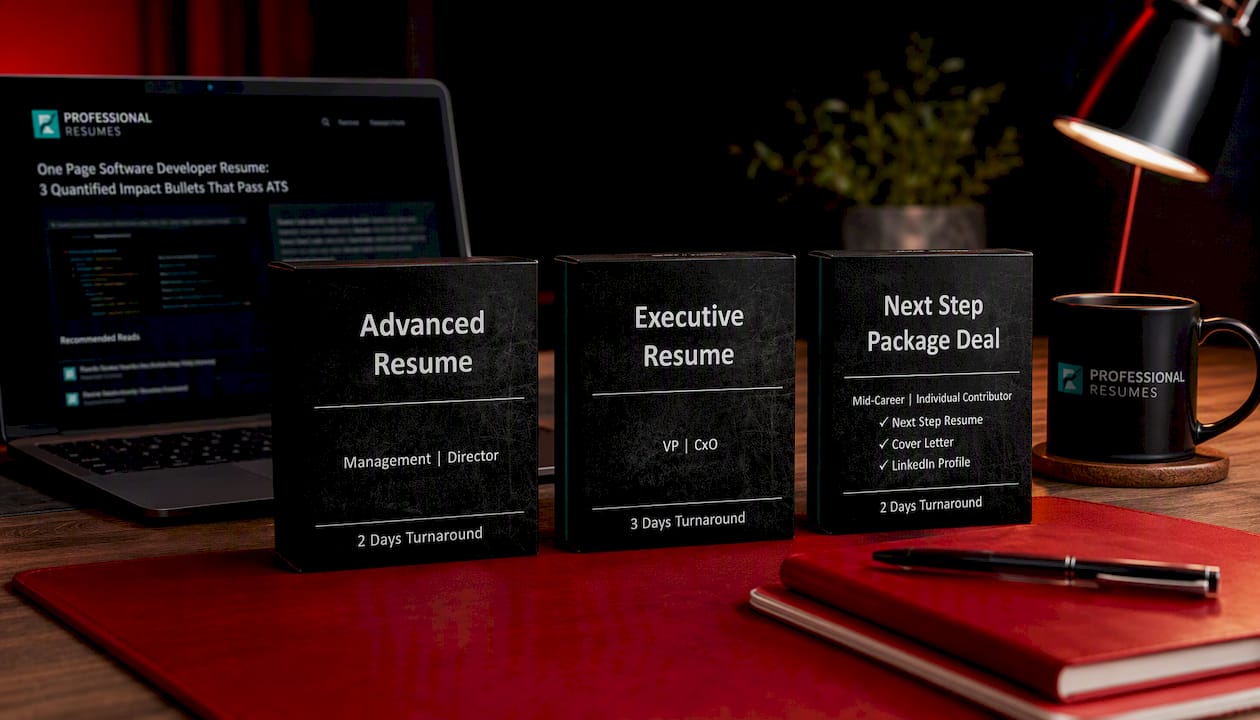
For candidates targeting director, VP, or CTO-level roles, the Executive Resume package adds the editorial strategy that leadership hiring committees expect, framing that goes beyond metrics into organizational outcomes and board-level positioning. And if you need the full package, resume, cover letter, and a LinkedIn profile that actually matches the story your resume tells, the Next Step Package Deal bundles all three with revisions included.
These packages typically include a tailored, ATS-ready PDF export, quantified bullets built from consultation about your actual work, and revision rounds until the document is right. If your resume hasn’t changed since your last job search and your target role has, that’s the signal to book a consultation and start the rebuild now.
Sources
- How to Write a Software Developer Resume (With Steps)
- Practical guide to writing FAANG-ready software engineer resumes
FAQ
How do you write a resume for a software developer?
Lead with a reverse-chronological, one-page layout, then build three to five quantified bullets per role using the formula: action verb, task, technology, measurable result.
What are the 5 P’s of a resume?
Definitions vary across career coaches, and no single version is standard for technical resumes; the more reliable framework for developers is the structure covered above: header, summary, skills, experience, and projects.
How should you write a software engineering resume in 2026?
The core format hasn’t shifted: one page, ATS-friendly formatting, quantified impact bullets. What’s changed is the expectation that your skills section reflect current tools, cloud platforms, AI-assisted development workflows, and modern data stacks, rather than only legacy languages.
How do you write a resume with two years of experience?
Lead with your strongest project or role, use two to three bullets per position with concrete metrics, and add a projects section with GitHub links if your work history alone feels thin. An entry-level resume with strong projects often outperforms a padded work history.
Should an entry-level software resume include a summary line?
Yes, but keep it to two lines naming your specialization and strongest technical strength, not a generic statement about being a “hard worker” or “team player.”