
A strong Canadian cover letter does one job: it connects a specific, measurable achievement to the exact priority named in the posting, then asks for an interview. Keep it to one page, tailored to that employer, backed by one STAR example, and proofread twice. Everything else in this guide exists to help you execute that one paragraph well, with samples and a template you can adapt tonight.
TL;DR:
- A Canadian cover letter should connect a measurable achievement directly to the job’s top requirement using a STAR example to demonstrate impact.
- Tailoring the letter to the specific employer and including exact keywords from the posting increases the chances of passing ATS scans and impressing recruiters.
- Keep the letter to one page, with a professional format matching your resume, and avoid including salary expectations or vague generalities.
- Use a warm, confident tone that balances professionalism and approachability, adjusting formality based on the industry and province.
- Hiring a professional writer is beneficial if you lack time, especially for senior roles, as they ensure proper formatting, impactful language, and tailored content.
Table of Contents
- Cover letter format canada: header, length and layout rules
- How do you address the hiring manager in a Canadian cover letter?
- How to write the body: showing impact with the STAR method
- Matching keywords without sounding like a robot
- Cover letter examples canada: three templates you can adapt
- The mistakes that cost you the interview
- Why and when to hire a professional cover letter writer
- Getting the tone right: professionalism without stiffness
- Should you write your cover letter in French?
- Should your cover letter mention salary or availability?
- How to present Canadian work experience and foreign credentials
- Adapting your letter across provinces and industries
- Author perspective: the editing rules that actually move the needle
- How Professionalresumes can help you get there faster
- Sources
- FAQ
Cover letter format canada: header, length and layout rules
Canadian employers expect a clean, single-page letter that mirrors your resume’s formatting. Federal and provincial applications, in particular, reward precision over creativity here.
Your header needs your full name, phone number, a professional email address, and optionally your LinkedIn URL. Below that, add the date and, when you have it, the recipient’s name, title, and company address. For emailed applications, a short letter can go directly in the email body; for online portals or PDF uploads, attach a formatted document instead.
Stick to a standard, readable font (Calibri, Arial, or Times New Roman at 10 to 12 point) and single spacing with a blank line between paragraphs. Length matters: RBC’s guidance for job seekers new to Canada is explicit that a Canadian resume and cover letter should stay to one page, tailored for each role.
A few specifics that trip people up:
- Federal and government postings often require a reference number and specific subject-line wording. Government application guidance instructs applicants to include contact details in the header and cite the exact position title and file number when requested.
- Skip the “Cover Letter” title at the top. It’s implied by the format.
- Save the file as “FirstName_LastName_CoverLetter.pdf,” not “Document1.pdf.”
How do you address the hiring manager in a Canadian cover letter?
Spend five minutes on LinkedIn or the company’s “our team” page before you default to a generic greeting. A name signals you did the work; a title alone rarely does.
When you can’t find a name, Canadian business communication guidance recommends “Dear Hiring Manager” rather than “To Whom It May Concern,” which reads as outdated and impersonal to most Canadian recruiters.
Your opening paragraph should name the role, deliver a one-line hook built around your best relevant result, and state briefly why this employer specifically interests you. Three examples worth adapting:
- “As a bilingual project coordinator who cut vendor onboarding time by 30% at a Toronto logistics firm, I’m applying for the Operations Analyst role at [Company].”
- “I’m writing to apply for the Registered Nurse position at [Hospital], where my five years in acute care and CNO licensure align directly with your unit’s needs.”
- “Your posting for a Marketing Specialist caught my attention because of [Company]’s recent expansion into Alberta, a market where I helped grow a competitor’s client base by 22%.”
How to write the body: showing impact with the STAR method
Career resources across Canada consistently point to the STAR method, Situation, Task, Action, Result, as the clearest way to prove impact instead of just claiming it. Hiring managers skim dozens of letters a day; a concrete result stops the skim.
Pick one or two achievements that map directly to the job description’s top requirements. Don’t try to summarize your whole career here.
- Situation: Set the scene in one short clause (“When our team’s client retention dropped 15% in a quarter…”).
- Task: State what you were responsible for.
- Action: Describe the specific step you took.
- Result: Quantify the outcome, percentage, dollar figure, time saved, or scale affected.
A weak resume bullet like “Managed customer accounts” becomes: “When client churn spiked, I redesigned our onboarding calls and personally managed the top 40 accounts, cutting churn by 18% in two quarters.” That’s a full STAR story in one sentence.
Pro Tip: If you’re early in your career and short on hard metrics, quantify scale instead of dollars, “coordinated a 12-person volunteer team” still proves you can lead.
Matching keywords without sounding like a robot
Applicant tracking systems scan for exact phrases from the job posting, but a letter stuffed with buzzwords reads badly to the human who eventually opens it. The fix is reading the posting twice: once for required qualifications (licences, years of experience, named software) and once for preferred or “nice to have” language.
Weave the required terms into your STAR sentences naturally rather than listing them. If a posting names a provincial credential, a nursing licence with the College of Nurses of Ontario, or a Professional Engineer designation with a provincial regulator, mention it plainly rather than assuming your resume alone covers it.
A quick checklist before you send:
- Does the letter repeat at least two or three exact phrases from the posting’s “requirements” section?
- Have you named any required licence, certification, or software by its exact title?
- Did you avoid repeating the same keyword more than twice, which reads as stuffing to a human reader?
- Is every sentence still readable out loud, not just scannable?
Recruiters in competitive Canadian sectors, tech, health care, and public service, often use a tailored letter as the tiebreaker between two similarly qualified candidates, since it’s the clearest signal of genuine interest and fit for the role and company.
Cover letter examples canada: three templates you can adapt
Templates work best as a skeleton you rebuild with your own numbers, not a script you copy verbatim. University career centres, including the University of Calgary’s career resources, structure every strong letter the same way: opening hook, STAR-based body, and a closing ask.
Entry-level: “I’m applying for the Junior Analyst role at [Company]. During my co-op term at [Previous Employer], I automated a weekly reporting task that saved the team six hours per week, a skill I’m eager to bring to your data team. My degree in Economics from [University] gave me the analytical foundation; your posting’s emphasis on Excel and SQL matches coursework I completed with distinction.”
Career changer: “After eight years managing retail operations, I’m transitioning into project coordination, and your posting for a Project Coordinator at [Company] is exactly the fit I’ve been building toward. At [Previous Employer], I led a store renovation project across three locations, coordinating five contractors and finishing two weeks ahead of schedule.”
Experienced professional: "With twelve years in supply chain management, including a CSCP designation, I’m applying for the Senior Buyer role at [Company].
Swap the metrics, company name, and credential in each template for your own. If your target role requires provincial licensing, name the licence explicitly rather than assuming the reader will find it in your resume, and pair your cover letter with a career summary that echoes the same tone.
The mistakes that cost you the interview
Most rejected cover letters share the same handful of errors, and they’re all fixable in ten minutes.
- Sending a generic letter. If it could go to any company, a hiring manager assumes you sent it to twenty companies.
- Typos and misnamed companies. Nothing signals carelessness faster than “Dear [Company Name]” left unedited.
- Formatting that doesn’t match your resume. Different fonts or margins between documents look sloppy, even if the content is strong.
- Broken or missing links. Test your LinkedIn URL and portfolio link before you hit send.
Run a one-minute pass before submitting: read it aloud once, confirm the company name and role title are correct everywhere, and check that your contact details match your resume exactly.
Why and when to hire a professional cover letter writer
A well-tailored letter takes real time to get right, and not every job seeker has that time between applications, interviews, and, often, a current job. This is where Professionalresumes fits for readers who want the STAR structure and ATS formatting done by someone who does it daily.
Professionalresumes offers resume packages for different career stages, with pricing details available on their website. Package deals bundle resume, cover letter, and LinkedIn work at each tier. Every engagement includes a consultation, a tailored cover letter written around your own achievements, ATS-friendly formatting, and revision rounds until the document is right.
Getting the tone right: professionalism without stiffness
Canadian workplace culture sits somewhere between the formality of British business writing and the more casual tone common in American cover letters, and that middle ground trips up a lot of job seekers. The safest register is warm but restrained: confident about your results, modest about your delivery.
Avoid two failure modes. The first is over-formality, opening with “I am writing to express my sincerest interest” and never using a contraction anywhere in the letter. It reads stiff and dated to most Canadian recruiters, particularly in tech, creative, and startup environments where a more conversational tone is expected. The second is over-familiarity, jokes, exclamation points, or overly casual phrasing that undercuts the seriousness of the application. Neither extreme lands well.
Canadian professional writing also tends to favour understatement over aggressive self-promotion. Where an American cover letter might say “I am the ideal candidate and will exceed all expectations,” a Canadian equivalent reads more like “I believe my experience aligns closely with what you’re looking for, and I’d welcome the chance to discuss how I could contribute.” The claim is just as confident, but the delivery is quieter.
Sector matters too. A cover letter for a government or public-sector role in Ottawa should lean more formal and precise, echoing the structured language of the posting itself. A letter for a Vancouver tech startup can be noticeably more direct and personable, sometimes even mentioning company culture or product enthusiasm. Read the tone of the job posting itself; it’s usually your best clue for how formal the employer expects your letter to be.
Should you write your cover letter in French?
Language choice matters most in Quebec, where Bill 96 and the province’s language requirements mean employers frequently expect application materials in French, even for roles that will ultimately be performed in English. If a posting is in French, or the company operates primarily in Quebec, submit your cover letter in French unless the posting explicitly invites English applications.
For federal government roles anywhere in Canada, bilingualism is often a stated asset, and some positions require it outright. If you’re fluent in both official languages, mentioning that explicitly, and demonstrating it by offering to provide a French version of your letter, can set you apart even for roles based outside Quebec.
Outside Quebec and federal postings, English is the default for the overwhelming majority of private-sector applications, including in bilingual cities like Ottawa and Moncton. That said, in New Brunswick, Canada’s only officially bilingual province, some employers, particularly in government, health care, and education, do expect candidates to indicate their language proficiency clearly in the letter itself.
The practical rule: match the language of the job posting first. If the posting is bilingual or silent on the issue and you have genuine fluency in French, a brief line noting your bilingual capability adds real value in a country where it’s a frequently cited differentiator for public-sector and customer-facing roles. Never claim fluency you don’t have; Canadian employers in bilingual regions often test language skills directly in interviews.
Should your cover letter mention salary or availability?
Leave salary expectations out of your cover letter in almost every case. Canadian hiring norms treat compensation as a conversation for later in the process, typically during a screening call or once an offer is imminent, and volunteering a number early can anchor you lower than what the role might otherwise pay. The exception is a posting that explicitly asks candidates to state salary expectations; when an employer requests it directly, provide a realistic range based on market research rather than ignoring the instruction.
Availability is different, and including it is often genuinely useful to the employer. If you’re currently employed and need two or four weeks’ notice, a single line near your closing, “I am available to start within two weeks of an offer”, helps the hiring manager plan without derailing the letter’s focus on your qualifications. If you’re immediately available, saying so plainly can work in your favour for roles with urgent start dates.
Some Canadian employers, particularly in government and unionized environments, list specific application requirements around availability, shift flexibility, or willingness to relocate. When a posting asks for that information directly, answer it briefly and move on. Don’t let a logistics detail crowd out the achievement-focused content that’s doing the real work of getting you an interview.
How to present Canadian work experience and foreign credentials
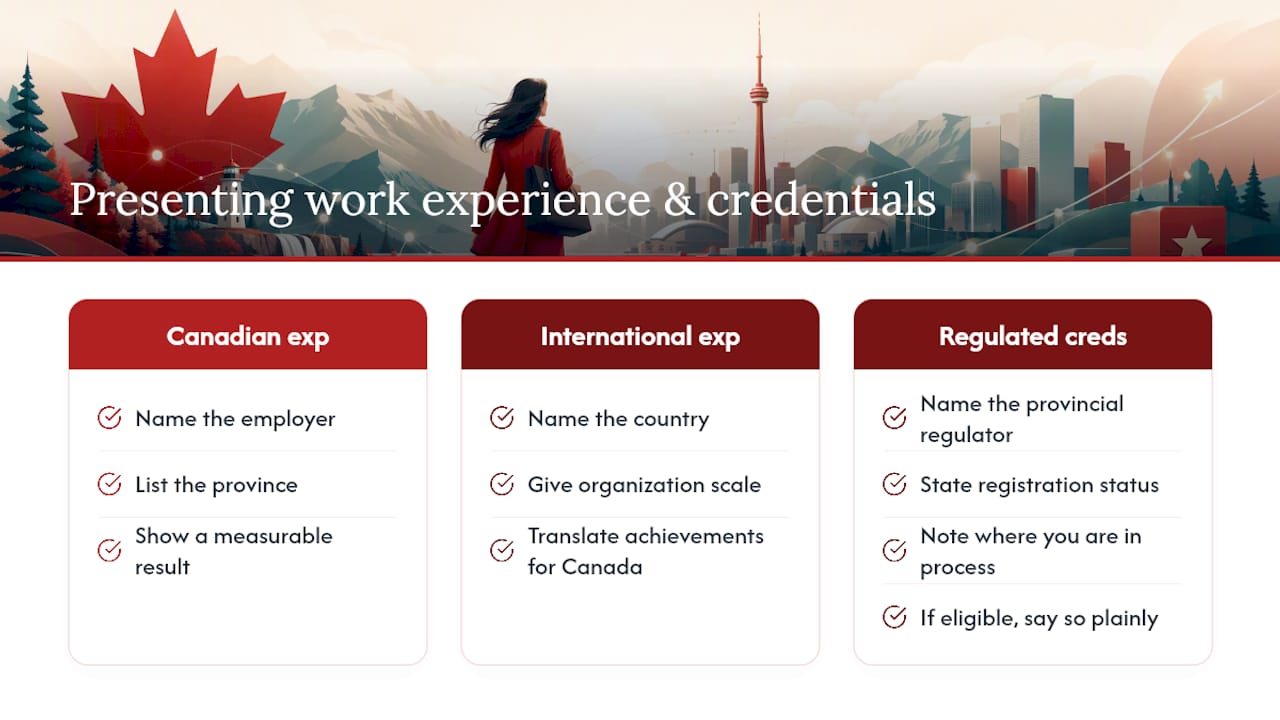
If you have Canadian work experience, even a few months, feature it prominently and specifically. Naming the employer, the province, and a measurable result signals to hiring managers that you already understand Canadian workplace norms, communication styles, and, where relevant, regulatory environments. That familiarity is often exactly what a nervous hiring manager is trying to de-risk when comparing candidates.
If your experience is entirely international, don’t downplay it. Name the country, the scale of the organization, and translate your achievements into terms a Canadian reader will recognize; “managed a team of 15 across two regional offices” reads clearly regardless of where it happened. Where a credential from your home country has a recognized Canadian equivalent, a foreign engineering degree assessed by a provincial regulator, or a nursing licence undergoing recognition, say so explicitly and note where you are in that process. Employers respond well to candidates who show they’ve already started navigating Canadian credential recognition rather than waiting to be asked.
For regulated professions, engineering, nursing, accounting, law, mentioning your registration status with the relevant provincial body (a Professional Engineer designation with Ontario’s regulator, for instance, or registration with the College of Nurses of Ontario) is worth a specific line rather than a vague mention of “licensure.” Provincial resources, including British Columbia’s government site, often list recognized equivalency pathways worth referencing if you’re mid-process. If you’re not yet licensed but eligible to apply, state that plainly rather than letting a hiring manager assume you’re unqualified.
Adapting your letter across provinces and industries
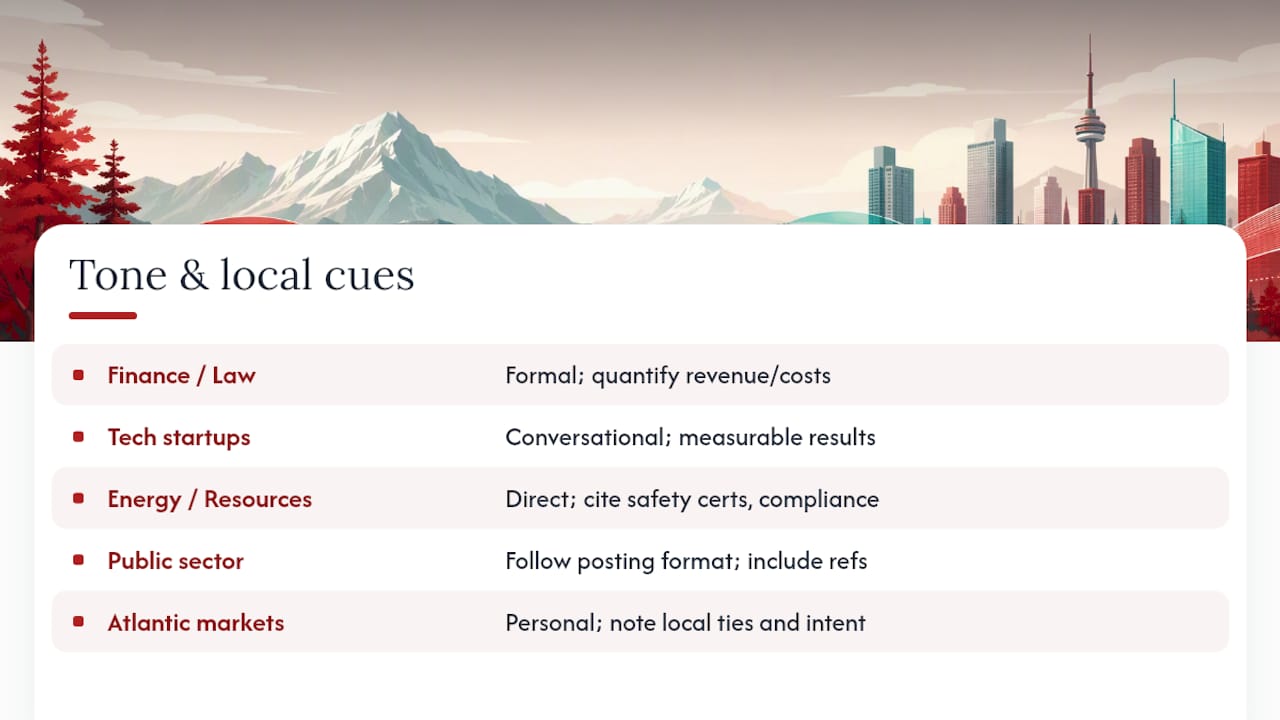
A cover letter that works in downtown Toronto’s finance sector will often feel wrong in Calgary’s energy industry or a Halifax nonprofit, and the difference usually comes down to formality and what results actually matter locally. Financial services and law firms in Toronto and Montreal tend to reward precise, formal language and quantified business outcomes, revenue, cost savings, deal size. Tech companies in Vancouver, Waterloo, or Toronto’s startup corridor generally respond better to a more conversational tone that still leads with measurable results but reads less like a legal document.
Resource and energy sector employers in Alberta and Saskatchewan often value directness and safety-conscious language; mentioning certifications like a Common Safety Orientation or specific regulatory compliance experience carries real weight in those postings. Public sector and government roles, concentrated heavily in Ottawa but present in every provincial capital, reward strict adherence to the posting’s stated format and language, sometimes down to specific headers or reference numbers the posting itself requires.
Atlantic Canada’s smaller job markets, in Halifax, St. John’s, or Charlottetown, often favour a more personal tone that references local community ties or an explicit intent to stay long-term, since employers there are frequently wary of hiring someone who will leave for a bigger city within a year. If you have a genuine local connection, mention it briefly.
The through-line across every province and sector is the same: read three or four job postings from the same company or industry before you write, and let their own language guide your register. A job-search workflow that includes this kind of research before each application consistently produces stronger, more targeted letters than a one-size-fits-all draft sent everywhere.
Author perspective: the editing rules that actually move the needle
Cut every sentence that doesn’t name a result. Replace “responsible for” with what you actually did. Verify every number before it goes out.
One real fix: “Handled client communications” became “Resolved 40+ client escalations monthly, cutting response time by half.” Same job, entirely different letter.
— Professional
How Professionalresumes can help you get there faster
Writing a tailored, STAR-driven cover letter for every application takes real time, time most job seekers don’t have when they’re applying to a dozen roles a month while still working full time. Professionalresumes offers a done-for-you alternative built specifically around the Canadian format and tone this guide covers, without the guesswork of drafting it solo.
Recent graduates and first-time applicants typically fit the Early Career Resume ($139) or the bundled Early Career Package Deal, which pairs resume and cover letter work. Professionals moving into a new role suit the Next Step Resume ($189), while senior candidates and executives are better served by the Advanced Resume ($239) or Executive Resume ($289). Every tier includes a consultation, a tailored cover letter written around your real achievements, and ATS-friendly formatting with revision rounds included. Browse the full shop to compare packages and request your consultation today.
Sources
- Business letters: salutation — Our Languages (Canadian government)
- How to submit a powerful application — Government of Canada (CSIS example)
- Write a Canadian resume and cover letter for your job search in Canada — RBC Royal Bank
FAQ
How do I write a cover letter for a job in Canada?
Open with the role and one measurable achievement, build the body around a single STAR example matched to the posting’s top requirement, and close with a direct request for an interview. Keep it to one page, formatted to match your resume, following the structure outlined by University of Calgary career resources.
What five things should a cover letter include?
A professional header with your contact details, the date and recipient’s name or title, a strong opening naming the role and a key achievement, one or two STAR-based body paragraphs, and a closing that states your availability and asks for an interview. RBC’s guidance confirms these elements should stay to one tailored page.
How can I write a strong cover letter this year?
Tailor every letter to the specific posting using two or three of its exact keyword phrases, lead with a quantified result rather than a generic claim, and keep the tone confident but understated in the Canadian style. Services like Professionalresumes’s Next Step Resume package handle this tailoring directly if you’d rather not draft it yourself for every application.
What should you not say in a cover letter?
Avoid outdated salutations like “To Whom It May Concern,” which Canadian government writing guidance specifically discourages, and skip vague claims like “hardworking team player” with no evidence behind them. Never volunteer salary expectations unless the posting explicitly asks for them, and never repeat your resume word for word.
How much does a professional cover letter cost in Canada?
Professionalresumes prices its resume and cover letter packages by career stage, from $139 for the Early Career Resume to $289 for the Executive Resume, with package deals bundling LinkedIn optimization at each tier. Current pricing and package details are available on the shop page.