
Yes, you can write an effective cover letter with no paid experience. A short, tailored letter that highlights transferable skills and connects them to a job requirement can win interviews on its own. If the posting doesn’t ask for a full letter, a 50 to 100 word note works better; if it does, follow a one-page, five-element structure and skip the apologies.
TL;DR:
- A tailored cover letter with specific examples can demonstrate suitability even without paid experience, especially when linking transferable skills directly to the job posting.
- Use a five-element structure—greeting, opening, body with two skills-based examples, connection, and closing—to maximize clarity and relevance in your application.
- Write the cover letter quickly by focusing on one concrete requirement from the posting, drafting relevant examples, and linking them explicitly to the employer’s needs.
- Short notes of 50 to 100 words can often outperform full letters when the application system offers only limited space or when applying for high-volume roles.
- Avoid common mistakes such as apologizing for inexperience, repeating your resume, using generic language, or neglecting to connect examples directly to the job requirements.
Table of Contents
- How do you write a cover letter with no experience?
- How do you write a cover letter in 20 minutes?
- Templates you can personalize in five minutes
- What mistakes make an entry-level cover letter weak?
- Final pre-send checklist
- How do you handle gaps or a thin resume in a cover letter?
- How do you customize a cover letter for different industries?
- When does a cover letter actually move the needle?
- How Professionalresumes helps you get past the first cut
- Sources
- FAQ
How do you write a cover letter with no experience?
Every entry-level cover letter needs five elements, regardless of the industry you’re targeting. Skip one and you’re either leaving credibility on the table or making a hiring manager work harder than they should to see your fit.
- Greeting. Search LinkedIn or the company’s “About” or “Team” page for the hiring manager’s name. If you can’t find one, “Dear Hiring Manager” or “Dear [Department] Team” beats “To Whom It May Concern” every time.
- Opening. Name the exact role, state one clear value claim, and show genuine interest in the company, not just the paycheque.
- Body. Write two short paragraphs covering two or three transferable skills, each backed by a specific example from school, volunteering, or a personal project. Vague claims like “hard worker” mean nothing without proof attached.
- Connection. Add a sentence that ties each example directly to something the posting actually asks for. This is the step most beginners skip, and it’s the one hiring managers notice most.
- Close. End with a decisive call to action requesting an interview, your contact details, and a professional sign-off.
Format matters more than most applicants think. Keep the letter to one page, use a 10 to 12 point font, and follow standard business letter formatting, according to a one-page cover letter handout from a university career centre. Save it as a PDF if the application system requests one, since formatting can shift in other file types. Most applicant tracking systems don’t weigh cover letter keywords heavily, so write for the human who’ll actually read it, not for an algorithm that probably won’t.
How do you write a cover letter in 20 minutes?
You don’t need an hour and a blank-page stare to produce something strong. Follow this order and you’ll have a tailored draft before your coffee goes cold.
- Read the posting once for the job title, then again for one concrete requirement you can speak to directly, whether that’s customer service, organization, or a specific software tool.
- Draft your opening in one or two sentences, naming the job and the single strength most relevant to it.
- Write two short STAR-style examples, covering the situation, the action you took, and the result, pulled from coursework, volunteer work, or a class project.
- Add one connection sentence linking your examples to what the employer actually needs, then close with a direct request for an interview.
- Proofread out loud, run a spelling and grammar check, and ask one other person to read it for tone before you send it, a routine career-centre guidance recommends for catching the errors your own eyes skip past.
- Save as PDF if the system requests it, and double check the file opens correctly before attaching it.
Not every application calls for the full treatment. When a posting doesn’t explicitly request a cover letter, or the application system offers only a small text box, a 50 to 100 word note outperforms a long letter, since recruiter interviews suggest shorter, role-specific notes get read more often than lengthy generic ones. Name the requirement, give one matching example, and ask for a brief conversation. That’s the whole note.
Pro Tip: Write your opening line last. Once you’ve drafted your examples, you’ll know exactly which strength to lead with, instead of guessing at the start and rewriting it anyway.
Templates you can personalize in five minutes
Two formats cover almost every entry-level scenario: the short note and the one-page letter. Below is one of each, plus a filled example so you can see the structure in action.
The short note (50 to 100 words):
“I’m applying for the [Job Title] role at [Company]. During [class project / volunteer role], I [specific action], which resulted in [specific outcome]. That experience directly matches your need for [requirement from the posting]. I’d welcome the chance to discuss how I can contribute. [Name] / [Phone] / [Email].”
The one-page letter, filled for a customer-service role:
“Dear Ms. Chen, I’m writing to apply for the Customer Service Representative position at Northline Retail. During a two-semester retail co-op, I resolved an average of 30 customer inquiries per shift while training two new team members on the point-of-sale system. That mix of composure under pressure and hands-on training experience lines up closely with the collaborative, fast-paced environment your posting describes. I’d welcome the opportunity to discuss how I can support your team. Thank you for your consideration.”
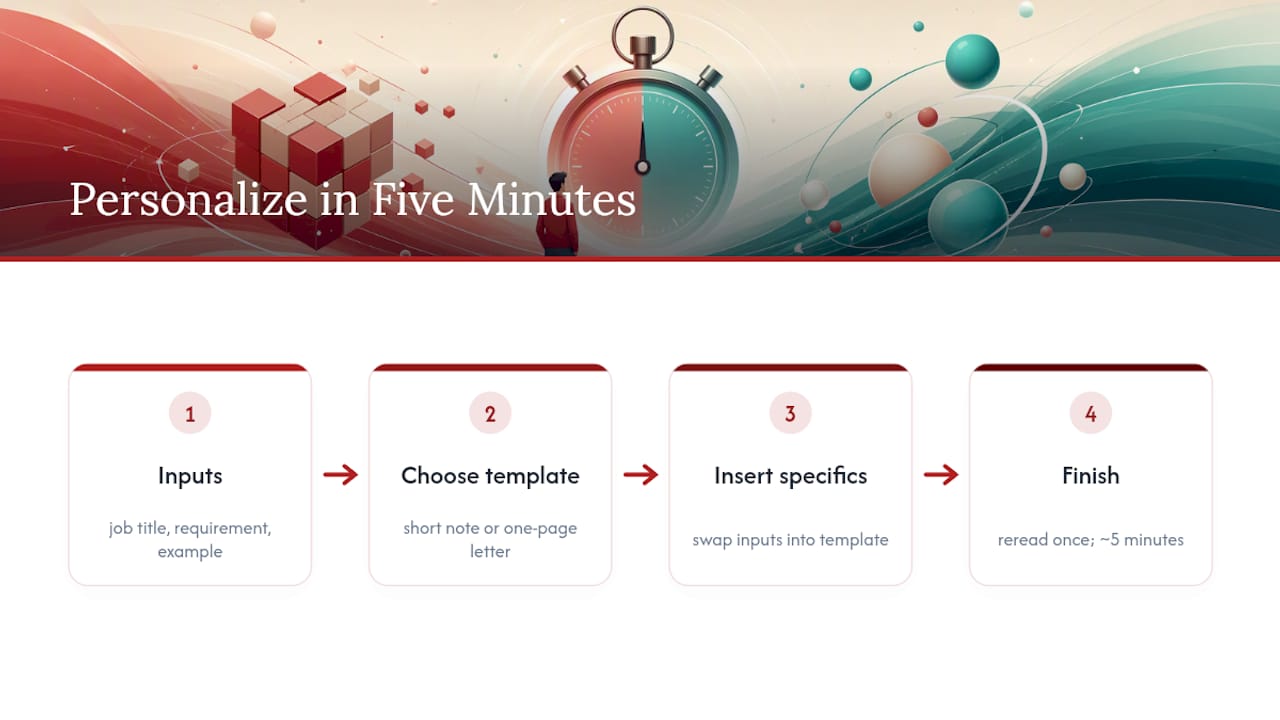
For an internship or project-based example, lean on coursework: describe the challenge, the tools or coordination involved, and a measurable result like attendance figures, grades, or a deliverable your professor praised. To personalize any template fast, swap in the job title, one matching requirement from the posting, and one real example, then reread it once for tone. Five minutes, done.
What mistakes make an entry-level cover letter weak?
Most weak letters fail for the same handful of reasons, and every one is fixable in under a minute.
- Apologizing for inexperience. Never open with “I don’t have much experience, but…”. Lead with what you can actually do.
- Repeating the resume. Use the letter to explain context and fit that your resume’s bullet points can’t show.
- Generic enthusiasm. “I’m excited about this opportunity” says nothing. Name one specific part of the role or company that matches your skills.
- Wrong length. A short note stretched to a full page reads as padded; a full letter squeezed to three lines reads as rushed. Match length to what the posting asks for.
- Obvious templated phrasing. Career-centre guidance flags generic salutations and copy-paste openers as common pitfalls that flatten an otherwise strong application. Personalize your voice and your examples every time.
Final pre-send checklist
Run through this in under a minute before you hit submit:
- Is the greeting personalized with a name, or professionally neutral if you couldn’t find one?
- Does the opening state the exact role and one clear strength?
- Are there two short examples directly tied to what the job needs?
- Is there a decisive call to action, plus your phone number and email?
- Is the format correct: one page or short note, 10 to 12 point font, standard margins, saved as the requested file type?
How do you handle gaps or a thin resume in a cover letter?
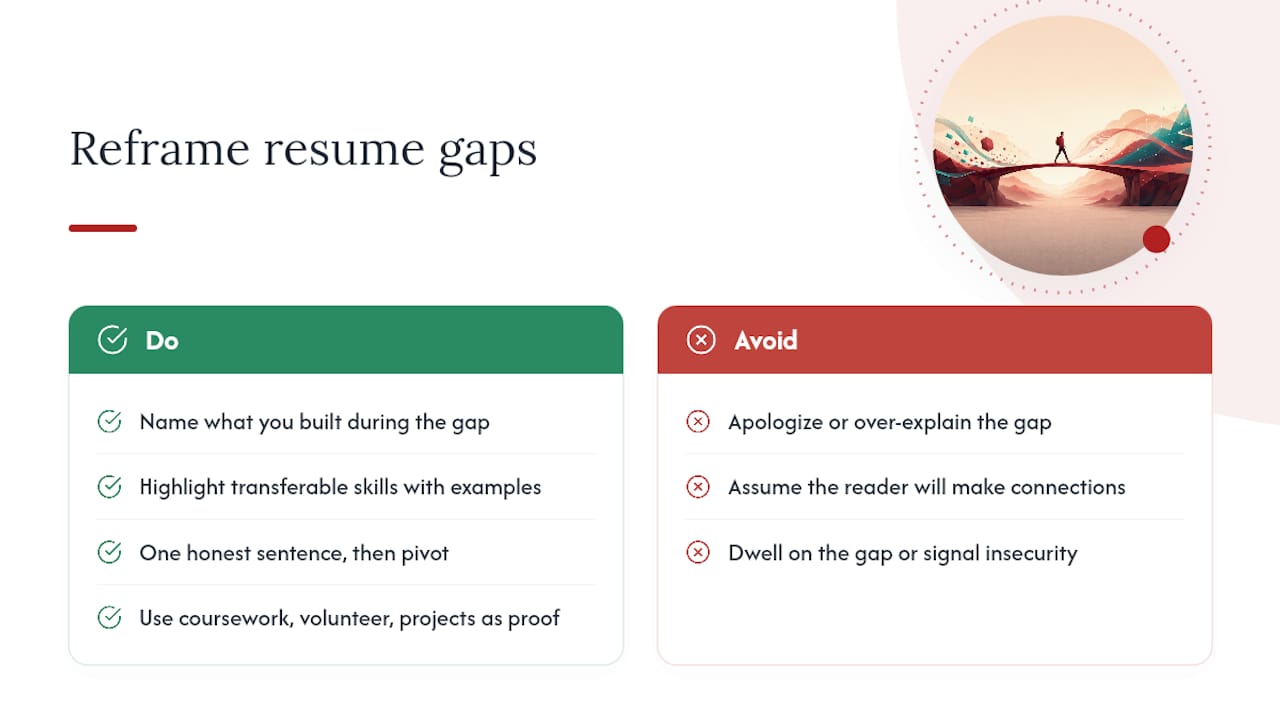
Address a gap by shifting the frame, not by apologizing for it. Instead of explaining what you don’t have, name what you built during that time, whether that’s a certificate, a volunteer commitment, freelance work, or caregiving responsibilities that developed real skills like scheduling, budgeting, or conflict resolution.
If you’re switching fields entirely, focus the letter on transferable capabilities rather than direct experience. Someone moving from retail into administrative work can point to cash handling accuracy, scheduling coordination, or customer de-escalation. These translate cleanly, provided you make the connection explicit rather than assuming the hiring manager will draw the line themselves.
For a true resume gap, whether from school, travel, or a health issue, one honest sentence is usually enough: state briefly what the period involved and pivot immediately to what you’re bringing now. Dwelling on it signals insecurity; naming it and moving on signals confidence. Job-site guidance on writing without experience consistently points to coursework, volunteer roles, and personal projects as legitimate, credible substitutes for paid history, provided the examples are specific rather than vague.
The goal isn’t to hide the gap. It’s to make the employer’s need the centre of the sentence, with your example as the proof, not the excuse.
How do you customize a cover letter for different industries?
The five-element structure holds across industries, but which skills you foreground should shift with the role. A retail or hospitality posting rewards examples showing composure under pressure and direct customer interaction. An office or administrative role rewards organization, attention to detail, and software familiarity, even if that familiarity comes from school assignments rather than a job.
For technical or trades-adjacent entry points, lead with hands-on project work: a class build, a repair you completed, or a tool you learned to operate competently. For creative roles, a short portfolio link paired with one sentence about your process often carries more weight than a paragraph of adjectives.
Nonprofit and community-facing roles respond well to volunteer history framed in outcomes: people served, funds raised, events coordinated. Corporate roles tend to favour measurable results, even small ones, like “reduced processing errors by double-checking a shared spreadsheet weekly.” The throughline across every industry is the same: match your example’s language to the posting’s language. If the job ad says “collaborative,” use a team example. If it says “detail-oriented,” use an example that proves precision, not just claims it.
When does a cover letter actually move the needle?
Some hiring managers skim past cover letters entirely, and some recruiters have said as much on record. But the pattern that matters for entry-level candidates is different: when a resume alone doesn’t show fit, whether because of thin experience or a career change, a specific, well-connected letter often does the explaining a resume can’t. Tailored documents tend to draw more interview requests than generic ones, particularly for candidates early in their careers where the resume carries less context on its own.
The short note works when the system asks for it or the role is high-volume. A full letter earns its place when you actually care about the role and have something specific to say about it.
— Professional
How Professionalresumes helps you get past the first cut
Writing a strong cover letter from scratch takes real effort when you’re new to the job market and unsure which examples actually count as relevant experience. Professional services build that document for you, tailored to your target role, so you’re not guessing at what a hiring manager wants to see.
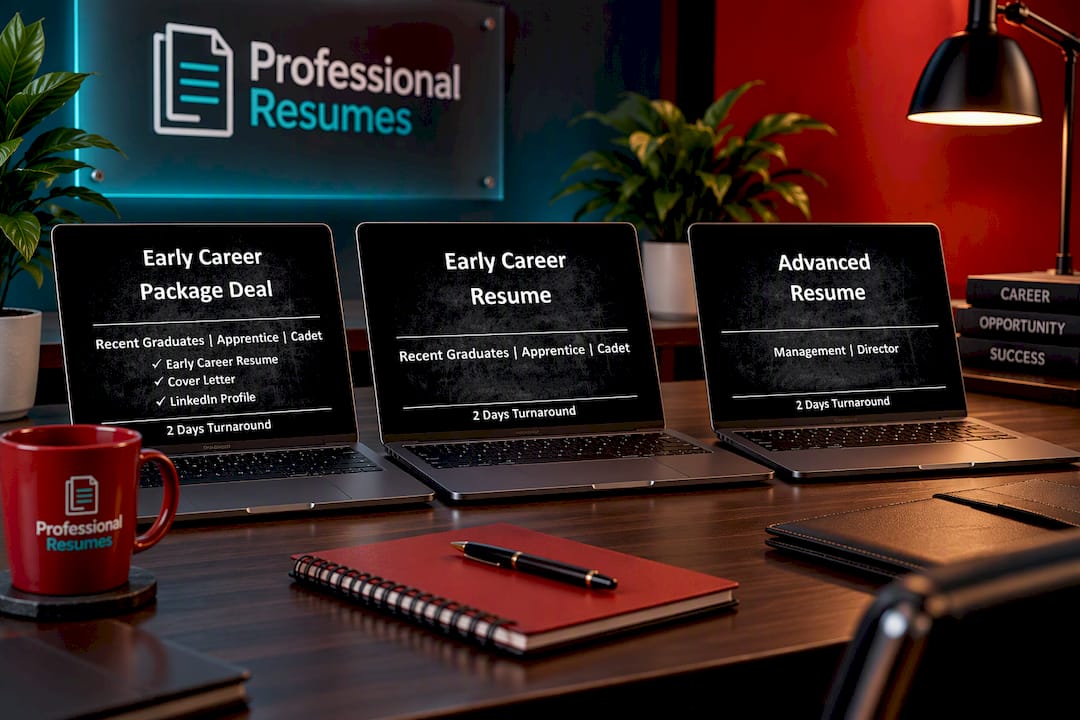
The Early Career Package Deal pairs a professionally written resume with a matching cover letter built around your actual coursework, volunteer work, and projects, developed through a real consultation rather than a generic template. It includes revisions, so the final version reflects your voice, not a form letter. If you need the resume piece on its own, the Early Career Resume covers that, and candidates with more to showcase can step up to the Advanced Resume for deeper optimization. Browse the full range on the shop page or add a LinkedIn profile optimization to match. Start with a consultation on a package page and see what a tailored letter looks like for your situation.
Sources
For structure and formatting rules, see the IUP career centre’s cover letter handout, Indeed Canada’s no-experience guide, and Monster’s entry-level examples. For interview-day follow-through, check this interview readiness checklist.
- 1-Page Cover Letter Handout (IUP career centre)
- How to write a cover letter with no experience (Indeed Canada)
- The cover letter is mostly dead in 2026 — recruiter interviews (DEV Community)
FAQ
How do I write a cover letter if I have no job experience?
Focus on transferable skills from school, volunteering, or personal projects, and connect each one directly to a requirement in the posting. Use the five-element structure: greeting, opening, two skill-based body paragraphs, a connection sentence, and a decisive close, following standard formatting guidance.
Are cover letters outdated in 2026?
No, but they’re used differently than they were a decade ago. Some recruiters skim past them for high-volume roles, but hiring managers interviewed on the topic still read a specific, well-tailored letter, especially for entry-level candidates whose resumes carry less context on their own.
What are common cover letter mistakes to avoid?
The most common mistakes are apologizing for lack of experience, repeating the resume instead of adding context, using generic enthusiasm without specifics, and skipping the connection between your examples and the job’s actual requirements, according to career-centre pitfall guidance. Poor proofreading rounds out the list.
What should a cover letter include?
A strong entry-level letter includes a professional greeting, an opening that names the role and one value claim, two or three body examples showing transferable skills, a sentence connecting those skills to the employer’s needs, and a clear call to action requesting an interview. Keep it to one page with 10 to 12 point font, per standard formatting rules.
How much does a professional cover letter service cost?
Professionalresumes bundles cover letter writing into its entry-level packages rather than selling it as a standalone product, with the Early Career Package Deal covering both resume and letter together. Current pricing for all packages is listed on the shop page.