
Yes, list your security clearance whenever the role requires, prefers, or would clearly benefit from one, and place it high on the page. A paste-ready line works for most cases: “Security Clearance: Secret, adjudicated March 2024.” In Canada, clearances are employer-sponsored, so list only what your record actually shows, and never imply active sponsorship you no longer have.
TL;DR:
- Listing your security clearance requires matching the exact level, status, and adjudication or last-used date to avoid inconsistencies that delay screening.
- Clearances should be placed either in the header, a brief summary block, or within individual role descriptions, using a consistent wording pattern.
- Never disclose classified project details, facility names, or personnel involved; only include the level, status, date, and issuing department to stay compliant.
- An active clearance is most credible when sponsored, and lapsed or expired clearances can be communicated using past-tense or eligibility phrasing with relevant adjudication dates.
- Precision in wording and consistency across your resume and official forms significantly improves your chances of smooth, quick clearance verification.
Table of Contents
- When to list a security clearance on your resume
- Where to place your clearance and how to word it
- What to include, and what you should never disclose
- Copy-ready examples for common clearance situations
- Formatting, ATS visibility, and matching Canadian screening forms
- When a tailored rewrite makes more sense than a template
- What the conventional advice gets wrong
- Get your clearance wording right the first time
- Sources
- FAQ
When to list a security clearance on your resume
Government positions, defence contractor roles, and any job posting that names a required clearance level make this a straightforward call: put it on the page. If the requisition says “must hold a valid Secret clearance” or “Reliability Status required,” a hiring manager is scanning specifically for that line, and burying it costs you screening time you don’t get back.
The trickier decision is Canada’s sponsorship model. You cannot walk into a screening office and request a clearance for yourself. A federal department or contractor sponsors the process, and it’s usually triggered by a conditional offer of employment rather than something you initiate independently. That single fact should shape how you word your resume. Writing “Active Top Secret” when no current sponsor exists overstates your status and can raise questions during reference checks.
Lapsed or expired clearances still carry value, just phrased differently:
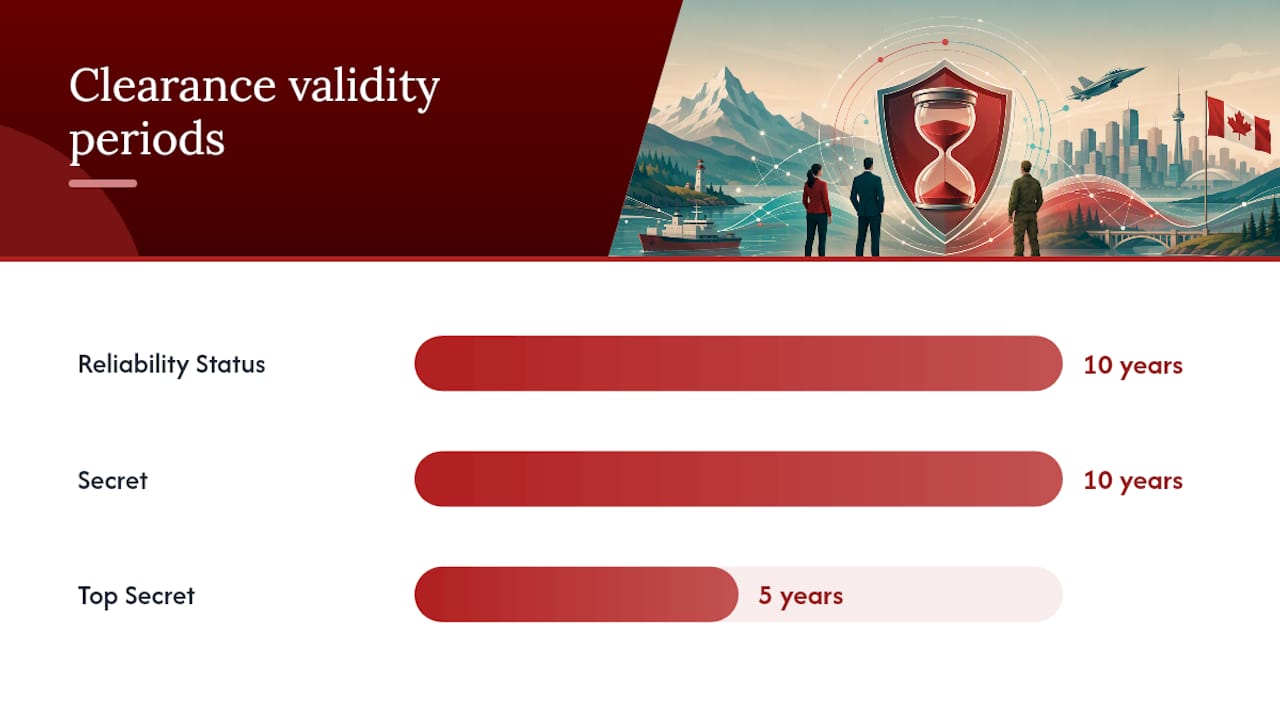
- If your clearance was adjudicated and is still within its validity window (Reliability Status and Secret run 10 years, Top Secret runs 5), state the level and adjudication date directly.
- If it lapsed after you left a cleared role, use “eligibility” or “previously held” language rather than present-tense wording.
- If you’re unsure whether your investigation is still reusable, say “clearable” or note the last-used date and let the hiring department confirm reciprocity.
A five-year-old Top Secret adjudication is a materially different signal than one from last month, and recruiters read the date, not just the label.
Where to place your clearance and how to word it
There are three accepted spots for a security clearance on a resume, and picking the right one depends on how central the clearance is to your candidacy.
- Header or contact line. For candidates applying almost exclusively to cleared positions, put the clearance directly under your name and contact details. Recruiter convention favours page one placement, either in the header or immediately under your summary, because it saves a hiring official from hunting for it.
- A short clearance block under your summary. This works well when you’re applying to a mix of cleared and non-cleared roles. A two-line block, “Security Clearance: Secret (Adjudicated: June 2023, Department of National Defence),” keeps it visible without dominating the page.
- Per-job parenthetical notes. Inside individual job entries, a short parenthetical like “(Secret clearance held throughout tenure)” reinforces the timeline and shows continuity across roles, which matters if a screener is reconciling your resume against your employment history.
Four wording patterns cover almost every situation you’ll encounter:
- Active with sponsor: “Security Clearance: Secret, active, sponsored by [Department/Contractor], adjudicated April 2022.”
- Interim: “Security Clearance: Top Secret (Interim), granted January 2026, final adjudication pending.”
- Lapsed or administratively closed: “Security Clearance: Reliability Status, last held 2021, eligible for reinstatement.”
- Multiple clearances: “Security Clearances: Secret (2019) and Top Secret (2023), both Government of Canada.”
Whichever pattern you choose, use it identically everywhere the clearance appears on your resume. Reusing the exact phrase in your header and in a job bullet avoids the kind of inconsistency that prompts a screener to ask follow-up questions. And date it. A dated adjudication tells a hiring official whether your prior investigation might be reusable, which speeds up their internal process more than a bare level ever will.
What to include, and what you should never disclose
Safe, useful information belongs on the page. Sensitive operational detail does not, and the line between the two is narrower than most candidates assume.
Include these elements:
- Clearance level: Reliability Status, Secret, or Top Secret, matching the levels defined by the Government of Canada.
- Status: active, interim, adjudicated, or lapsed.
- Adjudication date or “last used” date, ideally month and year.
- Issuing department, agency, or a general public-trust designation if that’s what your record shows.
- Polygraph type, only if one applies and only using the generic descriptor that matches your official record, not an internal program name.
Never disclose these, regardless of how impressive they might sound in an interview:
- Project or program names tied to classified work.
- Facility locations, building names, or unit designations.
- Compartment names or codewords.
- Names of supervisors, teammates, or clients from cleared assignments.
- Descriptions of classified tools, systems, or mission-specific outcomes.
Pro Tip: If you’re unsure whether a detail crosses the line, don’t guess. Run the exact wording past a security officer, your departmental liaison, or a transition office before you send the resume anywhere. A ten-minute check beats a security incident report.
Recruiters who work cleared requisitions are explicit about this trade-off: list the level, the date, and the agency, but never the compartment names or the people involved. That guidance holds whether you’re applying to a federal department or a private contractor supporting one.
Copy-ready examples for common clearance situations
Pick the example that matches your status and adapt the department name and date. These are deliberately plain, because plain is what gets parsed correctly and read quickly.
- Active Secret, header placement: “Jordan Fields | Ottawa, ON | jordan.fields@email.com | Security Clearance: Secret, active, adjudicated May 2024”
- Active Top Secret, under summary: “Security Clearance: Top Secret, active, sponsored by [Contractor Name], adjudicated November 2023.”
- Interim, pending final adjudication: “Security Clearance: Secret (Interim), granted February 2026, final review in progress.”
- Adjudicated but administratively closed: “Security Clearance: Reliability Status, held 2018 to 2022, eligible for reinstatement pending sponsor.”
- Multiple clearances across roles: “Security Clearance: Secret (2020, Department of National Defence); Top Secret (2023, Shared Services Canada).”
- Per-job repetition: Under a specific role, add “(Held active Secret clearance throughout this position)” to reinforce the timeline without repeating the full block.
Notice the pattern: level, status, date, and issuer, every time, in that order. Consistency matters more than cleverness here.
One habit separates candidates who breeze through screening from those stuck answering clarification emails: mirror this exact wording on your personnel-screening forms. If your resume says “Secret, adjudicated May 2024” and your form says something different, that discrepancy becomes someone else’s problem to resolve, and it delays you.
Formatting, ATS visibility, and matching Canadian screening forms
Applicant tracking systems parse plain text well and struggle with anything dressed up. Put your clearance on its own line, in standard text, never inside a graphic, header image, or text box that an ATS engine can’t read. Repeat the exact phrase in the relevant job entry so a keyword match fires twice, not once, and skip decorative fonts or colour coding around that line entirely.
The formatting stakes are higher than most candidates realize, because your resume doesn’t exist in isolation from the government’s own paperwork. For Secret and Top Secret clearances, applicants complete the Security clearance form (TBS/SCT 330-60E) alongside the Personnel Screening, Consent and Authorization form, TBS/SCT 330-23E. These forms ask for a ten-year employment and residence history, and any gap, mismatched date, or inconsistent employer name between your resume and your form submission tends to trigger a resubmission request rather than a quiet correction.
- Match employment dates on your resume to the ten-year window the forms require, down to the month where possible.
- Use employer names exactly as they appear on your forms, not shortened or rebranded versions.
- If a period is genuinely unaccounted for, note “unknown” with a brief explanation on the form rather than leaving it blank, since gap-free history reduces processing delays.
- Submit through the OLISS portal where available, since using it correctly cuts down on form return rates tied to avoidable data entry errors.
Interim clearances typically move faster than final adjudications, and dating both stages on your resume gives a screening officer useful context about whether your prior investigation is still reusable. A resume that matches your forms word for word isn’t just tidy. It’s one less reason for a department to send your file back for correction.
If you’re also applying for remote or hybrid cleared roles, the same ATS discipline applies. Our guide to building a resume for remote jobs in Canada covers formatting choices that keep parsing clean without sacrificing readability.
When a tailored rewrite makes more sense than a template
Templates work well for a single, clean clearance history. They start to break down once your record gets complicated: multiple sponsors, an interim clearance layered over a lapsed one, or a senior role where the wording has to satisfy both a hiring manager and a security office at the same time.
That’s the point where working with a professional writer earns its cost. Resume writing through direct consultation matters for cleared candidates specifically, because the wording has to thread a needle between what impresses a hiring manager and what stays consistent with a personnel-screening form. A generic template can’t make that judgment call. A writer who asks about your adjudication date, your sponsoring department, and your exact clearance history can.
For candidates in technical or IT roles that carry clearance requirements, our technology and IT resume service accounts for both the technical narrative and the clearance wording side by side. For those targeting federal or public-sector postings directly, the government and public-sector resume service is built around exactly this kind of alignment work.
What the conventional advice gets wrong
Most resume advice treats a security clearance like a certification: name it, date it, move on. That undersells how much the wording itself communicates. A recruiter reading “Active Top Secret” without a sponsor listed reads overreach, not confidence. The word “active” implies an employer relationship that, in Canada’s sponsorship model, may not exist anymore.
The bigger mistake, though, is treating the resume and the screening form as separate documents. They aren’t. A hiring department cross-references both, and a mismatched employment date does more damage to your candidacy than an underwhelming clearance line ever would. Prioritize consistency over polish: get the dates, employer names, and status wording identical across every document you submit, then worry about how the line reads. Clean alignment beats clever phrasing every time a security officer is the one reviewing your file.
— Professional
Get your clearance wording right the first time
Rewriting a clearance line yourself is manageable. Making it match a Treasury Board form, an ATS scan, and a skeptical hiring manager all at once is a different job. Every resume built through direct consultation, not a template drop-down, can ensure the wording around clearance level, sponsor, and adjudication date is checked against the actual record instead of a generic phrase bank.
For mid-senior candidates with a single clean clearance history, the Advanced Resume package covers the consultation and revisions needed to align your document with screening expectations. Senior candidates managing multiple clearances, sponsor changes, or executive-level positioning should look at the Executive Resume package instead, built specifically for that complexity. If your job search also needs a cover letter and LinkedIn profile brought into alignment with the same wording, the Advanced Package Deal bundles all three. Cleared candidates who need their language credentials presented clearly alongside security status may also find this guide to professional language proficiency useful for that section of the resume. Browse the full range of resume packages or start with a LinkedIn profile optimization to match your resume wording across platforms.
Sources
- Security screening (Government of Canada)
- Should I list a prior clearance on my resume? (ClearanceJobs)
- The security clearance line on a resume (Cleared Jobs)
FAQ
How do I indicate a security clearance on my resume?
State the level, status, and adjudication or last-used date in one consistent line, either in your header or directly under your summary. A working example: “Security Clearance: Secret, adjudicated May 2024.” Repeat that exact phrasing in relevant job entries so it reads consistently across the whole document.
Should I add my security clearance to my resume?
Yes, whenever the role requires or benefits from one, since recruiters actively scan for clearance level and dates on page one. Skip it only if the role has no plausible connection to cleared work and including it would look irrelevant or confusing.
Can you show an example of a resume that includes a security clearance?
A header example reads: “Jordan Fields | Ottawa, ON | Security Clearance: Top Secret, active, adjudicated November 2023.” A profile-block example reads: “Security Clearance: Secret (Interim), granted February 2026, final review in progress.” Both follow the same order: level, status, date, and issuer.
Can I say I have a security clearance if it’s lapsed?
Yes, but word it as past tense or eligibility rather than “active.” A phrase like “Security Clearance: Reliability Status, held 2018 to 2022, eligible for reinstatement” is accurate and still signals value to a hiring manager without overstating your current status.