
STAR gives an interviewer full context and detail; CAR skips the setup and leads with impact. As a rule of thumb, use STAR when a question calls for process, judgment, or team dynamics, and use CAR when time is short or the interviewer wants a leadership summary. Both are frameworks, not scripts, so the goal is to adapt each one to the story you are actually telling.
TL;DR:
- Candidates should prioritize CAR for quick, high-level responses during time-constrained interviews, especially in early stages or on phone screens.
- STAR is more suitable for detailed questions about processes, teamwork, or technical challenges, typically in later-stage or panel interviews.
- Effective answers combine a brief reflection on outcomes or lessons learned, regardless of the chosen framework, to demonstrate growth or leadership.
- Practicing conversion between STAR and CAR formats helps ensure preparedness for varying question types and time limits.
- Avoid reciting answers word-for-word; instead, develop stories flexibly to sound natural, credible, and focused on personal ownership and measurable results.
Table of Contents
- What is the STAR method and when should you use it
- Key differences at a glance to help you choose quickly
- How to choose between STAR and CAR: a short checklist and decision rules
- Templates and sample answers you can adapt across career stages
- Common mistakes and expert tips for making answers credible
- Why frameworks fail candidates who recite them
- How Professional Resumes helps you turn achievements into interview-ready stories
- Sources
- FAQ
What is the STAR method and when should you use it
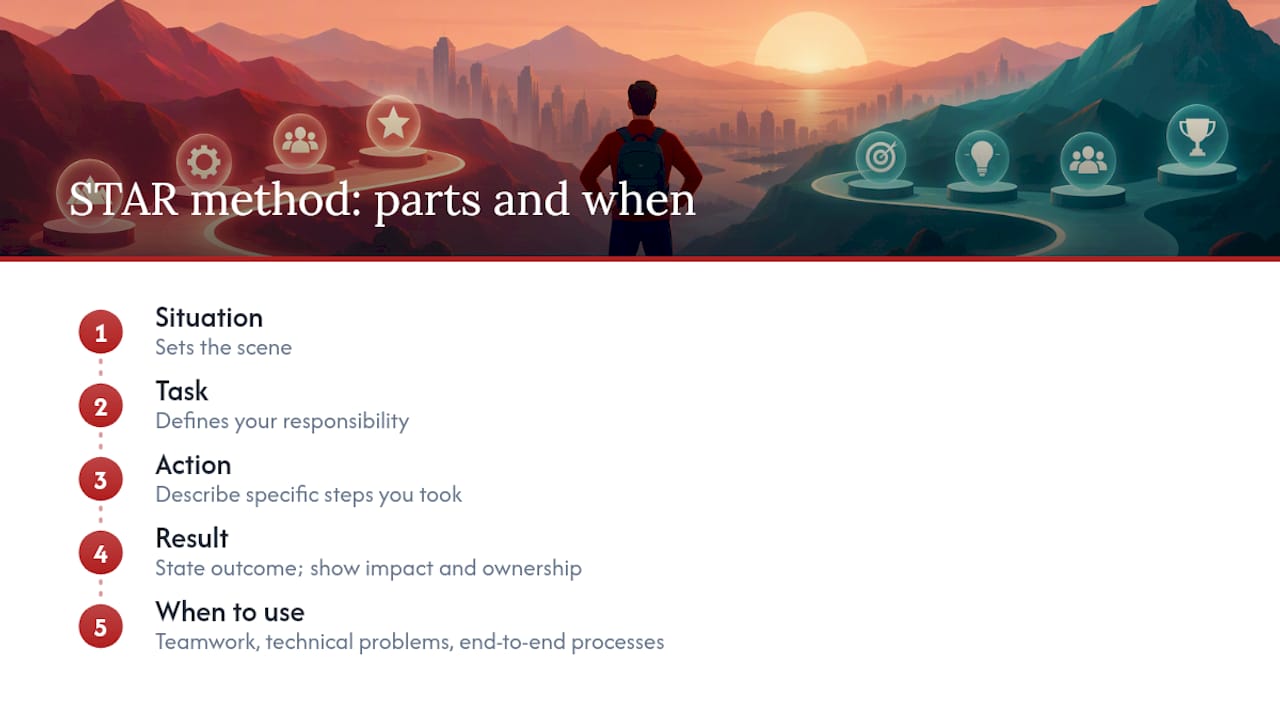
The STAR method breaks an answer into four parts: Situation sets the scene, Task defines what you were responsible for, Action describes the specific steps you took, and Result states the outcome. It is the standard structure for behavioural interviews because it forces a candidate to move from context to consequence instead of drifting into a general description of a job.
STAR works best when a question asks about teamwork, a technical problem you solved, or a process you managed end to end. Panel interviews and questions like “tell me about a time you resolved a conflict” reward the fuller picture STAR provides, since the interviewer is often assessing judgment as much as outcome.
The method has two common failure points. Candidates spend too long on Situation and Task, leaving barely a sentence for Result, and many default to “we” language that hides individual contribution. Recruiters and hiring managers consistently look for explicit ownership. Empirical work on how candidates actually answer STAR questions found that Situation appears in nearly all responses, while Task, Action, and Result are frequently underdeveloped or missing entirely.
A tight annotated example: “Our team’s release schedule was slipping every sprint (Situation), and I was asked to find the bottleneck (Task). I audited the deployment pipeline and moved code review earlier in the cycle (Action). Release delays dropped, and the process change is still in use today (Result).” That is roughly 55 words, close to the range most coaches recommend for a spoken answer of 60 to 90 seconds.
Key differences at a glance to help you choose quickly
STAR and CAR both structure a behavioural answer, but they put the emphasis in different places. STAR is built to show how you think and work; CAR is built to show what you achieved fast.
- Focus: STAR emphasizes process and context; CAR compresses straight to challenge, action, and result.
- Best for: STAR suits detailed process or teamwork questions; CAR suits phone screens, panel time limits, and senior-level summaries.
- Length and pacing: STAR answers typically run around a minute; CAR answers usually last less than a minute.
- Context: a first-round phone screen favours CAR’s speed, while a technical or panel round often has room for STAR’s detail.
- Reflection line: either method benefits from a short closing sentence on what you learned or what changed, when the question invites growth or leadership insight.
The practical difference shows up under time pressure. A candidate who only knows STAR will either rush the ending or run over their allotted time. A candidate who only knows CAR risks sounding thin when a panel wants to hear how a decision was actually made.
How to choose between STAR and CAR: a short checklist and decision rules
Choosing a format under interview pressure is a snap judgment, not a research project. A short checklist, memorized in advance, removes the guesswork.
- Read the question’s verb. “Walk me through” or “describe a time” usually signals STAR; “tell me about a result you’re proud of” or “give me an example of your impact” signals CAR.
- Check the clock. If you have less than a minute, or the interviewer has already said they’re short on time, default to CAR and skip background detail.
- Match the interview format. Phone screens and early-stage panels tend to reward concise answers; a later-round interview with a hiring manager often has room for STAR’s fuller narrative.
- Consider seniority. Entry-level and mid-career questions often invite STAR because interviewers want to see how you approach problems; leadership interviews increasingly favour CAR because the panel is assessing outcomes and decision quality under board-level scrutiny.
- Use a ten-second script in the moment: silently ask “do they want my process or my result?” before you open your mouth, then commit to one structure and don’t switch mid-answer.
- Default to compression. When unsure, start with CAR’s brevity and add one sentence of context only if the interviewer’s face says they want more.
The safest habit is to over-prepare STAR versions of your best stories, then practise cutting each one down to a CAR version. That way you always have the longer answer ready and the shorter one rehearsed, rather than trying to invent either on the spot.
Templates and sample answers you can adapt across career stages
A reusable template beats a memorized script because it flexes with whatever question actually gets asked. Keep both versions of your best two or three stories ready.
- STAR template (60 to 90 seconds, roughly 90 to 130 words): Situation (one sentence, the context and stakes), Task (one sentence, your specific responsibility), Action (two to three sentences, what you actually did), Result (one to two sentences, the outcome and, where relevant, what changed afterward).
- CAR template (30 to 45 seconds, roughly 50 to 80 words): Challenge (one sentence combining situation and stakes), Action (two sentences, the decisive steps), Result (one sentence, the outcome plus a short reflection line).
- Early-career sample (STAR): “During a retail shift, our POS system went down during a rush (Situation), and as the senior person on the floor I had to keep the line moving (Task). I switched us to manual receipts and assigned two coworkers to bagging while I handled payments (Action). We cleared the backlog in under fifteen minutes with no walkouts, and I wrote a one-page backup procedure the store still uses (Result).”
- Mid-career sample (CAR): “A key client threatened to leave over missed deadlines (Challenge). I rebuilt our project timeline, added weekly check-ins, and personally owned the client’s next two deliverables (Action). The client renewed for another year and became one of our references (Result).”
- Senior sample (CAR with reflection): “Our division was losing margin on a legacy product line (Challenge). I led the pricing review, cut two underperforming SKUs, and renegotiated supplier terms (Action). Margin recovered within two quarters, and the pricing framework is now used across three other divisions (Result and reflection).”
- Conversion drill: take a STAR story you already have written and delete every Situation detail that isn’t necessary to understand the stakes; merge Task into the opening Challenge line; keep Action, tighten Result. Reverse the drill by taking a CAR answer and adding one sentence of Situation and one of Task before Action, to practise expanding under less time pressure.
Case studies of how real achievements turn into interview stories can help you see this conversion in practice, and our own case studies and samples page shows several worked examples.
Common mistakes and expert tips for making answers credible
Behavioural interviewing has measurable predictive validity for job performance, with research syntheses reporting correlations in the range of roughly 0.28 to 0.32. That validity depends on candidates giving specific, honest answers rather than generic ones, which is where most interviews go wrong.
The most common mistakes are over-rehearsal that makes an answer sound recited, a weak or vague Result, and “we” language that obscures individual ownership. Practitioners advise leading with stakes rather than setup, replacing “we” with “I” wherever you personally acted, and describing what changed as a result of your action instead of reaching for a big, unverifiable number.
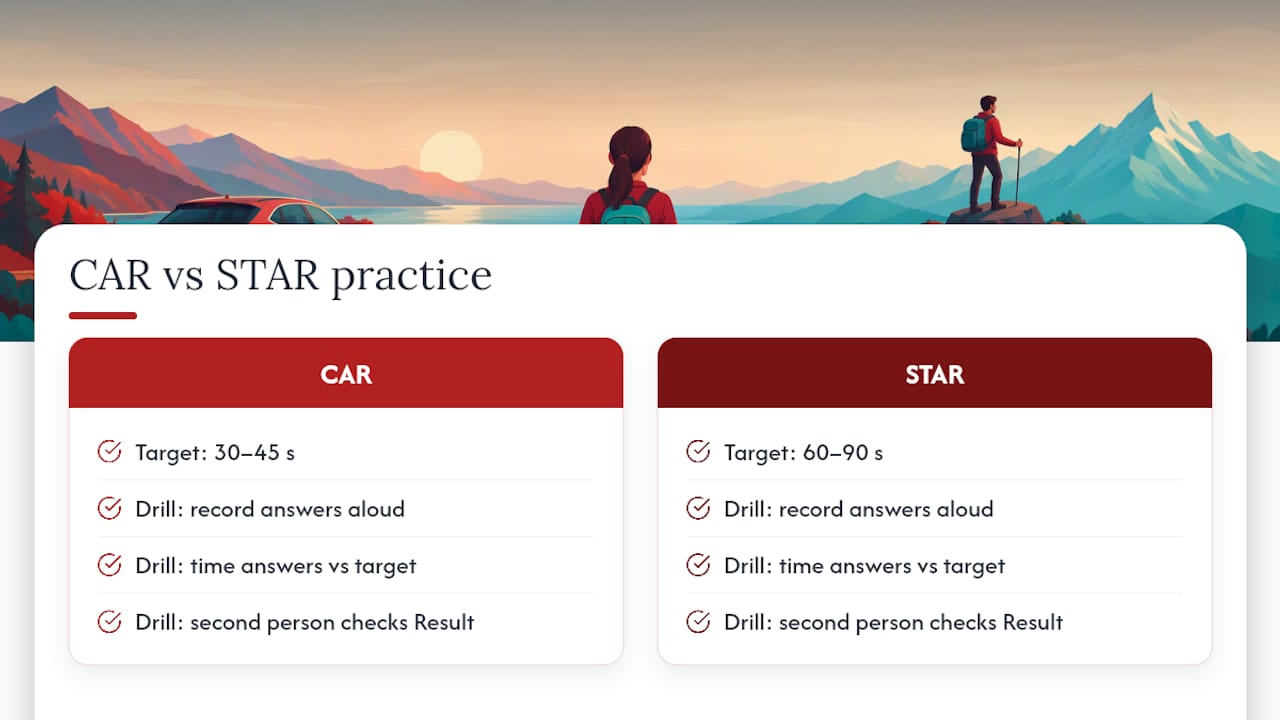
Three drills fix most of this. Record yourself answering out loud and listen for filler words and passive phrasing. Time each answer against the 30 to 45 second CAR target and the 60 to 90 second STAR target. Ask a second person to check whether your Result sentence would survive a follow-up question, since a credible outcome is one you can defend, not just one that sounds impressive.
Pro Tip: Practise the decision, not the script: rehearse choosing between STAR and CAR on the fly, so your delivery stays natural even when the question surprises you.
Why frameworks fail candidates who recite them
STAR and CAR are tools for organizing a story, not scripts to perform word for word. The most common failure is treating either one as a memorized speech, which produces the flat, over-rehearsed delivery that experienced interviewers notice immediately.
The better habit is knowing your stories cold and deciding, in the moment, how much structure a given question actually needs. A senior candidate answering a rapid-fire panel question should feel free to open with the result and backfill context only if asked. A candidate who has practised converting the same story between formats will sound prepared rather than rehearsed, and that distinction is what separates a strong interview from a forgettable one. Working through this kind of story development is also where a second, professional set of eyes tends to sharpen an answer faster than solo practice does.
— Professional
How Professional Resumes helps you turn achievements into interview-ready stories
The hardest part of building STAR and CAR answers is usually not the format, it’s finding the achievements worth telling. Professional Resumes works through extensive consultation to pull the specific, results-driven accomplishments off your resume and reshape them into stories that hold up under interview follow-up questions, tailored to your career stage.
- The Early Career Resume suits candidates building their first strong set of interview stories from limited experience.
- The Next Step Resume fits mid-career professionals who need sharper, more results-focused narratives.
- The Advanced Resume supports candidates moving into senior individual-contributor or management roles.
- The Executive Resume is built for leadership-level candidates whose stories need to reflect organizational outcomes and board-level scrutiny.
Each package is paired with the LinkedIn profile optimization service so your online presence matches the stories you tell in the room. Visit the shop to choose the package that fits your career stage and start turning your resume achievements into answers you can defend under any format.
Sources
- Mastering key interview questions for every role and industry
- Predictive validity comparison of four structured interview question types
- The STAR method is lying to you
FAQ
Is the STAR method outdated?
No, the underlying structure still works, and structured behavioural interviews retain measurable predictive validity for job performance. What has changed is delivery: candidates now get better results adapting STAR with a brief reflection line, sometimes called STARR, rather than reciting it rigidly.
What are common mistakes with the STAR method?
The most frequent errors are spending too long on Situation and Task, leaving a thin or vague Result, and relying on “we” language instead of clear “I” statements. Practitioners also warn against reaching for unverifiable big numbers instead of describing what actually changed.
What is the STAR method good for?
STAR is best suited to questions about teamwork, technical problem-solving, and any question that asks you to “walk through” or “describe” a process. It gives an interviewer enough context to judge your reasoning, not just your outcome.
What are good examples of the STAR method?
A strong STAR example states the stakes in the Situation, names a specific personal responsibility in the Task, details two or three concrete actions, and closes with a measurable or clearly described Result. The retail and product-margin examples earlier in this article show the format applied at different career stages.