
The single most effective LinkedIn approach for executives combines a polished, outcome-focused profile with a low-volume, high-quality posting rhythm and selective networking. Prioritise the headline, About and Featured sections first, then commit to one or two strategic posts per week. Begin now: update your headline today and block 60 minutes this week for content planning.
TL;DR:
- Executives should focus on a highly polished profile with a strong headline, about, and featured sections before posting regularly.
- Updating key profile elements like the headline, photo, and banner can significantly improve visibility and should be tested one variable at a time.
- Posting one to two high-value, outcome-focused posts weekly is more effective than high-frequency content, with formats including short essays, lessons, and brief videos.
- Building a deliberate network of peers, recruiters, and board members through thoughtful connection requests and comments yields better results than large, unfocused networks.
- Regular review of qualitative signals such as profile views and engagement quality helps refine content and targeting without relying on detailed analytics.
Table of Contents
- Profile optimisation checklist for executives
- Optimising visible fields: photo, headline and banner
- About, experience and featured content: narrative techniques for leaders
- Thought leadership and content rhythm for executives
- Strategic networking and recruiter engagement
- Measure impact: metrics and signals that matter
- Quick wins and delegation: what to do in under an hour and what to outsource
- How Professional Resumes helps executives with LinkedIn profiles
- Executive branding strategies beyond profile optimization
- Using LinkedIn Groups and Events for executive networking
- Author perspective: pragmatic trade-offs for leaders on LinkedIn
- Service call-to-action: LinkedIn profile optimisation offering
- Sources
- FAQ
Profile optimisation checklist for executives
An executive profile should read as a leadership brand statement, not an extended CV. Recruiters, board members and partners scan a handful of fields before deciding whether to read further, so those fields carry disproportionate weight.
Work through them in this order:
- Photo and banner: a current, professional headshot paired with a banner that reinforces your mission or area of authority.
- Headline: role, impact and niche combined into one scannable line rather than a job title alone.
- About: a one-line positioning statement, two or three signature outcomes, and a note on your current agenda.
- Featured: two or three pinned items, such as a keynote clip, a published article or a case study, that support your positioning.
- Experience: outcome-focused bullets that read like board notes rather than duty lists.
This sequence matters because a scanning reader rarely reaches the experience section without first being persuaded by the top of the profile. Guides that outline these components consistently point back to the same logic: positioning first, proof second, detail third.
Pro Tip: Rewrite your headline and About section before touching anything else. Those two fields do most of the persuasive work.
For a deeper look at how LinkedIn positioning ties into your broader executive brand, see this piece on personal branding for executives.
Optimising visible fields: photo, headline and banner
These three elements determine the first impression before anyone reads a word of your About section.
- Photo: a recent headshot, business or business-casual attire depending on your sector, shoulders up, cropped so your face fills roughly 60% of the frame.
- Headline: use a role plus impact plus niche formula, such as “CFO | Scaling SaaS Revenue from $10M to $100M | Board Advisor.”
- Banner: reserve this space for a mission statement, a still from a speaking engagement, or a link to a resource you want visitors to notice.
- Testing: swap one variable at a time, such as the headline phrasing, and watch profile views over a few weeks before changing another element.
Small, deliberate changes let you isolate what actually moves the needle rather than guessing at a full overhaul.
About, experience and featured content: narrative techniques for leaders
The About section is where most executive profiles fail, either by repeating the resume or by drifting into vague mission language. A tighter structure fixes both problems.
- Open with positioning: one sentence naming your function, your scale and the outcome you are known for delivering.
- Prove it with two or three results: concise, outcome-oriented statements rather than a running list of responsibilities.
- Close with your current agenda: what you are focused on now, which signals relevance to recruiters and partners reading in real time.
Avoid restating your resume line by line. Convert each Experience entry into a short outcome statement: what changed, at what scale, under your leadership, rather than what your role entailed. Featured content should earn its place: a keynote, a published piece or a case study that reinforces the same one or two themes running through your About section, not a scattershot of unrelated links. Recommendations work the same way. A handful of targeted requests from people who can speak to a specific outcome will do more for your credibility than a long list of generic endorsements. For guidance on translating achievements into resume-ready language that mirrors this approach, see these executive resume writing tips.
Thought leadership and content rhythm for executives
A realistic cadence for a time-pressed executive is one to two strategic posts per week, not daily activity. Consistency and quality matter more than frequency, and a leader’s audience tends to reward substance over volume.
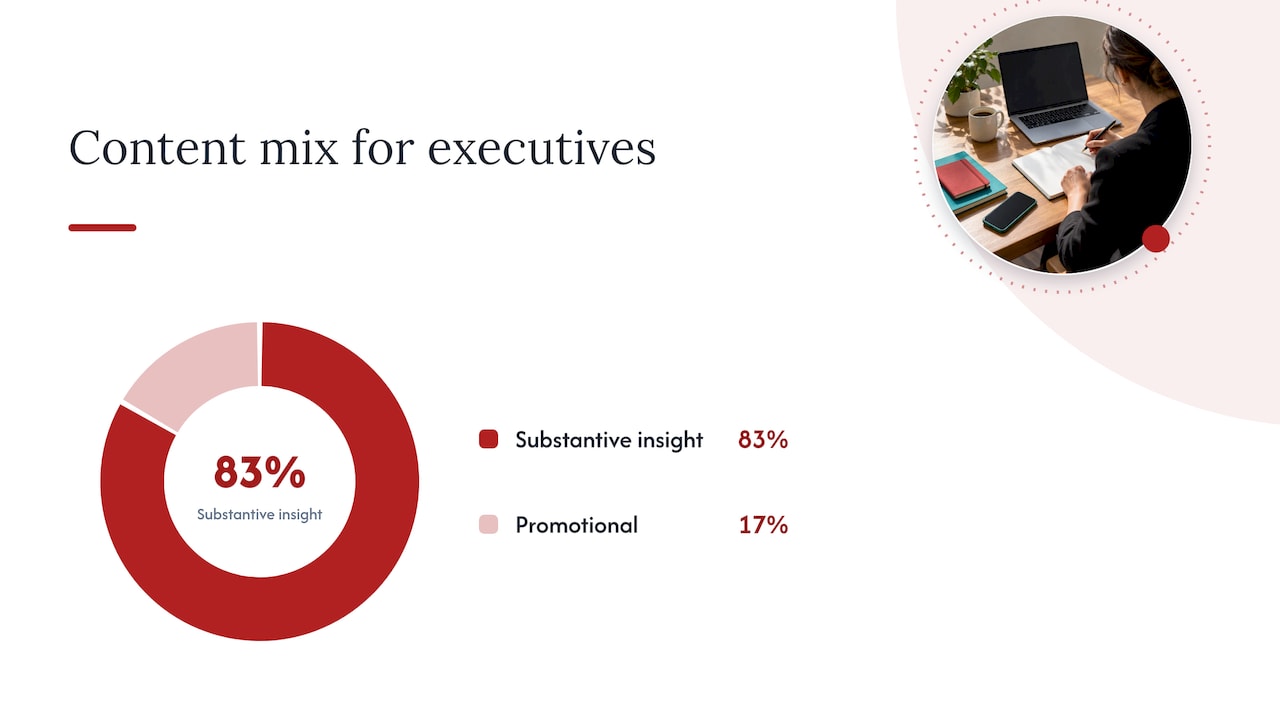
Common frameworks like the 3-2-1 and 4-1-1 models were built for high-volume creators and marketers, cycling through six posts with a mix of curated and original content. Executive guidance from LinkedIn’s own resources suggests adapting these frameworks into a lower-volume format that leans even more heavily toward value before promotion, closer to a five-to-one ratio of substantive insight to anything promotional. That shift reflects how leaders are read differently than creators: fewer posts, each expected to carry real weight.
High-value formats for this rhythm include:
- Short essays on a decision you made and why it mattered.
- Lessons from the boardroom, generalized enough to protect confidentiality.
- Data-informed insights relevant to your sector or function.
- Brief videos, a minute or two, sharing a single point clearly.
According to Sprout Social’s guide to executive presence, leaders who post strategically and authentically build trust that extends beyond individual engagement metrics into broader organisational reputation. To increase dwell time, open with a specific claim rather than a generic observation, and end with a genuine question rather than a call for likes.
Pro Tip: Batch a month of post ideas in a single sitting, then schedule the actual writing in short, weekly blocks so the habit survives a busy quarter.
Strategic networking and recruiter engagement
A high-signal network beats a large one. Executives benefit from connecting deliberately rather than accepting every request.
- Who to prioritise: peers in your function, board members, analysts covering your sector and recruiters specializing in your level.
- Weekly target: ten to fifteen new connections and five to ten thoughtful comments on posts from people in that circle.
- Connection notes: a single sentence naming a shared context or a specific reason for reaching out works better than a generic invitation.
- Comment strategy: a substantive comment on a well-placed post often earns more visibility than a standalone post of your own.
- Premium and InMail: reserve InMail for warm, specific outreach, such as following up after a conference, rather than cold volume messaging.
Recruiters notice pattern and consistency more than any single post, so a steady rhythm of thoughtful engagement tends to outperform sporadic bursts of activity.
Measure impact: metrics and signals that matter
Executives do not need a marketing dashboard. A handful of qualitative signals, reviewed regularly, is enough to refine both content and targeting.
- Profile views: a leading indicator of search visibility and headline effectiveness.
- Post-level engagement quality: comments from relevant people matter more than raw like counts.
- Search appearances: shows whether your keyword choices in the headline and About are working.
- Connection request sources: reveals whether recruiters, peers or vendors are finding you.
Executives who focus on strategic, authentic posting can influence trust and pipeline outcomes rather than vanity metrics alone, according to Sprout Social. Third-party analytics tools add value when you need to track visibility trends over time or benchmark against peers, which native LinkedIn data does not do well. A simple monthly routine of reviewing these signals is enough to spot what to adjust before the next posting cycle.
Quick wins and delegation: what to do in under an hour and what to outsource
Time is the real constraint for most executives, not knowledge. A short list of quick wins and a clear delegation boundary solves most of the problem.
- Rewrite your headline using the role, impact, niche formula.
- Update your photo if it is more than two years old.
- Pin one Featured item that reflects your current priorities.
- Send five targeted connection requests with a one-line note each.
- Comment on three posts from people in your target network.
Tactical work, scheduling posts, formatting graphics, drafting first pass copy from your notes, is safe to delegate to an assistant or a vendor. Keep a single approval step: you supply the core insight in a sentence or two, the delegate builds it into a full post, and you give one consolidated sign-off before it publishes.
Pro Tip: A short hand-off brief, your key message, tone preferences and any names or numbers off-limits, saves more time than any scheduling tool.
How Professional Resumes helps executives with LinkedIn profiles
Professional Resumes offers a dedicated LinkedIn profile optimization service built around the same priorities outlined above: headline, About, Featured and experience narrative, refined through direct consultation. Case studies, including one detailing a VP-level ascent supported by a rewritten resume and an updated LinkedIn presence, illustrate the kind of outcome a coordinated approach can support. When evaluating any vendor, ask about deliverables, the number of revisions included and how client information is handled, since confidentiality matters more at the executive level than at any other stage of a career.
Executive branding strategies beyond profile optimization
A LinkedIn profile is one surface of a broader executive brand, not the whole of it. Speaking engagements, board appointments, bylined articles in trade publications and podcast appearances all feed the same reputation that your profile summarizes. The strongest executive brands treat LinkedIn as a distribution channel for work happening elsewhere, a conference talk repurposed into three posts, a board decision generalized into a lesson, rather than the sole source of original content.
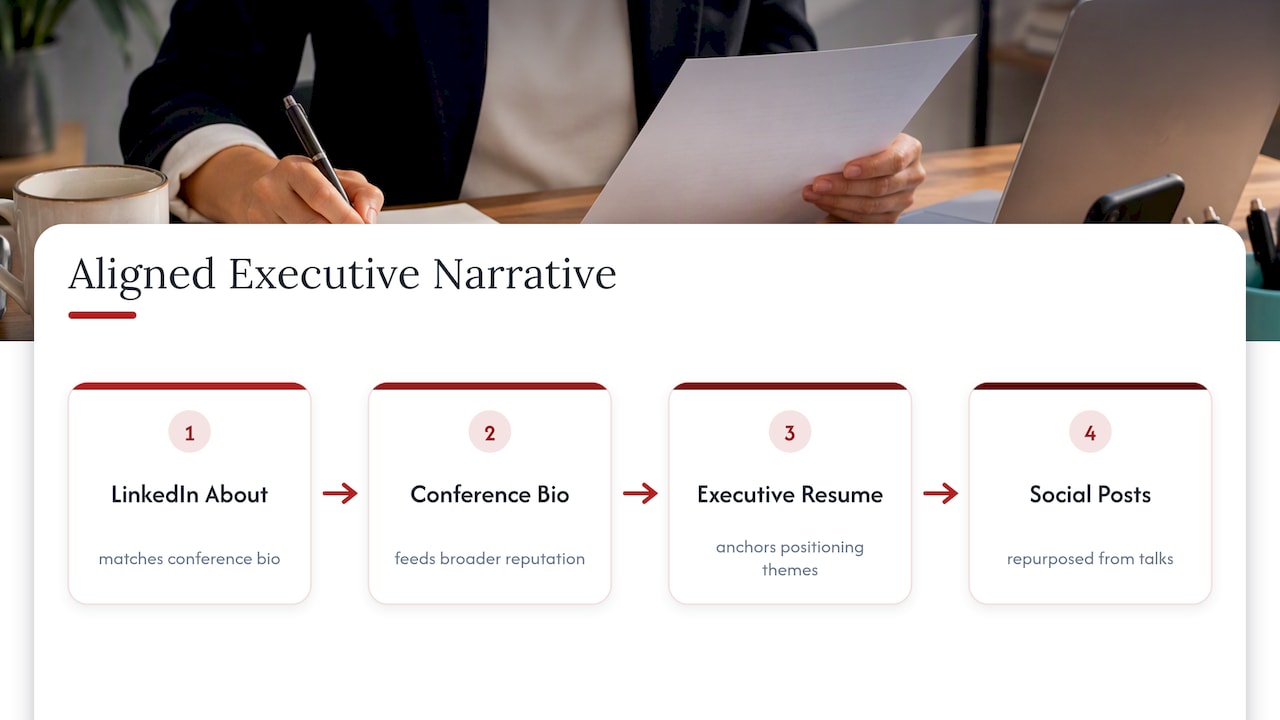
Consistency across channels matters more than volume on any one of them. The language in your About section should match the bio you send to conference organizers, and the themes in your posts should echo the positioning in your executive resume. When those pieces align, a recruiter or board member encountering you in multiple places sees one coherent narrative instead of several disconnected impressions. For a broader view of how these pieces fit together, this guide to executive personal branding covers positioning beyond the profile itself.
Executives who under-invest in this wider view often find their LinkedIn presence feels disconnected from their actual reputation, polished on the surface but thin on the substance a serious buyer or board is looking for.
Using LinkedIn Groups and Events for executive networking
Groups and Events offer a lower-effort way to stay visible within a specific professional community without adding to your regular posting load. A well-moderated group in your sector surfaces conversations worth commenting on, which supports the comment-first networking strategy covered earlier without requiring original content.
Events, particularly LinkedIn Live sessions or panel discussions tied to your industry, work well for executives because attendance itself signals engagement, and a single thoughtful question or comment during the event can generate more visibility than a week of solo posts. Hosting or co-hosting an event ties naturally into thought leadership, giving you a reason to post a recap afterward that fits the value-first content rhythm already in place.
Choose groups and events selectively. Two or three active groups tied directly to your function or sector, checked briefly once a week, will do more for your network than a long list of memberships that go unread.
Author perspective: pragmatic trade-offs for leaders on LinkedIn
A quality-first approach suits executives better than high-volume tactics because your time is the scarcest resource in the equation, not your ideas. There will be weeks when board preparation or a transaction takes priority over any post, and that is the correct trade-off, not a lapse in discipline. The checklist that holds up under real pressure is short: is the headline current, is the About section still true, and has a genuine insight been shared in the last two weeks. Anything beyond that is optional polish.
— Professional
Service call-to-action: LinkedIn profile optimisation offering
Getting an executive profile right without losing a week of your own time is exactly what the LinkedIn profile optimization service from Professional Resumes is built to solve, working directly with your writer through a confidential consultation rather than a template.
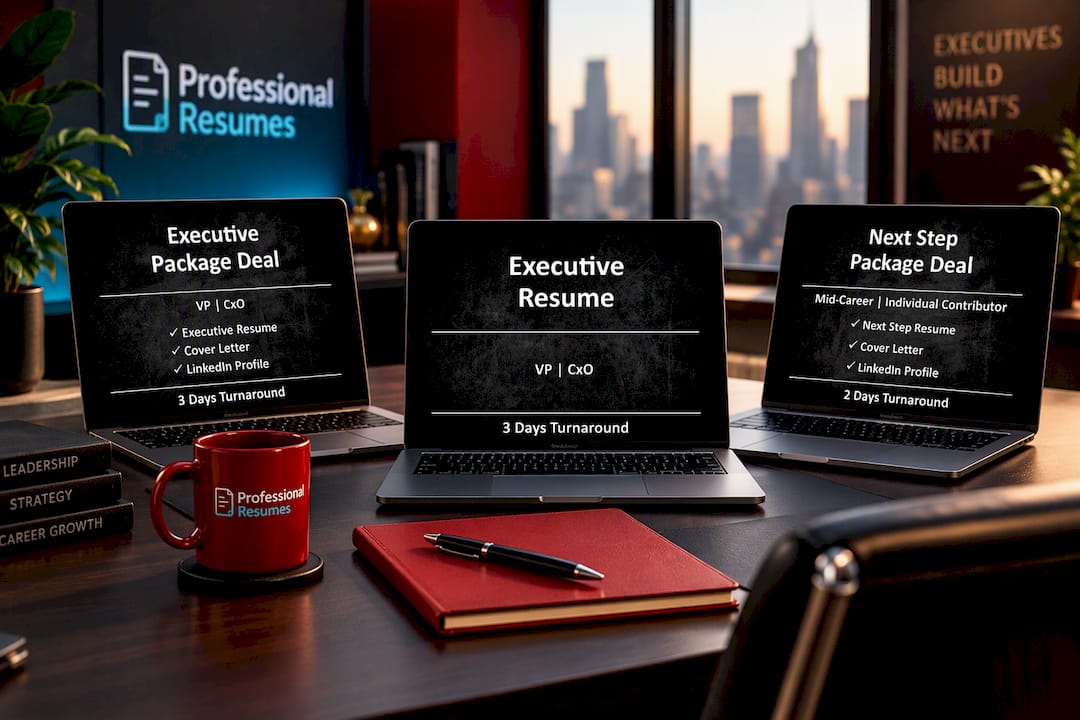
For candidates pairing a LinkedIn refresh with a resume rewrite, the Executive Package Deal bundles both, while the Executive Resume on its own covers the resume side at $289. Professionals moving into their next leadership step can also review the Next Step Package Deal or browse the full shop for other document options. Every engagement includes revisions and is handled in confidence, starting with a first consultation to map your positioning before any writing begins.
Sources
- Optimizing Senior Executive LinkedIn Profiles | LinkedIn top content
- LinkedIn for executives: How executive presence amplifies your social strategy | Sprout Social
FAQ
What is the 3-2-1 rule on LinkedIn?
The 3-2-1 rule is a content mix guideline built around six posts per cycle, blending curated and original content in a set ratio. For executives, LinkedIn’s own guidance suggests adapting it into a lower-volume, value-first version rather than following the original ratio directly.
What are the best practices for executives on LinkedIn?
Best practice starts with a strong headline, About section and Featured content, followed by a steady rhythm of one or two high-value posts per week. Selective networking and thoughtful commenting matter more than high connection counts, and executive presence has been linked to measurable trust and reputation outcomes.
Why are people getting rid of LinkedIn?
Some professionals step back from LinkedIn because high-volume posting norms feel mismatched with their available time or their comfort with public self-promotion. A lower-volume, quality-first approach, focused on a polished profile and occasional strategic posts, addresses that concern without requiring a full exit from the platform.
What is the 4-1-1 rule on LinkedIn?
The 4-1-1 rule is another content ratio framework, mixing curated shares with original posts across a six-post cycle. As with the 3-2-1 model, executive guidance favours adapting it toward fewer, more substantive posts rather than following the ratio exactly as designed for high-frequency creators.
How much does LinkedIn profile optimisation cost?
Pricing for the LinkedIn profile optimization service from Professional Resumes is available on request through a confidential consultation. Bundled options like the Executive Package Deal combine it with resume writing for candidates who want both updated together.