
Keep your resume to one or two pages: one if your relevant experience is limited, two when additional, recent accomplishments strengthen your case. Academic curricula vitae, certain funding applications, and select executive submissions are the main exceptions, each governed by its own rules rather than a generic page count. The deciding factor is never the page number itself: it is whether every line earns its place against the role you are targeting.
TL;DR:
- A resume should be one to two pages long unless you have extensive, recent, and relevant achievements that justify a second page.
- A single page suits early-career professionals or those with limited relevant experience, focusing on a targeted summary, key outcomes, skills, and measurable accomplishments.
- A second page is justified when there are enough recent, relevant achievements, projects, or certifications that add value without repetition, typically for mid-career or senior professionals.
- Longer resumes, such as three pages or more, are generally inappropriate for standard roles and reserved for academic CVs or specialized applications with specific page limits.
- Focus on relevance when trimming your resume, discard outdated roles over 10 to 15 years old, and ensure formatting remains clear and ATS-friendly to maximize readability.
Table of Contents
- How many pages should a resume be? An evidence-backed overview
- One-page resumes: who should use them and how to make them effective
- Two-page resumes: when a second page earns its place
- Three pages and the exceptions: academic CVs, funding applications and select executive submissions
- How to decide what to keep, edit or remove: a trimming checklist
- Formatting and ATS-safe basics that preserve readability
- Publisher perspective: how Professional Resumes helps job seekers decide the right length
- What the length debate misses
- Service options: which Professional Resumes product fits your stage
- Sources
- FAQ
How many pages should a resume be? An evidence-backed overview
Canadian guidance converges on a narrow range. Job Bank recommends limiting a standard resume to two pages and prioritizing experience that is both recent and relevant to the position. The University of Toronto’s resume toolkit gives the same range, one to two pages, and explains why the number matters less than what sits at the top.
That guidance rests on how resumes actually get read. Employers give a document a short initial scan before deciding whether it earns a closer look, which is why the strongest match signals belong on page one: job title, keywords from the posting, and a handful of measurable outcomes. A resume that buries its strongest match signals loses the reader before they get there.
Page count follows from this reality rather than setting it. A candidate with a decade of relevant, quantifiable achievements has earned a second page; a candidate without that history has not, and padding to fill it only dilutes what does matter.
One-page resumes: who should use them and how to make them effective
A single page suits students, recent graduates, early-career applicants, and some career changers whose most relevant experience is limited by definition, not by choice. Trying to stretch that experience across two pages usually adds noise rather than substance.
The page should carry only what moves the decision forward:
- A targeted summary of two to three lines that names the role and your strongest fit for it.
- The most relevant position or positions, described through outcomes rather than duties.
- A core skills line matched to the posting’s language.
- One to three quantified achievements that would survive a hiring manager’s brief scan.
Resist the instinct to shrink the font or compress the margins to fit more in. A one-pager that is hard to read defeats its own purpose.
Pro Tip: Cut a bullet entirely before you shrink the type below 11 point: a shorter, readable page beats a full, cramped one.
Two-page resumes: when a second page earns its place
A second page is justified when there is enough recent, relevant material to fill it without repetition. That typically describes professionals with several years of measurable achievements, technical specialists carrying certifications worth listing, and managers with real scope, team size, budget, or programs, to show.
Page two is where supporting evidence belongs:
- Notable projects or initiatives that reinforce the page-one narrative.
- Technical tools, platforms, or certifications relevant to the target role.
- Earlier roles summarized in a line or two rather than described in full.
Keep the focus on the last 10 to 15 years of work, three to seven bullets per role, and every bullet built around a measured result rather than a listed responsibility. A second page that repeats page one in different words is not earning its space.
Three pages and the exceptions: academic CVs, funding applications and select executive submissions
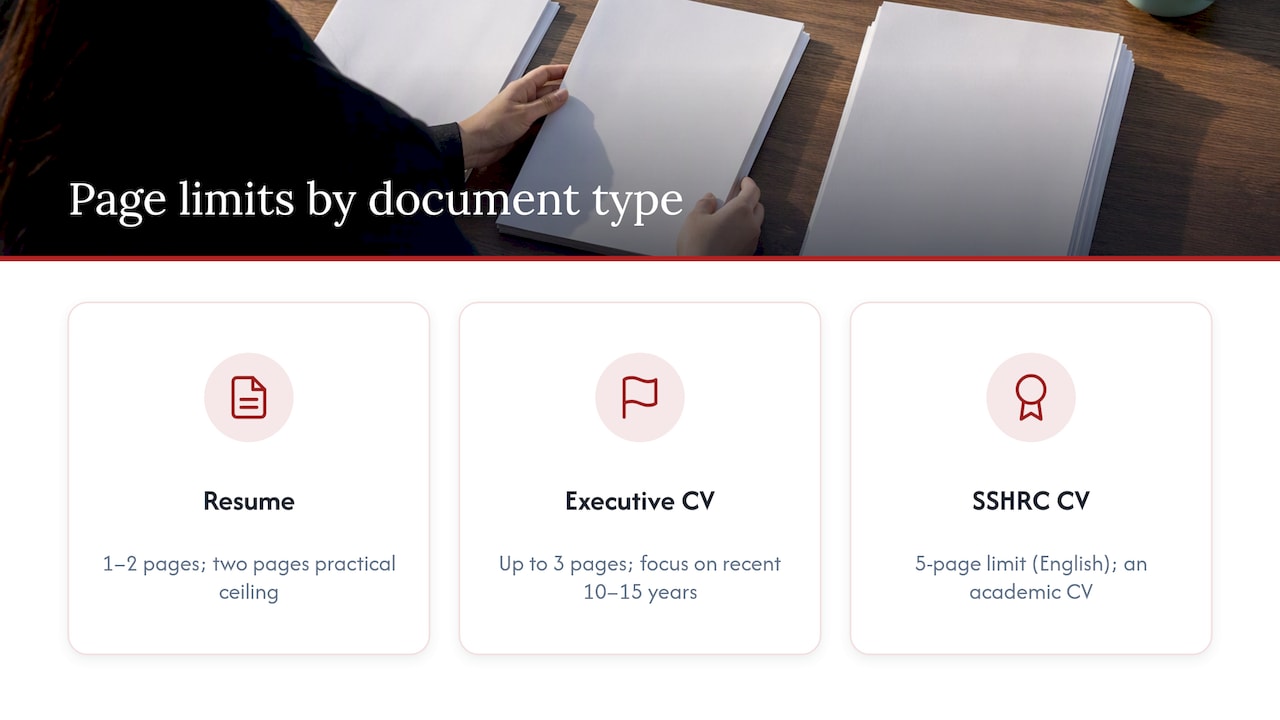
Some documents are governed by rules unrelated to resume conventions. The SSHRC tri-agency CV sets a five-page limit in English for that specific funding application, with its own formatting requirements, and it is a CV in the academic sense, not a resume.
At the senior end, Public Service Commission guidance for executive CVs allows up to three pages but still directs candidates toward the most recent 10 to 15 years and away from a full biographical account. For a standard professional resume, two pages remains the practical ceiling.
If your material genuinely exceeds these formats, the answer is usually a different document altogether: an academic CV, a portfolio, or an appendix, not a longer resume.
How to decide what to keep, edit or remove: a trimming checklist
Most resumes that run long are carrying weight they no longer need. Work through the document in this order:
- Cut or summarize any role older than 10 to 15 years unless it directly supports the job you want.
- Rewrite duty statements as accomplishment statements: what you did, the context, and the measurable result.
- Cap bullets at four or five per role and keep each to two lines at most.
- For every remaining line, ask whether it helps this specific application, not your career story in general.
- Move anything interesting but non-essential, a side project, an older credential, a longer narrative, to LinkedIn or a portfolio instead of the resume itself.
Pro Tip: If you find yourself defending a bullet’s inclusion, that is usually the sign it belongs elsewhere.
Applying that discipline, drawn from the same principle that resume length should follow relevance rather than habit, tends to shorten a bloated two-page resume before it ever needs a third.
Formatting and ATS-safe basics that preserve readability
Length and formatting solve the same problem from different angles: both exist to help a reader find what matters fast. University of Toronto and UTM career centre guidance recommends body text at 11 to 12 point, margins between three quarters of an inch and one inch, and a single-column layout that both people and applicant tracking systems can parse cleanly.
A few habits protect that readability:
- Avoid tables, icons, headers, and footers, which some applicant tracking systems misread or drop entirely.
- Use one consistent date format throughout, rather than mixing styles.
- Keep headings plain and bullets simple: no nested sub-bullets or decorative dividers.
Employers give a first pass to a resume in about 30 seconds, according to Job Bank, which is why the visual hierarchy matters as much as the words themselves. A clean, predictable layout lets that short window work in your favour rather than against you.
Publisher perspective: how Professional Resumes helps job seekers decide the right length
Deciding what belongs on page one versus page two is a judgment call, and it is where a consultation earns its value. Professional Resumes works with clients to map accomplishments against the target role before deciding whether a document needs one page or two, then applies ATS-friendly formatting so the structure holds up in both a hiring manager’s hands and a tracking system’s parser.
What the length debate misses
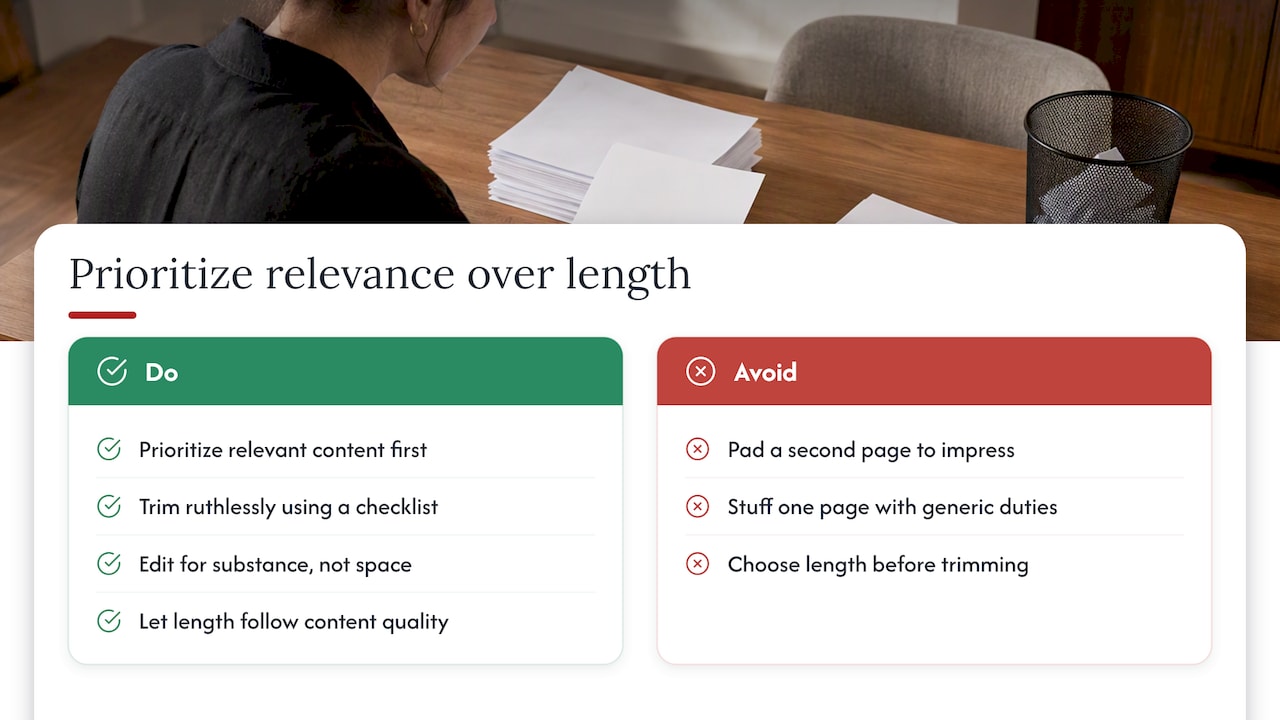
Most advice on this topic treats the page count as the variable worth arguing over, when the real variable is relevance. A one-page resume stuffed with generic duty statements is worse than a well-edited two-pager, and a two-page resume padded to look thorough is worse than a tight single page. The authoritative sources bear this out: Job Bank, the University of Toronto toolkit, and the Public Service Commission all frame their page guidance around what the reader needs to see quickly, not around a fixed number to hit.
What gets underestimated is how much damage a weak second page does. Adding length to appear more experienced usually signals the opposite: that the candidate could not decide what mattered. The reader should prioritize the exercise in the trimming checklist above before worrying about which side of the one-page or two-page line they land on. Get the content right first, and the correct length tends to reveal itself rather than needing to be chosen in advance.
— Professional
Service options: which Professional Resumes product fits your stage
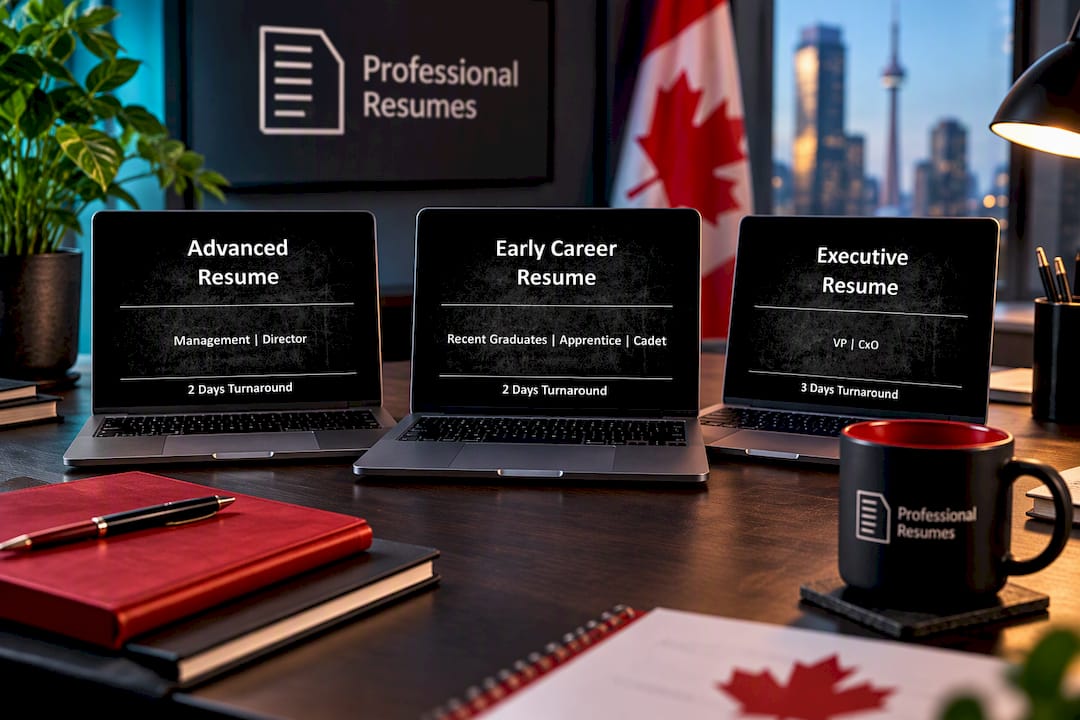
Matching the document to the career stage is most of the work. Professional Resumes structures its product lines around exactly that distinction: the Early Career Resume is built for students and recent graduates working within a tight one-page format, the Advanced Resume suits mid-career professionals who have earned a well-supported second page, and the Executive Resume is written for senior leaders whose scope and strategic outcomes need room to land.
- Browse the full shop to compare Early Career, Next Step, Advanced, and Executive options side by side.
- Pair a new resume with a LinkedIn profile optimization service so both documents tell the same story.
- Book a consultation directly through the product page that matches your current stage.
Sources
- How to write a good resume – Job Bank
- Resume and cover letter toolkit — University of Toronto
- Curriculum vitae tips for executives — Public Service Commission of Canada
- Tri-agency CV instructions — SSHRC
- Formatting matters — UTM Career Centre
FAQ
Is a 2 page resume ok?
Yes, a two-page resume is appropriate once you have enough recent, relevant, and quantified achievements to fill it without repetition. Job Bank and university career centres both treat one to two pages as the standard range for most professional resumes.
Is a 3 page resume too long?
For a standard professional resume, yes, three pages generally exceeds what employers expect to scan. The main exception is senior executive CVs, where Public Service Commission guidance allows up to three pages, while academic CVs for funding applications follow entirely separate page limits.
Is a 7 page resume too long?
Yes, a resume of that length falls outside every standard guideline for a professional job application and would typically only suit an academic CV governed by its own field-specific conventions. Even the SSHRC tri-agency CV, a lengthy academic format, caps out at five pages in English.
How long should a 20 year resume be?
A career spanning two decades still fits comfortably into two pages if you focus on the last 10 to 15 years and summarize earlier roles briefly. This approach follows Public Service Commission guidance on emphasizing recent scope and achievement rather than a complete work history.