
Only include salary expectations when the employer asks for them, or when leaving the figure out would put your application at a disadvantage. When a range is required, place a researched figure in the final paragraph, anchored to Job Bank wage data and your own experience, and pair it with a clear statement that you’re open to discussing the full compensation package.
TL;DR:
- Only include salary expectations if explicitly requested in the job posting or application form.
- Research occupation-specific wages in your region via Job Bank and adjust the range based on your experience and certifications.
- Present a salary range rather than a fixed number, and phrase it to convey flexibility and support from market data.
- Place your salary expectation at the end of the cover letter after establishing your fit and relevant achievements.
- Avoid repeating published salary ranges and never state rigid or non-negotiable language to keep the conversation open.
Table of Contents
- When to include salary expectations in your cover letter
- How to research and decide a justified salary range
- How to phrase salary expectations in a cover letter
- Where to place salary information and formatting tips
- Short cover-letter examples and a fill-in template
- A note on tailored cover letters and negotiation outcomes
- How Professional Resumes can help with salary language
- Sources
- FAQ
When to include salary expectations in your cover letter
Most cover letters should never mention a figure unless the job posting or application form asks for one directly. A direct request usually appears as a line in the posting itself, a mandatory field in an online application portal, or an explicit instruction such as “include salary expectations with your application.”
There are exceptions worth planning for. Time-limited postings with a hard deadline sometimes reward candidates who volunteer a range up front, since hiring managers are screening quickly and want to rule out mismatches early. Strict screening questions, particularly on government or large-employer portals, may block submission entirely without a number.
One error shows up more than any other: restating the range already published in the job posting. Employers read this as a signal that the candidate skimmed the posting rather than researched the role, and it wastes the one sentence you have to demonstrate judgment. If a posting already states a range, address your fit for the role instead and let the number stand.
- Only state a figure when the posting, application form or recruiter explicitly asks for one.
- Volunteer a range proactively only for time-sensitive postings or mandatory screening fields.
- Never repeat a salary range the employer has already published, since it adds no information and can read as inattentive.
How to research and decide a justified salary range
A defensible range starts with the Job Bank wage methodology, which publishes low, median and high wages by occupation and region and explains how those figures are calculated. Look up the specific occupation and region that match the role you’re applying for, not a national average, since regional wage reports can differ substantially by market.
Job Bank updates its wage tables regularly and reports them by occupation and region. An accounting bookkeeper report, for instance, was last refreshed on November 19, 2025, which means the figures reflect current conditions rather than a stale snapshot from years earlier.
Once you have the low, median and high figures for your occupation, adjust from the median based on your years of experience, any relevant certifications, and whether the role is remote or tied to a specific city. A candidate with five years of specialized experience and a professional designation typically sits above the median; someone early in their career typically sits closer to the low end.
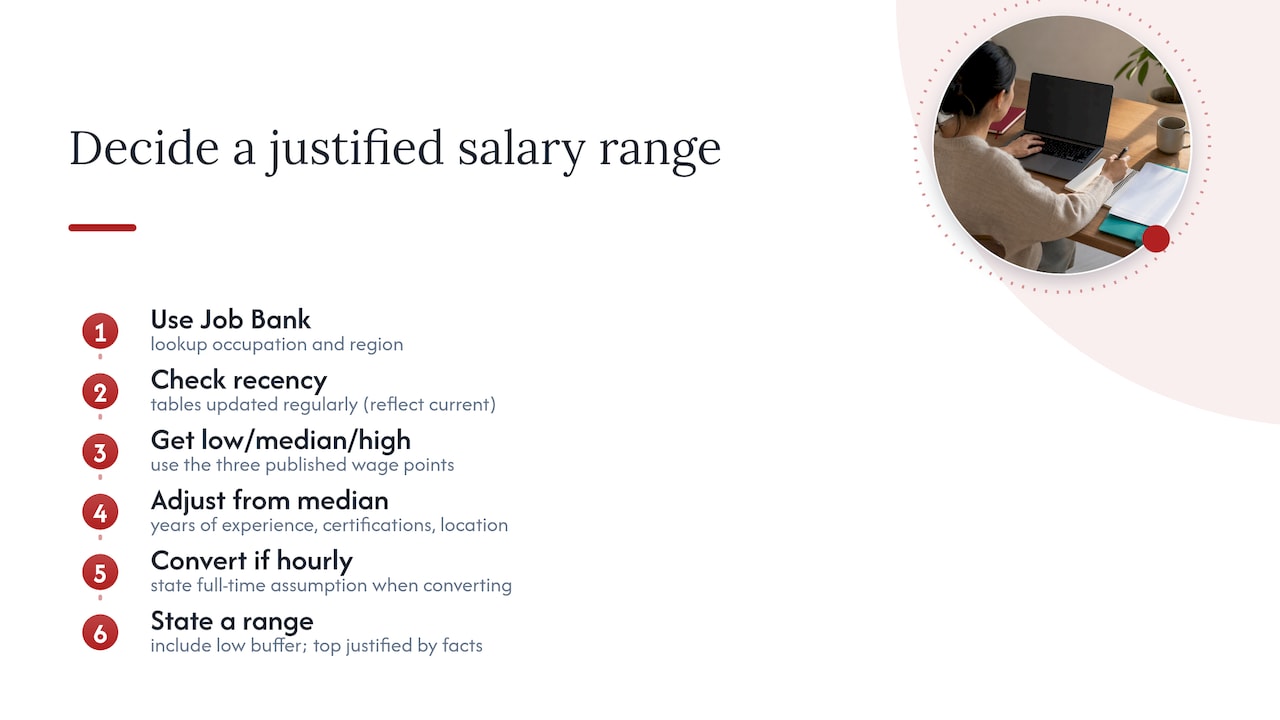
If the wage data is quoted hourly, convert it to an annual figure using a standard full-time hours assumption, and say so plainly if you reference the conversion in your letter. Build in a buffer on the low end of your stated range so you have room to negotiate without appearing to undercut yourself, and set the top of the range at a level you can justify with specifics rather than optimism.
A range is almost always the better choice over a single number. It gives the employer room to place you within their internal bands and gives you room to negotiate once an offer is on the table, which a fixed figure does not.
How to phrase salary expectations in a cover letter
The tone matters as much as the number. A well-phrased sentence connects your range to research and experience, and signals that you’re flexible rather than fixed on a single outcome.
- “Based on my research into [occupation] roles in this region and my [X years] of experience, my salary expectations fall between $X and $Y, and I’m open to discussing the full compensation package.”
- “Given the scope of this role and current market data for similar positions, I’m targeting a salary in the range of $X to $Y, though I remain flexible based on the overall offer.”
Avoid absolute or rigid language: phrases like “I require,” “my minimum is,” or “non-negotiable” close the conversation before it starts and can remove you from consideration even when your range is reasonable. Career experts note that salary questions often function as a screening step rather than a final decision point, so language that keeps the door open tends to serve candidates better than language that shuts it.
When a form insists on a single number rather than a range, choose a figure from the middle to upper-middle portion of your researched range rather than the floor. That position reflects confidence in your value without pricing yourself out of an initial screen.
Pro Tip: Read the exact wording of the request before you write anything: “expected salary” invites a range, while “salary history” is asking for a different, more specific answer.
Where to place salary information and formatting tips
Salary details belong at the very end of your cover letter, after you’ve made the case for why you’re a fit for the role. Leading with a number before establishing your value invites the reader to evaluate you on price first and fit second.
- Write your opening and body paragraphs to establish fit, relevant achievements, and interest in the role.
- Place your salary range in the final paragraph, immediately before or alongside your closing line.
- Match that figure exactly to any number you’ve entered in a separate application portal field, since a mismatch between the two can trigger an automatic rejection in applicant tracking systems.
- State whether the figure is annual or hourly, and note the conversion basis if you’ve translated one into the other.
Consistency across every document in your application matters more than the specific wording you choose.
Short cover-letter examples and a fill-in template
Entry-level example: “As a recent graduate with hands-on training in [field], I’ve researched entry-level [occupation] wages through Job Bank and am targeting a salary range of $X to $Y, with flexibility as I learn more about the full role.”
Mid-career example: “With [X years] of experience in [field] and a track record of [specific accomplishment], my research into current market wages for this region places my expectations at $X to $Y, and I’m happy to discuss the complete compensation structure.”
Senior-level example: “Given the scope of this position and my background leading [specific responsibility], I’m looking at total compensation in the range of $X to $Y, inclusive of base salary, benefits and incentives, and I welcome a conversation about the full package.”
Fill-in template:
“Based on my research into [occupation] roles in [region] and my [X years] of experience in [relevant skill or industry], my salary expectations fall between $[low] and $[high]. I’m open to discussing the complete compensation package, including [benefits, bonus structure, or other relevant terms].”
- Swap in the occupation and region to pull an accurate Job Bank baseline.
- Adjust the range up or down based on certifications, specialized skills or remote work status.
- Keep the closing sentence focused on flexibility rather than a fixed demand.
A note on tailored cover letters and negotiation outcomes
A cover letter that ties salary language to specific research and experience reads differently to a hiring manager than one with a generic figure attached. [brand_signal] Precision in this one paragraph often shapes how the rest of the negotiation unfolds, particularly at senior levels where compensation includes more than base pay. For roles carrying board-level visibility or complex total-rewards structures, working directly with a writer who can position that language strategically is worth the conversation.
— Professional
How Professional Resumes can help with salary language
Getting the wording right is one paragraph of a much larger document, and the rest of your cover letter has to earn the reader’s attention before that number ever lands. They build that case through a consultation-driven process, pairing tailored cover letter phrasing with ATS-friendly formatting so your application clears automated screens and reads well to a hiring manager.

The right product depends on where you sit in your career. New graduates typically start with the Early Career Resume, while professionals moving into a new role often choose the Next Step Resume or Advanced Resume for more developed positioning. Senior candidates preparing compensation-sensitive negotiations tend to work with the Executive Resume, which includes cover letter support built for that level of scrutiny. Readers who want resume and cover letter work handled together can review the full shop for package options.
Sources
The Job Bank wage methodology and its occupation-specific wage reports remain the most reliable starting point for building a defensible range, supported by practical cover letter templates from Isenberg’s career guidance and The Muse.
- Questions and Answers on Wages – Job Bank
- How to Write a Cover Letter With Salary Requirements (Template Included!) – The Muse
FAQ
How do I mention salary expectations in a cover letter?
State your expectation only in the final paragraph, after you’ve made your case for the role, and use a researched range rather than a single number. Tie the range to specific data, such as Job Bank figures for your occupation and region, and close with a line inviting further discussion about the full compensation package.
What is a good answer for salary expectations?
A good answer names a range, not a fixed figure, built from occupation and regional wage data adjusted for your experience level. It also signals flexibility, since career experts note that rigid or absolute wording can remove you from consideration at the screening stage.
What should I put as my expected salary?
Start with the median wage for your occupation and region from Job Bank’s occupation reports, then adjust upward for relevant experience, certifications or specialized skills. Present that adjusted figure as a range with a reasonable buffer on both ends rather than a single locked-in number.
How do you politely say the salary is too low?
Acknowledge the offer respectfully, then reference the market data and experience that support a higher figure, framing the conversation around the full package rather than base pay alone. Ask whether there’s room to revisit the number, or whether other elements of compensation, such as benefits or bonus structure, can close the gap.