
A strong marketing manager resume leads with a one-line summary naming your level, your specialty, and one measurable result, then backs it with achievement bullets built on action, scope, and metrics, clear digital and analytical skills, and clean ATS-friendly formatting. The examples and steps below show how to build each piece, matched to your experience level.
TL;DR:
- Entry level candidates should foreground one or two owned projects, while senior applicants should link team and budget scope to pipeline, revenue, or market share.
- Choose a hybrid layout with reverse chronological experience, standard headings and fonts, and no tables, columns, graphics, headers, or footers that parsers may miss.
- Build experience bullets around an action, scope, metric, and timeframe, then choose KPIs that fit your specialty, such as conversion or market share.
- Match your strongest evidence to each posting’s essential qualifications and wording; government applicants should also prepare an unformatted copy because GC Jobs does not autosave.
Table of Contents
- Marketing manager resume examples by experience level
- Resume templates and ATS-friendly formats
- How to write each resume section with real metrics
- Optimizing your resume for job postings and screening questions
- How Professional Resumes applies these principles
- What matters most on a marketing manager resume
- How we can help you build your marketing manager resume
- FAQ
- Sources
Marketing manager resume examples by experience level
The right example depends on where you sit in your career, since an entry-level summary and an executive summary carry entirely different weight. Each level below shows what belongs in the summary and how a plain responsibility line becomes an achievement.
An entry-level marketing coordinator moving into a manager title should lead with a summary like: “Marketing coordinator with three years in demand generation, skilled in campaign execution and reporting.” The resume should favour a tight skills section and one or two owned projects over a long job history.
- Before: “Responsible for social media posting and email campaigns.”
- After: “Grew email list by 22% over eight months by rebuilding the welcome sequence and testing subject lines weekly.”
A mid-level marketing manager summary should name the function and scale: “Marketing manager with six years leading brand and digital campaigns for a $5 million product line.” At this stage, bullets should show ownership of a channel or team, not just tasks.
- Before: “Managed paid social budget and agency relationships.”
- After: “Directed a $400,000 paid social budget across three agencies, cutting cost per acquisition by 18% in one year.”
Senior marketing managers should state scope and business impact in the summary: “Senior marketing manager overseeing a 12-person team and $3 million budget across brand, growth, and content.” Bullets at this level connect marketing activity to revenue or pipeline, not just channel performance.
- Before: “Oversaw marketing team and reported to VP of marketing.”
- After: “Led a 12-person marketing team that contributed to a 31% increase in qualified pipeline over two fiscal years.”
An executive-level resume (VP or CMO track) should open with strategic framing: “Marketing executive with 15 years driving category growth and leading cross-functional teams through two product launches and a brand repositioning.” Bullets here should show board-level outcomes: market share shifts, M&A support, or multi-year revenue contribution, with language that matches strong technological skills increasingly expected at senior levels.
Resume templates and ATS-friendly formats
A hybrid format, which pairs a short skills summary with reverse-chronological experience, works best for most marketing manager resumes because it shows both capability and career progression without forcing a reviewer to search for either. A purely functional format tends to bury the achievement data that recruiters scan for first, and a strictly chronological one without a summary wastes the top third of the page.
ATS-friendly formatting follows a few firm rules:
- Use standard fonts such as Calibri, Arial, or Georgia at 10 to 12 point size.
- Save and submit as a .docx or PDF unless an application system specifies otherwise.
- Use standard section headings (Summary, Experience, Skills, Education) rather than creative labels.
- Avoid tables, text boxes, columns, and graphics, which many parsers misread or skip entirely.
- Skip headers and footers for contact information, since some systems drop that content.
A simple scaffold to copy: contact information, a three-line summary, a skills section of eight to twelve items, experience in reverse chronological order with three to five achievement bullets per role, then education and certifications. Our guidance on ATS-friendly resumes covers the formatting details in more depth, and a quick parseability check, the kind described in RecrutFlo’s guide to resume parsing, can confirm a file reads cleanly before you submit it.
How to write each resume section with real metrics
Each section of a marketing manager resume earns its place by proving one thing: that you drove a measurable result, not just that you held a title.
Summary. State your level, your specialty, and one defensible result in a single sentence. “Brand manager with eight years in CPG, known for a packaging redesign that lifted category share by 4 points” tells a recruiter more in one line than a paragraph of duties would.
Experience bullets. Rewrite every responsibility line using this structure: action verb, scope of the work, the metric, and the timeframe or context that makes it credible.
- Start with a strong verb: led, built, cut, grew, launched.
- Name the scope: budget size, team size, channel, or market.
- Attach a metric: percentage change, dollar figure, or volume.
- Add context: timeframe, baseline, or the mechanism behind the result.
A bullet like “increased qualified leads by 38% year over year while reducing cost per acquisition from $42 to $28 over a six-month paid-social optimization” works because it names the starting point, the endpoint, and the channel, not just the outcome.
Skills and KPIs by specialty. Different marketing disciplines reward different proof points, so match your metrics to your function rather than listing every KPI you have ever touched.
- Brand management: share of market, brand awareness lift, campaign recall.
- Growth marketing: conversion rate, CAC, activation rate, retention curves.
- Demand generation: MQL to SQL conversion, pipeline contribution, cost per lead.
- Product marketing: adoption rate, time to launch, sales enablement usage.
- DTC and e-commerce: ROAS, average order value, repeat purchase rate.
Marketing management increasingly requires strategic judgement alongside execution, and the Job Bank’s occupational outlook notes the field drew 53,300 workers in 2023, a scale that makes differentiation on results, not platform familiarity, the deciding factor in a competitive applicant pool.
Tools and technical skills. List platforms in a way that shows decision-making rather than button-pushing. The Job Bank’s advertising and marketing managers profile lists SEO, analytics, and brand management among the technical skills most commonly sought, and flags that AI-driven tools are reshaping what employers expect candidates to know.
Education and professional development. List your degree, relevant certifications (Google Analytics, HubSpot, a marketing MBA), and any recent training in a short block after experience. Keep it factual and current rather than padded with coursework from a decade ago.
Pro Tip: List one certification or course from the past two years if you have one. It signals that your skills are current, not just credentialed.
Optimizing your resume for job postings and screening questions
Tailoring a resume to a specific posting starts with mapping your own experience and metrics directly against the qualifications listed, not against a generic marketing manager job description.
- Read the posting for essential qualifications first, then match your strongest bullets to each one explicitly.
- Mirror the employer’s own terminology for skills and tools rather than substituting synonyms, since many ATS systems match on exact phrasing.
- For government positions, prepare an unformatted version of your resume for online systems and answer screening questions with concrete examples rather than general statements.
- Save your application materials outside the application portal as you go, since GC Jobs does not autosave your work.
- Before submitting anywhere, run a final check for consistent formatting, correct file type, and keyword alignment with the posting.
Shared Services Canada’s own hiring guidance makes the same point for public-sector roles: match your résumé to the essential qualifications listed and back every claim with a concrete example, since naming a task without evidence behind it falls flat with a screening panel.
A one-sentence takeaway worth remembering: keeping a master resume with every achievement you have, then trimming it down for each posting, is faster than rewriting from scratch and keeps your strongest metrics ready to deploy.
How Professional Resumes applies these principles
Our process for a marketing manager resume follows several steps to enhance metrics, rewrite around achievement bullets, apply ATS formatting, and revise after candidate review.
In practice, the consultation step often helps candidates improve their resume bullets to better highlight measurable results and metrics.
- Discovery conversation to surface metrics, scope, and context the candidate has not written down.
- Rewrite pass that restructures bullets into action, scope, metric, and timeframe.
- ATS formatting check to confirm the file parses cleanly across common systems.
- Revision round so the candidate can refine language before submission.
The result described most often is a higher rate of interview requests when achievements, not just job titles, are visible on the page.
What matters most on a marketing manager resume
The single habit that separates a strong marketing manager resume from an average one is this: every bullet should answer “so what happened” rather than “what did you do.” A candidate who writes “led paid media strategy” has described a task. A candidate who writes “led paid media strategy that cut CAC by 18% over two quarters” has described a result, and results are what a hiring manager remembers.
The most common mistake is over-indexing on platform lists and under-indexing on outcomes. Knowing a dozen tools says little if the resume never shows what you did with them. Start your next rewrite by picking your three strongest bullets and checking each one for a real metric before you add anything else.
— Professional
How we can help you build your marketing manager resume
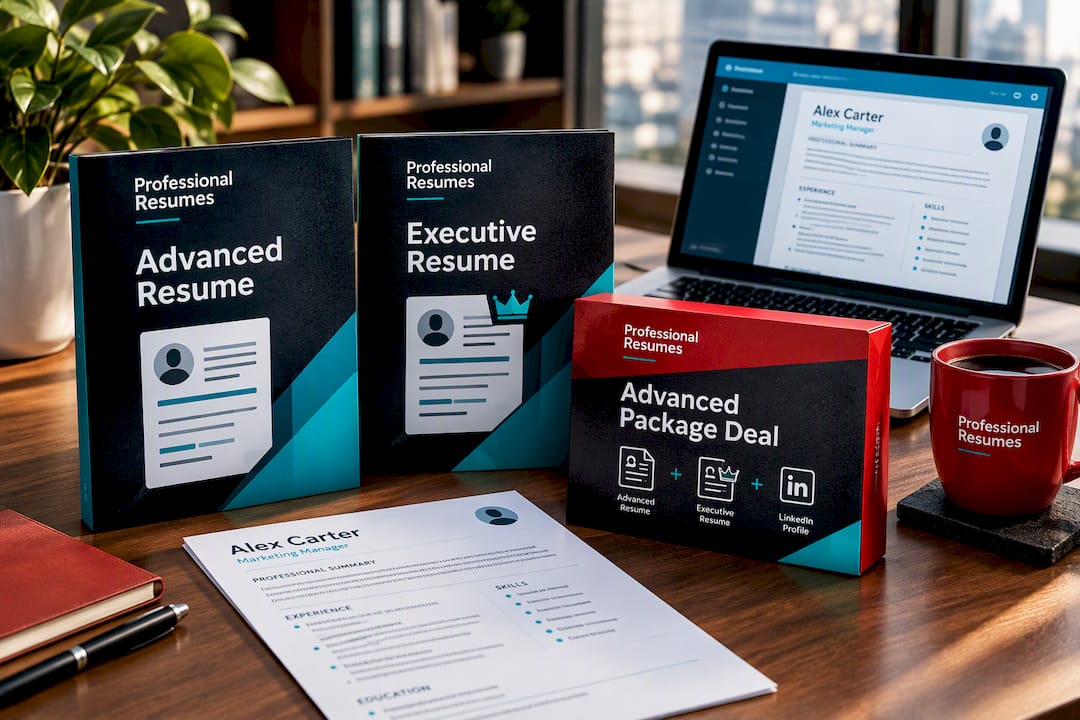
We offer three paid options built for exactly this stage of a marketing career. Our Advanced Resume suits a mid-to-senior marketing manager who needs achievement-driven bullets, ATS formatting, and a revision round built around their own metrics. Our Executive Resume is designed for VP and CMO-track candidates who need board-level framing, strategic language, and a document that holds up under scrutiny from a search committee. Our Advanced Package Deal pairs a resume rewrite with LinkedIn profile work, a practical choice for a candidate running an active search on both fronts.
- Advanced Resume: achievement-focused bullets, ATS formatting, and a revision round for mid to senior managers.
- Executive Resume: strategic framing and board-level language for VP and CMO-track candidates.
- Advanced Package Deal: a resume rewrite bundled with LinkedIn optimization for an active job search.
Every package starts with a consultation, so the document reflects the metrics only you know. Browse the full resume packages to compare options and find the one that matches where you are in your search.
FAQ
What is the role of a marketing manager in a business?
A marketing manager plans and oversees campaigns, budgets, and teams to drive measurable business outcomes such as leads, revenue, or brand awareness. The role increasingly combines strategic planning with strong technological and analytical skills, rather than campaign execution alone.
What is a good short summary for a resume?
A good summary names your level, your specialty, and one measurable result in a single sentence, such as “Growth marketing manager with five years driving a 30% lift in conversion rate.” It should sit at the top of the resume, before your work history, so a recruiter sees your strongest claim first.
What are top 6 skills for a resume?
For a marketing manager, the strongest skills to list are campaign strategy, data analytics, brand management, budget management, SEO and digital advertising, and cross-functional leadership. The Job Bank’s occupational profile lists SEO, analytics, and brand management among the competencies most commonly sought for these roles.
How to make a good marketing resume?
A good marketing resume opens with a results-focused summary, uses achievement bullets built on action, scope, and metrics, and lists skills that match the specialty you are applying for, whether that is brand, growth, or product marketing. It should also use ATS-friendly formatting: standard fonts, standard section headings, and no tables or graphics that a parser might misread.
How should I tailor my resume for a specific marketing manager job posting?
Read the posting for its essential qualifications, then match your strongest achievement bullets to each one using the employer’s own terminology. For government or large public-sector postings, prepare an unformatted resume version for online systems and answer screening questions with concrete examples rather than general claims.