
If your work history has a gap of a year or more, acknowledge it in your cover letter in one or two sentences, then move straight to what you offer the employer. If the gap is short, a few months at most, you can leave it out. The skill lies in saying just enough: a plain reason, evidence that you stayed current, and a clear reason why this role suits you now.
This guide explains when a gap needs a mention, where it belongs in the letter, how to word it for different situations, and how to keep the rest of the letter focused on value. It draws on Canadian provincial guidance, university career resources and Canadian hiring commentary.
TL;DR
- Gaps of one to four months generally need no mention. Gaps of a year or more are usually worth a brief, proactive acknowledgement.
- Give the reason in one sentence, say what you did or learned, and return to the job. Do not apologize or over-explain.
- Share only what is relevant. You are not required to disclose private medical or family details.
- Show that you stayed current: courses, micro-credentials, volunteering, professional contacts, industry reading.
- Keep your resume and cover letter consistent, so the dates and the explanation tell the same story.
Table of Contents
- Do you need to mention the gap at all?
- What recruiters are actually asking
- Where the gap belongs in the letter
- A three-part sentence that works
- Sample wording for common situations
- Show that you stayed current
- The rest of the letter matters more than the gap
- A full sample letter
- Mistakes that make a gap look larger
- Make your resume and cover letter agree
- Get your letter and resume written together
- Frequently asked questions
- Sources
Do you need to mention the gap at all?
It depends mainly on length. USC Online’s guidance says career breaks of one to four months generally need no mention in a cover letter, while a gap of a year or more is generally worth acknowledging briefly so that you answer the employer’s question before it is asked. For a gap of two years or more, the same source advises acknowledging it briefly and then returning to your strengths.
The practical reading of that guidance:
| Length of gap | What to do in the cover letter |
|---|---|
| Up to about four months | Usually say nothing. Let the resume dates speak. |
| Five to eleven months | Use judgment. Mention it if the resume makes it obvious or if it fell in the middle of your recent history. |
| One year or more | Acknowledge it in one or two sentences. |
| Two years or more, or several gaps | Acknowledge it briefly, and show what you did and how you stayed current. |
The table is a working rule, not a regulation. Some career advisers prefer to leave a gap out of the letter and address it in an interview instead, and the two approaches can both succeed. Our view is simple: if a reader will see a visible gap on your resume, a short, confident sentence in the letter removes the question before it becomes a doubt.
Canadian hiring commentary points the same way. The Globe and Mail reported in January 2025 that gaps are increasingly normalized, yet hiring leaders still respond well to applicants who explain proactively, and they are interested in what motivated the break and what the applicant learned from it. CBC Life, in an October 2024 piece, quotes Canadian resume experts who recommend transparency, noting that it sets a good precedent and shows you as an honest employee.
What recruiters are actually asking
A useful way to decide what to write is to answer the questions behind the gap. Alberta’s alis service lists the questions recruiters commonly have: why the gap happened, what skills you learned during it, whether further breaks are planned, why you want this organization, and how your experience benefits the employer.
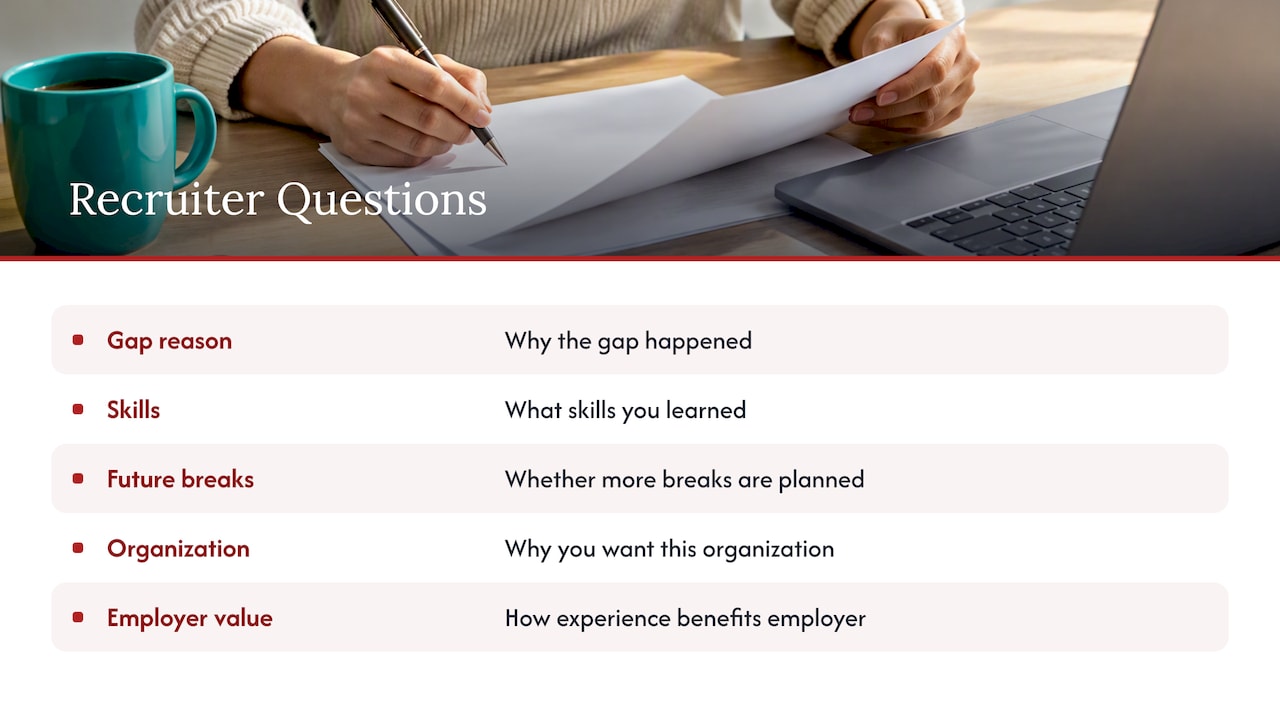
Notice that only the first question is about the past. The rest are about the future and about fit. That tells you how to allocate space in the letter: one sentence for the reason, and the rest of the letter for the employer’s needs. Ontario’s public-service writing guide takes the same position, centring the letter on the value you offer rather than on defending your chronology.
Where the gap belongs in the letter
A conventional cover letter has an opening, one or two body paragraphs and a close. The University of Toronto’s toolkit describes this as an opening that explains why you are writing, one or two main paragraphs with concrete examples, and a closing that thanks the employer and opens a path to an interview. The Government of Québec adds that a letter should be tailored to the employer and the job, and no longer than one page.
Within that structure, the gap works best in one of two places.
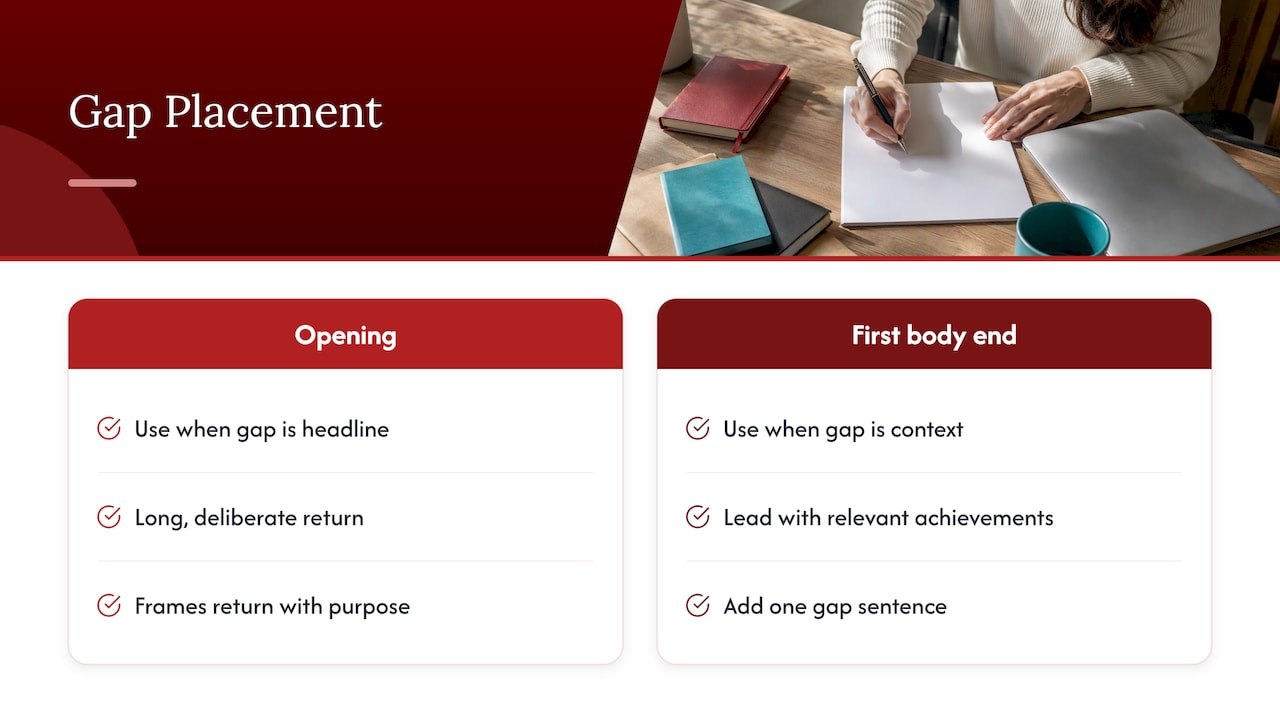
Opening paragraph, when the gap is the headline. If you are returning to work after a long break and the role is a deliberate return, say so in the first lines. This frames the letter as a return with purpose rather than a gap to be discovered.
End of the first body paragraph, when it is context. If the gap is a smaller part of your story, state your relevant achievements first, then add the gap as a single sentence. Your strongest evidence appears before the question does.
Avoid giving the gap its own paragraph. A paragraph signals a problem. A sentence signals a fact.
A three-part sentence that works
Hays Canada recommends a concise explanation with three parts: why you were away, what you did during that time, and why the opportunity is right for you now. It also advises being open without unnecessary personal detail, using positive language and not apologizing. That structure translates well from interviews to letters.
A template:
From [year] to [year], I [reason, stated plainly]. During that time I [one relevant activity or skill]. I am now returning to [field] and am particularly drawn to this role because [specific reason tied to the employer].
The structure is deliberately short. If you cannot say it in two sentences, you are probably including detail the reader does not need.
Sample wording for common situations
These are samples of phrasing, not scripts. Change them to fit your facts, and never include anything that is not true.
Caring for a family member
I stepped away from my operations role in 2022 to care for a family member. During that period I completed a supply chain certificate and kept in touch with my professional network. With that responsibility now resolved, I am ready to return full time, and the coordinator position at your distribution centre is a direct match for my background in logistics planning.
Alis notes that caregiving can develop problem-solving, multitasking and communication skills. You can draw on that framing without overstating it, but only name skills you can support with an example.
Health reasons, without the details
I took a planned leave from 2023 to 2024 to focus on my health, and I am fully ready to return. In that time I kept my accounting knowledge current through continuing professional development, and I am eager to bring it to your audit team.
USC’s guidance is to avoid sharing too much personal information and to frame the break as time for caretaking, personal growth, skill development or education. A diagnosis, a treatment plan or family conflict does not belong in a cover letter. “Health reasons” or “personal reasons” is an adequate and respectful limit.
Raising children
After leaving my marketing coordinator role in 2020 to raise my children, I spent the last year volunteering as communications lead for a local community association, where I grew its newsletter readership and ran its social channels. I am now ready to return to marketing full time, and your brand manager role draws on exactly the campaign work I enjoy most.
Only include a figure such as readership growth if you can verify it. A specific, true result is worth far more than a general claim.
Layoff followed by a long search
Following a restructuring at my previous employer in 2023, I used the time to complete a project management certification and to take on contract work in cost analysis. I am now looking for a permanent role where I can apply that experience, and your finance analyst opening fits that goal.
If the gap followed a layoff, say so directly and move on. Layoffs are common, and hiring managers know it.
Relocating or settling in Canada
After relocating to Canada in 2024, I focused on settling my family and on completing a Canadian credential recognition process in my field. I am now seeking a role where I can apply eight years of civil engineering experience to your infrastructure projects.
If you are an immigrant adapting your documents to Canadian expectations, the gap sentence is also a place to signal that you know the local market. Keep it factual and forward-looking.
Show that you stayed current
The most persuasive part of a gap explanation is evidence that your skills did not stand still. Alis suggests that useful evidence for a return-to-work letter can include an online course or micro-credential, volunteering related to your field, maintaining professional contacts and following industry news. CBC Life’s resume experts similarly point to volunteering, community work, formal training and micro-credentials completed during a break, along with showing how you maintained skills and industry knowledge.
The Ontario Public Service guide also advises including relevant volunteer work, self-study, training or education completed while out of the workforce, and pairing skills with specific examples.
To apply that in your own letter:
- Choose one or two activities that relate to the job, not a full list.
- Name the activity precisely (the course, the organization, the type of contract).
- State what it allows you to do for this employer now.
If you did none of these things, do not invent them. A truthful sentence about the break and a letter strong on your earlier achievements and your fit for the role is still a sound letter.
The rest of the letter matters more than the gap
The gap sentence takes ten seconds to read. The rest of the page decides the outcome. A few principles from Canadian career resources:
- Address a named person where possible. The CPA Alberta handbook advises avoiding generic content, excessive length, lack of personalization and the salutation “To whom it may concern”.
- Use the middle paragraphs for accomplishments. The same handbook recommends detailing accomplishments and explaining how you can solve the employer’s problem.
- Do not repeat the resume. The University of Ottawa’s guide says a letter should follow a narrative theme that highlights achievements and enthusiasm for the organization rather than restating the resume.
- Stay under one page. Columbia College Calgary’s career services advises keeping letters under a page, addressing them to a specific person and matching your skills to the job.
For a clear picture of how a short, personalized letter is built around value to the employer, an internship cover letter guide shows the same principles at a smaller scale.
A full sample letter
Here is how the pieces fit together on one page. It is an illustration, not a template to copy.
Dear Ms. Tremblay,
I am applying for the Senior Project Coordinator position at Northgate Construction. Over nine years I coordinated commercial building projects of up to $12 million, kept schedules within budget and trained junior coordinators on scheduling software.
From 2022 to 2024 I stepped away from full-time work to care for a family member. During that time I completed a project management certification and supported a community building project as a volunteer scheduler. I am now returning full time and am ready to contribute immediately.
Your posting emphasizes coordination across trades on tight timelines. At my last firm I rebuilt the weekly look-ahead process, which reduced rework caused by sequencing conflicts. I would bring the same discipline to your downtown projects.
Thank you for your time. I would welcome a conversation about how I can support your team, and I am available for an interview at your convenience.
Sincerely,
Jordan Lee
The gap occupies two sentences in the second paragraph. The opening names the role and the track record, and the rest of the letter is about what the employer needs. All figures and names are invented for illustration.
Mistakes that make a gap look larger
- Apologizing. Words such as “unfortunately” or “I know this looks bad” create the doubt you are trying to remove. Hays advises against apologizing for the gap.
- Over-sharing. Detailed personal history can be used against you, as USC notes. Keep it relevant.
- Being vague to the point of evasion. “Various personal pursuits” invites suspicion. A short, honest reason is better.
- Contradicting the resume. If the letter says you left in 2022 and the resume shows 2023, the discrepancy matters more than the gap itself. Our guide to resume fixes for career gaps in Canada explains how to present dates consistently.
- Spending half the letter on the gap. Ontario’s guidance treats the letter as a statement of value, not a defence of the timeline.
- Mentioning future breaks. Recruiters wonder whether more breaks are planned, as alis notes. If your situation is resolved, a phrase such as “ready to return full time” answers that.
Make your resume and cover letter agree
The cover letter explains, and the resume documents. If your resume lists the gap period as a line of its own (for example, “Career break, caregiving”), the letter can refer to it in a single sentence. If you list only years, as many Canadian resumes do, the letter provides the context the dates leave out. Either way, the facts must match.
If you are returning after a long absence, the layout of the whole application deserves attention. Our page on employment gap and return to work resume writing explains how we approach it, and if the return also involves a switch of field, our guide to career change cover letter rewrites shows the same principles applied to a different story.
Our perspective
In our experience writing for returning professionals, the gap is rarely what holds an application back. The weakness is usually the way the application is organized around it: a resume that gives a long break more visual weight than ten years of results, or a letter that spends its best lines justifying time away.
We approach a gap the way a retained search consultant would approach a sensitive point in a candidate’s file: state it accurately, briefly and without apology, then direct the reader to evidence of outcomes. That means working directly with your writer to decide which details are relevant, which are private and which achievements belong in the first lines of the page.
Our process is consultation-led for that reason. A template cannot know which of your activities during a break a particular employer will value, or how to phrase a career break for an audience that includes ATS screening and a human reader scanning in seconds. A personalized document can, and our clients are invited to have that conversation in confidence.
Professional
Get your letter and resume written together
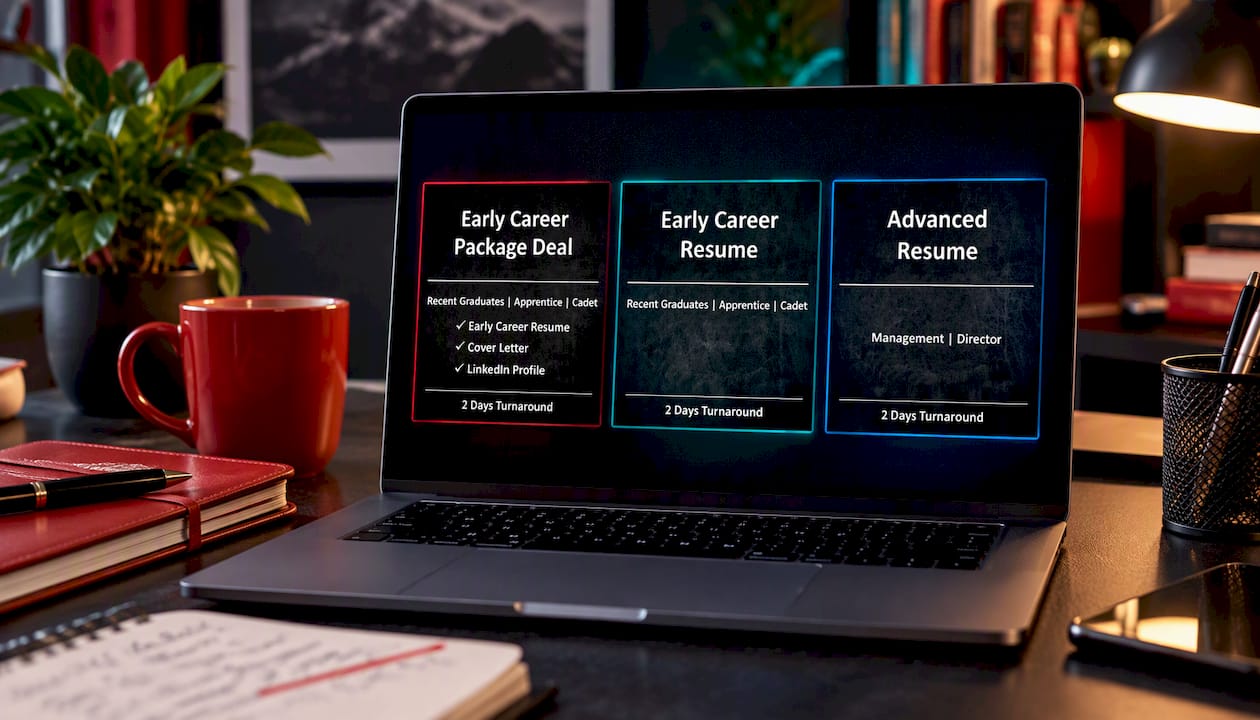
If you would rather not draft this alone, we write custom resumes and cover letters with a writer who learns your history first. Our Early Career Resume is $139, the Next Step Resume is $189, the Advanced Resume is $239 and the Executive Resume is $289, each a one-off price listed in our shop. For a first return to the workforce after a gap, the Advanced Resume is a common starting point for experienced professionals, and our Early Career Resume suits those earlier in their careers.
If your LinkedIn profile also shows the gap, our LinkedIn profile optimization service lets you present the same story across your resume, letter and profile.
Frequently asked questions
Should I explain a gap in my resume in a cover letter?
If the gap is a year or more, yes, briefly. USC’s guidance supports a short acknowledgement for longer breaks, while shorter gaps of one to four months generally need no mention. One or two sentences is enough.
How do I write a cover letter for an employment gap?
State the reason plainly, say what you did or learned during that time, and explain why you are ready and interested in this role now. Then spend the rest of the letter on your achievements and the employer’s needs, keeping to one page.
Is a gap in a resume a red flag?
Not by itself. Canadian hiring leaders quoted by the Globe and Mail describe gaps as increasingly normalized, though they still expect you to be ready to explain. An unexplained or inconsistent gap is more concerning than a clearly explained one.
How do I explain a two-year gap?
Acknowledge it in a sentence or two, name a relevant activity or skill that kept you current, and return to your strengths. Do not add personal detail beyond what the employer needs, and make sure the dates match your resume.
Sources
- How to Explain a Career Break in a Cover Letter, USC Online
- How to Address Gaps in Your Career, alis (Government of Alberta)
- Returning to Work After a Career Break, alis (Government of Alberta)
- How to update your resumé, CBC Life
- Gaps in resumes are becoming normalized, The Globe and Mail
- Writing a cover letter and resume, Ontario Public Service
- How to explain gaps in your CV, Hays Canada
- Writing a Cover Letter, Gouvernement du Québec
- Resume and Cover Letter Toolkit, University of Toronto
- The Resume and Cover Letter Guide, University of Ottawa
- Cover Letter and Resume handbook, CPA Alberta
- Career Services, Columbia College Calgary