

To quantify leadership impact, pair each leadership action with the measurable change that followed, state the scope of your role in it, and be honest about what you can and cannot claim. A hiring committee reading a senior resume is not looking for the size of your title. It is looking for evidence that organizations performed differently because you led them. This guide shows which numbers carry weight, how to write them into bullets, and how to handle figures you do not have or cannot disclose. Executives, healthcare leaders, public-sector applicants and professionals returning to work or adapting to the Canadian market will find the same method applies to each.
TL;DR
- Leadership impact is the result your leadership produced, not the responsibilities you held. Write it as context, action and result.
- Strong figures fall into four families: money, people, time and quality. Choose the two or three that matter most to the role you are targeting.
- Where exact numbers are unavailable, use scope, recognition or a conservative estimate, and label it as such.
- Credit what you contributed. A reader trusts a candidate who acknowledges other factors more than one who claims every result.
- Build your evidence file before the search begins, so that every figure on the resume can be explained in an interview.
Table of Contents
- What leadership impact means on a resume
- Four families of numbers that show leadership
- The bullet formula
- When you do not have exact figures
- Validating what you claim
- Presenting impact for your situation
- Our perspective
- Getting the evidence onto the page
- FAQ
- Sources
What leadership impact means on a resume
A responsibility describes what you were expected to do. Impact describes what changed because you did it. Western University’s career centre defines an impact statement as a Context, Action, Result bullet that goes beyond stating what you did by showing the measurable or meaningful result of your effort.
The distinction matters more as you rise. The University of Alberta’s Centre for Teaching and Learning notes that leadership is not defined by a title or administrative role. It is shown through visible contributions and evidence of influence, such as colleagues adopting your approach or practices changing, rather than a list of activities. A VP resume that says “oversaw a 60-person division” describes a seat. One that says what the division delivered under your direction describes leadership. Our guide on accomplishments versus responsibilities covers the same line in more detail.
Four families of numbers that show leadership
Most leadership results fall into one of four families. Searching your own record under each heading is the quickest way to find figures you had stopped noticing.
| Family | What to look for | Example of the form |
|---|---|---|
| Money | Revenue, margin, budget managed, cost removed, P&L ownership | “Delivered a 12% reduction in operating cost across three sites” |
| People | Team size, span of control, turnover, promotion rate, engagement | “Reduced voluntary turnover in a 40-person team from 18% to 11%” |
| Time | Cycle time, delivery ahead of schedule, time to hire, time to readiness | “Delivered the program three weeks ahead of schedule” |
| Quality and risk | Error rates, audit results, safety, patient or client satisfaction, compliance | “Closed all audit findings within one review cycle” |
The Center for Creative Leadership’s impact framework recognizes that results exist at individual, group, organizational and societal levels. Individual outcomes include promotions and improved communication. For a resume, this means you can legitimately show impact at more than one level: the people you developed, the team that performed, and the organization that benefited.
Outcomes that employers recognize are the ones they already track. Crestcom Canada suggests that organizations define two or three business outcomes before a leadership program starts, for example reducing voluntary turnover in manager-led teams by 15% within 12 months, improving engagement scores, or filling more leadership vacancies through internal promotion. Those same measures are a good shortlist of what a hiring executive will understand at a glance.
Scale also matters at the top. McKinsey reports that companies with top-quartile leadership effectiveness have, on average, 3.5 times greater total return to shareholders than bottom-quartile companies over three years. Boards read that sort of linkage closely, which is why enterprise-level claims need enterprise-level evidence.
The bullet formula
Every credible leadership bullet answers three questions: what situation you faced, what you did, and what followed. The Globe and Mail describes this as an impact portfolio built around context, analysis, solution and effect. Yale’s Office of Career Strategy recommends the Action, Project, Result format, with results expressed as a percentage improvement or increase.
A working structure for senior roles:
Action verb + what you led + scale or scope + result.
The form is simple. Where candidates go wrong is in the choice of verb and the missing scope. Compare:
- Weak: “Managed operations for a new commercial product line.”
- Stronger: “Directed a new commercial product line and launched operations from scratch in an underperforming region, growing customer engagement by 200% within six months.”
That contrast follows the pattern Forbes describes for senior resumes: the second version names the leadership action, the setting and the number. Forbes also notes that leadership evidence can come from volunteering, mentoring or deputizing, not only formal titles, which helps anyone whose recent roles did not carry a management title.
A second worked example, in Canadian healthcare:
- Before: “Responsible for staffing and quality on a 32-bed medical unit.”
- After: “Led a 45-person nursing team on a 32-bed medical unit, introducing a structured handover that cut overtime by 14% and lifted patient satisfaction scores from 78 to 86 in 12 months.”
The figures here are illustrations of the form, not benchmarks. Use only your own verified numbers. Our page on quantifiable resume metrics and the achievement examples with PAR templates give further patterns you can adapt.
Five questions that surface the numbers
If a bullet has no figure yet, ask of each role:
- How many: people, clients, sites, vendors?
- How much money: budget, revenue, savings?
- How much time: faster, earlier, shorter?
- What grew or shrank, and from what starting point?
- What improved as a percentage or score?
The starting point is the part most often forgotten. “Raised annual renewal to 86% from 72%” is the kind of before-and-after statement The Globe and Mail uses, and it is far more persuasive than “improved renewals.”
When you do not have exact figures
Senior leaders often lack clean data: a former employer holds the dashboards, the project predates the metrics, or the work was cultural rather than financial. There are four honest options.
Use scope instead of outcome. “Developed training materials used by 200+ employees across four regional offices” shows reach without claiming a result you cannot prove.
Use recognition. A promotion, a mandate extension, an appointment to a board committee or a request to replicate your model elsewhere is evidence that others judged your leadership to be effective.
Estimate conservatively, and say so. Words such as “approximately” or “over” are acceptable when you can reconstruct the range from records you hold. Do not round up.
Describe observed change. Adoption of your work by other teams, a changed practice or specific written feedback can stand in where a metric does not exist. Stop short of outcomes you cannot confirm.
Attribution: claim your contribution, not the whole result
Leaders rarely produce results alone, and experienced readers know it. The Office of the Auditor General of Canada’s guidance on contribution analysis states that definitive attribution is usually not possible. The aim is to reduce uncertainty by acknowledging other factors and presenting a credible link between actions and outcomes.
On a resume, that translates into verbs and phrasing that match your real role: “led,” “directed,” “sponsored,” “co-led with Finance,” “contributed to.” Prof. DeWan, quoted in The Globe and Mail, argues that linking your actions to changes in tracked numbers shows you think in terms of impact, even without claiming all the credit. Precision about your share protects you in an interview, where a recruiter or board member will ask how the number was reached.
Confidential figures
Some results cannot be disclosed: a pending transaction, a private company’s margins, a restructuring. Use ratios and ranges instead of absolutes. “Grew EBITDA margin by 4 points” or “delivered a nine-figure divestiture” signals scale without revealing protected data. If a figure is covered by a confidentiality agreement, leave it out rather than test the boundary.
Validating what you claim
A number on a resume should survive three questions: where does it come from, who else can confirm it, and how was it measured?
A peer-reviewed framework published in 2024 by Geerts and colleagues observes that balancing self-ratings with ratings from colleagues and supervisors increases credibility, because self-reports alone are unreliable. Although written about program evaluation, the principle applies to a candidate’s own evidence file: pair each self-reported figure with a second source such as a performance review, a 360 report, a board paper or a reference who can speak to it. The same paper notes that free-text feedback captures outcomes that are hard to quantify, such as increased confidence, so keep written testimonials alongside your numbers.
Build the file continuously, not in the week you start applying. Record:
- the baseline before you took the role or launched the initiative;
- the result at 6 and 12 months;
- the other factors in play, such as market conditions or a concurrent restructuring;
- who can confirm it.
The discipline of fixing measures first and tracking change over time is the same one organizations use for setting success measures and tracking change, and it works for a personal career record too. Heidrick & Struggles names defining success in tangible terms and diagnosing baseline data as the first two success factors for measuring leadership development. A baseline is what turns “improved” into a defensible figure.
Crestcom Canada also advises reporting in business language, such as a fall in turnover and the estimated replacement-cost saving, rather than reporting that most participants rated a program highly. The resume equivalent is plain: an outcome beats an approval rating.
Presenting impact for your situation
Executives preparing for a C-suite search. Lead with enterprise outcomes: P&L ownership, transformation led, shareholder or board-level results, and the size of the organization you ran. Keep each bullet to one result and place the strongest in the first third of page one. For structure, see what makes a powerful C-level resume and our executive resume writing tips.
Healthcare professionals. Use patient and operational measures that your sector already reports: wait times, readmissions, satisfaction scores, staffing stability, compliance results. Remove patient identifiers entirely and describe results at unit or program level.
Federal and public-sector applicants. Screening is often based on how clearly your resume demonstrates each stated criterion. Match the language of the posting and show, for each leadership requirement, the situation, your action and the result. Budgets managed, staff supervised and service-delivery outcomes are the natural measures.
Returning to work after a gap. Leadership evidence is not limited to paid roles. Volunteer boards, community programs and mentoring can carry the same structure of context, action and result. Put the figures from before the gap first if they are your strongest, and describe the gap plainly.
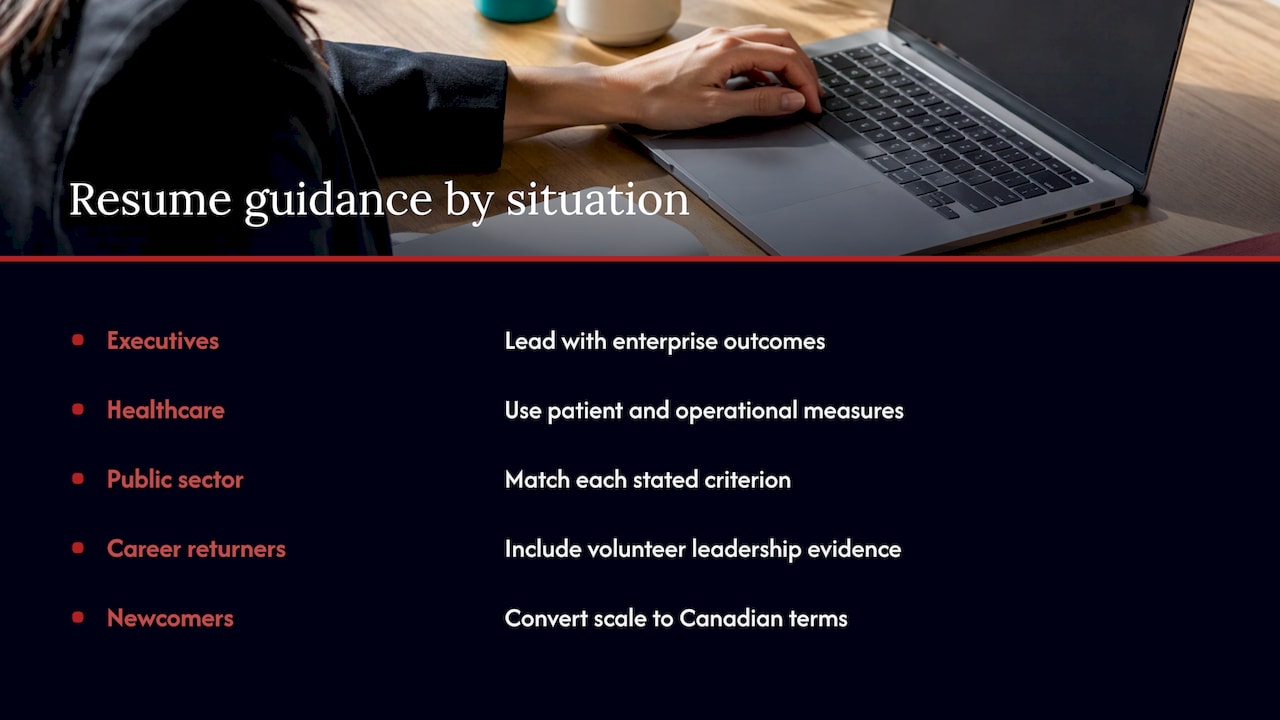
Newcomers adapting to the Canadian market. Convert currencies and organizational scale into terms a Canadian reader recognizes, for example the size of a team, the value of a budget in Canadian dollars with the original noted, and the sector. Replace titles that have no Canadian equivalent with the closest functional description.
Our perspective
Most executives we speak with have real results and a resume that hides them. The work is rarely inventing numbers. It is recovering the baseline, the scope and the decision you made, then writing them in a way that stands up to board-level scrutiny.
That is why our process begins with a consultation. Working directly with your writer, you go through each role and identify the outcomes that matter for the position you are targeting. The conversation is confidential, and the revisions that follow are there to sharpen the claims, not inflate them.
Our documents are written to be ATS-friendly and informed by industry trends, so the figures are read by the software first and by a person second. A well-quantified bullet serves both.
Professional
Getting the evidence onto the page
If you have the figures but not the framing, a writer can take the work off your hands. Professional Resumes offers resumes at four levels: Early Career at $139, Next Step at $189, Advanced at $239 and the Executive Resume at $289, each a one-off price. Every service includes extensive consultation and multiple revisions, and cover letters and LinkedIn profile optimization are available to carry the same results into the rest of your search.

For an executive search, the Executive Resume is designed for the leadership outcomes described above. You can see all options in the shop.
FAQ
How many numbers should a leadership bullet contain?
One or two. A bullet with scope and a single result is easier to read and easier to defend than one stacked with five figures. Put the result last so it is the final thing the reader sees.
What if my results were achieved by a team?
Say so, and describe your role precisely. Use verbs such as “led,” “sponsored” or “co-led,” and name the team size. Readers trust a candidate who states a contribution clearly more than one who claims the entire outcome.
Can I include estimates?
Yes, when you can reconstruct them from records you hold and you label them as approximate. Choose the conservative end of the range. Never present an estimate as an audited figure.
How do I handle confidential numbers?
Use percentages, ratios, ranges or descriptors of scale in place of the confidential value. If a nondisclosure agreement covers the figure, omit it and rely on scope or recognition instead.
Does ATS formatting change how I write these bullets?
Not the substance. Keep bullets in plain text, use standard section headings and include the role’s keywords in the same sentence as the result. The numbers then work for both the software and the human reader.
Sources
- Impact Statements, Western University Career Centre
- Polishing for impact: Demonstrating educational leadership, University of Alberta
- Leadership Development Impact Framework, Center for Creative Leadership
- How to Measure the ROI of Leadership Development Training, Crestcom Canada
- Leadership at Scale sampler, McKinsey
- An Impact Portfolio is essential to advancing your career, The Globe and Mail
- Writing Impactful Resume Bullets, Yale Office of Career Strategy
- 5 Ways To Highlight Leadership Skills In Your Resume, Forbes
- Addressing Attribution Through Contribution Analysis, Office of the Auditor General of Canada
- Maximizing the Impact and ROI of Leadership Development, PMC
- Leadership assurance: measuring the impact of leadership development, Heidrick & Struggles
- Press Release Analytics: What to Measure and How