
Use a reverse-chronological resume, one to two pages, formatted with a simple ATS-friendly layout. Write in Canadian English, format dates as YYYY-MM-DD, and use metric units throughout. Then take one action right now: choose that format, and rewrite your top bullet point as a single quantified achievement instead of a duty.
TL;DR:
- Canadian resumes should use the reverse-chronological format with a simple ATS-friendly layout, including dates in YYYY-MM-DD and metric units throughout.
- Tailoring your resume involves linking keywords from the job posting to your achievements and emphasizing relevant certifications or credentials according to the industry.
- Quantified achievement bullets using the CAR framework significantly improve callback rates by demonstrating measurable impact in past roles.
- Personal details such as photo, date of birth, Social Insurance Number, and full home address should be left off to prevent bias and protect privacy.
- Use of templates alone does not guarantee success; a tailored, achievement-driven resume aligned with the specific role and ATS requirements makes the difference.
Table of Contents
- What is the standard Canadian resume format?
- What sections belong on a Canadian resume?
- How do you optimize a resume for ATS in Canada?
- What does a strong Canadian resume look like?
- How do you write achievement bullets that stand out?
- Where can you find official Canadian resume templates?
- What personal information should you leave off your resume?
- How should you tailor your resume for different Canadian industries?
- Do you need a bilingual resume for Quebec jobs?
- What are the most common Canadian resume mistakes?
- Professional Resumes’ take: why a tailored approach beats a template
- Which Professional Resumes package fits your situation?
- Sources
- FAQ
What is the standard Canadian resume format?
Reverse-chronological is the format Canadian recruiters expect, and it is the one you should default to unless your career history gives you a specific reason not to. Each of the three main structures serves a different situation, and picking the wrong one is one of the fastest ways to get passed over before a human ever reads your bullets.
Reverse-chronological lists your most recent role first and works backward. It maps cleanly onto how Applicant Tracking Systems (ATS) parse work history, and it is the format most Canadian recruiters are trained to scan quickly. If your career has moved forward without major gaps, this is your format.
Functional groups your experience by skill category rather than by job or date. It can help candidates with employment gaps or a career change hide a thin work history, but it comes with real trade-offs: many ATS platforms struggle to parse skill-grouped content, and recruiters often view it as a signal something is being obscured.
Hybrid (sometimes called combination) opens with a skills or qualifications summary, then follows with a standard reverse-chronological work history. It is the strongest option when you are pivoting industries and need to put transferable skills front and centre, without losing the credibility that a clear job history provides.
Pick your format in under 30 seconds with this checklist:
- Steady career, no gaps over six months: reverse-chronological.
- Career change, re-entering the workforce, or a gap to explain: hybrid.
- Extensive freelance or project-based work with no single employer narrative: functional, but only as a last resort.
For most job seekers reading this, hybrid or reverse-chronological will cover it. Functional stays a niche option.
What sections belong on a Canadian resume?
Every Canadian resume needs the same core sections, built to a consistent format so both software and hiring managers can find what they need in seconds.
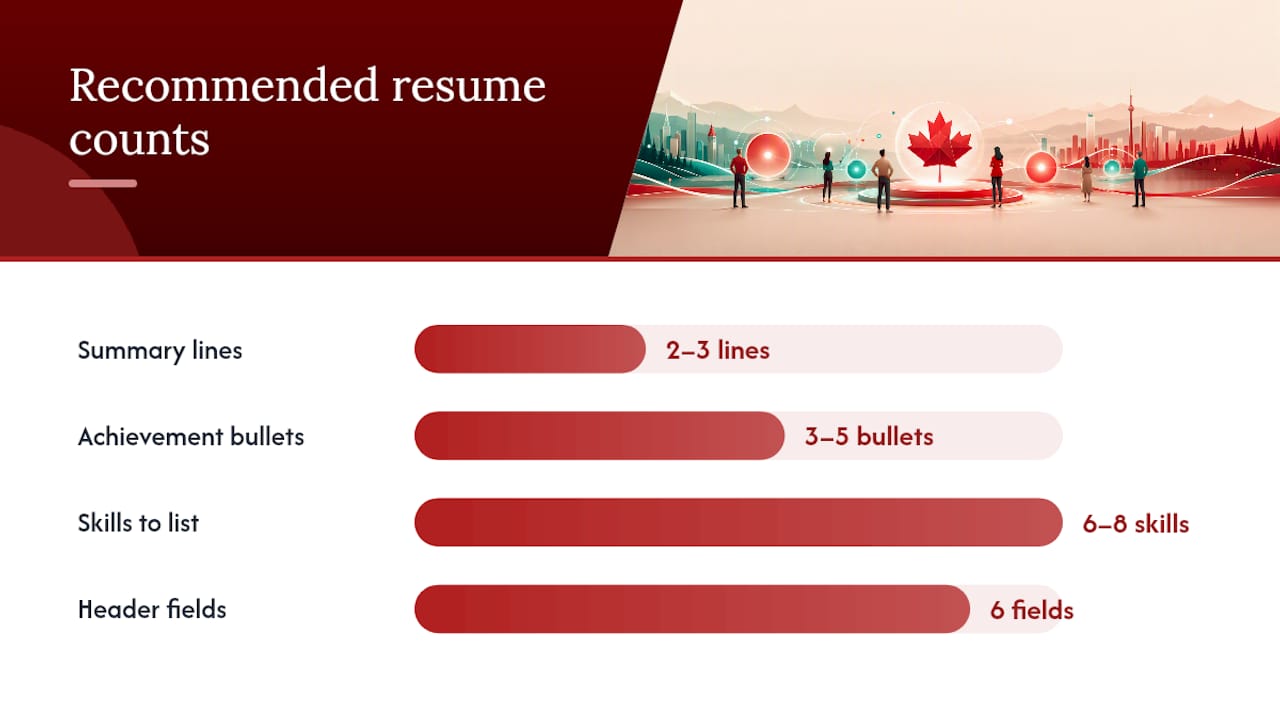
- Header. Include your full name, city and province, phone number, a professional email address, and your LinkedIn URL. Leave off your photo, Social Insurance Number, date of birth, and marital status. Canadian employers don’t expect or want them, and including them can actually work against you.
- Professional summary. Two to three lines summarizing your value, written for the specific role. Save the objective statement format for new graduates with no relevant experience yet. Everyone else should lead with what they’ve already accomplished.
- Work experience. For each role, list the employer, city and province, and dates in the YYYY-MM-DD format, and your job title. Follow with three to five achievement bullets built on the CAR (Context, Action, Result) or STAR framework.
- Skills. Choose six to eight skills that mirror the language in the job posting, not a generic list pulled from your last resume.
- Education. Recent graduates should place this section near the top, right under the summary; include your graduation date. Experienced professionals move it below work history and can drop the graduation year if it isn’t relevant.
- Extras. Certifications, professional licences, volunteer work, and languages spoken. Include these only when they strengthen your case for this specific role.
On formatting: keep margins at 1 inch, body text at 10 to 12 point, and headings at 12 to 14 point. Stick to a single-column layout, and save the file as a Word .docx rather than a PDF whenever the employer doesn’t specify a format, since ATS platforms parse Word files more reliably.
Pro Tip: Before you submit anything, read your resume out loud from the header down. If a section feels like it’s explaining rather than proving, it’s a duty, not an achievement, and it needs a metric.
How do you optimize a resume for ATS in Canada?
Start by pulling exact phrases from the job posting. Most postings repeat their most important requirements two or three times, and those repeated terms are what the ATS is scanning for. Drop those keywords into your summary, your skills section, and at least one achievement bullet, in language that matches, not a rough paraphrase.
Layout choices matter just as much as word choice. Simpler layouts without tables, columns, images, or graphics parse far more reliably than anything with visual flourishes, no matter how polished it looks to a human eye. Use standard section headings such as “Work Experience” and “Education” rather than creative alternatives like “My Journey” or “Where I’ve Been.” ATS software is matching against expected terms, not personality.
- Extract keywords from the posting and place them in your summary, skills list, and bullets.
- Avoid tables, columns, text boxes, and headers/footers; they often get skipped entirely during parsing.
- Name your file consistently: FirstName_LastName_Resume.docx works well and reads clearly to a recruiter’s inbox.
- Test your layout by pasting the resume into a plain text editor. If the section order breaks or bullets run together, simplify the formatting before you submit.
- Follow the employer’s stated file format instructions exactly; when none are given, Word is generally favoured for ATS parsing.
Pro Tip: One overlooked check: open your resume in Word and look for hidden formatting artifacts, especially leftover table borders or text boxes from an old template. These are invisible to you but can scramble how an ATS reads your content. A tool built around ATS-friendly resume structure can help you catch these before you hit submit, and the technique of matching your resume to a job posting quickly is worth bookmarking for every application you send.
What does a strong Canadian resume look like?
Seeing the format applied is more useful than reading about it in the abstract. Here’s how the same principles play out at two different career stages.
Mid-level example (Operations Coordinator, five years’ experience):
- Reduced monthly reporting time by 40% by redesigning the inventory tracking spreadsheet used across three warehouse sites.
- Managed a $250,000 annual procurement budget, cutting vendor costs by 12% through renegotiated supplier contracts.
- Trained and onboarded 15 new staff over 18 months, reducing new-hire ramp-up time from six weeks to four.
Entry-level example (recent graduate, marketing):
A tight two-line summary sits at the top, followed immediately by an education section (since the graduation date is recent and relevant), then a short work or internship history with quantified results wherever possible, even from part-time or volunteer roles.
A simple template outline to copy:
- Header: Name, City, Province | Phone | Email | LinkedIn URL
- Summary: Two to three lines tailored to the target role
- Skills: Six to eight bullet points, keyword-matched to the posting
- Work Experience: Employer, City/Province, YYYY-MM-DD to YYYY-MM-DD, Title, three to five bullets
- Education: Institution, credential, graduation date (YYYY-MM-DD)
- Extras: Certifications, languages, volunteer work
Save your draft as a .docx with a clear filename, and keep one master copy you tailor per application rather than editing the same file repeatedly. A strong career summary at the top does more work than people expect. It’s often the only part a recruiter reads closely on a first pass.
How do you write achievement bullets that stand out?
The CAR framework (Context, Action, Result) turns a flat job duty into proof of impact. Take “Responsible for customer service” and rebuild it: Context (a high-volume retail environment), Action (redesigned the return process), Result (“Cut average return processing time from 12 minutes to 7, across 40 transactions per shift”). The metric conversion matters here too: measurements should be in metric, and monetary figures should reflect the currency and scale of the actual role.
Lean on strong action verbs, “reduced,” “negotiated,” “launched,” “streamlined a process,” “generated,” and prioritize metrics tied to money, time, volume, or percentage change over vague scope statements.
- Cut filler words and adjectives that don’t add information.
- Prioritize your most recent and most relevant achievements first.
- Keep each role to three to five bullets; more than that dilutes the strongest ones.
- Read each bullet and ask: does this prove impact, or just describe a task?
Recruiters in Canada consistently favour quantified achievements over lists of responsibilities, which is why the same duty, written two different ways, can produce very different callback rates.
Where can you find official Canadian resume templates?
The Job Bank Resume Builder offers two starting templates: a traditional option for established job seekers and one designed for youth and recent graduates. It also lets you import job duties directly, which speeds up the first draft considerably.
If you’re applying to a federal public service role, use the Priority Administration résumé template instead. It has required fields and instructs applicants to list education and experience in chronological order, and skipping it can disqualify an otherwise strong application. Professional Resumes also breaks down how to prepare resumes for government and public sector roles if you want a deeper walkthrough of that process specifically.
What personal information should you leave off your resume?
Canadian privacy norms are stricter than what job seekers coming from some other countries expect, and getting this wrong can actually cost you interviews. Leave off your photo, date of birth, marital status, Social Insurance Number, and any health information. None of it is relevant to your ability to do the job, and including it can expose you to unconscious bias during screening, which is exactly what Canadian hiring practices are designed to reduce.
Your Social Insurance Number in particular should never appear on a resume under any circumstances. It’s only ever requested after a formal job offer, for payroll and tax purposes, and providing it earlier creates unnecessary identity theft risk with no upside for you.
Home address is another area worth rethinking. Full street addresses are becoming less common on Canadian resumes; city and province is sufficient, and it also protects your privacy if the document ends up shared more widely than you intended.
If you’re including a headshot on your LinkedIn profile, that’s a separate consideration from your resume itself, LinkedIn norms differ from resume norms here. But the resume document that lands in an ATS or a hiring manager’s inbox should stay strictly professional and free of identifying details beyond what’s needed to contact you: name, city, province, phone, email, and LinkedIn URL. That’s the full list.
How should you tailor your resume for different Canadian industries?
A resume that works for a construction project manager in Alberta won’t necessarily land the same way for a marketing coordinator in Toronto, and the differences go beyond just swapping industry buzzwords.
Trades and technical roles (construction, manufacturing, skilled trades) benefit from listing certifications and licences prominently, often right under the header, since these are frequently hard requirements rather than nice-to-haves. Metric measurements matter more here too: square metres, kilograms, litres, not their imperial equivalents.
Finance and professional services roles reward precision in your achievement bullets: exact percentages, budget figures, and scope of responsibility carry real weight, since these industries are used to evaluating candidates on quantifiable performance.
Healthcare applications should lead with credentials and licensing body registration status clearly and early, since compliance and verification are often the first thing a hiring manager checks before reading further.
Tech and startups tend to favour a slightly less formal tone and value a skills section that reads current, specific tool names and frameworks rather than broad category terms.
Regionally, Alberta and Saskatchewan’s resource sector still favours a fairly traditional, conservative format. British Columbia’s tech and creative sectors have more tolerance for a modern hybrid layout. Atlantic Canada’s smaller job markets often mean your resume competes in a tighter pool, where local references and community ties can matter more than they would in a larger city. None of this changes the fundamentals, reverse-chronological, ATS-friendly, quantified achievements, but it does change which details you emphasize first.
Do you need a bilingual resume for Quebec jobs?
If you’re applying for a position in Quebec, submit your resume in French unless the job posting is explicitly bilingual or English-specific. Quebec’s Charter of the French Language shapes hiring practices across the province, and a French-language resume signals both compliance with local norms and genuine interest in working there.
For genuinely bilingual roles, anywhere in Canada, not just Quebec, you have two solid options: submit two separate single-language resumes tailored to each, or build one resume that clearly lists both languages and your proficiency level in each (conversational, professional, fluent, native) within your skills section. What doesn’t work well is a resume that mixes English and French content throughout the same document; it reads as disorganized rather than genuinely bilingual, and it can confuse ATS parsing on top of that.
If French isn’t your first language but you’re applying in Quebec or for a federally bilingual role, be honest about your proficiency level rather than overstating it. Canadian employers in bilingual positions often test language skills directly during the interview process, and a mismatch between your stated fluency and your actual conversational ability creates a worse impression than an accurate, more modest claim would have.
What are the most common Canadian resume mistakes?
The single most common mistake is submitting the same resume to every job without tailoring it, when Canadian employers consistently expect the resume to speak directly to the specific posting, keywords and all.
Beyond that, a few patterns show up again and again:
Using American date formats or spellings is an easy tell that a resume wasn’t localized. “Color,” “organize,” and MM/DD/YYYY dates all read as slightly off to a Canadian recruiter, even if they can’t immediately articulate why.
Overloading the resume past two pages, especially for candidates under 10 years into their career, dilutes the strongest material instead of showcasing it. Including a photo, date of birth, or SIN, holdovers from formats common in other countries, can actively work against a Canadian application.
And finally, using a complex template with columns, graphics, or heavy design elements often backfires badly with ATS parsing, even when it looks impressive to the human eye. The safest resumes are also, generally, the most functional ones.
Professional Resumes’ take: why a tailored approach beats a template
A template gets your formatting right. It doesn’t know which of your achievements actually matters to the specific hiring manager reading your file, or how to phrase your industry’s language so it clears both the ATS and the recruiter’s expectations in the same pass. That’s the gap between a technically correct resume and one that gets callbacks: precision applied to your specific experience, not a generic formula. Resumes should be built around that gap, matching document strategy to the reader’s actual career stage and target role.
— Professional
Which Professional Resumes package fits your situation?
If you’ve been applying with a template and getting silence back, the format probably isn’t the problem. What likely is: your achievements aren’t quantified the way this guide describes, and your document isn’t tailored to how the specific employer’s ATS reads it. That’s the gap hands-on writing support can close, rather than relying on another template to fill in yourself.
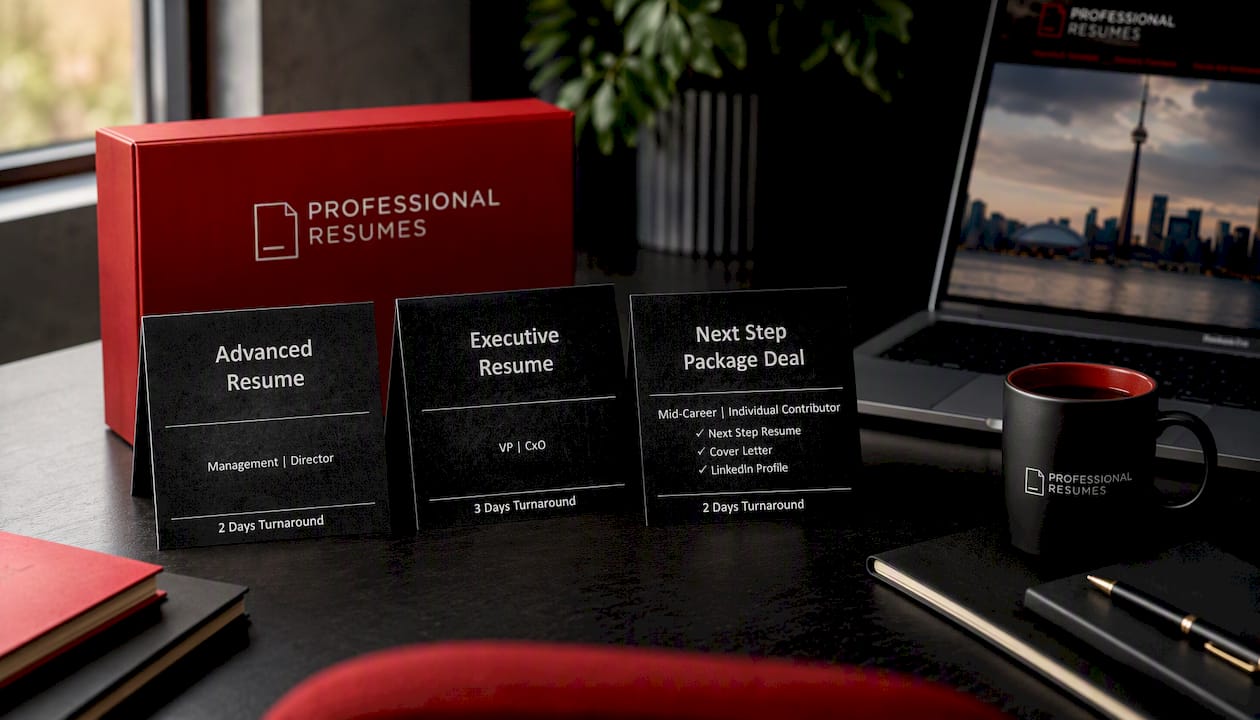
For mid- to senior-level professionals who need every bullet ATS-optimized and achievement-focused, the Advanced Resume package includes a full consultation and revisions built around the framework covered above. Executives who need strategic positioning at the C-suite or VP level, plus LinkedIn alignment to match, are better served by the Executive Resume package. If you want the resume, cover letter, and LinkedIn profile handled together as one coherent package, the Next Step Package Deal covers all three in a single engagement. Book a consultation to find out which one matches where you are in your search right now.
Sources
Skip the phrase “References available upon request” entirely; it’s outdated and adds nothing, since every recruiter already assumes you can produce references if asked. Canadian employers typically request references later in the hiring process, usually after a successful interview, not on the resume itself.
Prepare a separate reference sheet formatted like your resume header, with two to three professional contacts who supervised you directly. Always confirm each contact is willing to be listed and knows they may be called before you hand out their information. A former manager caught off guard by a reference call, without context on the role you applied for, rarely gives you a strong endorsement, no matter how well you actually performed.
Choose supervisors or senior colleagues over peers whenever possible, since Canadian hiring managers weight a former manager’s perspective more heavily than a coworker’s. If you’re early in your career and don’t have a workplace supervisor to list, a professor, coach, or volunteer coordinator who can speak to your work ethic is a reasonable substitute.
One exception: some government and unionized positions do ask for references directly on the application form rather than the resume. Read the posting instructions carefully. If it says to include them, follow that instruction exactly rather than defaulting to the general norm, since these processes are often more rigid about format compliance than a typical private-sector application.
- Canadian resume format guide | Monster
- Resume Builder | Job Bank
- How to write a Canadian resume and cover letter: Formats, templates, and tips | RBC
- Canada
FAQ
What is the recommended Canadian resume format?
A reverse-chronological resume, one to two pages long, with a simple ATS-friendly layout, Canadian English spelling, YYYY-MM-DD dates, and metric units, tailored to each specific job posting.
What is the 7-second rule for resumes?
It refers to the idea that a recruiter forms an initial impression of a resume within roughly the first seven seconds of scanning it, which is why your header, summary, and top bullet need to carry your strongest, most quantified information first.
Do Canadians use a resume or a CV?
Canadians use the term “resume” for job applications in almost all industries; “CV” (curriculum vitae) is generally reserved for academic, research, or medical roles where a longer, more detailed history is standard.
Should resume dates be in metric or a specific format?
Yes. Canadian resumes should use the YYYY-MM-DD date format and metric units for any measurements, distances, or quantities mentioned in your achievement bullets.
Can Professional Resumes help tailor my resume to a specific Canadian industry?
Yes. Professional Resumes builds industry-specific resumes, including for executives, healthcare professionals, engineers, and finance roles, with ATS optimization and consultation built into packages like the Advanced Resume.