
Easy Apply submits your stored profile and resume in a few clicks without leaving the job board. Apply sends you to the employer’s own careers site, where you attach a resume written for that role and answer the employer’s screening questions. For roles you genuinely want, the direct route is the stronger choice, and the quality of the resume you submit matters more than the button you press. A resume written for the role is what we help you build at Professional Resumes.
TL;DR
- Easy Apply keeps the whole application on the job board; Apply redirects you to the employer’s website or applicant tracking system (ATS), the software employers use to receive and sort applications.
- One 2025 tracking study of 10,247 applications found company websites produced more than twice the response rate of Easy Apply. It is a single study, not a controlled experiment.
- Use Easy Apply for good-fit, time-sensitive roles where your resume is already tailored. Use the direct route for roles you really want.
- Apply once per role, on one route only, and follow up with a short, specific message.
- Whichever button you press, the document the recruiter reads decides the outcome.
Table of Contents
- What each button actually does
- What the evidence says about response rates
- What happens to your application after you submit
- When to use Easy Apply and when to apply directly
- Make either application stronger
- Following up after you apply
- Where Professional Resumes fits in
- Our perspective
- FAQ
- Sources
What each button actually does
The two options look similar on a job posting, but they send your application to different places.
Easy Apply (the name varies by board) keeps the application inside the platform. On LinkedIn, it submits your profile details and a resume you have uploaded, often with a few screening questions. A recruiter in Toronto interviewed by the Globe and Mail described it as a profile-first process rather than a resume-first one, which makes it hard to tailor keywords for several different roles.
Apply takes you to the employer’s careers page or ATS. Indeed’s help centre explains the split on its own board: jobs hosted on Indeed have their status tracked in your account with confirmation emails, while jobs that redirect to an employer’s ATS carry no status updates from Indeed. The employer then communicates through its own platform or by email.
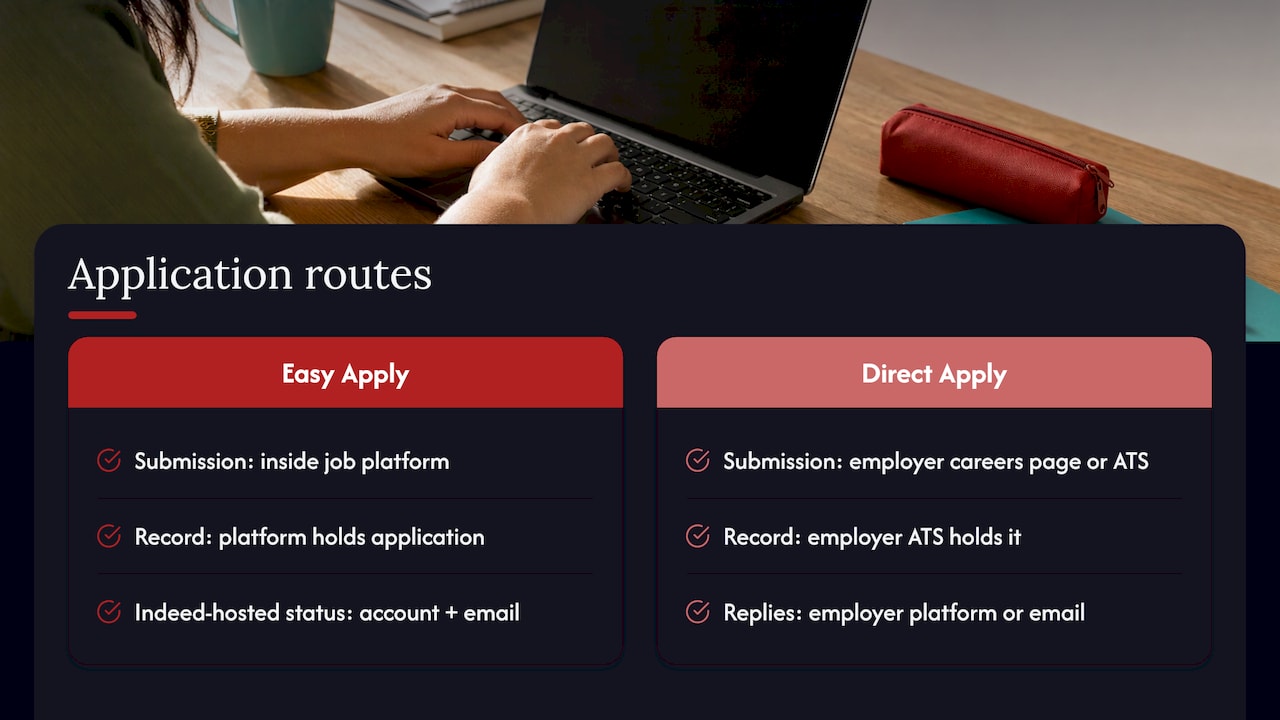
That difference shapes everything that follows: who holds your application record, which resume version is attached, and where replies arrive.
What the evidence says about response rates
The honest picture is that nobody publishes definitive figures, but the available data points in one direction.
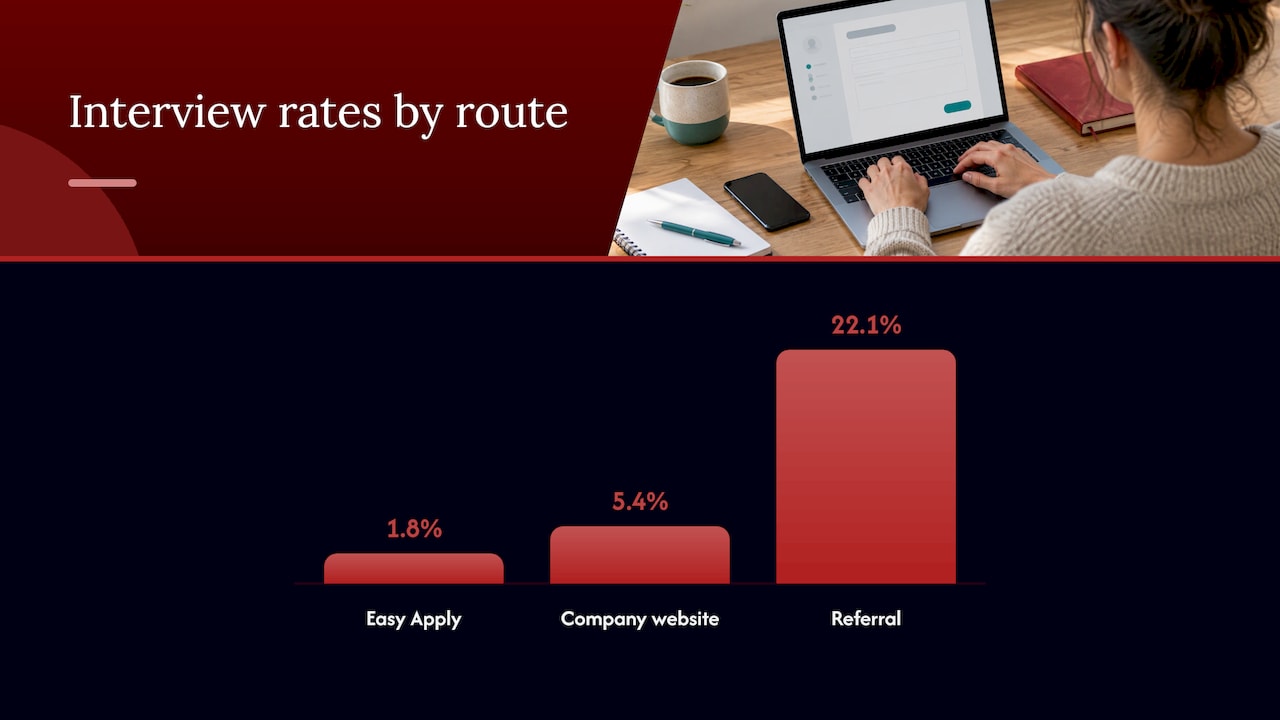
A study of 10,247 tracked applications from July to December 2025 recorded the following.
| Route | Response rate | Interview rate |
|---|---|---|
| Easy Apply | 4.2% | 1.8% |
| Company website | 11.7% | 5.4% |
| Referral | 38.2% | 22.1% |
Median time to a response was 9 days for Easy Apply and 6 days for company websites in the same study.
Two cautions keep these numbers in proportion. First, a comparison of the two routes notes that neither LinkedIn nor Indeed publishes data showing that one route gets more replies than the other. Second, another review of 2025 to 2026 benchmarks stresses that such figures are not controlled experiments and vary by role and seniority.
What the numbers do tell you is where the effort pays. The referral line is the largest gap in the table, and it reflects a person vouching for you. A direct application, which lets you attach a tailored resume and answer questions in full, sits in the middle. Easy Apply is the fastest and the most crowded.
Crowding is the practical reason. In the Globe and Mail’s reporting, more than half a dozen major Canadian employers declined to comment on whether Easy Apply candidates receive the same consideration as direct applicants. A career expert quoted there noted that Easy Apply postings are likely to draw more responses, which leaves recruiters less time for each one.
What happens to your application after you submit
With Easy Apply, the platform holds the record. You see a status in your account, and a recruiter sees a summary built from your profile alongside your resume. That is convenient, but your profile is the first thing read, so a thin headline or an outdated About section works against you.
With a direct application, the employer’s ATS holds the record. Your resume is parsed into fields, which means formatting matters: tables, text boxes, graphics and unusual headings can scramble what the system reads. Confirmation arrives in your own inbox, and you can reply to the same address later.
Do not do both. Guidance on this point is clear that submitting through a board and through the careers page creates a duplicate record the employer’s system has to reconcile, and the employer, not you, decides which copy survives. Pick the route that carries the employer’s own screening questions, and apply once.
One platform limit is also worth knowing. LinkedIn caps daily Easy Apply submissions and pauses accounts that submit too quickly, and it may lower a member’s daily limit if activity looks inauthentic. Volume is not a strategy the platform rewards.
When to use Easy Apply and when to apply directly
The choice depends on the role, the seniority and how ready your documents are.
| Situation | Better route | Why |
|---|---|---|
| Role is a solid fit, posting is new and closes soon | Easy Apply | Speed matters, and your resume and profile already match |
| Role is one you really want | Direct (Apply) | You attach a role-specific resume and answer custom questions in full |
| Executive, director or C-suite role | Direct, plus outreach | Senior hiring runs through recruiters and networks, not a form alone |
| Healthcare, education or government posting | Direct | These employers typically run their own portals with required fields |
| Application asks for unusual documents or long answers | Direct | The board form rarely accommodates them |
| You want confirmation and replies in your own inbox | Direct | Easy Apply replies stay inside the board |
The comparison above follows one practical rule from the sources: use quick-apply when the role fits and your documents are already tailored for it, and go to the company site first for roles you want most.
If you are employed and searching quietly
Easy Apply is tied to your LinkedIn profile, and sudden profile changes are visible to your network. The Globe and Mail piece warns that abrupt activity or a headline aimed at a different role can alert a current employer. If you are searching discreetly, which is common among executives, a direct application with a resume sent outside the platform keeps more under your control. Profile settings and a measured update schedule help as well.
If you are re-entering the workforce or new to Canada
These candidates are the ones most at risk from profile-first applications. A gap, a foreign employer name or credentials unfamiliar to a Canadian recruiter are easy to misread in a short profile summary. A direct application lets you present a resume that frames the gap, translates international titles and credentials into Canadian terms, and attaches a cover letter that explains the move. That context is difficult to supply through a one-click form.
Make either application stronger
The button is the smaller decision. What gets read is your resume, so these steps apply on both routes.
- Read the posting and mirror its language honestly. Pull the required skills, tools and credentials from the posting and use the same terms where they accurately describe your work. ATS software and recruiters both scan for them.
- Lead with outcomes. State what changed because of your work: revenue, cost, patient or client results, team size, scope of budget. For executives, that means P&L ownership, transformation led and results presented at board level.
- Keep formatting plain. Use standard headings, a single column and a standard font. Avoid text boxes, graphics and tables that an ATS may misread.
- Keep one master resume and make a version per role. Easy Apply works best when the resume stored on your account is already close to the role family you are targeting.
- Align your LinkedIn profile. On Easy Apply, the profile is read first. Your headline, About section and most recent roles should match your resume. We cover this in our guides to LinkedIn headline examples and the LinkedIn About section, and adding your LinkedIn URL to your resume keeps both documents connected.
- Answer screening questions completely. Short, specific answers beat blanks and one-word replies, particularly on direct portals where the answers are searchable.
- Add a cover letter when the route allows it. Direct applications usually have a field for one, and it is where you address a gap, a career change or a relocation. See our career change cover letter rewrites for working examples.
If you are targeting a particular market, tailoring has local detail too. Our guides on high-demand jobs in Toronto and Vancouver and on remote jobs in Canada show how to adjust a resume to each.
Following up after you apply
A follow-up separates a direct application from a lost one, and it is available to you on both routes if you can identify a contact.
One guide on follow-ups suggests waiting about two weeks after a portal application, keeping the email under 80 words, naming the role and application date, and adding one sentence on fit. If you send a second message, it suggests waiting 7 to 10 business days and sending it only if it adds something new.
A Canadian university career service recommends contacting the hiring manager on LinkedIn after you submit, with a brief note that reaffirms interest and highlights your most relevant skills. This is the step that Easy Apply users skip most often, because the application feels finished once the confirmation appears.
Where Professional Resumes fits in
Easy Apply, direct applications and recruiter outreach all depend on the same two documents: a resume that reads well to a person and parses cleanly in an ATS, and a LinkedIn profile that supports it. We write both, working directly with you through consultations and revisions, with ATS-friendly formatting and industry-specific resumes for executives, healthcare professionals, engineers, finance and education.
Our resume packages are priced by career stage: the Early Career Resume is $139, the Next Step Resume is $189, the Advanced Resume is $239 and the Executive Resume is $289, each a one-off fee. You can compare them on our resume packages page, or go straight to the Executive Resume if you are preparing for a senior search. Our LinkedIn profile optimization service covers the profile that Easy Apply puts in front of recruiters first.
Our perspective
Most job seekers treat Easy Apply versus Apply as a question about speed. We treat it as a question about which document the reader will see first.
On Easy Apply, a recruiter sees your profile, so the headline, summary and recent roles carry the application. On a direct application, the recruiter or the ATS sees your resume, so the structure, keywords and outcomes carry it. Either way, the application succeeds or fails on whether a specific document speaks to a specific role.
That is why our work starts with a consultation rather than a template. We look at the roles you are pursuing, the way employers in your field describe them and the results that make your case, then write the resume, cover letter and LinkedIn profile to match. For executives, that means precise, discreet positioning that stands up to board-level scrutiny. For people returning after a gap or adapting experience to the Canadian market, it means presenting the experience in terms a Canadian hiring team recognizes.
Used well, Easy Apply is a convenient way to submit a strong application quickly. Used with a prepared resume and an aligned profile, it stops being a gamble.
Professional
FAQ
Is LinkedIn Easy Apply the same as applying on the company website?
No. Easy Apply keeps the application on LinkedIn and submits your profile and resume there. The Apply button sends you to the employer’s website or ATS, where the employer holds your record and replies come from its own system or email.
Should I apply through both routes to be safe?
No. Submitting twice creates a duplicate record the employer’s system has to reconcile, and the employer decides which copy is kept. Choose the route that carries the employer’s screening questions and apply once. For roles you really want, add a short message to the hiring manager instead of a second application.
Does applying directly really get more interviews?
In one tracking study of 10,247 applications, company websites produced an interview rate of 5.4% against 1.8% for Easy Apply. The study is not a controlled experiment, and results vary by role and seniority, so treat the gap as a strong indication of where tailored effort pays.
Is Easy Apply a good option for executives?
It works for time-sensitive postings that match your background closely, but senior roles are more often filled through recruiters and networks. For those, a tailored resume, an aligned LinkedIn profile and direct contact usually serve you better than a form submission. Our LinkedIn for executives guide covers the profile side.
How many Easy Apply applications can I send a day?
LinkedIn applies a daily cap and a speed limit, and may lower a member’s limit if activity looks inauthentic. The exact numbers are set by the platform and can change, so aim for a smaller number of well-matched applications rather than the maximum.
Sources
- How job seekers can make the most of online tools that streamline the job search (The Globe and Mail)
- About Jobs on Indeed: What You Need to Know (Indeed Help Centre)
- Easy Apply vs Company Website: Which Gets More Interviews?
- Easy Apply or the company website: where should you apply?
- The Doom Loop Has a Winner, and It’s Not the Person Who Automated 200 Applications
- Check Which Path Reaches the Employer, Then Apply Once
- Follow-up email after applying: when, and to whom
- Why You Should Always Follow Up with Employers (Yorkville University Career Services)