
The strongest executive resumes in 2026 open with a branding headline and a three or four line executive summary that states scope, then anchor every experience bullet to a quantified outcome. Two pages remain standard; three pages is acceptable only when board or advisory history genuinely earns the space. The examples, structure, and role-specific templates below show exactly how to build one.
TL;DR:
- Resumes should open with a clear positioning statement and a strong signature achievement, followed by quantifiable results that support each experience bullet.
- Tailor each role’s achievements using the CAR formula to highlight context, action, and measurable outcomes, avoiding generic duty descriptions.
- Executive resumes must focus on enterprise value, capital efficiency, operational scale, or strategic milestones, depending on the specific C-suite role.
- Keep the length to two pages, with three pages acceptable for extensive governance or publication histories, and avoid complex formatting that can interfere with ATS parsing.
- Personal branding and soft skills should be demonstrated through outcomes and consistent messaging across LinkedIn, resume, and executive bio.
Table of Contents
- Executive resume examples by role: templates worth stealing
- What structure should an executive resume follow?
- How do you turn job duties into board-level achievements?
- Which resume evidence matters for each C-suite mandate?
- How do you keep an executive resume ATS-friendly?
- When does it make sense to hire a professional executive resume writer?
- How should personal brand and soft skills show up on the page?
- Where do affiliations, awards, and speaking engagements belong?
- How do you explain a career gap at the executive level?
- What mistakes show up most often in executive resumes?
- A resume writer’s take on what actually gets executives interviews
- Get your executive resume built by Professionalresumes
- Sources
Executive resume examples by role: templates worth stealing
Every one of these examples follows the same logic: lead with scope, prove it with one signature number, and let the rest of the document support that claim rather than compete with it. That principle holds whether you are writing CEO resume samples for a private equity board or building senior leadership resume examples for an internal VP promotion.
CEO example. Headline: “Transformation-Focused CEO | $340M Revenue Growth | Three Successful Exits.” The signature metric is enterprise value created, not headcount managed.
CFO example. Headline: “CFO | Capital Markets & M&A | Led $220M IPO Readiness Program.” CFO resumes live or die on capital efficiency. Borrowable bullet: “Restructured working capital processes, freeing $28M in trapped cash and reducing days sales outstanding from 62 to 41 within 14 months.” Finance leaders should never bury EBITDA improvement inside a paragraph. Put it in the first line of the bullet.
CTO example. Headline: “CTO | Cloud Migration & Engineering Scale-Up | 0 to 140 Engineers in 3 Years.” Technology executives often over-index on tools and under-index on business outcomes.
VP resume examples (Sales). Headline: “VP Sales | National Team Leadership | $60M to $110M in Four Years.” Borrowable bullet: “Scaled the national sales organization from 22 to 58 reps, restructured territory design, and grew annual recurring revenue from $60M to $110M without increasing cost per acquisition.”
Board CV example. Headline: “Board Director | Audit Committee Chair | Governance Across Regulated Industries.” Borrowable bullet: “Chaired the audit committee through a CEO transition and a regulatory investigation, preserving investor confidence and a clean audit opinion in both fiscal years.”
A note for Canadian readers adapting these executive CV samples: keep currency in the denomination you actually earned it in, and use metric units where your industry expects them. A search firm reviewing senior executive resume examples from a Toronto candidate does not need US dollar conversions or imperial measurements retrofitted onto a Canadian track record.
None of these are meant to be copied word for word. They are structural templates. Swap in your own scope, your own signature number, and your own mechanism, and the format still holds because the format is what recruiters are actually scanning for, according to Page Executive’s 2026 guidance on executive CVs, which stresses a leadership narrative over a list of duties.
What structure should an executive resume follow?
The skeleton matters more than the styling. Search firms and internal talent committees read hundreds of these documents a year, and they have learned to expect information in a specific order.
The headline sits directly under your name and contact information. It is not a job title. It is a positioning statement, typically eight to twelve words, that names your functional focus and one proof point. Below it, the executive summary runs three to four lines and answers three questions fast: what scope have you run, what is your signature achievement, and what kind of mandate are you suited for next.
Recommended section order:
- Branding headline (one line, bolded)
- Executive summary (3 to 4 lines, no bullets)
- Core competencies (8 to 12 keyword-rich terms, often in a two or three column list)
- Professional experience (reverse chronological, each role opens with scope, then 4 to 6 achievement bullets)
- Governance and board experience (a dedicated subsection if you hold or are pursuing board seats)
- Education, credentials, and select affiliations
Governance deserves its own subsection rather than a buried line item once you are actively seeking board work. Resumory’s guide to executive resume structure makes the same point: board experience needs to be surfaced explicitly, not folded into a general operating role.
On length, two pages is the working standard for executive resumes, and three pages is acceptable when board, advisory, or extensive publication history genuinely adds evidentiary weight, a norm reflected in most current professional resume templates. Keep formatting conservative: one serif or clean sans-serif font, 10.5 to 11 point body text, generous white space, and bullets that run one to two lines each. Avoid text boxes, columns built with tables, and decorative graphics, all of which can scramble parsing on the far side of an applicant tracking system.
Pro Tip: Write your executive summary last, after your bullets are finished. It is far easier to summarize achievements you have already quantified than to write a summary in the abstract and then hunt for evidence to match it.
A simple skeleton to copy directly:
For a deeper walk-through of how each section earns its place, Professionalresumes has published detailed executive resume writing tips that expand on sequencing and formatting decisions specific to leadership-level documents.
How do you turn job duties into board-level achievements?
Metrics are the currency executive readers trade in, and there are really only four categories worth using: financial impact (revenue, EBITDA, margin, cost reduction), operational scale (headcount, geography, sites, systems), strategic milestones (M&A, IPO readiness, market entry), and leadership outcomes (retention, succession, culture turnaround measured by a number, not an adjective).
The conversion formula that works reliably is CAR, sometimes extended to CARL: Context (what situation you inherited), Action (what you specifically did), Result (the measurable outcome), and optionally Learning (what it enabled next).
Before and after, side by side:
-
Before: “Oversaw finance function for a mid-size manufacturer.”
After: “Led a 14-person finance function through a private equity recapitalization, reducing close time from 12 days to 4 and supporting a $65M refinancing.” -
Before: “Managed marketing team and brand strategy.”
-
Before: “Responsible for operational efficiency initiatives.”
Career-guidance sources consistently find that before-and-after rewrites like these improve reader comprehension and recall far more than duty statements do, which is why annotated executive CV samples remain popular as models to work from.
Run every finished bullet through a short audit before it goes in the document: does it name a starting point, does it name a mechanism, does it name a number, and could a stranger repeat the achievement back to you after one read. If any answer is no, rewrite it.
Which resume evidence matters for each C-suite mandate?
One core resume rarely serves every mandate well. CEO, CFO, CTO, COO, and CMO searches each weight evidence differently, and Indeed’s guidance on C-level resume samples confirms that strategic decision-making, stakeholder management, and domain-specific outcomes are judged against different benchmarks depending on the seat.
CEO. Prioritize enterprise value creation, stakeholder and investor relationships, and transformation outcomes.
- “Led a turnaround that returned a $95M business to profitability within 18 months, restoring investor confidence ahead of a planned exit.”
- “Built and presented the five-year strategic plan that secured board approval for a $40M capital raise.”
CFO. Prioritize capital markets experience, cost structure discipline, and audit or compliance credibility.
- “Managed relationships with three institutional lenders through a $150M refinancing, securing terms 80 basis points below market.”
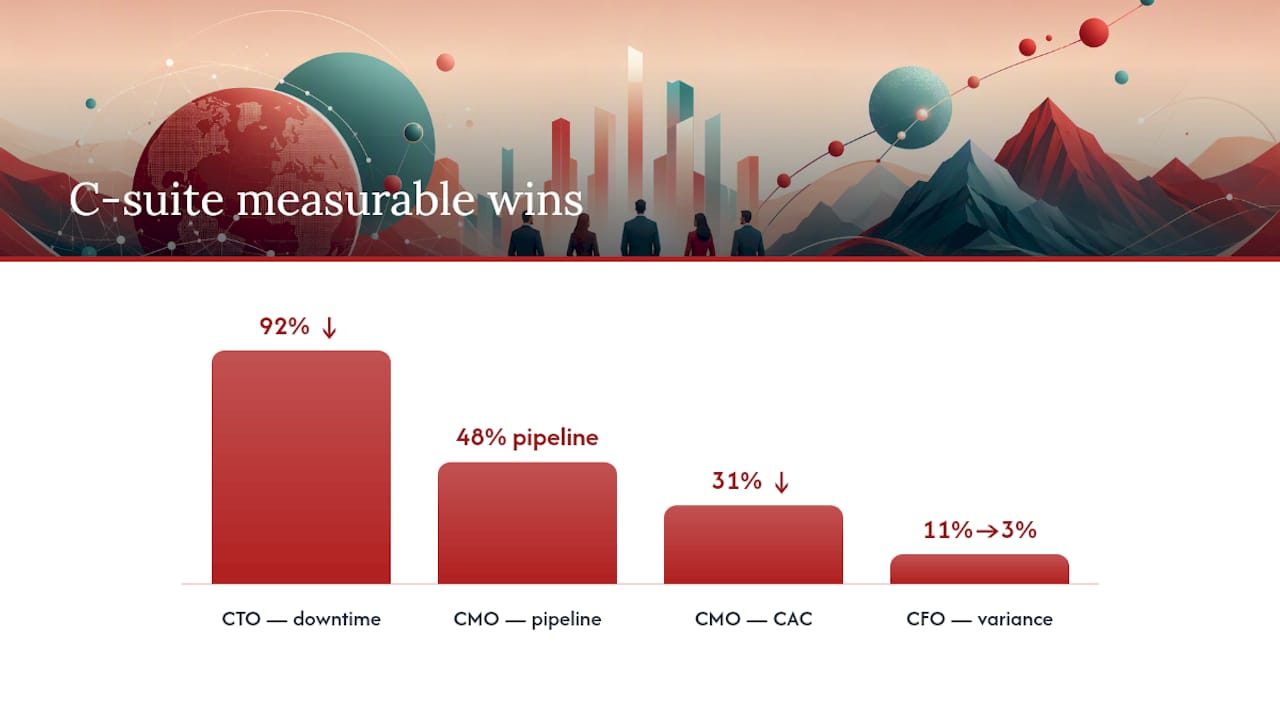
- “Implemented a rolling forecast model that cut budget variance from 11% to 3% across six business units.”
CTO. Prioritize technical scaling, security posture, and the business translation of engineering decisions.
- “Reduced platform downtime by 92% while scaling engineering headcount threefold, without increasing infrastructure spend proportionally.”
- “Led SOC 2 certification effort, closing a compliance gap that had blocked two enterprise sales cycles.”
COO. Prioritize operational scale, process standardization, and margin discipline across sites or geographies.
- “Consolidated procurement across nine business units, capturing $6.2M in annual savings within the first year.”
CMO. Prioritize pipeline contribution, brand equity, and demand generation efficiency.
- “Cut customer acquisition cost by 31% while growing marketing-sourced pipeline to 48% of total bookings.”
A dedicated board CV becomes worth building the moment you are actively pursuing outside directorships, separate from an operating role search. That document leads with governance experience, committee assignments, fiduciary training, and any regulatory or audit exposure, and it typically drops most operational bullet detail that a board search committee will not weigh heavily.
Hybrid or cross-functional mandates, such as a Chief Operating Officer who also owns technology, need a hybrid headline that names both domains explicitly rather than forcing a reader to infer the second function from buried bullets. Professionalresumes’ guide to powerful C-level resumes covers this kind of dual-mandate positioning in more depth.
How do you keep an executive resume ATS-friendly?
Applicant tracking systems parse executive resumes the same way they parse any other resume, and the failure points are predictable. Standardized job titles need to appear near the top of each role entry, not buried in a paragraph, and core keywords (your function, your industry, your certifications) belong in both the core competencies section and naturally within bullet text, so the resume reads well for a human and scans cleanly for software.
Headings should use conventional labels: “Professional Experience,” not “My Journey”; “Core Competencies,” not “What I Bring.” Formatting guidance on 2026 executive templates warns specifically against embedding text inside images or complex multi-column tables in key sections, since many parsing engines skip or scramble that content entirely, a risk flagged in StylingCV’s 2026 executive resume template guidance.
Quick do’s and don’ts:
- Do use standard section headers and reverse chronological order.
- Do repeat your target job title language naturally across the summary and experience sections.
- Don’t place contact information or headline text inside a header/footer field, which some systems fail to read.
- Don’t use text boxes, columns built as tables, or icons to convey information a reader needs.
Pro Tip: Save and submit your executive resume as a .docx file unless the posting explicitly requests a PDF. Some older ATS platforms still parse Word documents more reliably than PDFs, particularly for two-column layouts.
When does it make sense to hire a professional executive resume writer?
Adapting one resume yourself for a single application is manageable. Rebuilding your entire narrative for a board search, a confidential CEO mandate, or a cross-industry pivot is a different task entirely, and it is where most self-written documents lose precision under time pressure.
A professional service earns its cost when the stakes involve retained search scrutiny, board-level positioning, or a career pivot that needs someone outside your own narrative to identify which achievements actually matter to the next employer. Professionalresumes builds documents for exactly that situation, working directly with clients through consultation and revision rather than templating a generic format on top of a career history.
The service tiers map to distinct needs:
- Executive Resume for a focused rebuild of a single, tailored document ahead of a specific search.
- Executive Package Deal for candidates who also need a matching cover letter and a LinkedIn profile aligned to the same narrative.
- Advanced Resume for board-level or highly complex mandates that require deeper documentation and extensive prior history.
Reviewing Professionalresumes’ case studies and samples is a useful first step before a consultation, since it shows how a working document is structured once an existing career history has been reorganized around measurable outcomes rather than chronology alone.
How should personal brand and soft skills show up on the page?
Soft skills only land on an executive resume when they are demonstrated through outcomes, never when they are listed as adjectives. “Strong communicator” means nothing to a search committee. “Presented quarterly performance directly to the board and secured unanimous approval for a $30M capital plan” proves the same skill through evidence.
Personal brand works the same way. Your headline and executive summary are the brand statement, not a separate “About Me” section. If you are known for turnarounds, your entire document should read like turnaround evidence, from headline through your final bullet. If you are known for scaling teams, headcount growth numbers should appear in nearly every role entry.
Consistency across platforms matters more at this level than at any other career stage. A search firm or board recruiter will check your LinkedIn profile within minutes of receiving your resume, and a mismatch between the two, different framing, different metrics, a different apparent specialty, reads as a lack of self-awareness rather than versatility. Professionalresumes’ guide to personal branding for executives walks through how to align a resume, LinkedIn profile, and executive bio around one coherent narrative.
Leadership philosophy statements, if you include one at all, belong in a single line inside the summary, not a standalone paragraph. Executive readers want proof of judgment, not a mission statement.
Where do affiliations, awards, and speaking engagements belong?
These credentials matter, but they belong at the bottom of the document and only when they reinforce your positioning rather than pad the page. A board seat on an industry association is relevant evidence for governance credibility. A decade-old volunteer role with no connection to your target function usually is not, and cutting it makes room for something that matters more.
List professional affiliations by name and role, not just membership: “Board Member, Canadian Manufacturers & Exporters” carries more weight than “Member, CME.” Awards should include the granting body and the year, and should be trimmed to the two or three most relevant to your current target rather than a full career list. Speaking engagements are worth including when they signal domain authority, a keynote at an industry conference on supply chain resilience matters if you are targeting a COO role in logistics, but a single guest podcast appearance usually does not carry the same weight and can be left off.
Keep this section to five or six lines total. If it runs longer, the resume starts reading like a curriculum vitae padded for length rather than a focused executive document, and it starts competing with your experience section for the reader’s attention rather than supporting it.
How do you explain a career gap at the executive level?
Career gaps read differently at the executive level than they do earlier in a career, and search committees generally treat them with more nuance, provided the resume addresses the gap directly instead of leaving it for the reader to guess about.
The safest approach is a single line inside the relevant date range, framed around what you did rather than what happened to you: “2023 to 2024: Advisory consulting engagements with two portfolio companies during a planned career transition” reads as intentional. A blank gap with no explanation reads as something to ask about in a screening call, which wastes valuable interview time on clarification instead of evidence.
If the gap involved caregiving, a health matter, or a company closure, a neutral, brief line is enough. You do not owe a hiring committee a detailed explanation on the page. What you do owe them is enough context that the gap does not look like an unexplained void in an otherwise disciplined document.
For a gap caused by a demotion, a acquisition-driven role elimination, or a failed venture, frame the surrounding bullets around what you learned or built during that period rather than around the exit itself. Search committees at this level have generally seen every version of a difficult transition and respond better to composure on the page than to over-explanation.
What mistakes show up most often in executive resumes?
The most common failure is a document built as a chronology of duties rather than a narrative of outcomes. A resume that reads “responsible for,” “managed,” and “oversaw” repeatedly, with no numbers attached, tells a search committee nothing they could not have guessed from the job title alone.
The second most common mistake is length without density: five pages of history where two pages of quantified achievement would do more work. Length should track relevance, not tenure.
A third mistake is inconsistent formatting between roles, different bullet counts, different date formats, different levels of detail per employer, which signals a resume assembled piecemeal over several years rather than rebuilt with intention for this specific search.
Finally, many executive resumes bury the signature achievement three or four bullets deep instead of leading with it. If a recruiter only reads your first line under each role, that line needs to be the strongest evidence you have, not a warm-up sentence.
A resume writer’s take on what actually gets executives interviews
I have reviewed enough executive resumes to notice a pattern: the candidates who struggle most are rarely the ones with weak careers. They are the ones who wrote their own resume the way they would narrate their career out loud, in order, with every role given roughly equal weight. A search committee does not read chronologically the way a conversation unfolds. They scan for the one number that proves you can do the job they are hiring for, and if that number is buried on page two, you have already lost several seconds of attention you cannot get back.
The one change I would make everyone apply immediately: read your own headline and first bullet, then ask whether a stranger could guess your function and your biggest win from those two lines alone. If not, rewrite them before touching anything else.
— Professional
Get your executive resume built by Professionalresumes
A well-built template gets you most of the way there, but a search firm scrutinizing a CFO or COO candidate is comparing your document against dozens of others written by people who do this daily. Professional resume services close that gap by providing expert-written narratives centered on interview-worthy evidence rather than guesswork about relevant achievements.
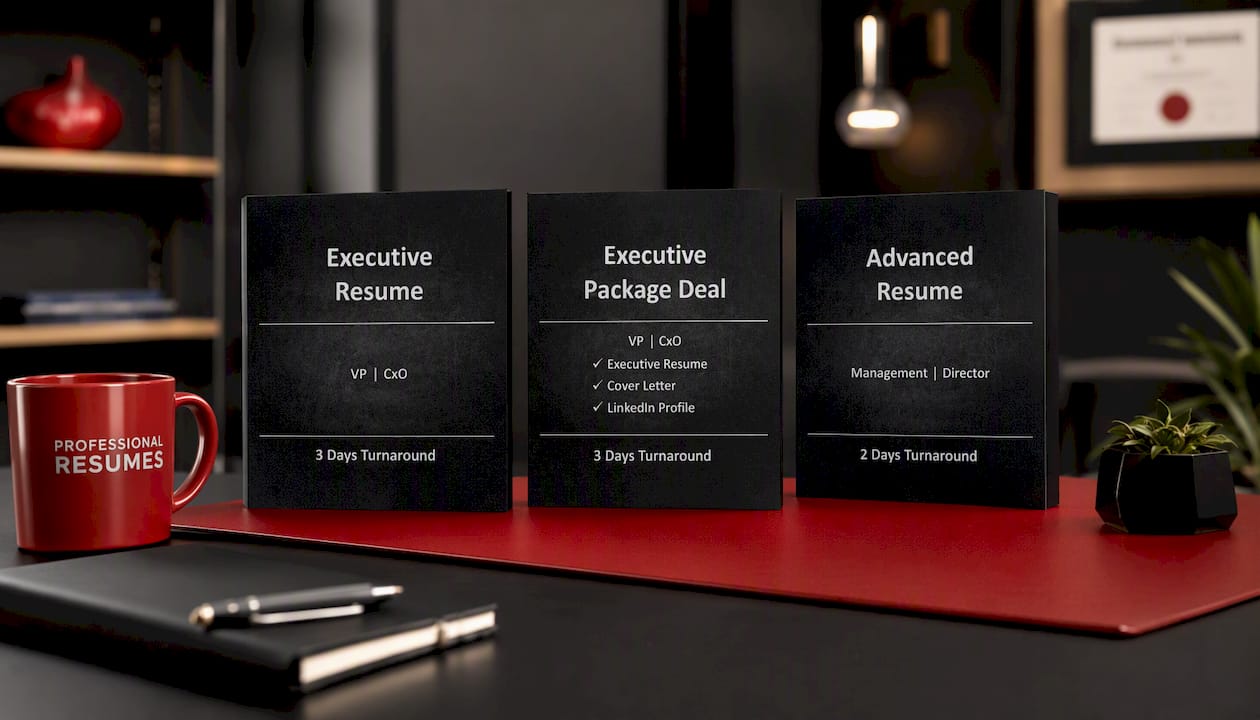
For a single, focused rebuild ahead of a specific search, the Executive Resume service is the right starting point. If you also need a cover letter and a LinkedIn profile aligned to the same story, the Executive Package Deal bundles all three. For board-level mandates or complex, multi-industry histories, the Advanced Resume tier is built for that depth. Start with a consultation through the executive resumes service page, and expect a document built around interview-generating evidence rather than a reformatted duty list.