
The most effective LinkedIn recommendations use a short, four-part micro-story: who you are, your relationship to the person, one specific action with a measurable outcome, and a clear endorsement. Copy one of the examples below and adapt it in 3 to 10 minutes. The best ones run 50 to 150 words, which is long enough to be credible and short enough that people actually read them.
TL;DR:
- Effective LinkedIn recommendations are brief stories that include specific actions, measurable results, and a clear endorsement, ideally under 150 words.
- They should highlight concrete behaviors or outcomes with evidence, such as project success or process improvements, rather than vague praise.
- Timing your request shortly after a project or achievement ensures the details are fresh, and offering bullet points or drafts increases the likelihood of quality responses.
- Hiding or revising weak recommendations is preferable to leaving them public, and replacing them with stronger ones can significantly boost your credibility.
- Recommendations work best when paired with a well-optimized profile that uses consistent, outcome-driven language to reinforce your strongest skills.
Table of Contents
- LinkedIn recommendation examples by relationship
- How do you write a LinkedIn recommendation that stands out?
- How do you ask for a LinkedIn recommendation?
- Templates by role and seniority you can copy right now
- What to do about a weak or negative LinkedIn recommendation
- How recommendations fit into your broader LinkedIn strategy
- Get your LinkedIn profile working as hard as your recommendations
- Sources
- FAQ
LinkedIn recommendation examples by relationship
Every strong recommendation follows the same underlying architecture, but the details change depending on who you are to the person. A manager writes differently than a client. A peer writes differently than a mentor. Below are examples organised by relationship, each built on the 4-part micro-story formula that career writers keep converging on: identity and relationship; a specific behaviour with an example; a concrete outcome; and a closing endorsement.
For a manager writing about a direct report:
- “I managed Priya for two years on our product analytics team. She rebuilt our churn dashboard from scratch after our vendor sunset the old tool, delivering it two weeks ahead of schedule and cutting weekly reporting time by roughly a third. Any team would be lucky to have her.” (Replace: dashboard project, timeframe, and the specific efficiency gain.)
- “James joined my sales team as a junior rep and closed his first enterprise deal within four months, well ahead of our usual ramp period. He asks better discovery questions than reps with twice his tenure. I’d hire him again without hesitation.” (Replace: deal type, ramp timeframe, and the skill you’re highlighting.)
For a direct report writing about a manager:
- “I reported to Alan for three years while we scaled our customer success team from four people to fourteen. He gave me real ownership early, including a renewal negotiation with our largest account in my first six months, and coached me through it rather than taking it over. Every promotion I’ve earned since traces back to lessons from him.” (Replace: team size, the stretch assignment, and your career outcome.)
For a peer or colleague:
- “Maya and I worked side by side on a six-month platform migration. She caught a data mapping error during QA that would have broken invoicing for our top 20 clients, and she flagged it calmly, with a fix already drafted. That’s the kind of colleague who makes deadlines survivable.” (Replace: the project, the specific catch, and the scale of impact.)
- “I’ve partnered with David across three cross-functional launches. He’s the person who remembers the dependency nobody else tracked and follows up before it becomes a fire. Teams move faster with him in the room.” (Replace: number of projects and the recurring strength you’ve observed.)
For a client writing about a service provider or consultant:
- “We hired Elena’s team to redesign our onboarding flow after our activation rate had stalled for two quarters. She delivered a revised flow in five weeks that lifted trial-to-paid conversion noticeably within the first month post-launch. She also pushed back, respectfully, when our original brief wasn’t going to solve the real problem.” (Replace: the business problem, the timeframe, and the result you observed.)
For a mentor writing about a mentee:
- “I mentored Sam through his first year in product management. He came to every session with specific questions rather than general ones, and within eight months he’d shipped a feature he’d originally pitched to me as a rough idea. That kind of follow-through is rare this early in a career.” (Replace: mentorship duration, the pitch-to-ship story, and the trait you want to highlight.)
For a mentee writing about a mentor:
- “Rachel spent an hour a month with me for over a year, mostly asking questions that forced me to think through my own decisions rather than handing me answers. The negotiation framework she walked me through directly helped me secure a 15% raise at my next review.” (Replace: mentorship cadence and the specific tool or framework, plus your outcome.)
For an intern or new hire:
- “Olivia interned with our marketing team for twelve weeks and independently built a competitor content audit that our full-time team ended up using for two subsequent campaigns. She asked for feedback constantly and applied it immediately, which is not something every intern does.” (Replace: internship length, the deliverable, and how the team used it.)
For a freelancer or contractor:
- “I’ve hired Ben for freelance design work on four separate projects over two years. He turns around first drafts faster than any contractor I’ve worked with, and he flags scope creep before it becomes a budget problem rather than after. I keep coming back to him for a reason.” (Replace: number of projects, timeframe, and the specific reliability trait.)
Notice what none of these examples do: they don’t open with “I highly recommend” or drift into generic praise like “a pleasure to work with.” A diverse mix of recommenders, spanning managers, peers, clients, and mentors, communicates different facets of your capability far more persuasively than five recommendations that all say the same thing from the same angle.
How do you write a LinkedIn recommendation that stands out?
Writing a strong LinkedIn recommendation comes down to a repeatable five-part structure, not natural talent for compliments. The Muse’s five-step approach, which pairs well with the broader 4-part micro-story formula used across career-writing guides, breaks the task into pieces small enough to finish in about five minutes.
- Open with a knockout line. Skip “I had the pleasure of working with.” Start with something specific: “Jordan solved a problem our team had been stuck on for six weeks.” A strong opener earns the second sentence.
- State the relationship plainly. One sentence: how long, in what role, on what team or project. This gives the reader context for judging everything that follows.
- Name a specific skill or behaviour, backed by a micro-story. This is the section that does the real work. Vague praise (“great communicator”) reads as filler; a specific incident (“explained a technical delay to an angry client in plain language and kept the account”) reads as evidence.
- State the outcome. What changed because of what they did? A number helps when you have one; a clear before-and-after works when you don’t.
- Close with a forward-looking endorsement. One sentence that tells the reader what kind of employer, client, or teammate would benefit from hiring this person.
Here’s that structure applied and labelled:
[Opener] “Working with Chen changed how our engineering team approached code reviews.” [Relationship] “I led the backend team he was part of for eighteen months.” [Skill + micro-story] “He introduced a lightweight review checklist after noticing our bug rate spike whenever we skipped peer review under deadline pressure.” [Outcome] “Production incidents from that category dropped noticeably over the following two quarters.” [Endorsement] “Any engineering leader would benefit from having him question the process, not just the code.”
A quick self-edit checklist:
- Is it under 150 words? Most guides land on a 50 to 200 word range as the sweet spot.
- Does it include one specific example rather than a general trait?
- Did you include a number, timeframe, or concrete outcome wherever one genuinely exists?
- Would this sentence make sense about literally anyone, or is it specific to this person?
- Did you avoid words like “amazing,” “rockstar,” and “hardworking” without backing them up with anything?
Pro Tip: Read your draft out loud. If it sounds like something you’d say about a stranger at a networking event, it’s too generic. Recommendations that sound like you actually know the person get read all the way through.
One more thing worth deciding upfront: whether to offer reciprocation. It’s optional, but a short closing line like “happy to return the favour” costs nothing and often prompts the person to write one back for you.
How do you ask for a LinkedIn recommendation?
Timing matters more than wording. The best moment to ask is right after a win, a positive performance review, or the close of a project, when the specifics are still fresh in the other person’s mind and their goodwill toward you is highest. Asking six months after you’ve left a role produces vaguer, weaker recommendations because the details have faded.
Forbes lays out a proven process for this: identify the right recommenders, give them context about why you’re asking and what you’d like highlighted, offer to draft language or supply talking points, and time the request to a moment of positive momentum rather than a random Tuesday.
Providing bullet points isn’t cutting corners. Offering a short draft or a few bullet points measurably increases both the likelihood someone follows through and the quality of what they write, since most people freeze up staring at a blank recommendation box even when they genuinely respect you.
Here’s what those bullet points might look like if you’re asking a former manager:
- Led the migration to our new CRM in Q3, finished two weeks early.
- Trained three junior team members who are now handling accounts independently.
- Handled the Whitfield account escalation directly, and we kept the client.
Request templates you can send as-is:
To a former manager:
“Hi [Name], I’m updating my LinkedIn profile and would love a recommendation from you if you have a few minutes. I’d especially value a mention of the [specific project] we worked on together. Happy to send over a few bullet points if that’s easier, and of course I’m glad to write one for you too.”
To a peer or colleague:
“Hey [Name], I’m putting together some LinkedIn recommendations and thought of our work on [project]. Would you be open to writing a short one? No pressure on length, just what stood out to you. Happy to return the favour.”
To a client:
“Hi [Name], it’s been great working with you on [project]. If you have five minutes, I’d really appreciate a LinkedIn recommendation, particularly touching on the results we saw. I can send a couple of bullet points as a starting point if that helps.”
To a direct report:
“Hi [Name], as you know I’m applying for [new role/leaving the company], and I’d love a recommendation reflecting our work together, especially [specific initiative]. Totally fine to keep it short. Let me know if a few prompts would help.”
Follow-up script, if two weeks pass with no response:
“Hey [Name], just following up in case my last message got buried. No worries at all if now isn’t a good time. Happy to send a couple of bullet points if that would make it easier.”
Career resources consistently point to one more habit that separates people who build a strong bank of recommendations from people who get one and stop: sending a specific thank-you after the recommendation goes live, referencing what it captured, and offering to write one in return. That single step is what turns a one-time favour into an ongoing exchange.
Templates by role and seniority you can copy right now
These are shorter, fill-in-the-blank versions of the formula above, grouped by relationship and seniority so you can scan for your exact situation and adapt one in minutes.
Manager level:
- “[Name] managed our [team type] for [duration]. Under their direction, [specific initiative] resulted in [outcome]. They lead with clarity and I’d work for them again without hesitation.” (Fill: team type, duration, initiative, outcome.)
- “As a manager, [Name] has a rare ability to [specific leadership behaviour], which showed clearly when [brief example]. Our team’s [metric] improved as a direct result.” (Fill: behaviour, example, metric.)
Senior manager or director:
- “[Name] led [department/function] through [specific challenge, e.g., a reorganisation or major system change]. They kept the team aligned through [duration] of change and delivered [outcome]. Executives who want steady hands during transformation should look no further.” (Fill: challenge, duration, outcome.)
- “I reported into [Name] during [context]. They gave me the latitude to own [specific project] while staying available for real guidance when I needed it, not just when things went wrong.” (Fill: context, project.)
Peer, same level:
- “[Name] and I worked together on [project] for [duration]. What stood out was [specific behaviour, e.g., how they handled a deadline or a technical problem]. Colleagues like this make hard projects easier.” (Fill: project, duration, behaviour.)
- “Few colleagues catch [specific type of issue] the way [Name] does. On [project], they [specific action], which saved [outcome, if known].” (Fill: issue type, project, action, outcome.)
Direct report or junior team member:
- “[Name] joined our team as [role] and quickly took on [specific responsibility] beyond their original scope. Within [timeframe], they delivered [outcome]. I’d welcome the chance to work with them again.” (Fill: role, responsibility, timeframe, outcome.)
- “As a new [role], [Name] asked sharper questions in their first month than most people ask in their first year. That curiosity showed up directly in [specific result].” (Fill: role, result.)
Client relationship:
- “We engaged [Name] for [service/project]. They delivered [specific outcome] within [timeframe], and communicated clearly throughout, including when [challenge] came up. We’d hire them again.” (Fill: service, outcome, timeframe, challenge.)
- “[Name]’s work on [project] solved a problem we’d struggled with for [duration]. The result was [outcome], and they made the process easy to follow.” (Fill: project, duration, outcome.)
Freelancer or contractor:
- “I’ve hired [Name] for [number] projects over [timeframe]. They consistently deliver [specific quality, e.g., faster turnaround, cleaner work] and flag issues before they become problems. That reliability is worth more than most people realise.” (Fill: number, timeframe, quality.)
Intern or early-career hire:
- “[Name] interned with our [team] for [duration] and delivered [specific project], which our team continued using afterward. For someone this early in a career, that level of initiative stands out.” (Fill: team, duration, project.)
Mentor to mentee:
- “I mentored [Name] over [duration]. They took every piece of feedback and applied it visibly, most notably when [specific example]. Their growth over that period was hard to miss.” (Fill: duration, example.)
Mentee to mentor:
- “[Name] mentored me for [duration], and the [specific advice or framework] they shared directly shaped [outcome, e.g., a promotion or a decision]. Their guidance had a measurable effect on my career.” (Fill: duration, advice, outcome.)
Once you’ve written a few, decide which to feature. LinkedIn displays recommendations in reverse chronological order by default, but you can reorder them on your profile. Put your strongest, most senior, or most metric-heavy recommendation first rather than leaving it to chance.
What to do about a weak or negative LinkedIn recommendation
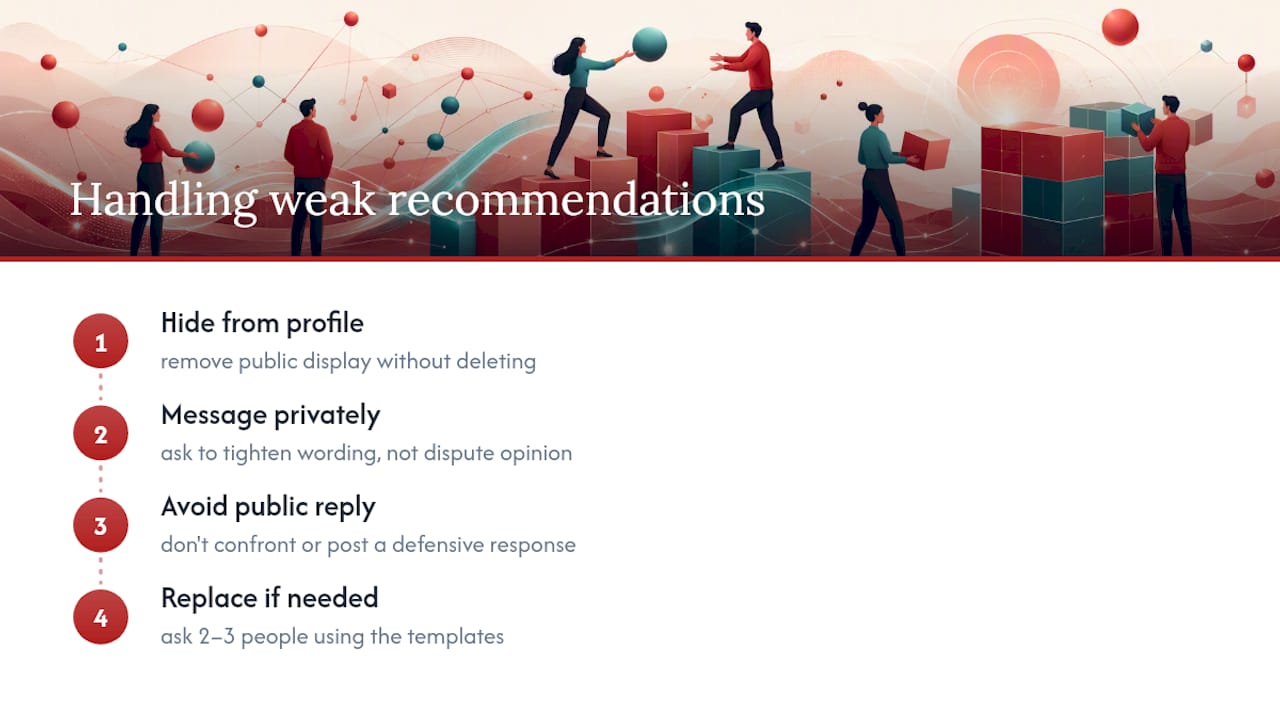
A lukewarm recommendation is worse than no recommendation at all, since a recruiter reading generic praise like “always willing to help” next to specific, detailed ones from other people will notice the contrast. You can hide any recommendation from your public profile without deleting it or notifying the person, so start there if one feels flat or off-message.
If the recommendation is factually wrong, outdated, or reflects a relationship that ended badly, don’t confront the person publicly or leave a defensive reply. Message them privately and ask, plainly, if they’d be open to revising a line or two, framing it as tightening the wording rather than disputing their opinion. Most people agree, since they wrote it as a favour and have no attachment to the specific phrasing.
If the person won’t revise it and it genuinely damages your profile, hiding it is a legitimate option. Nobody sees which recommendations you’ve received unless you display them, so a hidden weak one costs you nothing. Then go replace it: ask two or three people using the request templates above, ideally people who can speak to the exact skill the weak recommendation undercut.
How recommendations fit into your broader LinkedIn strategy
Recommendations do one job well: they turn a claim on your profile into someone else’s testimony. A resume says you led a migration; a recommendation from the person who watched you do it says the same thing with more weight. That’s the gap most professionals underestimate. A polished profile summary and a strong recommendation are supposed to reinforce the same two or three core strengths, not tell three unrelated stories.
Where this gets harder is at the executive level, where recommendations carry board-level scrutiny and the wrong tone, too casual, too vague, or too focused on soft skills, can undercut an otherwise strong candidacy. Time-poor professionals in the middle of a job search often don’t have the bandwidth to draft polished requests, chase busy former colleagues, and rewrite their own profile summary at the same time. That’s a reasonable moment to bring in outside help rather than a sign you can’t handle your own career materials.
LinkedIn profiles and career documents work best when they use consistent, specific, outcome-driven language aligned with strong recommendations.
— Professional
Get your LinkedIn profile working as hard as your recommendations
Strong recommendations only pay off if the profile around them is doing its job. Professionalresumes’ LinkedIn profile optimization service rewrites your summary, experience sections, and keyword positioning to match the same specific, outcome-driven language you’ve just used to ask others to write about you, rather than leaving your own words generic while your recommendations do all the work.
Which package fits depends on where you are. If you’re early in your career and building your first strong profile, the Early Career Resume or the Early Career Package Deal pairs resume and profile work together. If you’re aiming for a step up, the Next Step Resume covers that stage, and if you’re at the executive level where every line faces board-level scrutiny, the Executive Package Deal combines resume and profile optimisation into one consultation. Browse the full range of resume packages or book a consultation to get started.
Sources
- The Proven Process For Getting The Best LinkedIn Recommendations — Forbes
- How to Write a LinkedIn Recommendation (with Examples!) — The Muse
- How to Write a LinkedIn Recommendation (HubSpot)
FAQ
Can you give an example of a good LinkedIn recommendation?
A good one names a specific project and a measurable result rather than general praise. For example: “I managed Priya for two years. She rebuilt our churn dashboard two weeks ahead of schedule and cut weekly reporting time by roughly a third. Any team would be lucky to have her.” That’s the 4-part micro-story formula in action: relationship, specific action, outcome, endorsement.
How do you write a recommendation on LinkedIn?
Go to the person’s profile, click “More,” then “Recommend,” choose your relationship and their position at the time, and write your text in the box provided. Use the five-part structure: an opener, your relationship, a specific skill with an example, the outcome, and a closing endorsement, following the five-minute method most career guides recommend.
What makes a recommendation letter genuinely effective?
An effective one is specific rather than general, includes at least one concrete example of behaviour or a result, and closes with a clear statement of who would benefit from hiring or working with the person. Vague adjectives without evidence, like “amazing” or “a pleasure,” carry little weight on their own.
What words should you actually use in a recommendation?
Skip generic adjectives and lean on words tied to action and outcome: “led,” “delivered,” “reduced,” “built,” “resolved,” “mentored,” “launched,” “improved,” “trained,” “negotiated,” and “exceeded.” These words point to something the person actually did, which is what makes a recommendation read as credible rather than decorative.
How many LinkedIn recommendations should you aim for?
Most career guides suggest 5 to 10 quality recommendations as enough to establish credibility without looking assembled for show. A mix of managers, peers, and clients matters more than the raw count.