
In Canada, you should not list references on your resume itself, and you should not write “references available upon request” either. Prepare a separate reference page, match it to your resume, and send it only when an employer asks, which usually happens late in the process. This guide covers how many references to list, whom to ask, what each entry contains and how the rules shift for executive and federal government roles.
TL;DR
- Keep references off the resume. Use a separate page that you hold ready and provide on request.
- List three to five professional references, each with name, title, organization, email, phone and a one or two sentence note on how you worked together.
- Ask permission first, brief each person on the role, and keep them updated. In Canada, privacy expectations make consent a requirement in practice, not a courtesy.
- Executives and federal applicants follow a stricter sequence: references come after screening, testing and interviews, and are shared with discretion.
- Format the reference page to match your resume so the two documents read as one set.
Table of Contents
- Do you put references on a resume in Canada?
- When employers actually ask for references
- How many references to list
- Who to choose as a reference
- What to put on the reference page
- Consent and privacy in Canada
- Executive and senior-level references
- Our perspective on references
- Get the whole application package right
- A reference checklist before you apply
- Common mistakes to avoid
- FAQ
- Sources
Do you put references on a resume in Canada?
No. A resume has limited space, and every line should show what you delivered, not who will vouch for you. A reference list takes up room that belongs to your achievements, and it exposes the contact details of people who have not yet been told about this particular application.
The line “references available upon request” has the same problem. Employers already assume you have references, so the sentence states the obvious and uses a line you could spend on a result. Remove it.
There is one exception. If the job posting explicitly asks for references with the application, supply them, preferably as a separate attached page, not inside the resume. Follow the posting to the letter, because an incomplete submission is often the quickest way to be screened out.
This matches the guidance in university career centres. A reference sheet is a separate document listing people who can verify and elaborate on your professional experience, prepared in advance and handed over when the employer requests it.
When employers actually ask for references
References are a late-stage check. A typical sequence runs from application to screening, interviews, and then a request for references once you are a finalist. At that point the employer is looking for confirmation, not discovery.
That timing is the reason to prepare early. When a recruiter writes on a Thursday asking for your references by Friday, a polished page that is ready to send signals organization. Scrambling to reach people who have not heard from you in three years signals the opposite.
In practice, you will meet references at these points:
- After a successful interview round. The recruiter says you are moving forward and asks for three contacts.
- Before an offer is finalized. The offer may be conditional on satisfactory reference checks.
- In retained executive searches. The search firm may speak to references before the client sees a shortlist, or at the final stage, depending on the mandate.
- In regulated or public sector hiring. Formal checks form part of a documented assessment process.
Federal government applications
The Government of Canada runs a long, structured process. According to the Public Service Commission, references are typically requested only after you have passed screening, tests and interviews, and the median time to hire was 227 days in 2021. Do not include them in your initial application unless the poster says so. If you are applying for a public service role, keep your page current for the long wait, and confirm with each referee that they still plan to be reachable months later.
How many references to list
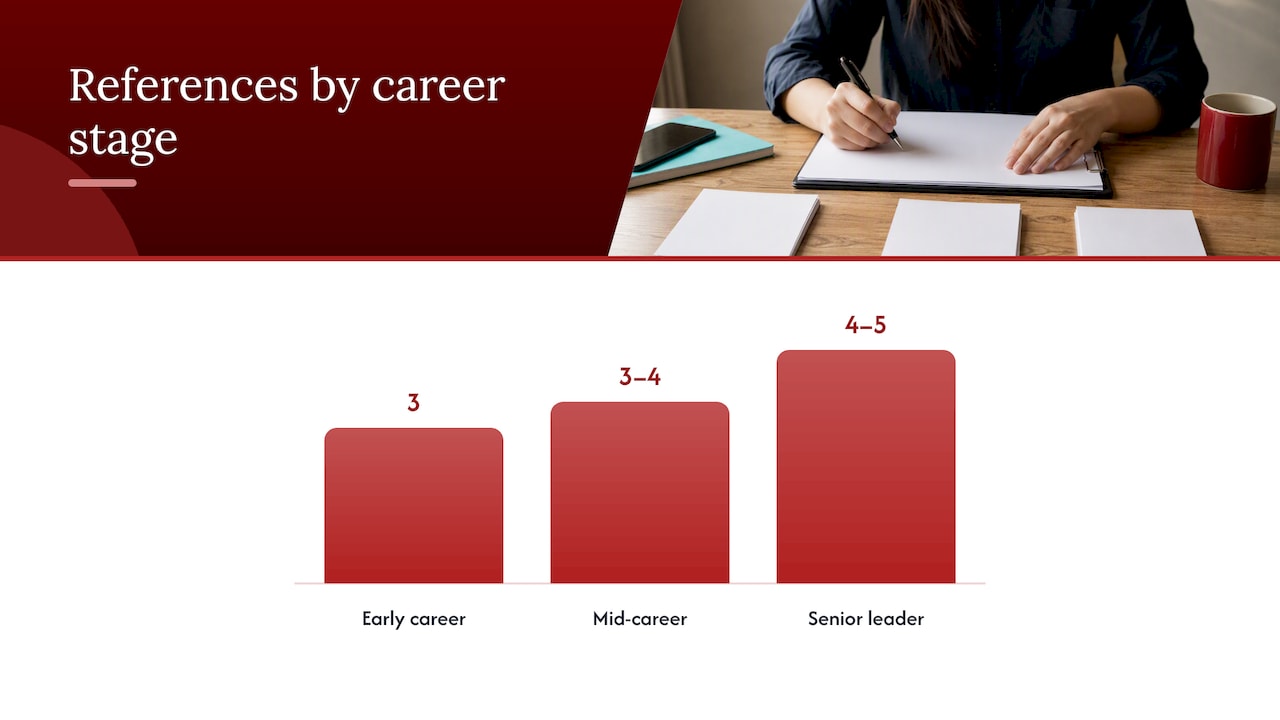
The sources agree on a range, not a single number. The Purdue guidance recommends a separate document with three to five professional references listed in order of importance. Virginia Tech’s career centre also describes three to five people as a good number. The University of California, Davis reference list format likewise calls for three to five professional references.
Our practical rule is simple:
| Career stage | Suggested number | Typical mix |
|---|---|---|
| Early career, first full-time role | 3 | Manager from an internship or co-op, a professor or advisor, a volunteer lead |
| Mid-career professional | 3 to 4 | Current or recent manager, a former manager, a senior peer or client |
| Senior leader or executive | 4 to 5 | Board member or CEO, a peer executive, a direct report, a client or partner |
Have five names prepared, even if a given employer asks for only three. That lets you choose the three who best fit the role, and it gives you a substitute if one person is travelling or unavailable.
Who to choose as a reference
A reference is your professional representative. The University of California, Davis career resources stress that the people you choose should offer specific, positive, work-related examples, because that detail can move a final-stage candidate into an offer.
Choose people who have seen you do the work. The strongest candidates are:
- Current or former supervisors. They can speak to results, reliability and judgment.
- Senior colleagues or peers. They can describe how you collaborate and handle pressure.
- Direct reports. For leadership roles, they show how you develop others.
- Clients, partners or vendors. They show how you perform outside your own organization.
- Professors, coaches or advisors. These suit early-career candidates with limited work history.
Avoid family members and close friends, which the Virginia Tech guidance also advises against. Avoid anyone who cannot recall specifics about your work. A well-known name who barely remembers you is weaker than a mid-level manager who can describe three projects in detail.
Match the referee to the role
Before you decide, read the posting and list the three capabilities it stresses most. Then ask yourself which person can give a concrete example of each. If the role stresses a transformation, choose someone who watched you lead one. If it stresses technical depth, choose someone who reviewed your work.
This is the same discipline as any self-assessment: identify skill gaps between what the job needs and what you can prove, then pick the people whose testimony fills those gaps. A reference who confirms what the resume already shows adds little. One who supports the claim a hiring manager is least sure about adds a lot.
Handling a difficult situation
Some candidates cannot name a current manager because their search is confidential. That is normal, and employers understand it. Offer references from previous roles first, and say that you will provide a current supervisor once an offer is conditional on the check. State this plainly, and keep it brief.
If you left a role on difficult terms, do not list that manager. Choose a colleague, a client or a leader from elsewhere in the organization who saw your work directly. If you are re-entering the workforce after a gap, include people from volunteer work, consulting, contract assignments or professional associations who can speak to recent activity.
What to put on the reference page
A reference entry should be complete enough that a recruiter can act on it without calling you. Each entry includes the person’s name, current job title, organization, email address, a business phone number and a brief line describing your relationship. The Purdue guidance suggests a one or two sentence statement of your working relationship.
Here is a model entry:
Jordan Mitchell, Vice President, Operations, Northfield Logistics Inc.
jordan.mitchell@example.com | 416-555-0142
Jordan was my direct manager from 2021 to 2024. I led the warehouse consolidation across three sites under Jordan’s sponsorship.
The name and company are fictional and the example is illustrative. Notice what the relationship line does. It gives the recruiter a reason to ask about a specific project, which produces a more substantive conversation than a generic “worked together for three years”.
Formatting the page
The reference page should be treated as part of your application package. Virginia Tech advises that it should match the formatting and style of your resume. In practice:
- Use the same header, with your name, city, phone, email and LinkedIn address.
- Use the same font, sizes and colour accents as your resume.
- Place the title “Professional References” below the header.
- List each person in order of relevance to the role, not in order of seniority.
- Keep it to one page and save it as a PDF with a clear file name, such as your name followed by “References”.
If you want the two documents to look like a set, our writers can build a matching reference page alongside your resume. Your personal brand should read consistently from the first page to the last.
Consent and privacy in Canada
Always ask before you list someone. This is professional courtesy, and in Canada it is also becoming a legal expectation for employers. HR Reporter, which covers Canadian employment law, advises that employers obtain explicit consent from the applicant before contacting any references. Quebec’s privacy regulator has gone further, and its recent focus on hiring practices indicates that employers must justify the collection of personal information and seek informed consent rather than relying on implied consent. Rules vary by province, so applicants in Quebec, British Columbia, Alberta and federally regulated workplaces should not assume the same standard applies everywhere.
For you, the consequence is practical. Your referees’ contact details are their personal information as well as yours. Do not hand them over without a conversation.
How to ask
A short, direct request works best. Write or call and cover four points:
- The role and employer you are pursuing, and why it fits.
- The two or three themes you hope they can address.
- Roughly when the call may come.
- An easy way to decline, so they can say no without awkwardness.
Then send your resume and the job description. People give better references when they know what the employer wants to hear. Afterwards, thank them and tell them the outcome, whichever it is.
Executive and senior-level references
At the senior level, discretion matters as much as content. The Public Service Commission’s guidance on executive curriculum vitae stresses concise, outcome-focused documents, and the same principle applies to references: obtain permission, keep referees informed and respect their time.
For C-suite searches, consider these additions:
- Sequence the disclosure. Share references only when you are a finalist and the employer or search firm commits to a conversation. Ask that your current employer not be contacted until an offer is conditional.
- Balance the panel. Include a board member or chair, a peer executive, and a leader who reported to you, so the panel reflects upward, lateral and downward views of your leadership.
- Prepare each referee on the mandate. If the role involves P&L ownership, a turnaround or a transaction, tell them which outcomes to speak to and give them the numbers.
- Keep the page clean. Titles and organizations should match your resume and your LinkedIn profile exactly. Inconsistency draws questions under board-level scrutiny.
If you are building a senior resume, our guide to a two-page C-suite resume covers what belongs in the document that decides whether a reference check ever happens.
Our perspective on references
We write resumes for executives, healthcare professionals, engineers, finance specialists, educators, newcomers to Canada and people returning after a break. Across those groups, we see the same mistake: candidates invest weeks in the resume and then treat references as an afterthought.
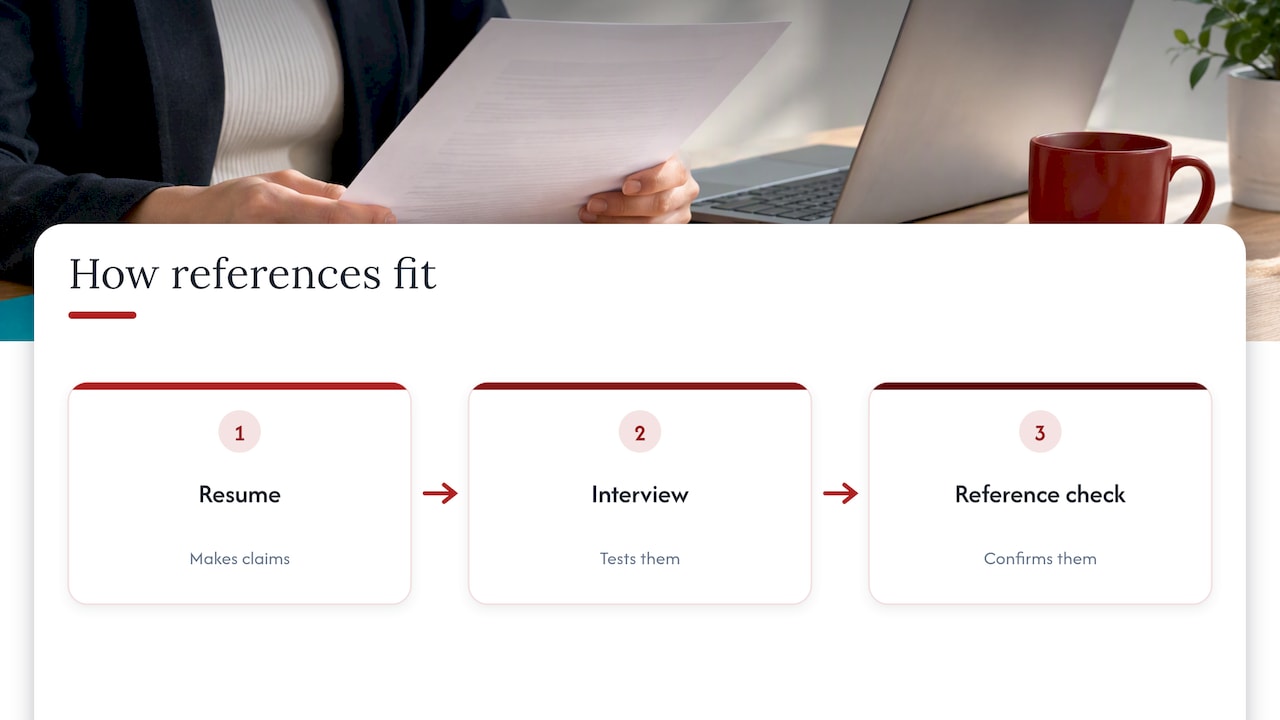
We consider references part of the same argument. The resume makes claims, the interview tests them, and the reference check confirms them. If the three do not tell the same story, the process stalls. That is why we ask clients about their referees during the consultation, and why we encourage them to choose people who can corroborate the specific results we have placed on the page.
Two habits separate prepared candidates from the rest. They hold a formatted reference page ready before any employer asks, and they brief their referees on the role as carefully as they brief themselves. Neither takes long, and both reduce the risk at the stage where the employer is closest to deciding.
For newcomers to Canada, there is a further point. Many hiring managers here expect to speak with a Canadian referee, which can be difficult for someone who has just arrived. Where that applies, we advise listing international managers with clear context, adding any Canadian volunteer, bridging-program or contract contacts, and being open about the reason. Employers generally respond well to candour that comes with a workable alternative.
— Professional
Get the whole application package right
A reference page works only when the resume that precedes it earns the interview. Our resume writers work directly with you through a consultation and revisions, producing an ATS-friendly document written for your industry and level. Current pricing, as published on our site:
- Early Career Resume: $139, one-off
- Next Step Resume: $189, one-off
- Advanced Resume: $239, one-off
- Executive Resume: $289, one-off
You can compare the options on our resume services page. If your search is moving, our LinkedIn profile optimization service aligns your profile with your resume, so the titles and dates your references confirm match what recruiters see online.
A reference checklist before you apply
Work through this list once, and keep the output saved in a folder you can reach from your phone.
- Choose five potential referees and confirm they are willing.
- Collect each person’s current title, organization, email and direct phone number, and check spelling.
- Write the one or two sentence relationship note for each.
- Build the page in your resume’s design and save it as a PDF.
- Send each referee your current resume and a short summary of your target roles.
- Remove “references available upon request” from your resume.
- Confirm your LinkedIn titles and dates match your resume. If you are unsure, our LinkedIn profile checklist walks through it.
- Check your resume length, since it is the space you save by leaving references off. Our guidance on resume length for Canadian job seekers explains where one page ends and two begin.
Common mistakes to avoid
Listing a reference before asking. The person may be caught off guard, and an unprepared referee gives a vague answer that can cost you the offer.
Choosing by title, not knowledge. A senior name who cannot discuss your work is weaker than a direct supervisor with detail.
Sending an outdated page. Wrong titles, retired phone numbers and former employers waste the recruiter’s time and reflect on your attention to detail.
Mixing personal and professional contacts. Friends and relatives do not carry weight in a professional check.
Forgetting to follow up. Tell your referees what happened. They will be more willing to help the next time you ask.
FAQ
Should I write “references available upon request” on my resume?
No. Employers assume you can provide references, so the line uses space without adding information. Use that line for a measurable achievement and keep a separate reference page ready.
How many references should I give?
Three to five professional references is the range recommended by several university career centres. Prepare five, and send the three or four that best fit the role unless the employer asks for a specific number.
Can I use a current manager as a reference if my search is confidential?
Yes, but only at the right stage. Offer former managers and other senior contacts first, and ask that your current employer be contacted only after a conditional offer. Most employers and search firms accept this arrangement, especially for senior roles.
Do I need to put references in a federal government application?
Not unless the job poster requires them. The Public Service Commission explains that references are typically requested after pre-screening, written tests and interviews, so keep your page ready but do not attach it to the initial application.
What if I have no Canadian references?
List your international managers with clear context on the country, company and role. Add any Canadian contact you have, such as a volunteer lead, a bridging program instructor or a contract client. Explain the situation in a single line to the recruiter.
Sources
- Reference Sheets, Purdue OWL
- References, Career Quick Start, Virginia Tech
- Reference List Format, UC Davis Human Resources
- References, UC Davis career development toolkit
- Applying for Government of Canada jobs: What to expect, Canada.ca
- The Curriculum Vitae: Tips for Executives, Canada.ca
- Privacy rules and legal boundaries around reference checks, HR Reporter
- Quebec’s privacy regulator puts spotlight on employee hiring practices, DLA Piper