
Use a hybrid resume that leads with a target-role headline, a 2 to 3 sentence professional summary, and a skills-first section, so a hiring manager can identify your intended pivot within seconds. This structure outperforms a chronological or purely functional layout because it satisfies applicant tracking systems while still telling recruiters exactly where you’re headed. Everything below explains how to build it, section by section.
TL;DR:
- Highlight your top two skill clusters at the beginning of the resume to emphasize relevance for both ATS and recruiters.
- Use measurable, outcome-focused bullet points that start with action verbs to demonstrate your transferable achievements.
- Place completed certifications and relevant projects immediately after the skills section to bridge experience gaps effectively.
- Keep the resume to one page unless applying for a senior role, and tailor each version with a master resume system to save time.
- Clearly state your target role in the headline and summarize your background, transferable skills, and value in three concise sentences.
Table of Contents
- Why the hybrid resume format works for a career change
- How do you write a resume summary for a career change?
- How do you identify and group transferable skills?
- How do you reframe past experience for a new industry?
- Where do certifications, courses, and projects belong?
- What formatting rules actually matter for ATS and recruiters?
- How do you manage multiple resume versions without losing your mind?
- A copy-ready checklist before you hit send
- What we’ve learned from working with career changers
- Which Professionalresumes package fits your pivot
- Sources
Why the hybrid resume format works for a career change
A chronological resume lists jobs in reverse date order and assumes your last title predicts your next one. That assumption breaks the moment you’re pivoting industries, which is exactly why a combination format, often called hybrid, performs better for career changers. It opens with a skills and summary block, then supports that pitch with a condensed work history underneath.
Purely functional resumes, the kind that hide dates and bury job titles under skill headings, tend to backfire. They can fail ATS parsing and make recruiters suspicious about what you’re not saying. A combination resume format keeps your history visible while still leading with relevance.
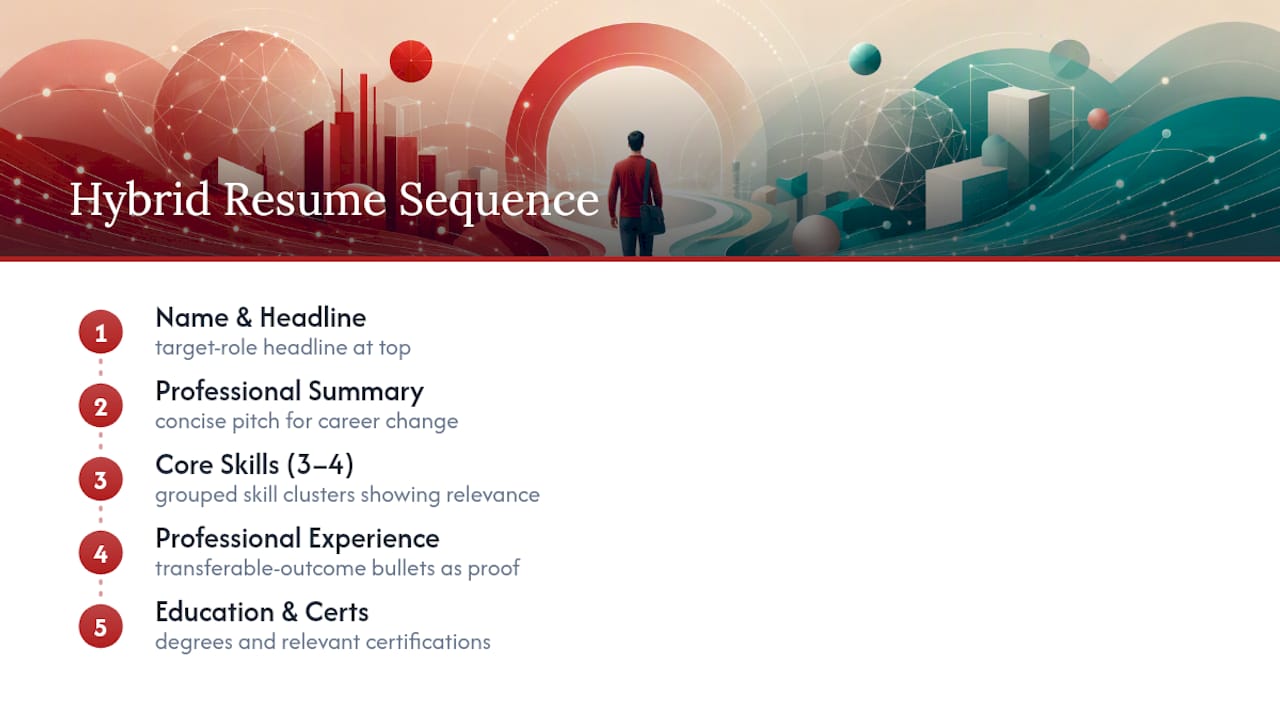
For a career change resume, structure the page in this order: name and target-role headline, professional summary, core skills grouped into 3 or 4 clusters, professional experience with transferable-outcome bullets, then education and certifications. That sequence gives a recruiter the pitch first and the proof second, which is the opposite of what a standard chronological resume does.
How do you write a resume summary for a career change?
Keep it to 2 or 3 sentences that connect your background, your strongest transferable skill, and the value you bring to the new role. That’s the formula Wharton recommends for career-change resumes, and it works because it does the interpretive labour a recruiter shouldn’t have to do themselves.
Choose a summary over an objective statement once you have at least some relevant experience, paid or not, to point to. Reserve a short objective for situations with almost no bridging experience, where you need one sentence to state the goal before pivoting straight into skills.
Example, mid-career pivot (operations manager to project coordinator):
“Operations manager with 8 years leading cross-functional teams and vendor relationships. Skilled in scheduling, budget tracking, and stakeholder communication. Bringing that discipline to project coordination roles in construction and infrastructure.”
Example, early-career pivot (retail supervisor to UX research):
“Retail supervisor with 3 years translating customer feedback into operational changes. Trained in user interview methods and usability testing through a recent certificate program. Ready to apply that customer-first instinct to UX research.”
Both examples name the past role, the transferable strength, and the destination. Neither apologizes for the pivot.
How do you identify and group transferable skills?
Hard skills are teachable and specific, things like financial modelling, SQL, or CAD software. Transferable soft skills, like stakeholder management, conflict resolution, or process improvement, travel across industries because they describe how you work, not what tool you used. A career change resume needs both, but transferable skills carry the argument.
Pull the job posting for your target role and highlight every recurring competency. Then group your own experience into 3 or 4 clusters that mirror that language rather than listing scattered single words. Excelsior OWL’s career-change guidance recommends this clustering approach specifically because it mirrors how recruiters and ATS software scan for keyword matches.
A rewrite might look like this: instead of listing “communication” as a bare skill, cluster it as Client Relations & Communication, then list bullet evidence underneath, such as “Managed 40+ client accounts, resolving escalations within 24 hours.” That’s a rewrite that shows the same competency the new industry’s job posts describe, using the target role’s own vocabulary.
- Leadership & Team Management: supervising, mentoring, delegating
- Data & Analysis: reporting, forecasting, process auditing
- Client Relations & Communication: negotiation, presentations, conflict resolution
- Project Delivery: scheduling, budget tracking, vendor coordination
Pro Tip: Place your top 2 skill clusters directly under your summary, not lower on the page. ATS software and human recruiters both weight the top third of a resume more heavily, so bury nothing important below the fold.
How do you reframe past experience for a new industry?
Filter your work history down to responsibilities that demonstrate relevance, not everything you’ve ever done. A resume for a career change isn’t a full job history. It’s a curated argument, and Harvard Business Review’s guidance on career switching is blunt about this: the resume should show where you’ve been and where you’re going, not hide the gap between them.
Use a short outcome-focused micro-formula for each bullet: what you did, using a strong verb, and what resulted, ideally with a number. Monster’s career-change resume guidance points to exactly this pattern, action plus measurable result, as what separates a forgettable bullet from a convincing one.
Before: “Responsible for team meetings and reporting.”
Before: “Handled customer complaints.”
- Cut any bullet that doesn’t demonstrate a skill your target role needs.
- Start every bullet with an action verb, never a noun phrase.
- Add a number or measurable outcome wherever you can defend it honestly.
- Replace industry jargon from your old field with language from the new one.
- Limit older, unrelated roles to a line or two under an “Earlier Career” heading.
Where do certifications, courses, and projects belong?
Completed certifications and credentials belong right after your skills section, not buried at the bottom of the page. In-progress courses can go in the same block, labelled clearly as “in progress” or with an expected completion date, so nothing reads as misrepresented.
Projects deserve their own short entries when you lack direct paid experience. Use a three-part format: one line of context, one bullet describing the task with a strong verb, and one line stating the result. That structure reads cleanly in both ATS scans and human reviews, and Forbes’ career-change resume guide confirms that clearly presented credentials and projects are one of the most effective ways to bridge a direct-experience gap.
- Completed certifications: list under a dedicated “Certifications” header, most recent first.
- In-progress coursework: label with expected completion date.
- Freelance or volunteer projects: format as context, action, result, exactly like a paid role.
- Portfolio links: include a single URL if your target field values visible work samples.
What formatting rules actually matter for ATS and recruiters?
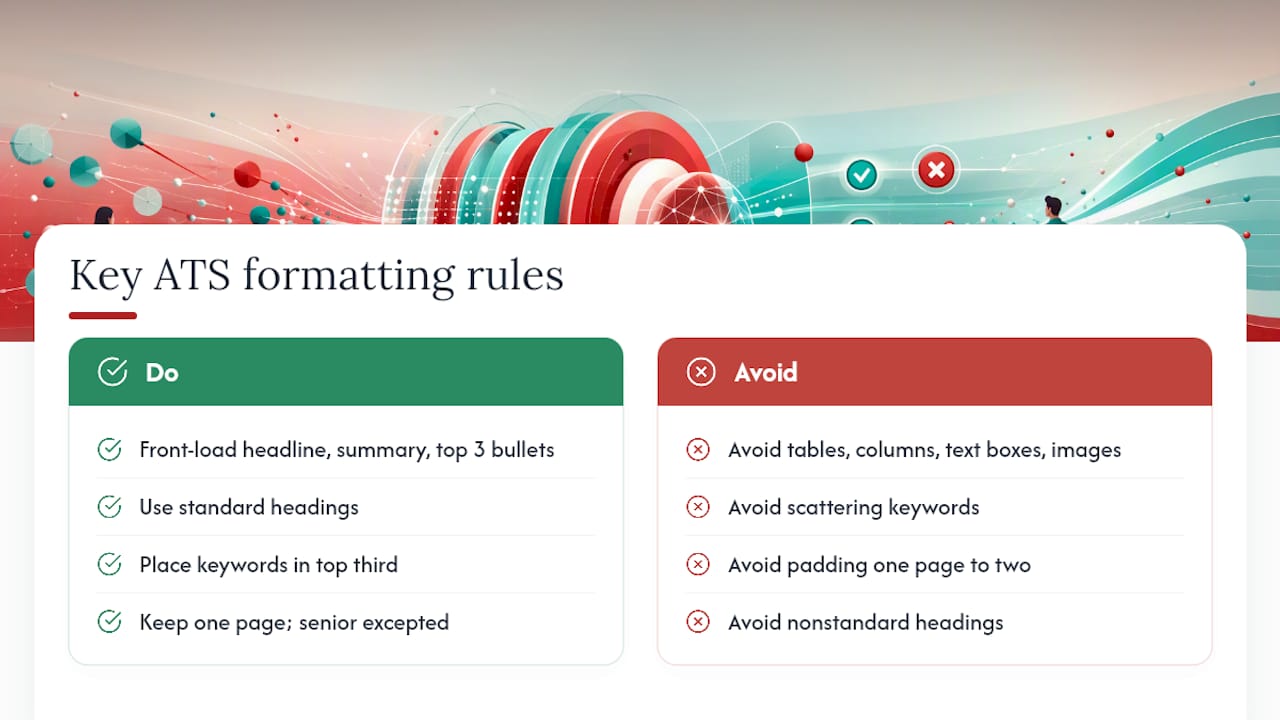
Recruiters spend about 6 seconds on an initial resume scan, which means your headline, summary, and top 3 bullets carry most of the weight. Everything below that needs to earn a second look, not carry the entire pitch.
Stick to standard section headings (“Professional Experience,” “Skills,” “Education”) because ATS software is built to recognize them, and avoid tables, columns, text boxes, or embedded images that scramble parsing. Place your most important keywords in the top third of the page rather than scattering them evenly, since some ATS platforms weight positional relevance. For an outside perspective on how parsing engines behave, JobsZA’s breakdown of ATS mechanics covers the keyword and formatting logic in more technical detail.
One page is standard for most career changers. Two pages become acceptable only when you’re pivoting from a senior or executive-level role with a genuinely long relevant history to summarize. Never pad a one-page resume to two just to look thorough.
How do you manage multiple resume versions without losing your mind?
Build one master resume containing every bullet, skill cluster, and credential you might ever use, then branch a targeted version for each application rather than editing from scratch every time. A labelled master-resume system saves time and keeps your formatting consistent across versions.
- Keep the master document in one file with every possible bullet and skill cluster included.
- For each application, swap the headline to match the exact target role title.
- Reorder or swap your top 6 skills to mirror that job posting’s language.
- Rewrite 2 to 3 bullets per relevant role to echo the posting’s specific priorities.
- Save each version with a clear filename, such as “LastName_ProjectCoordinator_v2.”
This approach also makes it easier to reposition experience for a mid-career transition without rebuilding your whole document every time a new posting appears.
A copy-ready checklist before you hit send
Headline example: “Project Coordinator | Former Operations Manager, Cross-Functional Team Leadership”
Two-sentence summary example: “Operations professional with 6 years managing vendor logistics and budget tracking. Pivoting that coordination experience into project management roles in construction.”
Bullet rewrite 1, before: “Worked with clients on service issues.”
Bullet rewrite 2, before: “In charge of scheduling for the department.”
Before submitting, confirm your headline states the target role by name, your summary is 3 sentences or fewer, your top skill cluster matches the job posting’s own wording, every bullet leads with a verb and ends with a result, and your file is saved as a standard, non-image PDF or Word document that any ATS-friendly formatting system can parse cleanly.
What we’ve learned from working with career changers
Career changers tend to underestimate how much interpretive work a hiring manager has to do when a resume doesn’t explain itself. The strongest resumes we see don’t apologize for a pivot or hide it behind vague titles. They state the target role plainly and let the skills clusters do the convincing.
Where professional support tends to accelerate a pivot is in the reframing itself, translating a decade of operations language into project-management vocabulary, for instance, without losing the substance of what actually happened. Professional support builds that translation through direct consultation and multiple revision rounds, tailoring each document to the specific industry a client is entering rather than issuing a generic rewrite. DIY works well for a first draft. A second, expert pass tends to matter most when the pivot is significant, the stakes are high, or the writer is too close to their own history to see what a stranger will find confusing.
— Professional
Which Professionalresumes package fits your pivot
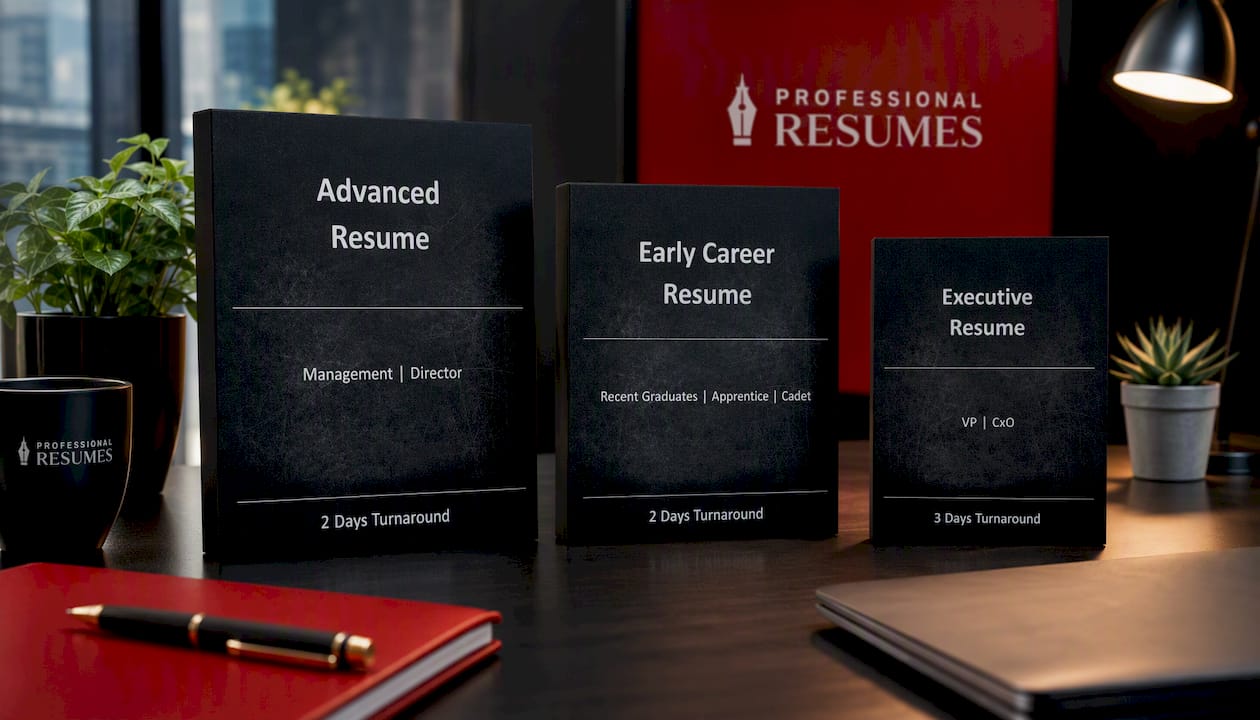
The right resume package depends on where you’re starting from, not just where you’re headed. If you’re early in your career or shifting into a field with limited direct experience, the Early Career Resume package is built around exactly that gap, helping you present coursework, projects, and transferable skills as legitimate proof of capability rather than filler. If you’ve built a solid work history and are making a lateral or upward pivot into a new industry, the Advanced Resume package focuses on translating your existing achievements into the language your target field actually uses. And if you’re pivoting at the senior or C-suite level, where the stakes and scrutiny are highest, the Executive Resume package is built for that scale of transition.
Packages often include consultation, revision rounds, and ATS-friendly formatting tailored to the target industry, so the document reflects the individual’s actual trajectory instead of a generic template. Book a consultation through the package page that matches your career stage and start the conversation about your pivot today.
Sources
- Career Change Resume & Cover Letter Writing Guide (HBS Online blog)
- How to Write a Career-Change Resume With Template (Wharton)
- Switching careers? Here’s how to write a strong resume (Harvard Business Review)
- How to write a career change resume (Monster)