
For internal job applications, submit a tailored internal resume that maps multiple STAR-formatted accomplishments to the role’s essential qualifications. Three priorities come first: match the posting’s own language, show measurable outcomes rather than duties, and prepare a plain-text version for application portals. This guide walks through the full process, with examples and a submission checklist.
TL;DR:
- Tailor your internal resume to match the posting’s language, highlighting measurable outcomes and relevant accomplishments instead of listing duties.
- Use specific company terminology, projects, and systems to demonstrate immediate fit, and focus on outcomes that show growth or scope.
- Prepare a plain-text version of your resume and screening answers in advance to ensure compatibility with application portals and ATS systems.
- Focus on recent, relevant STAR-formatted achievements that prove your readiness for the new role, emphasizing impact on efficiency, revenue, or risk reduction.
- Follow organizational policies, verify all details are consistent with official records, and craft a concise letter of interest that explicitly connects your experience to the role’s core qualifications.
Table of Contents
- What an internal resume is and why it matters
- How internal resumes differ from external resumes
- Step-by-step process to write and tailor an internal resume
- How to write accomplishment statements: STAR and measurable results
- Formatting rules, ATS and internal portal quirks, and public-sector application notes
- Common mistakes to avoid and red flags for internal applicants
- Final checklist: what to send and what to check before you submit
- Why professional help can help with internal applications
- Guidance on addressing potential concerns about changing roles within the same company
- Author perspective: practical, internal-mobility minded advice
- How Professional Resumes can help
- FAQ
- Sources
What an internal resume is and why it matters
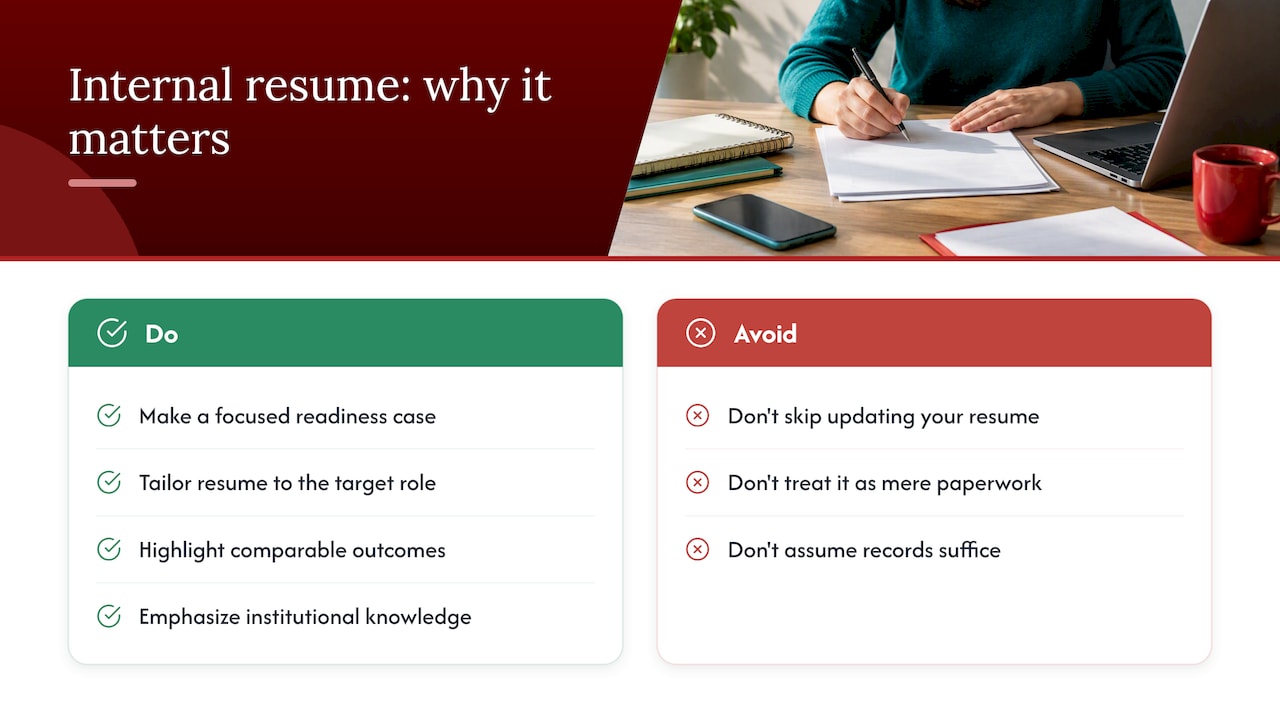
An internal resume is a resume submitted by an employee already working within an organization, written specifically to apply for a different role, a promotion or a lateral move inside that same company. It differs from a general resume in one essential way: the reader already has context on you, your conduct and your reputation, so the document carries a different burden. It must make a focused case for readiness rather than introduce you from scratch.
That focus pays off. A tailored internal resume demonstrates to the hiring manager that you understand the target role’s demands and have already produced comparable outcomes. It can also reduce the perceived onboarding period, since you bring institutional knowledge, existing relationships and familiarity with internal systems that an external candidate would need months to acquire. A large-scale study of career mobility found that moving into a new occupation within the same firm produces a stronger positive effect on upward mobility than either lateral internal moves or moves to a new employer, which makes the case for treating an internal application with the same rigour as an external one, not less, since intra-firm occupational change carries real weight for advancement.
Many employees assume that because HR or a hiring manager already has their file on record, updating the resume is optional. It is not. The file on record likely reflects the role you currently hold, not the one you want next, and it was never written to answer this posting’s specific qualifications. A stale resume signals, however unintentionally, that you have not thought carefully about the move. Treat the update as a deliberate act of positioning, not paperwork.
How internal resumes differ from external resumes
An internal resume speaks in the company’s own language. Where an external candidate must explain acronyms, internal projects and team structures from scratch, you can name them directly: the system you administered, the initiative you led, the department you partnered with. That specificity does real work. It shows immediate fit and lets the reader picture you performing the new role without a translation step.
The structure shifts too. External resumes often carry a longer career narrative, since the reader needs the full arc to judge trajectory. An internal resume can compress that narrative and devote more space to mapped outcomes: what you did, under what constraints, with what measurable result, directly against the posting’s qualifications. Career experts frame this well, describing the internal resume as a focused case for promotion rather than a full life story.
Cross-functional or stakeholder-facing examples deserve a place when the target role involves influence beyond your current team. If you are moving from an individual contributor position into one with broader scope, show at least one example where you worked across departments or represented your team to leadership. That single data point often matters more to a hiring panel than several examples confined to your current reporting line.
Step-by-step process to write and tailor an internal resume
Start by parsing the job posting itself before writing a word. Pull out the essential qualifications verbatim, and pay close attention to connecting words: a posting that says “experience in budgeting and vendor management” expects evidence of both, while “experience in budgeting or vendor management” allows either. Mark every phrase that looks like it comes from a formal competency framework, since screening systems and panels often reuse that exact language.
- Highlight every essential qualification and note whether it requires “and” (both) or “or” (either).
- Rewrite your opening statement to position you as the internal solution to this specific posting, not a general summary of your career.
- Select several accomplishments that map most directly to the posting’s qualifications, prioritizing relevance over chronology.
- Choose format and length based on where the resume lands: a hiring-manager-only process can support more design, while a portal submission needs a clean, plain-text-ready structure.
- Prepare a plain-text copy and draft answers to any screening questions before the application window opens.
Your opening statement carries more weight on an internal resume than people expect. Instead of a generic summary of your background, write two or three sentences that state your current role, your years of relevant internal experience and the specific value you bring to the target position. A line like “Currently leads scheduling for the east region team; seeking to apply four years of process-improvement work to the Operations Manager role” does more work than a paragraph of soft skills.
When selecting your several accomplishments, resist the urge to include everything you are proud of. Choose the examples that answer the posting’s qualifications most directly, even if that means leaving out strong work from earlier in your tenure. A hiring panel reading dozens of applications will reward precision over volume.
Formatting choices depend entirely on the submission path. A resume reviewed directly by a hiring manager you already know can carry some visual structure: bolded headers, light use of colour, a clean one-page layout. A resume submitted through an application portal needs to survive text parsing, which brings us to the plain-text copy. Build it early rather than scrambling at the deadline, and test it by pasting it into a plain text editor to confirm nothing breaks.
Pro Tip: Keep a master version of your resume in a simple table of accomplishments, each tagged with the qualifications it proves, so you can rebuild a tailored version for any posting in under an hour.
Screening questions deserve the same preparation as the resume. Many internal postings, particularly in larger organizations, ask applicants to answer specific questions about each essential qualification before a resume is ever reviewed. Draft these answers alongside your resume, not after, since the strongest accomplishment statements often serve double duty in both places.
- Pull exact qualification language from the posting before drafting anything.
- Build four to eight STAR-based accomplishments mapped to that language.
- Draft a plain-text version and screening-question answers in the same sitting.
How to write accomplishment statements: STAR and measurable results
The STAR method, which stands for Situation, Task, Action, Result, turns a vague duty into verifiable proof. For an internal application, STAR statements work best when they isolate your individual contribution rather than describing what “the team” accomplished, since a hiring panel is evaluating you specifically.
Choosing the right metric matters as much as the structure. Internal stakeholders tend to respond to efficiency gains, revenue or cost impact, risk reduction and adoption or uptake of a process you introduced, since these map directly to what a manager has to defend to their own leadership. A plain-text research summary on internal mobility notes that career outcomes tied to internal moves are well studied, which supports treating a clear, quantified accomplishment as a credible signal rather than a nice-to-have.
Three paired examples show the shift from duty to proof:
- Duty: Managed customer complaint intake. STAR achievement: Redesigned the complaint routing process (Situation and Task), built a triage checklist and trained three colleagues on it (Action), cutting average response time and reducing repeat complaints within the quarter (Result).
- Duty: Assisted with budget tracking. STAR achievement: Identified a recurring reconciliation error across two cost centres (Situation and Task), built a cross-check spreadsheet and flagged discrepancies weekly (Action), preventing a repeat of the prior year’s year-end adjustment (Result).
- Duty: Supported the onboarding process for new hires. STAR achievement: Noticed new hires were taking longer than expected to reach full productivity (Situation and Task), created a structured 30-60-90 day onboarding guide (Action), shortening ramp-up time for the next three cohorts (Result).
Internal mobility research shows that moving to a new occupation within the same firm has a measurably stronger link to upward progression than a lateral internal shift, which is one more reason to frame your statements around growth and scope, not just task completion, per this 2026 study.
Formatting rules, ATS and internal portal quirks, and public-sector application notes
Large organizations, and public-sector employers in particular, often route applications through portals that strip bolding, columns and special characters before a human ever sees the resume. Preparing a plain-text version in advance means you are never reformatting under deadline pressure. Draft your resume normally, then paste it into a plain text editor and clean up any line breaks, bullets or spacing that do not survive.
Government of Canada guidance for GC Jobs recommends creating an unformatted resume for portal submission and tailoring your screening answers using the STAR method to demonstrate each essential qualification. Shared Services Canada’s own application tips echo this, advising a simple resume kept current, with every required qualification addressed explicitly when a question uses “and.”
- Use the exact keywords from the posting, not synonyms, since screening questions are often scored against specific phrases.
- Write screening answers in first person (“I led,” “I reduced”), never “we,” so your individual contribution is unambiguous.
- When a question lists two or more requirements joined by “and,” answer each one by name rather than assuming one example covers both.
Pro Tip: Save your plain-text resume and screening answers as a single reference document, since many internal postings reopen similar competitions within the same year.
Our ATS-friendly resume guidance covers formatting considerations that apply equally well to internal portal submissions, particularly around keyword matching and file structure.
Common mistakes to avoid and red flags for internal applicants
The most frequent mistake is assuming the hiring panel will read your personnel file or remember your past work. They will not, and the fix is straightforward: tailor the resume to this posting and foreground outcomes from the last 12 to 18 months rather than relying on reputation.
Vague team language is the second common trap. Phrases like “our team improved” leaves your personal contribution invisible. Replace them with first-person, concrete actions and specific results, the same discipline the STAR method demands.
Over-formatting for a portal submission causes otherwise strong resumes to arrive garbled or unreadable. Prepare the plain-text version early and test it, and draft direct answers to screening questions rather than relying on the panel to infer them from your resume.
- Missing or inconsistent employment dates across internal documents can raise unnecessary questions during screening.
- Inconsistent job titles between your resume and your official personnel record can slow or stall your candidacy.
- Ignoring your organization’s manager-notification policy before applying can damage trust, even when the policy is informal.
Final checklist: what to send and what to check before you submit
Before you submit, confirm the fundamentals are in place rather than relying on memory.
- Confirm your opening statement names the target role and your most relevant internal experience directly.
- Verify you have multiple STAR-formatted accomplishments mapped to the posting’s essential qualifications.
- Check that keywords from the posting appear in your resume and screening answers using the same phrasing.
- Verify every date, title and team name is accurate and consistent with your official record.
- Prepare a plain-text copy and save your files with a clear naming convention, such as your name and the position title.
- Confirm whether your organization’s policy requires notifying your current manager before you apply.
- Attach a concise letter of interest that reinforces your fit without repeating the resume line by line.
Why professional help can help with internal applications
A second set of experienced eyes catches what familiarity hides, and that is often the real value of a professional rewrite for an internal candidate. Working directly with a writer who understands how to structure STAR accomplishments and align them to a posting’s essential qualifications can turn a serviceable resume into a genuinely competitive one, particularly when the stakes involve a meaningful step up in scope or compensation.
Our product lines are built around exactly this kind of situation; for those in regulated professions, you can find guidance to get your licence after LLQP in Canada to advance your career. The Advanced Resume suits employees applying for a significant step up in responsibility, while the Executive Resume is built for leadership-level internal moves where board-level or senior-stakeholder scrutiny is likely. The Advanced Package Deal bundles resume and complementary documents for candidates who want a complete, consistent application package.
Each service includes consultation, drafting, and revision processes to ensure the final document aligns with the target role and your experience, reflecting both the posting’s language and your personal voice.
Guidance on addressing potential concerns about changing roles within the same company
Hiring panels reviewing an internal candidate often carry questions that an external candidate would never face: will this move leave a gap on your current team, is this a lateral sidestep rather than genuine growth, and does your manager support the move. Address these directly rather than hoping they go unasked.
In your letter of interest, briefly acknowledge the transition and frame it in terms of growth and organizational benefit rather than dissatisfaction with your current role. A line that connects your current team’s needs to a reasonable transition timeline shows you have thought beyond your own interests.
If your organization has a policy on notifying your manager before applying, follow it before you submit, not after. Skipping this step is one of the fastest ways to damage trust, even when the policy is informal rather than written. When a move represents a lateral shift rather than a promotion, use your resume and letter to make the growth case explicit: new skills, broader scope or exposure to a function that supports a longer-term trajectory you can describe concretely.
Author perspective: practical, internal-mobility minded advice
The strongest internal resumes make a case for readiness, not a recap of history. Panels already know your past; they need proof you can do the next job. Seek a rewrite or coaching when the stakes are high enough that a generic update feels thin, and always respect your organization’s notification policies and the relationships that got you this far.
— Professional
How Professional Resumes can help
We build internal and promotion-focused resumes around the same discipline this guide describes: STAR-based accomplishments mapped directly to a posting’s essential qualifications, in language your hiring panel already recognizes. Working directly with your writer through a consultation and revision process means the final document reflects your actual contributions, not a generic template.
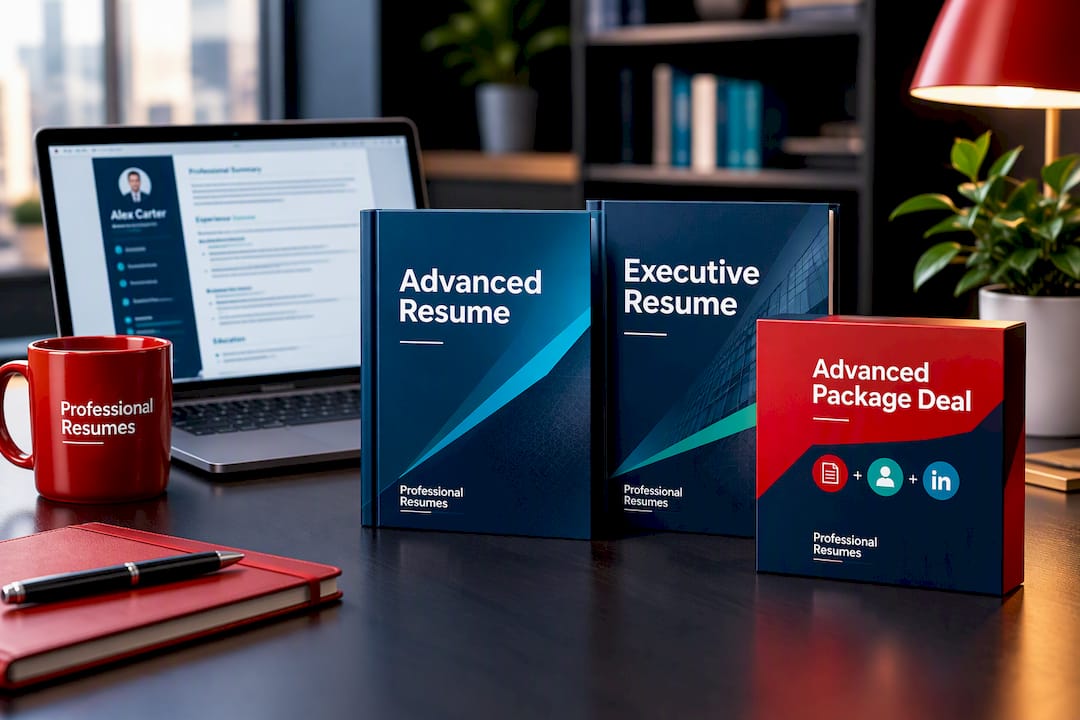
- The Advanced Resume suits employees targeting a meaningful step up in scope or responsibility.
- The Executive Resume is built for leadership-level internal moves facing senior-stakeholder scrutiny.
- The Advanced Package Deal bundles your resume with complementary documents for a consistent application.
Browse our full range of resume packages to find the option that matches the scope of your next move, or get in touch to start a consultation.
FAQ
What should I put on my resume for an internal position?
Lead with an opening statement naming the target role and your relevant internal experience, then include multiple STAR-formatted accomplishments mapped to the posting’s essential qualifications. Use internal project names, systems and acronyms where they show immediate fit, and keep a plain-text version ready for portal submission.
What are four common resume mistakes to avoid?
Common mistakes include assuming the panel already knows your work instead of tailoring your resume, using vague team language like “we” instead of specific first-person actions, over-formatting a document meant for a text-stripping portal, and leaving dates or job titles inconsistent with your official record.
How do I write a strong letter of interest for an internal position?
A strong letter of interest names the specific role, briefly addresses why you are seeking the move, and connects one or two of your strongest accomplishments to the position’s core requirements. Keep it concise, acknowledge the transition from your current team constructively, and avoid repeating your resume line by line.
What are the five P’s of a resume?
Definitions of the “five P’s” vary by source and are not a standardized industry framework, so treat any specific list with some caution. A practical substitute for internal applicants is to prioritize purpose, relevant proof points, precise language matched to the posting, polish in formatting, and a plain-text version ready for portal submission.
Sources
Internal references carry particular weight because the person reading your application may already know or be able to reach the people you name. Choose references deliberately: a manager or senior colleague who can speak directly to the specific qualifications the new role requires will do more for your case than someone simply senior in title.
Where appropriate, weave a brief, specific endorsement into your letter of interest rather than your resume itself, since resume space is better spent on your own accomplishments. A short line such as noting that a cross-functional partner has already relied on your analysis for a recurring decision tells the reader your reputation is already established in a relevant area.
Always confirm with a reference before naming them, and tell them which role you are applying for so their account lines up with the qualifications you are trying to prove. An internal reference who is caught off guard, or who gives a generic answer, can undercut an otherwise strong application. If your organization has a formal endorsement or sponsorship process for internal moves, follow it precisely, since skipping a required step can raise a flag unrelated to your actual qualifications.
- Leveraging large language models for career mobility analysis: a study of gender, race, and job change using U.S. online resume profiles | EPJ Data Science
- Canada
- Seeking Internal Mobility? 5 Expert Resume Tips To Avoid Disappointment — Forbes