
Pick the target job, map its three or four most repeated capability requests to your own evidence, then place that evidence in a targeted career summary, a selective skills section, and accomplishment bullets in your work history. That mapping, not a longer skills list, is what moves a resume from generic to credible. The sections below walk through the method and give sample bullets you can adapt.
TL;DR:
- Listing transferable skills without supporting evidence makes a resume less credible; instead, include specific accomplishments that demonstrate each skill in context.
- Focus on three to five key transferable skills that match the job posting’s repeated language, supporting each with one clear, result-oriented bullet.
- Use a structured method to identify skills from job descriptions, your work history, and duties, then convert these into evidence-based accomplishment bullets.
- Emphasize quantifiable results, such as managing budgets or reducing process times, to make skills verifiable and impactful to recruiters.
- Adapt your resume’s summary, skills section, and achievement bullets around your strongest, most relevant transferable skills for better chances of success.
Table of Contents
- What transferable skills are and why they matter on a resume
- A step-by-step method to identify your transferable skills
- High-value transferable skills and what evidence looks like
- How to present transferable skills in each resume section
- Choosing a resume format when you’re changing direction
- Sample summaries and bullets you can adapt
- How Professional Resumes translates transferable skills into interview-ready evidence
- Common mistakes that weaken a transferable skills resume
- Quantifying transferable skills with measurable results
- Carrying transferable skills into your cover letter and interview
- Services that convert your transferable skills into a finished resume
- When hiring a writer makes more sense than doing it alone
- Sources
- FAQ
What transferable skills are and why they matter on a resume
Transferable skills are capabilities that carry across roles and industries: communication, problem solving, project coordination, people management. They differ from technical skills, which are tied to a specific tool, system, or certification. A financial analyst’s Excel modelling is technical; the stakeholder negotiation behind the model is transferable.
The Occupational and Skills Information System, built on the Skills and Competencies Taxonomy, separates occupation profiles into skills, abilities, and knowledge, each with its own rating scale. That distinction matters for resume writing because a hiring manager scanning for “problem solving” is looking for a specific ability applied in a specific context, not an adjective.
This is why evidence outperforms a list. A line that says “strong communicator” claims an attribute. A line that says a candidate prepared briefings that cut decision time demonstrates the same attribute through outcome. Employers reading dozens of resumes a day default to skepticism toward unsupported claims and attention toward specific, contextual proof. The goal of a transferable skills resume is to close that gap between claim and evidence before the reader has to ask for it.
A step-by-step method to identify your transferable skills
Most candidates already have the evidence. The problem is it’s buried in job descriptions, volunteer records, and memory rather than organized for a resume. This method surfaces it in four passes.
- Mine the job posting. List every capability word that appears more than once (coordination, stakeholder management, reporting) and treat those as your priority targets.
- Inventory your history. Go through each role, course, and volunteer commitment and note what you actually did, not your job title.
- Match duties to descriptors. Next to each inventory item, write the closest capability from your target list.
- Convert duties into accomplishment bullets. Use the pattern: action verb, task, result, context or stakeholders.
A duty like “responsible for team scheduling” becomes “coordinated weekly scheduling for a 12-person crew, reducing shift conflicts across two departments.” The second version proves coordination instead of naming it.
Job Bank recommends putting your strongest demonstrations in the work experience section and using plain, persuasive action verbs rather than jargon, since the person reading your resume may not know your previous field. That guidance is especially relevant for career changers translating industry-specific language into terms a new sector will recognize. Cross-reference your descriptors against the Skills and Competencies Taxonomy files for your target occupation to avoid generic labels and pick wording closer to what that field actually expects.
Pro Tip: Keep a running document of every accomplishment bullet you write, even the ones you don’t use. Most apply to more than one job posting with minor rewording.
High-value transferable skills and what evidence looks like
Not every transferable skill deserves equal space. Choose three to five that match the posting’s repeated language, then support each with one line of proof rather than listing a dozen unsupported traits.
- Communication: prepared monthly briefings for senior leadership, shortening review cycles by surfacing key decisions early.
- Problem solving: diagnosed a recurring order error, traced it to a mislabelled inventory code, and corrected the process.
- Teamwork: partnered with three departments to launch a shared intake process adopted company-wide.
- Adaptability: retrained on a new scheduling system within two weeks while maintaining full coverage.
- Time management: managed overlapping deadlines for four concurrent projects without missing a delivery date.
- Leadership: mentored two new hires through onboarding, both retained past the probation period.
- Digital literacy: migrated a paper filing system to a shared digital tracker, cutting retrieval time.
- Customer service: resolved escalated client complaints directly, reducing repeat calls to the support line.
- Organization: restructured a shared drive used by twenty staff, improving document retrieval for the whole team.
- Negotiation: renegotiated vendor terms that lowered supply costs for a recurring order.
- Analytical thinking: built a tracking sheet that flagged budget overruns before month-end close.
- Conflict resolution: mediated a scheduling dispute between two teams without escalation to management.
Statistic callout: Statistics Canada research on business conditions finds that recruitment difficulties are widespread and that employers value customer service, problem solving, and communication alongside technical ability. That means a resume leaning only on technical qualifications leaves value on the table, even in technical hiring.
Choosing which of these to feature comes back to the job posting. If the listing repeats “cross-functional” three times, your teamwork and communication evidence should lead; if it emphasizes “deadline-driven,” time management and organization take priority.
How to present transferable skills in each resume section
Three places carry the weight: the summary, the skills section, and the bullets underneath each job.
- Career summary. Name the capability and immediately back it with specific scope: “Operations coordinator with five years managing cross-departmental logistics for teams of 15 or more.” This gives the reader the claim and the proof in one breath, before they’ve read a single bullet.
- Skills section. Keep it short and selective, matching the posting’s own phrasing rather than a generic list. Every skill named here should have supporting evidence elsewhere on the page. A skill with no corresponding bullet reads as a claim without proof, which undercuts the rest of the resume.
- Accomplishment bullets. Use the action verb, task, result, context structure consistently: “Led a four-person team through a system migration, completing the transition two weeks ahead of schedule.”
For wording and layout, a career summary built around capability and evidence tends to outperform a generic objective statement, and ATS-friendly formatting keeps that evidence readable by the software that screens it before a person ever sees it. Mirror the job posting’s own terms where accurate: if it says “stakeholder management,” use that phrase rather than a synonym, since applicant tracking systems often match on exact or close phrasing.
Pro Tip: Read the job posting aloud and underline every verb. Those verbs, not adjectives, are usually the words the applicant tracking system is scanning for.
Choosing a resume format when you’re changing direction
The right structure depends on how far you’re moving from your last role, and Job Bank’s career-planning guidance points career changers toward chronological or combination formats rather than a skills-only layout, which can read as evasive to many recruiters.
- A combination resume leads with a capability-focused summary and skills section, then follows with full chronological work history, which suits most career changers.
- A straight chronological resume works when your most recent role already overlaps meaningfully with the target job.
- A skills-based resume with minimal chronology is reserved for unusual gaps or very early-career applicants with little formal work history.
Relevant volunteer work, coursework, or side projects belong in a dedicated section rather than folded into employment dates, which keeps your timeline honest while still surfacing the evidence. For a structured approach to a mid-career pivot, order sections so the strongest, most relevant evidence appears before older, less relevant roles, regardless of date.
Sample summaries and bullets you can adapt
These examples show the conversion from duty to evidence. Adjust the numbers, context, and verbs to match your own history and the exact wording of your target posting.
- Early-career summary: “Recent graduate with hands-on project coordination experience through two internships, comfortable managing competing deadlines across small teams.”
- Mid-career pivot summary: “Customer service manager with eight years resolving escalated accounts, now applying that conflict-resolution and process background to operations roles.”
- Returning-to-work summary: “Experienced administrator returning to the workforce after a caregiving leave, bringing prior budget-tracking and scheduling responsibility for a 20-person office.”
- Coordinated onboarding for 15 new hires per quarter, cutting ramp-up time by standardizing training materials.
- Tracked a $40,000 departmental budget, flagging two overspend risks before quarter-end.
- Resolved an average of 25 customer escalations weekly, maintaining consistent service-level targets.
- Built a shared project tracker adopted by three teams after its initial pilot.
- Trained four part-time staff on new point-of-sale software within one week of rollout.
- Negotiated a vendor contract renewal that held pricing flat for a second year.
Each sample should be rewritten around your target posting’s own language rather than copied directly.
How Professional Resumes translates transferable skills into interview-ready evidence
Professional Resumes works through consultation first: inventorying a client’s roles, education, and volunteer history before mapping that material against the target occupation’s language. The rewrite stage turns duties into accomplishment bullets, and the formatting stage checks that the result reads cleanly through applicant tracking systems. The process is the same one outlined above, applied with a second set of eyes and industry-specific phrasing, including for technical fields such as the approach used in a standout resume for IT professionals.
The strongest resumes read as evidence files, not as lists of claims.
Readers comfortable with the mapping method can run it themselves. Those short on time, or moving into an unfamiliar field where the right phrasing isn’t obvious, often find the consultation step shortens that learning curve considerably.
Common mistakes that weaken a transferable skills resume
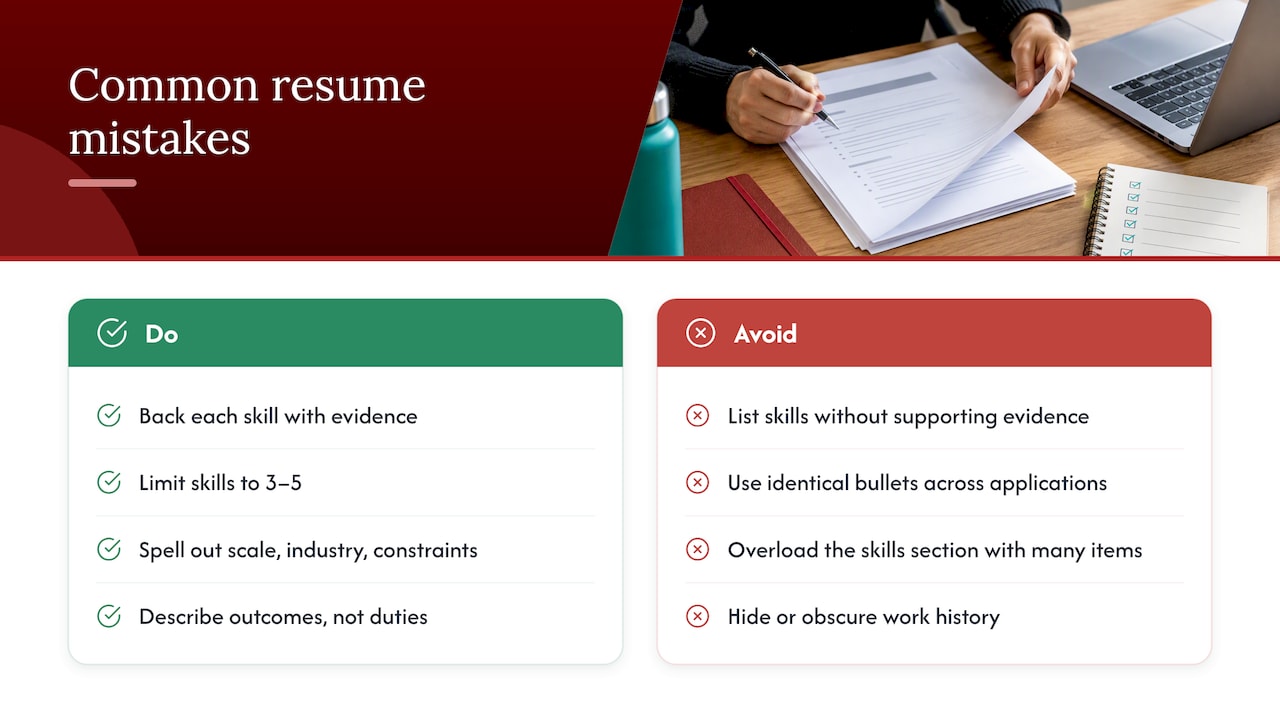
The most frequent error is listing skills without supporting evidence anywhere else on the page. A skills section with “leadership, communication, problem solving” and no bullet that demonstrates any of them reads as filler, and an attentive recruiter notices the gap immediately.
A second mistake is copying the same bullets across every application. Transferable skills only land when the surrounding context matches the posting, so a bullet about “managing a team” needs the scale, industry, and constraints spelled out, or it stays abstract. Generic phrasing like “excellent communicator” or “team player” with no context behind it tells the reader nothing they can verify.
Overloading the skills section is another common problem. Ten or fifteen skills crammed into a list dilutes the ones that actually matter for this posting. Choosing three to five and backing each with evidence does more work than a long list ever will.
Some candidates also hide their work history entirely in an effort to downplay an unrelated past role, which Job Bank’s guidance cautions against: a Canadian-style resume should stay straightforward about chronology rather than obscuring it. Trying to disguise a career change usually reads as evasive rather than strategic.
Finally, many resumes state duties instead of outcomes. “Responsible for customer service” describes a function; “resolved escalated complaints, maintaining service-level targets across a 300-call weekly volume” describes a result. The second version is the one that gets remembered.
Quantifying transferable skills with measurable results
Numbers make evidence verifiable, and most roles generate more measurable detail than candidates initially think to include. Team sizes, dollar values, time saved, error rates, and volume handled are all fair game, even in non-sales roles.
Start by asking what changed because of what you did. If you trained new staff, how many, and how long did ramp-up take before and after your involvement? If you managed a budget, what was its size, and did you catch any overruns? If you resolved customer issues, what was the weekly or monthly volume?
Where an exact figure isn’t available, a defensible estimate is still more useful than no number at all, as long as it’s honest. “Reduced onboarding time by roughly one week” is credible if that’s genuinely your recollection; inventing a precise percentage you can’t support is not worth the risk if asked about it in an interview.
Pair the number with context so it means something to the reader. “Managed a team of six” is clearer than “managed a team,” and “cut processing time from five days to two” is clearer than “improved processing speed.” The context turns a bare number into a story the hiring manager can picture.
Not every bullet needs a number, and forcing one where none exists weakens credibility rather than strengthening it. Use measurable results where they exist and rely on clear scope and outcome language everywhere else.
Carrying transferable skills into your cover letter and interview
A resume states the evidence; a cover letter and an interview explain it. The cover letter is the place to pick one or two of your strongest transferable skills and walk through the specific situation behind them in a sentence or two, connecting that story directly to what the posting is asking for.
In an interview, the same accomplishment bullets become the backbone of behavioural answers. A bullet about coordinating a cross-departmental project turns naturally into a response to “tell me about a time you worked with a difficult team,” because the groundwork, the context, the action, and the result, is already written down.
Consistency matters across all three documents. If the resume claims problem-solving ability, the cover letter and interview answers should reinforce that same claim with different supporting detail rather than repeating the resume bullet word for word. Interviewers often ask follow-up questions that test whether the resume’s claims hold up under detail, so having two or three stories ready per skill, not just one, keeps answers from sounding rehearsed or thin.
Services that convert your transferable skills into a finished resume
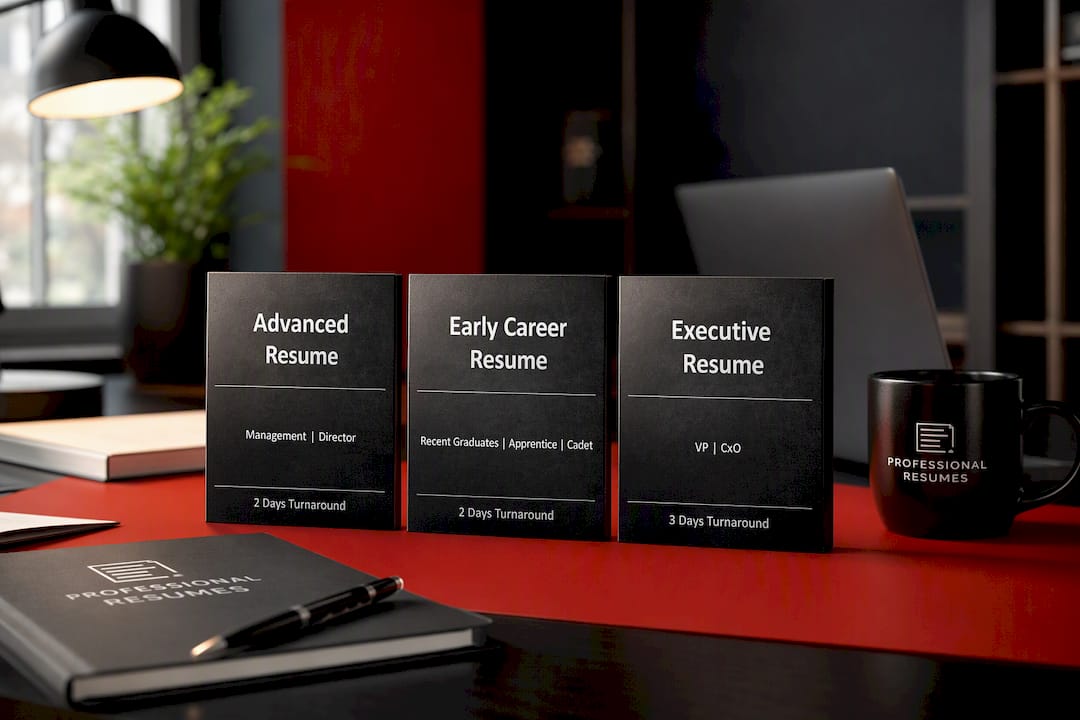
Mapping your own evidence takes time and a second perspective helps when the right phrasing for a new field isn’t obvious. Three product lines are commonly available to suit candidates at different career stages.
- The Early Career Resume suits candidates with limited work history leaning on education, internships, and volunteer evidence, at $139.
- The Advanced Resume fits established professionals pivoting industries or seniority levels, at $239.
- The Executive Resume is built for senior leaders needing precise, outcome-driven language, at $289.
Each includes a consultation, targeted rewriting, and applicant tracking system formatting. Browse the full shop to compare options, or pair a resume with the LinkedIn profile optimization service for consistent evidence across both.
When hiring a writer makes more sense than doing it alone
Professional help tends to change outcomes most when you’re entering unfamiliar territory, an industry whose language you don’t yet speak fluently, or a senior role where every line faces close scrutiny. Reviewing your own career for the first time is harder than reviewing someone else’s, which is where outside input, including career coaching alongside a rewrite, often helps.
DIY works well when your target role sits close to your last one and you already know the field’s vocabulary. Either path can raise interview callbacks, though no approach guarantees a specific result.
— Professional
Sources
For occupation-specific descriptors and current formatting guidance, go to the primary sources rather than secondhand summaries.
- How to write a good resume – Job Bank
- Occupational and Skills Information System (OaSIS) – 2025 Version 1.0 – Open Government Portal
- Survey-based research on skills gaps – Statistics Canada
FAQ
How do you describe transferable skills on a resume?
Name the skill and immediately back it with a specific accomplishment that proves it, rather than listing it as an adjective. For example, instead of writing “strong communicator,” write a bullet showing what you communicated, to whom, and what changed as a result.
What are five examples of transferable skills?
Common examples include communication, problem solving, teamwork, adaptability, and time management. Each should be paired with a specific accomplishment bullet rather than left as a standalone claim, since Job Bank recommends demonstrating qualifications through concrete, accomplishment-focused language.
What are seven transferable skills examples?
Beyond communication, problem solving, teamwork, adaptability, and time management, leadership and digital literacy round out a common list of seven. The right combination for your resume depends on which of these the target job posting repeats most often.
What are the top ten transferable skills?
Definitions vary slightly by source, but a common list spans communication, problem solving, teamwork, adaptability, time management, leadership, digital literacy, customer service, organization, and conflict resolution. Prioritize the three to five that match your target posting rather than trying to feature all ten.