
A Canadian nursing resume should generally run one page for early-career candidates and no more than two pages for senior practitioners, according to Job Bank guidance. Recruiters scan first for a highlights section, clinical placement or work history, and licensure status. Omit a photo, date of birth and Social Insurance Number, since these are not standard on Canadian resumes.
TL;DR:
- Match five to eight repeated terms from each posting across highlights and experience; acute care, long term care, and emergency roles require different clinical language.
- State the provincial regulator, NNAS report status, and scheduled exam dates explicitly; NNAS verifies credentials, but provincial regulators make licensing decisions.
- Use a Word document or searchable PDF, plain section headings, and consistent dates; keep essential details out of images, headers, footers, and tables.
- For new graduates, emphasize placements and coursework; midcareer nurses should show measurable outcomes, while experienced nurses should foreground leadership, coordination, and specialty credentials.
- Quebec postings may require French, while rural and northern roles often value broad practice across emergency, obstetric, and chronic care.
Table of Contents
- Core sections every Canadian nursing resume needs
- Formatting and length: what actually passes screening
- Annotated resume examples by career stage
- Keywords, ATS and NOC codes that get a nurse resume seen
- Internationally educated nurses: showing licensure progress clearly
- Tailoring your resume by province or territory
- Showing soft skills and teamwork without sounding generic
- Including volunteer work and continuing education
- Why a tailored resume changes outcomes for nurses
- Resume packages built for nurses at every stage
- FAQ
- Sources
Core sections every Canadian nursing resume needs
A nursing resume built for the Canadian market follows a fairly fixed structure, and each section carries a specific job.
Contact details stay simple: full name, phone number, email address and a LinkedIn URL if the profile is current. Leave out a photo, marital status or birth date, since these fields are not expected on Canadian resumes and can work against an applicant.
A career summary works best for nurses with some Canadian clinical history, while a “Highlights of Qualifications” section suits new graduates or those pivoting specialties. A strong highlight line names a skill and a context: “Delivered post-operative care across a surgical unit” says more than “experienced in surgical nursing.”
Licensure and registration status need to be explicit, not implied. State the regulator name (College of Nurses of Ontario, for example), the licence number if active, or the current stage of the NNAS process for internationally educated applicants.
Clinical placements belong in reverse chronological order, each with the facility, unit, dates and relevant measurable tasks or outcomes, similar to the format shown in this nursing resume example from a university career centre.
Education and certifications close the resume. Prioritize:
- Nursing degree or diploma, institution and graduation year
- Active certifications such as BLS, ACLS or NRP, with expiry dates
- Any specialty training tied to the target role
Formatting and length: what actually passes screening
Length follows experience, not personal preference. Early-career nurses should generally stay to one page; those with extensive leadership or specialty experience can stretch to two, consistent with Job Bank’s recommendation that longer resumes risk looking unfocused.
A reverse chronological format suits nurses with a steady work history. A hybrid format, which leads with a skills or highlights block before the chronological history, works better for new graduates or nurses re-entering after a career gap.
Layout details matter more than they get credit for:
- Use a standard font such as Calibri or Arial, sized 10 to 12 points for body text
- Keep margins consistent and wide enough to make the text easy to read
- Use consistent date formats throughout (Month Year to Month Year)
- Label sections with plain headings: “Experience,” “Education,” “Certifications”
Pro Tip: Save and submit your resume as a Word document or a text-based PDF, never an image-based PDF, so applicant tracking systems can read every field correctly.
Avoid headers, footers, text boxes or tables for anything critical, since many ATS platforms fail to parse content placed outside the main body.
Annotated resume examples by career stage
A nursing resume changes shape as experience grows, and seeing the pattern side by side makes it easier to copy.
- Entry-level: Lead with a highlights section, then clinical placements with specific tasks, for example “Assisted in care planning for patients during a medical-surgical placement.” Relevant coursework and simulation lab hours can round out the page.
- Mid-career: Shift to a career summary, then work experience with outcomes: “Reduced average patient wait time on triage by reorganizing intake workflow” shows initiative beyond daily tasks. Leadership roles, mentoring students, or quality improvement committees belong here.
- Experienced nurse: Open with a summary that names years of practice, specialty and scope, then detail multidisciplinary coordination, charge nurse duties, and advanced credentials such as critical care certification.
For licensure and NNAS status, place it directly under the summary or in its own labelled section, never buried in a cover letter. A line such as “NNAS advisory report completed; CNO registration in progress, exam scheduled for [month, year]” reads clearly to a recruiter who sees this phrasing often.
- Entry-level resumes favour clinical placements and coursework
- Mid-career resumes favour measurable outcomes and early leadership
- Experienced resumes favour coordination, mentorship and advanced certification
Keywords, ATS and NOC codes that get a nurse resume seen
Applicant tracking systems scan for exact phrasing before a human ever opens the file, so matching the language in a job posting is not optional.
Read the posting twice: once for required skills, once for repeated clinical procedures or terms like “wound care,” “medication administration” or “telemetry monitoring.” Place those exact terms in the highlights and experience sections, not just the summary.
Keyword bundles differ by role. An acute care RN posting often repeats “triage,” “rapid response” and “interdisciplinary rounds.” A long-term care LPN posting leans on “chronic disease management” and “resident care planning.” An emergency nurse posting features “trauma assessment” and “code team.”
NOC codes rarely belong on the resume itself, though understanding them helps with targeting. Registered nurses fall under NOC 3012, and knowing the official occupation definition can clarify which duties to emphasize.
- Pull five to eight repeated terms directly from the job posting
- Place them naturally across the summary, highlights and experience sections
- Use plain text headings and consistent date formats throughout
- Avoid embedding critical details in images, headers or footers
Internationally educated nurses: showing licensure progress clearly
Internationally educated nurses face one recurring problem: recruiters cannot tell what “in progress” actually means. The NNAS verifies credentials and issues an advisory report, but licensure decisions rest entirely with the provincial regulator for the province where the nurse intends to work.
State specifics rather than leaving the status open-ended:
- Name the regulator directly: “Applying to the College of Nurses of Ontario”
- Note NNAS advisory report completion date if finished
- Include exam scheduling, such as NCLEX date or jurisprudence exam status, per the Canadian RN application instructions
- Reference verified clinical hours when relevant to immigration pathways under IRCC’s health-care worker guidance
A vague “licensure pending” line reads as uncertainty. A dated, specific line reads as momentum, and recruiters respond to momentum.
Tailoring your resume by province or territory
Nursing registration in Canada is provincial, not national, so the same resume rarely works unchanged across every application.
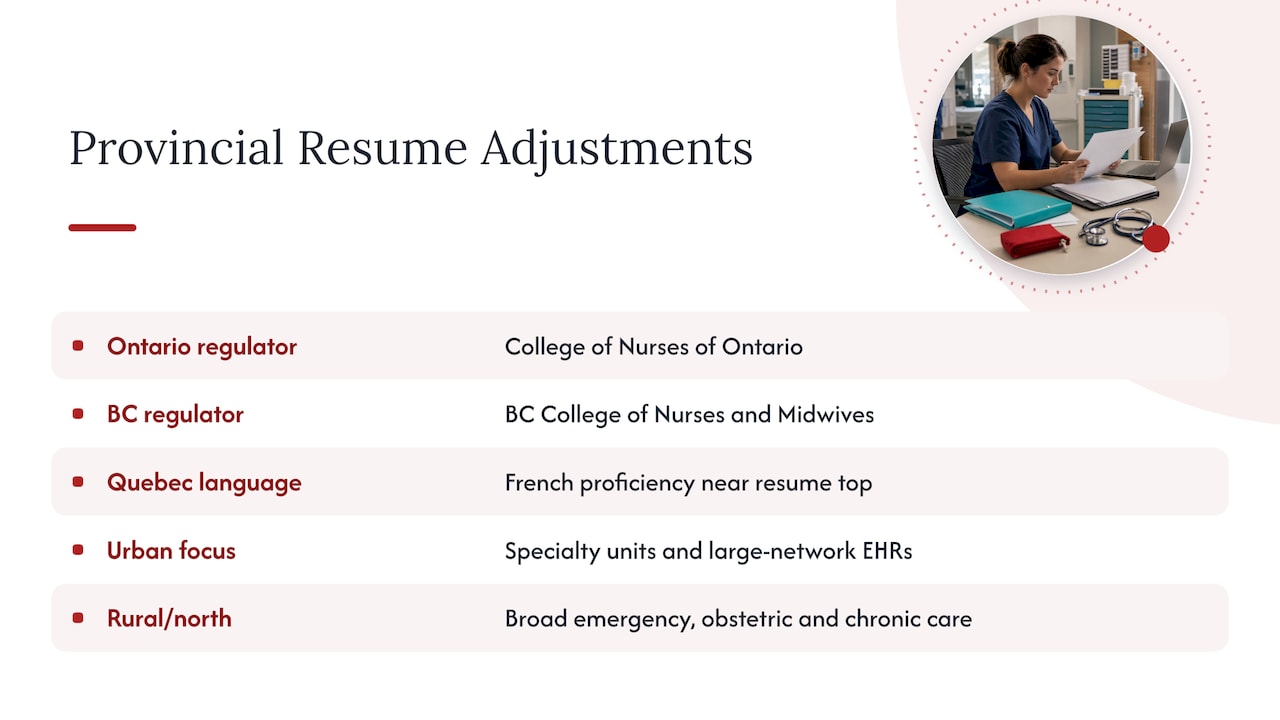
A nurse applying in Ontario lists the College of Nurses of Ontario by name. One applying in British Columbia references the BC College of Nurses and Midwives. The regulator name has to match the province of the job posting exactly, since recruiters check this detail early.
Healthcare system structure also shifts the emphasis. Larger urban centres in Ontario or Quebec often screen for specialty unit experience and electronic health record systems common to large hospital networks. Rural and northern postings, common across Saskatchewan, Manitoba and the territories, tend to value broad scope of practice: a nurse comfortable managing emergency, obstetric and chronic care in one shift reads as a stronger fit than one with narrow specialization.
Language requirements differ too. Quebec postings frequently require French proficiency alongside clinical credentials, and that should appear clearly near the top of the resume rather than buried in a skills list.
When targeting multiple provinces at once, keep one core resume for structure and content, then adjust the regulator name, language notes and any province-specific certification requirements for each application. A nurse moving from Alberta to Nova Scotia, for example, should not assume the same credential wording applies, since each regulator sets its own registration language.
Showing soft skills and teamwork without sounding generic
Canadian healthcare employers consistently look for evidence of collaboration, not just clinical competence, since most nursing roles involve daily coordination across disciplines.
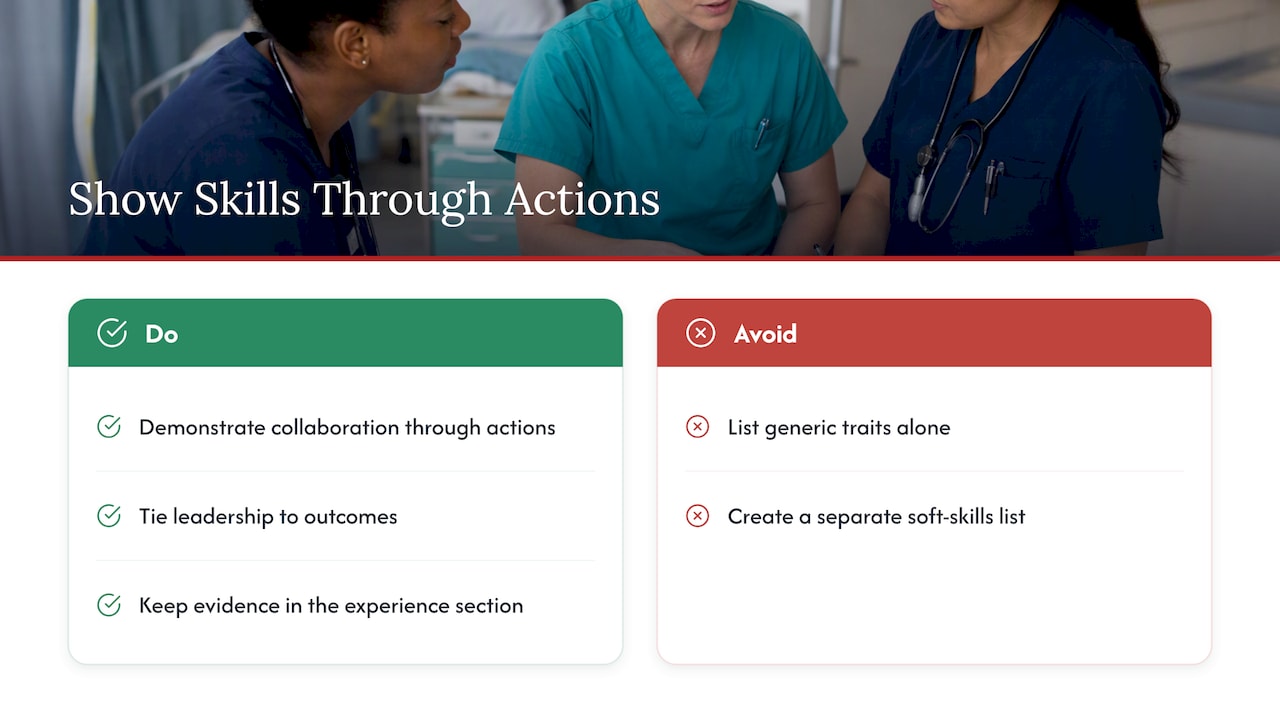
The mistake is listing “strong communicator” or “team player” as standalone traits. Recruiters skim past adjectives. What holds attention is a line showing the skill in action: “Coordinated discharge planning with physiotherapy, social work and pharmacy to reduce readmission risk” demonstrates interprofessional collaboration far better than naming the trait directly.
Conflict resolution, patient advocacy and cultural competency also carry weight in Canadian healthcare settings, given the diversity of patient populations across most provinces. A line like “Advocated for culturally appropriate care planning for Indigenous patients in collaboration with community liaison staff” signals both skill and awareness without overstatement.
Charge nurse or preceptor experience is one of the clearest ways to show leadership and teamwork at once. Mention the number of staff supervised or students mentored, and tie it to an outcome where possible, such as improved shift handover consistency or reduced incident reports.
Keep these details inside the experience section rather than a separate “soft skills” list. Recruiters trust demonstrated behaviour far more than a bullet that simply names a trait.
Including volunteer work and continuing education
Volunteer work and continuing education carry real weight on a Canadian nursing resume, particularly for new graduates or internationally educated nurses building Canadian-specific experience.
Volunteer clinical experience, such as working with a community health clinic, a blood donor clinic, or a public health immunization campaign, shows initiative and local engagement. List it in a dedicated “Volunteer Experience” section if it is clinically relevant, with the same structure as paid roles: organization, dates and specific contributions.
Continuing education matters just as much, especially certifications completed after graduation. A course in wound care management, mental health first aid, or a specific electronic health record system shows a nurse staying current. List the course name, provider and completion year under a “Professional Development” or “Continuing Education” heading, separate from the core certifications list.
For internationally educated nurses, Canadian-specific continuing education, even a short course on the Canadian healthcare system or provincial scope of practice, signals direct effort toward integration and can offset a shorter Canadian work history.
Keep both sections brief. Two or three strong entries say more than a long list padded with unrelated activities.
Why a tailored resume changes outcomes for nurses
We have worked across healthcare resume files long enough to see a consistent pattern: nurses with strong clinical skills often underwrite their own resumes, listing duties instead of outcomes and leaving licensure status vague, which is why understanding being bondable is important to your job application. A consultation-driven rewrite, built around ATS-friendly formatting and industry-specific phrasing, closes that gap directly.
— Professional
Resume packages built for nurses at every stage
Nurses moving into a more senior unit or chasing a competitive posting often need more than a template. Our Next Step Resume suits nurses advancing within their specialty or applying across provinces, priced at 189 $ one-off. Our Advanced Resume, at 239 $ one-off, fits senior nurses and internationally educated nurses who need a full repositioning around Canadian licensure language and multidisciplinary leadership.

Every package includes a direct consultation, ATS-friendly formatting, and language tailored to the individual nurse. Browse the full resume shop to compare options, or add our LinkedIn profile optimization service to match your resume across platforms.
FAQ
How long should a nurse resume be in Canada?
New graduates and early-career nurses should generally keep their resume to one page, while senior nurses with extensive experience can use up to two pages, per Job Bank guidance. Longer resumes risk reading as unfocused to recruiters scanning quickly.
What should internationally educated nurses include about licensure?
State the provincial regulator by name, the current status of the NNAS advisory report, and any scheduled licensing exam dates. Vague phrasing like “pending” reads as uncertain, while a dated status line reads as active progress.
Should a Canadian nurse resume include a photo or birth date?
No. Canadian resumes typically omit photos, date of birth, marital status and Social Insurance Number, since these are not standard fields and can introduce bias concerns.
What format works best for an ATS-friendly nursing resume?
Use a text-based Word document or PDF with plain section headings, consistent date formats and no images, headers or footers carrying critical information. This format allows applicant tracking systems to parse every field correctly before a human reviews it.
Can Professional Resumes help with provincial licensure wording?
Yes, our writers work directly with nurses to phrase NNAS status, provincial regulator names and certification details clearly within a consultation-driven resume, available through our Advanced Resume package for internationally educated applicants.