
Send a short, specific thank you email within 24 hours of your interview, addressed to each person you met, naming one topic you discussed and restating why you fit the role. That is the whole formula. The rest of this guide covers the details that separate a message that is read and remembered from one that is skimmed and forgotten: timing, subject lines, structure, panel interviews, recruiters, Canadian government competitions and the situations where the standard template fails.
TL;DR
- Send the email the same day if you can, and within 24 to 48 hours at the latest. A late email is still better than none.
- Keep it to two short paragraphs: thanks, one specific reference to the conversation, and a clear statement of continued interest.
- Write a separate email to each interviewer, each with its own detail. Never paste the same text.
- Use the email to strengthen an answer you feel was weak, briefly and without apologizing at length.
- For public service roles in Canada, the email is courtesy only: ratings are set against standardized criteria, so do not expect it to change a score.
Table of Contents
- Does a thank you email after an interview still matter?
- When to send it
- What a strong message contains
- A template, then a worked example
- Panel interviews and multiple interviewers
- Using the email to repair a weak answer
- If a recruiter is involved
- Government of Canada and public service roles
- Mistakes that cost candidates
- Perspective: what we see across thousands of applications
- Make the whole application consistent
- After the thank you: preparing for an offer
- FAQ
- Sources
Does a thank you email after an interview still matter?
It does, with realistic expectations. A thank you note will not secure a job on its own. According to a veteran recruiter interviewed by Business Insider, it can act as a differentiator when a hiring decision is close, because it signals that you are polished, interested and likely to be a collaborative colleague.
That framing is useful. When two finalists have comparable experience, the hiring manager is looking for tie-breakers: judgment, communication, attention to detail. A well-built message gives them evidence of all three in under 150 words. A missing message gives them nothing, and a careless one (a wrong name, a generic paragraph) works against you.
The email is also a working tool, not only etiquette. University career services such as the University of Waterloo’s CareerHub describe it as a chance to share information you forgot to mention in the room. Treat it as the last, shortest document in your application, and give it the same care as your resume and cover letter.
When to send it
The standard is within 24 hours. Harvard Law School’s public interest advising office tells candidates to write within 24 hours of the interview, and Grammarly’s guidance adds that the same day is ideal while a late email is always better than none. Many career offices work to a 24 to 48 hour window, which is the practical outer limit.
A few timing judgments help:
- Morning interview: send the email that afternoon, once you have had an hour to note what stood out.
- Afternoon or evening interview: write it that evening, but send it the next morning during business hours, so it sits at the top of an inbox rather than under overnight mail.
- Interviewer said a decision is imminent: send it within a few hours. A message that arrives after the shortlist is set has lost most of its value.
- You missed the window: send it anyway, with one line acknowledging the delay only if it has been more than three days. Do not over-apologize.
The thank you email is separate from a status check. If no timeline was given, one hiring guide suggests waiting 5 to 7 business days before asking for an update, or 1 to 2 days after a stated deadline passes. Do not fold a request for news into your thank you message.
What a strong message contains
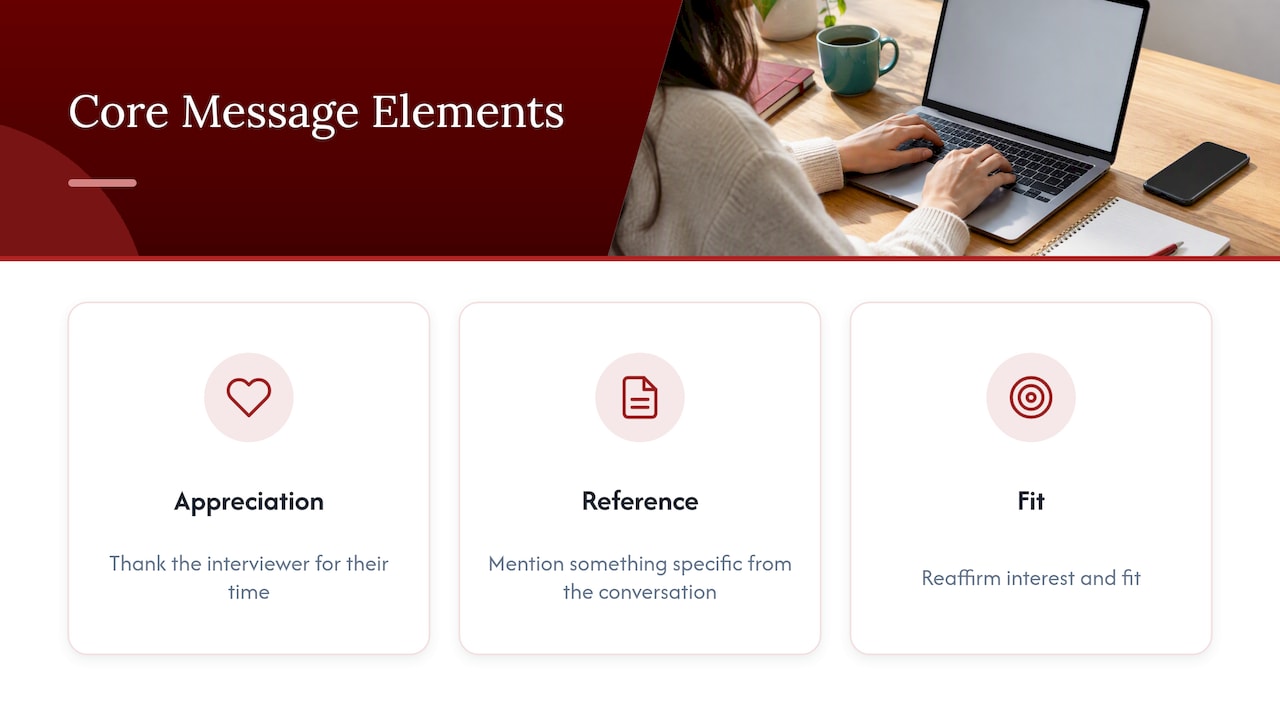
Grammarly’s research summary points to three core elements: appreciation for the interviewer’s time, a specific reference to something discussed, and a reaffirmation of your interest and fit. It also recommends keeping the message to one or two short paragraphs. Here is how to build each part.
The subject line
Clarity beats cleverness. Recruiters process dozens of messages a day, and your subject line should let them file yours instantly. Indeed Canada suggests simple structures that combine thanks with your name or the job title. In practice, use the role and your name:
- Thank you, Marketing Manager interview
- Thank you from Priya Sharma, Senior Analyst interview
- Following our conversation on Tuesday, Director of Operations
Avoid all-caps, exclamation marks and vague lines such as “Hello” or “Quick note.”
The opening: thanks that names something
Open with gratitude, but make it specific to the meeting. “Thank you for your time today” is accurate and forgettable. Compare it with: “Thank you for walking me through how the Calgary team is restructuring its regional reporting.” The second sentence proves you listened.
The middle: one detail and one point of value
Choose a single topic from the conversation: a project, a challenge, a goal the team mentioned. Then connect it to something you have done. This is where you add value rather than repeat your resume. If the interviewer raised a concern about your lack of experience with a particular system, address it directly in a sentence, with a concrete example.
One recruiter-style rule of thumb: if the sentence could be sent to any employer after any interview, delete it or make it specific.
The close: interest and a clear next step
Restate that you want the role, and say why in one clause. Then end simply: you look forward to the next step, and you are available if they need anything further, such as references or work samples. Sign off with “Sincerely” or “Kind regards”, your full name, phone number and, if relevant, your LinkedIn URL.
A template, then a worked example
Template
Subject: Thank you, [Job title] interview
Dear [Name],
Thank you for meeting with me on [day] to discuss the [job title] position. I especially valued our conversation about [specific topic], and it reinforced how much I would like to contribute to [team or goal].
[One sentence connecting your experience to that topic, with a result or example.] I remain very interested in the role and confident that my background in [area] fits what you described.
Thank you again for your time. I look forward to hearing about next steps.
Kind regards,
[Full name]
[Phone] | [LinkedIn URL]
Worked example: mid-career finance role
Subject: Thank you, Finance Manager interview
Dear Ms. Tremblay,
Thank you for speaking with me on Wednesday about the Finance Manager role. Your description of the planned ERP migration was especially helpful, and it confirmed my interest in joining the team during that transition.
In my current role I led month-end close through a similar system change and shortened the close cycle from eight working days to five. I would welcome the chance to bring that experience to your team, and I remain very enthusiastic about the position.
Thank you again for your time. I look forward to the next step.
Kind regards,
Daniel Okafor
416-555-0142
The example is invented for illustration, so replace every detail with your own real accomplishments. Your numbers must be ones you can defend in a reference check.
Panel interviews and multiple interviewers
When you met several people, write to each of them individually. Hiring guidance on follow-up timing warns that interviewers often compare notes, and identical messages reveal a template approach. Reference a unique topic from your exchange with each person.
A practical routine:
- Before you leave, ask for business cards, or confirm the correct spelling of names and titles with the coordinator.
- Within an hour of the interview, jot down one detail from each person: a question they asked, a project they mentioned, a concern they raised.
- Draft the first email fully, then adapt the middle paragraph for each of the others. Change the opening line too.
- Send them at the same time, so no one feels like an afterthought.
If you cannot get individual addresses, send one email to the main contact and ask them to pass on your thanks, naming each panel member in the message.
Using the email to repair a weak answer
Most candidates replay the interview on the drive home and land on one answer they wish they had given differently. The thank you email is the legitimate place to fix it. The Business Insider recruiter suggests that if you sense you bombed a question, a thank-you note is an opportunity to strengthen your answer.
Keep it proportionate. Add context; do not relitigate. A workable line is: “I have been thinking more about your question regarding vendor negotiations and wanted to add a bit more detail to my earlier response.” Then give two or three sentences with a specific example. This shows intellectual engagement and resourcefulness, whereas a long apology draws attention to the weakness.
The same logic applies to qualifications you forgot to mention. If the posting emphasized stakeholder management and you never got to describe the cross-functional program you ran, one sentence in the email can close that gap. If you find you often leave out your strongest material, the problem may start earlier, in the documents. A clear career summary helps you rehearse your top three selling points before every interview.
If a recruiter is involved
When an executive search consultant or agency recruiter placed you in the process, they should be your primary channel. According to a timing guide for follow-ups, recruiters hold direct relationships with hiring managers, can obtain candid feedback that is rarely shared with candidates, and can follow up on your behalf in a way that feels less pushy.
This does not mean you skip the thank you email. In most cases you do both:
- Send a brief thank you to the interviewers, unless the recruiter has asked you to route all communication through them.
- Send your recruiter a short debrief the same day: how it went, what you learned, your continued interest and any concerns you want them to address.
In retained searches at the senior level, discretion matters. Ask the recruiter how they prefer to handle communication before you write to a board member or CEO directly.
Government of Canada and public service roles
Public sector hiring works differently, and your email should reflect that. The Public Service Commission’s guide to conducting interviews describes a structured process in which board members assess each candidate independently and then arrive at a final board assessment. Informal contact is not part of those ratings.
What that means for you:
- A thank you email is still polite and appropriate, but do not expect it to move a score. Do not use it to introduce new qualifications as though they could change the assessment, and never ask how others performed.
- Keep it brief and neutral. Thank the board for the opportunity and confirm your continued interest in the position.
- Use email, not post. Mail routed through government internal systems can delay delivery, so email is the efficient channel.
- Know what happens next. The Government of Canada explains the post-application stages, and your most useful follow-up is checking your account for status updates rather than writing repeatedly.
If you are preparing for a provincial or federal competition, the quality of the application itself carries far more weight than any follow-up. Our guides to federal resumes in Canada and to meeting the Ontario government’s page limit cover that stage.
Mistakes that cost candidates
| Mistake | Why it hurts | Fix |
|---|---|---|
| Generic opening | Reads as a template | Name one topic from the meeting |
| Same text to every interviewer | Interviewers compare notes | Change the middle paragraph for each person |
| Three or four paragraphs | Respect for their time is part of the message | Two short paragraphs |
| Typos in the name or company | Signals carelessness | Check spelling against the signature of the invitation |
| Asking about salary or start date | Shifts tone from gratitude to negotiation | Wait for an offer |
| Attaching new documents unprompted | Looks like overreach | Offer to send samples if useful |
| Casual tone, emoji or slang | Undercuts professionalism | Match the formality of the interview |
Perspective: what we see across thousands of applications
At Professional Resumes, we work directly with executives, healthcare professionals, newcomers to Canada and people returning after a career gap, and a pattern repeats. Candidates treat the interview as a separate event from their documents, when in fact the two should say the same thing. The thank you email is where that consistency shows. If your resume positions you around turnaround leadership and your email suddenly talks about being a team player, the hiring manager notices the mismatch.
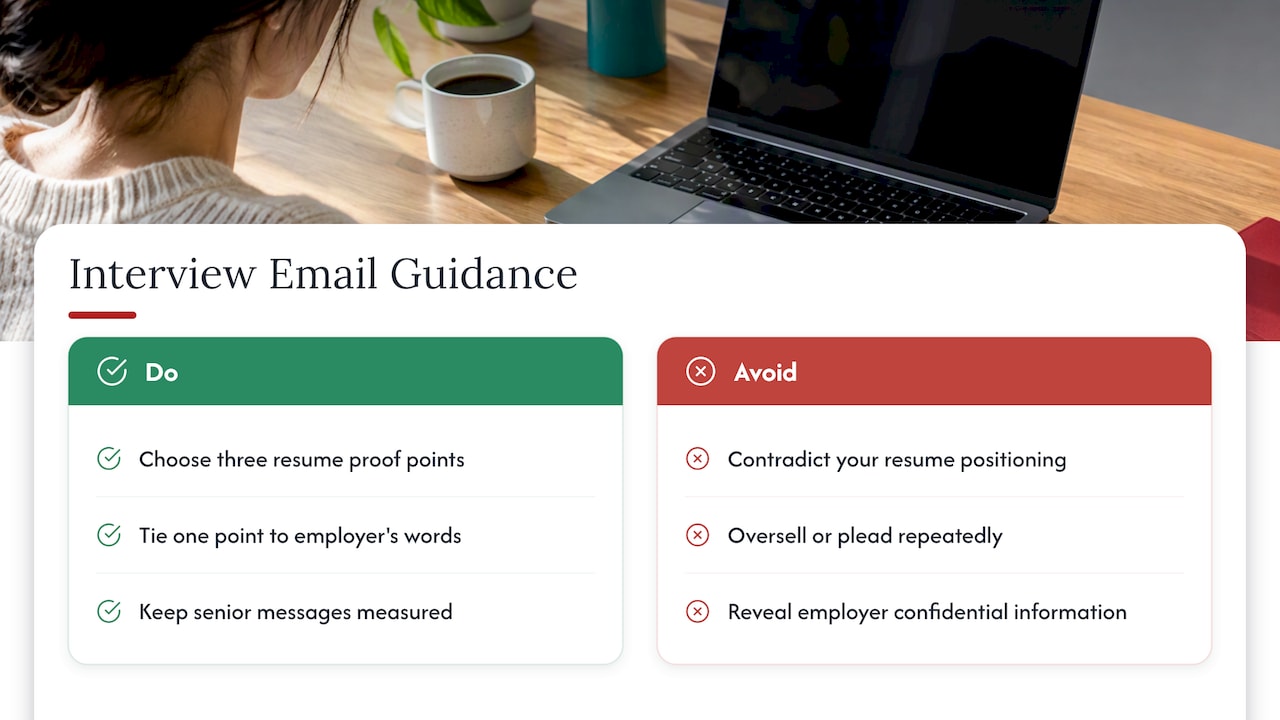
Our advice follows from how we write for clients. Before any interview, choose the three proof points your resume leads with. After the interview, the thank you email should return to one of them, tied to something the employer said. For senior candidates, the message should be measured and discreet: no overselling, no repeated pleading, and nothing that reveals confidential information from a current employer. At the executive level, board-level scrutiny rewards precision, so one sharp sentence outweighs a page of enthusiasm.
We also tell clients that the email cannot rescue a weak application, but it can reinforce a strong one. That is why we put such weight on consultation: your writer needs to understand your actual story before they can help you tell it consistently across your resume, cover letter and LinkedIn profile.
— Professional
Make the whole application consistent
If you are getting interviews but not offers, or getting few interviews to begin with, look at the documents before the follow-up. A Canadian cover letter built around one STAR paragraph and an ATS-friendly resume give you stronger material to reference in your thank you email.
We write custom resumes, cover letters and LinkedIn profiles for Canadian job seekers, with consultation and revisions included. Published prices for one-off resumes are $139 for the Early Career Resume, $189 for the Next Step Resume, $239 for the Advanced Resume and $289 for the Executive Resume. You can compare them on our shop page, and our LinkedIn profile optimization service helps ensure the profile an interviewer checks after your meeting supports the story you told.
After the thank you: preparing for an offer
Once your message is sent, resist the urge to refresh your inbox. Use the waiting period to prepare for the next stage. Re-read the posting, list your questions about scope and reporting lines, and decide your salary range before a number is raised. Our guide on stating salary expectations using Job Bank data shows how to ground that range in Canadian figures.
When an offer arrives, compare it on take-home pay, not only the headline figure. This guide to negotiating a job offer with take-home pay in mind is built around a calculator using United States federal and state tax tables, so Canadian readers should use it for the method and apply Canadian federal and provincial tax rates to their own numbers.
FAQ
Should I send a thank you email if the interview was a phone or video call?
Yes. The same expectations apply, and the timing is identical. Refer to something specific from the call, and if technical problems interrupted part of it, you can use a line to briefly restate an answer that was cut off.
How long should the email be?
Two short paragraphs, roughly 100 to 150 words. Grammarly’s guidance recommends one or two short paragraphs, and longer messages risk being skimmed or ignored. If you have a lot to add, you are probably restating your resume.
What if I do not have the interviewer’s email address?
Ask the recruiter or HR coordinator who scheduled the interview, and send the message to them with a request to forward it. You can also reply to the thread in which the interview was arranged. As a last resort, send a LinkedIn message, kept to the same short format.
Is it acceptable to send a handwritten note instead?
Only as an addition, never a replacement. Career guides note that handwritten notes suit situations where immediacy is not an issue, and in most hiring processes the decision moves faster than the post. Send the email first.
What if I hear nothing after sending it?
Wait for the timeline you were given. If none was stated, a status check after 5 to 7 business days is reasonable, according to this timing guide. Keep that message separate, short and courteous.
Sources
- Business Insider: veteran recruiter on thank-you notes
- Scientec Consulting: when to follow up after an interview
- Grammarly: thank-you email after an interview
- Harvard Law School: interview follow-up thank-you notes
- University of Waterloo CareerHub: post interview considerations
- Indeed Canada: thank-you email subject lines
- Public Service Commission: how to conduct interviews
- Government of Canada: after you apply
- Loyola University Chicago: career correspondence guide