
A strong pharmacist resume in Canada is one to two pages, leads with your provincial licence and registration status, and proves clinical and operational impact with numbers rather than a list of duties. It is tailored to the setting you are applying to, whether community, hospital or clinical, and it is written in Canadian English without a photo or personal details. This guide shows you how to build each section, with worked bullet examples you can adapt.
TL;DR
- Put your licence, regulatory college and registration class near the top, and state where you are in the process if you are still completing registration.
- Keep it to one page for early-career roles and up to two pages for mid- and senior-level roles.
- Write each bullet as context, action and result, with figures such as prescriptions verified, vaccinations given or reviews completed.
- Mirror the posting’s language: community, hospital and clinical roles screen for different keywords.
- Leave out the photo, date of birth, marital status and references, and use Canadian spelling throughout.
Table of Contents
- What a Canadian pharmacist resume must contain
- How to present your licence, registration and education
- Writing experience bullets that show clinical and operational impact
- Tailoring by practice setting
- Skills and keywords for ATS screening
- Mistakes to avoid on a Canadian pharmacist resume
- Our perspective on pharmacist resumes
- Get professional help with your pharmacist resume
- A pre-submission checklist
- FAQ
- Sources
What a Canadian pharmacist resume must contain
Employers and screening software read a pharmacist resume for three things in the first few seconds: that you are licensed (or on a defined path to licensure), what practice setting you have worked in, and what outcomes you produced there. The structure should make all three obvious.
A workable order, in reverse chronological format, is:
- Name and contact details (city and province, phone, email, LinkedIn URL).
- Professional summary of three to four lines, including licence and years of practice.
- Licensure and certifications.
- Core skills, tailored to the posting.
- Professional experience.
- Education, residency or fellowship.
- Professional activities, committee work, teaching or publications, if relevant.
Professional guidance for pharmacy students recommends a brief one- or two-page resume organized in reverse chronological order under clear headings, with no photograph or personal information. The same presentation notes that functional formats, which group experience by skill rather than by date, are usually not preferred by employers. For a licensed pharmacist with a continuous record, reverse chronological is the safer and more readable choice.
Length: one page or two
For entry-level roles in Canada, RBC advises keeping the resume to one page, while two pages are acceptable for mid- to senior-level positions. For pharmacists, that translates as follows:
- New graduate or recent licensant: one page, with placements, student practice experience and any extra certifications.
- Staff pharmacist with several years of practice: two pages, with the most recent roles carrying the most detail.
- Pharmacy manager, clinical specialist or director: two pages, weighted towards scope, budgets, teams and measurable outcomes.
Never pad to reach a second page, and never shrink the font below readable size to hold a first page. Cut older, less relevant roles to one line each instead.
How to present your licence, registration and education
Pharmacy is regulated provincially, so your regulatory college and your registration status are the first credibility check. Place them in the summary or in a short “Licensure and certifications” block directly beneath it, not at the bottom of page two.
A clear format looks like this:
- Licensed Pharmacist, Ontario College of Pharmacists, Registration No. 000000
- Authorized to administer injections, registered with the College
- Current CPR/First Aid certification
Use the exact title your college uses, and include the class of registration if your province distinguishes one. A Canadian employer’s job posting shows what is expected: a Metro Pharmacy posting in Ontario asks for a registered pharmacist with the Ontario College of Pharmacists and for injection and smoking cessation certifications registered with the College. Read the posting you are targeting and make sure each requirement it names appears on your resume in the same words.
Injection and additional prescribing authorizations
Additional authorizations vary by province, so list the ones you actually hold, with the issuing body. In Alberta, for example, the College’s injection authorization requirements include a recognised training program and current first aid and CPR certification, and the College reminds members to keep those valid. Listing your CPR and first aid status alongside the authorization shows you have kept it current.
If you trained outside Canada
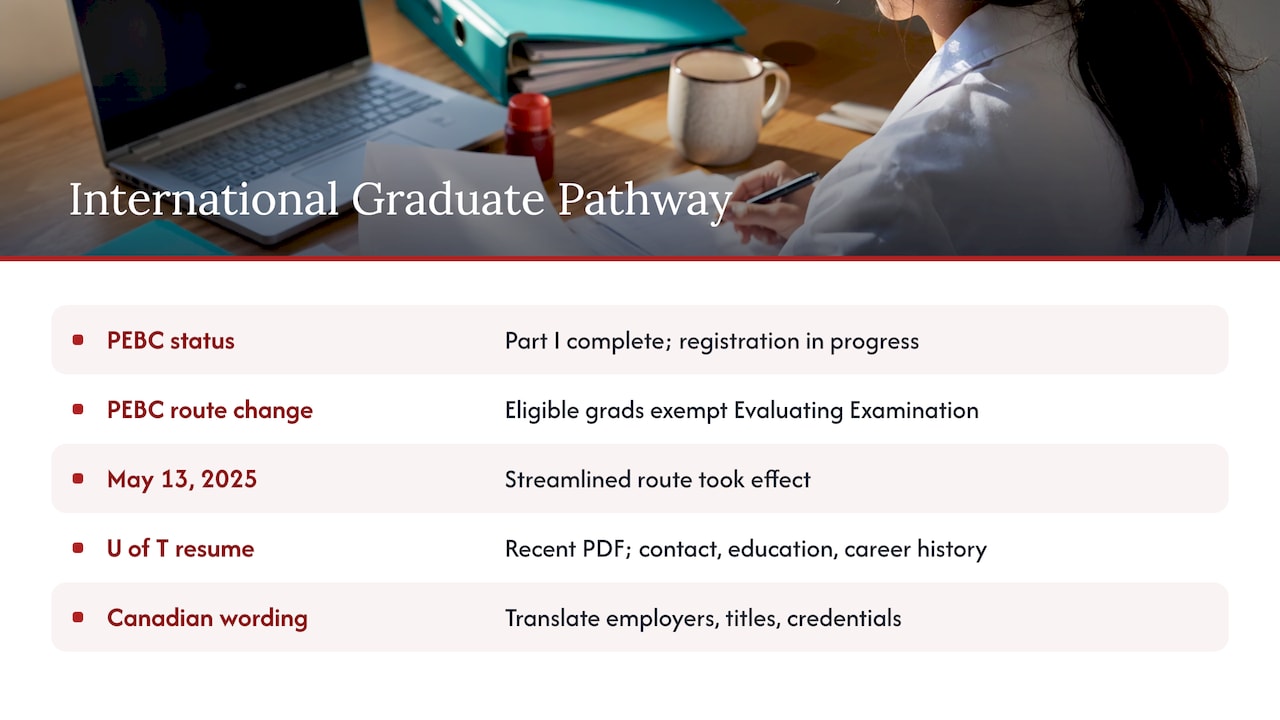
Do not hide the process. State your stage plainly in the licensure block, for example: “Pharmacy Examining Board of Canada (PEBC) Qualifying Examination Part I completed; provincial registration in progress.” The pathway has changed recently. The BC College of Pharmacists reported that, effective May 13, 2025, PEBC introduced a streamlined route that exempts eligible international graduates from the Pharmacist Evaluating Examination. PEBC’s international graduates page sets out the current certification pathway, so confirm your own status there before you write it down.
If you are applying to a bridging program, requirements differ again. The University of Toronto’s international pharmacy graduate program asks for a recent PDF resume with current contact information and a summary of education and career history.
Newcomers also need to translate foreign employers, titles and credentials into terms a Canadian hiring manager recognises. Our resume writing for newcomers to Canada page explains how we handle that adaptation.
Writing experience bullets that show clinical and operational impact
The most common weakness in pharmacist resumes is a list of duties: dispensing, counselling, verifying, managing inventory. Every pharmacist does these. What separates candidates is the scale, the outcome and the judgment behind them.
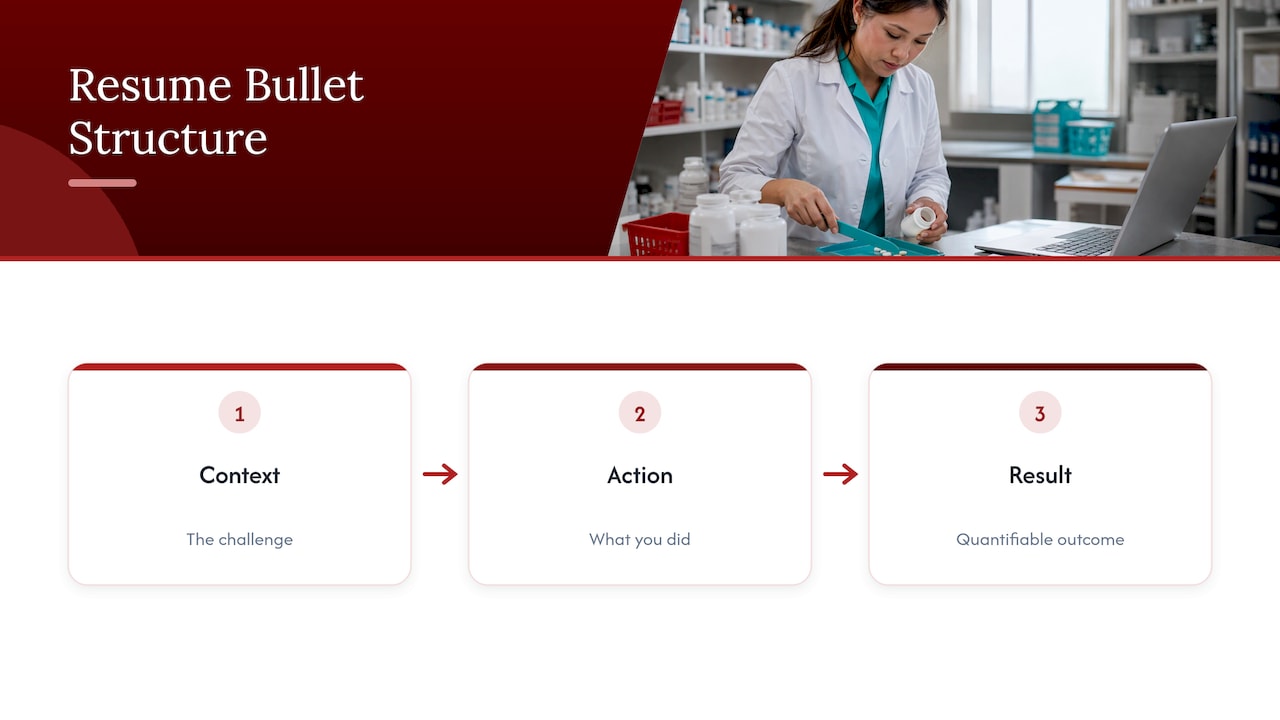
A useful structure is Context, Action, Result. Guidance on hospital-ready pharmacy resumes recommends this three-part format so each bullet carries a challenge, what you did and a quantifiable outcome, and frames each bullet around whether you can do the job and keep patients safe.
Community pharmacy examples
Quantify volume, services and patient outcomes. Use your own figures, and only figures you can stand behind:
- Verified 350 to 400 prescriptions daily in a high-volume community pharmacy while maintaining a documented error-reporting process.
- Administered approximately 1,200 vaccinations a year during a season in which the pharmacy added walk-in clinics.
- Completed 450 MedsCheck reviews in a calendar year and referred patients with identified drug therapy problems to their physicians.
- Trained and supervised two pharmacy technicians and four assistants, reducing average prescription wait time through a revised workflow.
These are illustrative templates. Replace each number with your own, and if you do not track a metric, estimate conservatively and be ready to explain it at interview.
Hospital and clinical examples
- Led medication reconciliation on admission for a 30-bed surgical unit, identifying discrepancies for pharmacist and physician follow-up.
- Managed anticoagulation consults for inpatients, applying dosing protocols and documenting monitoring plans.
- Prepared sterile compounded products in accordance with facility standards and supported formulary review for a therapeutic class.
- Contributed to an antimicrobial stewardship review and presented findings at interdisciplinary rounds.
For each, add the number you can defend: units covered, consults per month, interventions accepted, time saved, or error rates reduced.
Leadership and management examples
For pharmacy managers and directors, the language shifts to scope: staff supervised, budget or sales responsibility, inventory turns, audit results, accreditation outcomes and programs launched. Use the same Context, Action, Result structure, and lead with the outcome when it is strong.
Tailoring by practice setting
A single generic resume tends to perform poorly everywhere. Guidance on hospital resumes advises translating retail accomplishments into hospital vocabulary and focusing on inpatient and clinical keywords, because hiring managers and screening tools look for that language.
| Setting | Lead with | Typical keyword emphasis | Quantify |
|---|---|---|---|
| Community or retail | Licence, injection authorization, services offered | Prescription verification, patient counselling, MedsCheck, immunization, pharmacy software named in the posting | Daily volume, services per year, team size |
| Hospital or health system | Licence, residency or hospital experience | Medication reconciliation, anticoagulation, sterile compounding, formulary management | Unit size, consults, interventions, compliance results |
| Clinical or ambulatory | Advanced training, collaborative practice | Chronic disease management, medication review, prescribing authority, interprofessional care | Patients managed, clinic outcomes, referrals |
| Entry-level or residency | Education, placements, certifications | Patient counselling, rotations, research or QI project | Rotations completed, cases, projects, volunteer hours |
If you are moving from community into hospital practice, reorder your bullets so the clinical work comes first, even when it was a smaller share of your day.
Entry-level pharmacist resumes
RBC’s guidance for new graduates is to keep the resume clear and concise: one page, clean formatting, clear headers and bullet points, keywords from the posting, a customized version for each role, and volunteer experience to show initiative. For a new pharmacist, that means highlighting structured practice education placements, immunization or injection training, any research or quality improvement project, and community or professional association involvement.
Skills and keywords for ATS screening
Applicant tracking systems parse your resume into fields and compare it with the posting. Pharmacist postings tend to screen by practice setting and licensure, and ATS guidance for pharmacists recommends standard terms such as medication therapy management, anticoagulation management and drug utilization review, along with the pharmacy systems you have used.
Practical rules:
- Use the posting’s exact phrasing where it is true of your experience. If it says “medication reconciliation,” do not write “med history review.”
- Name software and systems you have used, as the Metro posting above does with its pharmacy systems.
- Keep a focused skills section of roughly eight to fifteen items. Overstuffed lists are one of the mistakes recruiters flag in Canadian resumes.
- Place the skills block directly after your summary so the key terms appear early.
- Use a single-column layout with standard headings. Two-column designs and graphic elements can parse badly.
Keywords only work when the experience below them backs them up. Each skill listed should appear again in at least one quantified bullet.
Mistakes to avoid on a Canadian pharmacist resume
- Including a photo, date of birth or marital status. These are not part of Canadian resume convention, and Canadian recruiters commonly flag them.
- Mixing American and Canadian spelling. Write “licence” as a noun, “centre,” “counselling” and “colour” consistently.
- Listing duties instead of accomplishments. Every bullet needs a result.
- Sending the same resume to every employer. Adjust the summary, skills and top three bullets each time.
- Adding references. Canadian convention is to omit them and supply them on request.
- Burying the licence. Place it where the first scan will find it.
- Using a functional format. It obscures your timeline, which employers in a regulated profession expect to see.
Our perspective on pharmacist resumes
We see the same pattern across regulated healthcare professions: the candidate is qualified, but the document does not show it quickly enough. A pharmacist’s licence, scope and clinical judgment are the substance of the application, and they have to be visible before a reader decides whether to continue.
Our approach is consultation-led. Working directly with your writer, you discuss the setting you are targeting, the services you have delivered and the outcomes you can substantiate, and the writer turns that into a resume organised around those priorities. We build documents with applicant tracking system formatting and keyword alignment to the roles you are pursuing, informed by current hiring trends.
For pharmacists changing settings, returning after a gap or adapting international credentials to Canadian expectations, that tailoring is what makes the difference between a document that lists a career and one that argues for the next role. Revisions are part of the process, so the final version reflects your voice and your facts.
Professional
Get professional help with your pharmacist resume
If you would rather not rebuild the document yourself, our writers prepare customized resumes for healthcare professionals, including pharmacists, working from a consultation about your practice setting and goals. Pricing is published per resume level: Early Career Resume at $139, Next Step Resume at $189, Advanced Resume at $239 and Executive Resume at $289, each a one-off fee.

Most staff and clinical pharmacists fit the Next Step or Advanced level, while a new graduate may prefer Early Career and a director or regional manager the Executive level. See the full range in our resume shop, read about our healthcare services resumes, or add a LinkedIn profile optimization service so your online profile matches your resume.
A pre-submission checklist
- Licence, college and registration status appear in the top third of page one.
- Additional authorizations and certifications are listed with current status.
- The summary names your setting and years of practice.
- The skills section mirrors the posting and holds eight to fifteen items.
- Every experience bullet follows Context, Action, Result and carries a number where honest.
- Spelling is Canadian throughout.
- No photo, personal details or references.
- The file is a clean single-column document, saved as PDF or Word according to the posting’s instructions.
FAQ
How long should a pharmacist resume be in Canada?
Entry-level candidates should keep it to one page, and mid- to senior-level pharmacists can use two. Spend the space on recent roles and measurable outcomes, and shorten older positions.
Where do I put my pharmacist licence on a resume?
Put it in your summary or in a short licensure block directly beneath it, near the top of page one. Include the regulatory college, your registration number and class if your province uses one, plus any injection authorization.
How do I list credentials if I am an internationally trained pharmacist?
State your stage clearly, for example the PEBC examination you have completed and that provincial registration is in progress. Confirm the current steps on PEBC’s pathway page, because the route for eligible graduates changed in 2025.
Should I use the same resume for community and hospital jobs?
No. Screening and hiring managers look for different language in each setting, so reorder your bullets and adjust keywords for every application. Hospital roles emphasize terms such as medication reconciliation and sterile compounding, while community roles emphasize services, volume and patient counselling.
Do I need to include references?
No. Canadian convention is to leave references off the resume and provide them when an employer asks.
Sources
- Résumés, CV’s and Portfolios (AACP)
- Resume writing tips for international students in Canada (RBC)
- Finding an entry-level job as a new graduate (RBC)
- Metro Pharmacy pharmacist posting
- Alberta College of Pharmacy: authorization to administer drugs by injection
- BC College of Pharmacists: new pathway for eligible international pharmacy graduates
- PEBC: international graduates certification pathway
- University of Toronto: IPG application process
- Crafting a hospital-ready resume (Council on Hospital Pharmacy Practice and Care)
- ATS resume checker for pharmacists
- How to make a resume in Canada (OnTheMoveCanada)