
A simple resume format in Canada is a reverse-chronological document of one to two pages, set in a clear font, with plain section headings, generous white space and achievements stated in numbers. It contains no photo, no personal details beyond contact information, and no design element that a screening system or a recruiter has to decode. Simple does not mean thin. It means every line earns its place.
This guide sets out the layout section by section, the font and spacing choices that hold up in applicant tracking systems, the content that belongs on the page, and the points where federal applications differ from private-sector ones.
TL;DR
- Use reverse-chronological order, one to two pages, with a clear font such as Arial, Calibri or Times New Roman at 10 to 12 points for body text.
- Lead with contact details, a short career summary, then experience, education and skills, each under a plain heading.
- Quantify results: budgets, team sizes, percentages and volumes, introduced by action verbs rather than lists of duties.
- Leave out photos, age, marital status, reasons for leaving and the line “references available upon request”.
- Federal (GC) applications often need plain text and an explicit match to the poster’s criteria, so build a second, stripped-down version.
Table of Contents
- What “simple” means in the Canadian market
- The layout, section by section
- Fonts, spacing and file type
- Length: when one page is enough, and when it is not
- Writing the bullets: the part that actually matters
- What to leave out
- Tailoring: the step that separates simple from generic
- Federal and public-sector applications
- A simple template you can copy
- Our perspective
- When a professional writer makes sense
- Common mistakes to check before you send
- FAQ
- Sources
What “simple” means in the Canadian market
The queries behind this topic vary: basic, plain, minimalist. They describe the same document. Canadian guidance from Job Bank on writing a good resume points to one to two pages, reverse-chronological order, a professional font and clear headings, because employers skim. Job Bank’s figure is an average of about 30 seconds per resume, which is why white space and headings carry so much weight.
Three principles follow from that.
- Scannable structure. A reader should find your current title, employer and dates within seconds.
- Relevance over completeness. Job Bank’s guidance favours removing extraneous information so the most relevant qualifications are visible at once. A simple resume is focused on the job description, not exhaustive about your history.
- Evidence over adjectives. Numbers and specific outcomes replace generic claims.
If you are still deciding between chronological, functional and combination layouts, our guide to picking the right Canadian resume format walks through the choice. For most candidates with a continuous work history, chronological is the correct answer. The U.S. Department of Labor’s Resume Essentials guide also describes the chronological style as the most popular with employers and one that works well with resume-scanning tools.
The layout, section by section
The order below suits most Canadian job seekers. Adjust it only when you have a reason, such as placing education first for a recent graduate.
| Section | What it holds | Typical size |
|---|---|---|
| Header | Name, city and province, phone, professional email, LinkedIn URL | 2 to 3 lines |
| Career summary | Your level, field, two or three strengths, one headline result | 3 to 4 lines |
| Professional experience | Title, employer, location, dates, then achievement bullets | Most of the page |
| Education and credentials | Degree, institution, licences, certifications | 2 to 6 lines |
| Skills | Tools, systems, languages, role-relevant competencies | 1 to 2 lines per group |
Header
Name at the top, slightly larger than body text. Add your city and province, a phone number, a professional email address and a LinkedIn link. You do not need a full street address. Leave out a photo, date of birth and marital status: Job Bank notes that these are not standard in Canada and can invite unconscious bias.
Career summary
Open with a short summary rather than an “objective” that describes what you want. State who you are professionally, what you are strongest at and one measurable result. A summary such as “Operations manager with eight years in food distribution, leading teams of up to 40 and reducing delivery errors by 18%” tells the reader more than a paragraph of adjectives. Our guide on writing a career summary that impresses Canadian recruiters covers the construction in detail.
Professional experience
List positions from most recent to oldest. For each, give the job title, employer, city and month-and-year dates on a consistent line. Under it, write three to six bullets. Lead each with an action verb. Job Bank suggests persuasive verbs such as managed, led, developed and increased, rather than describing duties.
The Shared Services Canada application tips give the same instruction for the structure: start with the most current information.
Education and credentials
Give the credential, institution and year. Add professional designations and licences that the posting names. If you studied abroad, state the credential and the country plainly. Employers in regulated fields may ask for assessment of foreign credentials, so include the status if you have it.
Skills
Keep skills specific to the role: software, systems, languages, technical methods. Group them by type in one or two lines each. A skills section is useful when it echoes the vocabulary in the posting. It is noise when it lists “team player” and “hard worker”.
Fonts, spacing and file type
The formatting choices are small, but they decide whether the document reads as clean or cluttered.
- Font: Arial, Calibri or Times New Roman. Job Bank’s guidance recommends a clear, professional font.
- Size: 10 to 12 points for body text, with headings a point or two larger.
- Margins: about 2 cm (roughly 0.75 to 1 inch) on all sides. This is a practical guideline, not an official rule.
- Colour: black text. One restrained accent for headings is acceptable, but it must survive a black-and-white print.
- Structure: no text boxes, columns, tables for layout, icons, skill-rating bars or graphics. They can scramble the reading order in screening software. Our page on ATS-friendly resumes for Canadian job seekers explains why.
- File type: follow the instruction in the posting. If none is given, a Word document or a text-based PDF is the usual choice. Name the file with your name and the role, for example “Amara-Singh-Resume.docx”.
A minimalist look is a style choice; ATS compatibility is a structural one. A resume can be visually quiet and still fail if its content sits in a table or a header image. The question of design versus convention is explored in modern versus traditional resume styles in Canada.
Length: when one page is enough, and when it is not
Job Bank puts the typical length at one to two pages. A candidate with under about five years of experience can usually fit everything onto one page. Mid-career and senior professionals normally need two, because a single page forces the omission of the results that justify the salary. A third page is rarely justified outside academic, scientific or some executive contexts.
To manage length, cut rather than shrink. Reducing the font below 10 points to fit more text makes the page harder to read. Instead:
- Drop roles older than about 15 years, or compress them into a single line, as Job Bank’s guidance on outdated experience suggests.
- Merge short, similar roles under one employer.
- Remove duties that are obvious from the title.
- Delete reasons for leaving, which do not belong on a resume.
Our page on resume length for Canadian job seekers gives more detail by career stage. Applicants who must fit a single page, such as students applying for funding, can compare a one-page bursary CV format with the Canadian norms described here, remembering that expectations differ by country.
Writing the bullets: the part that actually matters
A clean layout holds a weak resume just as easily as a strong one. The content principle in Canadian guidance is quantification. Job Bank advises using firm numbers and discourages generic statements about improving efficiencies.
Compare:
| Duty-based (weak) | Achievement-based (strong) |
|---|---|
| Responsible for customer service | Resolved an average of 60 customer enquiries per day while holding satisfaction scores above 90% |
| Managed a team | Led a team of 12 across two shifts, cutting overtime by 15% in one year |
| Handled budgets | Oversaw a $1.2M annual operating budget and delivered it 4% under plan |
| Improved processes | Redesigned intake workflow, reducing client wait time from 10 days to 4 |
The figures above are illustrative examples of the style, not benchmarks. Use your own numbers. If you do not have exact data, estimate honestly and conservatively: team size, number of clients, volume of orders, frequency of reports, size of the budget. Most roles contain at least three measurable facts.
A useful test for each bullet: what did you do, how much or how often, and what changed as a result? If a line answers none of the three, rewrite or cut it.
Voice and tense
Canadian resumes are written without “I”, “me” or “my”. Use past tense for completed roles and present tense for the current one. Short, verb-led phrases keep the tone professional and the focus on outcomes.
What to leave out
Simplicity is largely subtraction. The following items weaken a Canadian resume or waste its space:
- Photo, age, date of birth, marital status and nationality, which are not standard in Canada and can invite bias, according to Job Bank.
- “References available upon request”. Job Bank treats it as outdated. Keep a separate reference sheet ready and provide it when asked, typically after an interview.
- Reasons for leaving a job.
- An objective statement focused on what you want from the employer.
- Hobbies unrelated to the role.
- Experience over about 15 years old, unless it is directly relevant.
- Generic skills such as “detail-oriented” with no evidence.
If you are returning after a career gap, keep the same clean format and state the gap briefly where it falls, with any relevant activity such as study, caregiving or volunteer work. Do not explain at length on the resume itself. If you are an immigrant adapting an existing document, the main edits are usually the removal of personal details, the conversion to Canadian conventions for dates and spelling, and the translation of titles and responsibilities into terms a Canadian recruiter recognizes.
Tailoring: the step that separates simple from generic
The Job Bank guidance on standing out warns that recruiters are not interested in information that is generic, dated or irrelevant, and that they decide within seconds whether a resume shows potential. One base resume is fine; one resume sent unchanged to every posting is not.
A workable process takes about 20 minutes per application:
- Read the posting and highlight the five to eight requirements that recur.
- Reorder your bullets so the closest matches come first under each role.
- Mirror the posting’s exact terms where they are true for you, such as the name of a system, a certification or a method.
- Adjust the career summary so the first line matches the target title.
- Remove bullets that do not support this application.
The Parks Canada job application tips give the same advice in short form: create a new resume for each job and review the statement of qualifications so the document suits the position.
Federal and public-sector applications
Government of Canada postings follow different rules, and a polished layout can work against you. The Shared Services Canada application tips describe a screening process in which applicants must show clearly how they meet each qualification. Incomplete or vague answers can lead to automatic screening out. Portals may also require text pasted into fields, in which case special characters, symbols and bullets can be stripped or misread.
In practice:
- Mirror the essential qualifications from the poster and give a specific example under each, with dates, employer and scope.
- Write out how long you performed each relevant task. Screeners cannot assume it from a title.
- Keep a plain-text version with no bullets, symbols or special characters for pasting into the portal.
- Do not use “see resume” as an answer where the form asks for detail.
The Public Service Commission also publishes a résumé template for priority administration, which indicates that screening covers both indeterminate and term positions and asks for all relevant education and recent experience. Our full guide to federal resumes in Canada explains where polished formatting breaks in GC jobs.
A simple template you can copy
NAME
City, Province | 555-555-5555 | email@example.com | linkedin.com/in/yourname

CAREER SUMMARY
Title with X years in [field]. Strengths in [A], [B] and [C]. Headline result with a number.

PROFESSIONAL EXPERIENCE
Job Title | Employer, City | Mon YYYY to Present
- Action verb + what you did + number + result
- Action verb + what you did + number + result
- Action verb + what you did + number + result

Previous Job Title | Employer, City | Mon YYYY to Mon YYYY
- Action verb + what you did + number + result
- Action verb + what you did + number + result

EDUCATION AND CREDENTIALS
Degree, Institution, Year
Certification or licence, Year

SKILLS
Systems: ...
Technical: ...
Languages: ...
Paste it into a blank word-processing document, apply the fonts above, and fill it in with your own content. Resist adding columns or graphic elements afterwards.
Our perspective
We see the same pattern in resumes that arrive for review: the format is rarely what holds a candidate back. The problem is that a clean layout has been filled with duties rather than outcomes, or with the same wording sent to every employer. A simple format makes that weakness more visible, because there is nothing to hide behind.
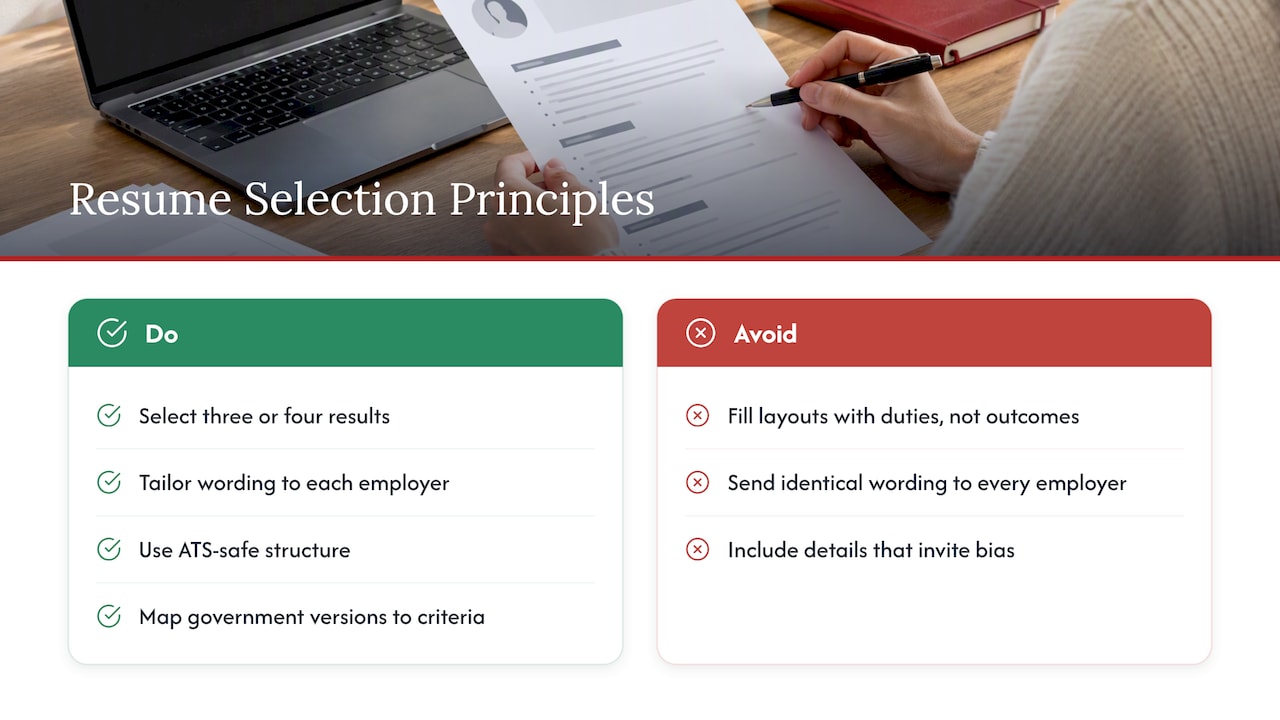
For that reason we treat simplicity as a discipline of selection. In a consultation, the work is to identify which three or four results best prove fit for the target role, and then to build the page around them. For executives, that means P&L ownership, organizational outcomes and transformation led, stated with the precision a board or retained search firm expects. For early-career candidates, it means internships, projects and part-time roles written up as results, not responsibilities.
We also build in the practical constraints of the Canadian market: ATS-safe structure, third-person tone, no personal details that invite bias, and, for government work, a version that maps to the poster’s criteria. Working directly with your writer, you review the draft, and revise it until it reads as you would want a hiring manager to read it.
— Professional
When a professional writer makes sense
Many candidates can produce a good simple resume themselves using the steps above. A writer is worth considering when you are changing industries, returning after a gap, applying at senior level, adapting an international background to Canadian expectations, or when your resume is getting few responses despite a solid record.
Our resume packages are fee-for-service, one-off prices:
- Early Career Resume: $139
- Next Step Resume: $189
- Advanced Resume: $239
- Executive Resume: $289
Each is built from a consultation and includes revisions. We also offer LinkedIn profile optimization, so the profile a recruiter checks after reading your resume says the same thing. You can compare the options on our shop page, or start with the level closest to your experience.
Common mistakes to check before you send
- Inconsistent dates. Use one style throughout, such as “Mar 2021 to Aug 2024”.
- Mixed tenses. Past roles in past tense, current role in present.
- Vague headings. “Professional Experience” and “Education” are read by both people and software without effort. Creative headings are not.
- Unlinked or unprofessional contact details. Use a plain email address based on your name.
- Orphan lines. A single line spilling onto page two looks careless. Tighten text until it fits cleanly.
- Typos. Read the resume aloud, then ask someone else to read it.
- Unnamed files. Save as your name, not “Resume final v3”.
You can find more on the wider process in our article on writing a resume that gets noticed in Canada. If you are targeting online-first employers, see how to tailor a resume for remote jobs.
FAQ
What is the basic format for a resume for beginners?
Use a reverse-chronological layout on one page: header, a short summary, education, any work, volunteer or project experience, then skills. With limited paid history, place education first and describe internships, school projects and part-time jobs in terms of results. Keep fonts clear and bullets short.
Is a one-page resume better than two pages in Canada?
Neither is better by default. Job Bank describes one to two pages as typical. Choose one page if everything relevant fits comfortably, and two if cutting would remove achievements that matter for the role. A third page is rarely needed.
Should I include references on my resume?
No. Job Bank treats “references available upon request” as outdated and a waste of space. Prepare a separate list and supply it when an employer asks, usually after an initial interview.
Does a minimalist resume work with applicant tracking systems?
Generally yes, provided the structure is plain: standard headings, no text boxes, columns or graphics, and a common font. Visual minimalism helps only if the underlying document is also simple. For government portals, you may need a plain-text version without bullets or special characters.
Sources
- How to write a good resume, Job Bank
- Stand out to employers and land your dream job, Job Bank
- Tips and tricks to apply for a job at Shared Services Canada, Canada.ca
- Parks Canada job application tips, Pukaskwa National Park
- Résumé Template, Priority Administration, Canada.ca
- Resume Essentials Participant Guide 2026, U.S. Department of Labor