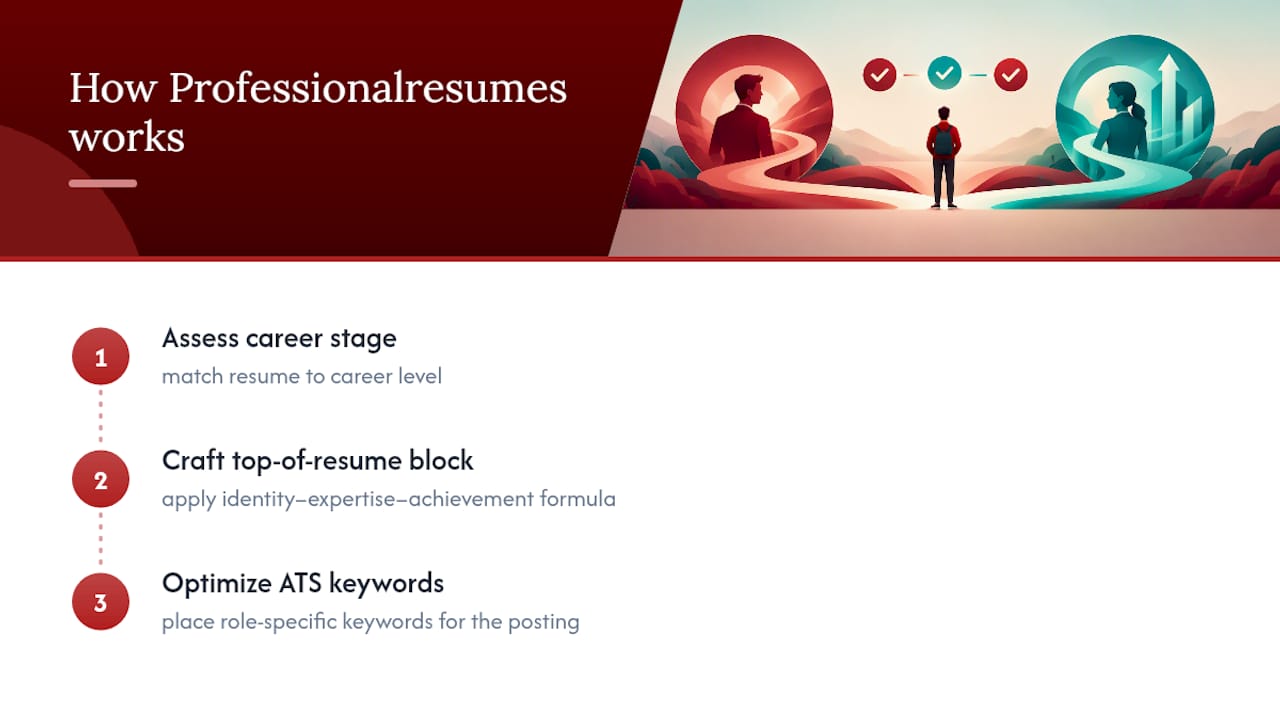
Decorative resume length title card

One to Two Pages: Resume Length That Works for Canadian Job Seekers

Keep your resume to one or two pages: one if your relevant experience is limited, two when additional, recent accomplishments strengthen your case. Academic curricula vitae, certain funding applications, and select executive submissions are the main exceptions, each governed by its own rules rather than a generic page count. The deciding factor is never the page number itself: it is whether every line earns its place against the role you are targeting.


TL;DR:

  • A resume should be one to two pages long unless you have extensive, recent, and relevant achievements that justify a second page.
  • A single page suits early-career professionals or those with limited relevant experience, focusing on a targeted summary, key outcomes, skills, and measurable accomplishments.
  • A second page is justified when there are enough recent, relevant achievements, projects, or certifications that add value without repetition, typically for mid-career or senior professionals.
  • Longer resumes, such as three pages or more, are generally inappropriate for standard roles and reserved for academic CVs or specialized applications with specific page limits.
  • Focus on relevance when trimming your resume, discard outdated roles over 10 to 15 years old, and ensure formatting remains clear and ATS-friendly to maximize readability.

Professionalresumes
Make Every Resume Line Count
Professional Resumes creates customized resumes, cover letters, and LinkedIn profiles tailored to your aspirations and informed by industry trends.

Explore resume services

Table of Contents

How many pages should a resume be? An evidence-backed overview

Canadian guidance converges on a narrow range. Job Bank recommends limiting a standard resume to two pages and prioritizing experience that is both recent and relevant to the position. The University of Toronto’s resume toolkit gives the same range, one to two pages, and explains why the number matters less than what sits at the top.

That guidance rests on how resumes actually get read. Employers give a document a short initial scan before deciding whether it earns a closer look, which is why the strongest match signals belong on page one: job title, keywords from the posting, and a handful of measurable outcomes. A resume that buries its strongest match signals loses the reader before they get there.

Page count follows from this reality rather than setting it. A candidate with a decade of relevant, quantifiable achievements has earned a second page; a candidate without that history has not, and padding to fill it only dilutes what does matter.

One-page resumes: who should use them and how to make them effective

A single page suits students, recent graduates, early-career applicants, and some career changers whose most relevant experience is limited by definition, not by choice. Trying to stretch that experience across two pages usually adds noise rather than substance.

The page should carry only what moves the decision forward:

  • A targeted summary of two to three lines that names the role and your strongest fit for it.
  • The most relevant position or positions, described through outcomes rather than duties.
  • A core skills line matched to the posting’s language.
  • One to three quantified achievements that would survive a hiring manager’s brief scan.

Resist the instinct to shrink the font or compress the margins to fit more in. A one-pager that is hard to read defeats its own purpose.

Pro Tip: Cut a bullet entirely before you shrink the type below 11 point: a shorter, readable page beats a full, cramped one.

Two-page resumes: when a second page earns its place

A second page is justified when there is enough recent, relevant material to fill it without repetition. That typically describes professionals with several years of measurable achievements, technical specialists carrying certifications worth listing, and managers with real scope, team size, budget, or programs, to show.

Page two is where supporting evidence belongs:

  • Notable projects or initiatives that reinforce the page-one narrative.
  • Technical tools, platforms, or certifications relevant to the target role.
  • Earlier roles summarized in a line or two rather than described in full.

Keep the focus on the last 10 to 15 years of work, three to seven bullets per role, and every bullet built around a measured result rather than a listed responsibility. A second page that repeats page one in different words is not earning its space.

Three pages and the exceptions: academic CVs, funding applications and select executive submissions

Some documents are governed by rules unrelated to resume conventions. The SSHRC tri-agency CV sets a five-page limit in English for that specific funding application, with its own formatting requirements, and it is a CV in the academic sense, not a resume.

At the senior end, Public Service Commission guidance for executive CVs allows up to three pages but still directs candidates toward the most recent 10 to 15 years and away from a full biographical account. For a standard professional resume, two pages remains the practical ceiling.
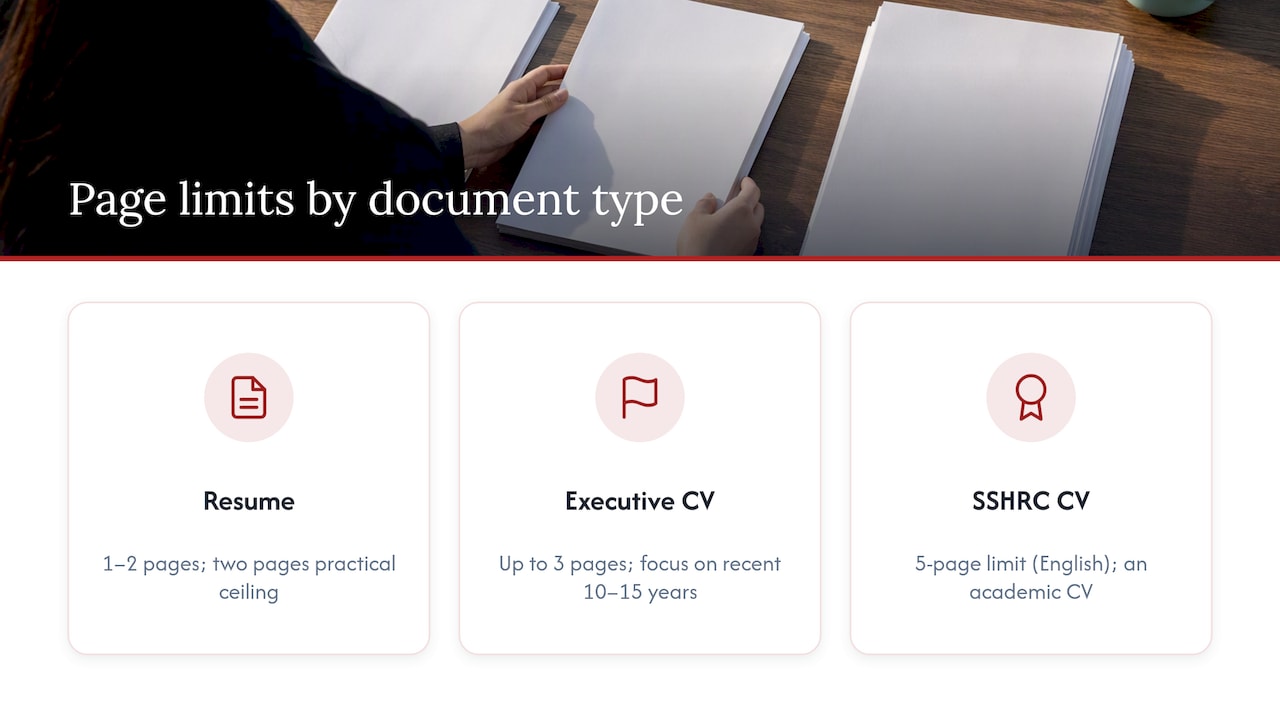
Comparison of resume and CV page limits

If your material genuinely exceeds these formats, the answer is usually a different document altogether: an academic CV, a portfolio, or an appendix, not a longer resume.

How to decide what to keep, edit or remove: a trimming checklist

Most resumes that run long are carrying weight they no longer need. Work through the document in this order:

  1. Cut or summarize any role older than 10 to 15 years unless it directly supports the job you want.
  2. Rewrite duty statements as accomplishment statements: what you did, the context, and the measurable result.
  3. Cap bullets at four or five per role and keep each to two lines at most.
  4. For every remaining line, ask whether it helps this specific application, not your career story in general.
  5. Move anything interesting but non-essential, a side project, an older credential, a longer narrative, to LinkedIn or a portfolio instead of the resume itself.

Pro Tip: If you find yourself defending a bullet’s inclusion, that is usually the sign it belongs elsewhere.

Applying that discipline, drawn from the same principle that resume length should follow relevance rather than habit, tends to shorten a bloated two-page resume before it ever needs a third.

Formatting and ATS-safe basics that preserve readability

Length and formatting solve the same problem from different angles: both exist to help a reader find what matters fast. University of Toronto and UTM career centre guidance recommends body text at 11 to 12 point, margins between three quarters of an inch and one inch, and a single-column layout that both people and applicant tracking systems can parse cleanly.

A few habits protect that readability:

  • Avoid tables, icons, headers, and footers, which some applicant tracking systems misread or drop entirely.
  • Use one consistent date format throughout, rather than mixing styles.
  • Keep headings plain and bullets simple: no nested sub-bullets or decorative dividers.

Employers give a first pass to a resume in about 30 seconds, according to Job Bank, which is why the visual hierarchy matters as much as the words themselves. A clean, predictable layout lets that short window work in your favour rather than against you.

Publisher perspective: how Professional Resumes helps job seekers decide the right length

Deciding what belongs on page one versus page two is a judgment call, and it is where a consultation earns its value. Professional Resumes works with clients to map accomplishments against the target role before deciding whether a document needs one page or two, then applies ATS-friendly formatting so the structure holds up in both a hiring manager’s hands and a tracking system’s parser.

What the length debate misses
What the length debate misses — overview diagram

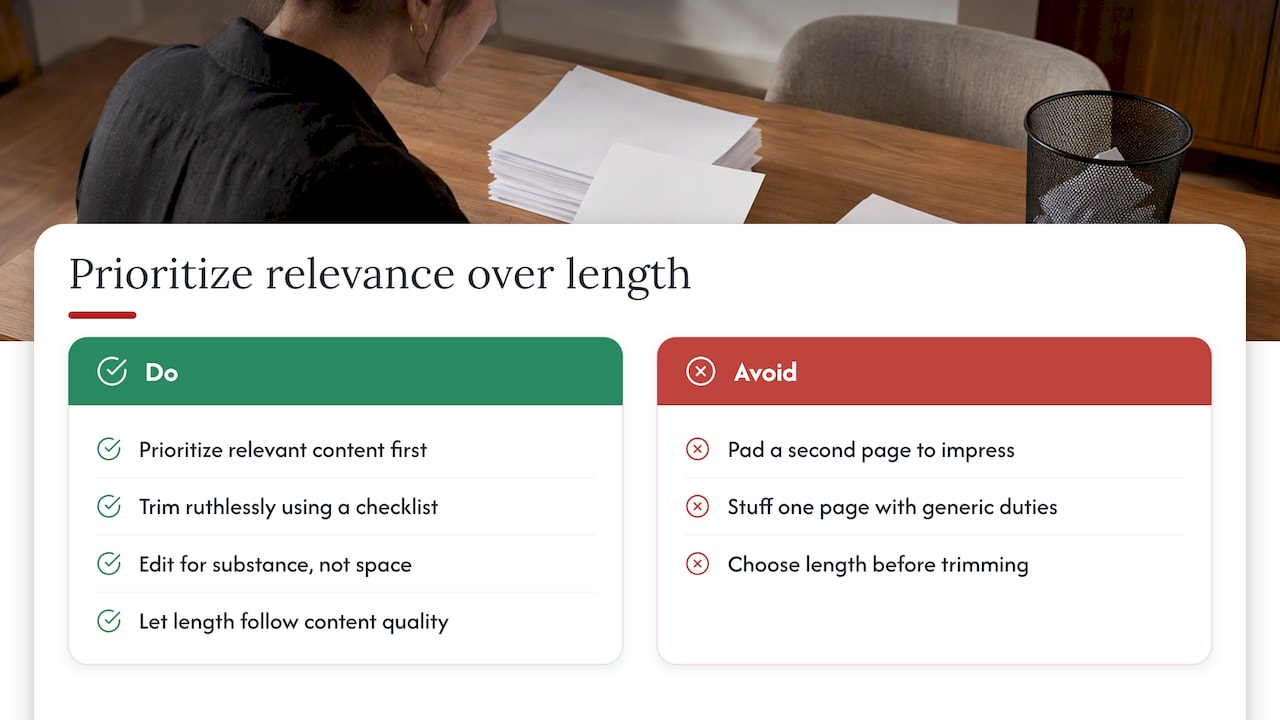
Most advice on this topic treats the page count as the variable worth arguing over, when the real variable is relevance. A one-page resume stuffed with generic duty statements is worse than a well-edited two-pager, and a two-page resume padded to look thorough is worse than a tight single page. The authoritative sources bear this out: Job Bank, the University of Toronto toolkit, and the Public Service Commission all frame their page guidance around what the reader needs to see quickly, not around a fixed number to hit.

What gets underestimated is how much damage a weak second page does. Adding length to appear more experienced usually signals the opposite: that the candidate could not decide what mattered. The reader should prioritize the exercise in the trimming checklist above before worrying about which side of the one-page or two-page line they land on. Get the content right first, and the correct length tends to reveal itself rather than needing to be chosen in advance.

— Professional

Service options: which Professional Resumes product fits your stage

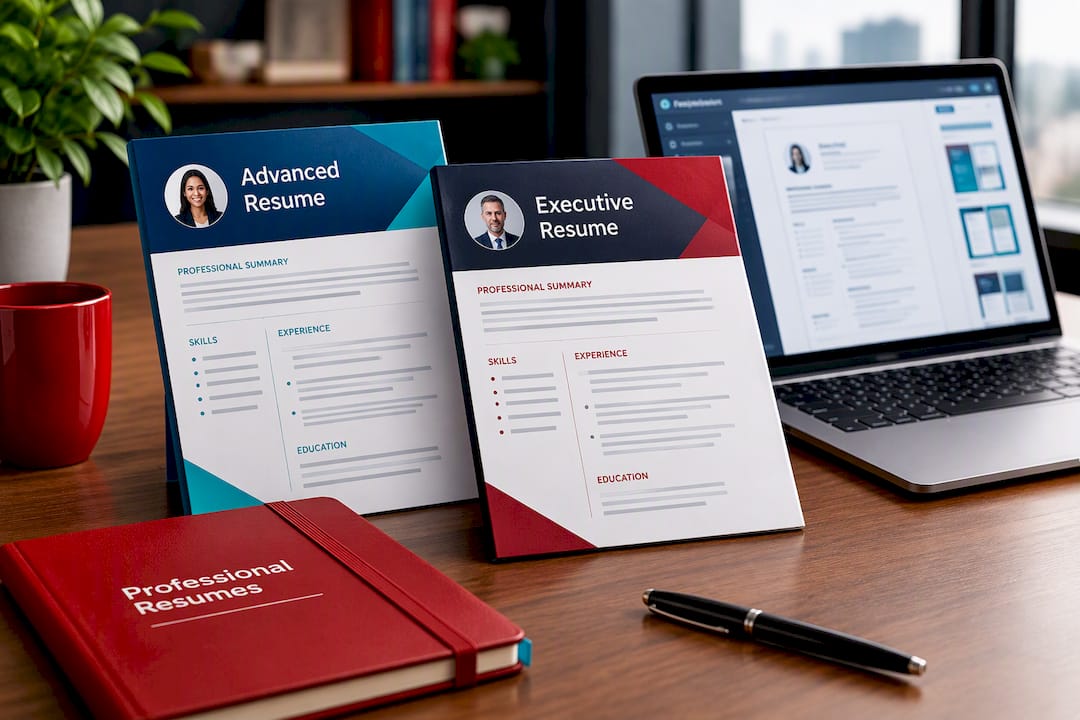
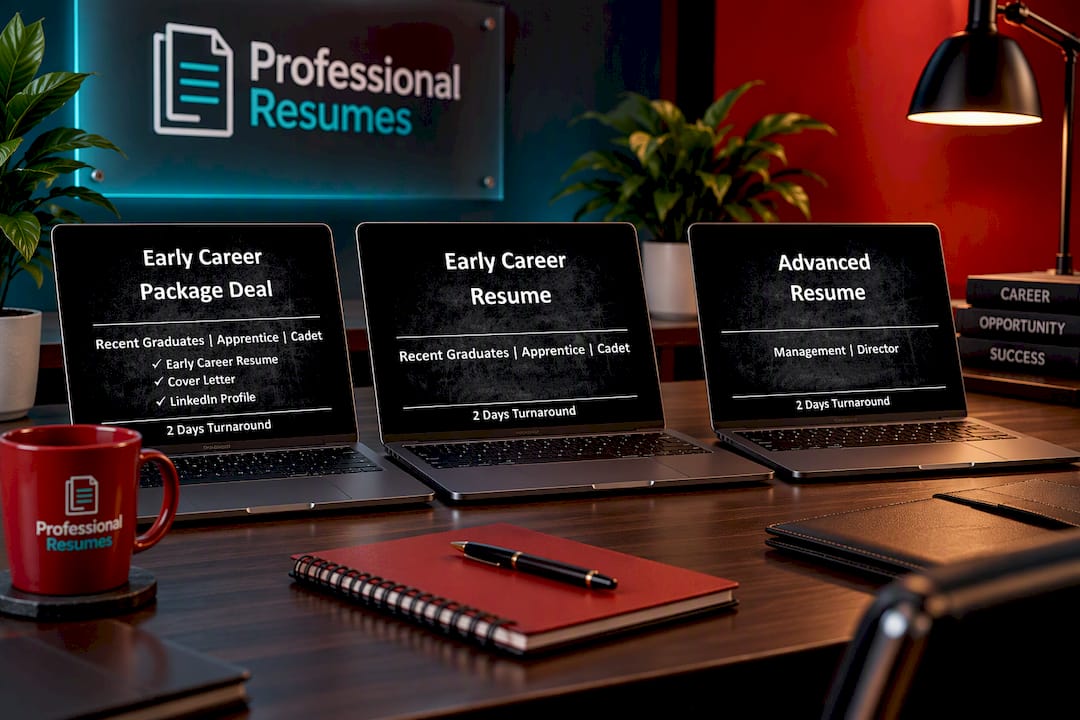
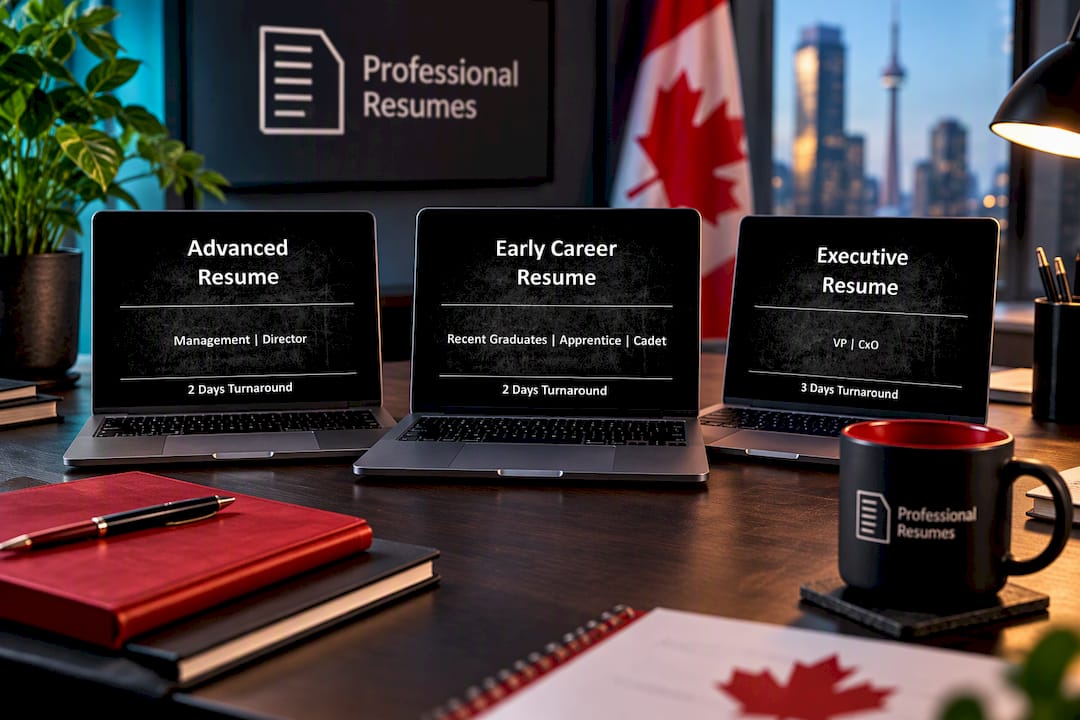
Matching the document to the career stage is most of the work. Professional Resumes structures its product lines around exactly that distinction: the Early Career Resume is built for students and recent graduates working within a tight one-page format, the Advanced Resume suits mid-career professionals who have earned a well-supported second page, and the Executive Resume is written for senior leaders whose scope and strategic outcomes need room to land.
Advanced Resume

  • Browse the full shop to compare Early Career, Next Step, Advanced, and Executive options side by side.
  • Pair a new resume with a LinkedIn profile optimization service so both documents tell the same story.
  • Book a consultation directly through the product page that matches your current stage.

Sources

FAQ

Is a 2 page resume ok?

Yes, a two-page resume is appropriate once you have enough recent, relevant, and quantified achievements to fill it without repetition. Job Bank and university career centres both treat one to two pages as the standard range for most professional resumes.

Is a 3 page resume too long?

For a standard professional resume, yes, three pages generally exceeds what employers expect to scan. The main exception is senior executive CVs, where Public Service Commission guidance allows up to three pages, while academic CVs for funding applications follow entirely separate page limits.

Is a 7 page resume too long?

Yes, a resume of that length falls outside every standard guideline for a professional job application and would typically only suit an academic CV governed by its own field-specific conventions. Even the SSHRC tri-agency CV, a lengthy academic format, caps out at five pages in English.

How long should a 20 year resume be?

A career spanning two decades still fits comfortably into two pages if you focus on the last 10 to 15 years and summarize earlier roles briefly. This approach follows Public Service Commission guidance on emphasizing recent scope and achievement rather than a complete work history.
Executive LinkedIn profile title card

LinkedIn for Executives: High Impact Profile in 60 Minutes

The single most effective LinkedIn approach for executives combines a polished, outcome-focused profile with a low-volume, high-quality posting rhythm and selective networking. Prioritise the headline, About and Featured sections first, then commit to one or two strategic posts per week. Begin now: update your headline today and block 60 minutes this week for content planning.


TL;DR:

  • Executives should focus on a highly polished profile with a strong headline, about, and featured sections before posting regularly.
  • Updating key profile elements like the headline, photo, and banner can significantly improve visibility and should be tested one variable at a time.
  • Posting one to two high-value, outcome-focused posts weekly is more effective than high-frequency content, with formats including short essays, lessons, and brief videos.
  • Building a deliberate network of peers, recruiters, and board members through thoughtful connection requests and comments yields better results than large, unfocused networks.
  • Regular review of qualitative signals such as profile views and engagement quality helps refine content and targeting without relying on detailed analytics.

Professionalresumes
professionalresumes.ca
Shape Your Executive LinkedIn Presence
Professional Resumes tailors LinkedIn profiles to your aspirations, with personalised consultations and revisions that clarify your leadership experience.

Explore LinkedIn profile services

Table of Contents

Profile optimisation checklist for executives

An executive profile should read as a leadership brand statement, not an extended CV. Recruiters, board members and partners scan a handful of fields before deciding whether to read further, so those fields carry disproportionate weight.

Work through them in this order:

  • Photo and banner: a current, professional headshot paired with a banner that reinforces your mission or area of authority.
  • Headline: role, impact and niche combined into one scannable line rather than a job title alone.
  • About: a one-line positioning statement, two or three signature outcomes, and a note on your current agenda.
  • Featured: two or three pinned items, such as a keynote clip, a published article or a case study, that support your positioning.
  • Experience: outcome-focused bullets that read like board notes rather than duty lists.

This sequence matters because a scanning reader rarely reaches the experience section without first being persuaded by the top of the profile. Guides that outline these components consistently point back to the same logic: positioning first, proof second, detail third.

Pro Tip: Rewrite your headline and About section before touching anything else. Those two fields do most of the persuasive work.

For a deeper look at how LinkedIn positioning ties into your broader executive brand, see this piece on personal branding for executives.

Optimising visible fields: photo, headline and banner

These three elements determine the first impression before anyone reads a word of your About section.

  • Photo: a recent headshot, business or business-casual attire depending on your sector, shoulders up, cropped so your face fills roughly 60% of the frame.
  • Headline: use a role plus impact plus niche formula, such as “CFO | Scaling SaaS Revenue from $10M to $100M | Board Advisor.”
  • Banner: reserve this space for a mission statement, a still from a speaking engagement, or a link to a resource you want visitors to notice.
  • Testing: swap one variable at a time, such as the headline phrasing, and watch profile views over a few weeks before changing another element.

Small, deliberate changes let you isolate what actually moves the needle rather than guessing at a full overhaul.

The About section is where most executive profiles fail, either by repeating the resume or by drifting into vague mission language. A tighter structure fixes both problems.

  1. Open with positioning: one sentence naming your function, your scale and the outcome you are known for delivering.
  2. Prove it with two or three results: concise, outcome-oriented statements rather than a running list of responsibilities.
  3. Close with your current agenda: what you are focused on now, which signals relevance to recruiters and partners reading in real time.

Avoid restating your resume line by line. Convert each Experience entry into a short outcome statement: what changed, at what scale, under your leadership, rather than what your role entailed. Featured content should earn its place: a keynote, a published piece or a case study that reinforces the same one or two themes running through your About section, not a scattershot of unrelated links. Recommendations work the same way. A handful of targeted requests from people who can speak to a specific outcome will do more for your credibility than a long list of generic endorsements. For guidance on translating achievements into resume-ready language that mirrors this approach, see these executive resume writing tips.

Thought leadership and content rhythm for executives

A realistic cadence for a time-pressed executive is one to two strategic posts per week, not daily activity. Consistency and quality matter more than frequency, and a leader’s audience tends to reward substance over volume.

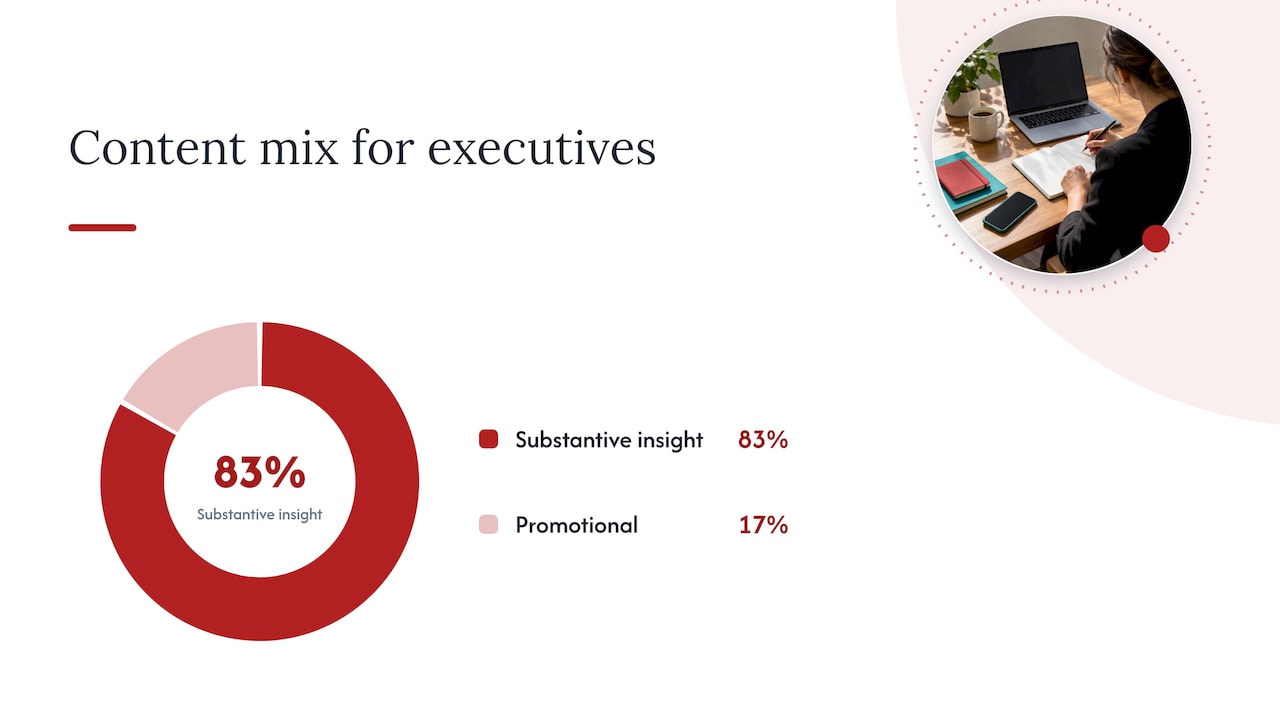
Common frameworks like the 3-2-1 and 4-1-1 models were built for high-volume creators and marketers, cycling through six posts with a mix of curated and original content. Executive guidance from LinkedIn’s own resources suggests adapting these frameworks into a lower-volume format that leans even more heavily toward value before promotion, closer to a five-to-one ratio of substantive insight to anything promotional. That shift reflects how leaders are read differently than creators: fewer posts, each expected to carry real weight.

High-value formats for this rhythm include:

  • Short essays on a decision you made and why it mattered.
  • Lessons from the boardroom, generalized enough to protect confidentiality.
  • Data-informed insights relevant to your sector or function.
  • Brief videos, a minute or two, sharing a single point clearly.

According to Sprout Social’s guide to executive presence, leaders who post strategically and authentically build trust that extends beyond individual engagement metrics into broader organisational reputation. To increase dwell time, open with a specific claim rather than a generic observation, and end with a genuine question rather than a call for likes.

Pro Tip: Batch a month of post ideas in a single sitting, then schedule the actual writing in short, weekly blocks so the habit survives a busy quarter.

Thought leadership and content rhythm for executives — overview diagram

Strategic networking and recruiter engagement

A high-signal network beats a large one. Executives benefit from connecting deliberately rather than accepting every request.

  • Who to prioritise: peers in your function, board members, analysts covering your sector and recruiters specializing in your level.
  • Weekly target: ten to fifteen new connections and five to ten thoughtful comments on posts from people in that circle.
  • Connection notes: a single sentence naming a shared context or a specific reason for reaching out works better than a generic invitation.
  • Comment strategy: a substantive comment on a well-placed post often earns more visibility than a standalone post of your own.
  • Premium and InMail: reserve InMail for warm, specific outreach, such as following up after a conference, rather than cold volume messaging.

Recruiters notice pattern and consistency more than any single post, so a steady rhythm of thoughtful engagement tends to outperform sporadic bursts of activity.

Measure impact: metrics and signals that matter

Executives do not need a marketing dashboard. A handful of qualitative signals, reviewed regularly, is enough to refine both content and targeting.

  • Profile views: a leading indicator of search visibility and headline effectiveness.
  • Post-level engagement quality: comments from relevant people matter more than raw like counts.
  • Search appearances: shows whether your keyword choices in the headline and About are working.
  • Connection request sources: reveals whether recruiters, peers or vendors are finding you.

Executives who focus on strategic, authentic posting can influence trust and pipeline outcomes rather than vanity metrics alone, according to Sprout Social. Third-party analytics tools add value when you need to track visibility trends over time or benchmark against peers, which native LinkedIn data does not do well. A simple monthly routine of reviewing these signals is enough to spot what to adjust before the next posting cycle.

Quick wins and delegation: what to do in under an hour and what to outsource

Time is the real constraint for most executives, not knowledge. A short list of quick wins and a clear delegation boundary solves most of the problem.

  1. Rewrite your headline using the role, impact, niche formula.
  2. Update your photo if it is more than two years old.
  3. Pin one Featured item that reflects your current priorities.
  4. Send five targeted connection requests with a one-line note each.
  5. Comment on three posts from people in your target network.

Tactical work, scheduling posts, formatting graphics, drafting first pass copy from your notes, is safe to delegate to an assistant or a vendor. Keep a single approval step: you supply the core insight in a sentence or two, the delegate builds it into a full post, and you give one consolidated sign-off before it publishes.

Pro Tip: A short hand-off brief, your key message, tone preferences and any names or numbers off-limits, saves more time than any scheduling tool.

How Professional Resumes helps executives with LinkedIn profiles

Professional Resumes offers a dedicated LinkedIn profile optimization service built around the same priorities outlined above: headline, About, Featured and experience narrative, refined through direct consultation. Case studies, including one detailing a VP-level ascent supported by a rewritten resume and an updated LinkedIn presence, illustrate the kind of outcome a coordinated approach can support. When evaluating any vendor, ask about deliverables, the number of revisions included and how client information is handled, since confidentiality matters more at the executive level than at any other stage of a career.

Executive branding strategies beyond profile optimization

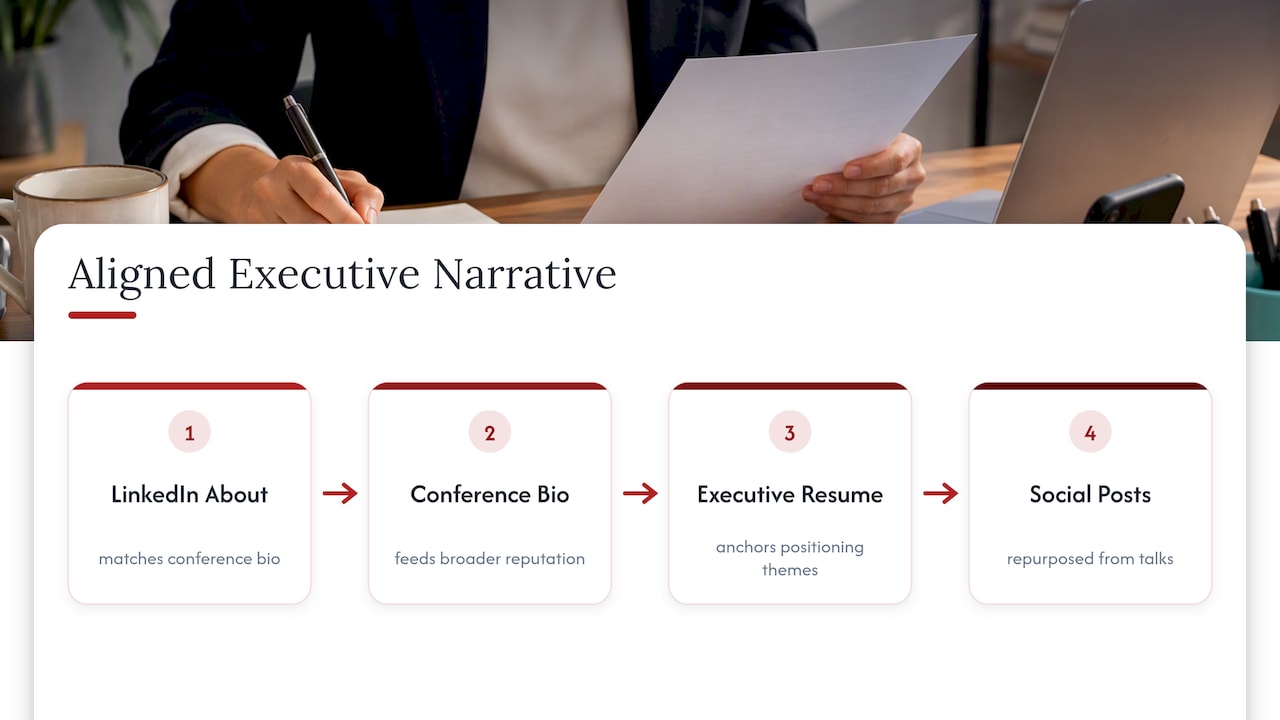
A LinkedIn profile is one surface of a broader executive brand, not the whole of it. Speaking engagements, board appointments, bylined articles in trade publications and podcast appearances all feed the same reputation that your profile summarizes. The strongest executive brands treat LinkedIn as a distribution channel for work happening elsewhere, a conference talk repurposed into three posts, a board decision generalized into a lesson, rather than the sole source of original content.

Consistency across channels matters more than volume on any one of them. The language in your About section should match the bio you send to conference organizers, and the themes in your posts should echo the positioning in your executive resume. When those pieces align, a recruiter or board member encountering you in multiple places sees one coherent narrative instead of several disconnected impressions. For a broader view of how these pieces fit together, this guide to executive personal branding covers positioning beyond the profile itself.

Executive brand alignment across channels

Executives who under-invest in this wider view often find their LinkedIn presence feels disconnected from their actual reputation, polished on the surface but thin on the substance a serious buyer or board is looking for.

Using LinkedIn Groups and Events for executive networking

Groups and Events offer a lower-effort way to stay visible within a specific professional community without adding to your regular posting load. A well-moderated group in your sector surfaces conversations worth commenting on, which supports the comment-first networking strategy covered earlier without requiring original content.

Events, particularly LinkedIn Live sessions or panel discussions tied to your industry, work well for executives because attendance itself signals engagement, and a single thoughtful question or comment during the event can generate more visibility than a week of solo posts. Hosting or co-hosting an event ties naturally into thought leadership, giving you a reason to post a recap afterward that fits the value-first content rhythm already in place.

Choose groups and events selectively. Two or three active groups tied directly to your function or sector, checked briefly once a week, will do more for your network than a long list of memberships that go unread.

Author perspective: pragmatic trade-offs for leaders on LinkedIn

A quality-first approach suits executives better than high-volume tactics because your time is the scarcest resource in the equation, not your ideas. There will be weeks when board preparation or a transaction takes priority over any post, and that is the correct trade-off, not a lapse in discipline. The checklist that holds up under real pressure is short: is the headline current, is the About section still true, and has a genuine insight been shared in the last two weeks. Anything beyond that is optional polish.

— Professional

Service call-to-action: LinkedIn profile optimisation offering

Getting an executive profile right without losing a week of your own time is exactly what the LinkedIn profile optimization service from Professional Resumes is built to solve, working directly with your writer through a confidential consultation rather than a template.

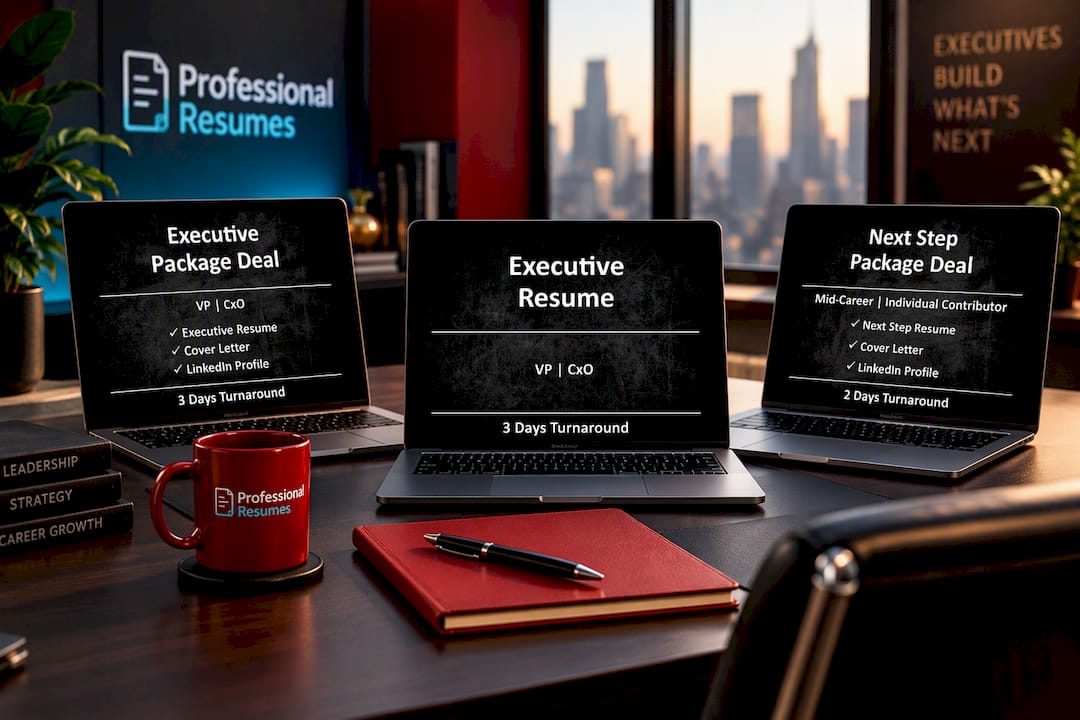
Executive Package Deal

For candidates pairing a LinkedIn refresh with a resume rewrite, the Executive Package Deal bundles both, while the Executive Resume on its own covers the resume side at $289. Professionals moving into their next leadership step can also review the Next Step Package Deal or browse the full shop for other document options. Every engagement includes revisions and is handled in confidence, starting with a first consultation to map your positioning before any writing begins.

Sources

FAQ

What is the 3-2-1 rule on LinkedIn?

The 3-2-1 rule is a content mix guideline built around six posts per cycle, blending curated and original content in a set ratio. For executives, LinkedIn’s own guidance suggests adapting it into a lower-volume, value-first version rather than following the original ratio directly.

What are the best practices for executives on LinkedIn?

Best practice starts with a strong headline, About section and Featured content, followed by a steady rhythm of one or two high-value posts per week. Selective networking and thoughtful commenting matter more than high connection counts, and executive presence has been linked to measurable trust and reputation outcomes.

Why are people getting rid of LinkedIn?

Some professionals step back from LinkedIn because high-volume posting norms feel mismatched with their available time or their comfort with public self-promotion. A lower-volume, quality-first approach, focused on a polished profile and occasional strategic posts, addresses that concern without requiring a full exit from the platform.

What is the 4-1-1 rule on LinkedIn?

The 4-1-1 rule is another content ratio framework, mixing curated shares with original posts across a six-post cycle. As with the 3-2-1 model, executive guidance favours adapting it toward fewer, more substantive posts rather than following the ratio exactly as designed for high-frequency creators.

How much does LinkedIn profile optimisation cost?

Pricing for the LinkedIn profile optimization service from Professional Resumes is available on request through a confidential consultation. Bundled options like the Executive Package Deal combine it with resume writing for candidates who want both updated together.

Decorative sketch of resume format structures

ATS Safe Resumes: When to Use Chronological, Functional, or Hybrid

Reverse-chronological remains the default choice for most job seekers, and recruiters generally expect it. A functional, skills-first format earns its place only in specific situations: career changes, employment gaps, or scattered experience that a timeline undersells. For many candidates, a hybrid resume solves the underlying presentation problem better than either pure format, provided it stays readable to both applicant tracking systems and the person doing the screening.


TL;DR:

  • A hybrid resume often offers the best balance for job seekers with relevant experience and the need for both skills highlighting and timeline transparency.
  • Keeping dates, titles, and employers visible in a skills-based resume prevents it from appearing to hide gaps or unrelated experience.
  • For ATS compatibility, avoid using tables, columns, images, or creative section headers, and use straightforward terminology matching the job posting.
  • Candidates with a consistent, linear career mainly benefit from a chronological format, while career changers or those with scattered experience should consider a hybrid or functional approach.
  • Defaulting to a hybrid resume provides flexibility and mitigates the main weaknesses of purely functional or purely chronological formats.

Professionalresumes
Make Your Resume Fit Your Goals
Professional Resumes creates customized, ATS-friendly resumes tailored to your experience, aspirations, and the employers you want to reach.

Table of Contents

What a chronological resume is and how it’s structured

A reverse-chronological resume lists your most recent job first, with responsibilities and accomplishments organized under each dated role. It’s the format most employers prefer when your recent experience lines up closely with the job you want, and it’s built to answer the questions a recruiter asks first: what did you do, where, and how recently.

This structure works because it lets a recruiter validate scope and recency in seconds. Titles, employers, and dates sit exactly where a trained eye expects them, which builds a kind of quiet confidence before a single accomplishment is even read.

Build one with this checklist:

  • Contact details and a short targeted summary at the top.
  • Work history in reverse order, each entry showing employer, title, and dates.
  • Two to four accomplishment bullets per role, quantified where possible.
  • Education and certifications below the experience section.

What a functional (skills-based) resume is and how it’s structured

A functional resume leads with grouped skills and supporting examples rather than a job-by-job timeline. UC Davis recommends organizing around three to four skill areas, each backed by concrete proof, followed by a condensed employment history.

This layout suits career changers whose most relevant experience sits outside their most recent title, people returning after a gap, and applicants whose transferable skills are scattered across several roles or freelance work. It lets you put the strongest evidence first instead of burying it under an unrelated job title.

The trade-off is real: separating skills from the timeline can look like something is being hidden, even when nothing is. Guard against that with a few habits:

  • Keep a clearly labelled Experience section with employers, titles, and month or year dates.
  • Place a proof bullet directly under each skill heading, not just a claim.
  • Avoid vague headings like “Miscellaneous Skills” that read as filler.
  • Never omit dates entirely: that’s the detail that turns a skills-first resume into a red flag.

If you’re weighing this option because of a career pivot, our guide to refreshing a resume for a mid-career transition walks through the same decision in more detail. Recent graduates facing a similar structural question will find more specific direction in our early career resume tips.

Quick decision guide: which format to choose and when to prefer a hybrid

Three questions settle most format decisions:

  1. Does your most recent job match the role you want? If yes, chronological is almost always the stronger choice.
  2. Would a strict timeline bury your strongest, most relevant evidence? If yes, a skills-first section near the top starts solving the problem.
  3. Do you still need a recruiter to trust your dates and titles? If yes, and it’s almost always yes, keep a full Experience section visible.

That third question is why combination formats are so often the practical answer: they foreground targeted skills while preserving the reverse-chronological record recruiters rely on to verify your history.

A few situation-to-format mappings: a steady same-field applicant fits chronological; a career changer with strong transferable skills fits functional or, better, hybrid; someone with a short gap and otherwise strong tenure fits hybrid with a brief summary addressing the gap directly.

Pro Tip: When in doubt, default to hybrid: it costs you little and protects you from the main weakness of a pure functional layout.

ATS and recruiter readability: format features that matter more than labels

Applicant tracking systems parse headings, dates, job titles, and keywords to build a structured profile of your resume before a person sees it. What breaks that process is rarely the format label itself and almost always the layout: tables, headers and footers, images, and unusual section titles all interfere with parsing, according to UW’s guidance on ATS behaviour.

Illustration of ATS parsing resume elements

Recruiters and hiring managers may spend under 10 seconds on an initial scan of a resume, and ATS use is near-universal among large employers, according to UCI’s ATS career guide. That narrow window means your top third has to carry your strongest, most relevant evidence, regardless of which format you choose.

A short checklist keeps any resume friendly to both audiences:

  • Use standard section headings like “Experience” and “Skills,” not creative substitutes.
  • Save as a clean .docx or PDF, and skip tables, columns, and text boxes.
  • Match the job posting’s exact terminology; small differences in wording affect keyword matching.
  • Keep fonts simple and left-aligned, with consistent, real dates rather than vague ranges.

For a deeper look at formatting choices and screening mechanics, see our guide to ATS-friendly resumes.

Short examples and templates: what each format looks like on the page

Seeing the skeleton makes the choice concrete faster than any description does.

  • Chronological: Summary, then “Marketing Manager, Company X, 2022 to present,” followed by a bullet such as “Grew organic traffic 40% in 12 months by rebuilding the content calendar around search intent.”
  • Functional: A “Project Leadership” heading followed by a proof bullet like “Coordinated a five-person team across three departments to launch a product two weeks ahead of schedule,” then a condensed Experience list with employers and dates underneath.
  • Hybrid: Summary, a short “Core Skills” block with two or three proof-backed strengths, then a full reverse-chronological Experience section identical in structure to the pure chronological version.

The hybrid skeleton is the one most readers underestimate. It doesn’t require inventing new sections, it just moves the strongest two or three points above the timeline instead of asking a recruiter to find them.

Practical resume-writing tips that apply to any format

Format aside, certain habits raise interview odds on their own. Write accomplishment bullets in a Challenge-Action-Result pattern, and quantify wherever the number exists: percentage, dollar figure, headcount, timeline. Match your language to the job posting’s own terms rather than a synonym you prefer.

Trim anything that doesn’t serve the specific role you’re applying to. A resume that tries to represent your entire career usually undersells the parts that matter for this job.

  • Cut outdated jobs and skills unless they’re directly relevant.
  • Avoid decorative fonts, icons, or graphics that ATS software can’t parse.
  • Proofread for consistent verb tense, and read bullets aloud to catch missing words.
  • Check that every date range is accurate and consistent in format.

Pro Tip: Ask someone unfamiliar with your work to read your resume for 10 seconds and tell you what they remember. That’s close to what a recruiter actually retains.

How Professional Resumes applies these formats in real client work

When a background is assessed, the format decision comes from the same three questions any job seeker should ask: does the timeline help or hurt, is the strongest evidence buried, and can a hybrid structure preserve both. Someone changing industries after a decade in one field rarely benefits from a purely chronological layout, and a person with a clean, linear history rarely benefits from a skills-first one.

Working directly with a writer through consultation and revision means the format isn’t a guess. It’s matched to the individual’s specific history, and for many, that matched format, paired with ATS-aware formatting, is the fastest realistic path to more interview requests.

— Professional

Getting started: matching your situation to the right resume service

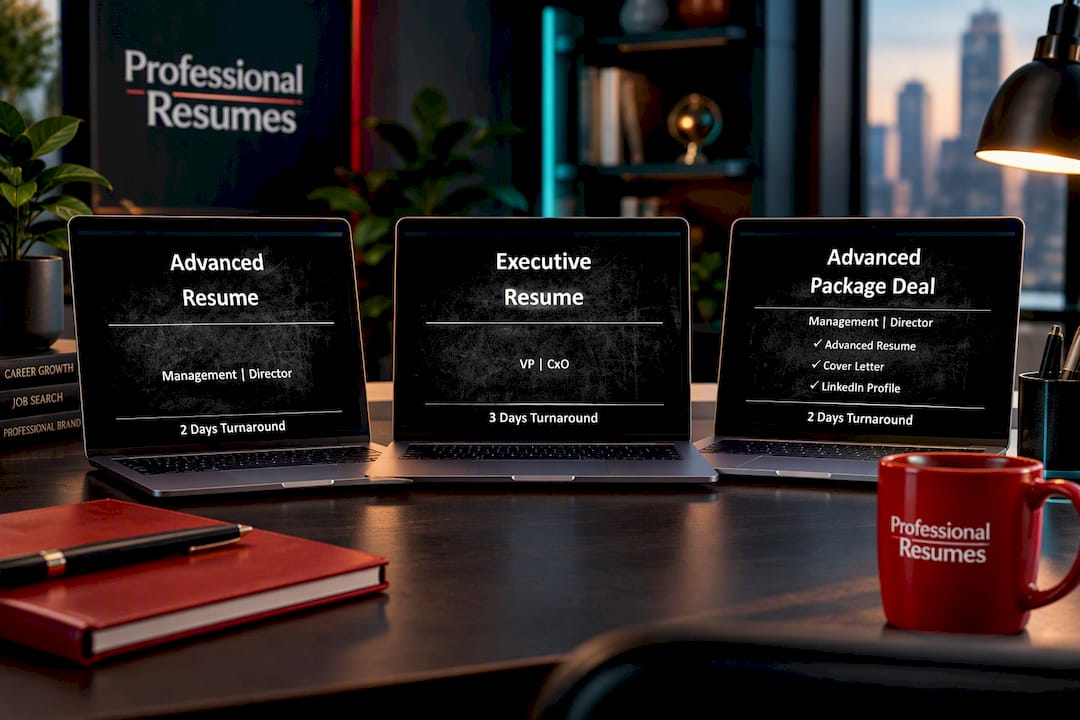
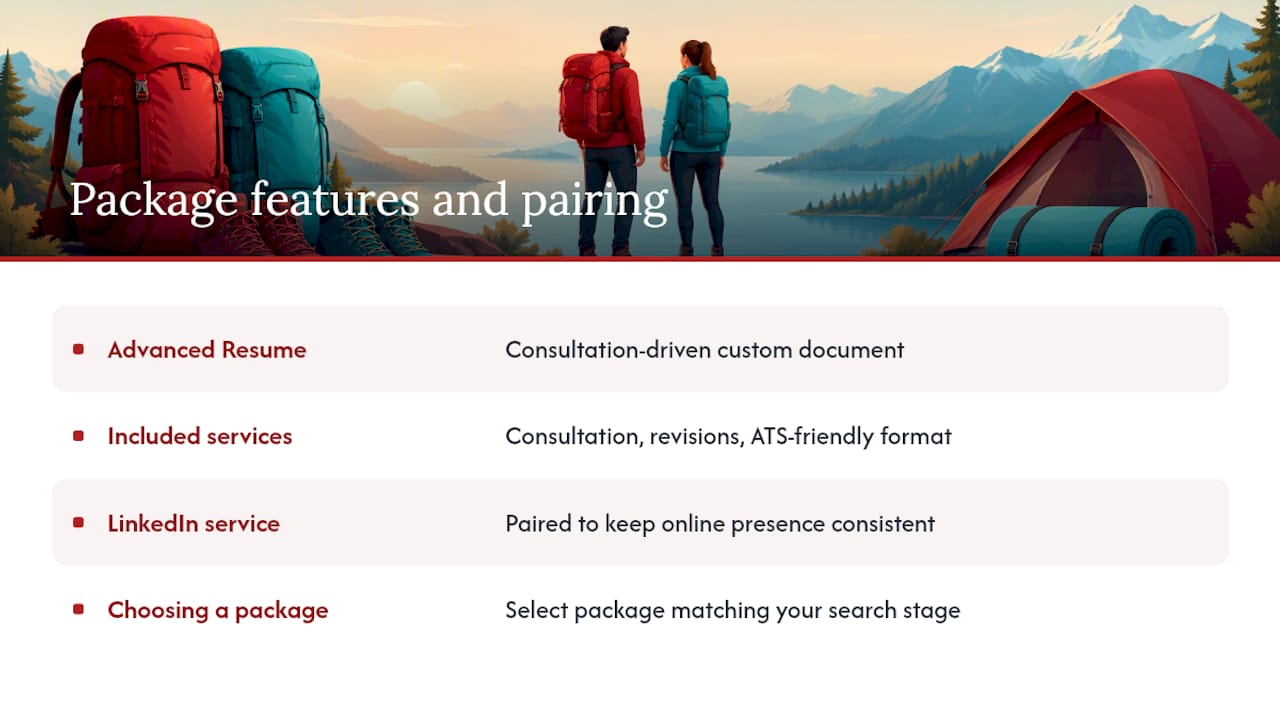
Format decisions matter, but execution is where most resumes fall short under real scrutiny. Early-career candidates weighing a functional layout often get more from our Early Career Resume, while candidates managing a career change or a complex history typically fit the Advanced Resume. Senior candidates facing board-level scrutiny should look at the Executive Resume, and those who also need a LinkedIn profile aligned to the same story can bundle both through the Advanced Package Deal.

Advanced Resume

Each option includes direct consultation with your writer, so the format applied to your resume is the one that fits your actual history, not a generic template. Browse the full lineup and start with the package that matches your stage.

Sources

The GW career services guide and UC Davis resume toolkit explain format fundamentals from a university career-centre perspective, while UCI’s ATS guide covers how screening software actually reads a resume. If a new role means a bigger financial decision on the horizon, Haven Mark Advisers’ guide to mortgages after a new job is worth a look too.

FAQ

What counts as a red flag on a resume?

Unexplained gaps with no context, missing dates, inconsistent job titles, and generic skill claims without proof all read as red flags to a recruiter. A functional resume that hides its Experience section entirely is a common version of this problem, since it can look like something is being concealed even when it isn’t.

Are functional resumes still used today?

Yes, functional resumes are still used, mainly by career changers, people returning after a gap, or applicants whose relevant experience spans freelance and varied roles. UC Davis recommends them specifically for these situations rather than as a general default.

What’s the difference between chronological, functional, and hybrid resumes?

A chronological resume lists jobs in reverse date order, a functional resume groups skills first with a condensed history below, and a hybrid or combination resume puts targeted skills near the top while keeping a full reverse-chronological Experience section intact. The hybrid is often the practical middle ground for readers who need both skills emphasis and timeline transparency.

What are the three main types of resumes?

The three main types are chronological, functional, and combination (or hybrid), each organizing the same underlying content in a different order and emphasis. Most career centres, including UC Davis, treat these as the standard categories job seekers choose between.

Decorative STAR and CAR interview title card

Cut Answers to 30–45s: Rules and Drills to Choose STAR or CAR

STAR gives an interviewer full context and detail; CAR skips the setup and leads with impact. As a rule of thumb, use STAR when a question calls for process, judgment, or team dynamics, and use CAR when time is short or the interviewer wants a leadership summary. Both are frameworks, not scripts, so the goal is to adapt each one to the story you are actually telling.


TL;DR:

  • Candidates should prioritize CAR for quick, high-level responses during time-constrained interviews, especially in early stages or on phone screens.
  • STAR is more suitable for detailed questions about processes, teamwork, or technical challenges, typically in later-stage or panel interviews.
  • Effective answers combine a brief reflection on outcomes or lessons learned, regardless of the chosen framework, to demonstrate growth or leadership.
  • Practicing conversion between STAR and CAR formats helps ensure preparedness for varying question types and time limits.
  • Avoid reciting answers word-for-word; instead, develop stories flexibly to sound natural, credible, and focused on personal ownership and measurable results.

Professionalresumes
Turn Career Wins Into Stronger Stories
Professional Resumes helps shape your experience into customized career documents that clearly showcase your skills and aspirations.

Explore Professional Resumes

Table of Contents

What is the STAR method and when should you use it

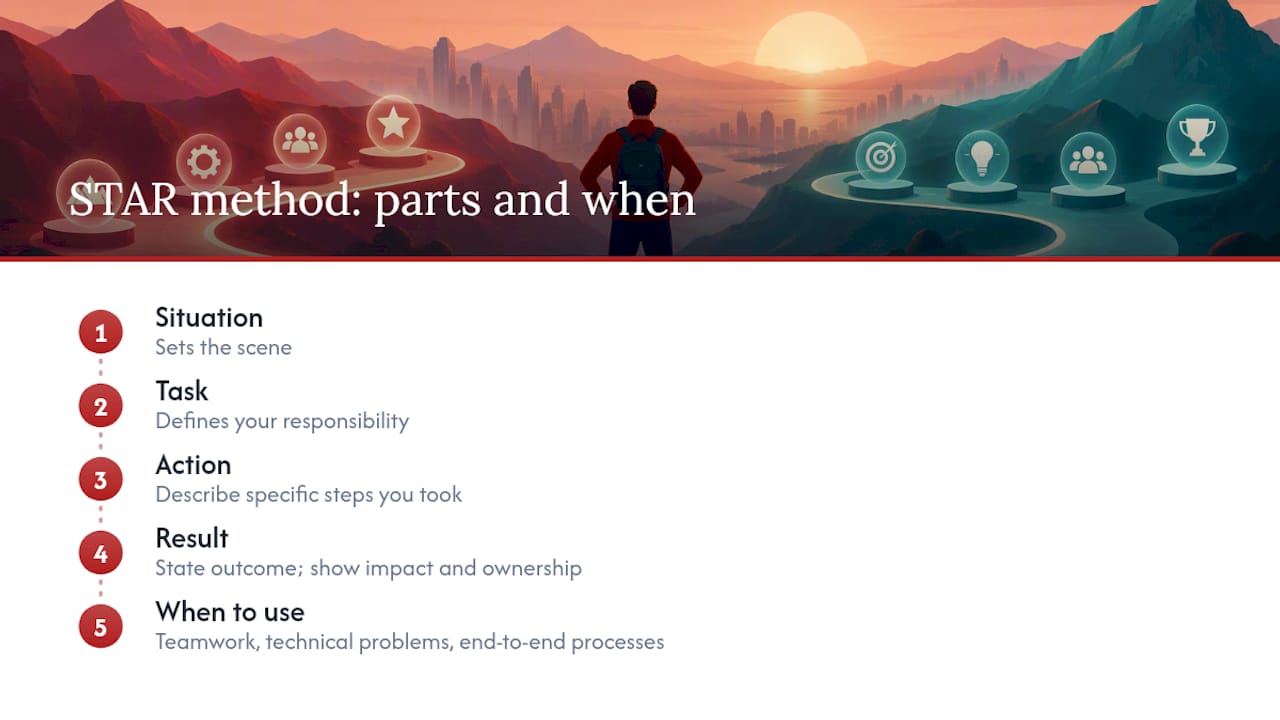
The STAR method breaks an answer into four parts: Situation sets the scene, Task defines what you were responsible for, Action describes the specific steps you took, and Result states the outcome. It is the standard structure for behavioural interviews because it forces a candidate to move from context to consequence instead of drifting into a general description of a job.

STAR works best when a question asks about teamwork, a technical problem you solved, or a process you managed end to end. Panel interviews and questions like “tell me about a time you resolved a conflict” reward the fuller picture STAR provides, since the interviewer is often assessing judgment as much as outcome.

The method has two common failure points. Candidates spend too long on Situation and Task, leaving barely a sentence for Result, and many default to “we” language that hides individual contribution. Recruiters and hiring managers consistently look for explicit ownership. Empirical work on how candidates actually answer STAR questions found that Situation appears in nearly all responses, while Task, Action, and Result are frequently underdeveloped or missing entirely.

A tight annotated example: “Our team’s release schedule was slipping every sprint (Situation), and I was asked to find the bottleneck (Task). I audited the deployment pipeline and moved code review earlier in the cycle (Action). Release delays dropped, and the process change is still in use today (Result).” That is roughly 55 words, close to the range most coaches recommend for a spoken answer of 60 to 90 seconds.

What is the STAR method and when should you use it — overview diagram

Key differences at a glance to help you choose quickly

STAR and CAR both structure a behavioural answer, but they put the emphasis in different places. STAR is built to show how you think and work; CAR is built to show what you achieved fast.

  • Focus: STAR emphasizes process and context; CAR compresses straight to challenge, action, and result.
  • Best for: STAR suits detailed process or teamwork questions; CAR suits phone screens, panel time limits, and senior-level summaries.
  • Length and pacing: STAR answers typically run around a minute; CAR answers usually last less than a minute.
  • Context: a first-round phone screen favours CAR’s speed, while a technical or panel round often has room for STAR’s detail.
  • Reflection line: either method benefits from a short closing sentence on what you learned or what changed, when the question invites growth or leadership insight.

The practical difference shows up under time pressure. A candidate who only knows STAR will either rush the ending or run over their allotted time. A candidate who only knows CAR risks sounding thin when a panel wants to hear how a decision was actually made.

How to choose between STAR and CAR: a short checklist and decision rules

Choosing a format under interview pressure is a snap judgment, not a research project. A short checklist, memorized in advance, removes the guesswork.

  1. Read the question’s verb. “Walk me through” or “describe a time” usually signals STAR; “tell me about a result you’re proud of” or “give me an example of your impact” signals CAR.
  2. Check the clock. If you have less than a minute, or the interviewer has already said they’re short on time, default to CAR and skip background detail.
  3. Match the interview format. Phone screens and early-stage panels tend to reward concise answers; a later-round interview with a hiring manager often has room for STAR’s fuller narrative.
  4. Consider seniority. Entry-level and mid-career questions often invite STAR because interviewers want to see how you approach problems; leadership interviews increasingly favour CAR because the panel is assessing outcomes and decision quality under board-level scrutiny.
  5. Use a ten-second script in the moment: silently ask “do they want my process or my result?” before you open your mouth, then commit to one structure and don’t switch mid-answer.
  6. Default to compression. When unsure, start with CAR’s brevity and add one sentence of context only if the interviewer’s face says they want more.

The safest habit is to over-prepare STAR versions of your best stories, then practise cutting each one down to a CAR version. That way you always have the longer answer ready and the shorter one rehearsed, rather than trying to invent either on the spot.

Templates and sample answers you can adapt across career stages

A reusable template beats a memorized script because it flexes with whatever question actually gets asked. Keep both versions of your best two or three stories ready.

  1. STAR template (60 to 90 seconds, roughly 90 to 130 words): Situation (one sentence, the context and stakes), Task (one sentence, your specific responsibility), Action (two to three sentences, what you actually did), Result (one to two sentences, the outcome and, where relevant, what changed afterward).
  2. CAR template (30 to 45 seconds, roughly 50 to 80 words): Challenge (one sentence combining situation and stakes), Action (two sentences, the decisive steps), Result (one sentence, the outcome plus a short reflection line).
  3. Early-career sample (STAR): “During a retail shift, our POS system went down during a rush (Situation), and as the senior person on the floor I had to keep the line moving (Task). I switched us to manual receipts and assigned two coworkers to bagging while I handled payments (Action). We cleared the backlog in under fifteen minutes with no walkouts, and I wrote a one-page backup procedure the store still uses (Result).”
  4. Mid-career sample (CAR): “A key client threatened to leave over missed deadlines (Challenge). I rebuilt our project timeline, added weekly check-ins, and personally owned the client’s next two deliverables (Action). The client renewed for another year and became one of our references (Result).”
  5. Senior sample (CAR with reflection): “Our division was losing margin on a legacy product line (Challenge). I led the pricing review, cut two underperforming SKUs, and renegotiated supplier terms (Action). Margin recovered within two quarters, and the pricing framework is now used across three other divisions (Result and reflection).”
  6. Conversion drill: take a STAR story you already have written and delete every Situation detail that isn’t necessary to understand the stakes; merge Task into the opening Challenge line; keep Action, tighten Result. Reverse the drill by taking a CAR answer and adding one sentence of Situation and one of Task before Action, to practise expanding under less time pressure.

Case studies of how real achievements turn into interview stories can help you see this conversion in practice, and our own case studies and samples page shows several worked examples.

Common mistakes and expert tips for making answers credible

Behavioural interviewing has measurable predictive validity for job performance, with research syntheses reporting correlations in the range of roughly 0.28 to 0.32. That validity depends on candidates giving specific, honest answers rather than generic ones, which is where most interviews go wrong.

The most common mistakes are over-rehearsal that makes an answer sound recited, a weak or vague Result, and “we” language that obscures individual ownership. Practitioners advise leading with stakes rather than setup, replacing “we” with “I” wherever you personally acted, and describing what changed as a result of your action instead of reaching for a big, unverifiable number.

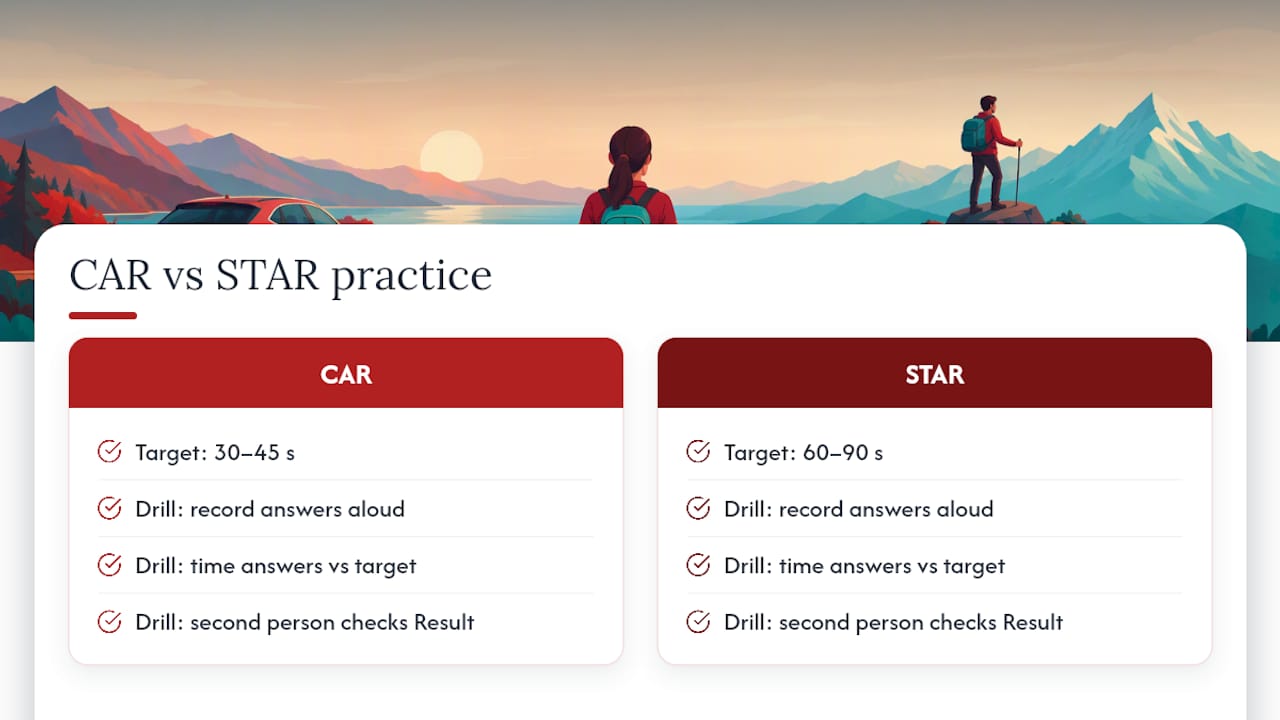
Three drills fix most of this. Record yourself answering out loud and listen for filler words and passive phrasing. Time each answer against the 30 to 45 second CAR target and the 60 to 90 second STAR target. Ask a second person to check whether your Result sentence would survive a follow-up question, since a credible outcome is one you can defend, not just one that sounds impressive.

STAR and CAR timing comparison with practice drills

Pro Tip: Practise the decision, not the script: rehearse choosing between STAR and CAR on the fly, so your delivery stays natural even when the question surprises you.

Why frameworks fail candidates who recite them

STAR and CAR are tools for organizing a story, not scripts to perform word for word. The most common failure is treating either one as a memorized speech, which produces the flat, over-rehearsed delivery that experienced interviewers notice immediately.

The better habit is knowing your stories cold and deciding, in the moment, how much structure a given question actually needs. A senior candidate answering a rapid-fire panel question should feel free to open with the result and backfill context only if asked. A candidate who has practised converting the same story between formats will sound prepared rather than rehearsed, and that distinction is what separates a strong interview from a forgettable one. Working through this kind of story development is also where a second, professional set of eyes tends to sharpen an answer faster than solo practice does.

— Professional

How Professional Resumes helps you turn achievements into interview-ready stories

Professionalresumes

The hardest part of building STAR and CAR answers is usually not the format, it’s finding the achievements worth telling. Professional Resumes works through extensive consultation to pull the specific, results-driven accomplishments off your resume and reshape them into stories that hold up under interview follow-up questions, tailored to your career stage.

  • The Early Career Resume suits candidates building their first strong set of interview stories from limited experience.
  • The Next Step Resume fits mid-career professionals who need sharper, more results-focused narratives.
  • The Advanced Resume supports candidates moving into senior individual-contributor or management roles.
  • The Executive Resume is built for leadership-level candidates whose stories need to reflect organizational outcomes and board-level scrutiny.

Each package is paired with the LinkedIn profile optimization service so your online presence matches the stories you tell in the room. Visit the shop to choose the package that fits your career stage and start turning your resume achievements into answers you can defend under any format.

Sources

FAQ

Is the STAR method outdated?

No, the underlying structure still works, and structured behavioural interviews retain measurable predictive validity for job performance. What has changed is delivery: candidates now get better results adapting STAR with a brief reflection line, sometimes called STARR, rather than reciting it rigidly.

What are common mistakes with the STAR method?

The most frequent errors are spending too long on Situation and Task, leaving a thin or vague Result, and relying on “we” language instead of clear “I” statements. Practitioners also warn against reaching for unverifiable big numbers instead of describing what actually changed.

What is the STAR method good for?

STAR is best suited to questions about teamwork, technical problem-solving, and any question that asks you to “walk through” or “describe” a process. It gives an interviewer enough context to judge your reasoning, not just your outcome.

What are good examples of the STAR method?

A strong STAR example states the stakes in the Situation, names a specific personal responsibility in the Task, details two or three concrete actions, and closes with a measurable or clearly described Result. The retail and product-margin examples earlier in this article show the format applied at different career stages.

Decorative resume career gap title card

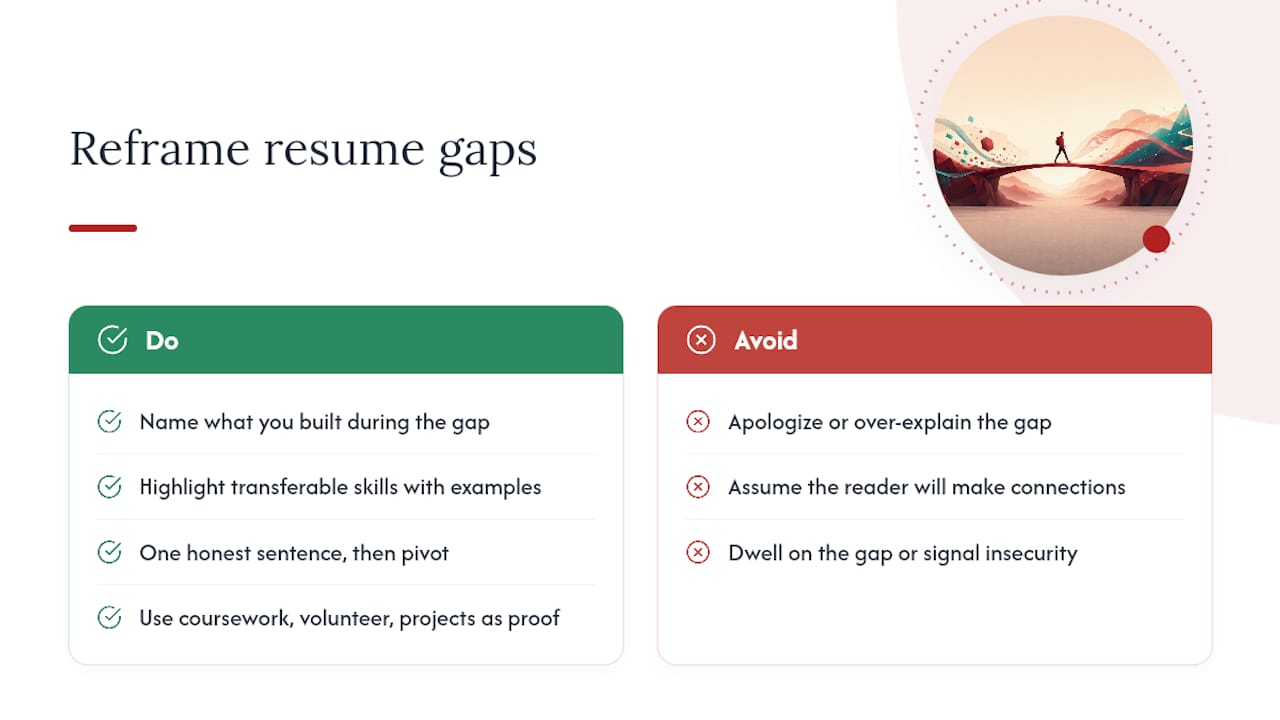
Research Backed Resume Fixes for Career Gaps in Canada, Use Years Only

Treat a career gap as a formatting decision, not a confession. Lead with a years-only or accomplishment-first layout that keeps recruiter attention on experience, and save any explanation for the cover letter or interview unless an application specifically requires exact dates. A field experiment on resume framing found this approach improves callback rates for candidates with gaps. Follow the employer’s format when one is specified.


TL;DR:

  • Using years-only dates and listing gaps as labeled activities helps keep a candidate’s experience the focus and reduces the visibility of employment gaps.
  • Leading with a concise career summary that highlights recent accomplishments and relevant skills can divert attention from the break for most recruiters.
  • Short gaps under a year often do not require explicit explanation if months are removed; longer gaps benefit from a labeled entry and brief, neutral context.
  • Tailoring the resume format to the gap length—chronological for short gaps, hybrid or functional for longer ones—improves readability and perception.
  • During interviews and cover letters, candidates should quickly address the gap with a factual reason and immediately shift to recent achievements to demonstrate readiness.

Professionalresumes
Present Your Career Story Clearly
Professional Resumes creates tailored resumes, cover letters, and LinkedIn profiles for job seekers navigating career gaps and changing markets.

Explore resume services

Table of Contents

Practical resume tactics to reduce the gap’s visibility

The goal is to shift a recruiter’s attention from when you worked to what you accomplished. A few structural choices do most of the work.

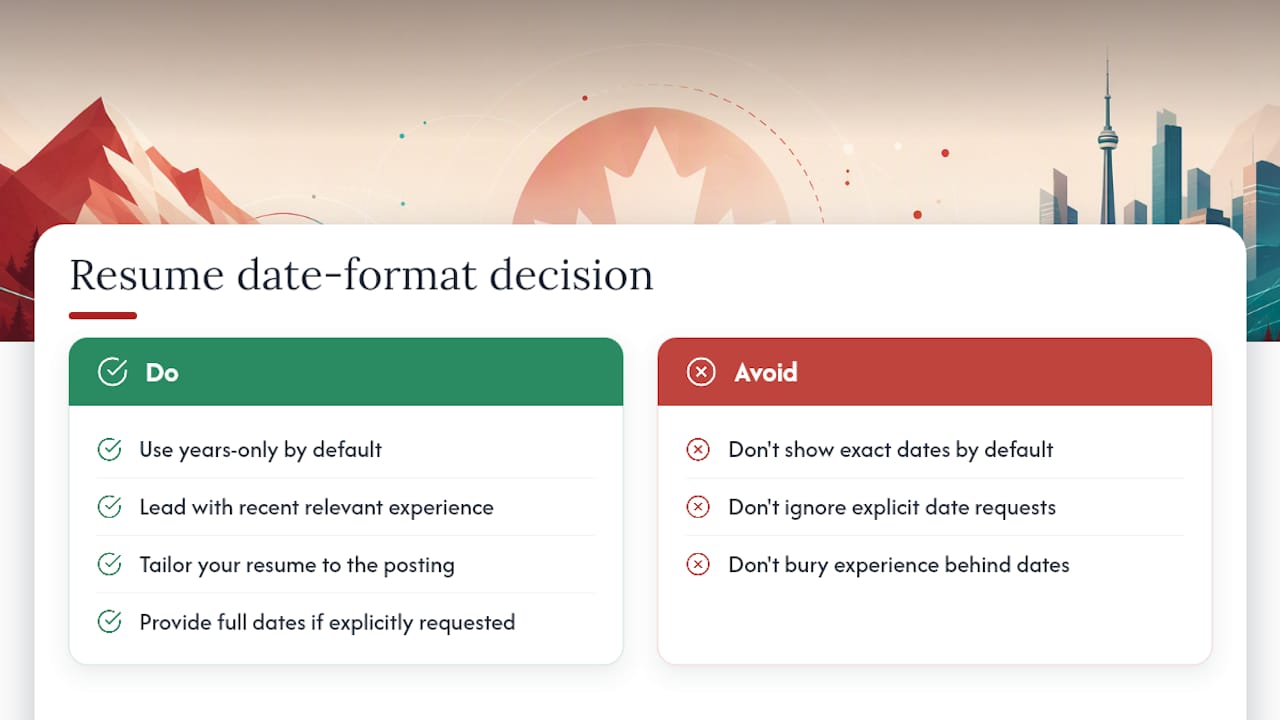
Use years instead of months wherever the application allows it. Listing “2021 to 2024” instead of “March 2021 to January 2024” removes the visual cue that flags a gap, without misrepresenting your history. This only works when the employer has not requested exact dates, so check the posting or portal instructions first.

Open with a career summary that reframes the break. Three or four lines at the top of the resume, written in the present tense, should state your target role, your strongest relevant skill, and one measurable result from your most recent position. This gives a reviewer something concrete before they reach the chronology.

Convert productive time into a labelled entry. If the gap involved study, freelancing, caregiving, or volunteering, give it a title and treat it like any other role: “Independent Consultant,” “Caregiver, Family Support,” or “Professional Development, Project Management Certificate.” Add two or three bullets that describe outcomes, not just activity: budgets managed, courses completed, projects delivered.

Choose your format based on gap length and role type. A gap under a year usually disappears inside a standard chronological resume once months are dropped. A gap of two to five years often reads better in a hybrid format, summary and skills first, chronology second. A gap longer than five years, or several gaps, may call for a functional resume that groups experience by skill area rather than by employer. For more on adapting structure to your situation, this guide to mid-career resume refreshes walks through the trade-offs.

Before sending anything out, run a short pass through what stays, what goes, and what moves:

  • Remove months from role dates when the application does not require them.
  • Keep any certification, course, or volunteer role that used skills relevant to the target job.
  • Move outdated roles or unrelated short-term jobs further down or into a condensed “Earlier Experience” line.

Pro Tip: Read your summary out loud. If it explains your gap instead of selling your skills, rewrite it.

Resume samples and short templates you can copy for common gap lengths

Different gap lengths call for different structures. These examples show the format, not the wording you have to use.

  1. Six-month gap, standard chronological format. Keep the layout exactly as it would look with no gap at all, dates in years only. Open with a two-line summary: “Marketing coordinator with six years of campaign management experience, including a 40% increase in email engagement at [Company].” No mention of the gap is needed.
  2. Two-year gap, labelled career break entry. Under your most recent role, add: “Career Break, Family Caregiving, 2022 to 2024. Managed household finances and coordinated medical appointments for a family member; completed an online project management certificate during this period.” Two bullets are enough; three is the ceiling.
  3. Five-plus year gap, hybrid or skills-led format. Lead with a “Core Skills” section listing four or five capabilities relevant to the target role, followed by a “Selected Achievements” block pulling your best two results from past positions. Chronology moves to the bottom, years only, no elaboration.

Keep summaries under 40 words, bullets under 20, and verb tense consistent: past tense for finished roles, present tense only for the summary line describing who you are now. A career summary guide covers wording choices in more depth if you want to sharpen that opening section further.

How to explain the gap in a cover letter and interview

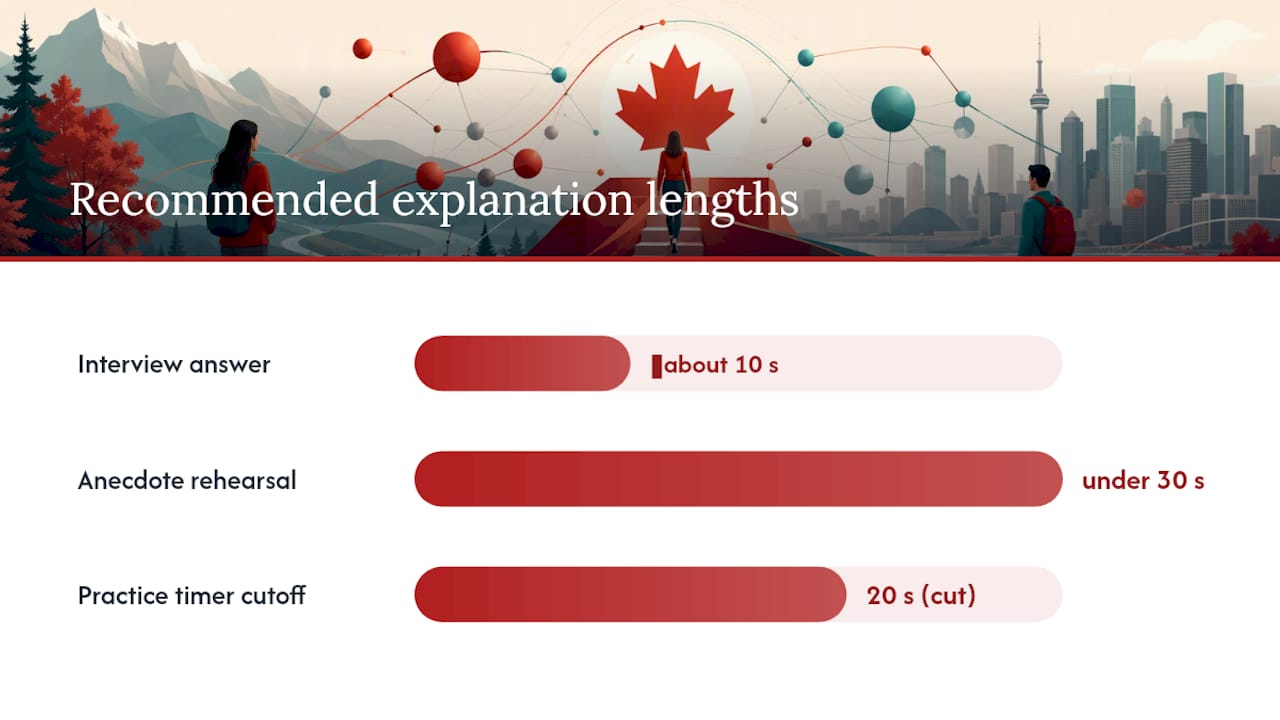
The interview version of your explanation should take about ten seconds to say and end on your readiness, not your circumstances.

  • Use a neutral, factual opener: “I took time away from full-time work to [reason]. During that time, I [skill or activity], and I’m ready to bring that back to a full workload.”
  • Pivot immediately to a recent accomplishment, even one from the gap itself: a course finished, a volunteer project delivered, a freelance client retained.
  • Keep health or caregiving references general: “I stepped away for a family matter” is sufficient; no medical detail is expected or necessary.

Relaunch experts at Stanford Graduate School of Business advise being matter-of-fact about the break and moving quickly to why you’re the right fit, rather than over-explaining. Interviewers are generally checking for readiness and current capability, not looking for a detailed accounting of your time away.

For the cover letter, one short paragraph does the job: acknowledge the gap in a single sentence, then list what you did that keeps you current. “After a two-year career break for caregiving responsibilities, I completed a certificate in supply chain management and volunteered with a local logistics non-profit, both directly relevant to this role.” That’s the full explanation. No apology, no lengthy justification.

Rehearsal matters more than wording. Build two or three short anecdotes from your most recent role and from anything productive you did during the gap, then practise saying them aloud until they take under thirty seconds each. A resource with scripted examples offers additional phrasing if you want more models to adapt.

Pro Tip: Practise your explanation with a timer. If it runs past 20 seconds, cut it in half.

How to explain the gap in a cover letter and interview — overview diagram

Formatting for applications that require full timelines

Some systems override every tactic above. Government portals, regulated professions, and certain ATS platforms expect complete, verifiable dates, and no formatting trick should override an explicit instruction.

  • Follow the application’s own guidance first: Government of Canada resume guidance instructs applicants to tailor each submission and provide full dates when a portal or employer requests them.
  • For ATS-heavy applications, keep formatting simple: standard headings, no tables or text boxes, and keywords from the job posting placed in your summary and bullets. This ATS formatting guide covers the layout choices that keep a resume readable by both software and people.
  • When dates are mandatory, minimize gap salience with a short labelled explanation rather than leaving a blank line: a one-line “Career Break” entry with dates satisfies the requirement without drawing extra attention.
  • For regulated professions or licensing applications asking for a full timeline, list every period in order, including gaps, and use a brief neutral label for each rather than omitting anything.

What the research says about these tactics

A field experiment on resume formatting found that applicants with employment gaps who listed years of experience instead of exact employment dates received more employer callbacks than those using full dates. The format works by making experience the most visible detail on the page, rather than the timing of the gap.

That finding lines up with Government of Canada guidance, which recommends tailoring each resume to the posting and leading with the most recent, most relevant experience, while still supplying full dates whenever an employer or application system specifically asks for them. The practical rule follows from both: default to years-only for visibility, but treat explicit date requests as non-negotiable instructions rather than a formatting preference to override.

Resume date format decision flow

What actually changes when a returning candidate’s resume works

Generic templates hurt candidates with gaps because they present every date and every role with the same weight, leaving the gap as the most noticeable thing on the page. A few focused edits change what a recruiter’s eye lands on first: a rewritten summary, two or three achievement bullets pulled to the top, and a years-only date format. None of that requires reworking the whole document.

A quick review checklist covers most of what matters in five to ten minutes: does the summary lead with a result, not a job title; are dates in years unless the application says otherwise; does any gap period have a label and a bullet, not a blank space; are keywords from the target posting present in the top third; is the most relevant experience above older, unrelated roles; and does the whole document fit on one or two pages without crowding.

— Professional

How Professional Resumes can help you present your timeline

Professional Resumes builds resumes around the same principle covered above: experience first, gap second, and only as much explanation as the situation calls for. Which product fits depends on where you are in your career. The Early Career Resume at $139 suits someone re-entering the workforce after an early-career break, while the Advanced Resume at $239 fits a mid-career relaunch with a longer work history to reframe. Job seekers who want both a resume and a LinkedIn profile addressed together can look at the Early Career Package Deal, which bundles those documents for a single re-entry into the market.

Early Career Resume

Each engagement starts with a consultation to walk through your work history and the gap itself, followed by a draft built around a tailored summary and years-based formatting, then a revision round to sharpen wording and structure. To get the most out of the consultation, come with a rough list of what you did during the gap, whether that was study, freelance work, or caregiving, and a target role or two in mind. The full range of resume packages, including the Next Step Resume and Executive Resume, is available for comparison, and the LinkedIn profile optimization service is worth pairing with any resume order if your profile still reflects your timeline the old way.

Where these recommendations come from

The formatting advice above draws on Government of Canada resume guidance for application and dating requirements, a PMC field experiment on years-based resume formatting and callback rates, and practical scripts from Stanford Graduate School of Business relaunch guidance. Each link above leads to the original source for further reading.

Sources

FAQ

Is a two-year gap bad on a resume?

A two-year gap is common and not inherently damaging when the resume leads with years-based dates and a summary built around recent skills and results. What matters more than the length is whether the document shows what you did during that time and how it connects to the role you want.

How long of a gap is okay on a resume?

There’s no fixed cutoff; a short gap under a year typically needs no mention at all once months are removed from the dates. Longer gaps, several years or more, are best handled with a labelled entry describing relevant activity, paired with a brief, confident explanation kept for the cover letter or interview.

How do I explain a two-year resume gap?

Use a short, factual sentence naming the reason in general terms, then pivot immediately to a recent skill, course, or project that shows you’re current. Career experts note that interviewers are mainly checking for readiness, so a ten-second answer followed by evidence of capability is usually enough.

How can I justify my career gap?

The strongest justification is evidence, not explanation: a certificate finished, a freelance client served, a volunteer project delivered during the gap. Listing that activity as a labelled entry on the resume, with two or three outcome-focused bullets, does more to reassure an employer than any amount of wording in a cover letter.

Security clearance resume title card illustration

Avoid 10 Year Form Delays: Security Clearance Resumes for Canada

Yes, list your security clearance whenever the role requires, prefers, or would clearly benefit from one, and place it high on the page. A paste-ready line works for most cases: “Security Clearance: Secret, adjudicated March 2024.” In Canada, clearances are employer-sponsored, so list only what your record actually shows, and never imply active sponsorship you no longer have.


TL;DR:

  • Listing your security clearance requires matching the exact level, status, and adjudication or last-used date to avoid inconsistencies that delay screening.
  • Clearances should be placed either in the header, a brief summary block, or within individual role descriptions, using a consistent wording pattern.
  • Never disclose classified project details, facility names, or personnel involved; only include the level, status, date, and issuing department to stay compliant.
  • An active clearance is most credible when sponsored, and lapsed or expired clearances can be communicated using past-tense or eligibility phrasing with relevant adjudication dates.
  • Precision in wording and consistency across your resume and official forms significantly improves your chances of smooth, quick clearance verification.

Professionalresumes
Present Your Clearance Clearly
Professional Resumes tailors resumes, cover letters, and LinkedIn profiles to help your experience speak directly to Canadian employers.

Explore resume services

Table of Contents

When to list a security clearance on your resume

Government positions, defence contractor roles, and any job posting that names a required clearance level make this a straightforward call: put it on the page. If the requisition says “must hold a valid Secret clearance” or “Reliability Status required,” a hiring manager is scanning specifically for that line, and burying it costs you screening time you don’t get back.

When to list a security clearance on your resume — overview diagram

The trickier decision is Canada’s sponsorship model. You cannot walk into a screening office and request a clearance for yourself. A federal department or contractor sponsors the process, and it’s usually triggered by a conditional offer of employment rather than something you initiate independently. That single fact should shape how you word your resume. Writing “Active Top Secret” when no current sponsor exists overstates your status and can raise questions during reference checks.

Lapsed or expired clearances still carry value, just phrased differently:

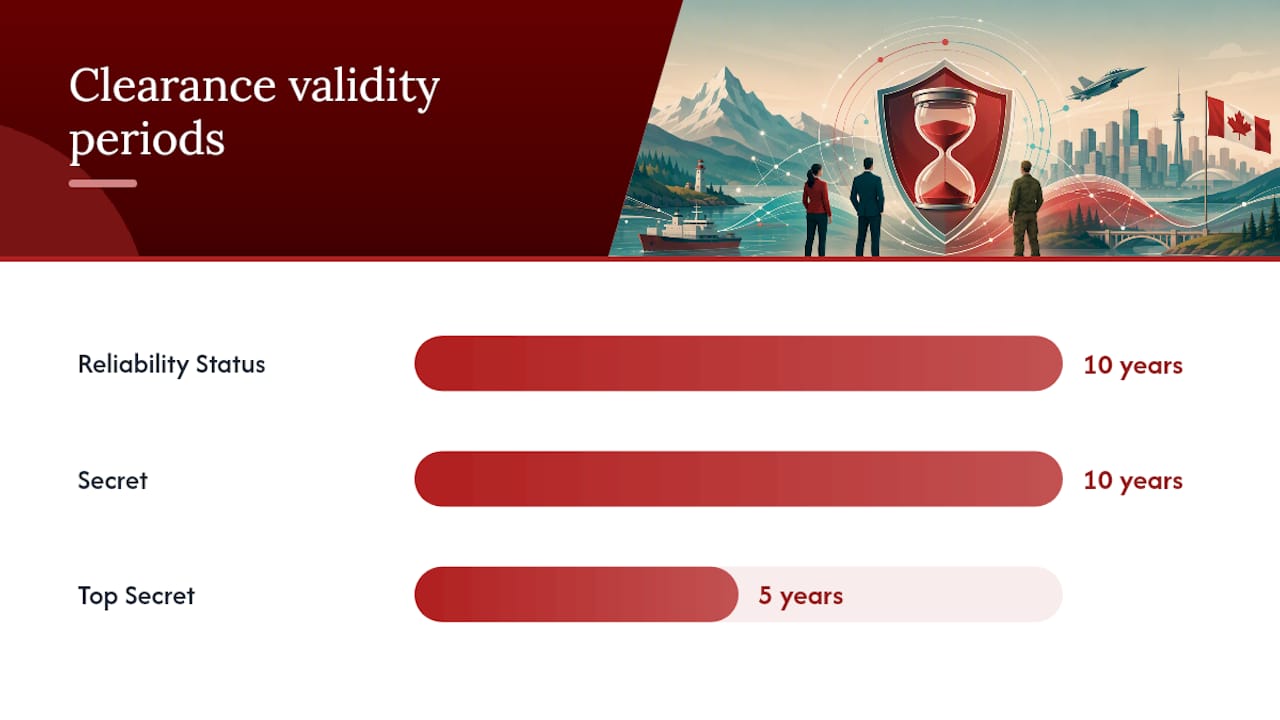
  • If your clearance was adjudicated and is still within its validity window (Reliability Status and Secret run 10 years, Top Secret runs 5), state the level and adjudication date directly.
  • If it lapsed after you left a cleared role, use “eligibility” or “previously held” language rather than present-tense wording.
  • If you’re unsure whether your investigation is still reusable, say “clearable” or note the last-used date and let the hiring department confirm reciprocity.

A five-year-old Top Secret adjudication is a materially different signal than one from last month, and recruiters read the date, not just the label.

Where to place your clearance and how to word it

There are three accepted spots for a security clearance on a resume, and picking the right one depends on how central the clearance is to your candidacy.

  1. Header or contact line. For candidates applying almost exclusively to cleared positions, put the clearance directly under your name and contact details. Recruiter convention favours page one placement, either in the header or immediately under your summary, because it saves a hiring official from hunting for it.
  2. A short clearance block under your summary. This works well when you’re applying to a mix of cleared and non-cleared roles. A two-line block, “Security Clearance: Secret (Adjudicated: June 2023, Department of National Defence),” keeps it visible without dominating the page.
  3. Per-job parenthetical notes. Inside individual job entries, a short parenthetical like “(Secret clearance held throughout tenure)” reinforces the timeline and shows continuity across roles, which matters if a screener is reconciling your resume against your employment history.

Four wording patterns cover almost every situation you’ll encounter:

  1. Active with sponsor: “Security Clearance: Secret, active, sponsored by [Department/Contractor], adjudicated April 2022.”
  2. Interim: “Security Clearance: Top Secret (Interim), granted January 2026, final adjudication pending.”
  3. Lapsed or administratively closed: “Security Clearance: Reliability Status, last held 2021, eligible for reinstatement.”
  4. Multiple clearances: “Security Clearances: Secret (2019) and Top Secret (2023), both Government of Canada.”

Whichever pattern you choose, use it identically everywhere the clearance appears on your resume. Reusing the exact phrase in your header and in a job bullet avoids the kind of inconsistency that prompts a screener to ask follow-up questions. And date it. A dated adjudication tells a hiring official whether your prior investigation might be reusable, which speeds up their internal process more than a bare level ever will.

What to include, and what you should never disclose

Safe, useful information belongs on the page. Sensitive operational detail does not, and the line between the two is narrower than most candidates assume.

Include these elements:

  • Clearance level: Reliability Status, Secret, or Top Secret, matching the levels defined by the Government of Canada.
  • Status: active, interim, adjudicated, or lapsed.
  • Adjudication date or “last used” date, ideally month and year.
  • Issuing department, agency, or a general public-trust designation if that’s what your record shows.
  • Polygraph type, only if one applies and only using the generic descriptor that matches your official record, not an internal program name.

Never disclose these, regardless of how impressive they might sound in an interview:

  • Project or program names tied to classified work.
  • Facility locations, building names, or unit designations.
  • Compartment names or codewords.
  • Names of supervisors, teammates, or clients from cleared assignments.
  • Descriptions of classified tools, systems, or mission-specific outcomes.

Pro Tip: If you’re unsure whether a detail crosses the line, don’t guess. Run the exact wording past a security officer, your departmental liaison, or a transition office before you send the resume anywhere. A ten-minute check beats a security incident report.

Recruiters who work cleared requisitions are explicit about this trade-off: list the level, the date, and the agency, but never the compartment names or the people involved. That guidance holds whether you’re applying to a federal department or a private contractor supporting one.

Copy-ready examples for common clearance situations

Pick the example that matches your status and adapt the department name and date. These are deliberately plain, because plain is what gets parsed correctly and read quickly.

  • Active Secret, header placement: “Jordan Fields | Ottawa, ON | jordan.fields@email.com | Security Clearance: Secret, active, adjudicated May 2024”
  • Active Top Secret, under summary: “Security Clearance: Top Secret, active, sponsored by [Contractor Name], adjudicated November 2023.”
  • Interim, pending final adjudication: “Security Clearance: Secret (Interim), granted February 2026, final review in progress.”
  • Adjudicated but administratively closed: “Security Clearance: Reliability Status, held 2018 to 2022, eligible for reinstatement pending sponsor.”
  • Multiple clearances across roles: “Security Clearance: Secret (2020, Department of National Defence); Top Secret (2023, Shared Services Canada).”
  • Per-job repetition: Under a specific role, add “(Held active Secret clearance throughout this position)” to reinforce the timeline without repeating the full block.

Notice the pattern: level, status, date, and issuer, every time, in that order. Consistency matters more than cleverness here.

One habit separates candidates who breeze through screening from those stuck answering clarification emails: mirror this exact wording on your personnel-screening forms. If your resume says “Secret, adjudicated May 2024” and your form says something different, that discrepancy becomes someone else’s problem to resolve, and it delays you.

Formatting, ATS visibility, and matching Canadian screening forms

Applicant tracking systems parse plain text well and struggle with anything dressed up. Put your clearance on its own line, in standard text, never inside a graphic, header image, or text box that an ATS engine can’t read. Repeat the exact phrase in the relevant job entry so a keyword match fires twice, not once, and skip decorative fonts or colour coding around that line entirely.

The formatting stakes are higher than most candidates realize, because your resume doesn’t exist in isolation from the government’s own paperwork. For Secret and Top Secret clearances, applicants complete the Security clearance form (TBS/SCT 330-60E) alongside the Personnel Screening, Consent and Authorization form, TBS/SCT 330-23E. These forms ask for a ten-year employment and residence history, and any gap, mismatched date, or inconsistent employer name between your resume and your form submission tends to trigger a resubmission request rather than a quiet correction.

  • Match employment dates on your resume to the ten-year window the forms require, down to the month where possible.
  • Use employer names exactly as they appear on your forms, not shortened or rebranded versions.
  • If a period is genuinely unaccounted for, note “unknown” with a brief explanation on the form rather than leaving it blank, since gap-free history reduces processing delays.
  • Submit through the OLISS portal where available, since using it correctly cuts down on form return rates tied to avoidable data entry errors.

Interim clearances typically move faster than final adjudications, and dating both stages on your resume gives a screening officer useful context about whether your prior investigation is still reusable. A resume that matches your forms word for word isn’t just tidy. It’s one less reason for a department to send your file back for correction.

If you’re also applying for remote or hybrid cleared roles, the same ATS discipline applies. Our guide to building a resume for remote jobs in Canada covers formatting choices that keep parsing clean without sacrificing readability.

When a tailored rewrite makes more sense than a template

Templates work well for a single, clean clearance history. They start to break down once your record gets complicated: multiple sponsors, an interim clearance layered over a lapsed one, or a senior role where the wording has to satisfy both a hiring manager and a security office at the same time.

That’s the point where working with a professional writer earns its cost. Resume writing through direct consultation matters for cleared candidates specifically, because the wording has to thread a needle between what impresses a hiring manager and what stays consistent with a personnel-screening form. A generic template can’t make that judgment call. A writer who asks about your adjudication date, your sponsoring department, and your exact clearance history can.

For candidates in technical or IT roles that carry clearance requirements, our technology and IT resume service accounts for both the technical narrative and the clearance wording side by side. For those targeting federal or public-sector postings directly, the government and public-sector resume service is built around exactly this kind of alignment work.

What the conventional advice gets wrong

Most resume advice treats a security clearance like a certification: name it, date it, move on. That undersells how much the wording itself communicates. A recruiter reading “Active Top Secret” without a sponsor listed reads overreach, not confidence. The word “active” implies an employer relationship that, in Canada’s sponsorship model, may not exist anymore.

The bigger mistake, though, is treating the resume and the screening form as separate documents. They aren’t. A hiring department cross-references both, and a mismatched employment date does more damage to your candidacy than an underwhelming clearance line ever would. Prioritize consistency over polish: get the dates, employer names, and status wording identical across every document you submit, then worry about how the line reads. Clean alignment beats clever phrasing every time a security officer is the one reviewing your file.

— Professional

Get your clearance wording right the first time

Rewriting a clearance line yourself is manageable. Making it match a Treasury Board form, an ATS scan, and a skeptical hiring manager all at once is a different job. Every resume built through direct consultation, not a template drop-down, can ensure the wording around clearance level, sponsor, and adjudication date is checked against the actual record instead of a generic phrase bank.

Advanced Resume

For mid-senior candidates with a single clean clearance history, the Advanced Resume package covers the consultation and revisions needed to align your document with screening expectations. Senior candidates managing multiple clearances, sponsor changes, or executive-level positioning should look at the Executive Resume package instead, built specifically for that complexity. If your job search also needs a cover letter and LinkedIn profile brought into alignment with the same wording, the Advanced Package Deal bundles all three. Cleared candidates who need their language credentials presented clearly alongside security status may also find this guide to professional language proficiency useful for that section of the resume. Browse the full range of resume packages or start with a LinkedIn profile optimization to match your resume wording across platforms.

Sources

FAQ

How do I indicate a security clearance on my resume?

State the level, status, and adjudication or last-used date in one consistent line, either in your header or directly under your summary. A working example: “Security Clearance: Secret, adjudicated May 2024.” Repeat that exact phrasing in relevant job entries so it reads consistently across the whole document.

Should I add my security clearance to my resume?

Yes, whenever the role requires or benefits from one, since recruiters actively scan for clearance level and dates on page one. Skip it only if the role has no plausible connection to cleared work and including it would look irrelevant or confusing.

Can you show an example of a resume that includes a security clearance?

A header example reads: “Jordan Fields | Ottawa, ON | Security Clearance: Top Secret, active, adjudicated November 2023.” A profile-block example reads: “Security Clearance: Secret (Interim), granted February 2026, final review in progress.” Both follow the same order: level, status, date, and issuer.

Can I say I have a security clearance if it’s lapsed?

Yes, but word it as past tense or eligibility rather than “active.” A phrase like “Security Clearance: Reliability Status, held 2018 to 2022, eligible for reinstatement” is accurate and still signals value to a hiring manager without overstating your current status.

Decorative resume comparison title card

Resume Objective vs Summary: Templates and a Three Step Checklist

Use a professional summary in most cases. It leads with what you offer an employer, not what you want from them, and it is what modern applicant tracking systems and recruiters are built to scan first. Reserve a resume objective for narrow situations: new graduates with no work history to summarize, deliberate career changers, or candidates explaining a short employment gap. Everything else belongs in a summary.


TL;DR:

  • A professional summary is preferred over an objective because it highlights your skills, experience, and achievements in two to four sentences, improving ATS parsing and recruiter attention.
  • Summaries should be immediately below contact details and include your job title, three relevant hard skills, and one quantifiable result to stand out effectively.
  • Objectives are only suitable for new graduates, career changers, or those explaining employment gaps, and should focus on employer needs rather than personal goals.
  • When writing a summary, structure it around identity, expertise, achievement, and optional future contribution, tailoring keywords to each specific job posting.
  • Skip both if your current role clearly signals your target position and your work history alone provides sufficient context.

Professionalresumes
Make Your Resume Opening Count
Professional Resumes crafts customized resumes, cover letters, and LinkedIn profiles through personalized consultations and revisions.

Explore resume services

Table of Contents

Resume objective vs summary: what a professional summary actually is

A professional summary is a two to four sentence block at the top of your resume, sitting directly below your name and contact information. It tells a recruiter who you are professionally before they read a single bullet point of your work history. Think of it as the pitch a colleague would give if they were introducing you in a hallway, minus the small talk.

ATS platforms and human reviewers treat this space differently than the rest of your resume. A professional summary outperforms a resume objective in almost every scenario because it functions as a high weight field. The system extracts your job title, years of experience, and skill signals from those opening lines, and recruiters skim the same block for the same information in the seconds before they decide whether to keep reading.

Label it “Summary” or “Professional Summary.” Skip “Objective” for this section entirely.

  • Place it immediately after your contact details, above your work history
  • Keep it to two to four sentences, no longer
  • Open with your job title or professional identity, not a personal pronoun
  • Avoid vague adjectives like “hardworking” or “detail oriented” without proof behind them

Pro Tip: Recruiter attention is concentrated in the top third of the page. A weak opening can stall the review before your best experience ever gets seen.

What a resume objective is and when it still earns its place

An objective is a one or two sentence statement of intent. It tells the employer what role you want and, ideally, why you are qualified to fill it. Where a summary sells your value, an objective states your direction. That distinction sounds small, but it changes how a reviewer reads the rest of your resume.

Career-centre guidance generally treats the objective as a weaker default choice, useful only when your work history cannot yet speak for you. Some guidance explicitly recommends avoiding objectives for most applicants because the format centres your wants over your value. Three situations still justify it:

  • You are a new graduate with limited paid experience and need to state your target role clearly
  • You are pivoting into a different industry or function and your past titles do not signal your new direction
  • You have a short employment gap and want to frame your intent before a reviewer starts asking questions

When you do write one, keep it employer focused. Name the role, then name one or two transferable strengths that make you a credible fit, rather than describing what you personally hope to gain.

Objective or summary: the differences that actually change your outcome

The choice comes down to focus. A summary tells an employer what you bring; an objective tells them what you want. That single difference explains nearly every other gap between the two formats.

  • Focus: Summary highlights your value and evidence; objective states your intent and target role
  • Length: Summary runs two to four sentences; objective usually stays to one or two
  • ATS handling: Summaries carry more parsing weight because they contain title and skill signals ATS software is built to extract
  • Recruiter read: A summary answers “why should I keep reading?” while an objective answers “what does this person want?”
  • Flexibility: An objective can often be reframed into a mini summary by swapping the wish statement for a value statement, using the same sentence length

A summary is generally the safer bet across resume formats and industries, according to career-centre guidance that favours evidence-based summaries over objective statements for applicants with any work history at all. The exception stays narrow: real career changers, first-time job seekers, and people who need to explain a gap before the resume moves forward.

How to write a resume summary that actually beats the scan

A reliable summary follows a four-part pattern: identity, expertise, achievement, and an optional line of intent. This structure maps cleanly to how ATS platforms extract data and how recruiters scan a page, because each part answers a different question they are already asking.

  1. Identity — state your job title or professional category in the first few words
  2. Expertise — name two or three hard skills pulled directly from the job posting’s language
  3. Achievement — include one quantified result: a number, a percentage, a dollar figure, or a scale
  4. Optional intent — close with a line on what you are aiming to contribute next, if space allows

A two to four sentence summary with a title signal, three to five hard skills, and one quantified result consistently performs best across ATS platforms. Here is how that formula plays out across career stages:

  • Early career: “Marketing graduate with hands on experience in social media analytics and content scheduling. Managed a student campaign that grew engagement by 40% in one semester.”
  • Mid-career: “Operations manager with seven years overseeing warehouse logistics for a mid-size distributor. Reduced shipping errors by 18% through a redesigned quality check process.”
  • Technical: “Backend developer specializing in Python and distributed systems. Cut average API response time by 30% across three production services.”
  • Leadership: “Director of finance with 12 years leading budgeting and forecasting for a $200 million division. Directed a cost reduction initiative that saved $1.4 million annually.”

Employers and career centres consistently favour evidence over generic adjectives in these statements. Swap “results driven professional” for the actual result every time. For a deeper walkthrough with more sentence variations, see this guide to writing a career summary that Canadian recruiters respond to.

How to write an objective that doesn’t sound like filler

A working objective template looks like this: “[Job title] seeking to bring [transferable skill or experience] to a [target role/industry] position, with a focus on [specific value you’d add].” It stays employer-focused by keeping the emphasis on what you contribute, not what you personally want out of the arrangement.

  1. New graduate: “Recent business administration graduate seeking an entry-level analyst role, bringing strong Excel modelling skills and a semester-long internship analyzing retail sales data.”
  2. Career changer: “Former high school teacher transitioning into corporate training, bringing eight years of curriculum design and public speaking experience to a learning and development role.”
  3. Return to work after a gap: “Marketing coordinator returning to the workforce after a family leave, bringing five years of campaign management experience and recent certification in Google Analytics.”
  4. Industry switcher with adjacent skills: “Retail store manager pivoting into logistics coordination, bringing proven inventory control and team scheduling experience to a warehouse operations role.”

When making a pivot, foreground the destination role’s keywords and one project or achievement that proves you can transfer, according to guidance on career-change resumes. Fresh graduates should lean on the same principle: naming a real project beats naming a personality trait, a point NACE’s research on high-impact skills reinforces for early-career candidates specifically. For more graduate-specific phrasing, this early career resume guide offers additional templates.

When your resume needs neither

Some resumes do not need a summary or an objective at all. If your most recent job title already signals your target role clearly and your work history speaks for itself, adding either block can feel redundant, even repetitive.

  • A senior specialist moving into an almost identical role at a comparable company often does better leading with a short professional title line instead of a full summary
  • Highlighting one flagship project or certification directly under your name can carry more weight than a generic paragraph
  • If you have a strong portfolio, GitHub profile, or published work, a single line linking to it near the top often outperforms three sentences describing your skills in the abstract

The test is simple: if a summary or objective would only restate what your job title and first bullet point already show, skip it and use that space for something concrete instead.

Quick decision checklist: summary, objective, or nothing

Run through this three-step flow for every application, because the right answer can change from one posting to the next.

  1. Check your experience level. If you have relevant paid or internship experience, default to a summary.
  2. Check whether you need to explain a transition. If you are changing careers, entering the workforce for the first time, or covering a short gap, an objective may serve you better.
  3. Check role specificity. If the posting uses precise language you can mirror, a targeted summary almost always beats a generic objective.

Watch for two red flags: vague adjectives with no evidence behind them, and a section labelled “Objective” that adds nothing relevant to the role. Before you submit, confirm your top block echoes the job title’s exact wording and includes at least one quantified result, per the ATS-focused writing guidance recruiters and parsing systems both respond to.

Pro Tip: Save two versions of your opening statement, one summary and one objective, then pick the one that matches the posting’s language most closely before you send it.

How Professionalresumes turns this guidance into a finished resume

Knowing the formula is one thing. Applying it consistently, across every application, in language that matches each posting, is where most job seekers lose momentum. Professionalresumes builds that top-of-resume block as part of a full resume package, matched to your career stage.

The resume packages suit professionals at various career stages who need summaries that reflect their experience and aspirations. Writers apply the identity, expertise, achievement structure covered above, adapted to ATS-aware keyword placement for the specific role targeted.

How Professionalresumes turns this guidance into a finished resume — overview diagram

A resume professional’s take on getting the opening right

The recommendation holds: lead with a summary unless you fall into one of the narrow cases where an objective genuinely serves you better. The habit worth building is smaller than it sounds. Before you submit anything, mirror the job posting’s exact title and pull two of its keywords into your opening lines. Try it on your next application and watch how differently the rest of the resume reads once that top line matches the role.

— Professional

Get your summary written by someone who does this daily

Templates get you most of the way there. What they cannot do is judge which achievement matters most for a specific posting, or catch the subtle mismatch between your current title and the role you are targeting. Professionalresumes builds that judgment into every package through direct consultation, not a form to fill out. Resumes include ATS-aware formatting and tailored summaries based on the identity, expertise, achievement formula, with revisions aimed to ensure the opening block reflects the role targeted.

Advanced Resume

If you are several years into your career and want a summary that reflects real progression, the Advanced Resume package is built for that stage. If you are applying for leadership roles and need a summary with board-level language and measurable outcomes, the Executive Resume package is the stronger fit. You can also compare all packages, including entry-level options, on the full resume shop page, or pair your new resume with a matching LinkedIn profile optimization so your headline and summary say the same thing everywhere a recruiter looks.

Sources

FAQ

What is a good objective for a resume example?

A good objective names the target role and one or two transferable strengths, such as: “Recent graduate seeking a marketing coordinator role, bringing hands-on experience in social media analytics and content scheduling.” It stays employer-focused rather than describing what the applicant personally wants from the job.

What is the 7 second rule for resumes?

Recruiters scan a resume very briefly before deciding whether to read further, with attention concentrated in the top third of the page. That is why the summary or objective at the top carries so much weight.

Are objectives on resumes outdated?

For most applicants with any work history, yes. Career-centre guidance generally treats objectives as outdated in favour of evidence-based summaries, reserving objectives for new graduates, career changers, and candidates explaining a short gap.

Is it okay not to put an objective on a resume?

Yes, and for experienced candidates it is usually the better choice. A summary that highlights your value typically outperforms an objective, and if your job title already speaks for itself, skipping both in favour of a short professional title line can work just as well.

What does Professionalresumes charge for a resume with a professional summary?

Pricing depends on the package and career stage; current prices are listed on the Professionalresumes shop page. Packages range from entry-level resumes through the Advanced Resume and Executive Resume tiers, each including a tailored summary built on the formula covered above.

Decorative entry-level letter template title card

Two Quick Entry Level Templates: 50–100 Word Note and One Page Letter

Yes, you can write an effective cover letter with no paid experience. A short, tailored letter that highlights transferable skills and connects them to a job requirement can win interviews on its own. If the posting doesn’t ask for a full letter, a 50 to 100 word note works better; if it does, follow a one-page, five-element structure and skip the apologies.


TL;DR:

  • A tailored cover letter with specific examples can demonstrate suitability even without paid experience, especially when linking transferable skills directly to the job posting.
  • Use a five-element structure—greeting, opening, body with two skills-based examples, connection, and closing—to maximize clarity and relevance in your application.
  • Write the cover letter quickly by focusing on one concrete requirement from the posting, drafting relevant examples, and linking them explicitly to the employer’s needs.
  • Short notes of 50 to 100 words can often outperform full letters when the application system offers only limited space or when applying for high-volume roles.
  • Avoid common mistakes such as apologizing for inexperience, repeating your resume, using generic language, or neglecting to connect examples directly to the job requirements.

Professionalresumes
Make Your Cover Letter Stand Out
Professional Resumes creates customized cover letters that connect your skills and experience directly to the roles you want.

Explore resume services

Table of Contents

How do you write a cover letter with no experience?

Every entry-level cover letter needs five elements, regardless of the industry you’re targeting. Skip one and you’re either leaving credibility on the table or making a hiring manager work harder than they should to see your fit.

  • Greeting. Search LinkedIn or the company’s “About” or “Team” page for the hiring manager’s name. If you can’t find one, “Dear Hiring Manager” or “Dear [Department] Team” beats “To Whom It May Concern” every time.
  • Opening. Name the exact role, state one clear value claim, and show genuine interest in the company, not just the paycheque.
  • Body. Write two short paragraphs covering two or three transferable skills, each backed by a specific example from school, volunteering, or a personal project. Vague claims like “hard worker” mean nothing without proof attached.
  • Connection. Add a sentence that ties each example directly to something the posting actually asks for. This is the step most beginners skip, and it’s the one hiring managers notice most.
  • Close. End with a decisive call to action requesting an interview, your contact details, and a professional sign-off.

Format matters more than most applicants think. Keep the letter to one page, use a 10 to 12 point font, and follow standard business letter formatting, according to a one-page cover letter handout from a university career centre. Save it as a PDF if the application system requests one, since formatting can shift in other file types. Most applicant tracking systems don’t weigh cover letter keywords heavily, so write for the human who’ll actually read it, not for an algorithm that probably won’t.

How do you write a cover letter in 20 minutes?

You don’t need an hour and a blank-page stare to produce something strong. Follow this order and you’ll have a tailored draft before your coffee goes cold.

  1. Read the posting once for the job title, then again for one concrete requirement you can speak to directly, whether that’s customer service, organization, or a specific software tool.
  2. Draft your opening in one or two sentences, naming the job and the single strength most relevant to it.
  3. Write two short STAR-style examples, covering the situation, the action you took, and the result, pulled from coursework, volunteer work, or a class project.
  4. Add one connection sentence linking your examples to what the employer actually needs, then close with a direct request for an interview.
  5. Proofread out loud, run a spelling and grammar check, and ask one other person to read it for tone before you send it, a routine career-centre guidance recommends for catching the errors your own eyes skip past.
  6. Save as PDF if the system requests it, and double check the file opens correctly before attaching it.

Not every application calls for the full treatment. When a posting doesn’t explicitly request a cover letter, or the application system offers only a small text box, a 50 to 100 word note outperforms a long letter, since recruiter interviews suggest shorter, role-specific notes get read more often than lengthy generic ones. Name the requirement, give one matching example, and ask for a brief conversation. That’s the whole note.

Pro Tip: Write your opening line last. Once you’ve drafted your examples, you’ll know exactly which strength to lead with, instead of guessing at the start and rewriting it anyway.

Templates you can personalize in five minutes

Two formats cover almost every entry-level scenario: the short note and the one-page letter. Below is one of each, plus a filled example so you can see the structure in action.

The short note (50 to 100 words):
“I’m applying for the [Job Title] role at [Company]. During [class project / volunteer role], I [specific action], which resulted in [specific outcome]. That experience directly matches your need for [requirement from the posting]. I’d welcome the chance to discuss how I can contribute. [Name] / [Phone] / [Email].”

The one-page letter, filled for a customer-service role:
“Dear Ms. Chen, I’m writing to apply for the Customer Service Representative position at Northline Retail. During a two-semester retail co-op, I resolved an average of 30 customer inquiries per shift while training two new team members on the point-of-sale system. That mix of composure under pressure and hands-on training experience lines up closely with the collaborative, fast-paced environment your posting describes. I’d welcome the opportunity to discuss how I can support your team. Thank you for your consideration.”

For an internship or project-based example, lean on coursework: describe the challenge, the tools or coordination involved, and a measurable result like attendance figures, grades, or a deliverable your professor praised. To personalize any template fast, swap in the job title, one matching requirement from the posting, and one real example, then reread it once for tone. Five minutes, done.

Three inputs personalize a cover letter

What mistakes make an entry-level cover letter weak?

Most weak letters fail for the same handful of reasons, and every one is fixable in under a minute.

  • Apologizing for inexperience. Never open with “I don’t have much experience, but…”. Lead with what you can actually do.
  • Repeating the resume. Use the letter to explain context and fit that your resume’s bullet points can’t show.
  • Generic enthusiasm. “I’m excited about this opportunity” says nothing. Name one specific part of the role or company that matches your skills.
  • Wrong length. A short note stretched to a full page reads as padded; a full letter squeezed to three lines reads as rushed. Match length to what the posting asks for.
  • Obvious templated phrasing. Career-centre guidance flags generic salutations and copy-paste openers as common pitfalls that flatten an otherwise strong application. Personalize your voice and your examples every time.

Final pre-send checklist

Run through this in under a minute before you hit submit:

  1. Is the greeting personalized with a name, or professionally neutral if you couldn’t find one?
  2. Does the opening state the exact role and one clear strength?
  3. Are there two short examples directly tied to what the job needs?
  4. Is there a decisive call to action, plus your phone number and email?
  5. Is the format correct: one page or short note, 10 to 12 point font, standard margins, saved as the requested file type?

How do you handle gaps or a thin resume in a cover letter?

Address a gap by shifting the frame, not by apologizing for it. Instead of explaining what you don’t have, name what you built during that time, whether that’s a certificate, a volunteer commitment, freelance work, or caregiving responsibilities that developed real skills like scheduling, budgeting, or conflict resolution.

If you’re switching fields entirely, focus the letter on transferable capabilities rather than direct experience. Someone moving from retail into administrative work can point to cash handling accuracy, scheduling coordination, or customer de-escalation. These translate cleanly, provided you make the connection explicit rather than assuming the hiring manager will draw the line themselves.

For a true resume gap, whether from school, travel, or a health issue, one honest sentence is usually enough: state briefly what the period involved and pivot immediately to what you’re bringing now. Dwelling on it signals insecurity; naming it and moving on signals confidence. Job-site guidance on writing without experience consistently points to coursework, volunteer roles, and personal projects as legitimate, credible substitutes for paid history, provided the examples are specific rather than vague.

The goal isn’t to hide the gap. It’s to make the employer’s need the centre of the sentence, with your example as the proof, not the excuse.

How do you handle gaps or a thin resume in a cover letter? — overview diagram

How do you customize a cover letter for different industries?

The five-element structure holds across industries, but which skills you foreground should shift with the role. A retail or hospitality posting rewards examples showing composure under pressure and direct customer interaction. An office or administrative role rewards organization, attention to detail, and software familiarity, even if that familiarity comes from school assignments rather than a job.

For technical or trades-adjacent entry points, lead with hands-on project work: a class build, a repair you completed, or a tool you learned to operate competently. For creative roles, a short portfolio link paired with one sentence about your process often carries more weight than a paragraph of adjectives.

Nonprofit and community-facing roles respond well to volunteer history framed in outcomes: people served, funds raised, events coordinated. Corporate roles tend to favour measurable results, even small ones, like “reduced processing errors by double-checking a shared spreadsheet weekly.” The throughline across every industry is the same: match your example’s language to the posting’s language. If the job ad says “collaborative,” use a team example. If it says “detail-oriented,” use an example that proves precision, not just claims it.

When does a cover letter actually move the needle?

Some hiring managers skim past cover letters entirely, and some recruiters have said as much on record. But the pattern that matters for entry-level candidates is different: when a resume alone doesn’t show fit, whether because of thin experience or a career change, a specific, well-connected letter often does the explaining a resume can’t. Tailored documents tend to draw more interview requests than generic ones, particularly for candidates early in their careers where the resume carries less context on its own.

The short note works when the system asks for it or the role is high-volume. A full letter earns its place when you actually care about the role and have something specific to say about it.

— Professional

How Professionalresumes helps you get past the first cut

Writing a strong cover letter from scratch takes real effort when you’re new to the job market and unsure which examples actually count as relevant experience. Professional services build that document for you, tailored to your target role, so you’re not guessing at what a hiring manager wants to see.

Early Career Package Deal

The Early Career Package Deal pairs a professionally written resume with a matching cover letter built around your actual coursework, volunteer work, and projects, developed through a real consultation rather than a generic template. It includes revisions, so the final version reflects your voice, not a form letter. If you need the resume piece on its own, the Early Career Resume covers that, and candidates with more to showcase can step up to the Advanced Resume for deeper optimization. Browse the full range on the shop page or add a LinkedIn profile optimization to match. Start with a consultation on a package page and see what a tailored letter looks like for your situation.

Sources

For structure and formatting rules, see the IUP career centre’s cover letter handout, Indeed Canada’s no-experience guide, and Monster’s entry-level examples. For interview-day follow-through, check this interview readiness checklist.

FAQ

How do I write a cover letter if I have no job experience?

Focus on transferable skills from school, volunteering, or personal projects, and connect each one directly to a requirement in the posting. Use the five-element structure: greeting, opening, two skill-based body paragraphs, a connection sentence, and a decisive close, following standard formatting guidance.

Are cover letters outdated in 2026?

No, but they’re used differently than they were a decade ago. Some recruiters skim past them for high-volume roles, but hiring managers interviewed on the topic still read a specific, well-tailored letter, especially for entry-level candidates whose resumes carry less context on their own.

What are common cover letter mistakes to avoid?

The most common mistakes are apologizing for lack of experience, repeating the resume instead of adding context, using generic enthusiasm without specifics, and skipping the connection between your examples and the job’s actual requirements, according to career-centre pitfall guidance. Poor proofreading rounds out the list.

What should a cover letter include?

A strong entry-level letter includes a professional greeting, an opening that names the role and one value claim, two or three body examples showing transferable skills, a sentence connecting those skills to the employer’s needs, and a clear call to action requesting an interview. Keep it to one page with 10 to 12 point font, per standard formatting rules.

How much does a professional cover letter service cost?

Professionalresumes bundles cover letter writing into its entry-level packages rather than selling it as a standalone product, with the Early Career Package Deal covering both resume and letter together. Current pricing for all packages is listed on the shop page.

Decorative cold cover letter title card

Cold Cover Letter That Gets Replies: Use a One Sentence Hook

Yes, a cold cover letter is worth sending when you’re targeting a company or role you genuinely want, even without a posted opening. For most first contact, a short cold email outperforms a full letter. Reserve a one-page speculative cover letter for senior executives or roles where a formal document signals seriousness. If you hear nothing back, follow up once, after seven to ten days.


TL;DR:

  • Sending a highly personalized cold cover letter can create new opportunities, especially if targeted to a specific contact and tailored to the company’s needs.
  • Keep outreach brief, focusing on one clear value proposition with a verifiable example, and avoid asking for direct employment, instead requesting small, low-friction actions.
  • Follow up politely after seven to ten days if there is no response, as persistence enhances the chance of engagement without damaging relationships.
  • Avoid generic templates and spelling errors, and heavily edit AI-generated drafts to include genuine, specific details that reflect your actual experience.
  • Using physical portfolios in design or trades can outperform emails, and hiring professional writers is advisable when reaching senior contacts or transitioning into new industries.

Professionalresumes
Make Your Career Story Stand Out
Professional Resumes creates customized cover letters tailored to your aspirations, experience, and the employers you want to reach.

Explore professional resume services

Table of Contents

What is a cold cover letter and when should you use one?

A cold cover letter, also called a speculative cover letter or unsolicited job application, is a message sent to a company without a corresponding job posting. It differs from a standard cover letter in one critical way: there’s no advertised role to respond to, so you’re creating the opportunity for a conversation rather than answering one. The goal isn’t always a direct hire. More often, a strong letter of interest for a job opens a conversation, secures an informational interview, or puts your name in front of a hiring manager before a role even exists.

Cold cover letter pathway and outcomes

Career resources describe this as a proactive way to get on a company’s radar, and it works because it operates on a different timeline than reactive applications. You’re not competing against fifty other candidates for one posting. You’re the only unsolicited job application that manager received this month, which changes the dynamic entirely.

Set realistic expectations. Most cold outreach leads to networking, referrals to other openings, or a “keep in touch” response rather than an immediate offer. That’s still valuable. A contact who remembers you favourably when a role does open is worth more than another anonymous application in an applicant tracking system.

How do you write and send a cold cover letter that gets read?

Treat this as a sequence, not a single draft you fire off in ten minutes.

  1. Research the company and confirm the right contact. Don’t send this to a generic careers inbox. Find the hiring manager or team lead on LinkedIn, check the company’s recent news or a specific project, and confirm the spelling of their name and title before you write a word.
  2. Decide between an email and a letter. A short cold outreach letter sent as an email works for most situations, especially early and mid-career outreach. Switch to a formatted one-page letter when you’re approaching a senior executive, applying in a field where a portfolio or writing sample matters, or when the company culture leans formal (law, finance, government).
  3. Write a subject line that earns the open. Vague subject lines get ignored. Try “Question about [Company]’s [specific project]” or “Referred by [mutual contact] regarding [team]” over anything generic like “Job Inquiry.”
  4. Open with a one-sentence hook. Tie yourself to a real company need in the first line: “I noticed [Company] recently expanded its supply chain team, and I’ve spent six years solving exactly that bottleneck.”
  5. Pitch your value in two or three lines. Quantify an outcome or point to one concrete example rather than listing your résumé. This is where most unsolicited cover letters lose the reader.
  6. Make a single, low-friction ask. Request a 15-minute call, an informational chat, or permission to send a portfolio. Don’t ask for a job outright.
  7. Follow up once, seven to ten days later. A brief, polite nudge referencing your original note is enough.

Cold outreach is frequently ignored, and the ones that land tend to demonstrate real understanding of the recipient’s work while making the ask easy to grant with minimal friction. That single idea, low friction, does more for your reply rate than any clever phrasing.

Pro Tip: In design, trades, or construction, a curated physical portfolio handed over in person can outperform a dozen polished emails. Tangible proof of work still moves people that a PDF attachment doesn’t.

What common mistakes kill your reply rate?

Most failed cold cover letters share the same handful of problems, and they’re all fixable once you see them named.

  • Sending a letter that reads like it was generated in thirty seconds, with no company-specific detail anywhere in it.
  • Listing five or six vague achievements instead of naming one project, metric, or link a reader can actually verify.
  • Misspelling the recipient’s name or title, which signals you didn’t do the research you claimed to.
  • Writing three pages when the reader will skim it in under a minute.
  • Going silent after one attempt instead of following up, or burning a bridge after a polite no.

Recruiters increasingly notice when a cover letter looks machine-written, and that’s not a minor concern. Reporting on 2026 hiring trends shows recruiters growing wary of the flood of AI-polished applications now landing in their inboxes, and surveys suggest a meaningful share of them believe they can spot AI-generated submissions on sight. If you use AI to draft, edit it hard afterward. Add the one detail only you would know: the specific project you referenced, the actual number behind your claim, a phrase that sounds like you and not a template.

When you hit silence, wait it out past your one follow-up and move to the next target. A polite rejection is often worth a short thank-you reply, since that’s how referrals happen months later.

What do a cold email and a speculative letter actually look like?

Structure beats length here. A letter of interest should stay short, name the organization specifically, and end with one clear ask.

Cold email template:

  • Subject: “Quick question about [Company]’s [specific initiative]”
  • Line 1: the hook tying you to their need
  • Line 2 to 3: your value pitch with one concrete example
  • Line 4: your ask (a 15-minute call, or permission to send more detail)

One-page speculative letter template:

  • Opening paragraph (40 to 60 words): the hook plus why this company specifically
  • Body paragraph (60 to 80 words): your value pitch and one verifiable example
  • Closing paragraph (30 to 40 words): your ask and a thank-you

Swap out every bracketed detail for something real. Generic placeholders are the fastest way to make an otherwise solid networking cover letter feel like a mass mailing.

When is it worth hiring a professional writer instead?

Doing this yourself works for most early and mid-career outreach. It’s worth paying for professional help when you’re targeting a senior executive, pivoting into a new industry where your language doesn’t match the role yet, or approaching a contact you can only realistically reach once. Professionalresumes builds custom, consultation-driven documents with multiple revisions and applicant tracking system-friendly formatting, which tightens both your value pitch and your follow-up plan for outreach that actually matters.

Why authenticity beats polish in 2026 hiring

Tailored outreach is scarce, which is exactly what makes it work. Most job seekers still send nothing unsolicited, so a specific, well-researched letter stands out by default. Use AI to draft if you want, but edit until it sounds like you, not a template. Track which targets respond and put more effort where the return is real.

— Professional

Get expert help writing outreach that lands

If you’re approaching a senior contact or pivoting industries, the margin for error in a cold cover letter shrinks fast, and a generic template won’t carry that weight. The Advanced Resume package from Professionalresumes gives you a consultation-driven, custom-written document built around your actual target roles, not a recycled draft. Every project includes direct consultation, multiple revisions, and applicant tracking system-friendly formatting, so your outreach and your resume tell the same tightened story. If your outreach references an online presence, pair it with the LinkedIn profile optimization service so a curious hiring manager finds a consistent picture the moment they search your name. Compare document levels on the full shop page and start with whichever package matches how far along your search actually is.

Get expert help writing outreach that lands — overview diagram

Sources

Advanced Resume

For more on cover letter trends, authenticity in AI-era hiring, and application packaging, see Business Insider and the Our Languages blog.

FAQ

Are cover letters outdated in 2026?

No. Experts remain split, but the consensus leans toward cover letters still mattering precisely because so few applicants send them. A tailored one, especially an unsolicited job application to a company you actually want, still stands out against a sea of resume-only submissions.

How do I write a cold email for a job?

Open with a one-sentence hook tied to a real company need, follow with two or three lines of value backed by one verifiable example, and close with a single low-friction ask like a 15-minute call. Keep the message short and personalize the subject line.

What are five common cover letter mistakes?

The biggest ones are obviously AI-generated phrasing with no personal detail, vague achievements instead of one verifiable example, misspelled names or titles, letters that run too long for a quick skim, and going silent after a single attempt instead of following up once.

Can I use ChatGPT to write a cover letter?

You can use it to draft, but recruiters increasingly report noticing AI-polished applications and growing wary of them. Edit any AI draft heavily to add specific, personal, verifiable details before you send it.

Decorative resume verb title card illustration

9 Verb Categories for Canadian Resumes and the Verb to Outcome Formula

Action verbs are the words that open a resume bullet and name the specific thing you did: “negotiated,” “analyzed,” “trained,” not “responsible for.” The immediate fix for a weak resume is simple: replace every duty phrase with a precise verb, then attach a measurable result to it. Yale University’s Office of Career Strategy and MIT’s Career Advising office both build their entire resume guidance around this swap, and this principle is applied in every client resume rewrite.


TL;DR:

  • Using specific action verbs aligned with skills improves clarity and demonstrates capability before reading any other resume content.
  • The typical structure of a strong bullet is verb plus contribution, context, and measurable outcome, ensuring each statement is concrete and interview-ready.
  • Avoid vague or overused words like “responsible for,” “helped with,” and “worked on,” replacing them with precise verbs paired with quantifiable results.
  • Tailoring verbs to the job posting’s keywords and maintaining consistent tense enhances ATS compatibility and overall professionalism.
  • Repeated overused verbs and missing outcomes signal rushed editing; a quick six-point checklist can help ensure each bullet is achievement-driven and accurate.

Professionalresumes
Make Every Resume Bullet Count
Professional Resumes creates customized resumes with personalized consultation and revisions, helping your skills and outcomes speak clearly to employers.

Explore resume services

Table of Contents

Categorized action verbs for resumes by skill and impact

Picking the right verb starts with naming the skill the bullet needs to prove. MIT’s Career Advising office organises its own verb bank this way, sorting words by category such as management, communication, research, and technical work, because a hiring manager scanning a resume reads verbs as shorthand for capability before they read anything else.

Here is a working library organised the same way, built for job seekers who want options they can drop straight into a bullet.

Achievement and results: achieved, attained, exceeded, surpassed, pioneered, generated, delivered, secured, reduced, increased, expanded, accelerated, converted, outperformed, restored.

Leadership and management: directed, orchestrated, chaired, spearheaded, mentored, delegated, mobilized, championed, authorized, appointed, supervised, motivated, unified, empowered, cultivated.

Growth, efficiency, and cost savings: streamlined, consolidated, optimized, automated, restructured, cut, trimmed, eliminated, standardized, accelerated, scaled, economized, renegotiated, condensed.

Communication and partnership: negotiated, liaised, briefed, persuaded, articulated, presented, facilitated, mediated, collaborated, corresponded, advocated, translated, publicized.

Research and analysis: analyzed, evaluated, quantified, audited, investigated, forecasted, benchmarked, diagnosed, interpreted, surveyed, modelled, validated, synthesized.

Creation, innovation, and technical work: engineered, developed, programmed, designed, architected, built, configured, integrated, prototyped, debugged, deployed, automated, migrated.

Teaching and helping: coached, instructed, trained, mentored, tutored, guided, onboarded, counselled, advised, supported, empowered, demonstrated.

Clerical and administrative: processed, coordinated, scheduled, compiled, catalogued, organized, maintained, documented, reconciled, dispatched, filed, tracked.

Illustration of categorized resume action verbs

Creative: conceived, crafted, produced, composed, illustrated, storyboarded, curated, branded, scripted, visualized.

If you want role-specific starting points instead of scanning nine categories, try these short lists:

  • Entry-level: assisted, contributed, supported, learned, participated, compiled
  • Mid-level manager: supervised, delegated, coordinated, improved, resolved, allocated
  • Technical: engineered, deployed, automated, debugged, integrated, migrated
  • Sales and marketing: generated, closed, upsold, launched, positioned, converted
  • Customer service: resolved, de-escalated, retained, responded, guided, triaged

Harvard Law School’s action verb bank organises verbs on the same category logic, which is a useful cross-check if you want a second source before committing to a word.

How do you turn a verb into a resume bullet?

A verb alone does nothing. Every strong bullet follows the same structure: verb + contribution + context + outcome. You name the action, what you did it to or with, the setting or scale, and what changed because of it. Yale’s guidance on writing impactful resume bullets points to the same pattern, and it echoes structure used in Canada’s federal public service: action verb, then result, then the means used to get there.

Three before-and-afters show how much that structure changes a bullet:

  1. Before: “Responsible for customer accounts.” After: “Managed 40 client accounts worth $2M in annual revenue, retaining 95% through proactive check-ins.”
  2. Before: “Helped with social media.” After: “Grew Instagram engagement 60% in six months by launching a weekly behind-the-scenes video series.”
  3. Before: “Worked on inventory.” After: “Reduced inventory holding costs by 18% by redesigning the reorder schedule across three warehouses.”

On tense: use past tense for every prior role, present tense only for the job you currently hold, and never mix the two within one job’s bullet list. Consistency here matters more than variety.

Keywords deserve the same discipline as verbs. If a job posting says “cross-functional collaboration” and “budget forecasting,” work those exact phrases into bullets that already lead with a verb, like “Forecasted a $500K departmental budget across four cross-functional teams.” That pairing satisfies both a human reader and an applicant tracking system scanning for exact terms.

Pro Tip: Don’t reach for a thesaurus first. Write the plain action in ordinary words, then add who, how, and what changed. Only after that’s on the page should you pick the sharpest, most accurate verb. Picking an impressive-sounding word before the facts exist is how resumes end up overstating what actually happened.

Which resume verbs and phrases should you avoid?

Some words show up on so many resumes that hiring managers stop reading them as information. Indeed’s guidance on action verbs that make a resume stand out flags vague framing like “tasked with” and “experience in” as the biggest offenders, because neither one names an action or an outcome.

Watch for these and swap them out:

  • “Responsible for” tells nobody what you did. Replace with managed, owned, or directed plus a specific result.
  • “Helped with” is passive and vague. Replace with supported, contributed to, or assisted, naming exactly what you added.
  • “Worked on” says nothing about scope. Replace with developed, built, or executed.
  • “Experience in” describes exposure, not achievement. Replace with a verb naming what you actually produced.
  • “Tasked with” frames you as passive. Replace with led, executed, or delivered.
  • “Managed” (overused across every bullet). Break it into coached, allocated, negotiated, or scheduled to show distinct actions instead of repeating one generic word.

Whatever verb you choose, make sure you can defend it in an interview. Claiming you “spearheaded” a project you supported peripherally is a credibility problem the moment someone asks a follow-up question.

Why Professionalresumes applies this same verb formula

Customized resumes, cover letters, and LinkedIn profiles are written for job seekers across industries, from executives to career changers adapting to a new market. The verb + contribution + context + outcome structure described above is the same framework applied in every client resume, adjusted to the client’s actual role and measurable results.

  • Each resume undergoes a consultation to extract real numbers before verbs are chosen.
  • Documents are built to be ATS-friendly, matching posting language without sacrificing readability.
  • Clients receive multiple revision rounds to sharpen verbs until each bullet is interview-defensible.

An editor’s checklist for catching weak verbs before you hit submit

Three problems show up constantly during resume edits: “managed” repeated across five unrelated bullets, verbs with no number or outcome attached, and past and present tense mixed within the same job entry. Any one of these signals a rushed edit to a recruiter skimming fast.

Run this six-point check in under five minutes: scan for repeated verbs, confirm every bullet has a number or concrete result, check tense consistency job by job, cut any “responsible for” or “tasked with” phrasing, verify each verb is one you could explain in an interview, and read the top three bullets aloud to see if they sound like an achievement or a chore. Variety matters, but accuracy always wins when the two are in tension. A slightly repetitive resume that’s true beats a colourful one you can’t back up.

— Professional

Get expert help writing verb-driven resume bullets

Reading a verb list gets you halfway there. Turning your own scattered accomplishments into tight, quantified bullets under deadline pressure is the part most job seekers struggle with alone. That service is offered as a direct one, where a writer works with the client’s work history to build the verb, contribution, and outcome into each line.

Advanced Resume

The Advanced Resume service is built for professionals with several years of experience who need every bullet quantified and ATS-optimized. The Advanced Package Deal bundles that resume work with cover letter writing, useful for anyone refreshing a full application at once. For senior leaders, the Executive Resume is written specifically for board-level and P&L-owning candidates whose bullets need to carry organizational weight, not just task lists. If you’re not sure which fits your career stage, the full product lineup lays out every option side by side, and a LinkedIn profile optimization service is available to carry the same verb-driven language onto your profile. Start by picking the resume tier that matches your career stage and let a writer take it from there.

Sources

If you’re clarifying which leadership verbs actually match your management style before writing bullets, a short tool like this leadership-style assessment can help you pinpoint the right words instead of guessing.

FAQ

What are some strong examples of action verbs for resumes?

Strong examples include achieved, negotiated, streamlined, engineered, coached, and analyzed, each chosen because it names a specific action rather than a general duty. The best choice always depends on the skill the bullet needs to prove, whether that’s leadership, technical work, or communication.

What is the verb-plus-outcome formula for writing resume bullets?

The formula is verb, contribution, context, and outcome: name the action, what it applied to, the setting or scale, and what result followed. This structure lines up with Yale’s approach to writing impactful bullets and with active-voice guidance used in Canada’s public service.

Which action verbs should you avoid on a resume?

Avoid vague framing like “responsible for,” “tasked with,” “experience in,” and “helped with,” since none of them names a real action or result. Indeed’s guidance recommends replacing these with verbs like led, executed, or delivered, each paired with a specific outcome.

Does Professionalresumes help with choosing action verbs for a resume?

Yes. Every resume Professionalresumes writes applies the verb plus contribution, context, and outcome structure, tailored to the client’s actual role and numbers. Pricing for the Advanced Resume and Executive Resume services is listed on the product pages.

How many action verbs should appear on one resume?

There’s no fixed count, but each bullet should open with a different verb wherever possible to avoid repetition, especially around commonly overused words like “managed.” A resume with 15 to 20 bullets typically draws from several categories rather than repeating the same three or four verbs throughout.

Google Rating 5.0 Based on 300+ reviews