
A cover letter and the email that carries it are two different documents with two different jobs. The cover letter is the argument for why you fit a specific role. The email is the delivery note that gets the reader to open your attachments. In most Canadian applications you need both, and the mistake is treating one as a substitute for the other.
This guide explains where the line falls, what to do when an employer gives no instructions, and how the answer changes for government, executive and portal-based applications.
TL;DR
- Follow the posting first. If it asks for an attached letter or a portal upload, that instruction overrides every general rule below.
- When you apply by email and nothing is specified, send a short email (three to five lines) and attach a formal cover letter and resume as PDFs.
- Do not paste the same letter into the body and the attachment. Use the email as a bridge to the attached package.
- For federal and other public sector roles, the letter is an evaluation tool, so an email note alone will not do.
- In an applicant tracking system (ATS) portal, upload the letter in the cover letter field even when it is optional.
Table of Contents
- What each document is for
- Three ways to send it, and when each works
- When the employer gives instructions, follow them
- ATS portals: upload the letter, even if it is optional
- Federal and public sector: the letter is part of the assessment
- What belongs in the letter itself
- A note on AI-written letters
- Our perspective
- Getting the package right
- A checklist before you press send
- FAQ
- Sources
What each document is for
The cover letter exists to make a case. A university career office describes its purpose as summarizing your qualifications and getting the reader interested in your resume, and the Tulane career guidance on cover letters and emails treats the email as an invitation rather than a replacement for the letter. The letter should map your experience to the requirements of the role, show that you know the organization, and close with a professional call to action. It is not a biography.
The email has a smaller job. It identifies who you are, which role you are applying for, and what is attached. A reader who sees forty applications in a morning decides within seconds whether to open yours, and a clear subject line and two sentences do that work.
The Rockwell Career Center at the University of Houston draws the same distinction: a cover letter and the message you send with your application are separate things, and the question is how to combine them without duplication.
| Cover letter | Application email | |
|---|---|---|
| Purpose | Argue that you fit this role and this employer | Deliver the package and invite the reader to open it |
| Typical length | One page for most private sector roles | Three to five lines |
| Format | Formal letter, saved as a PDF | Plain text, short and polite |
| Contains | Evidence, a specific achievement, knowledge of the employer, a call to action | Role title, a one-line introduction, attachment names, your contact details |
| Where it lives | Attachment or portal upload | Body of the message |
Three ways to send it, and when each works
Option 1: a short email with an attached letter
This is the safest default for applications sent to a named person or a careers inbox. The email body states your intent and points to the attachments. The letter inside the PDF stays formal, structured and customized. Both the Tulane and Houston guidance recommend this bridge approach, and it respects the reader’s time.
A workable email looks like this:
Subject: Application: Senior Project Manager (Job ID 4821), Priya Sharma
Dear Ms. Tremblay,
I am applying for the Senior Project Manager role advertised on your careers page. My cover letter and resume are attached as PDFs. I led a $12 million facilities programme to completion under budget, and I would welcome the chance to discuss how that experience applies to your capital plan.
Sincerely,
Priya Sharma, 416-555-0100
The example is illustrative. Replace the figures with your own verified results.
Option 2: the letter pasted into the email body
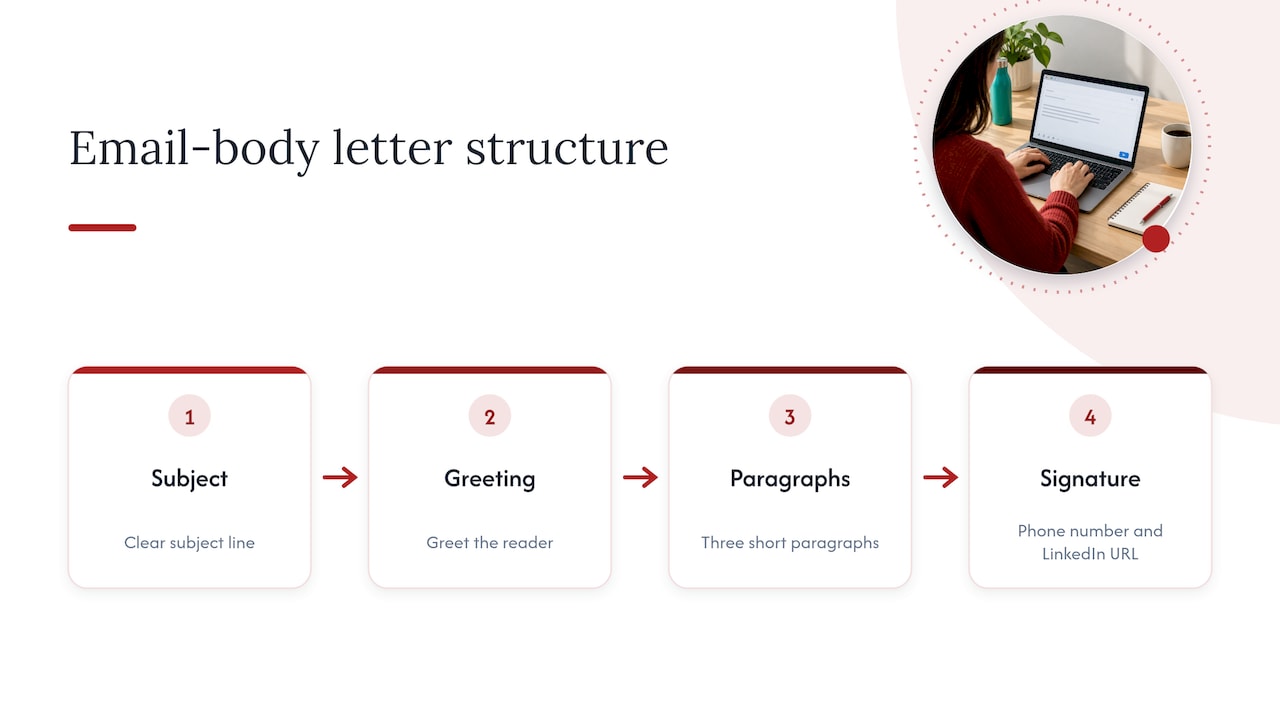
Some employers, particularly smaller firms, ask for applications by email with no attachments, or the reader may open applications on a phone. In that case the email is the cover letter. Keep it tighter than a formal letter: a clear subject line, a greeting, three short paragraphs and a signature with your phone number and LinkedIn URL. An email-body letter naturally reads less formally, which can suit roles where personality matters, but it should still be specific to the employer.
If your letter runs long, pasting it into the body is a poor choice. Long blocks of text are hard to read in an inbox, and formatting often breaks.
Option 3: both, in full
Do not do this. Repeating the whole letter in the body and again in the attachment makes the application bloated and gives the reader nothing new. The email should lead to the attachment, not duplicate it.
When the employer gives instructions, follow them
Employers set their own rules. Indeed Canada’s guide to emailing a cover letter notes that some organizations require attachments while others expect the letter in the email body, and it advises checking the posting before you decide. It also suggests a subject line that includes your name, the role and the words “cover letter”.
If the posting says nothing and you have a contact, a brief question about preferences is acceptable, but most applicants simply use Option 1.
File hygiene matters as much as the choice. Save both documents as PDFs, name them clearly (for example, Sharma_Priya_Cover_Letter.pdf), and open the attachments from your sent folder if you can to confirm they display correctly.
ATS portals: upload the letter, even if it is optional
Most mid-sized and large Canadian employers route applications through an applicant tracking system. In a portal there is no email to write, and the question becomes whether you use the cover letter field at all.
You should. The UConn career centre’s guidance on applicant tracking systems reminds applicants that an ATS is only the first reader and that a human reviewer is the ultimate audience. A thoughtful note typed into an email cannot reach a recruiter who never sees an inbox. Where a portal gives you a place to upload a dedicated letter, use it. Research on resumes and cover letters, summarized in a review in the Journal of Education and Development Psychology, reports that well-crafted, customized letters improve how evaluators rate applicants, and many applicants skip optional fields, so completing one can set you apart.
If the portal offers only a text box, paste a condensed version of the letter in plain text, without tables or special characters.
Federal and public sector: the letter is part of the assessment
Public sector hiring changes the calculation. In these competitions the letter is often assessed against stated criteria, not read as a courtesy introduction. The Canadian Security Intelligence Service, for example, tells applicants that the cover letter can run up to two to three pages in a specified font and layout, which is far beyond the single page expected in most private sector applications.
Three practical consequences follow:
- An email note alone will not qualify you. If the poster requests a letter, submit a full letter in the stated format.
- Mirror the poster. Use the language of the essential qualifications and give an example against each one.
- Respect the limits. Page counts, file types and submission methods are screening conditions, not suggestions.
If you are applying to the Ontario Public Service, our guide to an Ontario government resume within the five-page limit covers the same discipline for the resume side.
What belongs in the letter itself
Since the email is short, the attached letter carries the weight. The strongest Canadian letters are brief and evidence-led. One structure we recommend is a single STAR paragraph (situation, task, action, result) that proves one claim relevant to the role, which we explain in our guide to a Canadian cover letter built on one STAR paragraph.
A workable outline:
- Opening: the role, and one sentence on why this employer.
- Proof: one measurable achievement that matches the main requirement of the posting.
- Fit: a sentence or two on how your background applies to their priorities.
- Close: a direct call to action, such as a conversation about the role.
Some situations call for a different angle. If you are changing fields, see these career change cover letter rewrites. If you are writing to a company that has not advertised a role, a cold cover letter with a one-sentence hook works better than a generic introduction. When the posting asks for pay expectations, our article on stating salary expectations with Job Bank data explains how to handle it.
A note on AI-written letters
Readers ask whether a chatbot can write the letter. It can help you brainstorm, but recruiters are noticing the volume of generic submissions. The Globe and Mail reported in November 2025 on hiring managers who have seen a surge of applications that appear to be written by artificial intelligence. A letter that could be sent to any employer does not do the one thing a letter is for. Use drafts as raw material, then rewrite them with your own results and specific knowledge of the organization.
Our perspective
We see the same pattern in the applications that clients bring to us. The email is treated as an afterthought, or the letter is dropped because the posting made it optional. Both choices cost candidates attention they could have had.
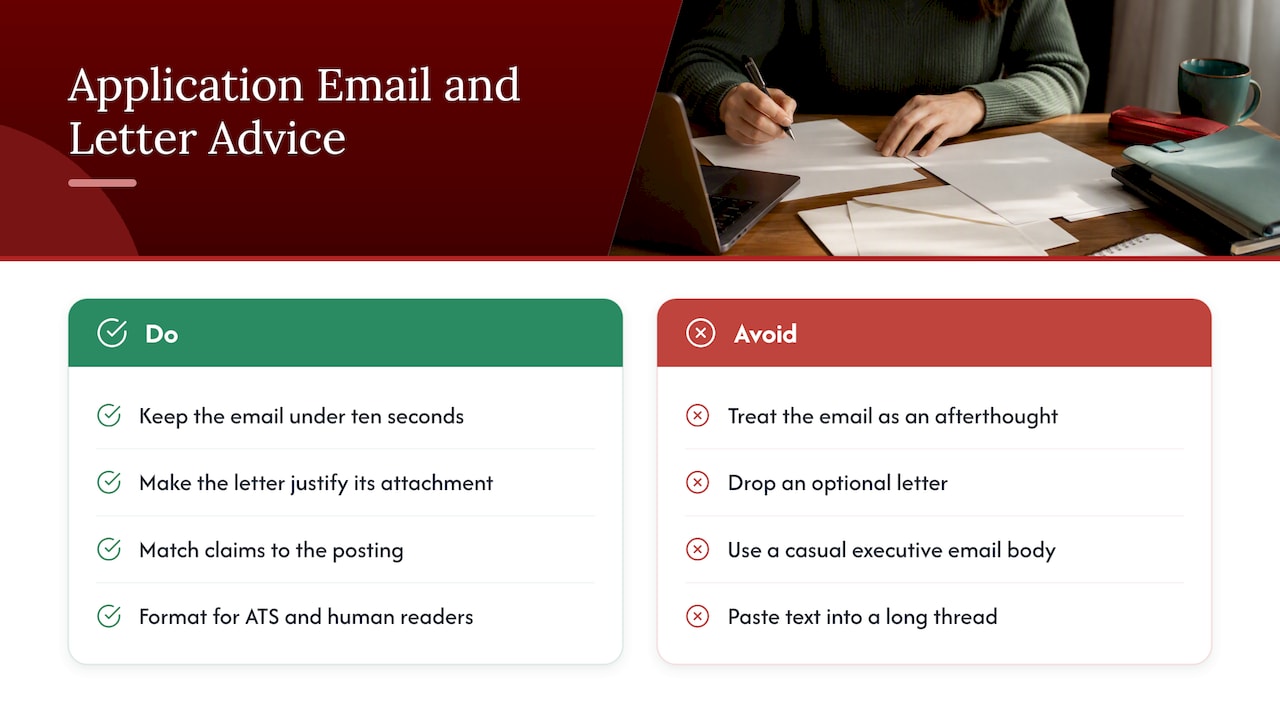
Our view is direct. The email should be short enough to read in ten seconds, and the letter should be strong enough to justify the attachment. For executive candidates, where decisions are made under board-level scrutiny and the first reader may be a search consultant or a chief of staff, the letter has to carry P&L ownership, transformation led and organizational outcomes in a few precise lines. A casual email body cannot do that, and it can signal that the application was not prepared with care. Confidentiality matters too: a formal PDF sent to a named recipient is easier to control than text pasted into a long thread.
Our approach is consultative. We work with you on the claims that matter for the role, check them against the posting, and format everything so that it reads cleanly both in an ATS and in a person’s hands. Executives can read more in our guide to the executive cover letter for leaders with 10 to 15 years of experience.
— Professional
Getting the package right
A good cover letter and email only help if the resume behind them holds up. If you want a writer to build the full package, our resume writing packages are one-off and priced by career stage: Early Career Resume at $139, Next Step Resume at $189, Advanced Resume at $239 and Executive Resume at $289. Each includes an extensive consultation and revisions, with ATS-friendly formatting. Senior candidates can start with the Executive Resume, and those who also want recruiters to find them can add LinkedIn profile optimization.
A checklist before you press send
- Have you reread the posting for submission instructions?
- Does the subject line include your name, the role and, if relevant, the job ID?
- Is the email body five lines or fewer, with no repeated letter?
- Are the letter and resume PDFs, named clearly, and addressed to the right employer?
- Does the letter mention the company by name and cite one measurable result?
- Have you checked the recipient’s name and spelling?
FAQ
Can an email count as a cover letter?
Yes, when the employer asks for applications by email without attachments, or the posting tells you to put your pitch in the message. In that case write it as a short, specific letter. When a posting asks for an attached or uploaded letter, an email note is not a substitute.
Should I attach the cover letter or paste it in the email?
Attach it when you can, and keep the email short. A PDF preserves formatting and lets the reader file the letter with your resume. Paste it in only if the employer asks for that, or if the letter is brief enough to read comfortably in an inbox.
Do I need a cover letter if the application says it is optional?
We recommend one. Many applicants skip optional fields, so a focused letter gives the reader a reason to look more closely. Skip it only if a short, tailored letter is not something you can write well for that role.
Can I use ChatGPT to write my cover letter?
You can use it to organize ideas, but do not submit its draft unedited. Recruiters are seeing many near-identical AI-written applications, so add your own results and employer-specific detail before you send anything.
Sources
- Cover Letters and Emails, Tulane University Career Services
- The Difference Between a Cover Letter and the Email You Send With Your Application, University of Houston
- 11 Steps to Email a Cover Letter, Indeed Canada
- Applicant Tracking Systems, UConn Center for Career Readiness and Life Skills
- The Resume Research Literature, Journal of Education and Development Psychology
- How to submit a powerful application, Canada.ca (CSIS)
- Job recruiters struggle to hire qualified people amid flood of AI-written job applications, The Globe and Mail