
A Government of Canada resume is a plain, complete and tailored document, built to show a screener exactly how you meet each qualification in the job poster. It is not a polished design piece. It is usually one to three pages, unformatted for the GC Jobs system, and written around the poster’s own keywords. The sections below set out the format, the content and the mistakes that cost qualified candidates an interview.
TL;DR
- Keep it complete and concise: one to three pages is enough, and respect any character limit in the poster.
- Build the version you paste into GC Jobs without bullets, underlines or bold, because the system strips most formatting.
- Tailor every application: use the exact keywords from the poster and screening questions, and support each with a specific example.
- Show how many years of experience you have, where you gained it and when, so a screener can verify each qualification without guessing.
- Keep a designed, formatted version for networking and non-government roles, and a separate plain-text version for federal applications.
Table of Contents
- How a federal resume differs from a standard Canadian resume
- Format and length
- What to include for each position
- Tailoring the résumé to the job poster
- The cover letter, when one is requested
- Where a federal resume goes wrong
- Our perspective
- Getting help with your federal application
- Before you submit: a short checklist
- FAQ
- Sources
How a federal resume differs from a standard Canadian resume
A private-sector Canadian resume is written to be read quickly by a recruiter or a hiring manager. A federal resume is written to be assessed against a list of qualifications. The reader is often a screener who works through the poster point by point and looks for evidence of each one in your application. If the evidence is not in the text, it does not count.
That changes four things in practice.
- Completeness over brevity. Government guidance asks for résumés that are complete, concise and well-structured. A short, achievement-only summary that omits dates, employers or duration can leave a screener unable to confirm that you meet a qualification.
- Plain text over design. GC Jobs asks you to paste your résumé into an online profile, and the system removes most formatting. Columns, icons, tables and graphics do not survive.
- Exact keywords over paraphrase. The official guidance tells applicants to tailor the résumé and use the exact keywords from screening questions. Synonyms that read well to a human may not match what the screener is checking for.
- Evidence tied to qualifications. Each essential qualification needs a visible example. Each asset qualification that you hold should be visible too, since asset qualifications may be used for screening or to determine fit, while essential qualifications must be met before appointment.
Our own guide to federal resumes in Canada and why polished formatting breaks in GC Jobs covers the formatting side in more depth.
Format and length
How long should it be?
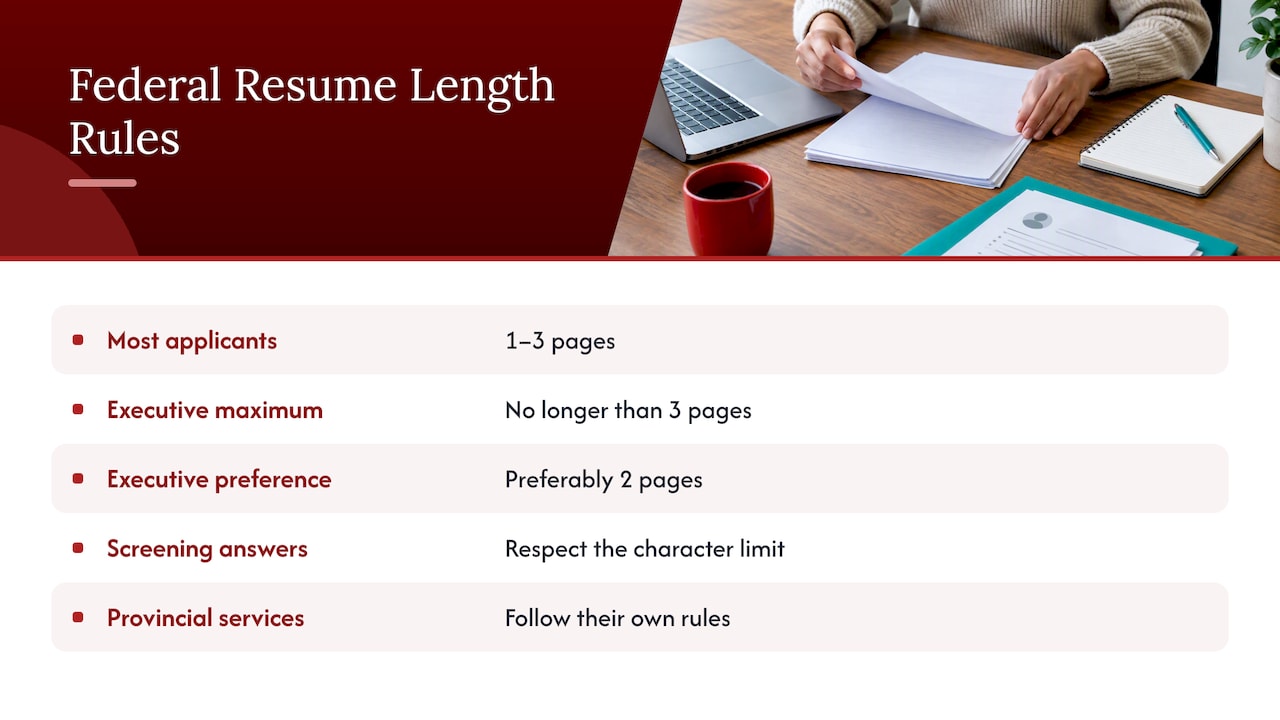
Federal guidance says one to three pages is enough for most applicants. For senior roles, the Public Service Commission advises that an executive CV be no longer than three pages, preferably two, and not crowded with text.
Two cautions apply. First, some job posters set a character limit on the résumé or on a screening answer. Respect it, because content beyond the limit may never be read. Second, provincial and territorial public services have their own rules. Ontario, for example, has a separate page-limit question, which we address in our guide to the Ontario government resume within the five-page limit. This article concerns the federal public service.
Why you need an unformatted version
The Public Service Commission’s top tip is to create an unformatted résumé for GC Jobs, with no bullets, underlines or bold. Whatever you paste is flattened. A résumé that looks organized in Word can arrive as one dense block.
Practical steps that follow from the official guidance:
- Write the résumé in a word processor first. Veterans Affairs Canada notes that the job advertising system has no spell-check, so you may wish to draft there and then copy and paste.
- Make headers readable without styling. The same page mentions that some applicants use all caps for headers, followed by a space so they stay clear after pasting.
- Separate sentences and entries with line breaks and plain punctuation rather than symbols that the system may not display.
- After pasting, read the whole profile in the system and correct anything that has shifted.
Order and personal information
List entries starting with the most recent and continuing in chronological order. The Priority Administration résumé template states that address, education and work experience are required for screening.
You do not need to include what does not bear on the qualifications. Executive CV guidance says personal information such as sex, age, health, race, religion, marital status or political affiliation is unnecessary. If you wish to self-identify as a woman, an Indigenous person, a member of a visible minority or a person with a disability, the Employment Equity section of the application is the voluntary place to do it, not the résumé.
What to include for each position
A federal screener needs enough detail to judge the depth and recency of your experience. For each role, give the title, the employer, the location, the dates and a short set of responsibilities and results.
The official tip sheet asks applicants to show how many years of experience you have, where you gained it and when. That sentence is the most useful template in the whole process. If the poster asks for “experience managing projects,” a line that reads “Managed budgets and timelines” is weaker than “Led six infrastructure projects between 2019 and 2024 as Project Manager at [employer], with budgets of up to $4 million.” The second gives years, place and scale.
Write accomplishments the screener can verify
- Start with an action verb and name what you did, not the team’s duties.
- Use the STAR structure (situation, task, action, result) for the examples that support essential qualifications. The tip sheet recommends action verbs and concrete STAR examples.
- Quantify where you honestly can: budget, team size, volume, turnaround time, percentage change.
- Describe your own role in a group effort. When work was shared, say which part was yours.
- Explain in plain language if your background is military or highly technical. Veterans Affairs Canada advises that readers may not share that experience, so explain your role in plain language.
- Spell out acronyms. Federal guidance says to avoid acronyms in screening responses so the reader understands them. The same logic applies to the résumé.
Extra details for executive applicants
Senior and executive-level applications carry additional expectations. The Public Service Commission’s executive CV guidance lists the following:
- For positions held over the last 10 to 15 years, the title, group, level, department, division and duration, where the roles were in the public service.
- A spoken and written language profile, along with the date and level of the most recent Second Language Evaluation.
- Security clearance level, where applicable.
For candidates coming from outside government, translate private-sector scope into terms a public-service panel understands: size of the budget you managed, number of direct and indirect reports, regulatory exposure, stakeholder groups and the organizational outcomes you were accountable for.
Tailoring the résumé to the job poster
Tailoring is where federal applications are won. The official guidance is direct: tailor your résumé for each position, use exact keywords and provide detailed examples. Sending the same document to ten postings works against you.
A workable process:
- Separate the poster into essential and asset qualifications. Essential ones are pass or fail. Assets can help with screening and fit.
- Build a matching grid. For each qualification, write down the job, the dates and the example that proves it. If you cannot find one, that is a gap to address before you apply, not hide.
- Reuse the poster’s exact wording in the résumé where it is true. If the poster says “develop policy options,” avoid replacing it with “prepared recommendations.”
- Put the strongest evidence for essential qualifications where it is easiest to find, in the most relevant role and within the profile or career summary.
- Understand the branch. Carleton University’s career centre advises applicants to research the scope of practice within the specific branch they are applying to, so your examples reflect what that team actually does.
A career summary at the top of the résumé helps the screener orient quickly. The Canada Energy Regulator’s published sample résumé, for example, includes Profile and Career Summary sections and prompts to identify essential and asset experience. Our guide on writing a career summary that impresses Canadian recruiters explains how to write one that still reads well in plain text.
Answering screening questions
Many postings add screening questions about experience and education. The guidance is consistent with what applies to the résumé: do not merely state that you have the experience, give details or examples. Use the exact keywords and skills from the question, describe your role and accomplishments, and avoid acronyms. The résumé and the answers should support each other. A screener who reads “five years of stakeholder engagement” in an answer will look for it in your work history.
The cover letter, when one is requested
Not every federal poster asks for a cover letter, so follow the instructions in each one. When a letter is requested, the Canada Energy Regulator suggests a format that is easy to screen: use each qualification as a header and write one to two paragraphs showing how you meet it. This mirrors the way a screener works and spares them from searching for evidence. The same page warns that failure to provide requested documentation may result in rejection, so check what each poster requires before you submit.
Where a federal resume goes wrong
| Common problem | Why it hurts | What to do instead |
|---|---|---|
| Designed template with columns and icons | Formatting is removed on paste and content can scramble | Use a plain-text version for GC Jobs |
| One résumé for every posting | Keywords and examples do not match the qualifications | Re-tailor each time |
| Vague duties (“responsible for…”) | Screener cannot confirm years, scope or results | Use action verbs, STAR examples, dates and scale |
| Missing dates or durations | Experience cannot be measured against the poster | State years and where each skill was gained |
| Unexplained acronyms and jargon | Reader may not understand your role | Spell out terms and use plain language |
| Typos from pasting | The system has no spell-check | Proofread in a word processor first |
Our perspective
We see federal applications fail for a consistent reason: the candidate is qualified, but the document does not prove it in the way a screener must verify it. A résumé that works well with a recruiter in the private sector can be removed from consideration in a public-service process because the evidence is implied rather than stated.
Our approach is to treat the job poster as the brief. We work directly with you in a consultation to identify which essential and asset qualifications you meet, which examples carry the most weight, and how to state years, scope and outcomes in plain, searchable language. Our documents are designed to be ATS-friendly, and for federal applications we prepare a clean version that holds its structure when pasted.
For executives, the standard is higher. Board-level scrutiny, P&L ownership, transformation led and organizational outcomes need to be expressed in terms a selection board can assess, with discretion about confidential detail. That is the work we are built to do, with revisions until the document is right.
Professional
Getting help with your federal application
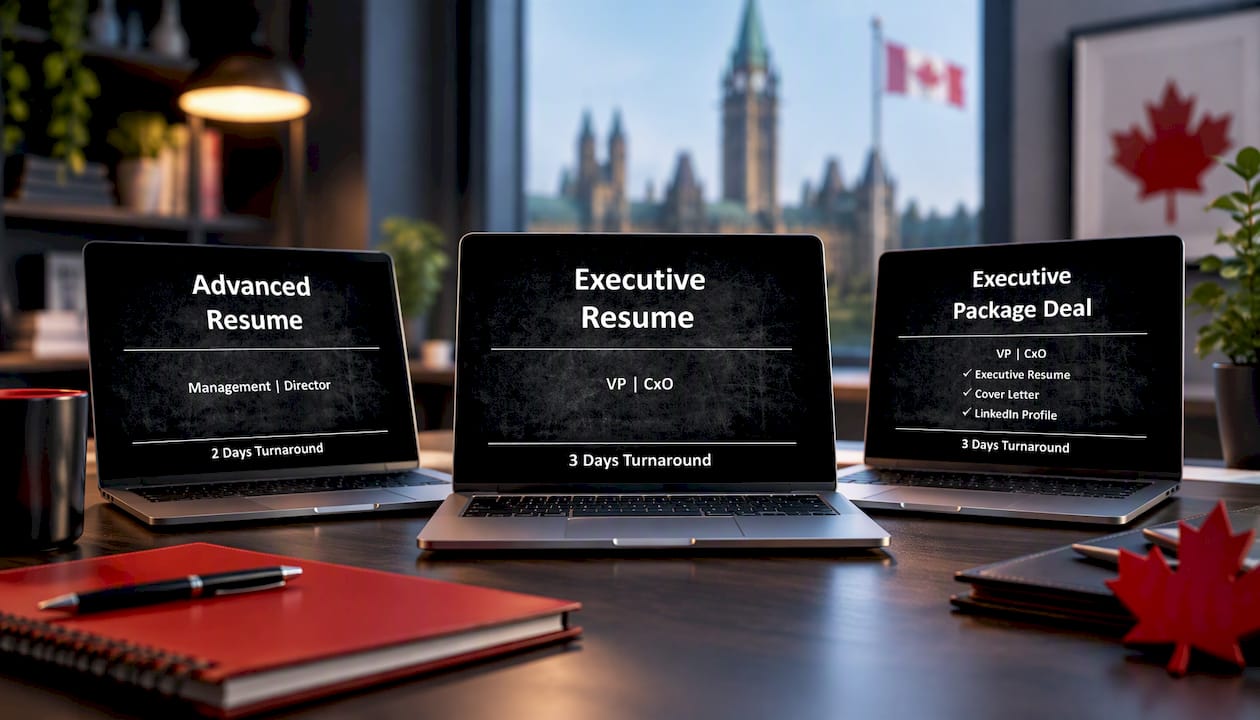
If you have the experience but are not certain it is coming through in the plain-text format, a professional writer can map your background to the poster and build a version that suits GC Jobs. Our government and public sector resumes service is designed for this. Pricing is published for our resume packages: Early Career Resume $139, Next Step Resume $189, Advanced Resume $239 and Executive Resume $289, all one-off. You can compare them in the shop, or go straight to the Executive Resume if you are applying at director level or above.
If your LinkedIn profile will be reviewed alongside your application, our LinkedIn profile optimization service keeps it consistent with your résumé.
Before you submit: a short checklist
- Does every essential qualification in the poster have a matching example, with years, employer and dates?
- Are the poster’s exact keywords used where they are accurate?
- Is the pasted version free of bullets, underlines and bold, and does it read cleanly in the system?
- Have you stayed within any character limit?
- Have you spelled out acronyms and described your own role in group work?
- Have you proofread it outside the system, since it has no spell-check?
- Have you included every document the poster requests?
FAQ
How long should a Government of Canada resume be?
One to three pages is generally enough, and executive CVs should be no longer than three pages, preferably two. Always check the poster for any character limit. Prioritize completeness of the relevant experience over padding.
Can I use bullets and bold in a GC Jobs resume?
Not in the version you paste into the system. The Public Service Commission advises an unformatted résumé without bullets, underlines or bold, because most formatting is removed on paste. Use clear line breaks and plain headers instead.
Do I need a different resume for each federal job?
Yes. Official guidance asks you to tailor your résumé to each position so it matches the qualifications in the poster. Keep a master document with all your experience, then pull the examples that fit each posting.
Do federal jobs require a cover letter?
Only when the poster asks for one. If it does, use each qualification as a header with one to two paragraphs that show how you meet it.
Should I include personal details like age or marital status?
No. Executive CV guidance says that sex, age, health, race, religion, marital status and political affiliation are not needed. Address, education and work experience are what screening requires.
Sources
- Applying for Government of Canada jobs: How to apply
- Tips and tricks to apply (Shared Services Canada)
- The Curriculum Vitae: Tips for Executives
- Résumé Template, Priority Administration
- Preparing your application, Veterans Affairs Canada
- CER: How do I apply?
- Public Service Recruitment Programs tip sheet, Carleton University