
Foreign experience belongs on your Canadian resume, and it should be written so a Canadian reader can follow it at a glance. Keep the true employer, dates and location. Add a short plain description where a company or title is unfamiliar. Lead with measurable results, and order the bullets by relevance to the job you want. The aim is to translate your experience, not to erase it or inflate it.
This guide is written for newcomers, internationally trained professionals and anyone returning to work after a gap who needs a resume that reads correctly in Canada. It covers what to include, how to describe overseas titles and employers, what to leave off, and how to handle a break in your history.
TL;DR
- Include overseas work, internships and volunteer roles. Canadian academic guidance treats international experience as relevant and as evidence of your competencies.
- Keep real employers, dates and locations, and add a one-line explanation where a title or company will not be familiar to a Canadian reader.
- Use a clean, single-column layout of one or two pages, with results quantified, Canadian spelling and no photo or personal details.
- Order each role’s bullets from most to least relevant to the target job, not by how much time you spent on each task.
- After a gap, a combination (hybrid) format and a tailored cover letter let your skills lead.
Table of Contents
- What counts as foreign experience
- Why a home-country CV does not travel
- Format and length in Canada
- Step by step: translating each overseas role
- What to leave off a Canadian resume
- Presenting foreign experience after a career gap
- Common mistakes with foreign experience
- Where professional help makes the difference
- Our perspective
- FAQ
- Sources
What counts as foreign experience
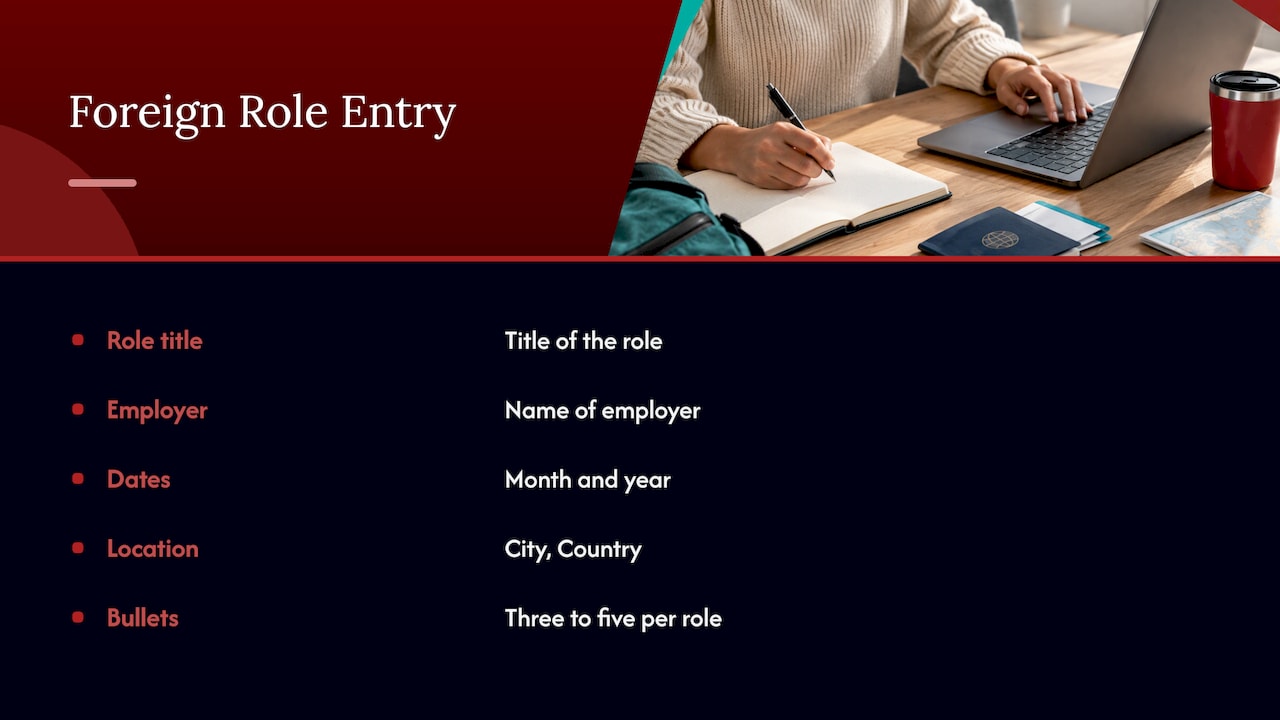
Foreign or international experience is any work, internship or volunteer role you held outside Canada. The University of Waterloo’s CareerHub states that international work experience is relevant and demonstrates your competencies, and it advises listing each entry with the role title, employer, month and year dates, and the location written as “City, Country” when the job was outside Canada. It suggests three to five bullets per role.
The same guidance notes that you can place Canadian academic or volunteer experience alongside overseas roles. This shows the same competencies applied in more than one cultural setting, which is useful for readers who worry about whether you will fit a Canadian workplace.
There is a practical point behind this. Hiring managers in Canada often say they want “Canadian experience”, but the guidance for employers is more precise. The British Columbia employer organization IEC-BC advises reviewers to look for related work experience rather than Canadian work experience, and to judge candidates against the descriptors of experience in the job requirements, not the job title. It adds that experience from other countries can be as valuable as Canadian experience, and sometimes more so. Your resume’s job is to make that match visible.
Why a home-country CV does not travel
Most problems with foreign experience are not about the experience itself. They come from how it is written. A document built for another market often has features a Canadian recruiter will not expect: a photo, a date of birth, a long list of duties, a three-page length, or titles that have no Canadian equivalent.
Two things happen as a result. A human reader spends the first few seconds trying to decode the document rather than judging your fit. And an applicant tracking system (ATS), the software many employers use to store and search applications, may not read a complex layout correctly. A plain structure and wording that mirrors the job posting reduce both risks. Our page on ATS-friendly resumes for Canadian job seekers explains the formatting side in more detail.
Format and length in Canada
The format decision comes first, because it shapes how your overseas history reads.
Length. Job Bank, the Government of Canada’s employment service, advises limiting a resume to two pages, with the emphasis on recent experience and with jobs more than 15 years old cut or minimized. RBC’s newcomer guide says a Canadian resume is typically one or two pages, and that a two-page resume is recommended for professionals with more than 10 years of work experience.
Resume versus CV. In Canada a resume is the document for most job applications. RBC distinguishes it from a CV, which is two pages or longer and used for academic applications. If you are applying for a corporate, clinical or technical role, you want the resume.
Structure. The same RBC guide says the reverse-chronological format, with your most recent role first, is the most popular in the Canadian job market. A hybrid or combination format, which puts a skills section above the work history, suits people with significant gaps or those switching fields. If you are unsure which applies to you, our guide to choosing a Canadian resume format walks through the decision quickly.
| Your situation | Format that usually fits | Why |
|---|---|---|
| Continuous career in one field, with relevant overseas roles | Reverse-chronological | Recent, relevant roles appear first |
| Changing fields, or experience that does not map to a single title | Combination (hybrid) | Transferable skills lead, history follows |
| Significant gap in your history | Combination (hybrid) | Skills and achievements are not buried by dates |
Step by step: translating each overseas role
1. Keep the facts true
A Canadian-style resume should make your overseas experience understandable. It should not change the employer’s name, your dates or your qualification names. Keep what is verifiable exactly as it is, and use the descriptive layer to help the reader. Any recruiter who checks a reference or a credential should find that it matches what is on the page.
2. Write the location the Canadian way
Use month and year for dates and “City, Country” for roles outside Canada, as Waterloo’s guidance recommends. CPA Alberta’s Capitalize magazine adds one option for candidates worried about bias: stating simply “overseas” as the location instead of a specific country. That is a personal decision. Many candidates keep the full location because the country is part of the strength of the story, for example a multinational market or a regulated industry.
3. Add a short bridge for unfamiliar titles
Titles do not always map across borders. George Brown College’s guidance for international and immigrant students gives an example: a CA in India is a CGA in Canada, so use the Canadian title where it is accurate. When no clean equivalent exists, CPA Alberta recommends a brief explanation under the role that clarifies what the position corresponds to in Canada.
In practice, that explanation is one line in italics or in the first bullet. Describe the scope: team size, budget, region or patient volume. A reader who sees scope understands level, whatever the title says.
4. Describe an unknown employer in a few words
Canadian recruiters may never have heard of your former employer. The Chambre de commerce du Montréal métropolitain advises newcomers to specify the sector and size of a company that is unknown locally. A short descriptor after the company name does this job, such as “regional retail bank with 40 branches” or “municipal hospital, 600 beds”. Use only figures you can stand behind.
5. Replace duties with results
This is the biggest gain in most resumes. A list of responsibilities tells a reader what the job description said. A result tells them what you did. Trimmed to the essentials, each bullet should name an action, the scale and the outcome. The CCMM guide advises limiting each role to a maximum of five responsibilities relevant to the position and adding a separate section of professional achievements with figures. George Brown’s guide likewise asks for results to be quantified.
Here is an illustrative example, not a real client. A line such as “Responsible for managing accounts and preparing reports” becomes “Prepared monthly consolidated reports for 12 subsidiaries and cut the close cycle from 10 working days to 6”. The second version needs no knowledge of the original country’s accounting practices to be understood.

6. Order bullets by relevance
Waterloo’s CareerHub advises ordering bullets from most to least relevant to the target position, and notes that even a skill you used only about 10% of the time belongs near the top if the job calls for it. This matters for foreign experience in particular: the task that mattered most in your home market may not be the one a Canadian employer is hiring for.
7. Present your education so it can be compared
George Brown’s guidance lists the Canadian equivalency of your education as something to include. Where you have had a credential assessed, you can state the result next to the degree. Keep in mind that an assessment confirms how a credential compares for a given purpose and does not itself guarantee a job or a licence. If your occupation is regulated, such as nursing, engineering or teaching, the licensing requirements are set by the relevant regulatory body, separately from your resume, so find out what they are early and describe your experience honestly in the meantime.
8. Mirror the language of the posting
Read the job posting for the exact words used for skills, tools and responsibilities. Where your overseas experience matches, use the posting’s terminology in your bullets. This helps an ATS keyword search and helps the human reader see the match. Our guide to writing a career summary that impresses Canadian recruiters shows how to carry that language into the opening of your resume.
What to leave off a Canadian resume
Because hiring in Canada is subject to anti-discrimination expectations, resumes generally omit personal details that are standard in some other countries. George Brown’s guide lists what to exclude: a photo, your SIN (Social Insurance Number), age, marital status, race or ethnicity, religion, immigration status, TOEFL scores and salary information. The CCMM guide gives a similar list, including date of birth and nationality, and recommends letter-size paper (8½ x 11).
CPA Alberta adds that you should not sign the resume and should open with a professional summary rather than an objective statement. It also recommends Canadian words and grammar, so check that you are using Canadian spelling consistently throughout, including in a LinkedIn profile that recruiters will compare with your resume.
Presenting foreign experience after a career gap
A gap is common for people who have relocated, retrained, raised a family or waited for a work permit. RBC’s guidance says a combination resume is commonly used by those with significant work gaps, and that unpaid or volunteer work can show Canadian experience when its skills match the target job. A cover letter can help explain the gap in a sentence or two.
In practice, this means three adjustments:
- Open with a summary and a skills section built from the job posting, so your strengths appear before the dates.
- List overseas roles with their real dates and give relevant volunteering, courses or contract work its own heading with equal weight.
- State the gap once, plainly, in the cover letter, and move on to what you offer.
The gap is not what stops most resumes. A resume that leaves the reader unsure what you can do now is what stops it.
Common mistakes with foreign experience
- One resume for every job. The same document sent to every employer cannot mirror each posting. Adjust the summary and the top bullets every time.
- Keeping the home-country layout. Photos, personal data and a third page signal a document written for another market.
- Listing every old job. Job Bank’s advice to cut or minimize roles more than 15 years old applies to overseas history too.
- Over-explaining. A one-line bridge is enough. A paragraph about how your former country’s hiring works crowds out results.
- Inflating to fit. Do not upgrade a title to a Canadian one that overstates your level. Describe the scope and let the reader judge.
Where professional help makes the difference
The steps above are straightforward on paper and hard to do for your own career. It is difficult to judge which of ten years of overseas achievements a Canadian employer will value, or whether a title bridge reads as clear or confusing. That is where a writer who works in the Canadian market earns the fee.
We built our resume services around a consultation, so the document reflects your actual aspirations and industry rather than a template. You work directly with your writer, and revisions are part of the process. Our resumes use ATS-friendly formatting, and the pricing is published:
- Early Career Resume: $139, one-off
- Next Step Resume: $189, one-off
- Advanced Resume: $239, one-off
- Executive Resume: $289, one-off
If you are new to the country, our resume writing services for newcomers to Canada and our immigrant resume guide describe how we approach overseas credentials. When you are ready, you can choose your package in the Professional Resumes shop.

A matching LinkedIn profile keeps your story consistent for recruiters who look you up after reading your resume. We offer LinkedIn profile optimization for this, along with cover letters that address a gap or a move across borders.
Our perspective
Overseas experience is an asset when a Canadian reader can see its scope. The candidates we hear from most often have the substance already: teams led, budgets owned, patients treated, systems built. What is missing is translation into the terms a Canadian hiring manager uses.
We approach that with a consultation first. Understanding what you want next, and which parts of your history support it, decides what goes at the top of the page. A senior leader with an international career needs a different emphasis from a healthcare professional re-entering work, and both differ from an engineer adapting to a new market.
Our approach is built around your aspirations and your industry, with ATS-friendly formatting and revisions until the document speaks directly to the employers you are targeting. Foreign experience then reads as what it is: a breadth of exposure that Canadian employers can place and value.
Professional
FAQ
Should I put my foreign work experience on a Canadian resume?
Yes, when it is relevant to the job. University of Waterloo guidance treats international work, internships and volunteer roles as experience that demonstrates your competencies. List each with the title, employer, dates and “City, Country”, and put the most relevant bullets first.
How far back should my overseas experience go?
Job Bank advises focusing on recent experience and cutting or minimizing jobs more than 15 years old. Older roles can be summarized in a single line or left off unless they are directly relevant to the target position.
Do I need Canadian experience to get an interview?
Not necessarily. IEC-BC guidance for employers recommends looking for related experience rather than Canadian experience, and judging candidates by the requirements of the job, not the title. Your task is to show that relationship clearly, and volunteering or a Canadian course can add a local reference point.
What is the best resume format if my overseas experience does not match Canadian job titles?
A combination (hybrid) format is a good option. It leads with a skills section and a professional summary, followed by your work history, so the reader sees your capabilities before the titles. Add a one-line explanation under any title that has no direct Canadian equivalent.
Can I leave the country off my overseas jobs?
CPA Alberta notes that if you are concerned about bias, you can state “overseas” instead of a specific location. Keep the employer and dates accurate in either case, since these are what a recruiter may check.
Sources
- University of Waterloo CareerHub: Experience section
- IEC-BC: Assessing International Experience
- Job Bank: How to write a good resume
- RBC: Newcomer’s guide to finding a job in Canada
- RBC Royal Bank: Write a Canadian resume and cover letter
- George Brown College: Resume tips for international and immigrant students
- CPA Alberta Capitalize: Canadianize your resume
- CCMM: CV in Quebec, 8 striking tips for newcomers