
A Canadian resume for an international student is a one-to-two-page, reverse chronological document. It has no photo, date of birth or nationality. It leads with a targeted summary, and it shows relevant experience from internships, projects, volunteering and work abroad, not only paid Canadian jobs. It also states your work authorization plainly. The rest of this guide shows how to build each part, so an employer who has never seen your school or home-country employers can still understand your value in the first few seconds.
TL;DR
- Keep the resume to one page if you are a student or recent graduate, and two pages at most. Use a single column, one standard font and standard headings.
- Leave out your photo, date of birth, SIN, marital status and nationality. Put your contact details, LinkedIn and a short targeted summary at the top.
- Count internships, co-ops, class projects, volunteering, club roles and home-country work as experience. Write each bullet as an action, a task and a result.
- State your work authorization in one clear line, and check current IRCC rules before you describe your hours or placements.
- Tailor every application to the posting’s wording, without copying it word for word.
Table of Contents
- What Canadian employers expect from a student resume
- Format, length and layout
- The sections to include, in order
- Showing experience when you have little Canadian work history
- What to leave off your resume
- Stating your work authorization
- Tailoring your resume to each posting and to ATS
- Common questions about structure and wording
- Our perspective
- Working with a resume writer
- A final check before you submit
- FAQ
- Sources
What Canadian employers expect from a student resume
Canadian employers read resumes quickly, and many first pass them through applicant tracking software. The expectations are consistent across the guidance that Canadian universities and professional bodies publish. IABC/BC says employers prefer resumes of one to two pages, ideally one page for students and recent graduates. It also asks for reverse chronological order, concise wording, and a focus on qualifications, experience, volunteer work, certifications and skills.
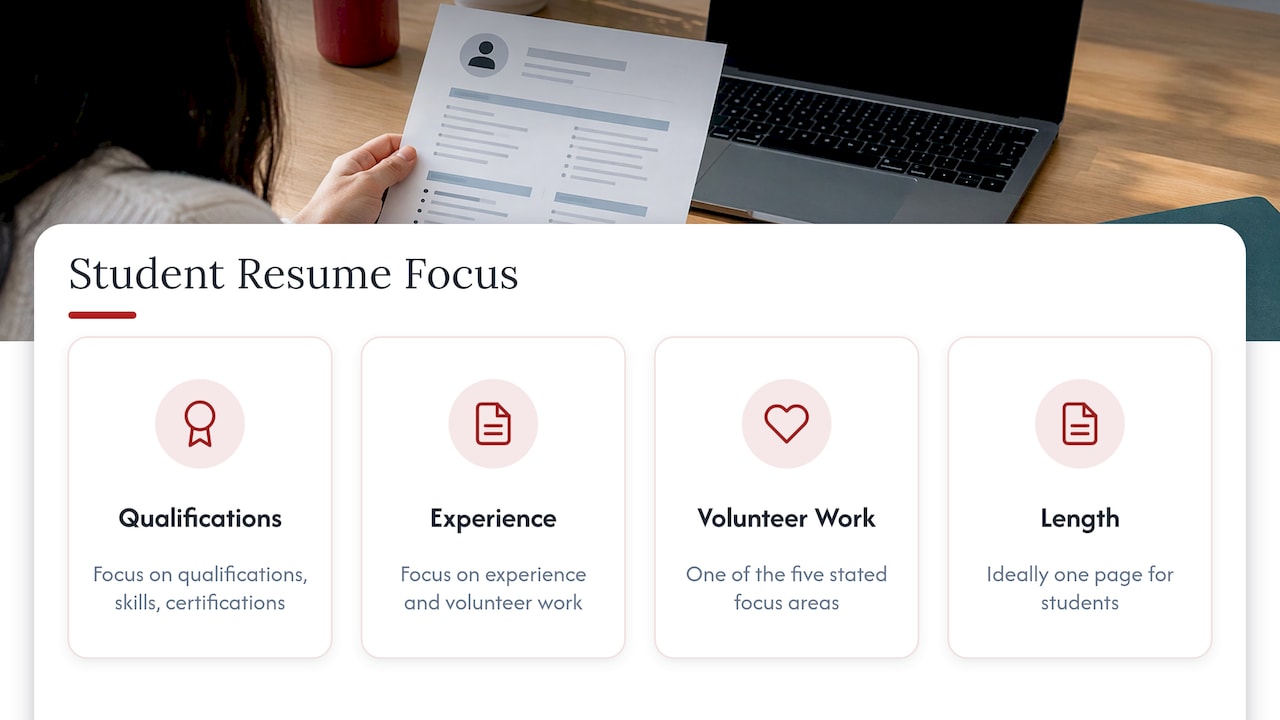
The University of Toronto’s resume and cover letter toolkit gives the same length range and recommends a single font such as Arial or Times New Roman. It also advises avoiding tables, icons and decorative templates, which can be difficult for ATS to read.
If you come from a country where a CV runs to many pages and includes a photo, personal details and references, this is the largest adjustment. In Canada, the document is a marketing summary of what you can do for a specific employer, and it is not a full record of your life. Our guide to when to use a CV or a resume in Canada explains the distinction. Academic and research applications are the usual exception.
Format, length and layout
Choose a layout that a person and a parser can both follow. Our pages on the Canadian resume format and on a simple resume format for Canada cover the options in more detail. For a student the practical rules are these:
- One column. Multi-column layouts and text boxes can scramble when software reads them.
- One standard font at a readable size, with consistent spacing and clear section headings.
- Reverse chronological order, with the most recent role or project first.
- Left-aligned bullets, not tables, icons, skill-rating bars or graphics.
- Contact details in the body of the page. Concordia University advises against placing important information in headers or footers, and the same guidance asks you to submit in the file format the employer requests.
The temptation for international students is to use a designed template to stand out. A modern layout can look polished, but in Canadian hiring, clarity wins. If you are weighing the two styles, see our comparison of modern and traditional resumes in Canada.
The sections to include, in order
Contact information and links
The Government of Québec lists the standard contact elements: name, address, telephone number, email address and a website if you have one. In practice, most Canadian students list city and province instead of a full street address, plus a professional email address, a phone number and a LinkedIn URL. Add a portfolio link if your field uses one, such as design, software or writing.
Work authorization line
This line is specific to international candidates, so it has its own section below.
Summary
A short summary at the top should speak directly to the skills and knowledge the role requires. UBC Student Services recommends a summary or highlights section for this purpose. Write two to three lines: your program and expected graduation date, two or three role-relevant strengths, and the kind of position you are seeking. Our guide to writing a career summary for Canadian recruiters goes deeper on wording.
Example for a business student: Third-year Bachelor of Commerce student with experience in financial reporting, Excel modelling and customer service. Seeking a co-op placement in corporate finance, with fluent English and Mandarin.
Education
List your degree, institution, location and dates. For a student in Canada this section usually sits near the top, above experience, until you graduate and gain more work history. Add relevant coursework, honours, scholarships and a GPA only if it strengthens your case. If your credential comes from outside Canada, name the degree and institution in plain terms that a Canadian recruiter can recognize.
Experience
This is the section that decides most applications, and it is covered in full below.
Skills, languages and certifications
List the technical tools, software and certifications first, because these are what keyword filters and hiring managers look for. RBC’s guidance for international students also names language skills as an item to include. In Canada, fluency in English or French, and in additional languages, is a real asset for many roles, so state your level honestly.
Showing experience when you have little Canadian work history
Most international students worry about this point more than any other. The reassurance is that Canadian employers accept a wide range of experience. RBC states that volunteer work, internships and relevant academic projects are considered valid work experience in Canada and should be highlighted when formal Canadian history is limited. IABC/BC suggests adding volunteering in Canada, club participation, school projects, language skills, soft skills and a portfolio.
Sources of experience worth listing:
- Co-op terms and internships, in Canada or abroad
- Part-time jobs, on or off campus
- Course projects, capstones and research assistant work
- Student clubs and leadership roles
- Volunteer work in your community
- Relevant jobs in your home country
If you already work in Canada, use your hours carefully and keep them within the rules described in the work authorization section. On-campus roles count as experience too, and campus employers understand student schedules.
Writing bullets that show impact
Every bullet should answer what you did and why it mattered. McMaster’s Student Success Centre describes accomplishment statements as an action verb, what you did, and the purpose or impact. RBC recommends the Challenge-Action-Result approach and quantifying results where you can.
Compare two versions of the same experience:
- Weak: Responsible for helping customers at a retail store.
- Stronger: Served up to 80 customers per shift in a high-volume store, resolving complaints on the spot and maintaining a 95% satisfaction score in monthly reviews.
Only use figures you can stand behind, because interviewers will ask about them. If you do not have a number, describe scope: team size, tools used, frequency, or the people who relied on your work.
For home-country experience, explain the employer in one phrase if it is not well known, for example a regional logistics company with 400 employees. Translate job titles into the Canadian equivalent when the duties match, and keep the original title in brackets if you need to remain accurate for reference checks. Our immigrant resume guide for Canada shows how to adapt overseas experience for local readers.
Students also often need to translate academic work. A final-year project becomes an experience entry when you describe the problem, the method, the tools and the outcome. A group assignment becomes evidence of teamwork when you name your role, the team size and the result.
What to leave off your resume
Canadian guidance is clear on personal details. The Government of Ontario’s student resume and cover letter tip sheet advises avoiding your date of birth, SIN, pictures and graphics, and urges you to proofread carefully for spelling, typing and grammar errors. IABC/BC adds marital status and nationality to the list of items that do not belong.
In practice:
- No photo. Employers in Canada generally do not want one in the document.
- No SIN. You provide it to an employer only after you accept an offer, for payroll purposes.
- No age, family status or religion.
- No references section. A line saying references are available is unnecessary, and you can prepare a separate list when asked.
- No unexplained gaps. If you took time between degrees, a short line such as Language studies or Family responsibilities keeps the timeline honest and clear.
Proofreading deserves its own attention for students writing in a second language. Read the resume aloud, run a spell check set to Canadian English, and ask someone at your campus career centre to read it. A single error in a short document is more visible than in a long one.
Stating your work authorization
Employers sometimes hesitate over candidates whose permits they do not understand. A clear line removes that hesitation before it forms. Recruiter Ruairi Spillane, writing for Moving2Canada, recommends making work authorization easy to understand, with a simple line such as an open work permit valid until a stated date. He also advises against assuming employers know what a specific program is, and suggests describing the permit as open or closed instead.
For a student, a clean version looks like this, placed directly under your contact details:
Study permit holder, authorized to work off campus up to 24 hours per week during academic terms and full time during scheduled breaks. Eligible for co-op and internship placements.
Use the wording that matches your actual conditions, and update it when your status changes, for example after a post-graduation work permit is issued.
Check the current rules before you write the line
The rules change, so confirm them on the official page for your own situation. At the time of writing:
- IRCC explains that eligible students may work off campus without a separate work permit for up to 24 hours per week during regular terms, and unlimited hours during scheduled breaks. They must be full-time at a designated learning institution, in an eligible program of at least six months, with work conditions on their permit and a SIN.
- The same page warns that working more than 24 hours a week off campus during regular terms violates study permit conditions. Consequences can include losing student status, being refused a future study or work permit, and having to leave Canada. Never advertise availability on your resume that exceeds your conditions.
- Canada.ca states that as of April 1, 2026, post-secondary international students do not need a co-op work permit for student placements such as co-ops or internships. Existing permit holders may use theirs for its full validity.
- CIC News reports that the placement must be confirmed by the institution as a mandatory program requirement, and must make up 50% or less of the program.
If you are unsure whether a job fits your conditions, ask your school’s international student advisor before you apply, and use the official IRCC pages as your final reference. Resume wording never changes what you are permitted to do. Separately, if you are still assembling your study permit paperwork, this overview of student visa requirements for Canada covers the documents involved.
Tailoring your resume to each posting and to ATS
A general resume sent to fifty postings performs worse than a targeted one sent to ten. Canadian universities teach the same process, with small variations.
- Read the posting as a wish list. Simon Fraser University tells students to highlight the qualifications and skills the employer asks for, then pair each with an example from their experience.
- Match the language. Concordia advises using similar keywords in the resume and cover letter, focusing on hard and technical skills such as tools, software and certifications. Soft skills should be tied to a concrete result, such as collaborating with a team of five to deliver a project ahead of schedule.
- Use both forms of a term. SFU recommends including the long form and the acronym, for example Customer Relationship Management (CRM).
- Do not copy the posting. The Ted Rogers School of Management at Toronto Metropolitan University suggests looking at the first three to five qualifications and duties for keywords. It warns against pasting the job description verbatim or hiding keywords in white text, because many systems flag resumes that match too perfectly.
- Write for people as well. The same school advises thinking like a recruiter, using the nouns they would search for and varying keywords with synonyms, while always remembering the human reader.
For the technical side of formatting, our guide on why ATS-friendly resumes matter for Canadian job seekers explains what the software reads and where it fails.
A worked example: a posting for a marketing assistant lists social media scheduling, Google Analytics and campaign reporting. If you managed your student club’s Instagram account, your bullet might read: Scheduled and analyzed social media content for a 600-member student club using Google Analytics, increasing event attendance by 30% over two terms. The keywords appear naturally, and the result is concrete.
Common questions about structure and wording
Should I include an objective? A targeted summary does more work. It names the role you want and the strengths that qualify you, which an objective rarely does.
Should I list every job? No. Select the experience that supports the application, and keep the rest off the page. One page rewards editing.
What about a cover letter? For most applications, a short letter that connects two or three of your strengths to the employer’s needs adds weight, especially when your Canadian history is limited.
Our perspective
Students often arrive with more evidence of capability than they realize, but it sits in formats Canadian recruiters do not instinctively read: a thesis project, a role abroad with an unfamiliar title, a club leadership position. Our work begins by identifying which of that evidence a Canadian hiring manager will value, and then restating it in the vocabulary of the target role.
We design every document around ATS-friendly formatting and around the specific goals you tell us about, in a consultation with your writer before drafting begins. Revisions follow, so the final document reflects your voice and the facts you can defend in an interview.
A student resume has little room for error. One page must establish the program, the strengths, the proof and the work authorization, and it must do so without decoration. That discipline is what we bring to each engagement.
Professional
Working with a resume writer
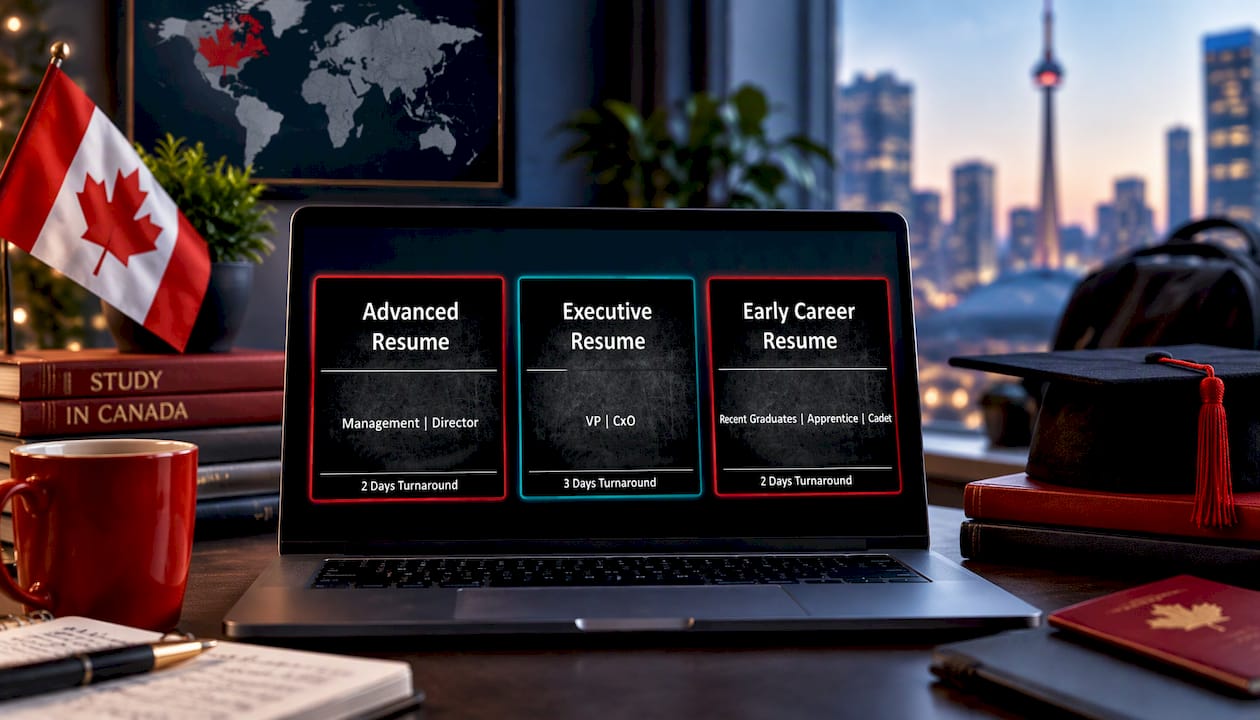
If you would rather not build the document alone, our Early Career Resume is priced at $139. It is where students and recent graduates usually begin, and it includes a consultation and revisions. Other levels are on the shop page, and the same approach applies to every one: your writer learns your goals, then drafts an ATS-friendly document that presents your experience clearly.
Once your resume is in place, a LinkedIn profile optimization service can align your online presence with it, since recruiters often check both. Newcomers adapting to the local market can also read about our resume services for newcomers to Canada.
A final check before you submit
Run through this list for every application:
- One or two pages, single column, one standard font
- No photo, date of birth, SIN, marital status or nationality
- Contact details in the body, with a LinkedIn link
- A summary matched to the posting
- Experience bullets with action, task and result
- Work authorization stated accurately and in line with current IRCC rules
- Keywords from the posting used in your own words
- Proofread for Canadian spelling and grammar, and saved in the file format requested
For a broader look at what makes a document stand out, see our guide to writing a resume that gets noticed in Canada.
FAQ
How long should an international student resume be in Canada?
One page is the ideal for students and recent graduates, and two pages is the general maximum. Canadian employers expect brevity, so select the most relevant experience and cut the rest. A longer CV format is reserved mainly for academic and research roles.
Can I include volunteer work and class projects as experience?
Yes. Volunteer work, internships and relevant academic projects are treated as valid experience in Canada, especially when you lack formal Canadian work history. Describe them like jobs, with an action, a task and a measurable result.
Should I put my study permit or work permit status on my resume?
Yes, a short factual line under your contact details helps employers understand your eligibility quickly. Describe it accurately and match it to your actual permit conditions. Before you apply, confirm current rules on the official IRCC pages or with your school’s international student advisor.
Do I need a photo or my date of birth?
No. Canadian guidance advises leaving out photos, date of birth, SIN, marital status and nationality. Include your name, contact details, LinkedIn and your qualifications.
Is a template enough for an ATS-friendly resume?
Only a plain one. Templates with columns, tables, icons or graphics can be difficult for ATS to read. A single-column document with standard headings and one common font is safer, and our writers build documents on that basis.
Sources
- IABC/BC: Resume writing for international students in Canada
- University of Toronto: Resume and Cover Letter Toolkit
- Concordia University: Applicant Tracking Systems (ATS) and your job search
- Gouvernement du Québec: Writing Your Résumé
- UBC Student Services: Resumes and cover letters
- RBC: Resume writing tips for international students in Canada
- McMaster Student Success Centre: Resume top tips
- Government of Ontario: Top Résumé and Cover Letter Tips
- Moving2Canada: Canadian work permit questions answered by a recruiter
- Canada.ca: Work off campus as an international student
- Canada.ca: Working in Canada as an international student
- CIC News: Off-campus work rules for international students
- Simon Fraser University: Resume
- Toronto Metropolitan University: Applicant Tracking System
- Student visa requirements for Canada