
GC Jobs screening questions are the written part of a federal application where you prove, one qualification at a time, that you meet the essential requirements of the poster. They are not interview questions. The people reading your answers have no prior knowledge of you, and they screen only on what you write. A complete answer gives dates, duration, your own role and a concrete result. A one-line “yes” does not. Your résumé then backs those answers up with the same facts, and that is where a well-built résumé earns its place.
TL;DR
- Screening questions are a “meets” or “does not meet” check on education and experience, made from the text you submit, before any test or interview.
- Each question maps to an essential qualification. Answer every one, with where, when, how long and what you personally did.
- “And” in a question means you must show every element. “Or” means at least one.
- Do not write “see my résumé”. Treat the résumé as the secondary source that confirms your answers.
- Screened in means tests, interviews, references and a security check come next.
Table of Contents
- What screening questions are and how they differ from interviews
- Read the poster before you read the questions
- How to write an answer that gets you screened in
- Gathering the evidence behind your answers
- Mistakes that screen out qualified people
- Where the résumé fits
- After screening: what happens next
- Our perspective
- Build the résumé your answers rely on
- FAQ
- Sources
What screening questions are and how they differ from interviews
When you apply on GC Jobs, the poster lists essential qualifications (education, experience, language, sometimes certifications) and often a set of questions tied to them. According to Health Canada’s self-screening tutorial for applicants, education and experience are screened on a “meets” or “does not meet” basis once the application is received. Language abilities for bilingual positions are assessed through standardized written and oral exams. Knowledge, abilities, competencies and personal suitability can be assessed later through written exams, interviews, reference checks and other processes, and security is validated through a security check.
That sequence matters for how you write. The screening stage is a gate, not a conversation. Nobody phones you to clarify a vague answer. An interview question lets you expand when the panel looks puzzled. A screening question gives you one chance, in writing, and the reader is working through a stack of applications against a checklist.
It also explains why the tone differs from a typical private-sector application. You are not selling a personal brand here. You are building an evidence file for each requirement.
Read the poster before you read the questions
Start with the poster, not the form. A federal poster separates essential qualifications from assets. A Communications Advisor poster on the public service resourcing system shows the pattern: essential education, experience and competencies are listed separately from asset experience qualifications, which are not mandatory, and language requirements and other competencies are flagged as assessed later.
The Public Service Commission (PSC), the federal body responsible for staffing in the public service, tells applicants in its how-to-apply guide to apply only if they hold all the essential qualifications. Assets are beneficial but not required, so you may apply without any of them.
A practical way to prepare is a simple grid before you open the form:
| Poster requirement | Your example | Where and when | Duration | Result |
|---|---|---|---|---|
| Experience leading a team | Your project or role | Employer, dates | Years and months | What changed because of you |
| Experience preparing briefing notes | Your example | Employer, dates | Years and months | Who used it, what it informed |
| Each asset you hold | Your example | Employer, dates | Years and months | Result |
This grid does two jobs. It gives you raw material for the answers, and it exposes a requirement you cannot yet evidence, which is better discovered before you apply than after a rejection.
“And” versus “or”
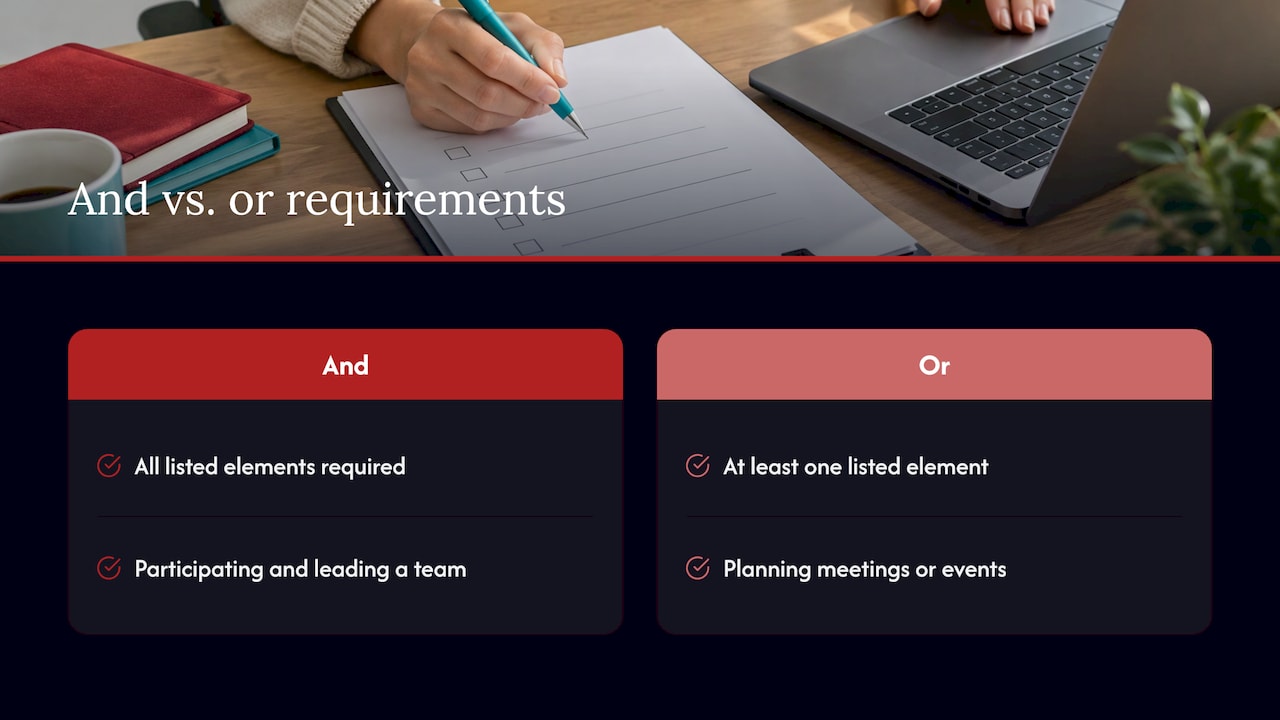
The PSC guide gives a rule many applicants miss. If a question uses “and” (for example, experience participating in and leading a team), your answer must show all of the elements. If it uses “or” (planning meetings or events), you need to show at least one. Underline every conjunction in each question before you write. An answer that is strong on leading but silent on participating fails the question even though it reads well.
How to write an answer that gets you screened in
The PSC’s “Screening questions 101” advice is direct: read each question carefully, do not just say you have the experience or education, give details or examples, and avoid acronyms so the reader understands. Its Tips and tricks sheet adds that stating you did something does not prove you meet the qualification: you must show how you did it. For a qualification requiring experience supervising a team, state how many years you have and where and when, with specific dates, you gained it.
A five-part answer structure
- Direct statement. Answer the question in the first sentence, using its own wording.
- Where and when. Employer or institution, your title, and start and end dates (month and year).
- Scope. Team size, budget, volume, client group or complexity, whatever makes the experience measurable.
- What you did. The tasks you performed, in the first person. Use “I”, not “we”.
- Result. What the work produced, such as a delivered report, a reduced backlog or an adopted process.
The PSC also recommends the STAR method (situation, task, action, result) for preparing examples for tests and interviews, and the same structure works well on paper.
What the PSC’s model answers show
The PSC publishes a model answer to a question about complex research using archival documents, historical maps and databases. The complete version names three years of experience across two universities with date ranges, describes the specific archive and database work, and ends with results: two academic articles and an award. The incomplete version says “Yes, I did historical research” and refers the reader to the education section of the résumé. The first can be marked against a standard. The second leaves the screener with nothing to mark.
Here is the same logic with an invented example, for illustration only. Suppose the question asks about experience supervising a team.
Weak: “I have supervised teams in my previous roles. See my résumé.”
Strong: “From March 2019 to June 2023 I was Operations Supervisor at a regional distribution centre, directing a team of 11 employees across two shifts. I built the weekly schedule, conducted quarterly performance reviews, resolved attendance and conflict issues, and trained six new hires. Over that period my team cut order errors from 4% to 1.5% through a checklist I introduced.”
The strong version supplies the years, the place, the size, the personal actions and a result. It also uses plain words rather than internal acronyms.
Do not refer to the résumé
The Natural Resources Canada guidance in its “Cracking the Code” video page tells applicants to avoid referring to the résumé in answers, because the questionnaire exists to capture experience properly. It also says not to list courses when asked about experience, and to describe projects, context, your role, who you worked with and challenges faced. The same page says it is acceptable to reuse the same example more than once, provided it answers the question asked.
The Communications Advisor posting says the same thing from the screener’s side: answers must include complete details, including dates, and résumés may be used only as a secondary source to validate the experience described in the questionnaire. The application is also used to judge written communication.
Gathering the evidence behind your answers
Most applicants do not struggle to write. They struggle to remember dates, numbers and results from jobs held years ago. The PSC tip sheet suggests thinking back across work, school, special projects and volunteer experience, and reviewing year-end performance evaluations and feedback for examples, including awards and special praise. It also reminds applicants to include every language they read, write and speak.
Before you start, pull together your performance reviews, old job descriptions, project summaries, certificates and letters of thanks. If you want a method for collecting supporting documents in one organized place, set that up first, so that the dates and figures in your answers match the paper trail later. Federal hiring includes reference checks and a security screening, so inconsistent dates are a risk that you can remove at the outset.
Mistakes that screen out qualified people
The public service posting is blunt about the rules. If you fail to answer all essential questions, the application will be rejected. Candidates are not contacted about missing or incomplete information, and applications are screened only on what was provided. Failing to show clearly how you meet education and experience requirements may also lead to rejection.
The recurring causes are predictable:
- Thin answers. “Yes, extensive experience” with no dates, size or result.
- Pointing to the résumé. The screener is told to treat it as secondary.
- Missing one half of an “and”. The answer covers the leading but not the planning, or vice versa.
- Unexplained acronyms. Internal shorthand that the reader may not know.
- “We” instead of “I”. The screener cannot tell what you did.
- Losing the work. Natural Resources Canada warns to save regularly, because responses can be lost after an hour on the same page. Draft in a separate document and paste in.
- Skipping proofreading. The Treasury Board’s careers in digital page lists proofreading, reading each question carefully and using concrete examples among its key reminders.
The Canadian Security Intelligence Service advises, in its guide to submitting a powerful application, taking each requirement (language, education, experience) in turn and explaining how you meet it with a concrete example. Do the same for each asset you hold. It defines assets as nice-to-haves that are not mandatory but may help you stand out.
Where the résumé fits
Because screeners treat the résumé as a validating document, it carries a specific job: confirm the employers, titles, dates and responsibilities that your answers cite. A résumé that contradicts an answer is worse than a thin one. A federal résumé also tends to need more detail than a private-sector one, since the screener has no context for your career.
We cover this in our guides to federal résumés in Canada and how to write a federal government résumé. For Ontario public service roles, see our guide on keeping an Ontario government résumé within the page limit. If you are applying from outside Canada or recently arrived, our page on résumé writing for newcomers to Canada explains how to present foreign experience for Canadian employers.
After screening: what happens next
The PSC’s after-you-apply page says you can use the Status of job applications page to review initial screening results, and the hiring department or agency will follow up on next steps. The Communications Advisor posting notes that applying enters you for the specific job and for a pool for future vacancies, that status inquiries are not acknowledged and that those selected for further consideration are contacted directly.
If you are screened in, the PSC’s testing and accommodation page says you may be asked to write a test or a series of tests and may be invited to an interview. Prepare by focusing on the qualifications named in your invitation, using the STAR method, and in the interview describing tasks you performed, speaking about yourself rather than “we”.
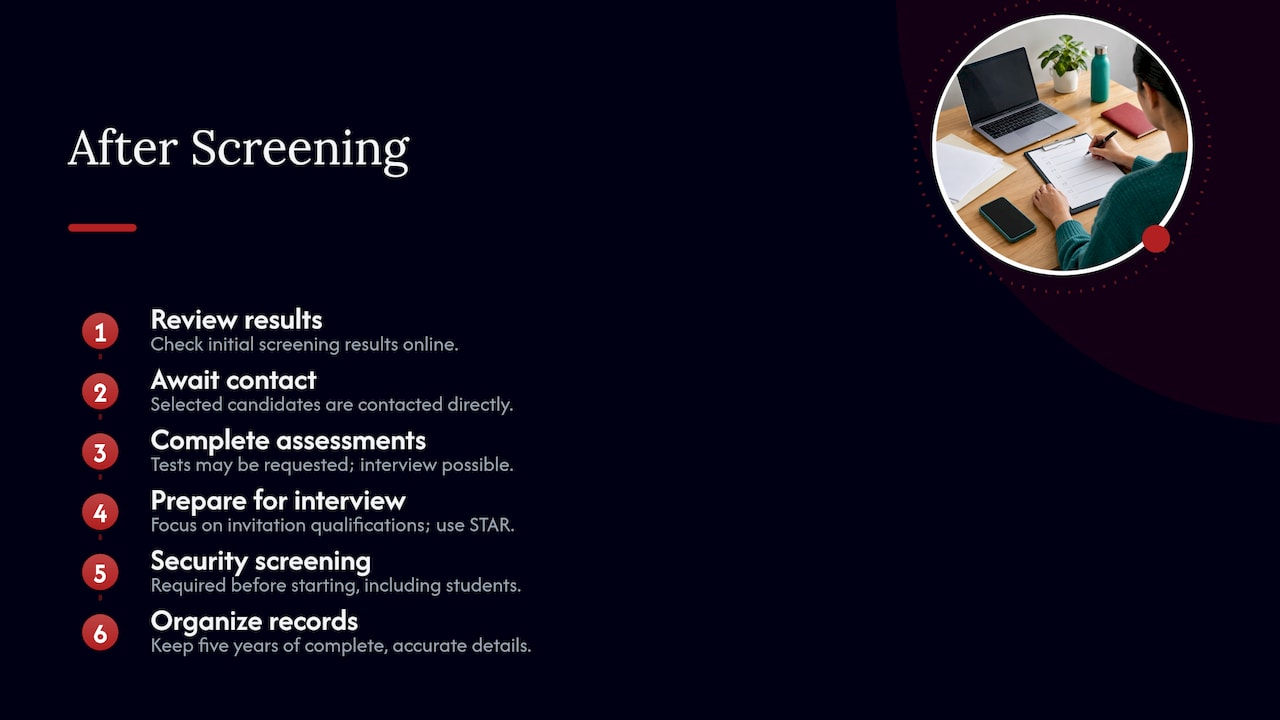
Before starting any federal public service job, everyone, including students, must be security screened. If you lack the required status or clearance, the hiring department contacts you to begin the process. The PSC advises keeping at least five years of information organized and giving complete, accurate details to avoid delays. Addresses, employers and dates from your résumé feed into this, which is another reason for consistency.
Our perspective
Applicants usually come to us with a real record and a document that does not show it. The same gap appears in a screening answer. The experience exists, but the dates, the scope and the result are missing, and a reader with no knowledge of you cannot supply them.
Our approach is built on consultation. Working directly with your writer, you talk through each role until the specifics come out: what you owned, how large it was, what changed. Those details belong in your résumé, and they are the same details a screener looks for in your answers. We revise the document with you until it reads accurately and consistently.
A federal application rewards precision over polish. We would rather give you a résumé whose titles, dates and responsibilities stand up line by line beside your questionnaire answers than one that is merely attractive.
Professional
Build the résumé your answers rely on
If your screening answers are the argument, the résumé is the record that supports it. Our résumé packages are one-off fees: Early Career Resume at $139, Next Step Resume at $189, Advanced Resume at $239 and Executive Resume at $289. Each is tailored to your career goals and industry, uses ATS-friendly formatting and includes extensive consultation and multiple revisions. Senior candidates moving into director or executive federal roles will find the Executive tier fits; you can compare all of them on our shop page. Our government and public sector résumé page explains how we approach these applications.

If you are also applying through professional networks, our LinkedIn profile optimization service keeps your public profile consistent with the résumé you submit.
FAQ
Are GC Jobs screening questions the same as interview questions?
No. Screening questions are written, answered in the application, and judged on a “meets” or “does not meet” basis for education and experience. Interviews and tests come later, only if you are screened in.
Can I reuse the same example for several questions?
Yes, as long as it answers the question each time. Natural Resources Canada says reusing an example is acceptable, but your answer should be tailored to the specific wording of each question, with the relevant dates and details.
How long should each answer be?
Long enough to show where, when, how long, what you did and what resulted, and no longer. Check the form for character limits. Lead with the direct answer and put the evidence in order of strength, so the key facts are not cut off.
Should I apply if I lack an asset qualification?
Yes. The PSC says assets are beneficial but not required, so you may apply without any. You must, however, hold every essential qualification and demonstrate each one in your answers.
Can I fix a missed answer after I submit?
Do not count on it. The posting states that candidates are not contacted about incomplete or missing information, and applications are screened only on what you provided. Review each answer before submitting.
Sources
- How-to-Apply Video Tutorial: Self Screen, Health Canada
- Applying for Government of Canada jobs: How to apply, Public Service Commission
- Tips and tricks to apply, Public Service Commission (PDF)
- Communications Advisor poster, Public Service Resourcing System
- Video: Cracking the Code, Natural Resources Canada
- How to submit a powerful application, CSIS
- Careers in digital, Treasury Board of Canada Secretariat
- Applying for Government of Canada jobs: after you apply, Public Service Commission
- Applying for Government of Canada jobs: Testing and accommodation measures, Public Service Commission
- Collecting supporting documents from candidates