
A strong healthcare cover letter in Canada is a single page of three to four paragraphs, addressed to a named person where possible. It is tailored to the posting and to the unit, hospital or health authority. It adds evidence your resume cannot carry on its own. It does not repeat your resume. This guide sets out the structure, a worked example paragraph, the conventions for nurses and internationally trained professionals, and what to check before you send it.
TL;DR
- Keep it to one page and about three to four paragraphs: opening, one or two body paragraphs, closing.
- Choose two or three results from your resume that match the posting, and tie them to the specific unit, site or health authority.
- Show clinical judgment through one concrete situation, not a list of adjectives.
- Internationally educated applicants should state work authorization and credential assessment status plainly.
- Use AI only to draft or edit, then rewrite in your own voice and check every detail.
Table of Contents
- What a Canadian healthcare employer expects from a cover letter
- How to structure a healthcare cover letter
- How to tailor it to the posting and the employer
- A worked body paragraph
- What to include in a nursing cover letter
- Non-nursing healthcare roles
- Conventions for internationally trained applicants
- Using ChatGPT or other AI for your cover letter
- Mistakes that cost interviews
- Perspective: why a healthcare letter is written differently
- Get help with your application documents
- FAQ
- Sources
What a Canadian healthcare employer expects from a cover letter
Health employers in Canada hire at volume and read quickly. A cover letter is your chance to tell them what the resume cannot: why this role, why this organization, and what you did in a comparable setting. Covenant Health, for example, describes the letter as an opportunity to say more about yourself and your experience, which is the right way to think of it.
The letter has three jobs:
- Show that you match the qualifications in the posting.
- Show that you chose this employer deliberately.
- Give the hiring manager a reason to open your resume with interest.
If the posting asks for a cover letter, send one. A missing letter on a request can lead to an application being set aside, so treat the instruction as a requirement rather than a courtesy.
How to structure a healthcare cover letter
The Association of Registered Nurses of British Columbia recommends an opening paragraph, middle paragraphs on skills, knowledge and experience, and a closing that thanks the employer and asks for an interview. Northern Health’s guidance adds a professional header with your contact details and body paragraphs covering education, relevant experience, achievements and skills for the team.
| Section | What it contains | Length |
|---|---|---|
| Header | Your name, phone, email, city and province; date; employer name and address | 4 to 6 lines |
| Salutation | The hiring manager’s name if known | 1 line |
| Opening | The role and posting number, your credential, and why this organization | 2 to 3 sentences |
| Body | Two or three results that match the posting, with context and numbers | 1 or 2 paragraphs |
| Closing | Thanks, availability, request for an interview | 2 to 3 sentences |
The salutation
Address the letter to a specific person if the posting or the employer’s website names one. The ARNBC guidance advises against a generic greeting such as “To Whom It May Concern”. When no name is given, “Dear Hiring Manager, [Unit or Department]” is acceptable and still shows that you read the posting.
The opening
State the position, where you saw it, and one sentence that connects your background to the role. Avoid opening with your life story or with “I am writing to apply” followed by nothing specific.
The body
This is where most letters fail, because they restate the resume in sentences. The ARNBC specifically warns that the letter should not replicate your resume. Pick the two or three items from the posting that matter most, and give one concrete example for each.
The closing
Thank the reader, say you would welcome an interview, and state how you can be reached. Keep it brief and courteous.
How to tailor it to the posting and the employer
Tailoring has two layers: the job and the organization.
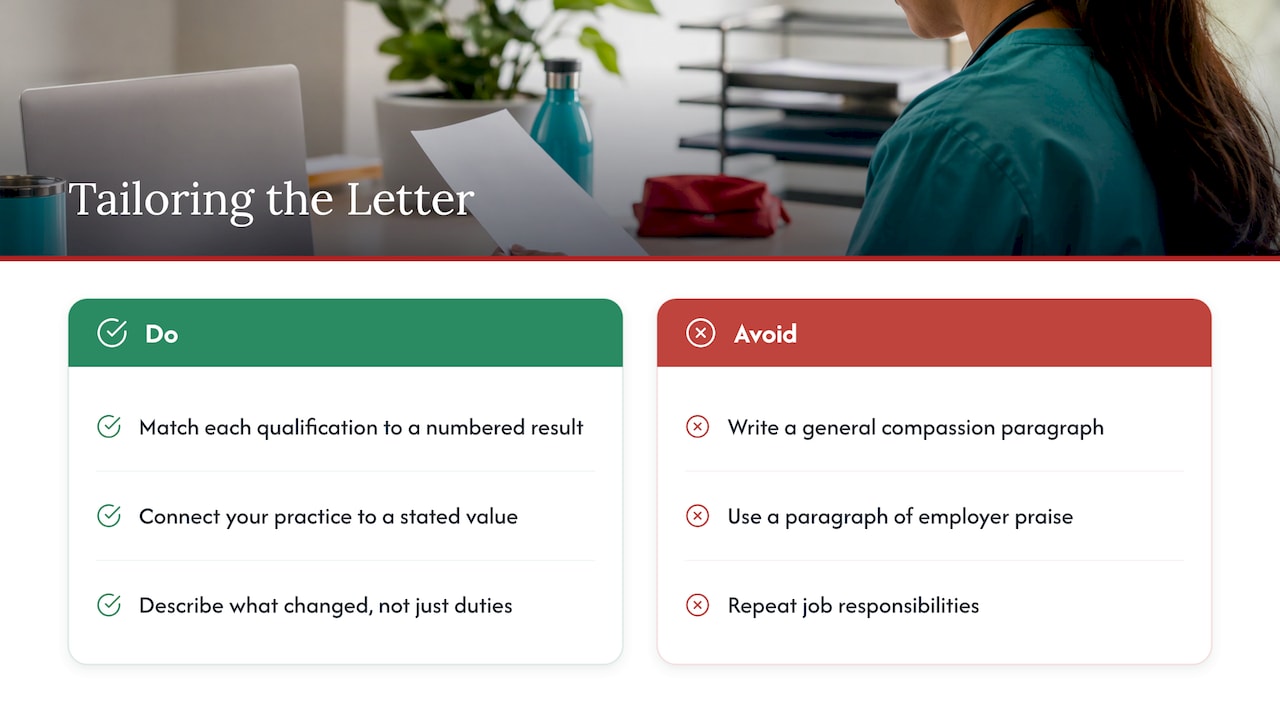
The job. Read the posting for the qualifications, then match each to a result you can state with a number. A posting for a medical-surgical RN that lists wound care, patient teaching and mentoring students deserves three short examples in that order, not a general paragraph on compassion.
The organization. The ARNBC advises explaining why you want to work in the particular unit, hospital or health authority. Health authorities publish their priorities, and some say so directly. Vancouver Coastal Health recommends that applicants become familiar with its priorities, vision, values and pillars, including Indigenous Cultural Safety and Anti-Racism, before writing a cover letter. One honest sentence that connects your practice to a stated value does more than a paragraph of praise.
Indeed Canada makes a related point for health-adjacent roles: describe how you applied your skills to improve outcomes or resolve challenges, rather than repeating responsibilities. A responsibility is what your job description said. An outcome is what changed because you did it.
A worked body paragraph
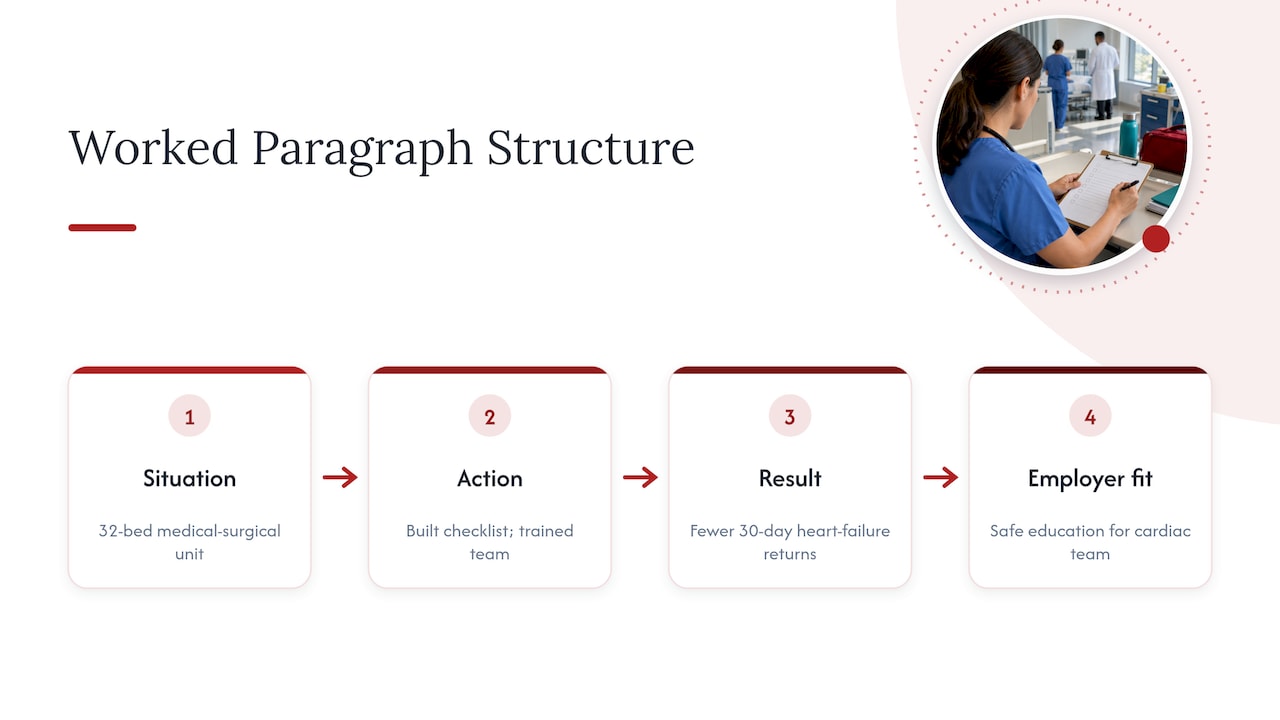
Use the situation, action, result pattern in a single paragraph. The example below is illustrative, written for a hypothetical applicant. Replace every detail with your own.
On a 32-bed medical-surgical unit, I noticed that discharge teaching for heart failure patients was inconsistent between shifts. I built a one-page teach-back checklist with our clinical educator and trained my team to use it. Over six months, our unit’s 30-day readmission audit showed fewer heart failure returns, and the checklist was adopted on two neighbouring units. I would bring the same focus on safe, repeatable patient education to your cardiac step-down team.
Notice what the paragraph does. It names a setting, shows initiative, gives a measurable result, and ends by pointing at the employer’s unit. It does not claim to be “passionate” or a “team player”. If you cannot share exact figures, describe the change honestly rather than inventing a percentage, and never include patient-identifying information.
Our own Canadian cover letter guidance, one STAR paragraph that gets interviews, covers the same pattern for any sector.
What to include in a nursing cover letter
For nursing roles, Northern Health lists contact information, an opening that introduces you and your interest, your qualifications and role, then education, relevant clinical experience, achievements and skills for the team, and a closing that thanks the manager and invites contact.
A few practical points for RNs, RPNs, LPNs and nurse practitioners:
- Name your registration. State your regulatory college and registration status in the opening or the header, for example “Registered Nurse, College of Nurses of Ontario”, so the reader sees eligibility immediately.
- Show skills through examples. Indeed Canada notes that nurse practitioners need hard skills such as patient assessment and emergency handling and soft skills such as empathy, communication, resilience and leadership, and that applicants should give concrete examples of how they used a skill instead of listing it.
- Pick evidence of judgment. Recruiters read for clinical competence, safe practice under pressure, and teaching or preceptorship experience. One short incident that shows how you prioritized, escalated and communicated will carry more weight than a list of competencies.
- Match the unit. Emergency, long-term care, mental health, community and perioperative postings each reward different examples. Lead with the one that fits.
- Keep to one page. Employers expect a business-style letter, and a second page rarely helps.
For your resume to support the letter, see our guide to nurse resumes in Canada and our broader piece on resumes for healthcare and medical jobs.
Non-nursing healthcare roles
Allied health, administration, pharmacy, lab, support and community care roles follow the same structure. The emphasis changes:
- Allied health (physiotherapy, occupational therapy, respiratory therapy): caseload, outcomes, interdisciplinary work, and any experience with a specific patient population.
- Health administration and unit clerks: accuracy, systems used, scheduling volume, and handling sensitive information.
- Support and community roles: reliability, communication with families, and your approach to dignity and safety.
If you are early in your career, use clinical placements, practicums and volunteer work as your evidence, and say what you were responsible for, what you learned and what the preceptor or team observed.
Conventions for internationally trained applicants
Canadian employers want to see that you are eligible to work and to practise, and they want it stated simply. Consider the following:
- Work authorization. If you are not a citizen or permanent resident, state your status and any permit validity in the closing or header, so the employer does not have to ask.
- Credential assessment. Internationally educated nurses begin with the National Nursing Assessment Service, which describes itself as the first step toward becoming a nurse in Canada. If you have started or completed your application, say where you stand in one sentence. Do not imply that you hold a licence you do not yet have.
- Language. Mention English and French ability where it is relevant, such as postings in Quebec, bilingual designations or federal roles.
- Local context. Describe your experience in terms a Canadian reader recognizes: type of unit, patient ratio, and technology used, rather than only the foreign institution’s name.
Our pages on resumes for newcomers to Canada explain how to adapt your experience for a local reader.
Using ChatGPT or other AI for your cover letter
AI can help with a first draft, editing or brainstorming. The University of Victoria’s career services says you should review the final letter for accuracy, make it specific to you and the job, and revise it in your own voice. The same page reports that employers see AI-generated applications looking alike, and that most screen out those that read as AI-written.
A sensible workflow for healthcare applicants:
- Write your own notes first: the posting’s top three requirements and your matching example for each.
- If you use AI, give it only those notes, never patient information or confidential employer details.
- Remove generic phrases and any claim you cannot support in an interview.
- Read the letter aloud and confirm every figure, date, title and credential.
- Make sure the unit, manager and organization are correct.
Mistakes that cost interviews
- Sending the same letter to every posting.
- Repeating the resume line by line.
- Using the wrong organization or unit name from a previous application.
- Listing traits (caring, dedicated) with no example.
- Running over one page.
- Leaving out registration or work authorization status.
- Including any detail that could identify a patient.
Perspective: why a healthcare letter is written differently
Healthcare hiring combines high volume with high stakes. A manager must see, in under a minute, that a candidate is licensed or eligible, has worked in a comparable setting and communicates clearly.
In our work with healthcare professionals, we focus on this combination. The resume documents scope and credentials, and the cover letter supplies one well-chosen example of judgment, tied to the unit or organization you are targeting. Working directly with your writer, we review the posting, select the strongest evidence and keep the tone measured and credible.
Our approach is built on consultation and revision. We ask about the patient population, the team structure and the outcomes you can discuss, and we draft documents that stay consistent with each other and with your LinkedIn profile, so that a recruiter finds the same story wherever they look. For internationally trained clinicians and those returning after a gap, we address the questions a Canadian reader will have before they are asked.
Professional
Get help with your application documents
If you want your resume and cover letter to work together, we write both for healthcare professionals. Our nursing resume writing services cover RN, RPN and NP roles, and our healthcare services resumes cover allied and support roles. Resume packages are published at $139 for Early Career, $189 for Next Step, $239 for Advanced and $289 for Executive. You can compare them on our resume packages page.

A clear resume gives your cover letter something to build on. Our LinkedIn profile optimization service keeps your online profile aligned with both documents.
FAQ
How long should a healthcare cover letter be in Canada?
One page is the standard, with roughly three to four paragraphs. The ARNBC guidance describes the letter as short and succinct. If you are tempted to add a second page, cut instead.
What should I put in a nursing cover letter?
Include your contact details, an opening that names the role and your credential, and a body with education, relevant clinical experience, achievements and skills for the team. Close by thanking the manager and inviting contact. Choose examples that show clinical judgment, safe practice and, where relevant, teaching or preceptorship.
Can I use ChatGPT to write a healthcare cover letter?
Yes, for drafting, editing or brainstorming, provided you review it for accuracy and rewrite it in your own voice. UVic career services notes that generic, AI-sounding applications are often screened out. Never paste patient or confidential employer information into an AI tool.
Do I need a cover letter if the posting does not ask for one?
A tailored letter is generally worth sending when the application system allows it, because it lets you explain fit for the unit or organization. If the posting explicitly says no attachments beyond the resume, follow that instruction.
How do I address a healthcare cover letter when no name is given?
Check the posting, the employer’s careers page or LinkedIn for the hiring manager or unit manager. If none is available, use “Dear Hiring Manager” with the unit or department name rather than a generic greeting.
Sources
- ARNBC: Assistance with cover letters
- Northern Health: Cover letter and resume writing tips
- Vancouver Coastal Health: Preparing your resume
- Indeed Canada: Peer support worker cover letter
- Indeed Canada: Nurse practitioner skills
- National Nursing Assessment Service
- UVic Career Services: Using AI in your work search