
Executive resume keywords are the precise business terms that appear in the role you want, such as strategic planning, P&L ownership, board relations or transformation, placed where an applicant tracking system and a search partner will both find them. They work only when each one is backed by scope and a measurable result. A list of impressive words with no evidence behind it does neither job.
This guide shows which keyword families matter at the C-suite and VP level, how to pull them from a Canadian posting, where to place them, and how to prove them. If you would rather have a writer build the document with you, our Executive Resume service is designed around exactly this work.
TL;DR
- Take your keywords from the postings you are targeting, not from a generic list. Read three to five and mark the terms that repeat.
- Prefer specific terms (P&L management, board reporting, M&A integration) over the bare word “leadership”.
- Put each keyword in the summary, core competencies and achievement bullets, and attach team size, budget or revenue to it.
- Never stuff or hide keywords. The resume must still persuade a person in seconds.
- Canadian postings often add governance, bilingualism and designation requirements, so check for those too.
Table of Contents
- Why keywords matter more at the executive level
- The keyword families that carry an executive resume
- What Canadian executive postings actually say
- How to find your keywords in 20 minutes
- Where keywords go on the page
- Prove every keyword with scope and results
- Keeping the document readable for software and for people
- Special cases: newcomers and returning executives
- A short keyword audit you can run today
- Perspective
- Have a writer build your executive keyword strategy
- FAQ
- Sources
Why keywords matter more at the executive level
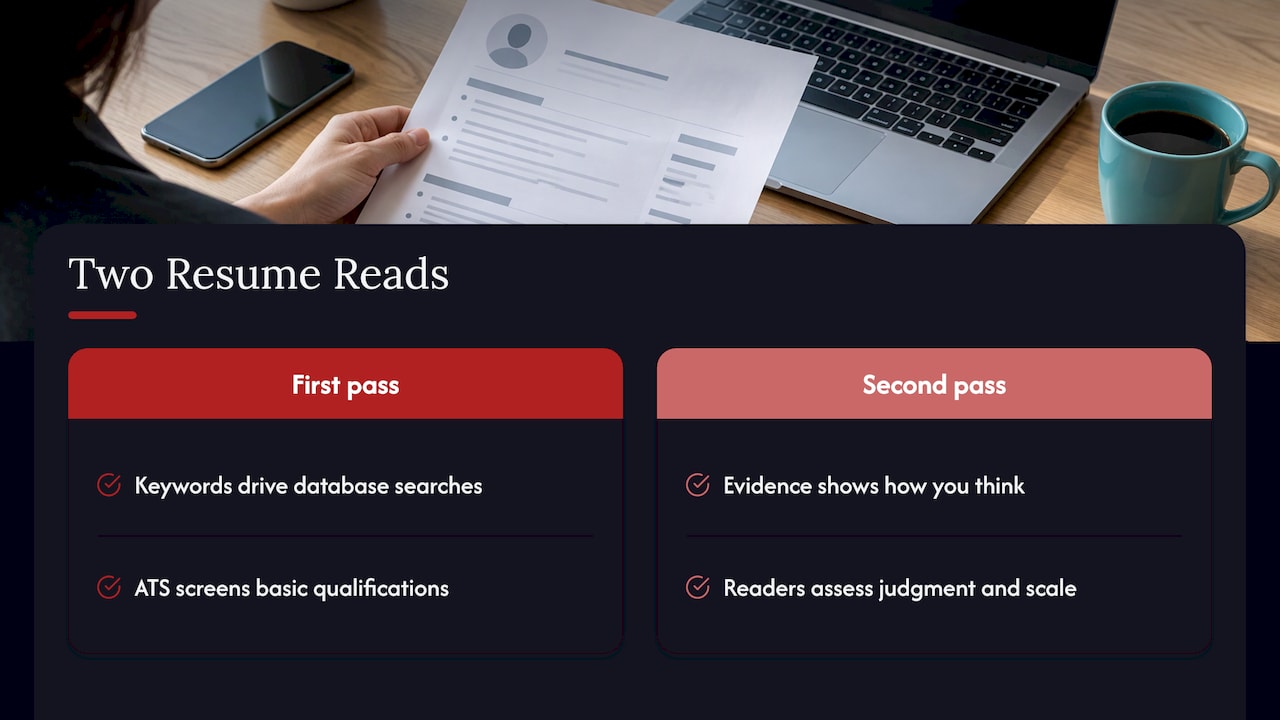
At senior levels, your resume is read twice. First by software and by a recruiter running searches, then by a board member, a retained search consultant or a hiring committee looking for judgment and scale.
On the first pass, keywords are the mechanism. The University of Michigan Ross School of Business executive resume guide notes that companies and recruiters use keywords as the primary way to search their resume databases. The same guide says keywords signal that you are a knowledgeable insider who understands what matters in the role.
Canadian professional bodies describe the same mechanism. CPA Alberta’s résumé handbook explains that applicant tracking systems are programmed to decline candidates who do not meet a set number of requirements, and that recruiters screen for keywords to judge basic qualifications.
On the second pass, the keywords you chose are read as evidence of how you think. An executive who writes “stakeholder engagement” and then shows a restructured relationship with a regulator or a union is credible. One who strings together “visionary” and “dynamic” is not.
The keyword families that carry an executive resume
Executive vocabulary falls into a handful of families. Your resume should draw from each one that applies to your mandate, using the words your target employer uses.
| Family | Typical terms | Best placed in |
|---|---|---|
| Leadership scope | executive leadership team, board reporting, cross-functional teams, global leadership | Summary, current role |
| Business ownership | P&L management, revenue growth, EBITDA, operating margin, budget ownership, cost reduction | Summary, achievement bullets |
| Strategy | corporate strategy, go-to-market strategy, transformation, turnaround, M&A integration | Core competencies, experience |
| Industry signals | healthcare, banking, manufacturing, retail, fintech, cybersecurity | Summary, company descriptions |
| Governance | board presentations, regulatory compliance, enterprise risk, audit, investor relations | Executive summary, role bullets |
The categories and placements follow an executive ATS keyword table published by an ATS-focused resume resource, and they match how senior resumes are usually organized.
Keywords by C-suite function
The function you target changes the vocabulary. Forbes’ Coaches Council column on C-level résumé keywords offers a representative list:
- CEO: corporate strategy, business development, stakeholder engagement, organizational growth, mergers and acquisitions.
- CFO: financial analysis, capital allocation, risk management, financial reporting, investment strategies.
- CIO: digital transformation, data analytics, IT governance, systems architecture, innovation management.
- CMO: market segmentation, brand development, ROI analysis, customer acquisition.
- CHRO: employee engagement, HR analytics, succession planning, talent acquisition, compensation strategy.
- CISO: vulnerability assessment, data privacy, compliance audits, threat mitigation, incident response.
The same column makes a point worth keeping: candidates often under-emphasize “stakeholder engagement” for CEOs or “ROI analysis” for CMOs, and over-rely on generic words like “leadership” that lack specificity.
What Canadian executive postings actually say
Generic lists only get you so far. Real postings show the register of your target market.
A CEO search for CPA Canada, posted by Odgers, uses language such as strategic and operational leadership, transformation, growth and renewal, membership and revenue growth, high-performance culture and governance acumen. It also lists bilingualism in English and French and a CPA designation as requirements.
A President and CEO search for an Ontario wine producer asks for P&L, budgets, commercial strategy and operational performance, along with experience leading multidisciplinary senior management teams and reporting to a board of directors or comparable ownership group.
The federal government frames the CEO role differently. The Privy Council Office’s position description guide for Crown corporation CEOs names five core competencies: conceptual innovative thinking, leadership, flexibility, impact and influence, and listening, understanding and responding. If you are targeting Crown corporations or federal appointments, those competency labels are vocabulary to mirror, with evidence beside each.
Three patterns follow for Canadian searches:
- Governance language is prominent. Board, ownership group and stakeholder terms recur.
- Credentials and language are keywords too. A designation, a licence or French-English bilingualism is often a screening criterion, and it should appear in plain text near the top.
- Industry context decides the rest. The same title in a regulated sector and in consumer goods draws on different terms.
How to find your keywords in 20 minutes
The method is simple, and the discipline is in applying it to the right postings.
- Collect three to five postings for the role you want, from employers and search firms you would actually answer. The Ross guide advises reading postings and highlighting the words that appear repeatedly.
- Mark repeated terms across them: skills, systems, scope measures, governance duties, sector terms. Terms that appear in every posting are non-negotiable. Terms that appear once are optional.
- Group them into the families in the table above, so you can see which areas of your background the market weighs most.
- Match each term to a fact. For every keyword, write down the budget, team, region or result that proves you have done it. If you cannot, the term does not belong on your resume.
- Use the posting’s exact wording where it is true to your experience. “Digital transformation” and “technology modernization” may mean the same to you, but a search filter treats them as different strings.
We publish a separate walkthrough on how to find and map resume keywords for ATS if you want a faster, step-by-step version of this process.
Where keywords go on the page
Placement matters because both audiences read in a predictable order.
Headline and summary. Open with your title, sector and scope: for example, “Chief Operating Officer | Multi-site manufacturing | $400M P&L”. Three or four lines should carry your strongest keywords in natural sentences.
Core competencies. A compact block of eight to twelve terms drawn from your marked list, grouped if possible. This is where an ATS finds the plain phrase it searches for.
Experience. Each role should carry the keywords in context, inside achievement bullets, not in a separate dump. This is also where a human decides whether the term is earned.
Governance and credentials. Board seats, designations, languages and certifications deserve a visible line. Our guidance on executive resume format for senior leaders covers how to keep that structure clean for software.
On length, most senior documents work at two pages. We explain our view in the two-page C-suite resume guide.
Prove every keyword with scope and results
A keyword gets you found. Evidence gets you interviewed. The research on resume writing is consistent here.
HEC Montréal’s career guidance recommends the CAR technique, which pairs Context, Action and Result, starting each statement with a past-tense verb and quantifying with figures and percentages where possible. Royal Bank of Canada’s newcomer guidance states that Canadian employers prefer to see achievements rather than job responsibilities, and suggests three to five accomplishments per position. A Career Professionals of Canada article on uncovering accomplishments adds that quantifying results gives content scale and scope.
For a leadership keyword, the working formula is: the term, the scale, the result.
| Weak | Stronger |
|---|---|
| Leadership experience in operations | Led a 240-person operations group across four plants, cutting unit cost 11% in two years |
| Strategic planning | Built a three-year strategic plan approved by the board, adding $38M in new-market revenue |
| Stakeholder management | Negotiated a collective agreement with two unions, avoiding a work stoppage during a plant expansion |
| M&A integration | Integrated two acquisitions into one platform and delivered $6M in synergies in 14 months |
The figures above are illustrations of structure, not claims about any person. Replace them with your own verified numbers, and keep them defensible: an executive search partner will ask about each one.
Replace the bare word “leadership”
Search software may count the word, but a reviewer skims past it. Use the specific form instead: team leadership, cross-functional leadership, executive stakeholder management, people management, organizational transformation. Then give each a headcount, a budget or an outcome.
Keeping the document readable for software and for people
An executive resume has to satisfy two audiences at once: a system that wants clean structure and obvious matches, and a reader who wants proof of scale and judgment. The strongest senior resumes are sharper, more selective documents, not longer versions of a mid-career resume.
Practical rules:
- No keyword stuffing and no hidden text. White-font tricks and repeated phrases are detectable and damage credibility with the person who finally reads the page.
- Use standard section headings such as Summary, Experience and Education, so parsing works.
- Keep formatting simple. Avoid text boxes, graphics that contain words, and multi-column layouts that parsers can read out of order.
- Write for the six to eight seconds. Executive Resume guides commonly cite a brief first scan by a human reader, so the top third of page one must carry your title, scope and two or three headline results.
It also helps to understand how screening works on the employer side. This overview of how recruiters screen resumes automatically explains why structure and clear matches matter before a person ever looks. For Canadian formatting detail, see our guide to ATS-friendly resumes for Canadian job seekers.
Special cases: newcomers and returning executives
Executives new to Canada. Translate titles and scope into terms a Canadian search firm recognizes: state revenue in dollars alongside local currency, name the regulators and standards you worked under, and describe team size plainly. Keep achievements outcome-first. RBC’s guidance above applies directly: Canadian employers read for achievements, so a duties list undersells you. Add language skills and any Canadian equivalency or designation in a visible line.
Executives returning after a gap. Lead with the summary and results, then use a short, factual line for the gap period, including board service, advisory work, consulting or study. Use the same posting-derived keywords. A gap matters far less than a resume that reads as dated, and current vocabulary signals that you are current.
Sector moves. If you are shifting from, say, banking to technology, use the destination sector’s terms for the skills you share, and keep your results in the headlines. Our pages on financial services resumes and technology and IT resumes reflect how each field phrases scope.
A short keyword audit you can run today
Open your resume and answer these questions:
- Does your title line match the title in your target postings, or a close, recognized variant?
- Do at least five of the most repeated posting terms appear in your summary and competencies?
- Does every keyword in the competencies block appear again inside an achievement bullet?
- Does each bullet carry a number: headcount, budget, percentage, revenue or time?
- Are credentials, languages and board roles in plain text?
- Could a reader tell your sector and scale within five seconds?
A no on any item shows where to revise first.
Perspective
Executives tend to arrive with strong careers and a resume that reads like a job description. The vocabulary is there, but it is generic, and the scale is buried.
Our approach is to work directly with your writer in an extensive consultation, identify the roles you are pursuing, and build the document around the language of those searches. Each keyword is connected to a result you can defend at board level. Our formatting is ATS-friendly, and revisions are part of the process, so the final document reflects your own judgment about how to present your record.
The aim is a resume that is found by the search and then holds up when a retained search consultant reads it closely.
Professional
Have a writer build your executive keyword strategy
If you want the keyword work done with you rather than alone, our Executive Resume is $289 as a one-off fee. It includes a consultation, ATS-friendly formatting and revisions. Our Advanced Resume is $239 and our Next Step Resume is $189, and our Early Career Resume is $139. You can compare them on the shop page, or go directly to the Executive Resume.

For a matching online presence, our LinkedIn profile optimization service applies the same vocabulary to your profile. For more on structure and positioning, read our executive resume writing tips and the overview of executive resumes.
FAQ
How many keywords should an executive resume include?
There is no fixed count. Aim for the terms that repeat across three to five target postings, usually eight to twelve in a competencies block, plus natural use inside your summary and bullets. Quality and evidence matter more than volume.
Are leadership keywords enough on their own?
No. The bare word “leadership” is too general to differentiate you. Use specific forms such as team leadership, cross-functional leadership or executive stakeholder management, and attach team size, scope and a result to each.
Should I use different keywords for each application?
Yes, adjust them. Keep a master list grouped by family, then mirror the wording of each posting where it is accurate. Small changes to your summary and competencies are usually enough.
Can I put keywords in white text or a hidden block?
No. Hidden or repeated text is a known tactic that screening systems and human readers can detect, and it harms your credibility. Use keywords naturally in your accomplishments and experience instead.
Do Canadian employers expect anything different?
Often yes. Canadian postings commonly emphasize governance, stakeholder terms, designations and sometimes English-French bilingualism. Employers also favour achievements over listed responsibilities, so each keyword should sit beside a measurable result.
Sources
- University of Michigan Ross School of Business executive resume guide
- CPA Alberta résumé writing handbook
- Forbes Coaches Council: C-level résumé keywords
- CEO of CPA Canada posting
- President and CEO posting, Ontario wine producer
- Privy Council Office position description guide for Crown corporation CEOs
- HEC Montréal: highlight your achievements
- Royal Bank of Canada: Canadian resume and cover letter
- Career Professionals of Canada: uncovering accomplishments
- Executive ATS keyword categories