
In Canada, the best resume is neither a design showpiece nor a dusty duty list. It is a single-column, reverse-chronological document that borrows what is useful from modern practice (quantified achievements, a focused summary, tailored keywords) and keeps the clean structure that recruiters and applicant tracking systems (ATS) read reliably. The “modern versus traditional” question is mostly a false choice, and this guide shows where the real differences lie, so you can decide what to keep and what to drop.
TL;DR
- “Modern” should describe your content (results, tailoring, a sharp summary), not your layout. Columns, icons, skill bars and photos tend to hurt more than they help.
- A reverse-chronological, single-column structure with standard headings remains the safest base for Canadian private-sector and public-sector applications.
- Keep it to one or two pages, and leave out photo, age, marital status and SIN.
- Federal government applications follow stricter rules: plain text, and wording that matches the poster.
- If you have a gap or are new to Canada, blend a strong summary into a chronological resume rather than switching to a functional format.
Table of Contents
- What people mean by “modern” and “traditional”
- Side-by-side: where each style stands in Canada
- Why layout matters more than most candidates expect
- What a modern Canadian resume should actually do
- What to leave off, and why it is a legal matter
- Length, format and the case against functional resumes
- Federal government applications are a category of their own
- Are there cases where a more designed resume is acceptable?
- Our perspective
- A practical checklist before you send
- When it makes sense to have it written for you
- FAQ
- Sources
What people mean by “modern” and “traditional”
The two words cover several different things, and mixing them up is where most bad advice starts.
Traditional usually means a plain, text-led document: name and contact details, a list of employers in reverse order, duties under each job, education at the bottom. Its weakness is that it describes what you were responsible for rather than what you achieved.
Modern can mean one of two very different things:
- Modern content: a short professional summary, bullet points built on measurable results, keywords drawn from the job posting, and ruthless editing of older roles.
- Modern design: two columns, sidebars, coloured blocks, icons, graphs for skill levels, a headshot.
The first kind is worth adopting. The second is where Canadian job seekers get into trouble. Contemporary templates sold online often bundle both, so a candidate who wants better content ends up with a layout that a parser cannot read.
Side-by-side: where each style stands in Canada
| Element | Traditional | Modern (design-led) | What we recommend in Canada |
|---|---|---|---|
| Layout | Single column | Two columns, sidebars, graphics | Single column |
| Order | Reverse-chronological | Often skills-first or hybrid | Reverse-chronological |
| Opening | Objective statement or none | Large header banner | Short career summary |
| Bullets | Duties and responsibilities | Mixed | Achievements with figures |
| Skills | Plain list | Rating bars, icons | Plain keyword list matched to the posting |
| Personal details | Sometimes included | Photo, age, nationality | Name, city and province, phone, email, LinkedIn |
| Length | One page, often too short | Varies | One to two pages |
| ATS behaviour | Generally parsed well | Frequently misread | Built to parse cleanly |
The last row is the one that decides most outcomes. If your resume is not read correctly by software, nobody sees the design.
Why layout matters more than most candidates expect
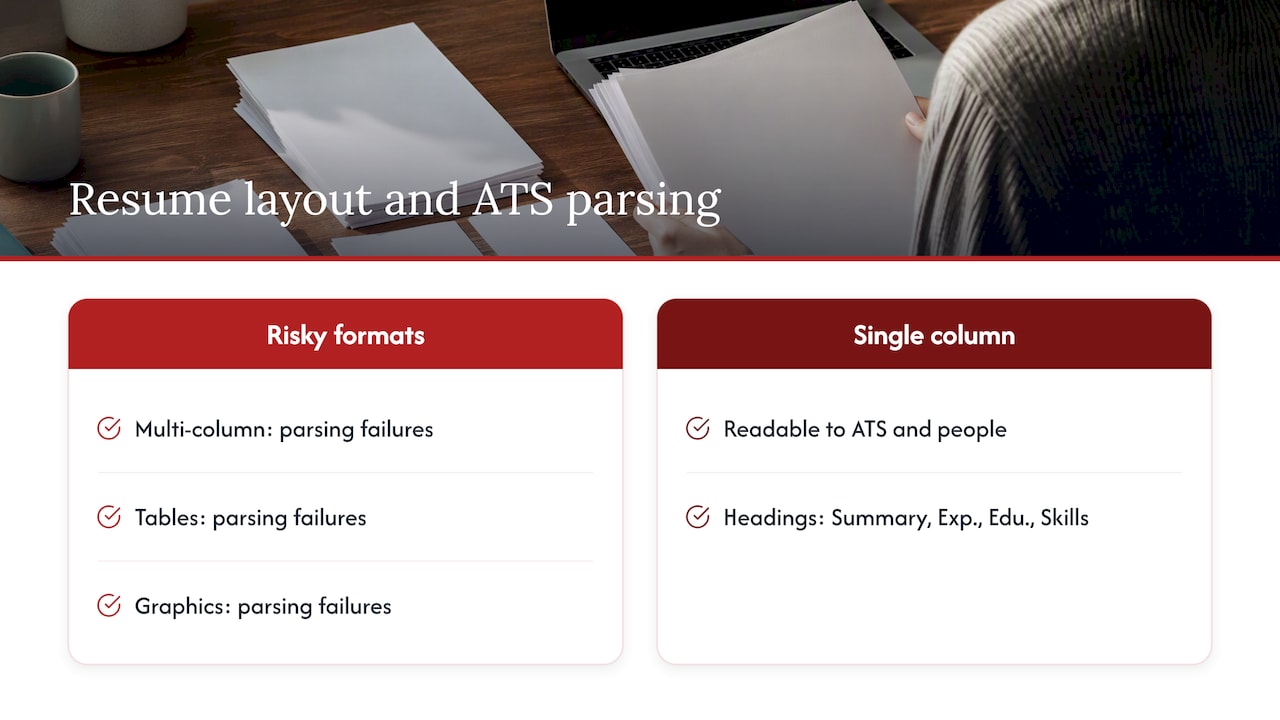
Most mid-size and large employers in Canada run an ATS. Trimax Employment notes that a resume built for another country often fails in Canada because it breaks local conventions and is filtered out by these systems. The same source advises avoiding multi-column layouts, tables and graphic elements for general private-sector applications, because they frequently cause parsing failures. A single column with standard headings (Summary, Experience, Education, Skills) is the format that stays readable to both the software and the person behind it.
The scale of the problem is debated. One 2025 academic paper on resume analysis reports that nearly 75% of resumes are rejected for formatting errors or lack of machine-readable structure, and that ATS compatibility can improve by an average of 23.4% with structural and keyword optimization. Treat that figure as indicative rather than a guarantee: it comes from one study, not from a Canadian employer survey. The direction, though, matches what we see in practice: structure and wording are the most controllable parts of an application.
You can read more about how this works in our guide to ATS-friendly resumes for Canadian job seekers.
A quick test for any template
Before you commit to a design, run three checks:
- Copy the whole document and paste it into a plain-text editor. If the order is scrambled or symbols appear, a parser will struggle too.
- Check that every section heading is one a recruiter would search for, not a creative label such as “My journey”.
- Remove any element whose only job is decoration. If the resume reads the same without it, it did not need to be there.
What a modern Canadian resume should actually do
The useful part of the modern approach is about substance. Job Bank, the Government of Canada’s job service, describes the resume as a document that must present your qualifications clearly, concisely and strategically. Three practices follow from that.
Lead with results, not responsibilities
Compare two lines for the same role:
- Traditional: “Responsible for regional sales.”
- Modern: “Grew regional sales by 25% over 18 months by rebuilding the account-management process.”
The second line tells a hiring manager what you are likely to do for them. If you do not have an exact figure, use a defensible range, a team size, a budget, a turnaround time or a volume. Never invent a number: interviewers will ask how you arrived at it.
Write for a 30-second skim
Job Bank’s guidance is built around the idea that recruiters spend very little time on a first pass. Put your strongest qualifications in the top third of page one, and make each bullet start with a verb. Our article on writing a career summary that impresses Canadian recruiters covers the opening paragraph in detail.
Tailor to each posting
Reuse the language of the job description wherever it honestly describes your experience. This serves both the software, which looks for matching terms, and the recruiter, who is checking whether you understood the role. A base resume with a customized summary and a re-ordered skills list is usually enough; rewriting everything for every application is not.
What to leave off, and why it is a legal matter
Canadian resumes omit a photo, age, date of birth, marital status and nationality. According to Job Bank, the standard resume should leave out personal details such as these, as well as your Social Insurance Number, which you only provide once you have a job offer. Employers avoid these details because Canadian human rights law prohibits discrimination on those grounds, so a resume that includes them can look like a liability.
This is the single biggest difference between a “design-forward” template imported from another market and a Canadian document. Many modern templates reserve a prominent circle for a headshot. Delete it.
Length, format and the case against functional resumes
Job Bank recommends keeping the resume to one to two pages and favours the reverse-chronological format for experienced professionals, while functional resumes are discouraged for most roles. The reason is practical: a functional layout groups skills away from employers and dates, which makes recruiters suspicious and which parsing software can read poorly.
If you are unsure which structure fits your situation, our Canadian resume format guide walks through the options in a few minutes.
Career gaps and newcomers
The functional format is often suggested to people with gaps or international experience. A better route is a hybrid within the chronological frame: place a strong professional summary and a short core skills line at the top, then keep the dated work history intact. The Trimax guidance for newcomers says the same: integrate functional elements into a reverse-chronological resume rather than replacing the work history. For gaps specifically, see our piece on handling career gaps by using years only.
Federal government applications are a category of their own
If you are applying through GC Jobs, forget polish. The Public Service Commission explains the process in its guide to applying for Government of Canada jobs, and the practical lessons are consistent: work through the application one step at a time, save your progress, and show clearly how you meet each essential qualification listed in the poster.
From what we see when preparing federal applications, three habits matter:
- Use plain text, with no decorative formatting that a form field will strip out.
- Mirror the exact wording of the poster’s criteria, rather than substituting synonyms.
- Give each qualification a concrete example: where, when and how you used it.
A beautifully designed resume has no advantage here, and a long list of generic achievements has less value than a precise match to each criterion.
Are there cases where a more designed resume is acceptable?
Yes, but narrowly. Roles in graphic design, branding or other visual fields may justify a portfolio link or a lightly styled document. Even then, we advise submitting a plain, ATS-safe version through the online portal and keeping the designed version for emailing a person directly or bringing to an interview. Think of the designed file as a supplement, not the primary application.
Sector-specific conventions also exist. In regulated and technical fields, such as aviation, licences and ratings sit near the top, and a resume guide written for pilots shows how certification-heavy backgrounds are laid out for applicant tracking systems, though you should adapt any such example to Canadian conventions and the regulator that applies to you. Our own pages on technology and IT resumes and financial services resumes cover how emphasis shifts by industry.
Our perspective
We read a large number of resumes from executives, healthcare professionals, engineers and newcomers, and the same pattern repeats. The documents that fail are rarely too plain. They are unclear: they list duties, hide the outcome, bury the scope of the role, or arrive in a layout that the employer’s system cannot read.
For senior candidates the stakes are higher. A board, a retained search partner or a hiring executive reads for ownership of results: P&L responsibility, a transformation you led, the size of the team and budget, the organizational outcome. None of that needs a graphic. It needs precise wording and a structure that makes the scale of your responsibility visible in the first few lines.
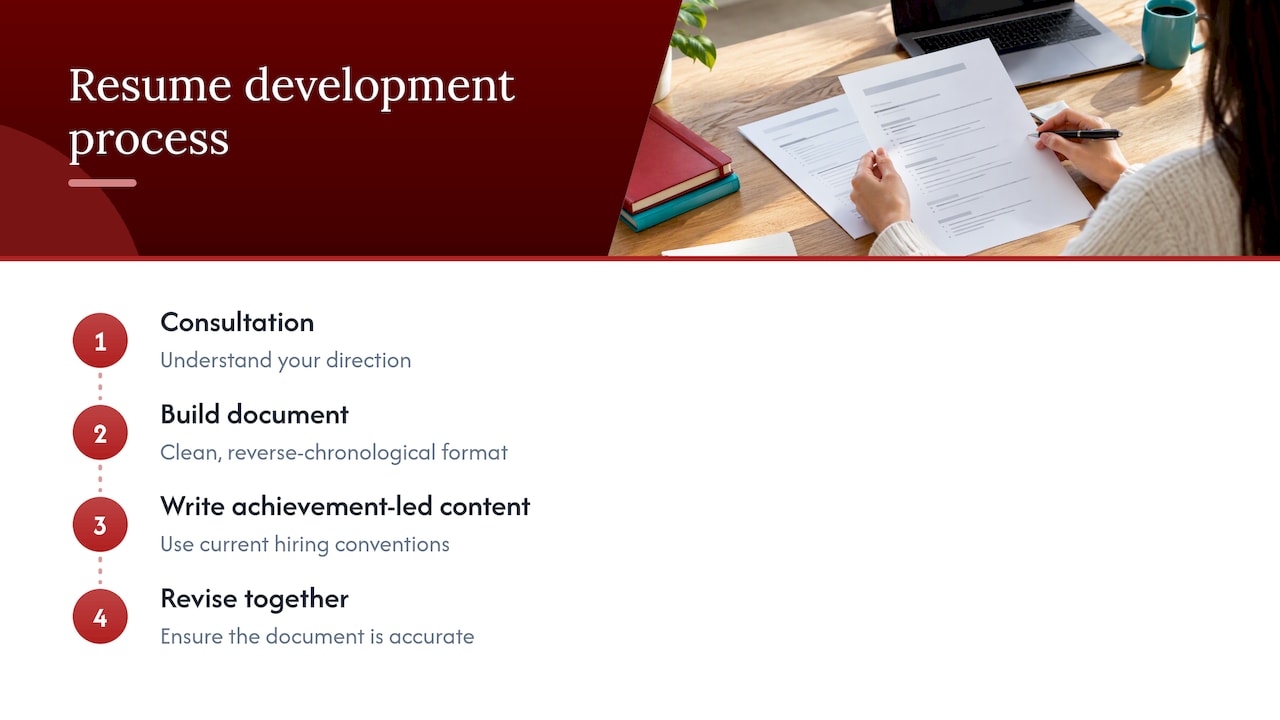
So our approach is consistent. We start with a consultation to understand your direction, build a clean reverse-chronological document, write achievement-led content informed by current hiring conventions, and revise it with you until it is accurate. The design is deliberately quiet, because the evidence points to readability as the thing that gets a resume seen.
— Professional
A practical checklist before you send
- One column, standard headings, a common font at a readable size.
- One or two pages, with the most relevant material first.
- A summary of three to four lines tailored to the role.
- Every recent role supported by achievements with figures where honest figures exist.
- Keywords from the posting used naturally, not stuffed.
- No photo, age, marital status, nationality or SIN.
- A file saved in the format the employer requests, and a plain-text test pass.
- Your LinkedIn profile consistent with the resume, since recruiters will check both.
If you also work remotely or apply to employers outside your city, our guide on tailoring your resume for remote jobs in Canada adds a few specifics, and our overview of writing a resume that gets noticed in Canada’s job market pulls the pieces together.
When it makes sense to have it written for you
Many people can follow the checklist above on their own. A writer adds the most value when you are too close to your own career to see your results, when you are moving into a new level or country, or when the stakes of an application are high enough that a second expert pass is worth paying for.
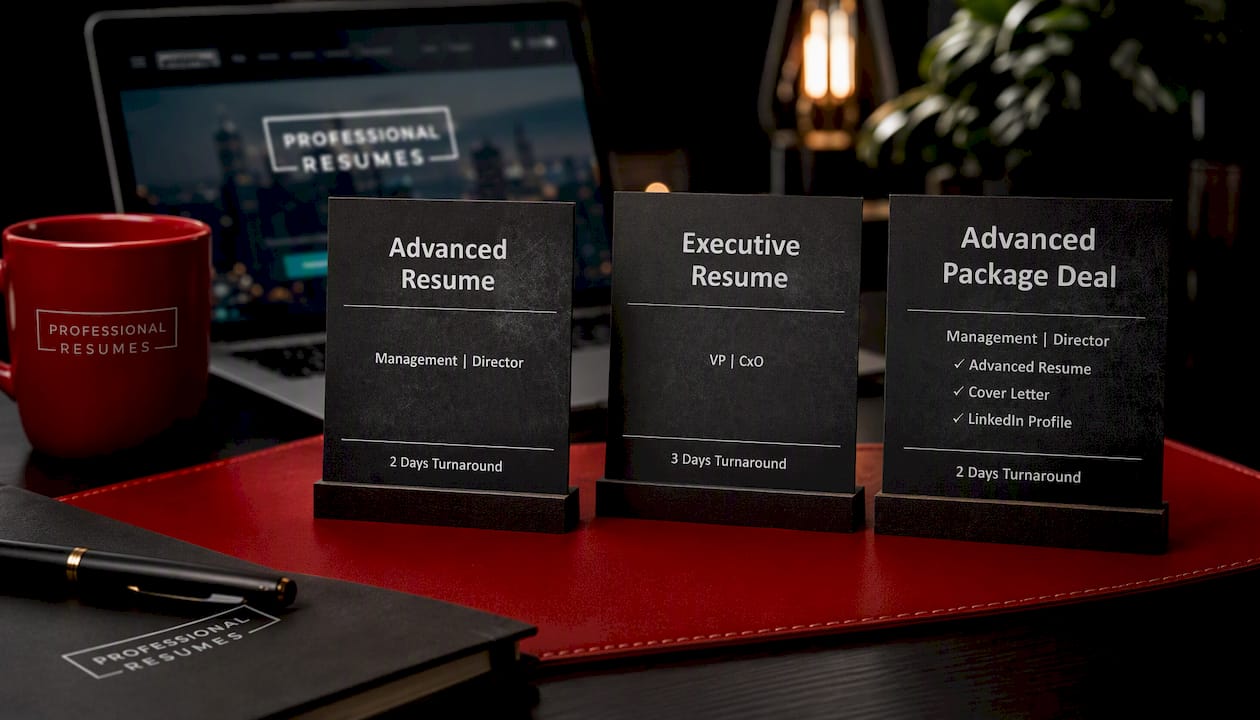
We offer four resume tiers, each with a consultation and revisions:
| Package | Price |
|---|---|
| Early Career Resume | $139 |
| Next Step Resume | $189 |
| Advanced Resume | $239 |
| Executive Resume | $289 |
All prices are one-off and listed on our shop page. If your resume is ready but your profile is not, our LinkedIn profile optimization service aligns the two. You can also start from our home page and tell us about your target role in a confidential conversation.
FAQ
Is a modern resume format better than a traditional one?
Only the content side of “modern” is better. Quantified achievements, a tailored summary and keyword alignment improve almost any resume. Modern design features such as columns, icons and photos tend to reduce readability for ATS software and conflict with Canadian norms, so a clean reverse-chronological layout is the stronger choice.
Should I include a photo on my Canadian resume?
No. Job Bank advises leaving out photos and other personal details such as age and marital status. Canadian human rights rules prohibit discrimination on these grounds, and employers prefer resumes that do not invite the question.
How long should a Canadian resume be?
One to two pages is the standard. Early-career candidates should aim for one page, and experienced professionals can use a second page when the content earns it. A third page rarely helps outside academic or very senior contexts.
Can I use the same resume for a federal government job?
Usually not without changes. Federal applications reward plain text and a point-by-point demonstration of each qualification, using the poster’s own wording. Keep a separate version for GC Jobs and follow the application guidance on the Public Service Commission site.
Sources
- How to write a good resume, Job Bank
- Applying for Government of Canada jobs: How to apply, Canada.ca
- 10 Steps for New Immigrants to Find Work in Canada (2026), Trimax Employment
- Screenify: AI Based Resume Analyzer