
A statement of merit criteria (SoMC) is the list of qualifications a federal hiring process uses to decide who moves forward, and your application is screened against that list, not against the job title. The examples below show how criteria change with level, and the sections after them show how to answer each one so a screener can tick it off. Candidates who treat the SoMC as a checklist to evidence, line by line, are the ones who get through screening. That is the discipline we apply when we build federal resumes and cover letters.
TL;DR
- A SoMC sets out essential qualifications (education, experience, language, knowledge, abilities, competencies), asset qualifications, operational requirements, organizational needs and conditions of employment.
- Each essential qualification is assessed separately, so strength in one area cannot make up for a gap in another.
- For every experience criterion, give the organization, your title, dates and a specific project or task with the situation, your actions and the result.
- Read the wording exactly: “and” requires both elements, “or” requires one.
- Structure the cover letter and resume so each criterion has its own visible answer.
Table of Contents
- What a statement of merit criteria is
- Statement of merit criteria examples by level
- How the criteria are used in screening
- Answering each criterion: a method that screens in
- A worked example: one criterion, answered three ways
- Common mistakes against a SoMC
- Our perspective
- Get your application built against the criteria
- FAQ
- Sources
What a statement of merit criteria is
Under the Public Service Employment Act, an appointment is made on merit when the person meets the essential qualifications set by the deputy head, official language proficiency included, and the hiring body also has regard to asset qualifications and to current or future operational requirements and organizational needs, as the PSC Staffing Manual sets out. The SoMC is where those components are written down for a specific position.
In plain terms, the components work like this:
- Essential qualifications: what you must have to do the work. If a manager marks a qualification as essential, a person without it could not function in the position.
- Asset qualifications: extras that may be considered, such as a second language or a specialized degree.
- Operational requirements: conditions of the work, such as weekend shifts or travel.
- Organizational needs: goals of the department, such as improving representation of a group in its workforce.
- Conditions of employment: requirements such as a security clearance.
The posting must carry these established criteria. The Appointment Policy requires advertisements to include the merit criteria, and departments must keep them for a minimum of five years after the last administrative action, so the wording you see is the wording you will be measured against.
Statement of merit criteria examples by level
Criteria scale with seniority, language needs and the operational context of the job. Three published examples show the range.
A policy officer: the classic structure
The Public Service Commission’s archived Guidance Series includes a sample for a Senior Policy Officer. It lists:
- a bilingual language profile (CBC/CBC, meaning a set level of ability in the second official language across reading, writing and oral interaction);
- a degree in economics, sociology or statistics;
- experience in policy development and in international trade;
- communication and interpersonal abilities;
- assets: a master’s degree in international trade and knowledge of Mandarin;
- an organizational need linked to Aboriginal representation;
- an operational requirement to work weekends;
- a Secret security clearance as a condition of employment.
Note how each line is a separate, testable statement. That is how it will be screened.
An executive: defined experience and leadership competencies
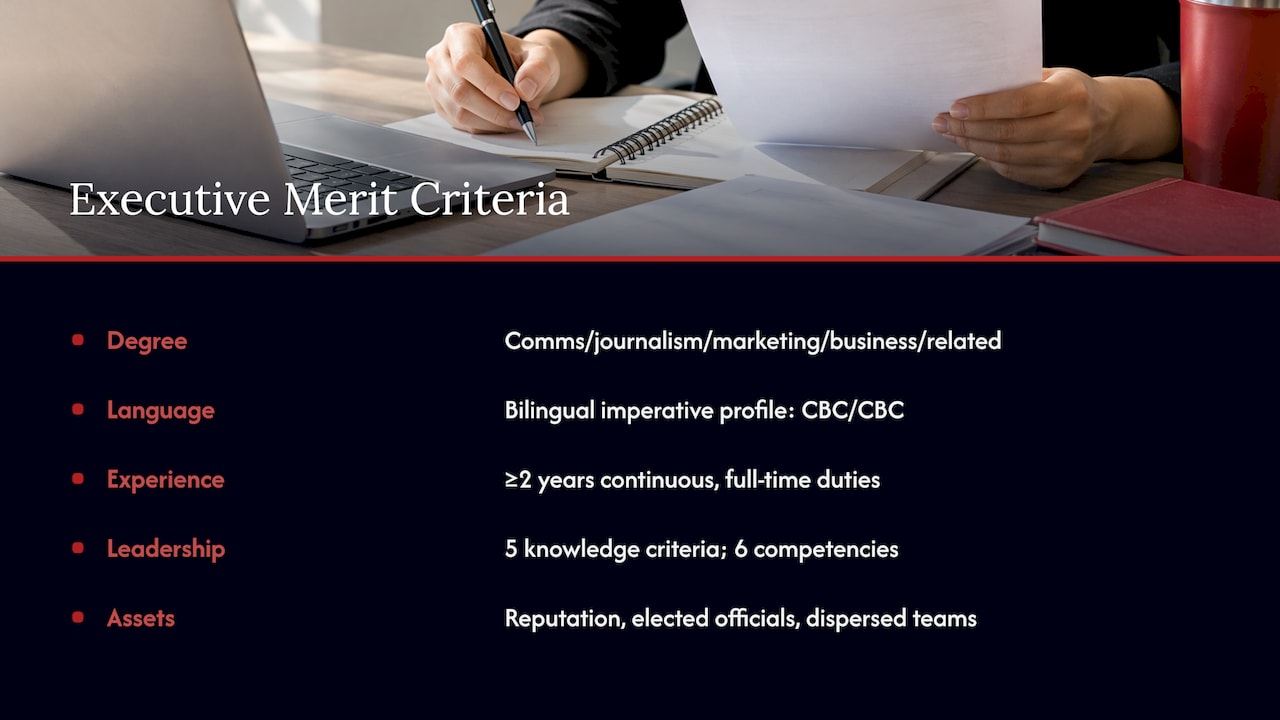
The Western Economic Diversification Canada SoMC for Director General, Communications (EX-02) shows how the bar rises. It asks for a degree in communications, journalism, marketing, business administration or a related field, a bilingual imperative profile (CBC/CBC) and executive-level experience. That experience covers leading teams, delivering comprehensive communications programs, developing strategic communications plans and managing human and financial resources, and it is defined as at least two years of continuous, full-time professional duties.
It then adds five knowledge criteria and six key leadership competencies, such as Create Vision and Strategy and Achieve Results. The assets include reputation management, engaging elected officials and leading dispersed teams. An employment equity organizational need and conditions of employment follow: Secret clearance, frequent travel and frequent overtime on short notice.
For an executive candidate, the definition of “executive-level experience” is the first thing to test. A career that includes the right responsibilities across a broken timeline may not satisfy a two-year continuous requirement. Check the definition before you write anything.
A regulatory analyst: experience defined by years
A Canada Energy Regulator posting for a Regulatory Policy Analyst shows another pattern. It defines “significant experience” as roughly five years and lists organization-wide and technical competencies to be assessed later in the process. It specifies English as the essential language, names four asset qualifications and sets conditions such as a Reliability Status Check and four days a week in the office. Your resume must prove the years and the substance, because the competencies are tested only if you clear screening.
How the criteria are used in screening
The Treasury Board Secretariat explains that screening first checks whether you meet the essential education and experience criteria. Candidates who pass may then be assessed on the other essential criteria, such as knowledge, abilities and competencies, through exams, interviews and references. Those who do not meet all essential qualifications are not considered further.
Two consequences follow:
- There is no averaging. The PSC Staffing Manual states that each essential qualification must be assessed separately and a global assessment is not allowed, so strengths elsewhere cannot offset a criterion you did not demonstrate.
- The screener works from your page, not from your reputation. An application that does not clearly demonstrate the screening criteria can be set aside. The Office of the Intelligence Commissioner’s Senior Counsel posting states this directly and asks for concrete, detailed examples covering both essential and asset qualifications.
Answering each criterion: a method that screens in
Step 1: Break the SoMC into single statements
Copy every criterion into a table with one row each: education, each experience item, language, knowledge, abilities, competencies, assets. Split compound lines so each testable element has its own row. Read the connectors closely. The Treasury Board Secretariat’s guidance notes that “coordinating and leading” requires you to show both, while “coordinating or leading” requires only one. It also notes that substituting education and experience for one another is accepted only where the SoMC allows it, at the manager’s discretion.
Step 2: Match evidence to each row
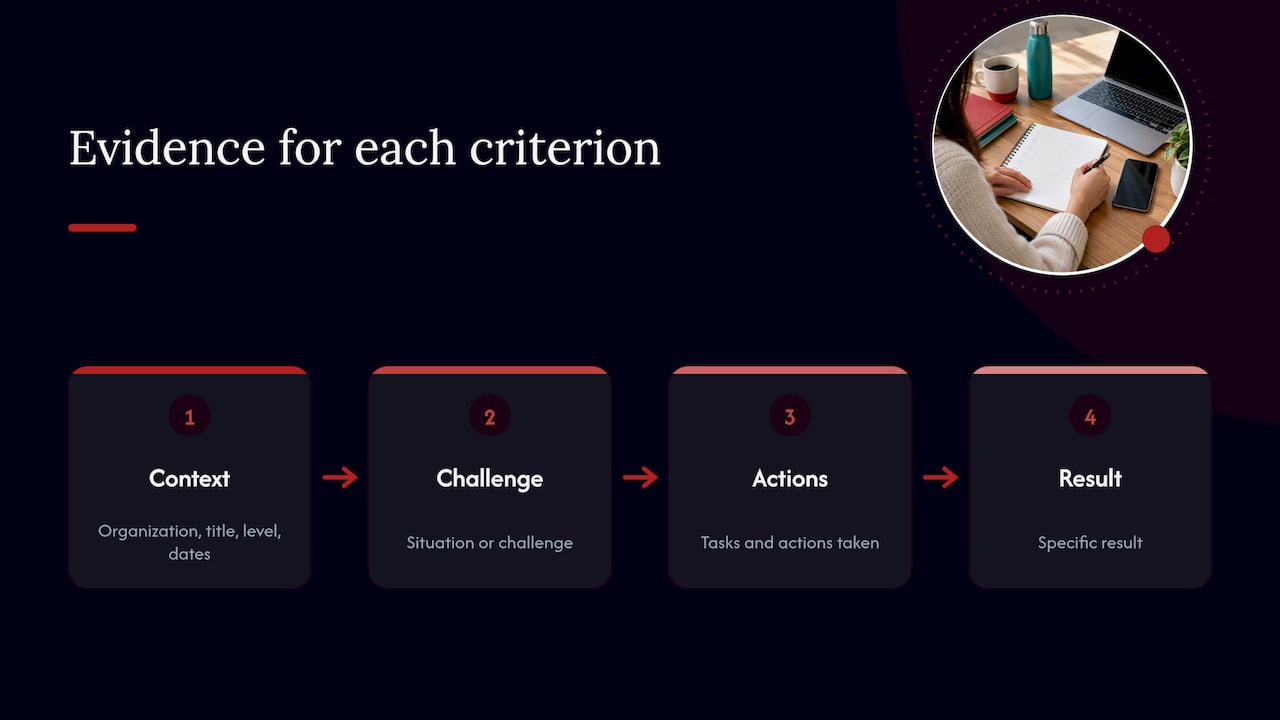
For each experience criterion, the Treasury Board Secretariat says to give the organization, the position title and level, the dates, and specific task or project details describing the situation or challenge, the tasks, your actions and the result. Listing responsibilities, or simply stating that you have the qualification, is not enough.
A weak line: “Responsible for stakeholder engagement across the department.”
A line that answers a criterion: “Director, Regional Operations, Health Authority, March 2019 to June 2023. Faced with a 30% rise in wait times, I convened eleven community partners, redesigned the intake process and cut average wait times by 18% within a year.” The figures here are an illustration of the structure, so replace them with your own verified results.
Step 3: Mirror the wording without copying it
Use the posting’s terms for the criterion, so a screener can find it, and attach your own evidence. If the criterion says “experience developing strategic communications plans,” the words “strategic communications plan” should appear next to your example, along with the organization, your title and the dates. Keep the same terms in the resume and the cover letter so the two documents agree.
Step 4: Structure the cover letter around the criteria
The Canada Energy Regulator’s How do I apply? page recommends using each qualification as a header in the cover letter, followed by one or two paragraphs showing how you meet it. Its sample letter responds to an education requirement with the specific degree and institution, and to experience items with numbered, concrete examples. The PSC’s guidance for executive appointment processes likewise advises a covering letter that complements the CV and addresses each screening requirement precisely and explicitly, supported by the CV. It also advises adapting the CV to the SoMC, keeping it brief and profiling significant achievements.
Our guides on the federal cover letter and the federal government resume walk through this structure in more detail.
Step 5: Address language and conditions plainly
State your official language level or your plan to meet it, in a line of its own. If a posting requires a particular profile in French, a structured TCF Canada preparation plan helps you work toward the exam score that supports your claim. For security clearances, say whether you currently hold one or are willing to obtain it. For operational requirements such as travel or shift work, a single confirming sentence is enough.
Step 6: Prepare for the stages after screening
When invited to a test or interview, the PSC’s testing guidance advises focusing on the qualifications listed in your invitation and using the STAR method (Situation, Task, Action, Result) to draw on examples from your experience. Interview questions assess the competencies in the advertisement, whether behavioural, such as adaptability, or technical, such as data analysis or project management. In written tests, concentrate on the tasks you performed yourself.
The examples you wrote for screening are the raw material for this stage, so build them once, carefully.
A worked example: one criterion, answered three ways
Take the criterion: “Experience managing human and financial resources.”
| Approach | What the screener sees | Likely outcome |
|---|---|---|
| Skills list: “Budget management, people leadership” | A claim with no organization, dates or scale | Not demonstrated |
| Duty statement: “Managed a team and a budget” | A responsibility, no actions or result | Weak, easily rated as unproven |
| Evidence block: organization, title, dates, team size, budget size, a decision you made and its outcome | A testable example tied to the criterion | Demonstrated |
The third row takes more space, which is why a federal resume is built differently from a one or two page private-sector document. Our guide to why polished formatting breaks in GC jobs explains how the length and layout expectations differ, and the Ontario government resume guide covers the five-page limit used in provincial screening.
Common mistakes against a SoMC
- Answering the job title instead of the criteria. Your work as a manager does not prove every sub-element of a criterion.
- Burying the evidence. If the example sits on page six under an unrelated role, a screener can miss it. Place the strongest evidence under the role where it happened and refer to it in the cover letter.
- Skipping the assets. Assets can matter when candidates are compared, and the posting may ask you to address them explicitly.
- Ignoring the definition of experience. “Significant” or “recent” is usually defined in the SoMC. Count the months.
- Reusing last year’s application. Criteria differ by position, even within one department.
- Missing the minimum content. Postings state what documents you must provide and how screening works, so follow those instructions to the letter.
Our perspective
A statement of merit criteria rewards precision. Most applicants have the experience; fewer put it where a screener can verify it against a specific line of the SoMC. When we work with a client on a federal application, the first document we build is the criteria map: each requirement, the role that proves it and the result that backs it up.
That is why our process is consultation-led. Working directly with your writer, you surface the projects, scope and outcomes that a quick resume pass would leave out, and the revisions then tighten each answer against the posting. For executives, that includes leadership competencies and the defined years of executive-level experience. For professionals re-entering the workforce or adapting their credentials to the Canadian market, it means presenting transferable experience in the terms the criteria use.
The result is a resume and cover letter that read as an answer to the posting, not a general career history. ATS-friendly formatting keeps the content readable to the systems that handle your file before a person does.
Professional
Get your application built against the criteria
If you are applying for a federal or other public sector position, our resume packages are written to the posting you bring us. The Next Step Resume is $189, the Advanced Resume is $239 and the Executive Resume is $289, with the Early Career Resume at $139. Each includes consultation and revisions with your writer. Our government and public sector resumes page explains how we approach these applications, and you can compare the full range in our resume shop.

If the posting is for a senior role, the Executive Resume is built for leadership searches. A matching LinkedIn profile is available through our LinkedIn profile optimization service.
FAQ
What is the difference between essential and asset qualifications?
Essential qualifications are the ones you must meet to be considered, and each is assessed separately. Asset qualifications are additional strengths that may be taken into account when selecting among qualified candidates. Address both in your application, starting with the essentials.
Can I use the same resume for several federal postings?
You can keep a master version, but each application should be adapted to the specific SoMC. The PSC advises adapting your CV to the specific appointment process. Criteria, definitions of experience and language profiles differ from posting to posting.
Do I need to address every criterion in the cover letter?
Many postings ask for it. The Canada Energy Regulator recommends using each qualification as a header followed by one or two paragraphs, and some postings state that applications that do not clearly demonstrate the screening criteria will not be considered further. Follow the instructions in the posting exactly.
How long should my answers be?
Long enough to give the organization, title, dates, situation, actions and result for each experience criterion, and no longer. Several short, specific examples serve a screener better than one broad paragraph.
Is a statement of merit criteria the same as a job description?
No. A job description outlines duties, while the SoMC sets out the qualifications and conditions used to assess candidates and make the appointment. Screening is done against the SoMC.
Sources
- PSC Staffing Manual
- Appointment Policy
- Archived Guidance Series: Assessment, Selection and Appointment
- Statement of Merit Criteria, Director General, Communications (EX-02)
- Understanding the application process: Job opportunities at the Government of Canada
- Senior Counsel, Office of the Intelligence Commissioner
- Canada Energy Regulator: How do I apply?
- Participating in EX Appointment Processes
- Applying for Government of Canada jobs: Testing and accommodation measures