
A strong LinkedIn profile does five things: it states a specific target role in the headline, places you in a named Canadian city, tells a first-person story in the About section, shows dated and keyword-rich experience, and spells out your credentials. The checklist below follows the profile from top to bottom, so you can audit your own page in about an hour and know exactly what to fix first.
Recruiters use LinkedIn differently from the way they read a resume. They search it, filter it and scan it for career progression. Each item below is written with that behaviour in mind.
TL;DR
- Set a specific city, not just “Canada”, and state the target role in your headline so you appear in recruiter searches filtered by location.
- Write the About section in the first person, as your reasoning and value, not as a copy of your resume.
- Date every position, list designations such as CPA or MBA explicitly, and keep volunteer work in its own section.
- LinkedIn can carry more detail and keywords than a one- or two-page resume, so do not trim it to match.
- Run the audit at the end of this page, then align the profile with your resume before you apply.
Table of Contents
- Why a checklist works better than general advice
- Section 1: the top card
- Section 2: the About section
- Section 3: experience
- Section 4: education, credentials and skills
- Section 5: settings, signals and activity
- A one-hour self-audit
- Keep the resume and profile aligned
- Our perspective: what we see when we review profiles
- When it makes sense to have a writer do it
- FAQ
- Sources
Why a checklist works better than general advice
Most profile problems are small omissions, not bad writing: a missing city, an undated role, a headline that only repeats your current job title. A checklist catches omissions because it asks yes or no questions. You do not need to be a writer to answer them.
The items are ordered by how much of a recruiter’s first impression they shape. The top card (photo, banner, headline, location) is seen in search results and in messages. The About section and the first experience entries are what a recruiter reads when they open the page. Everything below that is mostly searched, not read.
Section 1: the top card
This is the part of the profile that does the most work, because it is the only part visible before anyone clicks.
Photo and banner
- [ ] The photo is a clear headshot with good lighting and a plain, uncluttered background, not a cropped group photo or a selfie.
- [ ] Your face fills most of the frame, and your expression is approachable.
- [ ] The banner is either a neutral, high-resolution image or one that signals your current focus, such as your company, field or a publication. Profile guidance from a career-services workshop suggests using the cover photo to express current focus or keeping it generic.
A note for readers coming from other countries: photos on a Canadian resume are a different question from photos on LinkedIn. LinkedIn is expected to carry one; a resume generally should not. Our guide to resume photos in Canada explains the distinction and the risks.
Headline
- [ ] The headline names your target role, not only your current title.
- [ ] It includes two or three terms a recruiter would type into search, such as a function, a tool or an industry.
- [ ] It avoids filler such as “passionate” or “results-driven”, and it avoids a bare status like “seeking opportunities”.
- [ ] The most important words come first, because only the opening of the headline shows in many search and messaging views.
A workable pattern is role, specialty, proof: “Director of Finance | FP&A and Treasury | CPA, CA”. For a person who has not yet landed the next title, state the direction: “Senior Project Manager | Infrastructure and Utilities | PMP”.
Location
This is the most commonly missed line, and it matters more in Canada than people expect. Deloitte Canada’s guidance on building a LinkedIn presence points out that profiles need a specific city, not just “Canada”, to show up in localized recruiter searches.
- [ ] Your location names a city and province, for example Mississauga, Ontario, or Burnaby, British Columbia.
- [ ] If you are relocating, list the destination city and say “open to relocation” in the introduction.
- [ ] If you are applying from abroad, the headline states your target role and your availability. One guide for applicants from Pakistan recommends this approach and changing the location to your target city.
If you work in Toronto or Vancouver, where search pools are large, a city that matches the postings is even more useful. Our overview of high-demand jobs in Toronto and Vancouver shows how to align your language with local demand.
Section 2: the About section
The About section is where most profiles are weakest, usually because they are written as a paragraph of adjectives or pasted from a resume summary.
- [ ] It is written in the first person.
- [ ] It explains what you do, for whom, and what you want next.
- [ ] It contains at least two concrete outcomes: a revenue figure, a team size, a project scope or a measurable improvement.
- [ ] It bridges the job titles below it, so a reader understands why one role led to the next.
- [ ] It uses the same key terms as your headline and target job postings.
Career advisers consistently recommend that this section express your motivation and value proposition rather than summarize your resume, as the LinkedIn Profile Makeover slides note. If you want a second view on building a personal value proposition, this article on LinkedIn personal branding covers how to frame your narrative around a few core pillars.
For the same exercise in resume form, see our guide on writing a career summary that impresses Canadian recruiters. The two pieces should say the same thing in different registers: the resume summary is compact and third-person in feel, while the About section is longer and personal.
A before and after
Weak: “Dynamic, results-oriented professional with extensive experience in operations seeking new challenges.”
Stronger: “I run operations for mid-sized manufacturers, and I am known for turning underperforming plants around. Over the last six years I have led a 240-person team across three Ontario sites and cut lead times by a third. I am now looking for a VP Operations role in a company preparing for growth.”
The second version is an illustration of structure, not a real client result. It names the function, the scale, an outcome and the next step.
Section 3: experience
Experience is where recruiters judge career progression, so completeness matters more than polish.
- [ ] Every position has a start and end date. According to Deloitte Canada’s recruitment guidance, missing dates can lead recruiters to assume you stayed in one role for your whole tenure at a company.
- [ ] Job titles match your resume and the titles used in Canadian postings.
- [ ] Each role opens with one line of context: the employer’s industry, size and your mandate. This is especially useful for experience gained outside Canada, where a recruiter may not know the employer.
- [ ] Each role carries three to five achievement statements with figures, not a list of duties.
- [ ] Volunteer work sits in the Volunteer section, not in the experience list. Mixing the two can confuse recruiters about simultaneous employment and the order of your career, as the same Deloitte guidance explains.
- [ ] Older roles are still present, in shorter form.
More detail than your resume is fine
A resume is a tightly edited document. LinkedIn is a searchable record. A U.S. Department of Labor guide to LinkedIn profiles is often cited for the point that your profile can hold more history and keywords than a traditional resume. You can include earlier roles, tools and project detail that you cut from a two-page resume for length.
There is a limit to this, however. More detail should mean more relevant terms, not more padding. If a skill would not appear in the posting you want, it does not belong in the opening lines of a role.
Section 4: education, credentials and skills
- [ ] Designations are written out explicitly: CPA, CA, MBA, P.Eng., PMP, RN or whichever apply. Deloitte Canada’s guidance warns that credentials left implicit can be missed by automated screening and recruiter filters.
- [ ] Credentials earned outside Canada are stated with the granting body, and any Canadian equivalency or assessment is noted.
- [ ] Licences and certifications sit in the Licenses and Certifications section so they are searchable, with issue and expiry dates.
- [ ] The top three pinned skills match your target role.
- [ ] You list 15 to 30 skills in total, in the terms used in job postings.
- [ ] Languages are listed with a proficiency level. Deloitte Canada notes that proficiency in several languages, particularly French, is increasingly a criterion for many roles.
For regulated professions such as nursing, engineering and accounting, name the regulatory body or licence status if you hold one. If your licence is in progress, say so directly. It is better for a recruiter to read your status than to guess it.
Section 5: settings, signals and activity
The visible text is only part of the profile. A few settings decide whether the right people can reach you.
- [ ] Open to Work is configured with specific titles and locations. If your search is confidential, use the recruiters-only option so your current employer is not alerted.
- [ ] Your custom profile URL is shortened to a version of your name.
- [ ] Contact information is current, with a professional email address.
- [ ] Your profile is set to public, so it can be found outside LinkedIn.
- [ ] You have a few recommendations from managers, clients or peers, and have given some in return.
- [ ] You have featured one or two items, such as a published article, a project summary or a portfolio link.
- [ ] You engage occasionally: commenting thoughtfully on posts in your field is enough to keep the profile active.
Executives conducting a search while employed should treat the confidentiality settings with particular care. Check them before you change anything else on the profile, because edits can surface in your connections’ feeds if the notification setting is on.
A one-hour self-audit
Use this order. It puts the highest-impact fixes first.
- Search yourself as a recruiter would. Type your target title and your city into LinkedIn search and see whether profiles like yours appear. Note the terms they share.
- Fix the top card. Add the city, rewrite the headline and replace the photo if it fails the checks above.
- Date every role. Fill any gaps in start and end dates, and move volunteer roles out of the experience section.
- Rewrite the About section in the first person, with two measurable outcomes.
- Write out your designations and move certifications into their proper section.
- Compare to your resume. Titles, dates and employers should agree. Inconsistencies are a common reason a recruiter hesitates.
- Review the settings for Open to Work, visibility and your custom URL.
If you want a worked reference list while you do this, many universities publish their own versions, for example the South University Career Center checklist and the IDEA personal profile review checklist. They are useful for cross-checking, though neither is specific to the Canadian market.
Scoring yourself
| Result | What it means | Next step |
|---|---|---|
| Most boxes ticked, a few gaps | The profile works and needs light edits | Fix gaps in the order above |
| Top card and experience incomplete | You are likely missing from searches | Prioritize location, headline and dates |
| About section and achievements are the gaps | You are found but not convincing | Rewrite with outcomes, or ask a writer to |
| The profile and resume disagree | Recruiters will notice | Rework both documents together |
Keep the resume and profile aligned
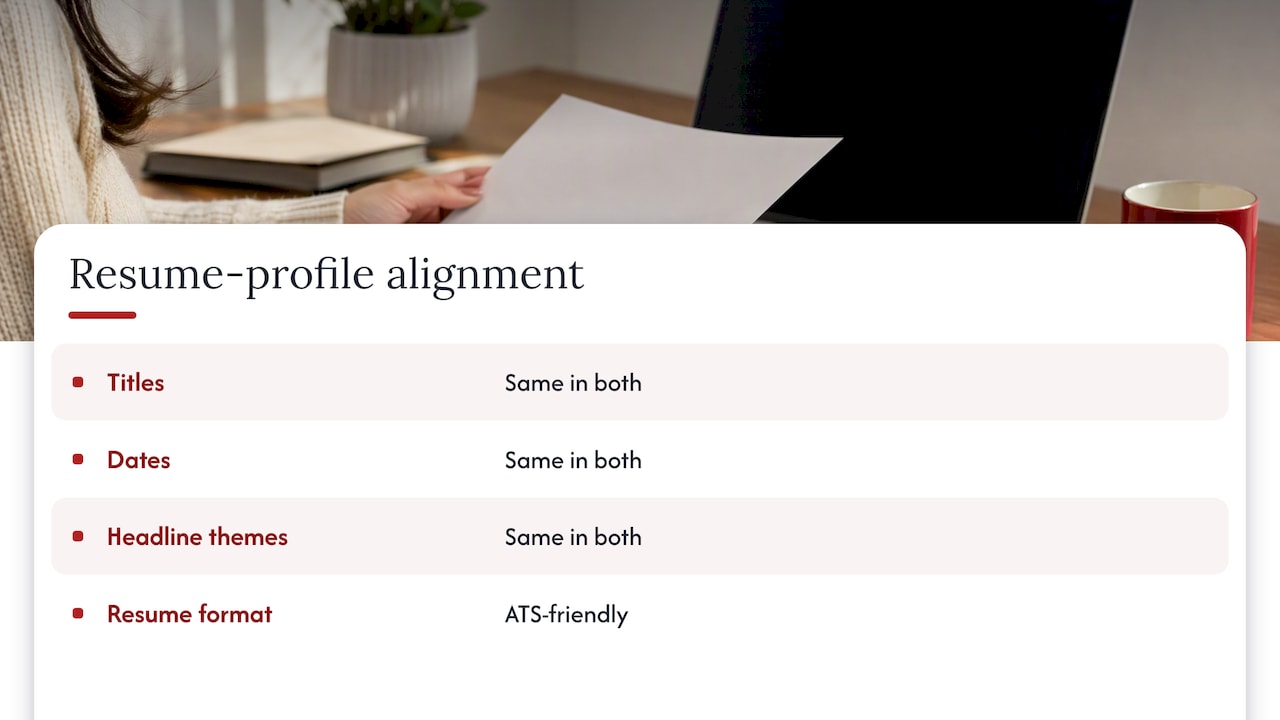
A recruiter who finds you on LinkedIn will often open your resume next, and a hiring manager who reads your resume will almost always open your profile. The two should tell one story.
That means the same titles, the same dates and the same headline themes. It also means the resume should be formatted to pass applicant tracking systems, even though the profile is a different kind of document. Our guide to ATS-friendly resumes for Canadian job seekers covers the formatting side, and our piece on writing a resume that gets noticed in Canada covers the content.
Technology candidates should also look at the technology and IT resume page, as keyword choice there differs from other fields. Senior leaders can read the executive resume overview and a case study on a VP-level move supported by a resume and an updated online presence.
Our perspective: what we see when we review profiles
We write resumes, cover letters and LinkedIn profiles for Canadian job seekers, and we work from one principle: the profile and the resume must support the same positioning. When they diverge, the candidate usually spends interviews explaining the difference.
Three patterns come up repeatedly in the consultations we hold with clients. First, the profile describes what the person did, not what changed because they did it. Second, newcomers and returning professionals leave their location, credentials or the context of foreign employers unexplained, so recruiters cannot place them. Third, executives write the About section as a biography when a board or a retained-search consultant wants to read scope, outcomes and the next mandate.
Our approach is consultative. Your writer works with you directly, asks about the scope you owned and the outcomes you can state, and then writes in the vocabulary that recruiters in your sector use. We build the profile with the same revision process as the resume, so the two documents remain consistent.
We do not publish a price for profile optimization, so we discuss scope with you first.
— Professional
When it makes sense to have a writer do it
The checklist is enough for many people. Hiring help is worth considering when:
- You are moving to a more senior level and your profile still reads like your last role.
- You are re-entering the market after a gap and need the timeline framed clearly.
- You are new to Canada and need your experience, credentials and titles translated for local recruiters.
- You work in a field such as healthcare, engineering or finance, where credentials and terminology carry weight.
- You have little time and a live search.
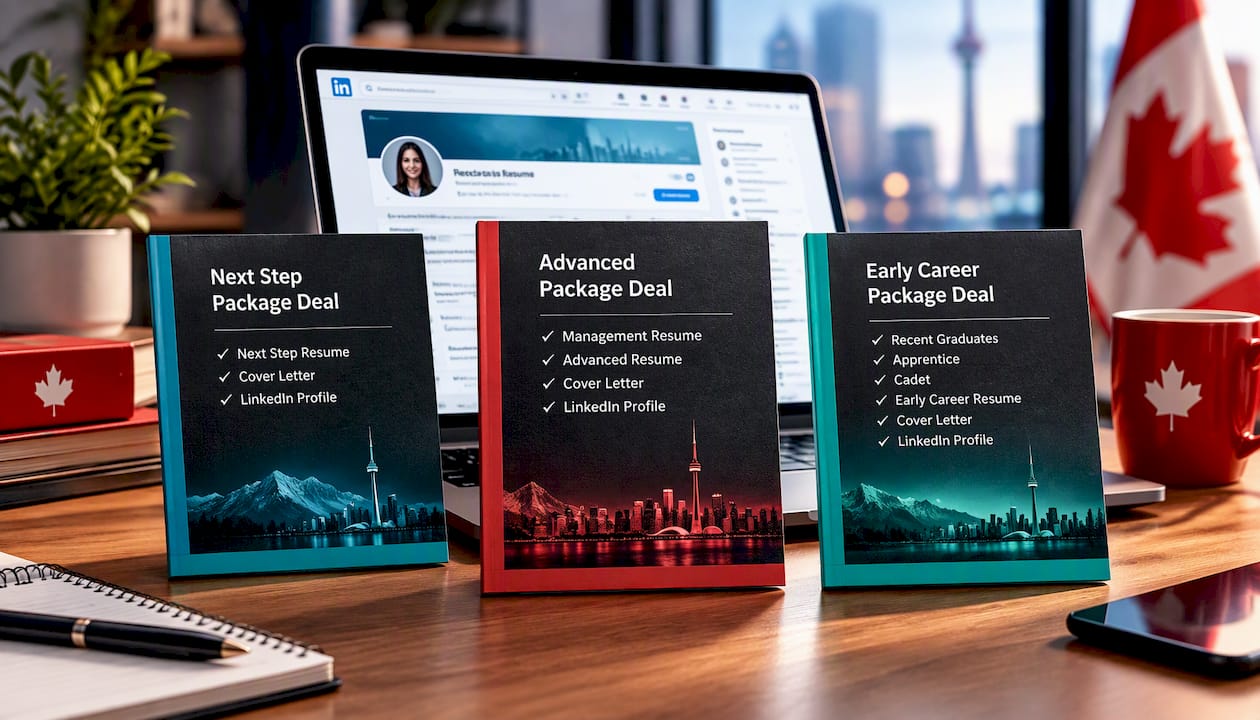
Our LinkedIn profile optimization service covers the headline, About section, experience and keyword structure through a consultation and revisions. Pricing for it is not published, so contact us for details. If your resume also needs work, our resume packages are listed in the shop: Early Career Resume at $139, Next Step Resume at $189, Advanced Resume at $239 and Executive Resume at $289, each a one-off fee.
FAQ
How often should I update my LinkedIn profile?
Review it at least every quarter and after any change of role, scope or credential. Before an active search, run the full checklist again, because small gaps such as missing dates or a general location compound over time.
Should my LinkedIn profile match my resume exactly?
The facts should match: titles, employers and dates. The wording does not need to be identical, and the profile can hold more detail and keywords. The About section also reads in the first person, which a resume summary usually does not.
Do I need a city in my location, or is “Canada” enough?
Name a city. Deloitte Canada’s guidance says that profiles listing only the country can miss recruiter searches filtered by city. If you are moving, list your destination and say you are open to relocation.
Should I include volunteer work on LinkedIn?
Yes, but in the dedicated Volunteer section. Placing it in the experience list can blur your timeline and make it look as if you held overlapping jobs.
What is the difference between a profile checklist and a profile audit?
A checklist is a list of items you tick off yourself. An audit is a review of the whole profile against your goal, often by a second person, and it also asks whether the profile fits the roles you want. The checklist above works as a first-pass audit.
Sources
- Build your LinkedIn presence, Deloitte Canada
- LinkedIn Profile Makeover slides
- LinkedIn Profiles guide, U.S. Department of Labor
- How to Get a Job in Canada from Pakistan 2026, AbroadMate
- LinkedIn Profile Optimization Checklist, South University Career Center
- LinkedIn Personal Profile Review and Optimization Checklist, IDEA