
A resume for Canada is a one- or two-page, reverse-chronological document that leads with a short summary, shows measurable results, translates your international experience into terms a Canadian employer recognizes, and leaves out personal details such as a photo, date of birth or marital status. Most newcomers already have the experience employers want. What usually fails is the presentation: titles that do not translate, duties instead of results, and a format built for another country’s hiring conventions.
This guide walks through each decision in the order you will face it, from format and length to credentials, gaps, applicant tracking systems and the mistakes we see most often.
TL;DR
- Use a clean, mostly chronological resume of one or two pages, with two pages appropriate once you have more than ten years of experience.
- Leave out your photo, date of birth, marital status, nationality and references. Lead with a two-sentence summary and quantified results.
- Translate foreign job titles, employers and credentials so a Canadian reader understands scale and level, and state only what a credential assessment says.
- No Canadian experience? Use relevant volunteer work, and tailor every resume to the posting’s keywords in plain, ATS-readable formatting.
- If regulated work is your goal, credential recognition and licensing come before the resume, not after.
Table of Contents
- What a Canadian resume looks like
- What to leave off
- Presenting international experience
- Results over responsibilities
- No Canadian experience
- Gaps, survival jobs and career changes
- Tailoring and applicant tracking systems
- Our perspective
- How we can help
- A final checklist before you apply
- FAQ
- Sources
What a Canadian resume looks like
Canadian employers expect a resume that is brief, factual and easy to scan in under a minute. RBC’s newcomer guide describes the core content as contact details, experience, education and a short summary of relevant skills, typically on one or two pages. It also recommends two pages for professionals with more than ten years of experience across several positions.
In practice the layout runs in this order:
- Name, city and province, phone, email and a LinkedIn URL.
- A short professional summary.
- Core skills or areas of expertise, kept to a compact list.
- Professional experience, most recent first.
- Education, credentials and licences.
- Volunteer work, languages or tools, if relevant to the role.
Your address does not need to appear in full. City and province are enough, and they tell the employer that you are in the local market.
Which format to choose
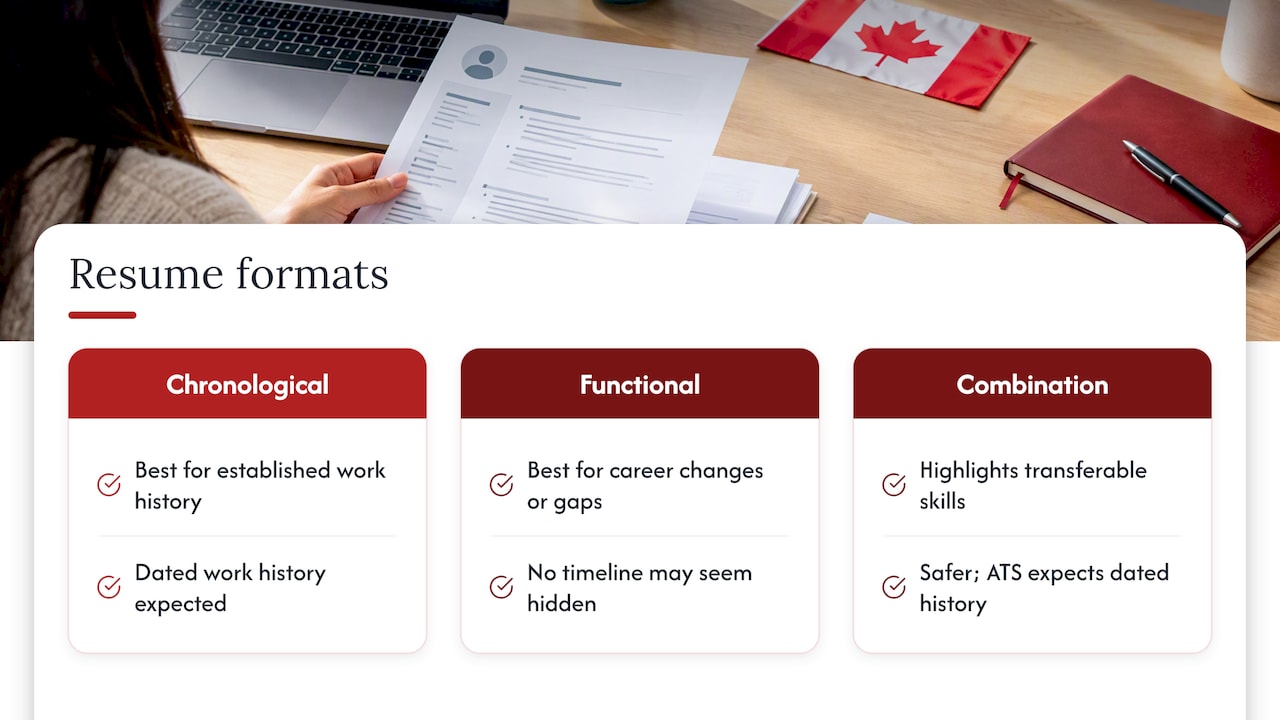
The same RBC guide sets out three formats: chronological for an established work history, functional for career changes or gaps, and combination to highlight transferable skills. For most newcomers the reverse-chronological or combination layout is the safer choice. Recruiters and applicant tracking systems are built around dated work history, and a purely functional resume, with no timeline, can read as though something is being hidden. If you are weighing the options, our guide to picking the right Canadian resume format and our notes on a simple resume format for Canada cover layout, fonts and section order in detail.
The summary at the top
The summary replaces the objective statements common in many other countries. The Government of Québec advises that a short statement of career objective or type of work sought generally takes one or two sentences. A strong one names your role, your years of experience, your sector and one or two proof points. We cover this in depth in how to write a career summary that impresses Canadian recruiters.
A weak summary: “Hardworking engineer seeking opportunity in a reputable company.”
A stronger one: “Mechanical engineer with eight years in automotive manufacturing, leading a 12-person team and cutting line downtime by 18%. Seeking a process engineering role in Ontario.”
The second tells a recruiter what you do, at what scale and with what result. The figures in this example are illustrative; yours must be your own and defensible in an interview.
What to leave off
Several items that are standard elsewhere work against you in Canada. RBC’s guide advises avoiding personal details such as marital status, nationality, interests and hobbies, date of birth, a full address or a photograph. It also warns against sending one generic resume to many employers.
Two further points:
- References. The Government of Québec says not to include references in the resume; keep the list ready for the interview. “References available on request” is also unnecessary.
- Work-permit status. You are not required to explain your immigration status on the resume. If a posting asks whether you are legally eligible to work in Canada, answer that in the application or cover letter, briefly and factually.
There is a reason beyond convention. Employers avoid information that could invite bias, and leaving it out keeps the reader focused on your qualifications.
Presenting international experience
This is where newcomer resumes gain or lose the most. A hiring manager in Calgary or Halifax may never have heard of your former employer, may not know how your title maps to a Canadian one, and cannot judge scale from a company name alone.
Translate titles and describe employers
Write job titles in English and describe the work so a Canadian employer understands the role. A newcomer resume guide from Candid Thread makes the same point and adds that you can give context about the employer’s scale. A Canadian mentoring resource suggests, for experience gained abroad, that you add the company website, a short descriptor and figures such as market share or annual revenue.
In practice:
Regional Sales Manager, Alpha Foods Ltd., Lagos, Nigeria
Leading consumer goods distributor with 400 employees and distribution across six states.
One italic or plain line under the employer name does more than a paragraph of explanation. It lets the reader place you immediately.
If your career involved relocations, secondments or work permits across several countries, you may also find it useful to read about global mobility and relocation support, which gives context on how overseas assignments are structured and described.
Credentials and education
The approach depends on whether your occupation is regulated. For regulated occupations and compulsory trades, Canada.ca explains that your credentials must be recognized by the relevant provincial or territorial regulator, and you must obtain licensure or certification before you can work in the field. That process is separate from your resume, and it is worth starting early. Until you have a licence, describe your status accurately, for example “Registered nurse (internationally educated), NNAS application in progress”, rather than implying you are already licensed.
For non-regulated roles, an educational credential assessment helps employers read your degree. George Brown College’s guidance for adapting an international resume suggests listing the original qualification, then its Canadian equivalent as evaluated by WES. WES states that an ECA is valid for five years from the date of issue. Whichever assessor you use, write only what the assessment says. If it states that your four-year bachelor’s degree is equivalent to a Canadian bachelor’s degree, use those words; do not upgrade it.
A clean education entry looks like this:
Bachelor of Engineering, Mechanical Engineering, University of Pune, India (2014)
Canadian equivalent: Bachelor’s degree (per WES Educational Credential Assessment)
Show transferable skills, not only titles
Employers hiring across industries often care more about what you did than where you did it. The federal Employer’s Roadmap tells employers that for many jobs relevant work experience matters more than where it was gained, and notes that in some provinces and territories requiring Canadian experience is considered discriminatory. Your resume should make that easy for a recruiter: match your skills to the posting’s language, and make results visible.
Results over responsibilities
Canadian recruiters and hiring managers prefer quantified accomplishments to lists of responsibilities, and the same guide recommends starting sentences with relevant action verbs. Compare:
| Duty-based line | Result-based line |
|---|---|
| Responsible for customer accounts | Managed 60 corporate accounts worth $2.4M annually, retaining 95% over three years |
| Handled financial reports | Prepared monthly consolidated reports for four subsidiaries, shortening close by three days |
| Taught mathematics | Taught 150 secondary students per term; raised pass rates from 71% to 86% |
The examples are illustrations of structure. Use real numbers: headcount, budgets, volumes, time saved, customers served. If you cannot measure something exactly, use a defensible range and be ready to explain it in the interview. Convert foreign currencies into Canadian dollars only where you can state the basis, or keep the original currency and add context.
No Canadian experience
The most common worry among newcomers is the missing Canadian line. Several options help.
- Volunteer and unpaid work. RBC’s guide says you can include unpaid or volunteer work if it uses skills relevant to the job, which shows Canadian experience on your resume. Treat it like a job: title, organization, location, dates and results.
- Pre-arrival and settlement programs. Canada.ca notes that free pre-arrival services, including the Active Engagement and Integration Project, can help newcomers write a résumé and prepare for interviews. Use them before and after landing.
- Local certifications and training. A Canadian credential in a health and safety, project management or software tool signals investment in the local market. List it with the issuing body and year.
- Canadian contact details. A local phone number, a city and province, and a LinkedIn profile showing a Canadian location all reduce friction in screening.
We also see newcomers undersell remote or contract work for international clients; if it is relevant, it belongs on the resume. Our guide on tailoring a resume for remote jobs in Canada explains how to present it.
Gaps, survival jobs and career changes
Gaps are common in migration: the period spent waiting for a permit, studying for an exam, or settling a family. Show them honestly and briefly. A single line such as “Career break: relocation to Canada and credential assessment, 2023 to 2024” is enough, and it tells the reader the gap is explained.
For transitions and gaps, a Canadian mentoring resource suggests that a functional or combination layout may help. If your relevant experience predates a survival job, place it under “Most Relevant Professional Experience” and the survival job under “Other Professional Experience”. The same source says to include a survival job when it relates to your occupation and omit it when it does not. A warehouse role that taught inventory systems helps a supply chain application; it adds little to a nursing one.
Tailoring and applicant tracking systems
Many employers filter applications through applicant tracking software before a person reads them. RBC’s guidance is to use keywords from the job posting and standard formatting, and to avoid images, designs, charts and tables, which software can misread. The same guide says to customize your resume for each position.
A workable routine for each application:
- Copy the posting’s required skills, tools and duties into a note.
- Match each one to a genuine line in your experience, using the posting’s wording where it is accurate.
- Move the most relevant achievements to the top of each role.
- Adjust the summary’s title and sector to the posting.
- Save as the file type requested, with a plain file name such as “Firstname-Lastname-Resume”.
A tailored cover letter reinforces this. See our guide to a Canadian cover letter built around one STAR paragraph, and our overview of how to write a resume that gets noticed in Canada’s competitive job market.
Our perspective
We work with newcomers whose careers are stronger than their resumes suggest. The pattern is consistent: a manager who led a regional team abroad lists “duties” over three lines, an engineer’s credential sits in a foreign format no recruiter can interpret, and a generic document is sent to forty postings. The experience is not the problem; the translation is.
Our approach is consultative. We begin with a conversation about your target role, your sector and the Canadian city or province you are aiming for, then work with you to decide what to emphasize, what to explain and what to remove. We format for applicant tracking systems, write for the recruiter who will read it in under a minute, and revise until you can defend every line in an interview. A resume does not replace credential recognition, networking or a focused search, but it is the document every one of those depends on.
— Professional
How we can help
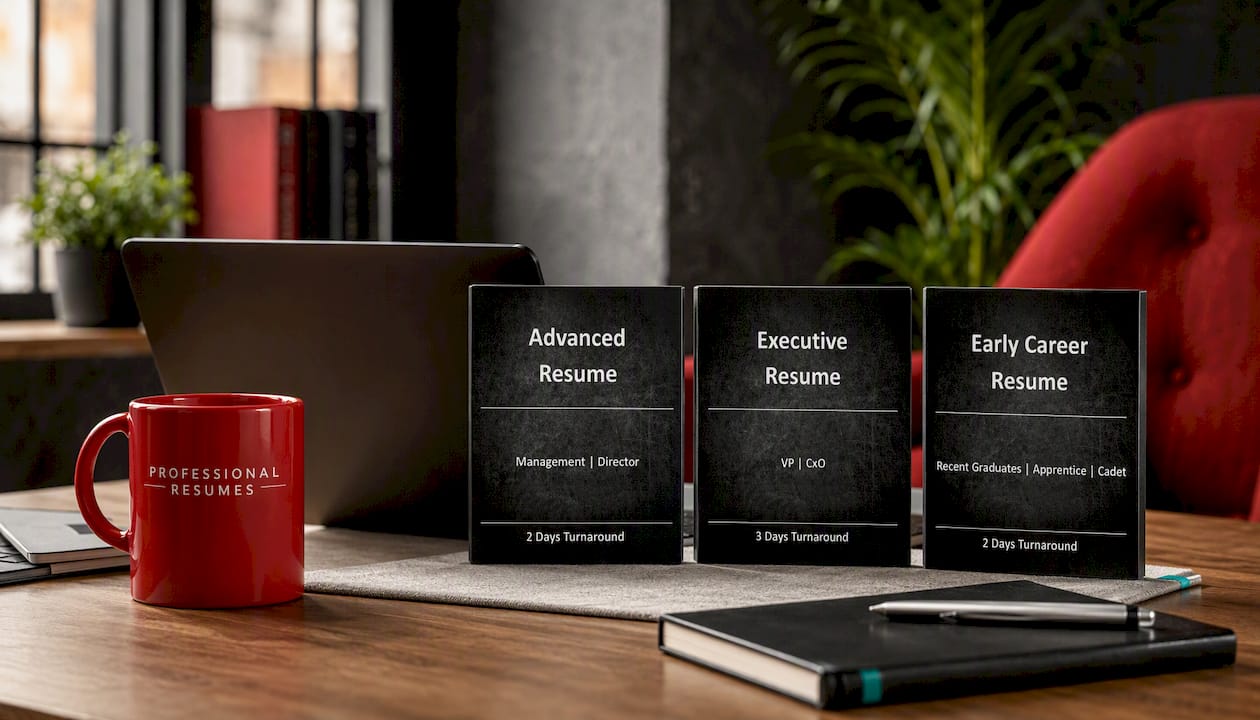
If you would rather have a writer shape this with you, our resume packages are priced for different career stages: Early Career Resume at $139, Next Step Resume at $189, Advanced Resume at $239 and Executive Resume at $289. Each involves a consultation and revisions, and the documents are written for the Canadian market and for ATS-friendly formatting. You can compare them on our shop page.
Your LinkedIn profile should tell the same story as your resume; we also optimize it so Canadian recruiters searching by title and keyword can find you.
A final checklist before you apply
- One or two pages, reverse-chronological or combination layout.
- Summary of one or two sentences with role, sector and a proof point.
- No photo, date of birth, marital status, nationality or references.
- Foreign titles translated, employers described, credentials stated exactly as assessed.
- Results with numbers in every recent role.
- Relevant volunteer or local training included.
- Keywords from this specific posting, in plain formatting.
- City and province, a professional email address and a complete LinkedIn URL.
FAQ
Should I include a photo on my resume in Canada?
No. RBC’s newcomer guidance lists a photograph among the personal details to avoid, together with date of birth, marital status and nationality. Employers focus on qualifications, and a photo adds nothing to your application.
How long should a newcomer’s resume be?
One or two pages. Two pages suit professionals with more than ten years of experience across several positions. If you are early in your career or changing fields, one focused page is usually stronger.
Do I need a credential assessment before I apply?
It depends on the occupation. For regulated occupations and compulsory trades, you must have your credentials recognized by the provincial or territorial regulator and hold the licence before working. For other roles, an assessment is optional but can help employers read your degree; list it exactly as the assessment states.
How do I explain a gap in my work history?
State it briefly and truthfully on the timeline, for example relocation, credential assessment or study. Where it helps, use a combination layout and put your most relevant experience first. Any survival job is worth listing only if it relates to your target occupation.
Can I include volunteer work as Canadian experience?
Yes, when it uses skills relevant to the job you want. Give it a title, organization, dates and results, as you would for paid work.
Sources
- Newcomer’s guide to finding a job in Canada (RBC)
- Writing Your Résumé (Gouvernement du Québec)
- Foreign Credential Recognition (Canada.ca)
- Adapting your international resume (George Brown College)
- Evaluations for Immigration (ECA) (WES)
- Resume for Newcomers in Canada (Candid Thread)
- Assist Your Mentee to Prepare an Effective Résumé
- The Employer’s Roadmap to hiring and retaining internationally trained workers (Canada.ca)
- Pre-arrival services: Prepare to work in Canada (Canada.ca)
- Write a Canadian resume and cover letter (RBC Royal Bank)