
Responsibilities describe what your role required of you. Accomplishments describe what changed because you held it. A Canadian employer already knows the duties attached to most job titles, so the lines that earn an interview are the ones that show a result: what you did, at what scale, and what it produced. If your resume reads like a job description, it is describing the position rather than you.
This guide explains the difference in plain terms, shows how to convert one into the other, and covers the situations where the balance shifts: executive searches, returns after a gap, newcomers to Canada, healthcare roles and federal applications.
TL;DR
- A responsibility is a task you were assigned. An accomplishment is a result you produced, ideally with a number, a scale and a beneficiary.
- Canada’s Job Bank advises against listing duties that are obvious from a job title and recommends specific examples of what you achieved.
- Use one short scope line for context, then three to five accomplishment bullets per role, each built as action verb, action, result.
- When you have no exact figure, describe the qualitative outcome honestly. Never inflate a result.
- Executives, returning professionals, newcomers and healthcare candidates each need a different emphasis, covered below.
Table of Contents
- What separates a responsibility from an accomplishment
- Why Canadian employers want results, not duty lists
- How to turn a responsibility into an accomplishment
- Examples of accomplishments across roles
- When you do not have exact numbers
- Linking accomplishments to the role you want
- Adjusting the balance for your situation
- Common mistakes to avoid
- What we have learned about this distinction
- Having your accomplishments written for you
- FAQ
- Sources
What separates a responsibility from an accomplishment
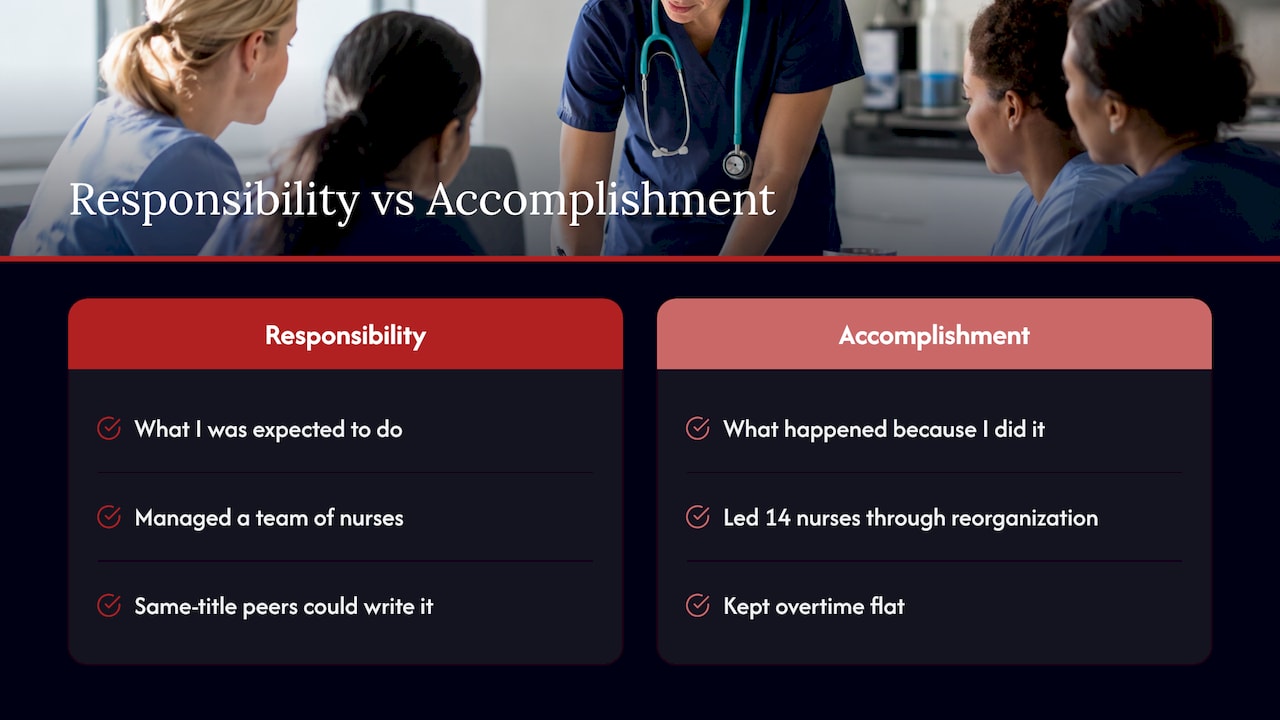
A responsibility answers the question “what was I expected to do?” An accomplishment answers “what happened because I did it?”
The test is simple. Read a bullet and ask whether another person with the same title could write exactly the same line. If so, it is a responsibility. “Managed a team of nurses” fits every charge nurse in the country. “Led a team of 14 nurses through a unit reorganization while keeping overtime flat” fits one person.
The Ontario Public Service’s resume writing guide explains why this matters: accomplishments communicate added value because they describe activities completed successfully and their positive effect on the organization, employer, colleagues or team. HEC Montréal puts the balance the same way: stating your role and duties is important, but explaining what you accomplished is more compelling, and its example is raising student association membership by 25% over the previous year.
A side-by-side comparison
| Responsibility | Accomplishment | |
|---|---|---|
| Answers | What was my job? | What did my work change? |
| Typical wording | Responsible for, duties included, in charge of | Increased, reduced, built, led, delivered |
| Evidence | None, the reader must trust the title | A figure, a scale, a before and after |
| Distinguishes you from other candidates | Rarely | Usually |
| Where it belongs | One scope line at the top of a role | The bullets beneath it |
Responsibilities are not useless. They give context, such as the size of a team, the budget you held or the region you covered. They simply should not take up the space where your results belong.
Achievements or accomplishments: which word to use
In resume writing the two words are used interchangeably, and employers do not read them differently. Pick one for headings such as “Selected Accomplishments” and keep it consistent. What matters is the content under the heading, not the label.
Why Canadian employers want results, not duty lists
Canadian hiring guidance is consistent on this. Job Bank recommends that you identify the best examples of where you demonstrated your skills, explain what you achieved in the role, place that in the work experience section, tailor it to the posting, quantify with understandable numbers and open with action verbs. Guidance for newcomers makes the same point: Moving2Canada’s resume format guide tells readers to emphasize achievements rather than duties, because employers already know the basic tasks of most jobs.
There is also a practical reason. A recruiter or hiring manager scanning dozens of resumes decides quickly. Amazon’s recruiting leadership notes that listing accomplishments gives a snapshot of a candidate’s strengths and ability to drive impact at scale, which goes beyond what a standard job description conveys. A list of duties offers no such snapshot.
How to turn a responsibility into an accomplishment
The conversion follows five steps. Each one is a place where candidates commonly go wrong.

1. Write the duty down plainly
Start with the line you already have: “Responsible for monthly financial reporting.” Do not edit it yet. This is your raw material.
2. Ask what changed
For each duty, ask what was better, faster, cheaper, safer or larger because of how you did it. The Ontario Public Service guide lists the kinds of change worth looking for: improving a process, achieving more with fewer resources, saving money or time, solving a longstanding problem, or improving staff or team morale. Most people discover two or three results hiding behind a single duty.
3. Add the number, the scale or the people affected
The same guide recommends using hours, dollars, percentages or people where applicable. For a closer look at figures that survive a reference check, see our guide to quantifiable resume metrics.
4. Build the sentence with a formula
Two published formulas work well. McMaster University recommends Strong Action Verb + Action + Result, or Strong Action Verb + Result + How You Got the Result. The University of Toronto Mississauga suggests Action Verb + scope, with quantifiers where possible, + result or reason, and recommends limiting each job or project to three to five accomplishment statements.
Applied to the reporting example:
- Before: Responsible for monthly financial reporting.
- After: Rebuilt the monthly reporting process across five business units, shortening the close cycle from 10 business days to 6 and giving leadership earlier visibility into variances.
Use past-tense verbs that describe what you did. McMaster advises describing concrete actions you took rather than how outside forces acted upon you, so “was given a new territory” becomes “expanded the territory by opening three accounts.”
5. Keep it true
Job Bank warns candidates not to overstate their skills or results, because doing so misleads the employer. Every figure should be one you can explain in an interview. If the result came from teamwork, say so: HEC Montréal recommends collaborative verbs such as “collaborated” and “contributed to” so that you claim your share and no more.
Examples of accomplishments across roles
Published career-centre examples show the range. George Brown College lists a marketing plan that increased customer bookings by 33%, an inventory policy that reduced expired products by $10,000, training 50 students while decreasing theft by 50%, an online scheduling system that eliminated double bookings, and three coordinated fundraising events that raised $8,000.
Alberta’s career service alis defines an accomplishment as a success earned after completing an activity, and its examples extend beyond sales figures: meeting or exceeding goals, meeting tight deadlines, organizing events, accepting leadership, receiving awards and earning bonuses.
Indeed Canada’s list of resume accomplishments adds categories such as saving the company money, resolving issues, creating or improving systems, completing unique projects, gaining promotions and obtaining press coverage. For ready-to-adapt structures, our five PAR templates for resume achievements show the problem, action and result pattern in full.
Three quick conversions
| Responsibility | Accomplishment |
|---|---|
| Handled customer complaints | Resolved an average of 40 escalated complaints a month and introduced a response template that cut repeat contacts |
| Supervised project schedules | Delivered six infrastructure projects on time and within approved budget |
| Trained new hires | Designed an onboarding program completed by 30 new staff, shortening time to independent work |
The figures above are illustrations of the format. Replace them with your own verified numbers.
When you do not have exact numbers
Not every result has a figure attached. Support roles, early-stage projects and confidential work often lack clean metrics. HEC Montréal’s advice is to describe a qualitative achievement when exact figures are unavailable. Columbia Career Education offers an example of the approach: increased attendance at several club programs throughout the year.
A qualitative result still names a change and a beneficiary. “Streamlined the intake process so clinicians spent less time on paperwork” is an accomplishment. “Handled intake” is not. If you can reasonably estimate a range, such as hours saved per week, ask a former manager to confirm it before you print it.
Linking accomplishments to the role you want
An accomplishment only counts if it matters to the reader. Job Bank asks that you tailor your examples to the posting, and HEC Montréal advises speaking the employer’s language through relevant keywords. Read the posting, note the three outcomes it stresses, and lead with the accomplishments that match. The logic is the same one behind skills-based hiring frameworks, where employers define what a role requires and assess candidates against those requirements.
Keywords should appear inside accomplishment statements, not in a separate block, so that applicant tracking systems and human readers both see them in context. Our guide to mapping resume keywords for ATS walks through the process, and the Canadian keyword examples by industry show the vocabulary by field.
Adjusting the balance for your situation
Executives preparing for C-suite searches
At senior level, scope is itself part of the accomplishment. Canada’s Public Service Commission recommends emphasizing outstanding achievements from the most recent 10 to 15 years, particularly experience managing people and financial resources and managing change, tailored to the position. For an executive, that means P&L ownership, transformation led and organizational outcomes, stated with the size of the budget, the headcount and the measurable result. If you are deciding how an executive document differs from a standard one, read our comparison of an executive resume and a professional resume.
Returning after a career gap
Accomplishments are not limited to paid employment. The Ontario Public Service guide says applicants returning after a gap may include relevant volunteer work, self-study, training or education completed outside the workforce, and notes that its applications are not screened on gaps in work history. It suggests a functional resume when a long gap is a concern. Present that activity in the same result-first format: what you organized, learned or delivered, and what came of it.
Newcomers adapting a resume to Canada
Many markets expect a detailed record of duties, sometimes with personal details and long entries. Canadian resumes are typically shorter and built around skills and accomplishments, according to Moving2Canada. Translate your duties into results that a Canadian employer can measure: convert currencies and scale to familiar terms, name the type of organization when the employer is unknown here, and drop responsibilities that any employer would assume.
Healthcare professionals
Clinical duties are standardized by licence and role, so the duty list tells an employer little. Accomplishments show what differentiated your practice: patient volumes managed, protocols introduced, preceptor or training roles, audit results, unit-level outcomes. Never include information that could identify a patient. Our overview of nursing resume services describes how clinical experience is presented.
Federal government applicants
Public service postings are screened against stated criteria, so each accomplishment should be evidence of a listed qualification. The Ontario Public Service recommends stating the situation, action and result, and that structure carries over to other public-sector applications. Match the language of the posting and show the experience the criteria ask for in specific, dated examples.
Common mistakes to avoid
- Opening bullets with “responsible for”. The University of Toronto Mississauga notes that replacing it with an action verb turns a group of tasks into evidence of capability.
- Writing eight or more bullets per role. Three to five stronger ones read better.
- Using the same verb repeatedly. Vary verbs so each bullet reads as a different result.
- Including a number with no context. “Increased sales by 20%” means little without the period, the base or the market.
- Claiming a team result as personal. Use collaborative verbs for shared work.
- Leaving out the scope line. One line for team size, budget or territory makes the bullets below it meaningful.
What we have learned about this distinction
Most weak resumes we review are not missing experience. They are missing selection. The candidate has done the work, but the page describes the role instead of the person.
Our approach is to start with a consultation, because accomplishments rarely come out in a form field. They surface when someone asks what you were brought in to fix and what was different when you left. Working directly with your writer, those answers become concise statements an executive search consultant, a hiring manager and an applicant tracking system can all read.
We write for specific audiences, from early-career candidates to executives, because the accomplishments worth showing at a director level are different from those at an entry level. Scope, financial responsibility and change led carry the weight in one; initiative and results in the first role carry it in the other.
Revisions are part of the process, since the right emphasis often becomes clear only once you see the draft.
Professional
Having your accomplishments written for you
If you have the material but not the time or the distance to select and phrase it, a writer can do that work with you. Our resumes are customized to your goals and industry, built with ATS-friendly formatting, and include extensive consultation and multiple revisions. Pricing is published on our shop page: the Early Career Resume is $139, the Next Step Resume is $189, the Advanced Resume is $239 and the Executive Resume is $289, each a one-off fee. Senior leaders can go directly to the Executive Resume, and we also offer LinkedIn profile optimization so your profile carries the same accomplishments.

If you are changing direction instead of moving up, our article on refreshing a resume for a mid-career transition covers which accomplishments to carry across.
FAQ
What is the difference between responsibilities and accomplishments on a resume?
Responsibilities are the tasks your role required. Accomplishments are the results you produced while doing them, ideally with a figure, a scale and a beneficiary. Employers can infer most duties from a job title, which is why Job Bank advises against simply listing them.
How many accomplishments should I list per job?
Three to five per role or project is a sound range, as the University of Toronto Mississauga suggests. Put the strongest first and choose the ones that match the posting. Older roles can carry fewer.
Can I include accomplishments if I cannot measure them?
Yes. Describe the qualitative result: what improved, for whom and how. HEC Montréal recommends this when exact figures are unavailable. Keep the claim accurate, since you may be asked about it in an interview.
Should I keep any responsibilities on my resume?
Keep one brief scope line at the top of each role, such as team size, budget or territory. It gives your accomplishments context. Remove everything else that any person in that job title would be assumed to do.
Is there a difference between achievements and accomplishments?
For a resume, no. Both describe results you delivered, and recruiters read them the same way. Choose one term for your headings and use it consistently.
Sources
- How to write a good resume, Job Bank
- Highlight Your Achievements, HEC Montréal
- Writing a cover letter and resume, Ontario Public Service
- Amazon job application: Resume writing tips
- Accomplishment Statements, McMaster University
- Get Noticed, University of Toronto Mississauga Career Centre
- Accomplishment statements, George Brown College
- Recognize Your Accomplishments, alis
- How to Include Your Accomplishments on a Resume, Indeed Canada
- Resumes with Impact, Columbia Career Education
- The Curriculum Vitae: Tips for Executives, Canada.ca
- How To Format Your Resume in Canada, Moving2Canada