

The right resume keywords are the exact skills, tools, credentials and titles that appear in the job posting and that your industry uses to describe the work. A software developer, a registered nurse and a finance director each need a different vocabulary, and a resume that borrows the wrong one reads as generic to both applicant tracking systems and human recruiters. This guide gives you working keyword sets for the main industries hiring in Canada, then shows how to extract keywords from a posting and place them without stuffing.
TL;DR
- A keyword is a word or short phrase tied to the qualifications of a job or industry: a skill, tool, credential or area of knowledge. It is not a buzzword.
- Take your keywords from the posting first, then from your industry’s standard vocabulary. Use both the full term and its abbreviation (for example, Certified Professional Accountant and CPA).
- Place keywords inside proof: a summary, a skills section and achievement lines with results. A list of terms with no evidence does not persuade a reader.
- Regulated professions, public-sector roles and executive searches each follow their own rules, covered below.
Table of Contents
- What counts as an industry keyword
- How to find the right keywords for your target role
- Resume keywords by industry
- Executive and leadership keywords
- Public-sector and federal applications
- Where to place keywords so they work
- Mistakes that cost interviews
- Our perspective
- Get a resume written to your target industry
- FAQ
- Sources
What counts as an industry keyword
Humber College’s career resources define an industry keyword as a word or short phrase related to the qualifications for a job or industry, such as abilities, skills or tools, and they separate it from a resume buzzword. “Results-driven” is a buzzword. “Variance analysis” or “Kubernetes” is a keyword. The difference matters because only the second kind tells a reader what you can actually do.
Alberta’s career information service describes keywords as the terms that show an employer whether you read the posting, studied a subject, earned a credential, or know a particular industry, tool or skill. Its guidance on choosing power words sorts them into four groups: keywords, action words, description words and number terms. Together they prove qualifications and hold an employer’s attention. That framework is useful here, because a strong resume uses all four, not just nouns.
In practice, you work with three layers:
- Role keywords: your job title and its common variants.
- Hard-skill keywords: tools, methods, systems, credentials and regulations.
- Outcome keywords: the verbs and numbers that show results, such as reduced, negotiated, grew, 18%, $4M.
If you want the formatting side of the same problem, our guide to ATS-friendly resumes for Canadian job seekers explains how the layout affects whether those keywords are read at all.
How to find the right keywords for your target role
Start with the posting, not with a generic list. The list below is a starting point; the employer’s own wording is the final authority.
- Copy three to five postings for the role you want into one document.
- Highlight repeated nouns and verb phrases. Anything that appears in most postings is a core keyword for the role.
- Separate must-haves from assets. Government and many corporate postings distinguish essential qualifications from nice-to-haves. Put the essentials first.
- Note equivalent terms. Indeed Canada recommends using keywords naturally and pairing related terms, for example accounting alongside bookkeeping and QuickBooks, because employers may search for adjacent wording.
- Check each keyword against your history. If you cannot back it with an example in an interview, leave it out.
That last step is the line between tailoring and exaggeration. A keyword you cannot defend becomes a liability the moment someone asks about it.
Resume keywords by industry
The sets below reflect terms that recur in Canadian postings. Treat them as prompts: use only the ones you can support, and mirror the spelling and abbreviation in your specific posting.
Technology, software and data
Technology postings are the most tool-specific, and they date quickly. Name the stack you have actually used and the method you worked in.
| Category | Example keywords |
|---|---|
| Methods | Agile, Scrum, DevOps, CI/CD, full-stack development |
| Cloud and infrastructure | AWS, Azure, GCP, Kubernetes, Docker, cloud migration |
| Languages and frameworks | Python, Java, React, Node.js, REST API |
| Collaboration tools | JIRA, Confluence |
| Data | Data engineering, SQL, data modelling, dashboards |
Avoid listing technology you used years ago and no longer maintain. Place the current stack at the top of your skills section and attach it to a result: “Migrated a billing platform to AWS, cutting infrastructure costs by 22%” is stronger than a bare list of services.
Healthcare and regulated professions
In Canadian healthcare, licensure is itself a keyword, and it is provincial. Registration status belongs near the top of the resume, not buried in an education section, because a recruiter screens for it first.
| Category | Example keywords |
|---|---|
| Licensure | RN, RPN, registration with your provincial college (for example CNO in Ontario or CRNBC in British Columbia), application status if pending |
| Clinical practice | Patient care, clinical documentation, infection control, medication administration |
| Systems | Electronic medical records (EMR), Epic |
| Settings | Acute care, long-term care, community health, emergency |
If you trained abroad and your registration is in progress, state it plainly: “Application submitted to the provincial regulatory college, [month, year].” Do not imply you are licensed when you are not. The same logic applies to engineers (P.Eng. or the provincial association), accountants, teachers and lawyers.
Finance, accounting and business
| Category | Example keywords |
|---|---|
| Credentials | CPA, CFA |
| Standards | IFRS, GAAP |
| Core tasks | Financial modelling, variance analysis, month-end close, reconciliation, forecasting |
| Transactions | Accounts payable, accounts receivable |
| Systems | ERP, SAP, QuickBooks |
Canadian employers often expect to see both the standard and the credential, so write “IFRS reporting” and “CPA” rather than assuming one implies the other. Add scale where you can: budget size, number of entities, reporting cycle.
Sales, business development and marketing
| Category | Example keywords |
|---|---|
| Sales model | B2B sales, SaaS, account management, business development |
| Process | Pipeline management, lead generation, forecasting |
| Tools | CRM, Salesforce, HubSpot |
| Results | Revenue growth, quota attainment, retention, conversion rate |
In marketing and creative roles, add the channels and platforms you have run (SEO, paid social, email automation, content strategy) with a number attached to each. Portfolio links belong in the header.
Supply chain, logistics and operations
| Category | Example keywords |
|---|---|
| Planning | Demand forecasting, inventory management, S&OP |
| Sourcing | Procurement, vendor management, contract negotiation |
| Systems | ERP, SAP SCM |
| Operations | 3PL, warehouse management, lean, continuous improvement |
Operations hiring managers want scale: units shipped, fill rate, days of inventory, cost per order. Attach one metric to every responsibility.
Education, skilled trades and other sectors
The same method applies outside the table above. Teachers should name certification (such as provincial teaching certificates), curriculum frameworks and student populations. Tradespeople should name certifications, Red Seal endorsements where held, equipment and safety training. The vocabulary changes; the principle does not: certification, tools and measurable outcomes first.
Executive and leadership keywords
Senior resumes use a different register. Recruiters and boards are not scanning for tools; they are looking for scope and consequence. The terms that carry weight describe what you owned and what changed because of you.
- Scope: P&L ownership, enterprise-wide, multi-site, national or international operations, headcount and budget managed.
- Strategy: strategic planning, business transformation, market entry, turnaround, mergers and acquisitions integration.
- Governance: board reporting, stakeholder management, risk oversight, regulatory compliance.
- People: succession planning, organizational design, leadership development, change management.
- Results: revenue growth, EBITDA improvement, margin expansion, cost reduction, each with a figure.
The discipline is the same as elsewhere: a phrase such as “transformation led” earns its place only when followed by the size of the organization, the period and the measurable outcome. An executive resume that lists leadership terms without figures invites exactly the scrutiny it is trying to avoid. Our guide to writing a career summary that impresses Canadian recruiters shows where these terms belong in the opening of the document.
Public-sector and federal applications
Government screening works differently from private-sector screening. The Government of Canada advises candidates applying to its departments to read the whole job poster and match their résumé to the essential skills and assets listed. It also recommends the STAR method (Situation, Task, Action, Result) to give concrete examples of how each essential qualification was met, rather than simply stating that a task was performed.
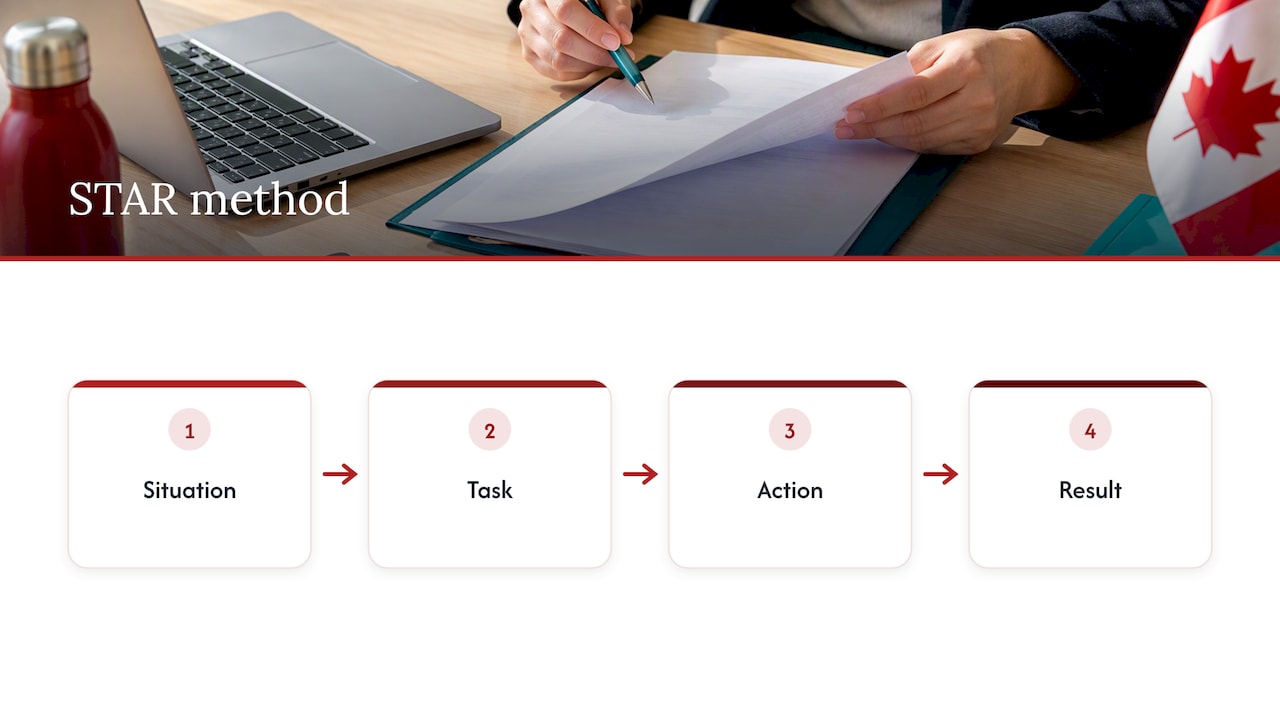
The practical consequence: for a federal job, the keywords are the exact wording of the stated criteria, and each one needs a dated example in your work history. Screeners often assess against criteria written in advance, so a paraphrase can cost you a point that the original phrase would have earned. Our article on federal resumes in Canada covers the formatting issues that commonly break in government portals.
Where to place keywords so they work
A keyword has value only where a reader or a parser finds it and sees proof beside it.
| Section | What to place there |
|---|---|
| Headline or title line | Target role title as the employer words it |
| Career summary | Three to five of the most important role and hard-skill keywords, in sentences |
| Skills section | Tools, systems, credentials, grouped by type |
| Experience | Action verbs plus keyword plus result, in each role |
| Education and certifications | Full credential name and abbreviation |
Two habits keep this honest. First, use each important keyword two or three times in different contexts, not twenty times in one block. Second, write the full term and the acronym once, such as “customer relationship management (CRM)”, so both versions match a search.
A worked example from an operations resume:
- Weak: “Responsible for supply chain activities and vendors.”
- Stronger: “Managed vendor relationships and procurement for 40 suppliers using SAP SCM, reducing cost per order by 9% through contract renegotiation.”
The second line carries four keywords (vendor management, procurement, SAP SCM, contract negotiation) and one result, in a single readable sentence.
Mistakes that cost interviews
- Stuffing. Hidden white text or repeated lists are visible to recruiters and parsers alike, and they undermine credibility. Indeed Canada’s guidance is to use keywords naturally.
- Claiming what you cannot support. Every term is a potential interview question.
- Using the wrong regional term. Canadian postings typically use “résumé” or “resume”, “CPA” rather than “CA” for current designations, and provincial college names rather than American licensing bodies.
- Graphics and tables for the main content. Complex layouts can fail parsing. Keep standard headings such as Experience and Education; see our notes on Canadian resume format and a simple resume format.
- One resume for every application. Reusing a single version across industries dilutes every keyword. Tailor a base version for each target role.
Our perspective
We see the same pattern in nearly every consultation. Candidates rarely lack experience; they lack the vocabulary that connects their experience to the role they want. A finance professional moving into a leadership position still describes work in task terms, an internationally trained nurse omits registration status, and a returning professional hides a gap instead of leading with current skills.

Our approach is to start with your target postings and your actual record, then work directly with your writer to find where the two overlap. Industry trends inform the vocabulary, but the evidence always comes from you: scope, outcomes and credentials you can defend in an interview. That is also why we do not sell keyword lists. A list can be found anywhere. The value is in deciding which five terms belong in your summary, which belong in a specific achievement, and which should be left out.
For senior candidates, discretion matters as much as precision. A confidential conversation about what to disclose, how to frame a transition and how to present board-level scope produces a stronger document than any keyword scan.
— Professional
Get a resume written to your target industry
If you would rather not map keywords yourself, our writers build the document around your target role, your credentials and your results, with consultation and revisions included. Packages are priced by career stage: the Early Career Resume is $139, the Next Step Resume is $189, and the Advanced Resume is $239. The Executive Resume is $289. You can compare them on our shop page, and if your online profile needs the same vocabulary, our LinkedIn profile optimization service aligns it with your resume.

FAQ
What keywords do employers look for in a resume?
They look for the skills, tools, credentials and industry terms named in the posting, plus evidence that you have used them. The wording of the posting is the best guide. Match its terms where they are true to your experience, and support each with a result.
How many keywords should a resume include?
There is no official number, and a count is the wrong target. Include the essential terms from the posting, usually ten to twenty across the document, each in a natural sentence or a grouped skills line. If a term reads awkwardly where you have placed it, it is probably there for the wrong reason.
Is a 70% ATS score good?
Scores from online scanners are estimates produced by each tool’s own method, not a standard that employers use. Treat them as a rough check on keyword coverage only. A better test is whether your resume reflects the essential requirements of the posting in readable form.
Should I use different keywords for every application?
Yes, to a degree. Keep a base resume for each target role, then adjust the summary, skills and top achievements to the posting’s wording. Changing everything each time is unnecessary; changing nothing wastes the match.
Do keywords matter if my resume is read by a person?
They do. Industry terms signal that you know the field, and a recruiter can see within seconds whether your experience maps to the role. Keywords with results beside them serve both the system and the reader.
Sources
- Choose Power Words to Make Your Résumé Stand Out, Alberta Learning Information Service
- Using Industry Keywords, Humber career resources
- Tips and tricks to apply for a job at Shared Services Canada, Government of Canada
- How to Use Keywords in Job Applications, Indeed Canada