
In Canada, a bilingual resume is rarely one document written in two languages. It is a resume that proves your language skills in the language the employer reads, and, where the role calls for it, a second version in the other official language. The skill belongs in your summary, your experience and your skills section, with a proficiency level the employer can verify, because bilingualism is screened for and, for many roles, tested.
This guide covers where to place language skills, how to word your level, when to send one version or two, and how to keep the file readable by applicant tracking systems (ATS), the software many employers use to filter applications before a person sees them.
TL;DR
- Write one resume per language and match the language of the job posting. Do not mix English and French in the same document.
- State your level in plain, checkable terms (a recognized scale or a precise description) and show the language in use in your work history.
- Put the skill early: in the summary on page one, then in your experience and in a dedicated languages line.
- Federal government roles set required levels separately for reading, writing and oral interaction, so your resume should address all three.
- Keep the layout simple. Complex columns can scramble when software converts the file.
Table of Contents
- What a bilingual resume means in Canada
- One language per document
- Where language skills go on the page
- How to state your level honestly
- Federal government roles: three skills, three levels
- Making it ATS-friendly
- Canadian conventions for newcomers and returning professionals
- Our perspective
- Work with a writer on your bilingual resume
- Checklist before you submit
- FAQ
- Sources
What a bilingual resume means in Canada
Canada has two official languages, but the country is not evenly bilingual. Citizenship and Immigration Canada’s newcomer workbook notes that New Brunswick is the only officially bilingual province, and that the population includes roughly 18 million Anglophones and seven million Francophones. That split explains why the same skill is a bonus in one city and a requirement in another.
In practice, “bilingual resume” covers three situations:
- A role that requires both languages. Customer service in Ottawa, Gatineau, Moncton or Montréal, health care, federal positions and many sales and account roles fall here. Your resume must show working-level ability in both.
- A role where a second language is an asset. The posting is in one language and mentions the other as an advantage. Your resume stays in the posting’s language, with the second language prominent.
- A role in Quebec. Indeed Canada’s guidance says English is standard for resumes in most provinces, while Quebec’s language rules make French compulsory for roles there. Polytechnique Montréal’s résumé guide adds that for jobs in Québec, both French and English are generally expected.
If you are applying in Montréal or Québec City, local conventions matter as much as language. Our pages on resume writing in Montréal and resume writing in Québec City cover how those markets read a Canadian resume.
One language per document
The most common error is a single resume with English headings, French bullets and a bilingual summary. Recruiters and ATS filters both read documents in one language. Mixed text makes keywords harder to match and signals that you did not decide who the reader is.
The rule is simple: submit the resume in the language of the posting. Randstad Canada advises newcomers to do exactly that. When the role requires both languages, Indeed Canada suggests considering versions in both.
A workable routine:
- Build a master resume in your strongest professional language.
- Produce the second version as a full rewrite of each bullet, not a line-by-line translation. Job titles, certifications and sector vocabulary differ between English Canada and Quebec.
- Label the files clearly, for example with your name and the language in the file name, so a recruiter opens the right one first.
- Keep both versions factually identical: same dates, titles, employers and figures.
When the posting is in English but the work involves francophone clients or colleagues, sending both versions with matching cover letters shows the skill rather than only claiming it.
Where language skills go on the page
A language line at the bottom of page two is easy to miss. Place the skill in three spots so it is read and also supported.
The summary on page one
For positions that need French, Ontario’s public-sector guide advises emphasizing your French level in the skills summary or profile on the first page and again in your cover letter. Indeed Canada recommends stating that you read, write, speak and understand the language, and how that benefits the employer. A career summary has only two or three lines, so the language claim has to share space with your strongest results. Our guide to writing a career summary for Canadian recruiters shows how to build those lines.
Example: Healthcare administrator with eight years in multi-site clinics, fully bilingual in English and French (reading, writing, speaking), leading patient intake in both languages for a team of 14.
The experience section
A level on its own is a claim. A bullet is evidence. Describe what you did in each language: resolving client complaints, drafting contracts, presenting to a board, training staff. Indeed Canada gives the example of resolving customer complaints in more than one language. Use the same pattern with a number or an outcome.
- Negotiated supplier contracts in French and English across Ontario and Quebec, reducing procurement costs by 11%.
- Delivered monthly client briefings in French to a Gatineau-based team and in English to head office.
The figures above are illustrative; use only numbers you can defend in an interview.
A dedicated languages line
The languages line is for scanning and for ATS keyword matching. McGill’s career guide says to list the languages relevant to the workplace first, even if they are not your mother tongue. The Government of Québec’s résumé page places foreign languages, spoken and written, under additional information. In Canada, a skills section or a short Languages heading near the top works for most employers.
How to state your level honestly
Employers test language skills in interviews, written exercises and, in the public service, mandatory assessments. An inflated level costs you at the interview stage. There are two sound ways to state it.
Descriptive wording. Polytechnique Montréal’s guide offers phrases such as “French and English (bilingual)” or an itemized description such as excellent oral comprehension and basic writing. McGill suggests:
| Your situation | Wording |
|---|---|
| Fluent in both languages | Fluent English and French (written and spoken) |
| Can manage in French but not fluent | English, French (details left for the interview) |
| Other languages | Fluent, conversational, working knowledge or basic |
| One language only | Leave the section out |
Framework levels. Polytechnique Montréal also describes the European CEFR scale, for example French C2 (mastery) or English B2 (advanced). For immigrants, Job Bank explains that English classes in Canada use the Canadian Language Benchmarks (CLB) and French classes use the Niveaux de compétence linguistique canadiens (NCLC). If you have a CLB or NCLC result, it is the scale Canadian employers and immigration programs know best.
Test results. The newcomer workbook lists IELTS, CELPIP and TOEFL for English, and TÉF and DELF for French, as widely recognized proof. If you have a score, put the test name and result next to the language. If you are preparing for a French exam, structured preparation such as TCF and TEF Canada coaching is built around reaching a target score, and a certified score gives your resume a number that no one has to take on trust.
Accuracy matters as much as level
Typos in the second language undermine the claim. Randstad Canada says proofreading is a must when writing in a language that is not your first, and recommends that a fluent speaker check the document, since glaring mistakes can lead some hiring managers to stop reading. The Government of Québec makes the same point, advising that someone who writes well should review your résumé. A bilingual resume with a visible error in either language is worse than a monolingual one.
Federal government roles: three skills, three levels
Federal job seekers face a more formal system. The Public Service Commission of Canada explains that a position requiring both official languages is designated bilingual, and that the manager sets a level for each of three skills: reading, writing and oral interaction. The levels are A (beginner), B (intermediate) and C (advanced), with Code P for expert proficiency. A common profile is CBC, meaning C in all three skills, and second-language proficiency is assessed by mandatory tests.
What this means for your resume:
- Mention reading, writing and speaking separately when your levels differ. “Advanced spoken French, intermediate written French” is more useful to a screener than “good French”.
- Mirror the posting’s language requirements in your summary.
- Show evidence of each skill in your experience, such as reports written, meetings chaired or services delivered in the second language.
Your resume does not replace the official assessment, but it determines whether you reach it.
Making it ATS-friendly
Bilingual candidates often add formatting to display two languages side by side. That is the wrong move. Seneca Polytechnic’s open textbook explains that a skills and qualifications summary that front-loads the posting’s keywords helps you pass electronic filters, and that some application software converts resumes into formats that can scramble text. It advises multi-column layouts only when you are sure the formatting will survive.
Practical checks:
- Use one column, standard headings and a plain font.
- Write the language line as text, for example “Fully bilingual (reading, writing, speaking) in English and French”, as the Seneca example puts it, not as a graphic or a rating bar.
- Use the posting’s exact words for skills and tools, in the posting’s language. Our guide to ATS-friendly resumes for Canadian job seekers explains how screening works, and resume keywords by industry lists Canadian examples.
- Choose a layout recruiters expect. Our Canadian resume format guide helps you decide.
Canadian conventions for newcomers and returning professionals
Two groups ask about bilingual resumes more than others: immigrants adapting to the Canadian market and people returning after a gap.
Immigrants. The newcomer workbook states that Canadian résumés should leave out age, marital status, gender, religion, SIN, political affiliation and immigration status. Photos and date of birth, standard in some countries, do not belong. Your multilingual background is an asset, but list only languages with a real use at work, and state the level you could demonstrate tomorrow. If you studied or worked abroad, say what the credential or role equals in Canadian terms.
Returning after a gap. A language skill does not expire in the way a technical certification can, and it can anchor your summary. Lead with the skill and recent results, and show any ongoing practice such as volunteering, courses or freelance translation. Keep the format chronological or hybrid, and keep the document to the one or two pages the Government of Québec recommends.
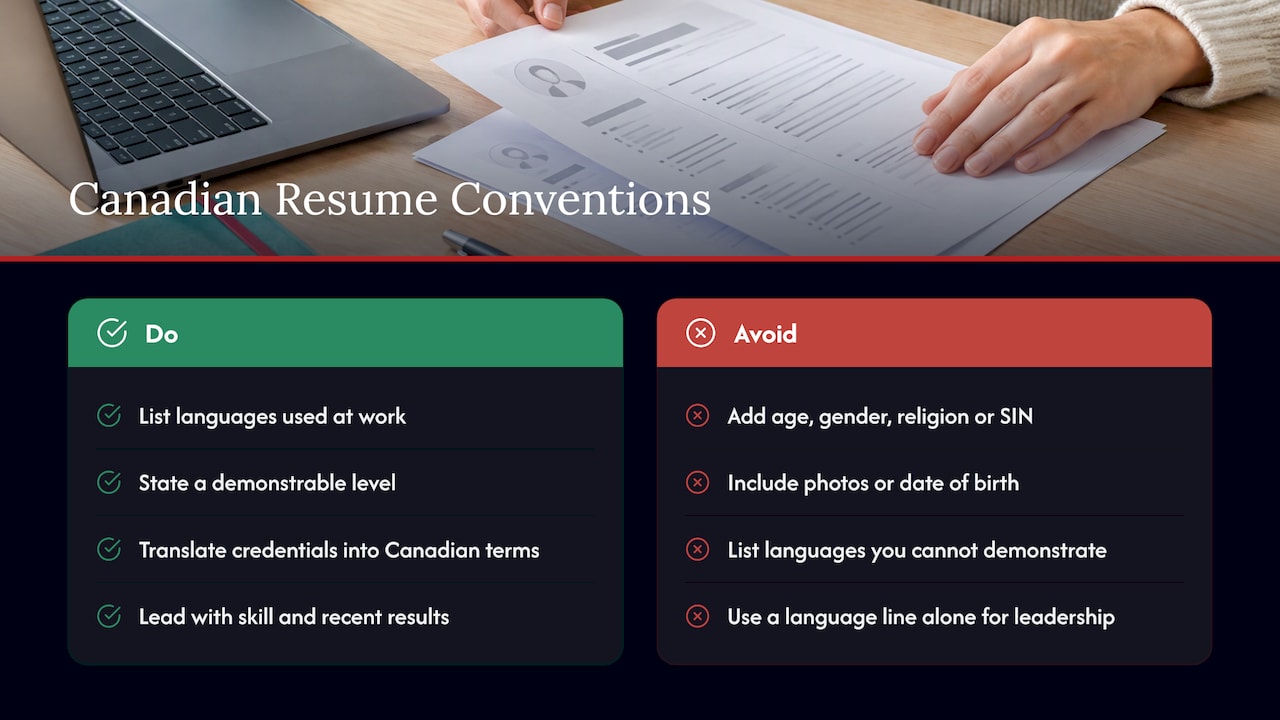
Executives. At senior level, bilingualism is read as a leadership capability: running a national P&L, representing the organization with francophone stakeholders, or leading teams in Quebec. Put it in the opening profile and back it with scope, not a language line alone. Our executive resume tips go deeper on that positioning.
Our perspective
We approach bilingual resumes as a positioning decision before a writing decision. The question is which employer you are addressing and in which language, and the document follows from the answer.
In our work, a resume is built through consultation and revisions, working directly with your writer. For bilingual candidates, that conversation settles the points that decide the result: the level you can honestly claim, the roles where the skill is required rather than optional, and which accomplishments show it in use.
We design every document with ATS-friendly formatting and with industry trends in mind, so the language claim reaches the recruiter intact and reads as a credential, not as a decoration.
Professional
Work with a writer on your bilingual resume
A resume that carries a language claim has to be precise, consistent and tailored to the sector. Professional Resumes writes customized resumes, cover letters and LinkedIn profiles, with consultation and multiple revisions, in ATS-friendly formatting. Resume packages are priced one-off by career stage: the Early Career Resume is $139, the Next Step Resume is $189, the Advanced Resume is $239 and the Executive Resume is $289. You can compare them in the resume shop.

If you also want your language skills visible to recruiters searching online, our LinkedIn profile optimization service covers your profile, and our LinkedIn profile checklist lists what a Canadian profile should contain.
Checklist before you submit
- The resume is in the language of the posting, with no mixed-language lines.
- Your level is stated in a recognized scale or in precise descriptive terms, and you could demonstrate it in an interview.
- Page one mentions the language in the summary, and at least one bullet shows it in use.
- For federal roles, reading, writing and oral levels are addressed separately where they differ.
- Both versions match on dates, titles, employers and figures.
- A fluent reader has proofread each version.
- The layout is single-column text, with no personal details such as age, marital status or photo.
FAQ
Should I write my resume in English or French?
Use the language of the job posting. In most provinces that is English, while for roles in Quebec French is expected. If the role requires both languages, prepare a version in each and send the one that matches, or both when the posting points to contact with francophones.
How do I describe my French level if I am not fully fluent?
Use wording you can support in an interview. McGill’s guide suggests listing “English, French” without a level if you can manage but are not fluent, and saving the details for the conversation. A recognized scale such as CLB/NCLC, or a TEF or TCF result, gives a more precise signal.
Do I need a bilingual resume for a federal government job?
Only if the position is designated bilingual. The Public Service Commission explains that such roles carry a level of A, B or C for reading, writing and oral interaction, with tests for second-language proficiency. Match your resume to the posting’s requirements and give evidence of each skill.
Can I put both languages on one page?
It is better not to. A single-language document is easier for recruiters and ATS software to read and match to keywords. Two clearly labelled versions are cleaner than one mixed document.
Sources
- How to Write an Effective Bilingual Resume, Indeed Canada
- Language requirements for candidates, Public Service Commission of Canada
- Résumés, Polytechnique Montréal
- Writing a cover letter and resume, Ontario Public Service
- Writing Your Résumé, Gouvernement du Québec
- C.V. Writing Guide, McGill University
- Resume writing tips for new immigrants, Randstad Canada
- Résumés and Cover Letters, Seneca Polytechnic
- Planning to work in Canada? An essential workbook, Government of Canada
- Find a job in Canada as a newcomer, Job Bank