

A strong Canadian teacher cover letter is one page, addressed to a named contact, and written for the specific school board and posting. It explains how your training, classroom experience and teaching approach meet the needs the employer has described, and it does not retell your resume. The sections below show the structure, how to tailor it, a sample body paragraph, and the errors that weaken otherwise good applications.
TL;DR
- Keep the letter to one page, dated, and addressed to the named hiring contact or the department named in the posting.
- Open with how you found the position, then spend the body on why you fit this board, this grade range and this subject.
- Use one or two concrete classroom examples with an outcome, not a repeat of your resume.
- Substitute, new graduate and internationally trained applicants each need a slightly different emphasis, covered below.
- Proofread for acronyms and unexplained jargon, and match the letter’s formatting to your resume.
Table of Contents
- What a teacher cover letter does in Canada
- The structure that works
- Tailoring the letter to a school board posting
- A sample body paragraph, and why it works
- Variations: substitute, new graduate and internationally trained teachers
- Mistakes that weaken a teacher cover letter
- Format and length for a one-page letter
- Our perspective
- Getting professional help with your application
- FAQ
- Sources
What a teacher cover letter does in Canada
A resume lists what you have done. A cover letter tells a principal, a vice-principal or a hiring committee why that history matters to their students. University teacher-education programs in Canada treat it this way. The University of Lethbridge’s teacher employment resources note that, for a teaching position, the letter looks forward and should reflect the training, experience and vision of a young teacher.
That forward-looking quality is what separates a teaching letter from a generic one. A school board reading hundreds of applications is not asking whether you have taught. It is asking whether you can teach Grade 4 French Immersion in this community, support students with an Individual Education Plan, and contribute to the school beyond the classroom.
The letter also demonstrates your writing. Teachers write report cards, parent emails and learning plans, so errors in a cover letter carry more weight in this profession than in many others.
The structure that works
The Gouvernement du Québec’s employment guidance gives a clear outline. It recommends a maximum of one page and a layout of a dated heading with the recipient’s name, title and professional address, an opening, one or two paragraphs on your fit, a closing paragraph thanking the reader and stating your availability for an interview, a formal closing, your signature and your contact details.
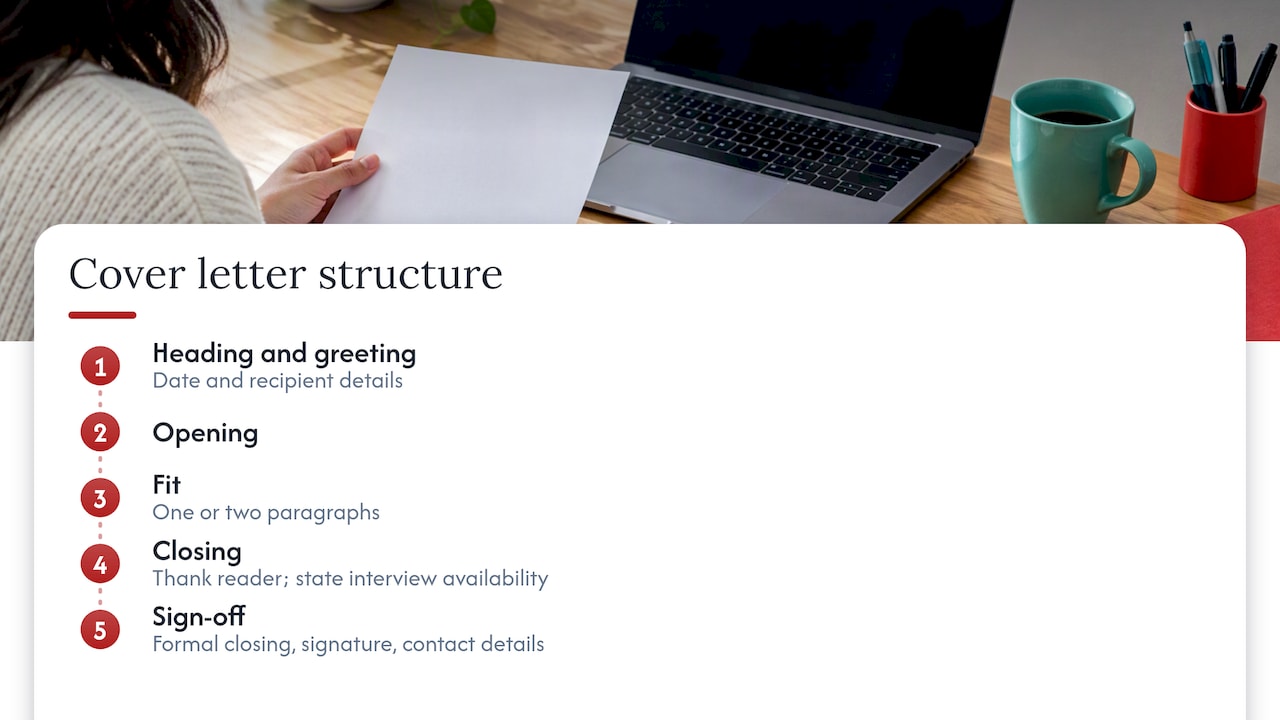
For a teaching application, that translates into five parts.
1. The heading and greeting
Include the current date, the contact’s name and title, and the school board’s or school’s address. The University of Toronto’s OISE placement handbook states that the document should be personalized with the date, the contact’s name and title, and the organization’s address.
If the posting gives no name, address the letter to the department or group it names. The same handbook suggests wording such as “Dear Human Resources” or “To the attention of the Hiring Committee” and advises avoiding “To whom it may concern” wherever possible.
Many boards run applications through an online portal, where you may upload a single document or paste text. The structure stays the same. If you are unsure whether to attach a letter or write a short email, our guide on cover letter versus email in Canada explains when each is appropriate.
2. The opening paragraph
State the position, the school or board, and how you heard about it. The Québec guidance describes the first part of the letter as the place to say how you learned of the job, with the second part explaining why you are the right person.
Good openings are specific. Name the grade range, subject and school, and add one line that signals your fit.
I am applying for the Grade 5 classroom teaching position posted on your board’s careers page. As an Ontario-certified teacher with two long-term occasional placements in intermediate math and a focus on inquiry-based learning, I would bring both subject depth and classroom stability to your school.
Weak openings state only your enthusiasm. A principal cannot act on enthusiasm alone.
3. The fit paragraphs
This is the core of the letter, and it should take one or two paragraphs. Cover the elements a hiring panel looks for:
- Relevant classroom experience, including practicum and placements
- Teaching skills such as differentiated instruction, assessment practices and classroom management
- Achievements, with data or a short anecdote where you can
- Certifications and additional qualifications
- Teaching-related work outside school, such as coaching, tutoring, camps or curriculum committees
This list follows the categories in Indeed Canada’s guide to teacher cover letters. The OISE handbook adds a useful standard: use positive, assertive language, and when possible include data or specific anecdotes showing impact on student learning.
4. The closing paragraph
Express continued interest, thank the reader for their time, and state your availability for an interview. Keep it short and direct.
5. The sign-off
Use a formal closing such as “Sincerely,” followed by your name, phone number, email address and, if you maintain a professional one, your LinkedIn address.
Tailoring the letter to a school board posting
Canadian education hiring is structured around boards, districts and divisions, and each has its own priorities. The OISE handbook advises researching the target board’s needs, mandate and objectives and tailoring the letter to the position, noting that an untargeted document gives an employer little incentive to read it.
In practice, tailoring takes about twenty minutes and follows a simple routine:
- Read the posting twice and underline the requirements: grade, subject, program (such as French Immersion, Core French, special education or Indigenous education) and any named priorities.
- Open the board’s website and find its strategic plan or equity and student-achievement priorities. Choose one that genuinely connects to your experience.
- Match two or three posting requirements with a specific example from your own teaching.
- Reuse the structure of your letter, never the content. A paragraph written for one board rarely fits another without changes.
The Gouvernement du Québec advises applicants to address the employer’s needs described in the job offer rather than speak only about themselves. A teacher cover letter that reads “I am passionate about helping every student” could be sent to any school. One that reads “Your posting asks for experience with literacy intervention, and in my placement I ran a small-group reading program that moved six students up a reading level” could not.
That last sentence is an example of the pattern, not a statistic. Use your own real numbers, and only ones you can support in an interview.
A sample body paragraph, and why it works
Here is a model fit paragraph for a primary teacher. Adapt the facts to your own record.
During my final practicum in a Grade 2 class, I noticed that several students avoided independent reading. I introduced a weekly choice-based reading station, tracked progress with short running records, and shared the results with my associate teacher and families at conferences. By the end of the term, most of those students were selecting books on their own. I would bring the same attentiveness to assessment and family communication to the primary team at your school.
Three things make it effective. It names a classroom problem, so it reads as a lived experience. It describes an action and a method of measuring it, and it ends by linking the experience to the future role. It also says something the resume cannot say as clearly: how you think.
For more on building this kind of paragraph, our guide to the Canadian cover letter with one STAR paragraph walks through the situation, task, action and result approach step by step.
Variations: substitute, new graduate and internationally trained teachers
Substitute and occasional teachers
A substitute letter is not a lesser version of a permanent one. It emphasizes adaptability. Indeed Canada notes that a substitute letter can describe the skills and qualifications needed to lead a class, sometimes across a wide range of students and subjects. Highlight your range of grade levels, your ability to follow a lesson plan left by another teacher, your classroom management in unfamiliar settings and your reliability. Mention any background checks you have completed, and the same guide’s advice to match your letter and resume formats is worth following so the package looks consistent.
New graduates
If your classroom experience is limited to practicums, use them fully: the grade levels, the associate teachers’ feedback you can honestly report, the units you designed, and your volunteer or coaching work. Our page on early career resume tips for fresh graduates covers how to present this experience on the resume itself. For the letter, the principle of leaning on specific accomplishments instead of general claims is explained in this guide to writing a letter with limited experience.
Internationally trained teachers
Teaching in a Canadian publicly funded school generally requires provincial certification. In Ontario, for example, the Ontario College of Teachers states that you must be certified by the College to teach in publicly funded schools. Each province or territory has its own certifying body and process, so check the one where you are applying.
In your letter, state your certification status plainly: certified, application in progress, or eligible and applying. Then explain how your classroom practice maps onto the Canadian curriculum and the diversity of the classrooms you are applying to. If you are building your Canadian application documents from scratch, our resume writing services for newcomers to Canada page explains how we adapt international experience for local employers.
Mistakes that weaken a teacher cover letter
The same few errors recur in application packages.
- Talking only about yourself. The Québec guidance lists this first among mistakes to avoid. The letter must address what the school or board needs.
- Repeating the resume. Both the Québec guidance and the OISE handbook warn against copying the resume. Use the letter to give context and specific examples of how you applied your skills.
- Exceeding one page. Hiring teams read many applications. A second page is rarely read.
- Unexplained acronyms. Bishop’s University advises that no unfamiliar acronyms be used, so the recruiter can quickly grasp your qualifications. Terms such as IEP, ELL or AQ are familiar to teachers but may not be to a human resources screener, so spell them out the first time.
- Skipping the proofread. The Québec guidance recommends rereading the letter carefully before sending it. Read it aloud, and have a colleague or associate teacher review it.
- Generic salutations and board names. Sending a letter that names the wrong school or board is among the fastest ways to be set aside.
Format and length for a one-page letter
A one-page letter typically runs between 250 and 400 words, depending on spacing and margins. Use a plain, legible font at a readable size, consistent margins, and a header that matches your resume. Your resume and letter should look like a matched set. Our guides on simple resume format for Canada and choosing the right Canadian resume format cover fonts, layout and sections for both documents.
Save the file as a PDF unless the portal asks otherwise, and name it clearly, such as “Lastname_Firstname_Teacher_Cover_Letter.”
Our perspective
Teaching applications are won on specificity. In our work with education professionals, we see the same pattern: capable teachers send a letter that could describe any teacher, and the reader cannot see the classroom behind it.
We approach each cover letter as part of a matched application. The resume establishes the facts, the letter explains the judgment behind them, and both are written for the board and posting in front of you. That is why our process begins with a consultation, where you work directly with your writer to identify the two or three experiences that speak to the role.
We format documents to be ATS-friendly, because many employers use applicant tracking systems before a human reads the file. We also build in revisions, because a teaching application deserves precision, and because your first draft rarely captures your best example.
Our aim is a letter you can stand behind in an interview, because every claim in it is something you can discuss in detail.
Professional
Getting professional help with your application
If you are applying to several boards or moving into teaching from another country or career, a writer can save time and sharpen the story. We create customized resumes, cover letters and LinkedIn profiles for job seekers across Canada, including education professionals. Our teacher resume writing services page describes how we work with teachers, and our education resumes page covers wider roles in the sector.
Our Early Career Resume is $139, Next Step Resume is $189, Advanced Resume is $239 and Executive Resume is $289, each a one-off price. You can compare them on the resume shop page.

If you already have a resume and need the letter and the LinkedIn profile to match it, ask about our LinkedIn profile optimization service. Many school leaders and recruiters search LinkedIn, so a consistent profile supports the application you send.
FAQ
How long should a teacher cover letter be in Canada?
One page. The Gouvernement du Québec’s guidance sets a maximum of one page, and most Canadian teacher-education programs give the same advice. In practice that means a short opening, one or two paragraphs on your fit and a brief close.
Who should I address the letter to if the posting names no one?
Address it to the department or group named in the posting, such as Human Resources or the Hiring Committee. Before settling on that, check the school or board website for the principal or hiring contact. Avoid “To whom it may concern” where you can.
Should I send a cover letter for a substitute teaching position?
Yes, if the board or portal accepts one. Keep it brief and focus on adaptability across grades and subjects, your classroom management and your reliability. Match its format to your resume so the two documents look consistent.
Can I reuse the same letter for different school boards?
Reuse the structure, not the text. Each board has its own priorities, programs and community, and a letter that is not targeted gives the employer little reason to read it. Plan on adjusting the opening, the fit paragraphs and the closing for every application.
Do I need to mention my certification in the letter?
Yes, state your certification status clearly. Provincial certification, such as with the Ontario College of Teachers, is required to teach in publicly funded schools in that province, so the hiring team will look for it. If your application is in progress, say so and name the certifying body.
Sources
- Writing a Cover Letter, Gouvernement du Québec
- Sample Job Search Documents, University of Lethbridge
- Professional Practice Courses handbook 2025-2026, OISE, University of Toronto
- Guide for Cover Letter, Bishop’s University
- Requirements, Ontario College of Teachers
- Guide to Teacher Cover Letters, Indeed Canada
- How to Write a Substitute Teacher Cover Letter, Indeed Canada