
Include volunteer experience on your resume whenever it demonstrates job-relevant skills, leadership or measurable impact. Place it inside your professional experience section when the responsibilities closely match the role you want; otherwise, give it a clearly labelled volunteer or community section. What matters most is specificity and quantified results, not the number of causes you have supported.
TL;DR:
- A hiring experiment found that applicants with volunteer experience received one third more interview invitations, with the effect appearing across sectors and stronger for women.
- Roughly 82% of hiring influencers said they were more likely to choose candidates who volunteer, especially when the work showed relevant skills or leadership.
- Use a role title, concrete duties, and a measurable result; recruiters rate volunteer work comparably to paid experience when entries receive similar professional detail.
- Place sustained roles with matching duties in the main work history, but group brief or unrelated commitments under Additional Activities or omit them.
- Mirror accurate job posting keywords, use month and year dates, and avoid tables or decorative symbols that can interfere with applicant tracking systems.
Table of Contents
- Why volunteer experience strengthens a job application
- Where to place volunteer experience on your resume
- Writing volunteer bullets that read like professional achievements
- Formatting volunteer entries so they read like paid roles
- Handling unrelated, short-term or informal volunteer roles
- How Professional Resumes approaches volunteer experience
- A priority rule worth remembering
- Turn your volunteer work into a stronger resume
- FAQ
- Sources
Why volunteer experience strengthens a job application
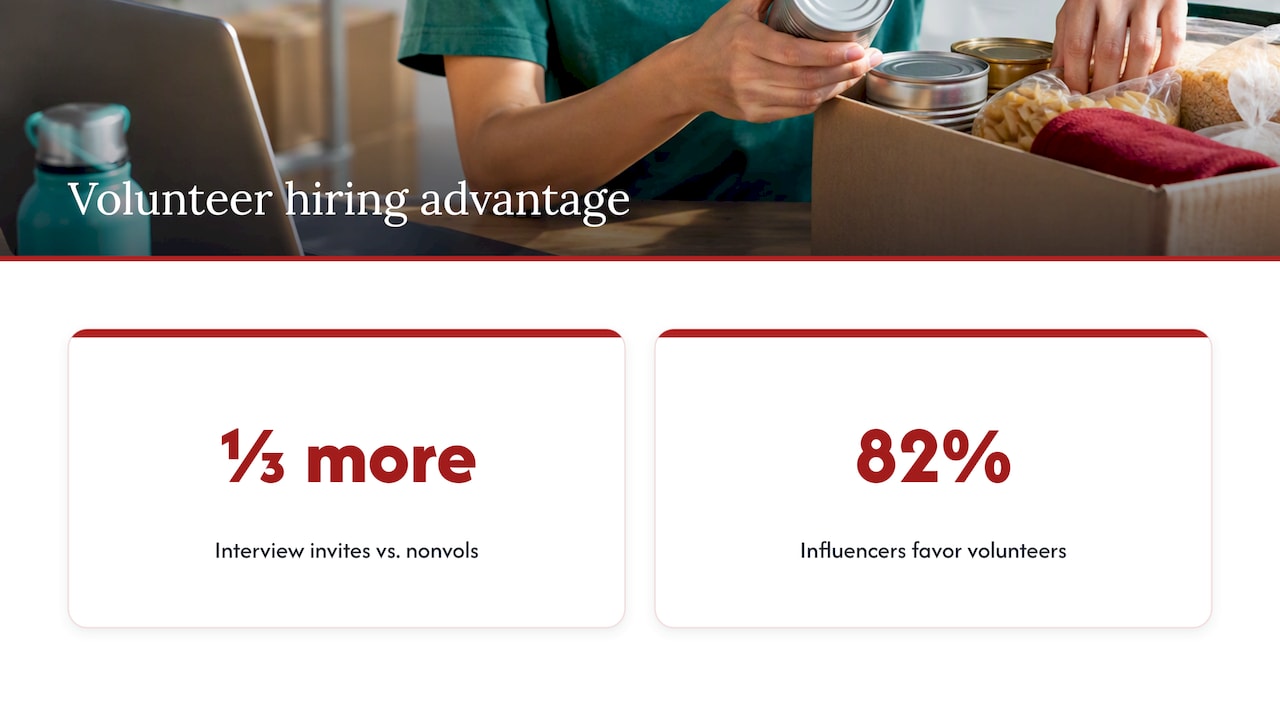
The evidence favours including it. A field experiment on hiring outcomes found that applicants with volunteer experience received one third more interview invitations than otherwise identical candidates without it, with the effect holding across sectors and appearing even stronger for female applicants. That is a meaningful advantage in a competitive hiring process, and it suggests recruiters read volunteering as a genuine signal rather than filler.
Roughly 82% of hiring influencers said they would be more likely to choose a candidate who volunteers, according to a Deloitte Impact Survey, which also found that many employers overlook minor resume flaws when volunteer work demonstrates leadership or relevant skills. The same survey noted that only a minority of resumes mention volunteering at all, which means most candidates leave this advantage on the table.
Employers tend to read volunteer work as evidence of leadership, initiative, teamwork and comfort stepping outside a defined job description. Recruiter-focused research found that when volunteer experience is presented with the same professional detail as paid work, recruiters rate it comparably to paid experience. This matters most for recent graduates with thin work histories, career changers bridging into a new field, and anyone with a gap who needs to show continuous skill-building.
Where to place volunteer experience on your resume
Placement depends on how closely the volunteer role mirrors paid work and how much responsibility you carried. Two clear patterns emerge from recruiter research and practical resume guidance.
- Fold it into professional experience when your duties matched or exceeded those of a paid role, you held the position for a sustained period, or you led a team or budget.
- Give it a separate section when you held several short, unrelated roles or when the involvement reflects background community commitment rather than a defined function.
- In a chronological resume, integrated volunteer roles sit in the main timeline; a dedicated section usually follows paid work, before education.
- In a functional or hybrid resume, volunteer achievements can anchor a skills-based grouping, with a brief chronological list underneath for context.
- Date formatting should match your paid roles exactly (month and year), and ongoing commitments are noted as “Present” the same way you would for a current job.
A recruiter study suggests that a resume mixing relevant paid and volunteer experience often earns better ratings than one built on paid experience alone, particularly when a candidate’s work history is short. If you are unsure, default to a separate section labelled clearly: it never looks out of place, and it keeps your paid work history easy to scan.
Writing volunteer bullets that read like professional achievements
The CAR framework, which is Context, Action, Result (also known as STAR when you separate Situation and Task), turns a vague line into one that earns attention. A weak bullet like “Helped at a food bank” becomes “Coordinated weekly food bank distribution for 120 households, recruiting and scheduling 15 volunteers to cut wait times by half.” The second version states the setting, what you did, and what changed.
Career guidance on community service recommends dropping generic labels like “Volunteer” in favour of a role title, concrete duties and a number wherever one exists. A resume gets a 6 to 10 second scan, and numbers are what a recruiter’s eye catches first.
Group your action verbs by function so you are not repeating the same word across every bullet:
- Leadership: led, directed, coordinated, organized, mentored, supervised, recruited.
- Operations: managed, scheduled, streamlined, maintained, allocated, tracked, distributed.
- Communication: presented, facilitated, advocated, drafted, liaised, trained, campaigned.
- Technical: built, designed, analyzed, programmed, migrated, automated, documented.
Sample bullets across career stages:
- Early career: “Tutored 8 high school students weekly in math, with 6 of 8 improving by one letter grade over a semester.”
- Early career: “Organized campus clothing drive that collected over 400 items for a local shelter.”
- Mid-career: “Managed a $15,000 annual budget for a community arts program serving 200 families.”
- Mid-career: “Built and maintained a volunteer scheduling system for 40 staff, reducing shift gaps by a third.”
- Leadership: “Directed a 12-person committee planning a fundraising gala that raised $85,000 for youth programs.”
- Leadership: “Trained and onboarded 25 new volunteers per quarter, improving retention over two seasons.”
Pro Tip: Write down the scope, the people involved and the outcome within a day or two of finishing a volunteer shift or project, since those details fade faster than you expect and are what make a bullet credible later.
Formatting volunteer entries so they read like paid roles
The heading you choose signals how central the experience is. “Relevant volunteer experience” works when the role maps directly to the job you want. “Community leadership” fits sustained, responsibility-heavy involvement. “Additional activities” suits shorter or more tangential commitments that still deserve a mention.
- List the organization name, your role title, location and dates in the same format you use for paid positions.
- Note unpaid status only if the role title alone would be confusing, and keep it brief, such as “(volunteer position)” rather than a qualifier that undersells the work.
- Mirror keywords from the job posting; a role described as “program coordinator” in a posting should appear that way in your bullet if it fits your actual duties, which also helps you pass ATS parsing.
- Use plain month-year dates and avoid decorative bullets, icons or tables, since non-standard characters can break applicant tracking systems.
Handling unrelated, short-term or informal volunteer roles
Not every volunteer commitment earns its own bullet, and padding a resume with minor roles dilutes the stronger ones. A single afternoon of event help or a one-off donation drive rarely justifies a dedicated line.
- Omit roles with no measurable contribution and no connection to the job you are targeting.
- Condense several small, unrelated roles into one “Additional activities” line with a single impact phrase, such as “Volunteered with three local nonprofits on event logistics and fundraising, 2023 to 2025.”
- Keep anything that shows a skill gap filled, even briefly, since a short data-entry stint can matter for an administrative role.
- Prepare a 30 to 60 second verbal version of your strongest volunteer bullet using the CAR structure, since interviewers often ask candidates to expand on a resume line they found interesting.
How Professional Resumes approaches volunteer experience
Our writers treat a volunteer role the same way we treat a paid one: a set of responsibilities and outcomes that deserve precise, ATS-ready language. During consultation, we ask targeted questions about scope, team size and results so vague activity becomes a quantified achievement, the approach we also use in our IT resume case study, which shows volunteer technical projects reframed into interview-ready bullets. For recent graduates, our early career resume guidance leans on volunteer work to offset a thin paid history.
When our team edits a volunteer entry, we check for:
- A role title that reads clearly against the target job description.
- At least one quantified outcome, whether that is people served, funds raised or hours saved.
- Keyword alignment with the posting, without forcing language that misrepresents the work.
A priority rule worth remembering
After years of reviewing resumes, the pattern that stands out is simple: relevance beats quantity, and quantity beats length. One well-measured volunteer bullet tied to the job description outperforms a crowded list of causes with no detail behind them. Save your best stories and specific numbers for the interview, where a recruiter can ask follow-up questions and the full impact of the work comes through.
— Professional
Turn your volunteer work into a stronger resume
Most job seekers undersell their volunteer experience because they are too close to it to see what counts as an achievement. We close that gap through direct consultation, pulling out the scope and results you would otherwise leave off the page. Our Early Career Resume service is built for recent graduates who need their volunteer work to carry real weight alongside limited paid experience. For mid-career and leadership candidates with more complex volunteer histories, our Advanced Resume service applies the same consultation-driven, ATS-friendly rewriting to board positions, committee leadership and sustained community roles.
Every package includes direct work with your writer through consultation and revisions, so volunteer achievements get the same measurable-impact framing we apply to paid roles. If you also want your LinkedIn profile to reflect that same story, our LinkedIn profile optimization service extends the work beyond the resume. Browse our full range of resume packages to find the fit for your career stage.
FAQ
How do you describe a volunteer experience on your resume?
Use a clear role title instead of the word “Volunteer,” then list concrete responsibilities and at least one measurable outcome, the same way you would describe a paid position. Career guidance on community service recommends this approach specifically because vague labels make a recruiter skim past the entry.
What are examples of volunteer experience?
Common examples include tutoring, food bank coordination, event fundraising, committee leadership, mentoring programs and nonprofit board service. The strongest resume examples name a specific scope, such as people served or funds raised, rather than describing the cause alone.
Is it worth putting volunteer experience on a resume?
Yes: a field experiment found that volunteers received one third more interview invitations than non-volunteers, and a Deloitte survey found that roughly 82% of hiring influencers favour candidates who volunteer.
Can I put volunteer experience as work experience?
Yes, when the responsibilities and time commitment match a paid role, folding it directly into your professional experience section is appropriate. Recruiter research suggests that resumes blending relevant paid and volunteer experience often receive stronger overall ratings than paid experience alone.
Sources
- Does It Pay to Care? Prosocial Engagement and Employment Opportunities
- Deloitte survey finds that a mere 30 percent of resumes include volunteering, despite the known benefits to career advancement
- How to show community service on your resume and school applications
- Do I look like someone who cares? Recruiters’ ratings of applicants’ paid and volunteer experience