

Lead with one specific accomplishment or employer connection that proves you can solve the hiring team’s immediate problem. Name the role and your reason for the pivot in a single line, show two or three transferable skills with a tiny piece of proof each, and close with a short, employer-focused call to action. Skip apologies and let your results carry the argument.
TL;DR:
- Spend ten minutes reviewing the posting’s verbs and outcomes, then mirror its language truthfully and place its highest priorities in the letter’s first half.
- Choose two or three skills the posting stresses, attach a concrete result to each, and use only figures you can defend in an interview.
- Use volunteer work, courses, or personal projects as evidence when they show real output, and connect each example to a specific need in the target role.
- Draft the body before choosing the opening hook, then keep the finished letter to one page and close by naming a next step for the employer.
- Follow up after the stated closing date, or after applying if none is listed; send one polite note and avoid repeated messages.
Table of Contents
- How do you open a career-change cover letter?
- How do you explain the career change and show transferable skills?
- What do annotated career-change cover letter examples look like?
- How do you tailor the letter to the job posting and employer?
- How should you close the letter and follow up?
- What are the most common mistakes in a career-change cover letter?
- What should each paragraph of the letter include?
- How do you address a lack of direct experience?
- How do you highlight education, certifications and training?
- How do you explain motivation and passion for the new career path?
- How do you mention networking or a referral?
- What our consultation process teaches us about career-change letters
- How can Professional Resumes help you write a stronger career-change letter?
- FAQ
How do you open a career-change cover letter?
The opening has one job: show intent and relevance before the reader decides you are off-track. Hiring managers skim, so a clear opening helps the rest of the letter get a fair read. Avoid apologies (“Although I have no direct experience…”) and generic lines (“I am writing to apply for…”). Recruiters tend to prefer a specific achievement or a direct link to the employer, because either one tells them the application is deliberate and not a mass submission.
Three hook types work well for career changers:
- Achievement hook: Open with a result that maps to the new role. “I improved hotel staff onboarding by rebuilding our training process, and I want to apply the same approach to customer onboarding at Northwind.”
- Employer connection hook: Tie yourself to something specific about the company. “After using your scheduling platform to run a clinic, I understand the problems your customer success team solves.”
- Mission fit hook: Link a real motivation to the employer’s work. “Your commitment to making financial tools plain-spoken is the reason I moved from retail banking toward product analysis.”
Treat the examples above as templates. Swap in your own numbers, tools and company details, and keep every claim true.
Before you move on, run a quick edit on your first paragraph: cut any sentence that could appear in anyone else’s letter, remove words such as “passionate” unless a fact backs them, and confirm the target job title appears once.
Pro Tip: Write the opening last. Once the body is finished, you will know which result and which skill matter most, and the hook becomes a matter of choosing the strongest one.
How do you explain the career change and show transferable skills?
Think of this as translation. Career-design practitioners advise mirroring the language of the new job posting and dropping old-industry jargon, so the reader can see at a glance how your past results map to the role. A hospitality manager does not “run the floor”; they “coordinate cross-functional teams under tight deadlines.” Same work, different vocabulary.
Practitioners also warn against apologetic framing. The inferred competence approach leads with how your proven skills solve the employer’s problems, instead of dwelling on what you lack. If you want to see the same principle applied on a resume, our guide on refreshing a resume for a mid-career transition covers it in detail.
Use this sequence to build the explanation paragraph:
- State the move in one sentence: your current field, the target role, and the reason in plain terms.
- Pick the two or three skills the posting stresses most.
- Attach one piece of proof to each skill.
- Link the proof to what the employer needs next.
- Stop. A paragraph that keeps explaining begins to sound defensive.
Here are proof templates for common transferable skill categories:
- Project delivery: “Delivered [project] under [constraint], which [result].”
- Stakeholder communication: “Coordinated teams or clients through [process], reducing [problem].”
- Problem solving: “Identified [issue], tested [fix], and [outcome].”
- Data and reporting: “Built [report or tracker] that let [group] decide [what], faster.”
- Training and leadership: “Trained people on [skill], which led to [outcome].”
Quantify honestly. If you do not have an exact figure, use a bounded, truthful description: “across every shift over an extended period” or “for the regional team” is stronger than an inflated percentage you cannot defend in an interview. Use rounded numbers only when you could still back them up.
A short worked example shows the translation at work. Say an events coordinator is applying for a project coordinator role. The weak version reads: “I have organized many events and I am eager to learn project management.” The translated version reads: “I coordinated vendors, budgets and volunteers for a large conference, delivering it on schedule and on budget. That is the same planning discipline your project coordinator role asks for: sequencing tasks, tracking risks, and keeping stakeholders informed.” The second version uses the posting’s language, names the proof, and never mentions what is missing.
If you want to build a vocabulary bank before drafting, our walkthrough on a transferable skills resume using Job Bank terms shows how to match your experience to standard occupational wording.
What do annotated career-change cover letter examples look like?
Each example below is short on purpose. Read the notes, copy the structure, and replace the details with your own. All names, figures and employers are illustrative.
Statistic callout: A cover letter is only as good as its proof, so every claim in the examples below carries a concrete result you would need to replace with your own verified one. Never reuse a number you cannot support.
Example A: hospitality to customer success
I led a front-desk team of 12 through a property-wide software changeover, bringing every shift to full confidence within three weeks. Customer success at Northwind asks for the same skills: onboarding people to new tools, calming frustration in real time, and turning complaints into retention. In my current role I resolve guest escalations regularly and track the root causes so the same issue does not come back.
- Why it works: The first sentence is an achievement tied to onboarding, which is the core of customer success. Hospitality terms such as “front desk” are present only as context.
- What to swap: The team size, timeline, and the count of escalations.
- Template: “I [led or handled] [number] [people or cases] through [change or problem], reaching [result]. [Target role] asks for the same skills: [skill 1], [skill 2] and [skill 3].”
Example B: operations or engineering to product analyst
In my role as a process engineer, I built a weekly dashboard that showed where a production line lost time, and my team used it to cut unplanned stoppages. Your product analyst posting stresses turning usage data into decisions. I have done the same with machine data: define the question, clean the numbers, present a recommendation, and check whether it worked.
- Why it works: It translates technical output (a dashboard) into the outcome the analyst role cares about (decisions).
- What to swap: The tool, the metric, and the decision your analysis supported.
- Template: “I built [tool or analysis] that helped [group] [make a decision], leading to [result]. [Role] asks for [skill]; I have applied it to [your data context].”
Example C: project manager to product manager
I have led cross-functional delivery for a small team, aligning engineers, designers and customers on one roadmap. I shipped a client portal ahead of plan after cutting scope with the stakeholders’ agreement. I want to move from delivering what is requested to deciding what is worth building, and your product manager role is built around that shift.
- Why it works: It names the real gap (prioritization) without apologizing for it, and it backs leadership with a delivery result.
- What to swap: Team size, the product shipped, and the trade-off you negotiated.
- Template: “I have [led or delivered] [project] for [team], [result]. I am moving toward [new responsibility], which is the core of [target role].”
Example D: recent graduate or entry-level pivot
Although my degree is in biology, I spent my final year building a public data project that tracks local air quality and presenting findings to a city volunteer group. That work taught me to ask a clear question, work with messy data, and explain results to non-specialists, all skills your junior analyst role requires. I would welcome the chance to bring that approach to your team.
- Why it works: Project-based evidence replaces work history, and the final sentence is employer-focused.
- What to swap: The project, the audience, and the skills your posting names.
- Template: “I built [project] that [result], teaching me [skill 1], [skill 2] and [skill 3], which match [role requirements].”
Want to see how real before-and-after documents read? Our case studies and samples show the kind of reframing described above.
How do you tailor the letter to the job posting and employer?
Tailoring is a process, not a feeling. Spend ten minutes on the posting before you draft, and the letter nearly writes itself.
- Mark the verbs. Highlight what the employer wants done: “coordinate”, “analyze”, “resolve”, “launch”. These become your verbs.
- Find the outcomes. Note what success looks like, such as faster response times or fewer errors. Your proof should point at the same outcomes.
- Rank the priorities. The posting’s highest-priority items usually carry the most weight. Cover those in the first half of the letter.
- Swap the jargon. Replace old-industry terms with the employer’s. “Covers” becomes “scheduling”, “regulars” becomes “repeat customers”, “rounds” becomes “daily checks”.
- Check the culture cues. Read the About page and recent announcements for one detail you can reference honestly.
A before-and-after rewrite shows the effect. Before: “I managed a busy kitchen and kept the line moving.” After: “I managed a team under daily deadline pressure, coordinating suppliers and schedules to keep output steady.” The second version speaks in the language of operations, which is what a logistics posting will use.
Reuse exact phrases from the posting where they accurately describe your work, because applicant tracking systems often scan for matching terms. Paraphrase whenever matching the phrase word for word would claim experience you do not have. Our guide to passing ATS in a career-change resume explains how the same logic applies to your resume.
Pro Tip: Before sending, read the opening of the posting and the opening of your letter side by side. If a stranger could not tell they belong to the same conversation, revise.
A short pre-send check: the job title is correct, the company name is spelled correctly, relevant posting phrases appear naturally, and no old-industry jargon remains unexplained.
How should you close the letter and follow up?
A good close restates what you bring and names a next step, in two or three sentences. It should read as confident, not pleading. Avoid “I hope you will consider me” and “I know I am not a typical candidate.”
Closing sentence options:
- “I would welcome a short conversation about how my delivery experience could support your team’s goals this year.”
- “I am available for a call next week and can share a brief example of how I approached [relevant problem].”
- “Thank you for your time. I look forward to discussing how I can help [team] reach [goal].”
Signal availability plainly (“I am available for a call or video meeting at your convenience”) and stop there. You do not need to explain why you are flexible or eager.
On timing, a common practice is to follow up after the stated closing date, or after applying when no date is given. Send one polite note, then wait. Following up repeatedly can undo the good impression your letter created.
A short follow-up email you can adapt:
Subject: Following up on [Role] application
Hello [Name],
I recently applied for the [Role] position and wanted to confirm my application arrived. I remain very interested in contributing to [specific team goal]. I would be glad to share more about [relevant result] if helpful.
Thank you for your time,
[Your name]
Networking after you apply also helps. This practical piece on graduate networking actions shows how short, regular outreach builds relationships over time, and the same habit works for career changers who want a warm connection inside a new industry.
What are the most common mistakes in a career-change cover letter?
Most problems fall into a few patterns, and each has a quick fix.
- Apologetic framing: “Although I lack experience…” hands the reader a reason to say no. Replace it with inferred competence: lead with what you have done that solves their problem.
- Vague claims: “I am a strong communicator” proves nothing. Swap it for one line of proof: “I presented weekly progress to a leadership team over an extended period.”
- Buried strengths: If your best skill appears only in the last paragraph or only on your resume, move it into the first half of the letter.
- Unfiltered jargon: Terms from your old field can confuse a new reader. Translate them into the posting’s language.
Two editing checks catch most of these: search your draft for “although”, “unfortunately” and “I lack”, and highlight every claim that has no number, example or named outcome beside it.
What should each paragraph of the letter include?
A career-change letter works best in a few short blocks, each containing a few sentences, on a single page.
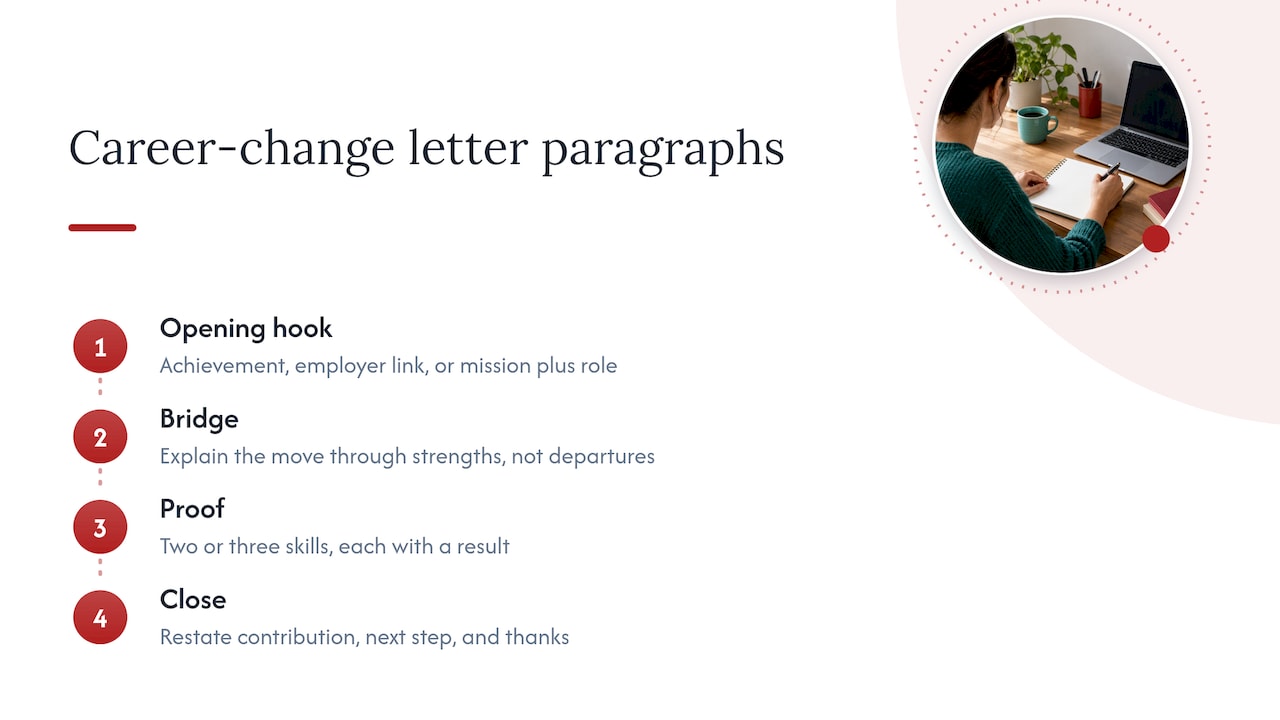
Opening hook. One achievement, employer connection or mission link, plus the role you are applying for. This paragraph earns the read.
Bridge. One paragraph that names the move and explains why it makes sense, in terms of what you offer rather than what you are leaving. Mention the old field only as the source of your strengths: “Eight years in hospitality taught me to resolve problems under pressure, which is the heart of customer success.”
Proof. The longest paragraph. Pick two or three transferable skills from the posting and give each a result. This is where your translated vocabulary and your numbers live. If you have a relevant course, project or certification, add it here in a single sentence.
Close. Restate your contribution, name the next step, and thank the reader. Keep it to two or three sentences.
For length, a concise letter that fits on one page is a useful target. Anything longer risks losing a reader who is reviewing dozens of applications. If a sentence does not move the reader toward “this person can do the job”, cut it or fold it into the paragraph where it belongs.
How do you address a lack of direct experience?
Do not hide it and do not dwell on it. The reader already knows your last job title is different from the one you want. What they are checking is whether you can do the work, so answer that question with evidence.
Start by naming the gap indirectly through the evidence you do have: “I have not held a product title, but I have spent three years deciding what my team builds next.” This acknowledges the difference and moves straight to proof.
Then use these approaches:
- Reframe past work as the same work. Most roles share core tasks such as planning, communicating, analyzing and problem solving. Show the overlap with specifics.
- Add side evidence. Volunteer projects, freelance jobs, internal initiatives and personal projects all count when they show real output.
- Show you have done the homework. One sentence about a recent course, a conversation with someone in the field, or a challenge you studied signals commitment more convincingly than “I am a fast learner.”
- Be specific about the first contribution. Describe what you could do early in the role. It shows you understand the role and shifts the focus from your past to their future.
Avoid hedging words such as “hopefully” and “I believe I could”. Say what you have done and what you would do, in plain statements.
How do you highlight education, certifications and training?
For a career changer, recent learning is often the most persuasive bridge between two fields. The goal is to make it visible without letting it replace proof of results.
Place relevant credentials near the proof paragraph, where they support a skill claim: “I completed a data analytics certificate and applied it immediately, building a sales tracker that my team now uses.” The credential explains the capability, and the sentence shows it in use.
Keep these habits:
- Choose relevance over volume. Mention the relevant courses or certificates that match the posting, not a full list.
- Name what you built. A course project, capstone or portfolio piece gives the reader something concrete to picture.
- Include in-progress learning. “Currently completing [program], with [module] finished” is acceptable and honest.
- Connect the learning to the employer’s tools. If the posting names specific software or methods, mention your training in them.
- Keep older degrees brief. An unrelated degree needs a short mention at most, unless it carries a transferable skill such as research or writing.
If your education is the main bridge, as with a recent graduate, give it more room and lead with projects. If you are mid-career, let your work results carry the weight and use training as supporting evidence.
How do you explain motivation and passion for the new career path?
Motivation is believable when it is specific and linked to action. “I have always been passionate about technology” is forgettable. “I started automating my team’s weekly reporting two years ago and found I enjoyed that part of the job more than any other” is a reason.
Use a simple structure:
- The trigger. A concrete moment, task or project that pointed you toward the new field.
- The action. What you did afterwards: a course, a side project, a conversation, a trial task.
- The link to this employer. Why this role and organization fit that interest.
Keep the tone grounded. Hiring managers read plenty of enthusiasm and little evidence, so let the evidence do the talking. A few sentences are enough.
Be careful with two traps. First, do not criticize your past employer or industry. “I am leaving because the field is declining” sounds like escape, while “I want to apply my experience where I can build products directly” sounds like direction. Second, avoid grand statements about destiny or lifelong dreams unless a real story supports them.
If your reason for changing is personal, such as relocation or a life event, you can keep it to one neutral clause or leave it out. The letter is about what you will do for the employer, and the reader does not need your full history to feel confident in your choice.
How do you mention networking or a referral?
A referral is one of the strongest openers a career changer has, because it answers the reader’s question about risk before they ask. Use it early and be specific.
Good pattern: “Maria Chen, a senior analyst on your data team, suggested I apply after we discussed [topic].” Get permission from the person first, and use their name and title accurately.
If you have no referral, a lighter connection still works:
- An informational conversation: “After speaking with a member of your customer success team about how onboarding works, I saw how closely it matches my work in…”
- An event or talk: “I attended your recent webinar on [topic] and was struck by [specific point].”
- Shared community: A professional association, meetup or online group, mentioned briefly and truthfully.
Keep the mention to one sentence, then move on to your proof. A referral opens the door, but your evidence has to carry you through it.
Do not name-drop people you barely know or imply endorsement that does not exist. Recruiters often check, and a small exaggeration can end an otherwise strong application. When in doubt, describe the interaction exactly as it happened.
Finally, thank anyone who helped, and let them know how it went. Those relationships often matter more than the application itself.
What our consultation process teaches us about career-change letters
In our work with job seekers, the same pattern shows up again and again: people undersell what they have already done. A short consultation usually uncovers achievements the client never thought to mention, because to them those tasks were just part of the job. Our writers then frame those results in the hiring team’s language, which is why we put translation ahead of polish.
The key point is clear. The reader needs a reason to keep reading, and proof supplies it faster than explanation does.
Whether to write your own letter or ask for help comes down to time and confidence. If you can gather your results, read the posting closely, and edit ruthlessly, the templates above will carry you far. If you would rather have a second set of eyes on what to emphasize, that is the work we do.
— Professional
How can Professional Resumes help you write a stronger career-change letter?
Hiring teams often review applications quickly, so a letter that makes your transferable results obvious can be the difference between a reply and silence. We write documents built around your own achievements, shaped through a consultation and refined through revisions.
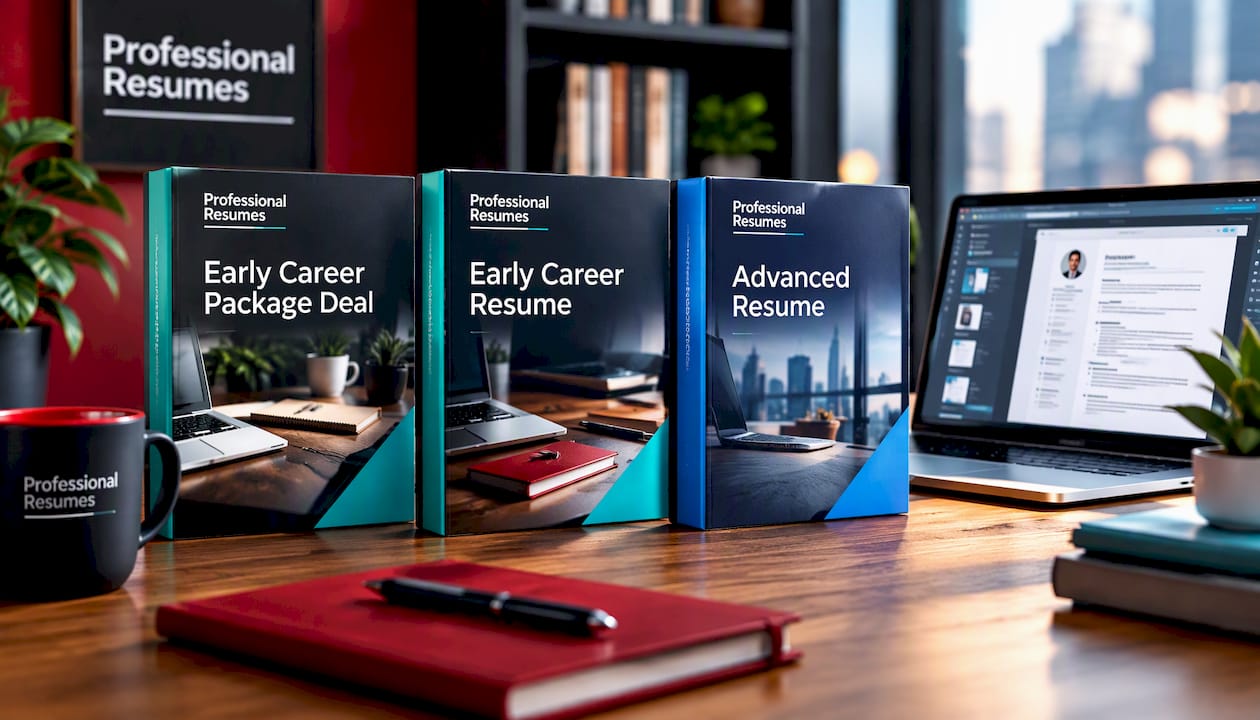
Here is what suits career changers:
- Early Career Package Deal: A bundled option for people entering or pivoting into a new field who want documents that work together.
- Early Career Resume: Priced at $139 one-off, it’s built for people with limited experience in the new field.
- Advanced Resume: Priced at $239 one-off, it’s designed for experienced professionals translating deep expertise into a new role.
We also offer LinkedIn profile optimization so your online profile tells the same story as your letter. You can browse every resume option and pick the one that fits where you are now.
FAQ
How do you write a resume when changing careers?
Lead with a short summary that names your target role and your two or three strongest transferable skills. Then rewrite your experience bullets in the language of the new field, putting results first. Our guide on resumes for career change walks through the steps.
Are cover letters outdated in 2026?
No, they still matter most when your job history does not point directly at the new role. A strong letter explains the connection your resume cannot, which is exactly what a career changer needs. Always follow the employer’s instructions if the posting says a letter is optional or not accepted.
How do you write a cover letter for a new job?
Open with a specific achievement or employer connection, bridge to the role in a sentence or two, support it with proof for two or three skills, and close with a short call to action. Keep the letter concise and tailor it to each posting.
Do you bring a cover letter to a career fair?
It is usually not required, but a printed resume is expected. If you want to stand out, bring a short, tailored note for a role you are targeting. Treat the conversation itself as your cover letter and lead with the same hook you would use on paper.