
A federal cover letter in Canada is not a polite introduction. It is a screening document. Government of Canada departments use it to confirm, point by point, that you meet the essential qualifications on the poster, so it should be built around that poster, supported by concrete examples, and formatted to whatever instructions the competition gives. This guide shows what to include, how to structure it, how long it should be, and which errors lead to rejection.
TL;DR
- Submit a cover letter whenever the poster asks for one, and treat it as the main evidence of your qualifications, not a courtesy.
- Use the education and experience criteria from the poster as headings, then give one to two paragraphs of real examples under each.
- Put the reference number and position title at the top, and respect the page or word limit stated in the competition.
- Never write ‘see my attached resume.’ Departments state that this can lead to rejection.
- Address the asset qualifications too, even though they are not essential.
Table of Contents
- Is a cover letter required for a Government of Canada job?
- Why the federal cover letter carries so much weight
- Decide whether to apply: essential and asset qualifications
- How to structure a Government of Canada cover letter
- How long should it be, and how should it look?
- How to write each example so it counts
- Mistakes that get federal applications rejected
- A step-by-step process
- Our perspective
- Get help with your federal application
- FAQ
- Sources
Is a cover letter required for a Government of Canada job?
It depends on the competition, and the poster is the authority. The National Research Council states that a cover letter is only required when the competition poster specifically requests it, although including one can add value to an application. The same page confirms that a general salutation such as ‘Dear Hiring Manager’ is acceptable.
In practice, many federal processes ask for a cover letter, a covering letter, or a written statement that does the same job. Some collect the information through screening questions in the online application instead. Read the ‘how to apply’ section of the poster before you draft anything, because it tells you the format, the length and the method of submission.
If the poster does not request a letter, you will still often have room to explain how you meet each qualification, either in the application form or in the resume. In that case, a short, well-organized letter can only help the screening board see the connection between your background and the criteria.
Why the federal cover letter carries so much weight
Private-sector hiring managers often skim a cover letter, if they read it at all. Federal screening works differently. Parks Canada explains that the way you write is often evaluated, and that resumes are used only to validate the education and experience you describe in your cover letter. In other words, the letter is where you demonstrate qualifications, and the resume is where a screener checks that your claims are credible.
That has two consequences for your writing:
- A qualification that appears only in your resume, without a clear explanation, may not be counted.
- The screener cannot ask you for clarification. Fisheries and Oceans Canada notes that hiring managers will not request additional details if you have not provided enough information, so you must supply your top accomplishments related to the essential criteria up front.
One posting for an External Relations Manager role states plainly that applications missing this information cannot be screened and that the department does not have the capacity to follow up. Treat every competition as a one-attempt submission.
Decide whether to apply: essential and asset qualifications
Before you write, confirm that you qualify. The Public Service Commission advises that you should only apply if you have all the essential qualifications listed on the posting. Asset qualifications are beneficial but not essential, so you should still apply if you have none of them.
Fisheries and Oceans Canada gives the same guidance: its advertisements state that your application must clearly explain how you meet the essential qualifications, and you should not apply if you lack any of them. The cover letter is where that explanation lives.
A practical way to start is to build a simple matrix before drafting:
| Poster criterion | Type | Your best example | Where it happened |
|---|---|---|---|
| Experience leading a multi-stakeholder project | Essential | Your strongest project, with scope and outcome | Employer, role, dates |
| Degree in a relevant field | Essential | Credential and institution | Institution, year |
| Language requirement | Essential | Your proficiency, and any test results | Where you used it |
| Experience with a specific system or method | Asset | A short example of use | Employer, project |
Once each row is filled, you have the raw material for the letter.
How to structure a Government of Canada cover letter
There is no single national template, and each department may set its own instructions. The Canadian Security Intelligence Service publishes one of the clearest outlines. It says a cover letter should contain:
- your name and contact information in the header;
- the reference number and position title in the subject line;
- a short opening section describing your interest;
- a longer section explaining how you meet the language, education and experience requirements;
- a shorter final section explaining how you meet the assets.
The source is the CSIS guidance on submitting a powerful application. It is a useful default structure for most competitions unless the poster specifies something different.
Opening section
Keep it brief. State the position, the competition or reference number, and why the role interests you. Avoid generic enthusiasm. One or two sentences naming the department’s mandate or the work of the team, and how your background connects to it, are enough.
The body: criteria as headings
This is where most of the letter’s value sits. Parks Canada recommends copying the education and experience criteria from the poster and using them as headings, writing about every experience listed, and explaining with real examples how your skills match each heading. The Canada Energy Regulator gives similar advice: use each qualification as a header, then write one to two paragraphs showing how you meet it.
This format does two things. It makes the screener’s job easy, because they can tick each criterion as they read. And it forces you to answer every requirement, including the ones you might otherwise skip.
Asset qualifications
Give these a shorter section of their own. The Canada Energy Regulator strongly encourages applicants to show how they meet the asset qualifications as well. Assets often separate candidates who all meet the essentials.
Details that vary by department
Some organizations ask for more. The Government of the Northwest Territories, for example, asks applicants to state their priority under the Indigenous Employment Policy, include the job posting number, address willingness statements and list relevant certifications. It also asks for a one-page letter addressed to the Selection Committee, without acronyms. That is a territorial process, not a federal rule, but it shows why you must read each poster’s instructions rather than reuse a letter.
How long should it be, and how should it look?
Follow the instruction attached to the competition. Examples from official sources show how much it varies:
| Source | Length and format instruction |
|---|---|
| CSIS | No more than 2 to 3 pages, Arial 10, single-spaced, letter-size |
| Public Service Commission, Advanced Policy Analyst Program poster (2015) | Covering letter of 800 words maximum |
| Government of the Northwest Territories | One page, short and concise |
The lesson is not that longer is better. Three pages is a ceiling for one agency, and a single page is the expectation for another. When a poster gives no limit, aim for the shortest letter that answers every essential criterion with a real example. For a typical mid-level role with five or six essential criteria, that usually means roughly two pages.
Keep the formatting plain and consistent. Use a standard font, clear headings, short paragraphs and no graphics. If you want to understand how formatting choices affect screening of the accompanying resume, our guide to federal resumes and formatting in GC jobs covers it in detail.
How to write each example so it counts
A screener needs to see how, when and where you met a criterion. The Shared Services Canada tips sheet recommends the STAR method (Situation, Task, Action, Result) and notes that saying you did something does not prove you meet the qualification: you must show how you did it. Veterans Affairs Canada says some processes require specific details about accomplishments, including dates, places, projects and files.
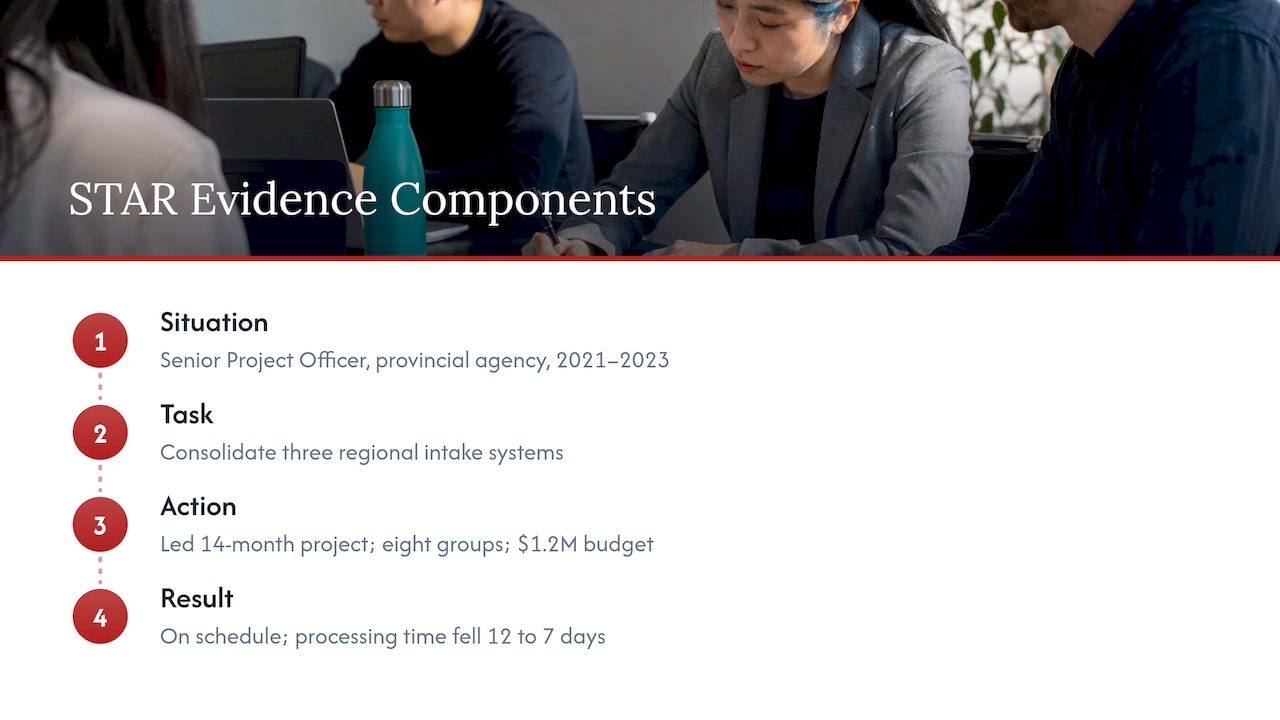
Here is an illustrative example of the difference. The names and figures are invented to show the structure.
Weak: ‘I have extensive experience managing projects and stakeholders.’
Stronger, under the heading ‘Experience managing multi-stakeholder projects’: ‘From 2021 to 2023, as Senior Project Officer at a provincial health agency, I led a 14-month project to consolidate three regional intake systems into one. I coordinated eight stakeholder groups, set up a bi-weekly steering committee and managed a budget of $1.2 million. The system went live on schedule, and average processing time fell from 12 days to 7.’
The second version names a role, a period, a scale, an action and a result. A screener can match it to the criterion without guessing. For a deeper look at the paragraph structure, see our guide to a Canadian cover letter built on one STAR paragraph.
Mistakes that get federal applications rejected
Referring to the resume instead of explaining. An Indigenous Services Canada posting warns that comments such as ‘refer to my attached resume’ will not be accepted and may result in rejection. Responses should say how, when and where you meet the criteria.
Claiming without evidence. The Advanced Policy Analyst Program posting states that it is your responsibility to provide appropriate examples that illustrate how you meet each qualification, and that failing to do so could result in rejection.
Leaving out requested documents. The Canada Energy Regulator notes that failure to provide the requested documentation may lead to the application being rejected.
Skipping the proofreading. The same regulator recommends getting a second or third opinion on your resume and cover letter, and applying early to avoid late arrival caused by technical difficulties. Writing quality is also assessed, as Parks Canada points out.
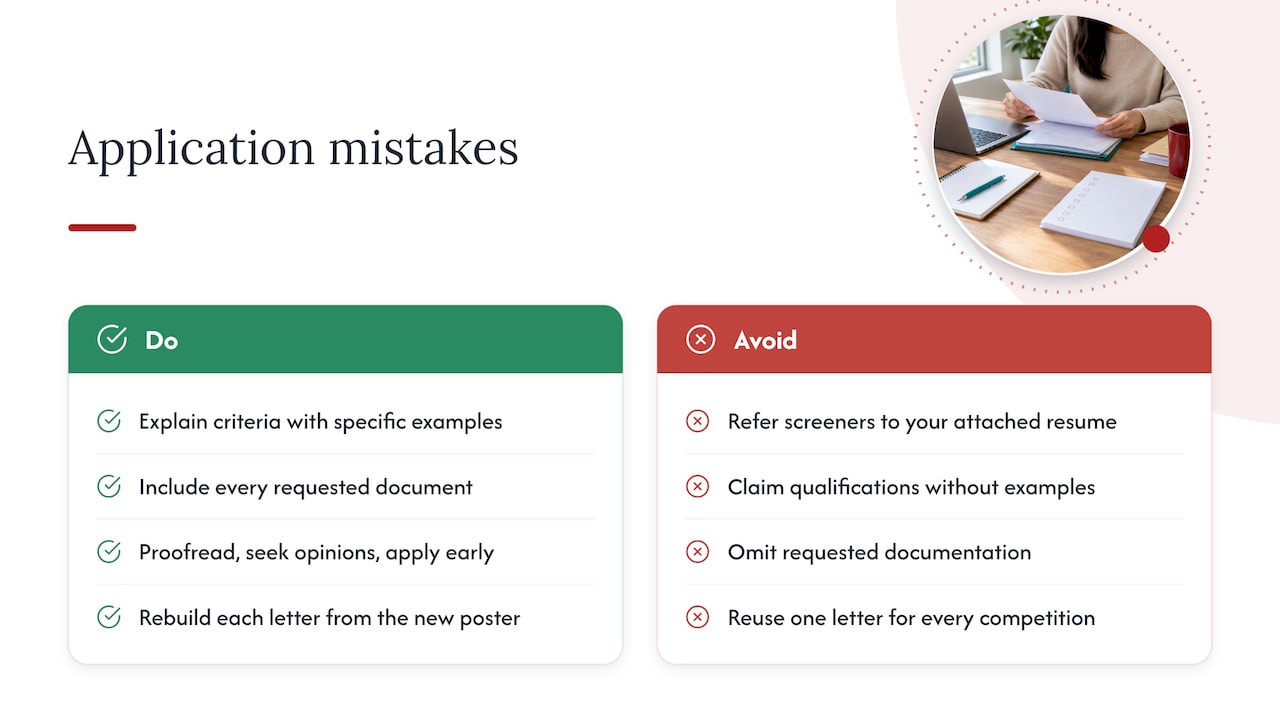
Reusing one letter for every competition. Reference numbers, classification levels, criteria and instructions differ. A letter that does not mirror the current poster is hard to screen. Keep a master document of your examples, then rebuild the letter each time from the new poster.
A step-by-step process
- Read the entire poster, including the ‘how to apply’ section, and note the length, format and submission method.
- Copy the essential and asset qualifications into a new document as headings.
- Under each heading, write one to two paragraphs using the STAR structure, with dates, places and results.
- Add the header with your contact information, and the reference number and position title in the subject line.
- Write a short opening and, if the format calls for it, a brief close.
- Check the letter against the poster line by line, then proofread it and have someone else read it.
- Submit early, and confirm that every requested document was attached.
The resume you submit alongside the letter should be consistent with it. Dates, titles and employers must match, since the resume validates what the letter claims. Our overview of a federal government resume in Canada explains how to prepare that document.
Our perspective
Federal hiring rewards precision, and that is the standard we apply to every government cover letter we help prepare. Candidates often have the qualifications but present them the way a private-sector application would, with a general summary of strengths. A screening board needs something different: each essential criterion answered directly, with the context, the action and the outcome.
When we work with clients on government applications, we begin with the poster and the merit criteria, not with a template. We map your career to each requirement, identify where your strongest evidence sits, and build the letter around it. Working directly with your writer, you can discuss which accomplishments to lead with, how to describe scope and results, and how to keep the letter within the limits the competition sets.
Our approach is consultative and informed by hiring trends, and our documents are formatted to be ATS-friendly. We believe a letter and resume prepared together, with matching dates and examples, give a screener the clearest possible view of your candidacy.
Professional
Get help with your federal application
If you are preparing a Government of Canada application and want your letter and resume to work as one consistent case, we can help. Our resume services are one-off and published at $139 (Early Career Resume), $189 (Next Step Resume), $239 (Advanced Resume) and $289 (Executive Resume). Package deals are also available, and our government and public sector resumes page explains how we approach these roles.

You can review the options in our resume shop, or begin with the Advanced Resume if you are applying for a mid-career or senior federal position. If your profile is also part of your search, our LinkedIn profile optimization service keeps it aligned with your application.
FAQ
Do I need a cover letter for every Government of Canada job?
No. A cover letter is required when the competition poster requests it, as the National Research Council explains. Some processes use screening questions or an application form instead. Read the ‘how to apply’ section of each poster, and include a letter whenever the format allows it.
How do I address a federal cover letter?
Use the name of the contact or the Selection Committee if the poster provides one. If it does not, a general salutation such as ‘Dear Hiring Manager’ is acceptable according to the NRC. Always include the reference or competition number and the position title in the subject line.
Should I apply if I do not meet the asset qualifications?
Yes, if you meet all the essential qualifications. The Public Service Commission states that assets are beneficial but not essential. Still, address any asset you do hold in a short separate section.
Can I reuse the same cover letter for several federal competitions?
Reuse your examples, not the letter. Each poster has its own criteria, reference number and instructions, and the letter should answer that poster directly. Keep a master list of accomplishments in the STAR format, then assemble a fresh letter for each competition.
Sources
- NRC Careers: frequently asked questions
- Parks Canada: How to apply for jobs
- Fisheries and Oceans Canada: Navigate the application process
- Public Service Commission: Applying for Government of Canada jobs
- Canada Energy Regulator: How do I apply?
- Veterans Affairs Canada: Preparing your application
- CSIS: How to submit a powerful application
- Government of the Northwest Territories: Preparing your application
- Advanced Policy Analyst Program poster
- External Relations Manager poster
- Indigenous Services Canada: Administrative Clerk poster
- Shared Services Canada: Tips and tricks to apply