
A strong engineer resume for Canadian employers is a clean, one- to two-page, reverse-chronological document. It leads with your discipline and licensing status, uses bullets that show measurable results, and mirrors the tools and wording of the job posting. It leaves out a photo and personal details. This guide covers each of those points, then shows how mechanical and civil engineers, new graduates and internationally educated engineers should adjust the same framework.
TL;DR
- Keep it to one or two pages, in reverse-chronological order, with a simple single-column layout that survives applicant tracking systems.
- Put your licensing status (P.Eng., EIT or the pathway you are on) near the top, named by province.
- Write every bullet as an action, a task and a measurable result, using numbers, percentages or dollar amounts.
- Mirror the software, standards and job titles in each posting, and tailor a short summary to match.
- Leave out a photo, date of birth, marital status and other personal details.
Table of Contents
- What a Canadian engineering resume contains
- Length and formatting rules
- Licensing: how to show P.Eng. and EIT status
- Writing bullets that show results
- The summary: three to five lines that match the posting
- Skills, software and keywords
- Tailoring for mechanical engineers
- Tailoring for civil engineers
- New graduates and career changers
- Internationally educated engineers
- Our perspective
- Get help from an engineering resume writer
- A final checklist before you apply
- FAQ
- Sources
What a Canadian engineering resume contains
Canadian engineering career offices agree on the building blocks. The University of Western Ontario’s engineering career office lists contact information, an optional summary of qualifications, education, engineering and other work experience, academic projects, technical skills and certifications, awards, and extracurricular activities. The same guide advises against including a birthday, marital status, picture or country of origin.
The order matters less than the logic: the strongest, most relevant material goes where a recruiter looks first. The same Western guide notes that a resume is looked at for an average of 5 to 7 seconds, which is why it recommends a summary of three to five points drawn from the job description at the top.
A workable skeleton for an experienced engineer:
- Name, city and province, phone, professional email, LinkedIn URL.
- Headline with discipline and licensing status, for example “Civil Engineer, P.Eng. (Alberta)”.
- Short summary of qualifications.
- Technical skills and software.
- Professional experience, most recent first.
- Education, licences and certifications.
- Projects, publications or memberships where relevant.
For a deeper look at layouts, our guide to choosing the right Canadian resume format explains when each one applies.
Length and formatting rules
Engineering is a field where two pages are normal. McMaster University’s engineering graduate checklist (2025) states that a two-page resume is standard for engineering graduates. It also asks for one font style throughout, third-person writing without “I” or “my”, and dates in month and year format aligned to the right margin.
Practical rules that follow from this:
- One page is enough for a new graduate or an engineer with fewer than five years of experience.
- Two pages suit anyone with several projects, a licence and a record of measurable results. Do not fill the second page with duties.
- Single column, standard font, clear headings. Tables, text boxes, icons and graphics can scramble when an applicant tracking system reads the file. Our article on why ATS-friendly resumes matter for Canadian job seekers covers this in detail.
- PDF or Word: follow the posting. If it names a format, use that one.
- No photo and no personal data such as age, marital status or nationality.
Licensing: how to show P.Eng. and EIT status
In Canada, engineering is a regulated profession, so licensing status is one of the first things an employer checks. Name it plainly and name the province.
APEGGA, the regulator in Alberta, explains that the P.Eng. designation is a professional licence that allows you to practise engineering in the province and take responsibility for that work. It describes an EIT as a Member-in-Training who has met the academic and good character requirements and is still gaining the required experience.
How that looks on the page:
| Your situation | How to present it |
|---|---|
| Licensed in a province | “P.Eng. (Ontario)” in the headline and again in the credentials section |
| Registered as a member-in-training | “EIT, registered with [your provincial regulator]”, with the year registered |
| Application in progress | “P.Eng. application in progress”, with the regulator named |
| Licensed abroad only | State the foreign licence factually and add your plan or progress toward Canadian licensure |
The terminology differs by province (EIT, Engineer Intern, Member-in-Training), so use the exact wording of the regulator where you plan to work. Never imply a licence you do not hold: the right to sign off on engineering work depends on it, and a claim that cannot be verified costs you the application. For current requirements, such as years of experience and examinations, go to the regulator in your province, since those rules are revised.
Writing bullets that show results
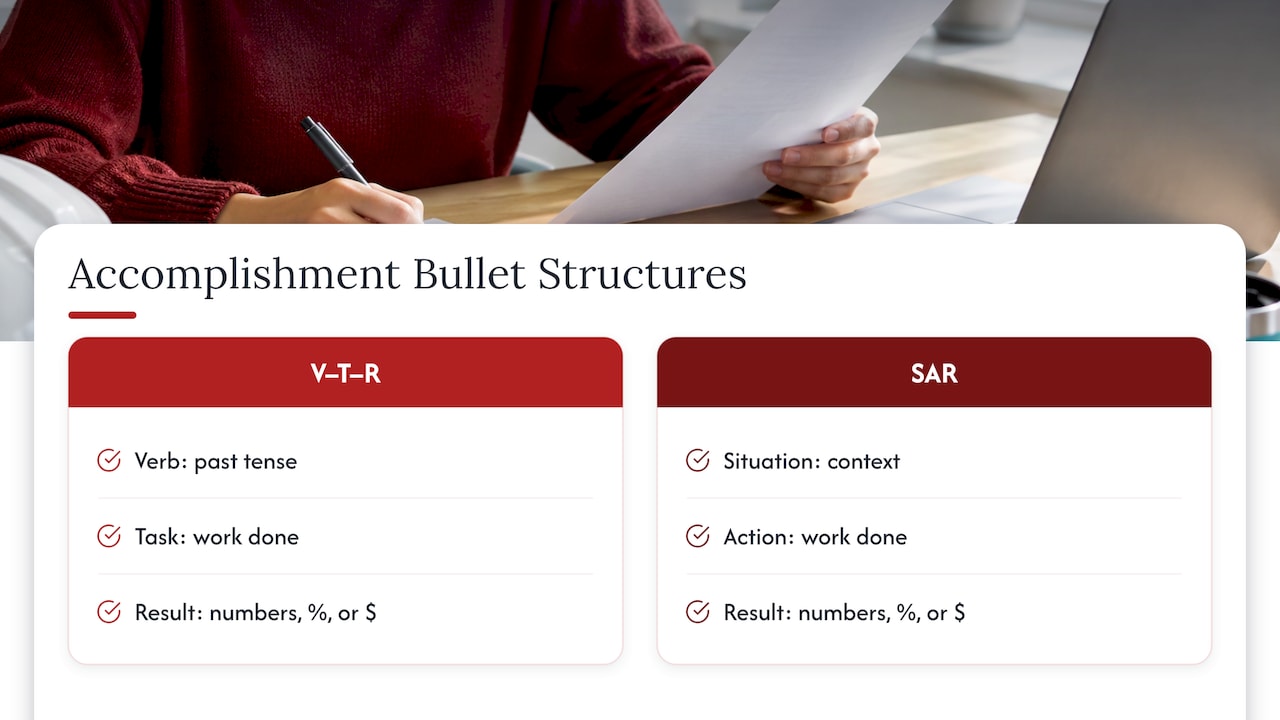
Most engineer resumes fail on the same point: they list responsibilities rather than outcomes. UBC Engineering’s resume toolkit recommends past-tense accomplishment statements without pronouns or filler words, following a Verb–Task–Result pattern. Carleton University’s engineering handout (2026) suggests the SAR method (Situation, Action, Result) and advises adding numbers, percentages or dollar amounts to show impact.
Job Bank, the federal government’s employment service, gives the same direction: quantify achievements with firm numbers the employer will understand, such as how many people you supervised or by what percentage you raised sales.
Before and after
Weak: “Responsible for pump station upgrades.”
Stronger: “Led design of a pump station upgrade across three sites, coordinating two subcontractors and delivering the work $120,000 under budget.”
These figures are illustrations of structure. Use only your own verified numbers, and where a figure is confidential, describe scale in other terms: number of sites, team size, project phases, schedule or tonnage.
Metrics engineers can draw on
- Cost: budget managed, savings against estimate, reduction in material or rework cost.
- Time: schedule recovered, cycle time reduced, turnaround on design reviews.
- Quality and safety: defect rates, inspection pass rates, incident-free hours.
- Scale: project value, number of units, size of the team or the number of stakeholders.
- Performance: efficiency gains, load capacity, mass reduction, uptime.
If you can name the standard, code or method you worked to, add it. Specifics let a hiring manager judge your level in seconds.
The summary: three to five lines that match the posting
Western’s guidance is to keep any summary to three to five points that highlight the skills the posting asks for. For an experienced engineer, this reads as a short block under your headline: years of experience, discipline, sector, the strongest credential, and one or two quantified achievements. Rewrite it for each application so its words reflect the posting.
For wording and structure, see our piece on writing a career summary that impresses Canadian recruiters.
Skills, software and keywords
Western’s guide lists technical skills such as AutoCAD, C++, Java, Python, MATLAB and SolidWorks alongside non-technical skills such as communication, organization, time management, problem solving and leadership, and tells candidates to use the job posting to decide which skills to highlight.
In practice:
- Group skills by category: design software, analysis tools, programming, project management, codes and standards.
- Use the same spelling and form the posting uses. If it says “Civil 3D”, write “Civil 3D”, not a loose description.
- Match the job title where it honestly describes your role. If your title was internal and unusual, add the standard equivalent in brackets.
- Place the keywords in your bullets as well as in the skills list, so they appear in context.
Our walkthrough on mapping resume keywords for ATS shows a quick method, and resume keywords by industry gives Canadian examples.
Tailoring for mechanical engineers
Mechanical roles in Canada span manufacturing, automotive, aerospace, energy and consulting, so the resume should signal your sector at once. Emphasize:
- Design and validation: CAD tools such as SolidWorks, finite element analysis, GD&T, prototyping and testing.
- Manufacturing and quality: process improvement, tolerance work, documentation, and the standards you worked to, such as ASME where it applies.
- Quantified outcomes: mass reduced, cost saved, cycle time cut, reliability improved.
Carleton’s handout uses a mechanical example, a 3D aircraft bracket designed in SolidWorks, to show how a project bullet pairs the tool with the result. Follow that pattern: tool, action, outcome.
A sample bullet structure: “Redesigned a mounting bracket in SolidWorks, validated with FEA, reducing part mass by [your figure]% while meeting the load requirement.”
Tailoring for civil engineers
Civil engineering hiring in Canada leans on project experience and licensing, so both deserve space.
- Project portfolio in bullets: name the type of project (municipal infrastructure, transportation, structural, water and wastewater, site development), the value, your role, and the delivery result.
- Licensing near the top: show P.Eng. or EIT status and the province, as covered above.
- Software and codes: AutoCAD, Civil 3D or the structural analysis tools you use, and the codes and municipal or provincial standards you worked with.
- Site and construction exposure: inspection, contract administration, safety record, coordination with contractors and authorities.
- Stakeholders: municipalities, regulators, consultants and communities you worked with show responsibility beyond calculations.
If you are early in your career, summer and co-op work in design offices or on site counts. Describe the tasks and the results the same way you would a permanent role.
New graduates and career changers
Graduates have a different job: prove capability without long employment history. McMaster and Western both place education, academic projects and co-op work prominently. Lead with a capstone or design project, name the tools, state the team size and describe the result with a measure. Add technical skills, awards and extracurriculars such as design teams, which show teamwork and initiative.
Career changers should lead with a summary that links past work to the engineering role and keep the focus on transferable results: project management, technical analysis, field work or regulatory knowledge.
Internationally educated engineers
The Canadian format differs from many other countries, so a few adjustments make a large difference:
- Remove the photo, date of birth, marital status, religion and nationality.
- Use a professional email address and, where you have one, a Canadian phone number.
- Describe your experience honestly, with scope and results, and use the terms Canadian employers recognize. Job Bank job descriptions are a helpful reference for standard wording.
- State your licensing position clearly. A licence from another country does not give you the right to practise in a province, so show what you hold and what you are pursuing.
- Add the Canadian context where it exists: volunteering, coursework, bridging programs, or projects completed here.
Some of the regulatory details change over time, so check the provincial regulator before you describe your status.
Our perspective
Engineers are often the hardest clients to write for, because the work is precise and the results are real, yet the resume reads like a list of duties. In our experience, the gap is rarely technical ability. It is the translation of project work into outcomes that a recruiter, and an ATS, can read in seconds.
Our approach is consultation-driven. Working directly with your writer, you walk through the projects, the tools, the standards and the numbers, and the document is built around the roles you want next. We format for applicant tracking systems, keep the structure clear for the human reader who follows, and revise with you until it is accurate.
For engineers, we believe the right resume does three things: it states your licensing status without ambiguity, it ties each project to a measurable result, and it speaks the vocabulary of the target role. That is how a resume earns the interview.
Professional
Get help from an engineering resume writer
If you would rather not carry this work alone, our engineering resumes service pairs you with a writer who builds the document from your projects, credentials and target roles. Our current resume packages are listed on our shop page: Early Career Resume at $139, Next Step Resume at $189, Advanced Resume at $239 and Executive Resume at $289, each a one-off price.

For senior engineers moving into leadership, the Executive Resume is designed for that step. We also offer LinkedIn profile optimization, so your profile and resume tell the same story. If you want a wider view of what employers expect this year, read our summary of Canadian resume trends and our resume tips for engineering and technical jobs.
A final checklist before you apply
- Headline shows discipline and licensing status with province.
- Summary is three to five lines and matches the posting.
- Every bullet has an action, a task and a result with a number where possible.
- Software, standards and titles mirror the posting.
- Single-column layout, standard font, consistent dates (month and year).
- No photo or personal details.
- One or two pages, saved in the format the employer requests.
- LinkedIn profile consistent with the resume.
FAQ
How long should an engineer resume be in Canada?
One page suits new graduates and engineers with limited experience, and two pages is standard for most others. McMaster’s engineering checklist calls a two-page resume standard for graduates. Add the second page only when it carries results, not duties.
Should I list P.Eng. or EIT on my resume?
Yes, and name the province. APEGGA describes the P.Eng. as a licence to practise and take responsibility for engineering work, and an EIT as a member-in-training who is still gaining experience. Use the regulator’s own wording for your province.
Does a US PE licence count in Canada?
A licence from another country does not give you the right to practise in a Canadian province, so list it factually and show your Canadian licensing status or progress next to it. Confirm the current process with the provincial regulator where you plan to work.
What should a mechanical or civil engineer put in the skills section?
List the tools, standards and methods named in the posting. For mechanical roles that typically means CAD, FEA, GD&T and relevant standards, and for civil roles design software, codes and project delivery skills. Place the same terms in your bullets so they appear with results.
Do I need a different resume for each application?
You need the same core resume with a tailored summary, a reordered skills list and keywords that match each posting. Western’s career office recommends choosing summary points from the job description.
Sources
- Resume Formatting Guidelines, Western University Engineering
- Graduate Resume Checklist, McMaster Engineering
- UBC Engineering Resume Toolkit
- Engineering General resume handout, Carleton University
- How to write a good resume, Job Bank
- Applicants: Engineers: General, APEGGA