Decorative education resume audit title card

30 Second Audit: Education Section on Your Resume That Gets Read

The education section on a resume needs just four elements: degree and field of study, institution name, location, and graduation date (or expected date). List it above your work experience only if you’re a recent graduate or the job demands a specific credential; otherwise, place it after your professional history. Add honours or coursework only when they actively strengthen your candidacy for that specific role.


TL;DR:

  • Listing a relevant degree or credential prominently can be crucial for career pivots or recent graduates, even with extensive work experience.
  • Keep education entries simple and consistent, focusing on the most recent, relevant, and distinctive details, and avoid cluttering with unrelated coursework.
  • Placement of the education section depends on your career stage; prioritize it for new graduates or credential-dependent roles, but place it after experience for seasoned professionals.
  • Only include GPA if it is 3.5 or higher, and tailor optional details like honors or coursework to match the specific job requirements.
  • Use a straightforward, linear format without tables or columns; ensure every detail directly supports your fit for the role and enhances your credibility.

Professionalresumes
Make Every Resume Section Count
Professional Resumes creates customized resumes, cover letters, and LinkedIn profiles through personalized consultations and revisions.

Explore resume services

Table of Contents

What belongs in your education section

Four fields are non-negotiable. Every entry should include your most recent degree or ongoing education, the school name and location, field of study, and a graduation year or expected date. Miss one of these, and a recruiter has to guess. Guessing costs you seconds you don’t have on a 20-second resume scan.

Beyond the essentials, a handful of optional additions can work in your favour, but only when they’re doing actual work:

  • Honours and awards — Dean’s List, scholarships, academic distinctions. Include these if they’re recent and relevant to the field you’re entering.
  • GPA — worth listing only when it strengthens your application, which generally means 3.5 or higher. Below that, leave it off entirely. A missing GPA reads as neutral; a low one may be a liability.
  • Relevant coursework — two or three courses, named specifically, that map directly to the job posting’s requirements.
  • Projects or thesis titles — particularly valuable for recent graduates with limited work history, since a capstone project can double as proof of applied skill.
  • Language of instruction — worth noting when you studied outside your target country and the hiring manager might otherwise wonder about your English or French fluency.

If you’re still in school, label the entry honestly. Include an expected graduation date rather than leaving the date field blank or vague. If your program stalled or you left before finishing, list completed credits or relevant coursework instead of writing “incomplete” or “unfinished”. “Unfinished” reads as a red flag; “87 credits completed toward a B.Comm” reads as a fact.

Where to place the education section on a resume

Placement comes down to one question: where does this section best answer the recruiter’s first question about your qualification? Work through it in this order:

  1. Recent graduate with limited work history — put education above your experience section. It’s your strongest asset right now, so lead with it.
  2. Role requiring a specific credential — nursing licence, professional engineering designation, CPA. Place education first even if you have years of experience, because the credential is the gate, not a bonus.
  3. Career pivot into a new field — if you’ve completed a relevant certificate or diploma, move it up near the top to signal your new direction before a recruiter assumes you’re the same professional you were three years ago.
  4. Mid-career or senior professional in a stable field — list education after your experience. Your track record is doing the persuading now, not your transcript.

Keep every entry visually consistent and simple for applicant tracking systems: no tables, no columns, no unusual date formats. A clean, linear layout parses correctly whether a human or a bot reads it first.

How to list education on your resume by career stage

The format holds steady across career stages: degree and field first, then institution, location, date, and any optional detail worth including. What changes is how much you include and how prominently you place it.

Recent graduate:

  • Bachelor of Arts in Psychology, University of Waterloo, Waterloo, ON. Expected graduation: June 2026. GPA: 3.8. Relevant coursework: Cognitive Behavioural Interventions, Research Methods in Psychology. Capstone project: designed a peer support intervention piloted with 40 first-year students.

This entry earns its length. Every line points toward employability, not just academic completion.

Experienced professional:

  • Bachelor of Commerce, McGill University, Montréal, QC, 2011.

That’s it. If you graduated more than 10 to 15 years ago and space is tight, drop the graduation year altogether or list just the decade. Nobody hiring a director of operations needs to know you finished school in 2009.

In-progress education:

  • Master of Business Administration, York University, Toronto, ON. Expected graduation: December 2026. Relevant coursework: Strategic Financial Management, Organizational Leadership.

Naming the expected date and one or two relevant courses shows momentum without overselling an unfinished credential.

Incomplete education:

  • Bachelor of Science in Computer Science, University of Alberta, Edmonton, AB. Completed 90 credits (2019–2021). Relevant coursework: Data Structures, Web Application Development.

If the coursework connects more to your target job than to a formal degree, consider moving some of it into a separate “professional development” section instead, alongside certifications and online courses. That reframes an unfinished degree as a set of applied skills rather than an unmet goal.

Practical tips and mistakes to avoid

A practical rule of thumb keeps each entry to roughly 15 to 30 words, tailoring the optional details to the specific job posting rather than repeating the same block on every application.

Do this:

  • Use the institution’s official name (Toronto Metropolitan University, not “TMU,” on a first reference).
  • Format every date the same way across the whole resume — month and year, or year only, never a mix.
  • Tailor coursework and projects to match keywords in the job description.
  • List degrees in reverse chronological order, most recent first.
  • Keep each entry short enough to scan in under five seconds.

Avoid this:

  • Listing a GPA under 3.5 out of habit rather than strategy.
  • Cramming in every course you ever took, relevant or not.
  • Writing vague labels like “various courses” or “general studies” with no specifics.
  • Mixing abbreviations inconsistently (B.A. in one line, “Bachelor of Arts” in the next).

Pro Tip: Run a 30-second audit before you submit any resume: read only your education section out loud. If nothing in it directly supports the job you’re applying for, cut it back to the four essentials and stop there.

How Professionalresumes approaches the education section

Professional resume services build education entries around the same principle: match the depth of detail to what the job actually needs, whether that’s a first resume for a new graduate or a senior document for someone with extensive experience. The approach adjusts formatting, phrasing, and placement based on career stage and industry, from entry-level resumes for construction and trades roles where certifications need to be front and centre, to finance sector resumes where regulated credentials carry real weight with recruiters.

A professional editor typically catches things you won’t spot on your own:

  • ATS formatting errors that make a perfectly good degree invisible to scanning software.
  • Coursework or project descriptions phrased generically instead of tied to the target job.
  • International credentials that need translation or context for a Canadian hiring manager.

DIY education sections tend to underperform most in three narrow cases: career pivots where old coursework needs reframing, international degrees that require equivalency context, and executive resumes where credential placement affects perceived seniority. In those situations, a second set of trained eyes is worth more than another hour of self-editing.

A fast litmus test for what to keep

Placement should track signal strength, not a rigid formula based on years of experience — a credential that directly answers a job requirement earns top billing even for a 20-year veteran. For anything optional, run three questions: does it prove fit for this specific job? Is it recent enough to matter? Is it distinctive rather than generic? If an item fails all three, cut it. Then read your education section as if you were the hiring manager, not the graduate who earned it.

— Professional

Get your education section built right the first time

Formatting rules only get you so far. Deciding what to include, how much detail to add, and where to place it for your specific industry takes judgment that’s hard to apply to your own resume objectively. Professionalresumes builds that judgment into every project instead of leaving you to guess.

Early Career Resume

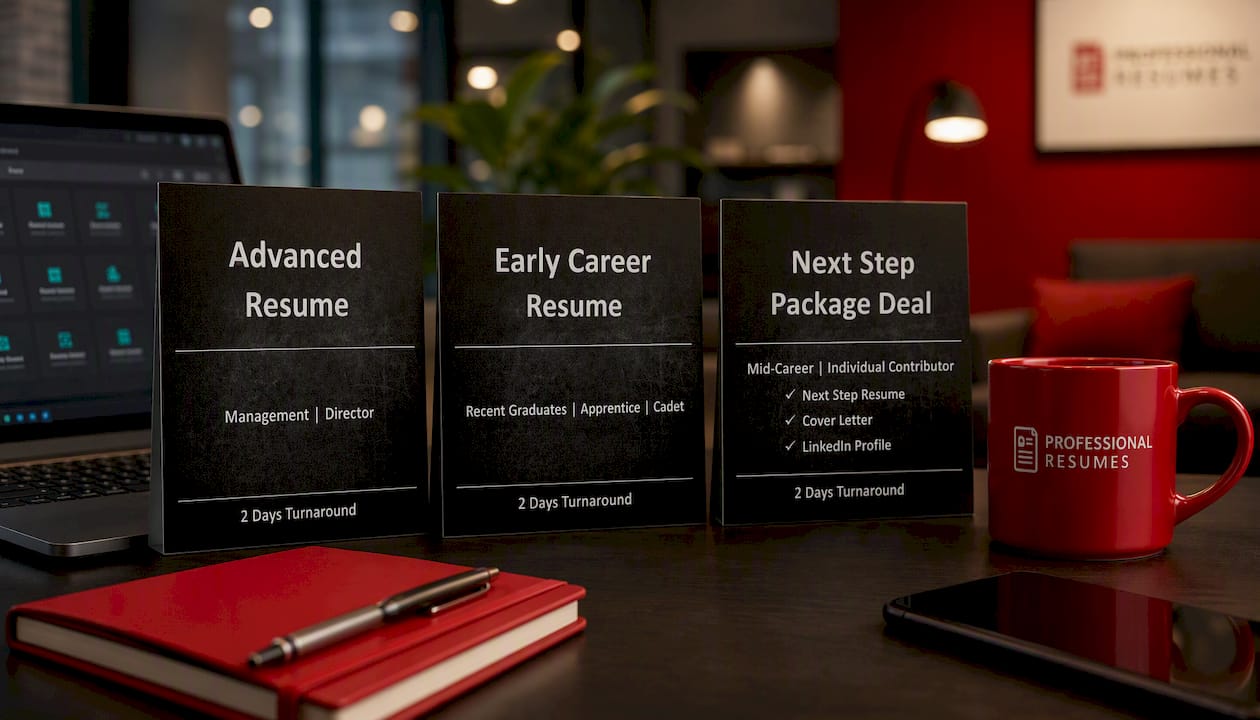
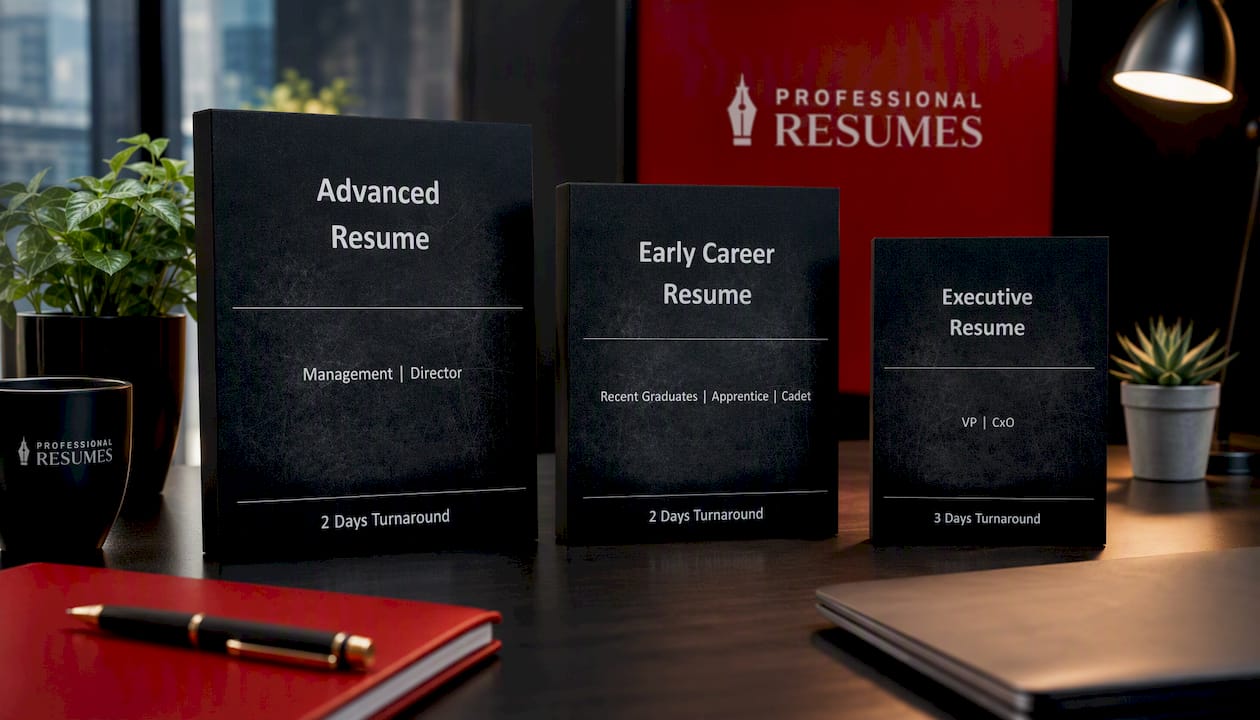
The Early Career Resume service is built for recent graduates and early-career job seekers who need to make a thin work history look substantial. It’s the right fit if your degree, projects, and coursework are still your strongest selling points. The Advanced Resume service is built for mid-career and senior professionals, including those navigating a career transition, and it includes ATS-friendly formatting plus a full consultation to decide exactly how much education detail belongs on the page. Whichever stage you’re at, the next step is the same: get a resume that puts your education exactly where it earns you the most credibility, and not a line further.

Sources

FAQ

How do I write an education section on a resume?

Lead with your degree and field of study, then list the institution name, location, and graduation date (or expected date). Add GPA, honours, or coursework only if they strengthen your fit for the specific job.

What counts as a red flag in a resume’s education section?

Vague labels like “various courses,” inconsistent date formats, and unexplained gaps without context all read as red flags to recruiters. Listing a weak GPA out of habit, rather than leaving it off, is another common one.

What are common mistakes people make in their education section?

The most frequent ones are overloading the section with irrelevant coursework, mixing degree abbreviations inconsistently, using non-official institution names, and failing to tailor coursework to the job posting.

What should I avoid putting in my resume’s education section?

Avoid a GPA below 3.5, coursework with no connection to the target role, and vague terms like “incomplete” for education still in progress. List completed credits or relevant coursework instead.

Should I include my GPA on a resume?

Only if it’s 3.5 or higher. Below that threshold, omitting it entirely is the safer, more strategic choice.

Decorative board resume title card illustration

Senior Execs: One Board Resume Shift That Gets You Shortlisted

A board resume is a strategic biography, not an operational CV. It signals governance judgment, committee readiness, and fiduciary discernment rather than P&L wins. The single highest-impact edit: open with a board-focused summary, then list board and advisory service before executive history, so a nominating chair sees governance fit in the first ten seconds.


TL;DR:

  • Emphasize governance experience over operational roles by listing board service first, highlighting specific committee roles, and using governance language in all bullets.
  • Keep the résumé within one page, with board and advisory service at the top, and focus on skills, credentials, and evidence of fiduciary and risk oversight.
  • Reframe operational achievements into advising or oversight language, especially around risk, succession, and ESG, to better fit board expectations.
  • Highlight diversity and governance credentials strategically, tying them directly to oversight value, and include endorsements from recognized governance figures.
  • Maintain strict confidentiality, avoid excessive detail, and tailor each résumé version to targeted committees or skill gaps to maximize impact.

Professionalresumes
Position Your Resume for Board Roles
Professional Resumes creates customized resumes, cover letters, and LinkedIn profiles tailored to your career aspirations and industry expectations.

Explore resume services

Table of Contents

Crafting a professional summary that positions you for a board seat

Search firms and nominating chairs typically scan a résumé for fifteen seconds before deciding whether to keep reading. Your summary either earns the next look or costs you the interview, which is why it has to work harder than any paragraph in your executive résumé ever did.

A board-ready summary answers three questions immediately: what governance value do you bring, which committee(s) can you serve on today, and what sector or credential backs that up. It reads in third person or neutral voice, avoids “I,” and states scope rather than duties.

A workable structure looks like this: [Governance identity] with [X years] in [sector], bringing expertise in [core competency] and [core competency]. Serves on the [type] board committee, contributing [specific value].

  • State organization type and scale (public company, private equity backed, $500 million revenue) rather than your job title’s full duty list.
  • Name one or two committees you’re qualified for, not every function you’ve ever touched.
  • Cut anything that reads as operational: “managed a team of 200” belongs on an executive résumé, not here.
  • Keep it to two to four lines, full stop.

Pro Tip: Write the summary last. Draft your board-service bullets and governance achievements first, then pull the strongest thread of value into a two-line opening. Trying to write the summary cold almost always produces vague filler.

The NACD’s guidance on building a board résumé frames this correctly: the résumé is read as a strategic biography, and the summary is where that framing either lands or fails.

Order and structure: presenting board service before executive history

Nominating committee members and retained search consultants often read board résumés out of order on purpose. They jump straight to governance experience because that’s the qualifying signal, and if it’s buried on page two under fifteen years of operating roles, they may never get there.

That’s the case for restructuring the whole document:

  1. Name, contact, and summary at the top, unchanged from any strong résumé.
  2. Board and advisory service, listed immediately after the summary: organization name and type (public, private, nonprofit), your role, years served (not months), committee assignments, and one governance-oriented bullet per entry.
  3. Executive history, condensed to titles, companies, and dates, with one or two lines per role focused on scope and outcomes rather than day-to-day duties.
  4. Education and governance credentials, followed by any appendix material.

If you have an extensive publication list, speaking history, or academic credentials, move that to a one-page addendum rather than letting it crowd the main document. The AICD’s guidance on creating the perfect CV is explicit on this point: keep the core résumé to one page where possible, two at most, with board and committee service listed first so it can be scanned in seconds.

What boards look for: skills, committee experience, and proof you can govern

Boards recruit for a specific set of competencies, and your résumé needs to map to them directly rather than implying them through job titles. The NACD identifies financial literacy, risk oversight, strategic planning, succession planning, and committee experience as the recurring priorities, with nonprofit boards also weighing fundraising capacity and community engagement.

Committee fit matters as much as general governance credibility. Audit committees want financial statement literacy and internal controls exposure. Compensation committees want experience designing incentive structures at scale. Governance and nominating committees want succession planning and board evaluation experience. Risk committees increasingly want cybersecurity or ESG familiarity layered on top of traditional risk oversight.

Translate operational history into governance language:

  • Instead of “led enterprise risk function,” write “advised the audit committee on enterprise risk framework redesign.”
  • Instead of “oversaw succession planning for VP roles,” write “guided board-level CEO succession planning and evaluation criteria.”
  • Instead of “built the ESG program,” write “provided strategic input on ESG disclosure and stakeholder risk exposure.”

The verb shift, from doing to advising, is the entire exercise.

Governance education and certifications: showing board-readiness

Formal governance credentials are one of the fastest ways to signal seriousness to a nominating committee that doesn’t know you personally. A designation like ICD.D in Canada or completion of NACD director education tells a chair you’ve studied board dynamics, not just assumed you understand them from the C-suite side of the table.

Where to place it depends on how central it is to your candidacy:

  • If it’s your strongest credential, work it into the summary line directly (“ICD.D-certified director with 20 years in financial services”).
  • Otherwise, give it its own line under a “Governance Credentials” or “Certifications” heading near education.
  • A short “Governance Training” subsection works well if you’ve completed multiple programs worth listing together.

If you lack formal certification, don’t leave the space blank. Volunteer board service, committee internships with nonprofit organizations, or targeted executive education in governance topics are legitimate substitutes. The NACD notes that pairing governance training with even unpaid board experience is a credible path for first-time directors, and search firms understand that everyone’s first board seat has to come from somewhere.

Sample summary lines and board-service bullets you can adapt

Sample summary lines and board-service bullets you can adapt — overview diagram

A résumé built on the right structure can still fail on wording. Governance language is a specific register, and most executives default back to operational phrasing without noticing.

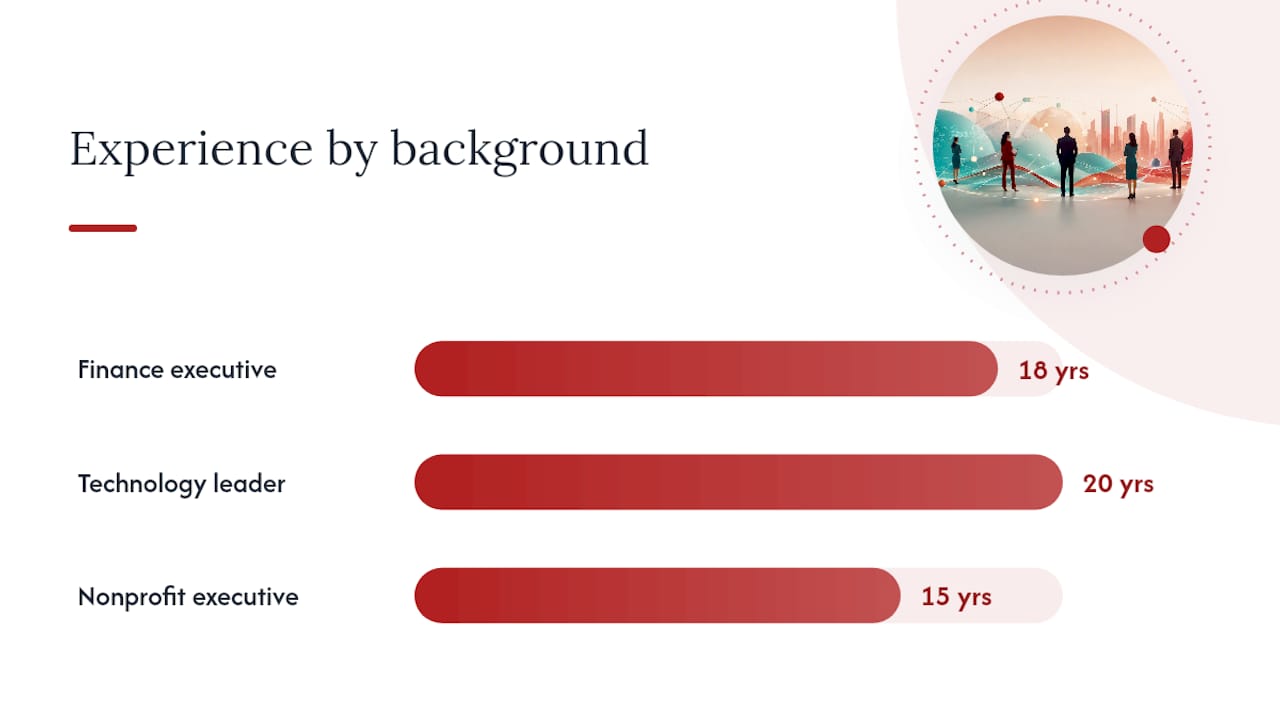
Three summary lines to adapt by background:

  • Finance: “Finance executive with 18 years in capital markets, bringing audit committee expertise and deep familiarity with SEC reporting and internal controls.”
  • Technology: “Technology leader with two decades scaling SaaS platforms, offering board-level insight on cybersecurity risk, digital transformation, and product governance.”
  • Nonprofit: “Nonprofit executive with 15 years in community health, contributing fundraising strategy and stakeholder governance experience to mission-driven boards.”

Board-service bullets that show oversight rather than operation:

  • “Provided oversight during a cross-border acquisition, evaluating integration risk and reporting findings to the full board.”
  • “Chaired the compensation committee’s review of executive incentive structure, aligning pay with long-term shareholder value.”
  • “Advised on a divestiture that protected shareholder value amid a contracting market segment,” which is the kind of high-level framing Robert Half recommends over granular operational metrics.

Aim for a résumé length around one page, with a slightly longer document acceptable for candidates with extensive multi-board histories. Use a clean, single-column layout with generous white space; a governance résumé crowded with small type undercuts the very discretion it’s meant to project.

Common mistakes and a quick readiness checklist

The most frequent error is repurposing an executive résumé wholesale and calling it a board document. Operational verbs (“managed,” “directed,” “built”) signal you’re still thinking like an operator, not a director. A close second: résumés that run three or four pages because every job function from the last twenty years made the cut.

Before sending your résumé to a nominating committee, confirm:

  • Board and committee service appears before executive history, not after.
  • Every bullet uses governance language: oversaw, advised, guided, evaluated.
  • Length sits at one page, two at the absolute maximum.
  • Dates use years only, never months.
  • LinkedIn matches the résumé’s framing exactly, headline included.

Pro Tip: Keep two or three versions of your summary paragraph on file, each weighted toward a different committee strength (audit, risk, ESG). Swap in the version that matches the specific board’s stated gap before you submit.

When professional help speeds up board readiness

Some candidates can make this shift alone. Many can’t, particularly executives with no formal board seat yet who need help translating a strong operating record into governance language a nominating committee will recognize on sight.

Signs it’s worth bringing in expert help: you have zero board experience to draw from, you’re struggling to reframe your career narrative, or you’re facing a submission deadline with no time to iterate. A resume writer working specifically on board documents should deliver a tailored board summary, committee-focused bullets, a LinkedIn profile aligned to the same messaging, and at least one round of revisions once you see how it reads.

Highlighting diversity attributes that add value to a board

Boards increasingly evaluate candidates against gaps in perspective, not just gaps in skill. If you bring a different professional path, geography, gender, ethnicity, age cohort, or lived experience than the board’s current composition, that’s a legitimate credential and belongs in your résumé, not left as an unstated fact about you.

Frame it as a governance contribution rather than a personal detail. Instead of a generic diversity statement, tie the perspective to a specific oversight value: “Brings a consumer-market perspective underrepresented on the current board, informing risk assessment in emerging demographic segments.” That’s concrete enough for a nominating chair to see exactly what gap you close.

This works particularly well for candidates moving from operating roles in sectors the board wants exposure to, immigrants with international market experience the board lacks, or professionals whose functional background (technology, legal, ESG) fills a stated skills gap on the board’s own recruiting brief. If the board has published a skills matrix or stated priorities, mirror that language directly rather than making the committee infer the connection.

Understate rather than overstate. One clear sentence in the summary, reinforced by a bullet or two in your board-service section, carries more weight than a paragraph that reads as a checklist.

Showing fiduciary responsibility and risk oversight experience

Every director carries a fiduciary duty of care and loyalty, and boards want proof you understand what that means in practice, not just in theory. That proof comes from specific language, not a general claim of integrity.

Show fiduciary judgment through examples of independent decision-making: instances where you challenged management’s recommendation, flagged a risk before it became material, or voted against a proposal on governance grounds. These are the moments that separate a genuine director from someone who simply attended meetings.

For risk oversight specifically, reference the categories boards care about most right now: cybersecurity, regulatory compliance, ESG-related liability, and enterprise risk frameworks. A bullet like “Evaluated cybersecurity risk posture ahead of a planned acquisition, informing the board’s go/no-go recommendation” does more work than any general statement about being “risk aware.”

If you’ve served on an audit or risk committee, name it explicitly and describe one substantive contribution rather than listing the committee as a bare credential. Nominating committees read committee names quickly, but they remember specific examples of judgment exercised under real stakes.

Including recommendations and endorsements relevant to board roles

A résumé makes a claim; an endorsement corroborates it. Where you can, use recommendations strategically rather than treating them as an afterthought bolted onto the bottom of the page.

LinkedIn recommendations from board chairs, fellow directors, or senior executives who’ve watched you exercise governance judgment carry more weight than generic praise from a former direct report. Request one or two specifically focused on governance qualities: independent judgment, financial literacy, committee contribution, rather than operational leadership.

A brief reference line naming a sitting board chair or CEO willing to speak to your candidacy, with their permission, can be included discreetly at the bottom of a résumé or in a cover note rather than the résumé body itself. Some candidates prepare a short reference sheet as a separate document, available on request, which keeps the résumé itself clean while still signalling that credible endorsement exists.

Avoid vague testimonial language (“a trusted advisor”) in favour of specific attributions (“recommended by [board chair] for audit committee expertise”), and always confirm permission before naming anyone.

Addressing gaps in board experience or transitioning from operations

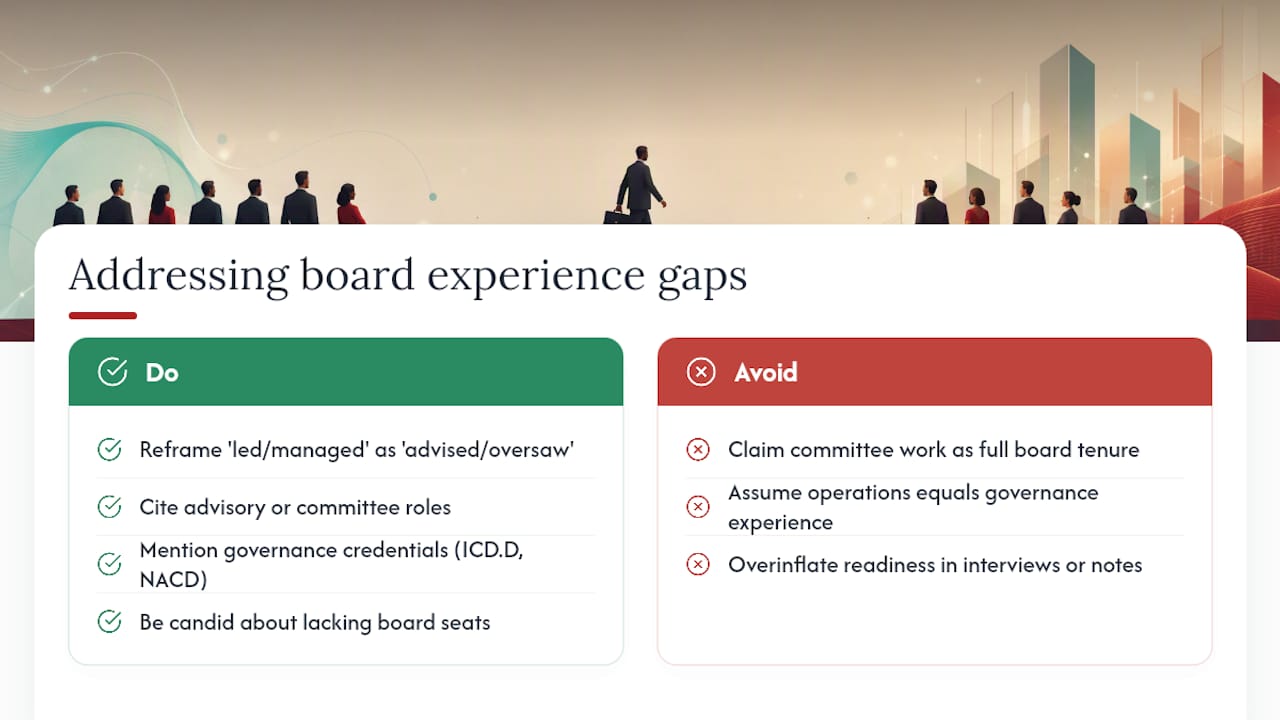
Most first-time board candidates have zero prior board seats, and that gap doesn’t need to be hidden. It needs to be reframed around adjacent evidence: committee-level exposure, advisory board work, or governance training that demonstrates you already think in board terms.

If you’ve never held a formal board seat, lean on advisory roles, nonprofit board service, or committee work within a professional association. These count as legitimate governance experience, particularly when paired with a credential like ICD.D or completed NACD coursework, which signals you’ve deliberately studied the discipline rather than assumed it transfers automatically from operating experience.

For executives transitioning directly from a C-suite role, the challenge is different: you have plenty of leadership experience but it’s phrased entirely in operational terms. The fix is the reframing exercise covered earlier in this piece, converting “led” and “managed” into “advised” and “provided oversight.” A related resource on C-level resume writing covers the mechanics of that translation in more depth for readers still building the underlying document.

Be candid about the gap in your cover note or during interviews rather than overselling committee work as full board tenure. Nominating chairs respect a clear account of readiness far more than an inflated one that unravels under a reference check.

Addressing gaps in board experience or transitioning from operations — overview diagram

Confidentiality and discretion in board resumes

Board searches run quietly, often through retained search firms who explicitly ask candidates not to distribute their materials broadly. The Women Get on Board FAQ on building a board résumé notes that search firms and chairs favour concise, tailored documents precisely because they’re circulated within a small, controlled group rather than posted publicly.

That discretion should show up in how you handle your own résumé. Avoid naming specific confidential deal details, unreleased financial figures, or proprietary strategic initiatives your current employer hasn’t disclosed publicly. Frame prior board discussions in general governance terms rather than describing specific board debates or votes that were meant to stay in the room.

If you’re currently serving on a board undergoing a sensitive process (a pending merger, a leadership change), it’s reasonable to note your role without detailing the situation itself. A nominating committee reading your résumé understands that discretion around live matters is itself a signal of trustworthiness, not a gap in transparency.

Keep your résumé distribution list tight, and if a search firm is managing your candidacy, let them control where the document goes rather than sending it broadly yourself.

A short note on the operator to director mindset

The hardest part of this exercise isn’t formatting. It’s genuinely believing that oversight, not execution, is now your value. Most executives write their first board resume draft in the voice of the job they’re leaving, not the seat they’re trying to earn.

Try this now: take one bullet from your current résumé and rewrite it using “advised,” “evaluated,” or “provided oversight” instead of “led” or “managed.” Notice how differently it reads.

— Professional

How one professional service builds board-ready documents

Reframing a career narrative from operator to director is exacting work, and most executives are too close to their own history to see where the operational language is still showing through. That’s where a second, trained eye earns its cost back quickly.

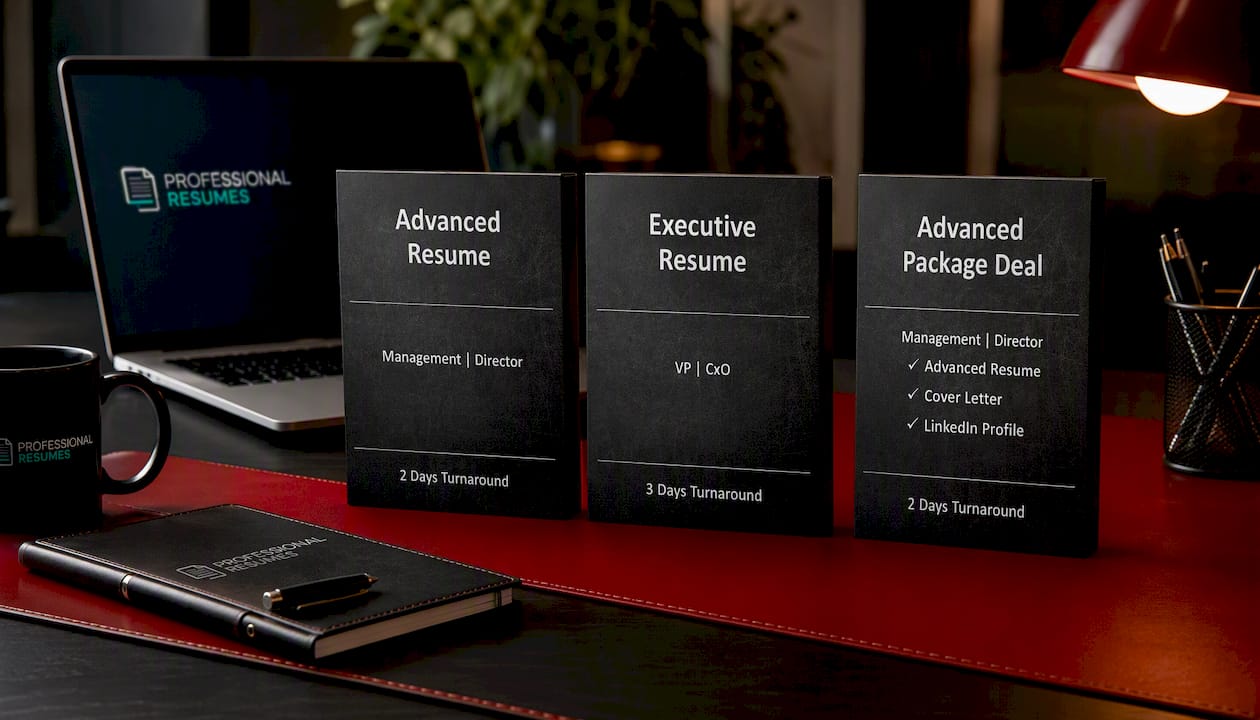
Advanced Resume

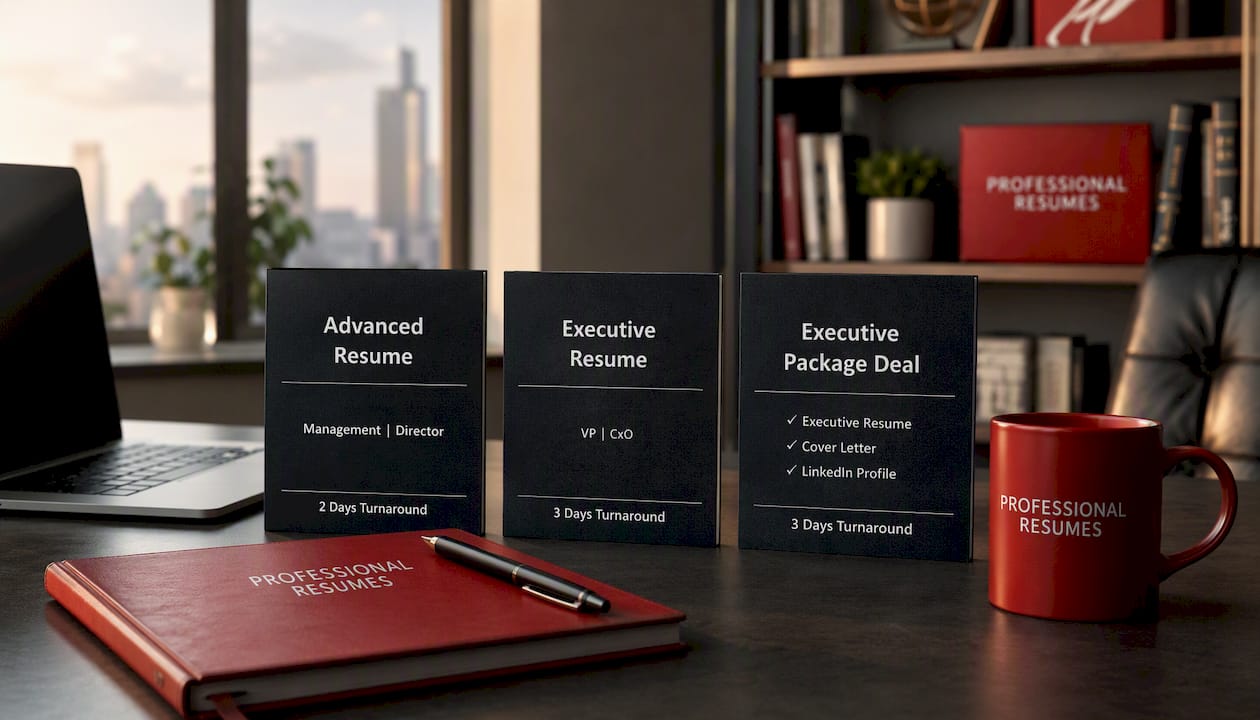
For candidates targeting a specific board seat, the Advanced Resume service builds a tailored summary and committee-focused bullets around the exact governance gap a target board has stated. Senior leaders who need the full executive-to-director translation, not just a targeted rewrite, are better served by the Executive Resume package, which handles the language shift at the level of an entire career history. For executives pursuing board seats while also managing a broader job search, the Executive Package Deal bundles the résumé with a matching cover letter and LinkedIn profile, so every document a search firm or chair reviews tells the same governance story. Each package includes direct consultation with your writer and multiple revision rounds, so the final draft reflects your actual governance voice, not a template. Book a consultation to find out which package fits your timeline.

Sources

Decorative resume summary title card illustration

Copy and adapt resume summary examples by level: why pros draft them last

A strong resume summary is 2 to 4 lines placed at the top of your resume that names your professional title or level, lists 2 to 3 top skills, and quantifies one achievement that shows an employer what you deliver. The single rule that governs everything else: write it last, after the rest of the resume is finished, so it reflects real accomplishments instead of aspirations. Every example that follows builds on that formula.


TL;DR:

  • Tailor your resume summary to include the exact job title and keywords from the posting to improve ATS ranking and recruiter recognition.
  • Limit the summary to 40 to 60 words, focusing on a relevant title, two to three top skills, and a measurable achievement that demonstrates your value.
  • Write the summary after completing the rest of your resume to ensure it is based on actual accomplishments rather than aspirations or vague claims.
  • Highlight quantifiable results, such as percentages or dollar figures, to provide concrete evidence of your effectiveness and stand out among candidates.
  • Focus on achievement-based language rather than duties, ensuring your summary clearly communicates what you deliver on day one for the employer.

Professionalresumes
Make Your Resume Show Your Value
Professional Resumes crafts customized resumes, cover letters, and LinkedIn profiles around your skills, experience, and career aspirations.

Explore resume services

Table of Contents

What is a resume summary?

A resume summary sits directly beneath your contact information and gives a hiring manager the case for reading further. It states your title or years of experience, names two or three areas of expertise, and closes with one measurable result or clear statement of value to the employer.

Length matters more than most job seekers assume. Aim for roughly 40 to 60 words, or 2 to 4 lines. Longer than that, and recruiters skim past it. Shorter, and it reads as filler rather than a pitch.

When should you use a resume summary?

A summary earns its place on the page for mid-career professionals, senior candidates, and anyone tailoring an application to a specific job posting. If you have relevant achievements to cite, lead with them.

Long resumes packed with certifications or technical qualifications sometimes do better with a bulleted “summary of qualifications” instead of prose. Very early-career applicants with little paid experience, or anyone shifting into a structured training program, may still find an objective statement more honest than an inflated summary.

Why bother with a summary statement at all?

Recruiters scanning a stack of resumes decide fit in seconds. A summary puts your strongest match right where their eyes land first, instead of buried on page two.

It also does double duty for applicant tracking systems. Placing your target job title and 2 to 3 keywords near the top helps automated screens and human readers agree on the same conclusion. For career changers or people with gaps and pivots in their work history, a summary reframes a non-linear path around transferable skills rather than a chronological list that raises questions before you’ve had a chance to answer them.

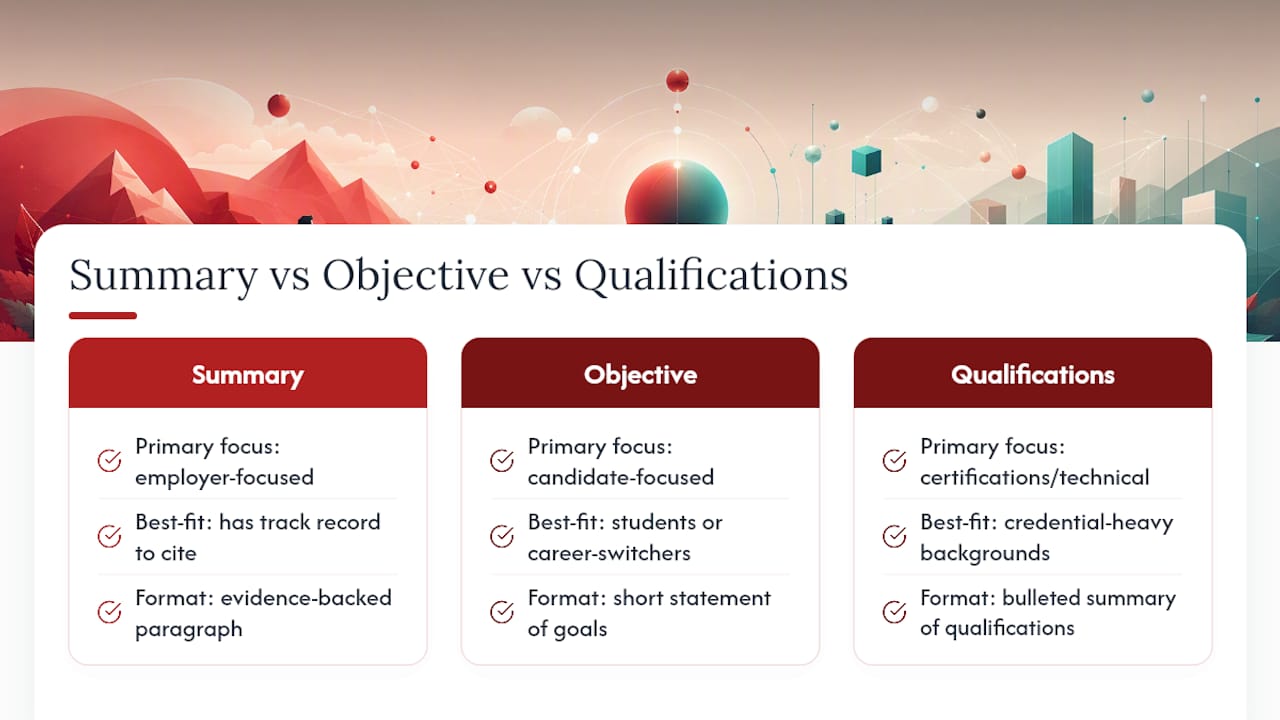
Resume summary vs. objective: a quick rule

A summary is employer-focused. It tells the reader what you bring, backed by evidence, so use it whenever you have a track record worth citing. An objective is candidate-focused. It states what you want, and it fits a narrow set of cases: students, career-switchers with no relevant history yet, or workers entering their first structured role.

When your background is heavy on certifications or technical qualifications rather than narrative achievements, a bulleted “summary of qualifications” often communicates faster than a paragraph.

Comparison of resume summary formats

How to write a resume summary: a 5-step process

Follow this sequence and you’ll never stare at a blank line under your name again.

  1. Finish the resume first. Draft your work history, achievements, and skills sections before touching the summary. You can’t summarize accomplishments you haven’t written down yet, and experts consistently recommend this order because it keeps the summary anchored in real results.
  2. Identify the target title and keywords. Read the job posting and pull the exact job title and 2 to 3 recurring terms. These become the language your summary echoes.
  3. Draft your 2 to 4 lines. Cover who you are (title, years or level), what you do best (2 to 3 skills), and one quantified result that shows employer value.
  4. Tailor it per application. Swap the keywords and, where possible, the quantified result to match what each posting actually asks for. Robert Half’s guidance is blunt on this point: generic summaries get skimmed past.
  5. Edit for concision and active verbs. Cut adjectives that don’t carry information. Replace “responsible for” with what you actually did and what happened as a result.

Pro Tip: Ask a colleague or mentor to read your finished resume and tell you, in one sentence, what stood out. That sentence is often the strongest raw material for your summary, since outside readers catch achievements you’ve stopped noticing yourself.

Resume summary examples by experience level and format

Here are professional summary examples organized by career stage, plus three format options worth testing against your own resume.

Entry-level (paragraph format):
Strong writer with working knowledge of Canva and basic analytics tools.
Personalize the internship detail, the percentage, and the named tools.

Early career, 2 to 4 years (bulleted summary):

  • Project Coordinator with 3 years supporting cross-functional teams in the software sector.
  • Skilled in Asana, stakeholder communication, and timeline management.
  • Reduced average project delivery time by 15% through improved intake processes.

Mid-career (paragraph format):
"Customer Service Manager with 8 years leading teams of up to 12 representatives in high-volume retail environments. Expertise in conflict resolution, CRM systems, and staff training.
Swap the team size, tools, and satisfaction figures for your own.

Senior/executive (transferable-skills summary):
“Operations leader with 15+ years spanning manufacturing and logistics. Areas of expertise include supply chain optimization, P&L ownership, and vendor negotiation. Led a plant consolidation that cut annual overhead by $1.2 million.”
Readers moving toward this level often benefit from understanding how an executive summary differs from a standard professional one before drafting theirs.

Each format works. The paragraph style reads naturally, the bulleted version scans faster on mobile, and the transferable-skills approach helps when your history spans more than one industry.

Common mistakes and a six-item self-edit checklist

The same errors show up across thousands of resumes: vague adjectives with nothing to back them up, duty lists instead of results, missing job-specific keywords, summaries stretching past 4 lines, and zero quantified achievements anywhere in the statement.

Quick checklist:

  • Does it name your title or experience level in the first line?
  • Does it list 2 to 3 specific, relevant skills?
  • Does it include at least one number, percentage, or dollar figure?
  • Does it echo language from the job posting?
  • Is it under 60 words?
  • Would a stranger know what you’d deliver on day one?

Before: “Hardworking professional responsible for managing a team and handling customer issues.”

Quantifying results turns a vague claim into evidence a hiring manager can act on. Formatting matters too. Unusual symbols or dense paragraphs can confuse ATS parsers, which is one more reason ATS-friendly formatting belongs on your pre-submission checklist.

Why professional writers draft the summary last

Writing the summary after the rest of the resume isn’t a stylistic preference. It’s a sequencing decision that produces sharper, more evidence-backed statements, because you’re synthesizing what you actually accomplished rather than guessing at what sounds impressive.

Professional resume writers spend most of a project extracting the achievements clients undervalue: the process fix nobody asked them to make, the retention number they never thought to mention, the dollar figure buried in a performance review. That extraction work, paired with knowledge of how applicant tracking systems parse keywords, is what separates a generic summary from one that survives both the algorithm and the recruiter’s six-second scan.

What the research gets right, and where advice falls short

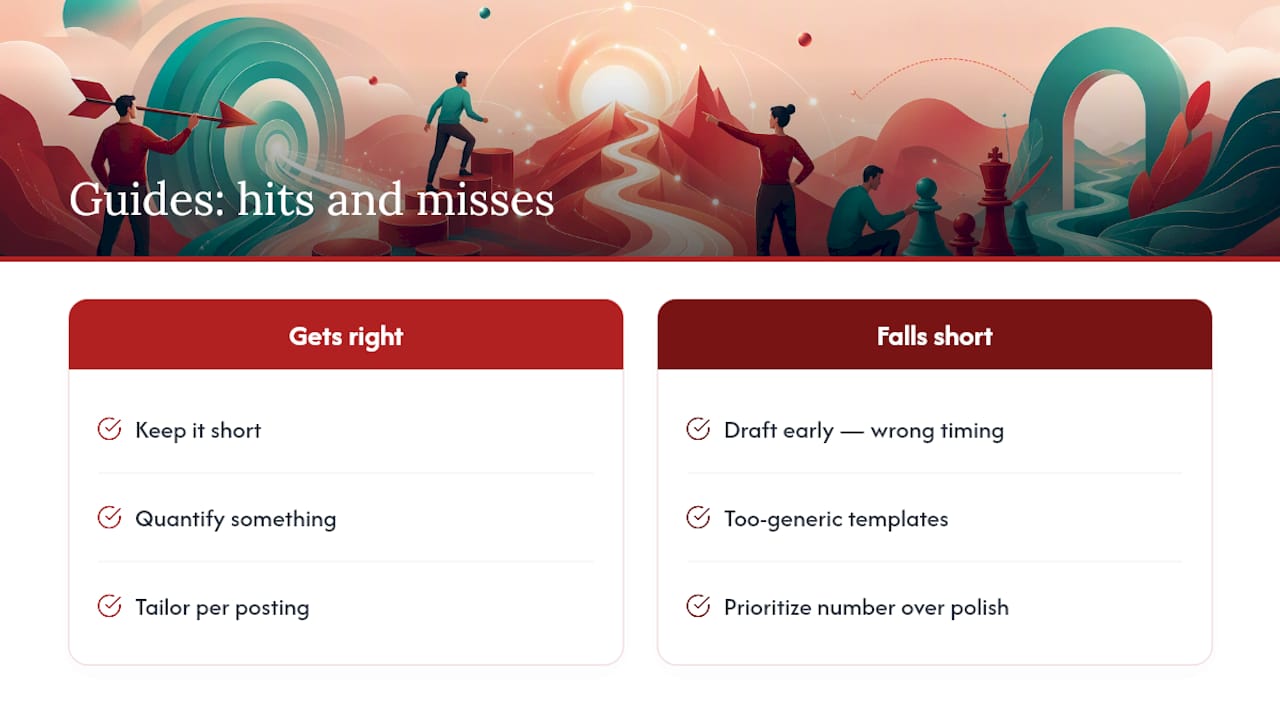
Most guides agree on the mechanics: keep it short, quantify something, tailor it per posting. Where the advice consistently falls short is timing. Writers are told to draft a summary early, as a kind of warmup, when the opposite order produces better results almost every time.

What the research gets right, and where advice falls short — overview diagram

The other gap is specificity. Generic templates tell you to “highlight your strengths,” which is advice so broad it’s nearly useless. The better instruction is narrower: find the one metric, dollar figure, or percentage that proves your strongest claim, and build the summary around that single data point rather than a list of adjectives.

If you take one thing from this, prioritize the quantified result over polish. A summary with one hard number and average phrasing will outperform elegant prose with nothing to measure, every time a recruiter has to choose between two candidates in the same stack.

— Professional

Get hands-on help with your resume summary

Writing a summary that survives both an ATS scan and a six-second human read is harder alone than it looks on paper. Professional resume writing services build that top-of-page statement around achievements that move hiring decisions, tailored to your target role rather than a generic template.

Advanced Resume

For senior professionals with a track record to distill into three sharp lines, the Advanced Resume service pairs in-depth consultation with multiple revisions to get the summary and full document right. Recent graduates and early-career applicants without a long work history to draw from get a different kind of support through Early Career Resume, which focuses on turning internships, coursework, and volunteer work into employer-facing value statements. If you need your resume, cover letter, and LinkedIn profile aligned around the same summary language, the Next Step Package Deal bundles all three into one coordinated project. Starting with a consultation can help tailor services to the role you’re targeting.

Sources

Career change resume title card illustration

Pass ATS and the 6 Second Scan: Resume for a Career Change

Use a hybrid resume that leads with a target-role headline, a 2 to 3 sentence professional summary, and a skills-first section, so a hiring manager can identify your intended pivot within seconds. This structure outperforms a chronological or purely functional layout because it satisfies applicant tracking systems while still telling recruiters exactly where you’re headed. Everything below explains how to build it, section by section.


TL;DR:

  • Highlight your top two skill clusters at the beginning of the resume to emphasize relevance for both ATS and recruiters.
  • Use measurable, outcome-focused bullet points that start with action verbs to demonstrate your transferable achievements.
  • Place completed certifications and relevant projects immediately after the skills section to bridge experience gaps effectively.
  • Keep the resume to one page unless applying for a senior role, and tailor each version with a master resume system to save time.
  • Clearly state your target role in the headline and summarize your background, transferable skills, and value in three concise sentences.

Professionalresumes
professionalresumes.ca
Make Your Career Pivot Clear
Professional Resumes creates customized resumes, cover letters, and LinkedIn profiles tailored to your career goals and industry expectations.

Explore Professional Resumes

Table of Contents

Why the hybrid resume format works for a career change

A chronological resume lists jobs in reverse date order and assumes your last title predicts your next one. That assumption breaks the moment you’re pivoting industries, which is exactly why a combination format, often called hybrid, performs better for career changers. It opens with a skills and summary block, then supports that pitch with a condensed work history underneath.

Purely functional resumes, the kind that hide dates and bury job titles under skill headings, tend to backfire. They can fail ATS parsing and make recruiters suspicious about what you’re not saying. A combination resume format keeps your history visible while still leading with relevance.

For a career change resume, structure the page in this order: name and target-role headline, professional summary, core skills grouped into 3 or 4 clusters, professional experience with transferable-outcome bullets, then education and certifications. That sequence gives a recruiter the pitch first and the proof second, which is the opposite of what a standard chronological resume does.

Hybrid resume structure from pitch to proof

How do you write a resume summary for a career change?

Keep it to 2 or 3 sentences that connect your background, your strongest transferable skill, and the value you bring to the new role. That’s the formula Wharton recommends for career-change resumes, and it works because it does the interpretive labour a recruiter shouldn’t have to do themselves.

Choose a summary over an objective statement once you have at least some relevant experience, paid or not, to point to. Reserve a short objective for situations with almost no bridging experience, where you need one sentence to state the goal before pivoting straight into skills.

Example, mid-career pivot (operations manager to project coordinator):
“Operations manager with 8 years leading cross-functional teams and vendor relationships. Skilled in scheduling, budget tracking, and stakeholder communication. Bringing that discipline to project coordination roles in construction and infrastructure.”

Example, early-career pivot (retail supervisor to UX research):
“Retail supervisor with 3 years translating customer feedback into operational changes. Trained in user interview methods and usability testing through a recent certificate program. Ready to apply that customer-first instinct to UX research.”

Both examples name the past role, the transferable strength, and the destination. Neither apologizes for the pivot.

How do you identify and group transferable skills?

Hard skills are teachable and specific, things like financial modelling, SQL, or CAD software. Transferable soft skills, like stakeholder management, conflict resolution, or process improvement, travel across industries because they describe how you work, not what tool you used. A career change resume needs both, but transferable skills carry the argument.

Pull the job posting for your target role and highlight every recurring competency. Then group your own experience into 3 or 4 clusters that mirror that language rather than listing scattered single words. Excelsior OWL’s career-change guidance recommends this clustering approach specifically because it mirrors how recruiters and ATS software scan for keyword matches.

A rewrite might look like this: instead of listing “communication” as a bare skill, cluster it as Client Relations & Communication, then list bullet evidence underneath, such as “Managed 40+ client accounts, resolving escalations within 24 hours.” That’s a rewrite that shows the same competency the new industry’s job posts describe, using the target role’s own vocabulary.

  • Leadership & Team Management: supervising, mentoring, delegating
  • Data & Analysis: reporting, forecasting, process auditing
  • Client Relations & Communication: negotiation, presentations, conflict resolution
  • Project Delivery: scheduling, budget tracking, vendor coordination

Pro Tip: Place your top 2 skill clusters directly under your summary, not lower on the page. ATS software and human recruiters both weight the top third of a resume more heavily, so bury nothing important below the fold.

How do you reframe past experience for a new industry?

Filter your work history down to responsibilities that demonstrate relevance, not everything you’ve ever done. A resume for a career change isn’t a full job history. It’s a curated argument, and Harvard Business Review’s guidance on career switching is blunt about this: the resume should show where you’ve been and where you’re going, not hide the gap between them.

Use a short outcome-focused micro-formula for each bullet: what you did, using a strong verb, and what resulted, ideally with a number. Monster’s career-change resume guidance points to exactly this pattern, action plus measurable result, as what separates a forgettable bullet from a convincing one.

Before: “Responsible for team meetings and reporting.”

Before: “Handled customer complaints.”

  1. Cut any bullet that doesn’t demonstrate a skill your target role needs.
  2. Start every bullet with an action verb, never a noun phrase.
  3. Add a number or measurable outcome wherever you can defend it honestly.
  4. Replace industry jargon from your old field with language from the new one.
  5. Limit older, unrelated roles to a line or two under an “Earlier Career” heading.

Where do certifications, courses, and projects belong?

Completed certifications and credentials belong right after your skills section, not buried at the bottom of the page. In-progress courses can go in the same block, labelled clearly as “in progress” or with an expected completion date, so nothing reads as misrepresented.

Projects deserve their own short entries when you lack direct paid experience. Use a three-part format: one line of context, one bullet describing the task with a strong verb, and one line stating the result. That structure reads cleanly in both ATS scans and human reviews, and Forbes’ career-change resume guide confirms that clearly presented credentials and projects are one of the most effective ways to bridge a direct-experience gap.

  • Completed certifications: list under a dedicated “Certifications” header, most recent first.
  • In-progress coursework: label with expected completion date.
  • Freelance or volunteer projects: format as context, action, result, exactly like a paid role.
  • Portfolio links: include a single URL if your target field values visible work samples.

What formatting rules actually matter for ATS and recruiters?

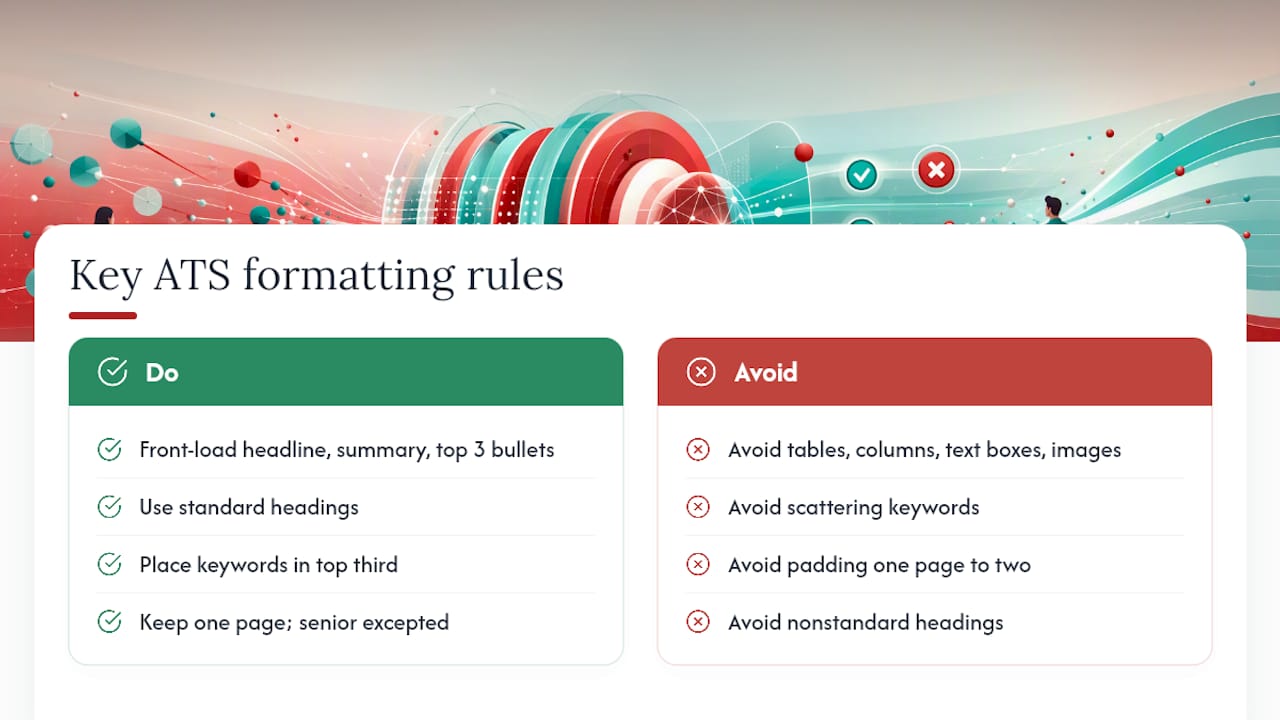
Recruiters spend about 6 seconds on an initial resume scan, which means your headline, summary, and top 3 bullets carry most of the weight. Everything below that needs to earn a second look, not carry the entire pitch.

Stick to standard section headings (“Professional Experience,” “Skills,” “Education”) because ATS software is built to recognize them, and avoid tables, columns, text boxes, or embedded images that scramble parsing. Place your most important keywords in the top third of the page rather than scattering them evenly, since some ATS platforms weight positional relevance. For an outside perspective on how parsing engines behave, JobsZA’s breakdown of ATS mechanics covers the keyword and formatting logic in more technical detail.

One page is standard for most career changers. Two pages become acceptable only when you’re pivoting from a senior or executive-level role with a genuinely long relevant history to summarize. Never pad a one-page resume to two just to look thorough.

What formatting rules actually matter for ATS and recruiters? — overview diagram

How do you manage multiple resume versions without losing your mind?

Build one master resume containing every bullet, skill cluster, and credential you might ever use, then branch a targeted version for each application rather than editing from scratch every time. A labelled master-resume system saves time and keeps your formatting consistent across versions.

  1. Keep the master document in one file with every possible bullet and skill cluster included.
  2. For each application, swap the headline to match the exact target role title.
  3. Reorder or swap your top 6 skills to mirror that job posting’s language.
  4. Rewrite 2 to 3 bullets per relevant role to echo the posting’s specific priorities.
  5. Save each version with a clear filename, such as “LastName_ProjectCoordinator_v2.”

This approach also makes it easier to reposition experience for a mid-career transition without rebuilding your whole document every time a new posting appears.

A copy-ready checklist before you hit send

Headline example: “Project Coordinator | Former Operations Manager, Cross-Functional Team Leadership”

Two-sentence summary example: “Operations professional with 6 years managing vendor logistics and budget tracking. Pivoting that coordination experience into project management roles in construction.”

Bullet rewrite 1, before: “Worked with clients on service issues.”

Bullet rewrite 2, before: “In charge of scheduling for the department.”

Before submitting, confirm your headline states the target role by name, your summary is 3 sentences or fewer, your top skill cluster matches the job posting’s own wording, every bullet leads with a verb and ends with a result, and your file is saved as a standard, non-image PDF or Word document that any ATS-friendly formatting system can parse cleanly.

What we’ve learned from working with career changers

Career changers tend to underestimate how much interpretive work a hiring manager has to do when a resume doesn’t explain itself. The strongest resumes we see don’t apologize for a pivot or hide it behind vague titles. They state the target role plainly and let the skills clusters do the convincing.

Where professional support tends to accelerate a pivot is in the reframing itself, translating a decade of operations language into project-management vocabulary, for instance, without losing the substance of what actually happened. Professional support builds that translation through direct consultation and multiple revision rounds, tailoring each document to the specific industry a client is entering rather than issuing a generic rewrite. DIY works well for a first draft. A second, expert pass tends to matter most when the pivot is significant, the stakes are high, or the writer is too close to their own history to see what a stranger will find confusing.

— Professional

Which Professionalresumes package fits your pivot

The right resume package depends on where you’re starting from, not just where you’re headed. If you’re early in your career or shifting into a field with limited direct experience, the Early Career Resume package is built around exactly that gap, helping you present coursework, projects, and transferable skills as legitimate proof of capability rather than filler. If you’ve built a solid work history and are making a lateral or upward pivot into a new industry, the Advanced Resume package focuses on translating your existing achievements into the language your target field actually uses. And if you’re pivoting at the senior or C-suite level, where the stakes and scrutiny are highest, the Executive Resume package is built for that scale of transition.

Advanced Resume

Packages often include consultation, revision rounds, and ATS-friendly formatting tailored to the target industry, so the document reflects the individual’s actual trajectory instead of a generic template. Book a consultation through the package page that matches your career stage and start the conversation about your pivot today.

Sources

Executive resume format title card illustration

Pass ATS, Win Interviews: Executive Resume Format for Senior Leaders

The strongest executive resume format right now is a clean, single-column, chronological layout led by a tight executive summary and a core-competencies grid, backed by an ATS-friendly plain-text version for online applications. Before anything else, rebuild the top third of page one: your headline, a three-to-five-line summary, and 6 to 12 core competencies, so they mirror the language of the role you want. Everything else follows from that.


TL;DR:

  • The top third of an executive resume should feature a clear headline, a concise summary, and core competencies aligned with the target role’s language.
  • Achievements should be written using the Challenge-Action-Result model, quantifying impacts like revenue growth, cost savings, or efficiency improvements.
  • A two-page length is standard, with older roles condensed into a summary or included as minimal bullets, and multiple versions prepared for different application formats.
  • ATS-friendly formatting requires simple fonts, standard section headers, and avoidance of complex tables or graphics that can be misread by applicant tracking systems.
  • Tailoring the top third for each role—including keywords, achievement highlights, and scope adjustments—can be done effectively in under an hour.

Professionalresumes
Make Your Executive Resume Stand Out
Professional Resumes creates customized resumes tailored to your aspirations, with consultations and revisions to showcase your skills and experience.

Explore resume services

Table of Contents

Executive resume format: anatomy and section-by-section structure

A modern executive resume format works the way a well-run board meeting works: the most important information comes first, and everything else supports it. Recruiters and retained search consultants spend seconds, not minutes, deciding whether to keep reading, and the sections below need to earn their placement in that order.

Headline and executive summary

Your headline is a positioning statement, not a job title. “Chief Operating Officer, Manufacturing & Supply Chain” tells a reader more in five words than “Experienced Executive” ever will. Below it, a three-to-five-line executive summary should state your scope (P&L size, team size, industry), your signature strength, and one or two headline outcomes.

A workable micro-template: "COO with P&L ownership up to $180M across three business units. Known for turning around underperforming operations and rebuilding executive teams during private equity ownership transitions.

Core competencies matrix

List 6 to 12 competencies in a compact grid, three or four per row, directly beneath the summary. These should read as leadership domains, not soft skills. Think “Post-Merger Integration,” “Board & Investor Relations,” “Global Supply Chain Redesign,” rather than “Communication” or “Leadership.” Pull the exact phrasing from the job description wherever it’s accurate. This section does double duty: it gives human readers a fast scan and gives ATS keyword matching something concrete to find.

Professional experience

Each role should open with a single context sentence, company size or revenue, industry, and your mandate, before the achievement bullets begin. A reader who doesn’t know that “Company X” was a $400 million industrial distributor with 1,200 employees has no way to judge whether your results were impressive or modest. Follow that sentence with four to six achievement bullets per recent role, tapering to two or three bullets for roles more than ten years old.

  • Most recent role: context sentence plus 4 to 6 bullets
  • Second and third most recent: context sentence plus 3 to 4 bullets
  • Older roles (10+ years back): title, company, dates, and 1 to 2 bullets only
  • Roles beyond 15 years: often collapsed into a single “Early Career” line

Board, advisory, publications, and education

These belong near the bottom of page one or the top of page two, sized to their relevance. A sitting board seat or advisory role for a candidate targeting board work deserves its own labelled section near the top. For most operating executives, education and certifications sit last, listed simply: degree, institution, year optional. Publications and speaking engagements only earn space if they reinforce your positioning, thought leadership for a CMO candidate, technical authority for a CTO. Reviewing executive resume writing tips built around this section order helps confirm you’re not burying a strong differentiator on page two.

Executive Resume

Which executive resume layout should you actually use?

Layout choice signals experience level before a recruiter reads a single word, so it deserves as much thought as the content itself.

Single-column is the safest default. It parses reliably across every applicant tracking system, reads cleanly on any device, and gives recruiters a familiar top-to-bottom scanning path. For the majority of executive searches, especially anything routed through a corporate careers portal or a retained search firm’s database, single-column is the right call.

Two-column or sidebar layouts have a narrower use case. A sidebar can work well for board candidates or executives with a long list of certifications, affiliations, and technical credentials that would otherwise crowd the narrative sections. Two-column formats are common at senior levels specifically because they let you show breadth without cluttering the main achievement story. The trade-off is real: sidebar content is frequently misread or skipped entirely by ATS parsers, which means anything essential to passing a keyword screen, your title, your core competencies, your industry, should never live in the sidebar alone.

Functional and hybrid formats are a niche tool, not a default. They make sense in one specific situation: an executive pivoting industries or functions, where a strict chronological history would bury transferable leadership skills under an unfamiliar job title. Outside that scenario, a functional format tends to read as evasive to experienced recruiters, who are trained to wonder what a chronology-averse resume is hiding.

For layout specs that preserve executive presence without sacrificing parseability:

  • Fonts: Calibri, Garamond, or Georgia at 10.5 to 11.5 points for body text
  • Name and headline: 16 to 20 points, bold, no decorative fonts
  • Margins: 0.6 to 0.8 inches on all sides, never below 0.5 inches
  • Line spacing: single or 1.08, with a clear blank line between roles
  • Section headers: bold, slightly larger than body text, consistent capitalization throughout

Pro Tip: If you’re torn between single-column and sidebar, build the single-column version first. It’s easier to add a compact skills sidebar later than to strip parsing-risky elements out of a design you’ve already grown attached to.

Conservative, ATS-friendly layouts with clear hierarchies consistently outperform visually elaborate designs at the executive screening stage, where the reader is scanning for substance, not admiring your design software skills.

How long should an executive resume be?

Two pages is the standard length for a senior leader with significant experience, and an executive resume functions as a strategic marketing document rather than an exhaustive career record, so every line has to earn its place. Extending to three pages is justifiable in specific circumstances such as a very long career with multiple distinct chapters, a candidate targeting a board seat where governance experience needs its own section, or a technical executive whose patents, publications, or clinical trial leadership require an addendum.

If you’re pushing past two pages without one of those justifications, the fix isn’t a smaller font. It’s moving older roles into a condensed “Early Career” summary and cutting bullets that describe responsibilities rather than results.

You need three distinct versions of your resume, not one file doing three jobs:

  1. A Word or PDF version for human readers. Word remains the most universally compatible format for systems that ingest and forward resumes, while PDF preserves your formatting exactly when a document is being forwarded to a hiring committee or board.
  2. An ASCII or plain-text version for online application forms. Many corporate portals and ATS platforms ask candidates to paste resume content directly into a text box, and a document full of tables, columns, or special characters will paste in as a garbled mess. Keep a stripped-down version, plain paragraph breaks, simple bullet dashes, no tables, ready for exactly this purpose.
  3. A short networking summary. One tight paragraph, roughly 100 words, that you can drop into an email introduction or a LinkedIn message to a connector. This isn’t a fourth resume format so much as a distilled version of your executive summary.

On file naming and sending: use a clear, professional file name (“JaneSmith_COO_Resume.pdf”), never “Resume_Final_v3.docx.” Strip personal metadata from document properties before sending. When a job posting doesn’t specify a format, send PDF by default to preserve formatting, but always keep the Word version ready, some corporate systems reject PDFs outright or fail to parse them correctly.

Writing achievement bullets that actually get executives hired

The Challenge-Action-Result model, CAR, is the single most useful bullet-writing habit for a senior leader to adopt: name the business challenge you inherited, describe the action you took, and quantify the result. Executive resumes need to demonstrate strategic impact rather than list duties, and CAR forces that discipline because it’s structurally impossible to write a CAR bullet that only describes a responsibility.

Map every outcome to a business metric your reader already cares about: revenue growth, EBIT or margin improvement, market share, headcount efficiency, customer retention, or time-to-market. Here are conversions from duty-based language to CAR-based, quantified language:

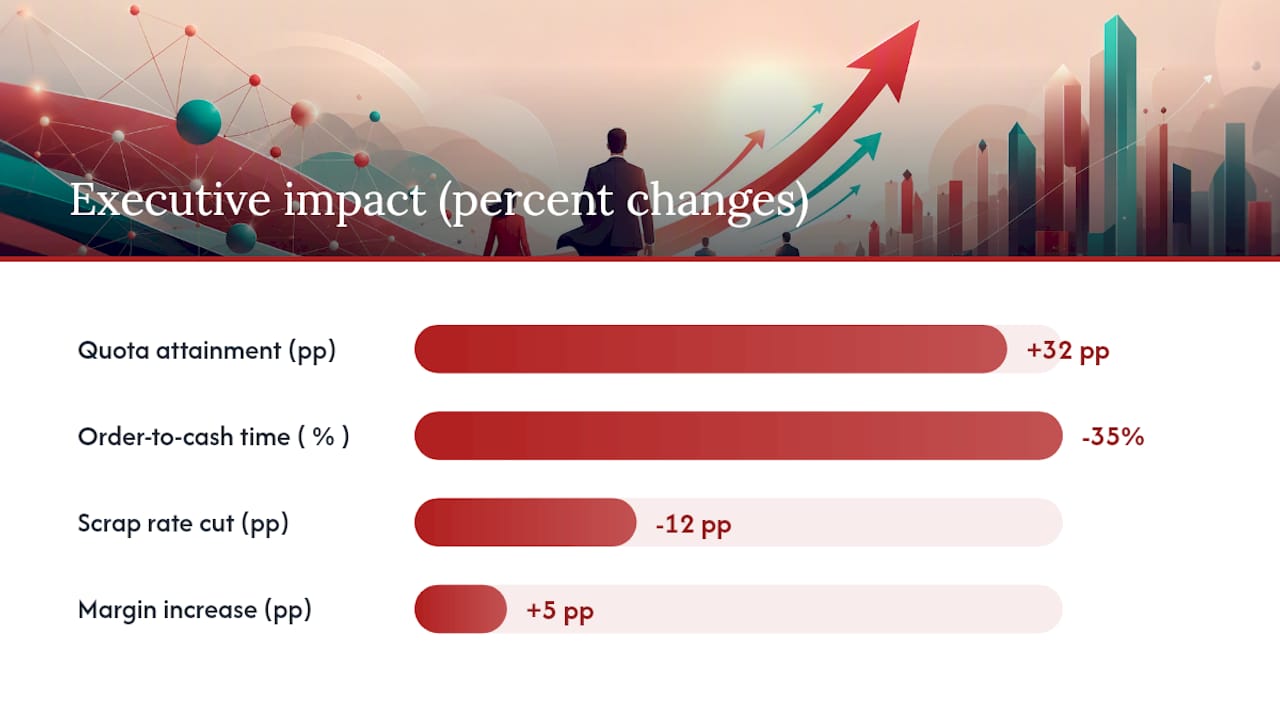
  • Before: “Responsible for P&L management of the western division.” → After: “Owned $85M P&L for western division; grew regional margin from 11% to 16% over two fiscal years through vendor renegotiation and SKU rationalization.”
  • Before: “Led the sales team.” → After: “Rebuilt underperforming 40-person sales organization after 30% attrition; restored quota attainment from 62% to 94% within three quarters.”
  • Before: “Managed the company’s digital transformation.” → After: “Directed enterprise ERP migration across 6 business units; cut order-to-cash cycle time by 35% and eliminated $2.1M in annual reconciliation labour.”
  • Before: “Oversaw manufacturing operations.” → After: “Turned around underperforming plant with 18% scrap rate; implemented lean protocols that cut scrap to 6% and avoided a planned $4M capital expansion.”
  • Before: “Responsible for hiring and team development.” → After: “Rebuilt executive bench after 4 C-suite departures in 14 months; all 4 replacement hires remained past the two-year mark.”
  • Before: “Handled vendor relationships.” → After: “Renegotiated top-5 supplier contracts, reducing input costs by 12% and securing preferential terms during a market-wide shortage.”
  • Before: “Improved customer satisfaction.” → After: “Redesigned client escalation process; cut churn among top-20 accounts from 18% to 4% in one year.”
  • Before: “Led a merger integration.” → After: “Directed post-merger integration of $220M acquisition; achieved planned synergies six months ahead of schedule.”

Use absolute numbers when you’re allowed to and the number is genuinely impressive; use percentages, ranges, or relative comparisons when confidentiality requires it.

On prioritization: for a career spanning 20-plus years, keep the strongest 3 to 4 bullets per role for anything in the last decade, and be ruthless about cutting bullets that describe process rather than outcome. A bullet that starts with “Participated in” or “Assisted with” rarely survives a serious edit.

Writing achievement bullets that actually get executives hired — overview diagram

What to show in the top third of your resume

If strategic fit isn’t obvious in the top third of page one, much of the rest of the resume goes unread. That single fact should govern how you spend your editing time. Recruiters and retained search consultants scan for a handful of signals almost immediately: your functional title, your industry, the rough size of the P&L or budget you’ve managed, and one or two signature achievements that prove you can do the job being advertised.

Before submitting to a specific role, run through this tailoring checklist:

  • Rewrite your headline to echo the exact title or function named in the posting
  • Swap in 2 to 3 core competencies that match language pulled directly from the job description
  • Move your most relevant achievement bullet to the top of your most recent role
  • Adjust your summary’s scope language (P&L size, team size, geography) to match the scale of the target role
  • Cut or shrink any competency or bullet irrelevant to this specific search
  • Confirm your industry and functional keywords appear at least once in the top third

For a rapid tailoring workflow that fits into a busy executive’s calendar: spend the first 10 minutes reading the job description twice, once for function, once for language. Spend the next 20 minutes editing your headline, summary, and competencies grid. Spend a final 15 to 20 minutes reordering or lightly rewriting your top two role bullets. That’s a complete, credible tailoring pass in under an hour, done from a strong baseline resume rather than a rebuild from scratch.

Pro Tip: Keep a “master” version of your resume with every achievement bullet you’ve ever written, then build each tailored version by selecting from that master document rather than writing new content under deadline pressure.

ATS formatting rules that actually matter for executives

Applicant tracking systems reward structural simplicity, and most of the formatting choices that damage parsing are also the choices that hurt human readability, so getting this right serves both audiences at once.

Keep contact information (name, phone, email, city) in the main body of the document, never in a header or footer. Many ATS platforms simply don’t read header and footer fields, which means a resume with contact details tucked into a document header can arrive at a recruiter’s desk with no way to reach the candidate. Use standard date formats throughout (“January 2021 to March 2026,” not “01/21 to 03/26” or creative alternatives), and keep section headers as plain, conventional labels: “Professional Experience,” not “My Journey” or “Where I’ve Made an Impact.”

Avoid complex tables, text boxes, and multi-column text blocks for anything essential, your title, your competencies, your achievement bullets. These elements frequently get scrambled or dropped entirely during parsing. If you want a sidebar for visual balance, reserve it for genuinely non-essential extras: a list of board memberships, professional association names, or language proficiencies, content that doesn’t need to survive a keyword scan intact.

  • Use standard fonts (Calibri, Garamond, Georgia, Arial) rather than decorative or condensed typefaces
  • Keep font size at 10.5 points minimum for body text, even under length pressure
  • Leave genuine white space between sections rather than compressing margins to fit more content
  • Save and submit as Word (.docx) unless the posting specifically requests PDF
  • Never embed critical content inside an image, logo, or graphic element

After you build your plain-text version, validate it before submitting: paste the content into a basic text editor (Notepad, TextEdit) and check that section breaks, bullets, and spacing still make sense without any formatting. If sentences run together or bullets vanish, the formatting in your source document is too complex for a clean paste-in. Reviewing ATS-friendly resume practices before your next application round is a fast way to catch these issues before a recruiter does.

Executive resume templates you can adapt right now

Modern templates from sources like Canva or Word’s built-in library can be a reasonable starting point for layout and spacing, but almost none of them are built with executive-level content in mind out of the box. They need adaptation, more white space, a competencies grid, and room for a real executive summary, before they’re ready for a senior search.

Three executive-summary templates for common situations:

Growth-stage leader: “Revenue-focused [title] with a track record of scaling teams and systems through periods of rapid growth. Grew [Company]’s revenue from $40M to $110M over four years while building the commercial infrastructure to support continued expansion. Known for translating ambitious growth targets into operational plans that hold up under scrutiny.”

Turnaround leader: “Operating executive specializing in underperforming business units and organizations facing structural decline. Took over a division with three consecutive years of margin erosion and restored profitability within 14 months through cost discipline, portfolio rationalization, and leadership team reconstruction. Comfortable operating under board-level scrutiny and tight timelines.”

Scale-stage leader: “Experienced [title] focused on building the systems, teams, and governance structures that let a growing company operate like a mature one. Led the infrastructure buildout that supported [Company]’s transition from founder-led operations to institutional-grade reporting ahead of a successful Series C raise.”

A copyable competencies grid example, formatted as three columns:

P&L Ownership M&A Integration Board Reporting
Organizational Design Change Management Capital Allocation
Global Operations Talent Development Investor Relations

Three short experience snippets showing the context-sentence-plus-bullets structure:

COO, mid-market industrial company ($260M revenue, 900 employees): Directed operations across four manufacturing sites during a private equity ownership transition. Led a 22-person leadership restructuring that reduced management layers from six to four. Delivered $6.8M in annual cost savings within the first 18 months.

CFO, technology services firm ($90M revenue, venture-backed): Built the finance function from the ground up ahead of a planned Series C raise. Reduced monthly close time from 18 days to 5. Secured $35M in growth financing on favourable terms by rebuilding investor reporting credibility.

VP Engineering, SaaS platform (200-person engineering organization): Rebuilt engineering leadership after the departure of three directors in one year. Reduced average feature delivery time from 11 weeks to 6.

Keep language market-neutral throughout, avoid country-specific legal claims about employment status, work authorization, or credential equivalency, since those vary by jurisdiction and don’t belong in a resume document itself.

Why trust this guidance: Professional Resumes’ approach to executive formatting

This guidance reflects formatting principles applied for senior-level and C-suite resume preparations. As an author with specialized focus on executive resume strategy, Professional’s approach centres on the same discipline outlined throughout this piece: a scan-first top third, quantified achievement bullets, and a resume built to survive both a retained search consultant’s read and an ATS parse.

The approach emphasizes personalized, consultation-driven resume writing rather than template-filling, with client testimonials highlighting increased interview requests and stronger positioning in executive searches. That approach shows up in how each engagement runs: an in-depth consultation to surface the achievements a busy executive rarely remembers to mention, a working draft built around the section structure covered above, and a revision process that keeps the client’s voice intact while sharpening the strategic framing.

In practice, every executive client often leaves with more than a single static file. The multi-version workflow, including Word or PDF for human readers and a plain-text version for ATS submission, is an important part of delivering finished work.

A writer’s checklist for updating an executive resume fast

When I sit down to refresh a senior leader’s resume under time pressure, I run the same seven-step pass every time, because it catches the errors that actually cost interviews.

  1. Rewrite the headline and summary to match the target role’s exact language.
  2. Rebuild the competencies grid with 2 to 3 keywords pulled straight from the posting.
  3. Identify the single strongest achievement bullet and move it to the top of the most recent role.
  4. Write or revise three bullets using the CAR structure with a real metric in each.
  5. Strip out any duty-based language that survived from an earlier draft.
  6. Generate the plain-text version and paste-test it in a basic text editor.
  7. Proof every number twice, a wrong metric on an executive resume undermines credibility fast.

The most common mistake I see is an executive resume that reads like a job description of the role they already have, rather than a case for the role they want next.

— Professional

How Professional Resumes can help with your executive resume

The format matters, but execution under deadline pressure is where most executives lose momentum, particularly when a strong opportunity surfaces with a two-week application window. Professional Resumes builds each document around the multi-version workflow covered throughout this guide, so you’re never scrambling to convert a design-heavy resume into something an ATS can actually read.

Executive Resume

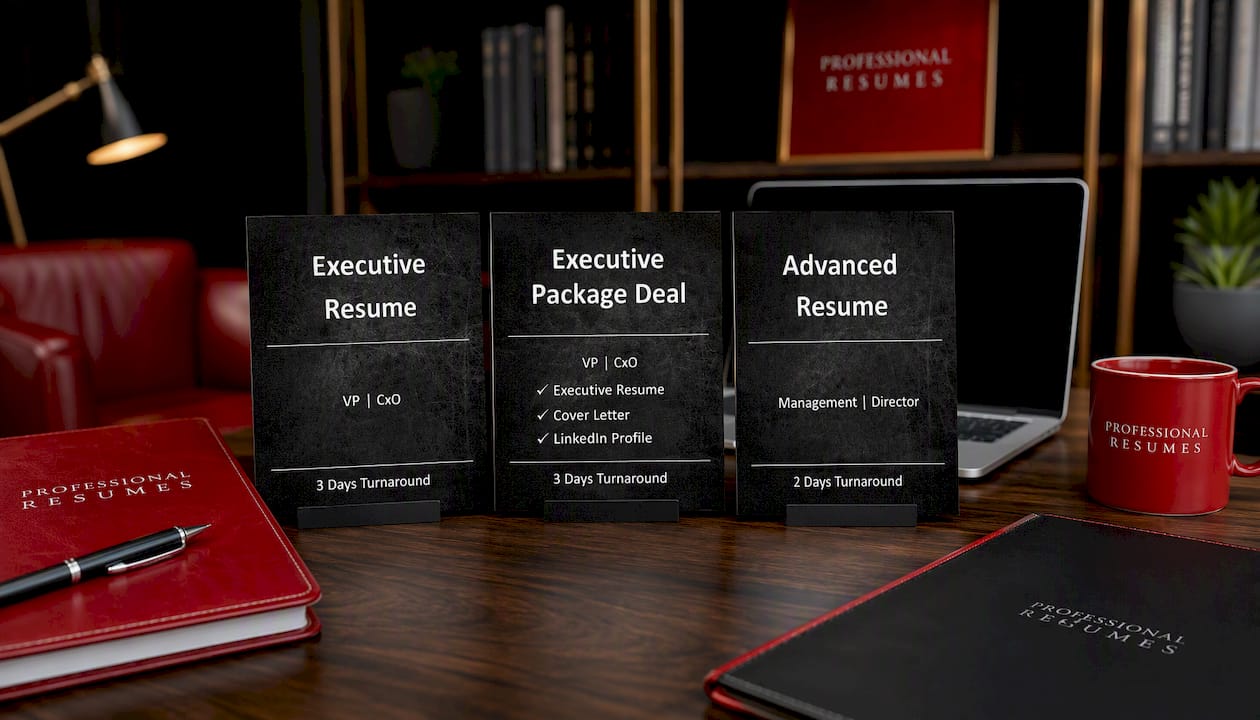
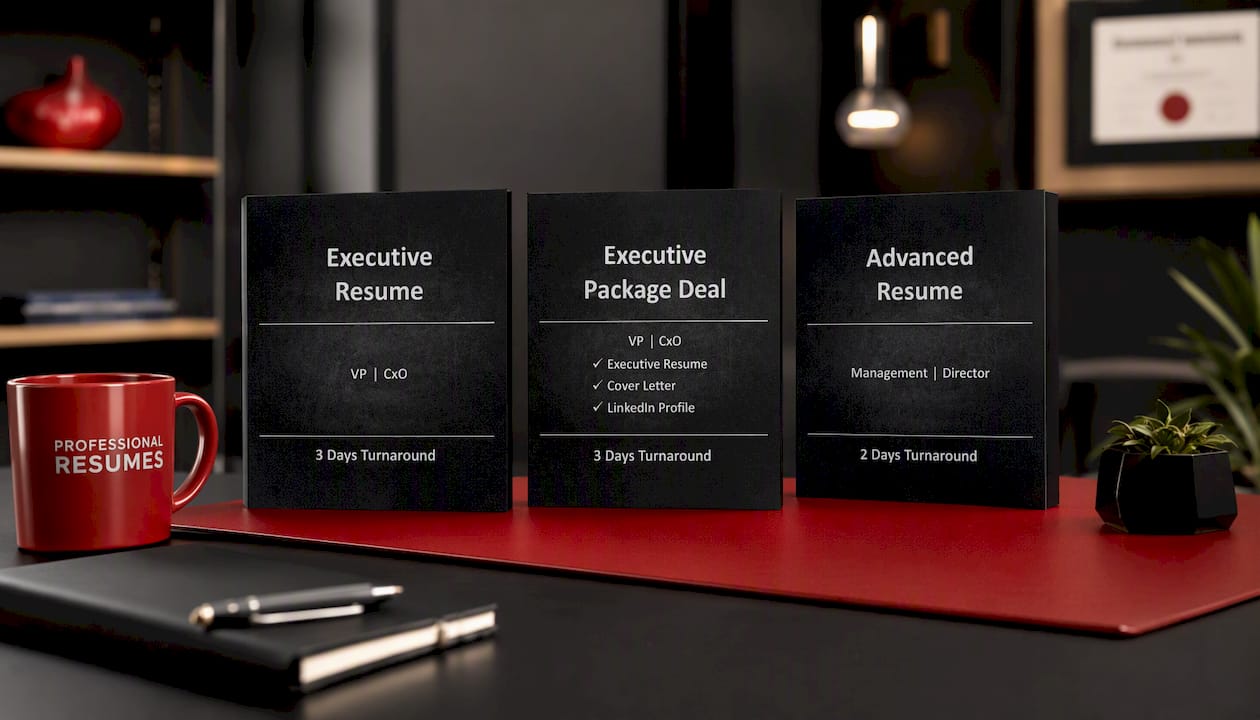
The Executive Resume service fits a leader who needs a single, sharply positioned document, built through direct consultation, for an active search. The Executive Package Deal bundles that resume writing with a matching cover letter and LinkedIn profile optimization, a fit for anyone running a full search rather than responding to one posting. For candidates with complex, multi-chapter careers, board roles, multiple industries, or a long list of credentials to organize, the Advanced Resume package is built to handle that density without losing scan-friendliness.

Every engagement starts with a consultation to surface the achievements and context a resume alone won’t capture, followed by a working draft and a revision process built around your feedback. If your current resume was built for a role three job titles ago, that consultation is the fastest way to find out what needs to change.

Decorative LinkedIn job search title card

Set up LinkedIn Open to Work in 2 minutes, double recruiter messages

Turn on Open to Work. For most job seekers, defaulting to “Recruiters only” is the smarter first move, since LinkedIn’s own data shows enabling the feature doubles the odds of a recruiter message, and the public green frame can lift InMail volume by up to 40%. None of that matters, though, if the profile underneath the badge is thin. And recruiter-only visibility limits exposure to your current employer, not eliminates it.


TL;DR:

  • Using the recruiters-only setting keeps your profile visible only within LinkedIn Recruiter tools, reducing the chance of current employers seeing your job search signals.
  • To generate interviews, enhance your profile with a targeted headline, quantified achievements, specific skills, and active engagement, alongside steady outreach.
  • Keeping the public badge visible for about two weeks maximizes exposure without signaling desperation, then switching to recruiters-only keeps your search discreet.
  • The badge alone is insufficient; a well-optimized profile, tailored resume, and strategic timing greatly improve chances of converting recruiter interest into interviews.

Table of Contents

How do you turn on LinkedIn open to work?

The setup takes about two minutes on desktop or mobile, and LinkedIn’s own help documentation lays out the exact menu path and visibility options. Here is the sequence:

  1. Open your profile and click the “Open to” button directly beneath your name and headline.
  2. Select “Finding a new job” from the dropdown that appears.
  3. Enter up to five desired job titles, your preferred locations, and the work type you want (on site, hybrid, or remote).
  4. Choose your visibility setting: “All LinkedIn members” displays the recognizable green photo frame publicly, while “Recruiters only” keeps the signal visible solely to recruiters using LinkedIn Recruiter tools.
  5. Click “Add to profile” to confirm.

Removing the setting is just as quick. Click the same “Open to” button, select “Finding a new job” again, and choose “Remove this from profile.” Removal clears both the public badge and the recruiter-only flag at once. There is no way to keep one active while dropping the other. On mobile, the flow sits in the same spot, just beneath your profile photo in the LinkedIn app, and a LinkedIn Learning walkthrough shows the tap sequence if you want a visual reference.

What’s the difference between the two visibility settings?

“All LinkedIn members” puts a green ring around your profile photo that anyone browsing LinkedIn can see, including coworkers, clients, and your current manager if they happen to look. “Recruiters only” keeps that ring hidden and surfaces your candidacy only inside the search and filtering tools recruiters use through LinkedIn Recruiter.

The limits matter here. Recruiters-only visibility does not guarantee your employer will never find out. In-house recruiters at your own company often have the same Recruiter seat access as external agency recruiters, and shared connections can occasionally surface signals indirectly through mutual networks. Before flipping the switch, run through this checklist:

  • Check who can see your full activity feed under Settings and set it to a smaller audience if needed.
  • Turn off “Notify network” so likes, comments, and profile edits do not ping your connections.
  • Review your connections’ visibility so casual contacts and colleagues cannot cross-reference your activity easily.
  • Confirm your current employer is not listed prominently if you are searching confidentially.

If you are unemployed, a student, or an early-career candidate who needs maximum reach, the public badge is worth the exposure. If you are currently employed and searching quietly, recruiters-only is the safer default. Pro Tip: Before enabling anything, search your own name in an incognito browser window to see exactly what a stranger, or your boss, would find.

Does the open to work badge actually work?

LinkedIn’s reported figures back the feature up: enabling Open to Work doubles the likelihood of a recruiter message, and candidates who add the public green frame see recruiter InMail volume climb by as much as 40% compared with profiles without it.

LinkedIn data indicates the public green frame drives up to a 40% increase in recruiter outreach on top of the baseline doubling effect from enabling Open to Work.

Recruiters interviewed on the topic aren’t uniformly enthusiastic, though. Several caution that the public badge can read as a signal of desperation for senior or executive candidates, where confidential searches are the norm and a visible “looking” flag can undercut leverage in negotiations. The practical takeaway: entry-level and mid-career candidates tend to benefit most from public visibility, while executives generally do better staying quiet or relying on recruiters-only. Either way, the badge amplifies a profile. It does not fix one that is vague or outdated.

How do you make Open to Work actually generate interviews?

The badge gets you found. What happens after that depends entirely on what a recruiter sees when they click through, and profile completeness has an outsized effect. Guides tracking profile optimisation consistently point out that profiles with a photo and complete work history draw far more views than sparse ones.

  1. Rewrite your headline to include your target job title and two or three keywords a recruiter would actually search, not a vague phrase like “seeking opportunities.”
  2. Update your summary to lead with a quantified accomplishment, mirroring the approach in writing a career summary that impresses recruiters.
  3. Add specific skills tied to your target roles so LinkedIn’s search algorithm surfaces you for the right queries.
  4. When a recruiter messages you, respond within a day or two, mention one specific reason their role interests you, and attach a resume tailored to that posting.
  5. Post occasionally about a project, a certification, or an industry observation, since activity signals engagement rather than passivity.

Pro Tip: Skip generic “open to opportunities” posts. A short post breaking down a real project result gets more recruiter attention than any announcement that you’re job hunting. Pair the badge with steady outreach and a resume that matches each posting’s language, and the combination does far more work than the badge alone.

How long should you keep the public Open to Work badge up?

Recruitment advisors generally recommend keeping the public green badge visible for about two weeks, then switching to recruiters-only. A badge that lingers for months starts to look stagnant, as though nobody is biting, which undercuts the exact impression you want to create.

Watch for a few signals that it’s time to adjust:

  • Recruiter messages have slowed to a trickle after the first couple of weeks.
  • You’ve landed interviews and want to reduce visibility to your wider network.
  • LinkedIn has quietly disabled the flag, which it sometimes does when it detects inactivity or unanswered recruiter outreach.

A short monthly check keeps the signal useful: respond to any pending messages, confirm your job title and location preferences are still accurate, and refresh a keyword or two in your summary so search relevance doesn’t go stale.

Why the badge gets more credit, and more blame, than it deserves

Job seekers tend to treat Open to Work as either a magic switch or a career liability, and both reactions miss the point. The badge is a distribution mechanic. It puts your name in front of more recruiters, which is genuinely useful, especially for candidates without a deep referral network. But distribution without substance just means more people glance at a weak profile and move on.

Why the badge gets more credit, and more blame, than it deserves — overview diagram

The more overlooked issue is timing discipline. Most guidance focuses on whether to turn the badge on, and almost none of it addresses when to turn it off. A badge left running for three months signals something uncomfortable: either the market has rejected you repeatedly, or you’ve stopped paying attention to your own job search. Neither is true for most people who leave it up that long. They simply forgot. Treat the badge like an active campaign with a start and end date, not a permanent fixture, and it keeps working the way it’s supposed to.

For candidates weighing recruiter-only against public visibility, the honest answer is that the choice matters less than what happens after a recruiter opens the profile. A tailored resume and a sharp summary will outperform a badge every time reputation or negotiating leverage is on the line.

— Professional

Turn recruiter attention into interview offers

Open to Work gets recruiters looking. Whether they stop scrolling depends on the resume and profile behind that green frame.

Early Career Package Deal

If you’re early in your career and just activated the badge, the Early Career Package Deal pairs a polished resume with LinkedIn profile work built for first and second job moves. Mid-career candidates fielding recruiter messages but getting silence after the first reply often need a sharper resume paired with a stronger LinkedIn presence, which is exactly what the Advanced Resume and the Next Step Package Deal are built to solve, combining resume and profile optimisation into one coordinated package. Executives navigating a confidential search, where the public badge is rarely the right call, tend to get more value from a rewritten resume and personal branding strategy than from any visibility setting. If professional development and networking are part of your broader search strategy, resources like Formation PNC can complement the LinkedIn work.

Book a consultation through the Advanced Package Deal and get your resume and profile working together before your next recruiter message lands.

Sources

Decorative executive resume title card

Executive Resume Examples With Templates and When to Hire a Pro

The strongest executive resumes in 2026 open with a branding headline and a three or four line executive summary that states scope, then anchor every experience bullet to a quantified outcome. Two pages remain standard; three pages is acceptable only when board or advisory history genuinely earns the space. The examples, structure, and role-specific templates below show exactly how to build one.


TL;DR:

  • Resumes should open with a clear positioning statement and a strong signature achievement, followed by quantifiable results that support each experience bullet.
  • Tailor each role’s achievements using the CAR formula to highlight context, action, and measurable outcomes, avoiding generic duty descriptions.
  • Executive resumes must focus on enterprise value, capital efficiency, operational scale, or strategic milestones, depending on the specific C-suite role.
  • Keep the length to two pages, with three pages acceptable for extensive governance or publication histories, and avoid complex formatting that can interfere with ATS parsing.
  • Personal branding and soft skills should be demonstrated through outcomes and consistent messaging across LinkedIn, resume, and executive bio.

Table of Contents

Executive resume examples by role: templates worth stealing

Every one of these examples follows the same logic: lead with scope, prove it with one signature number, and let the rest of the document support that claim rather than compete with it. That principle holds whether you are writing CEO resume samples for a private equity board or building senior leadership resume examples for an internal VP promotion.

Executive Resume

CEO example. Headline: “Transformation-Focused CEO | $340M Revenue Growth | Three Successful Exits.” The signature metric is enterprise value created, not headcount managed.

CFO example. Headline: “CFO | Capital Markets & M&A | Led $220M IPO Readiness Program.” CFO resumes live or die on capital efficiency. Borrowable bullet: “Restructured working capital processes, freeing $28M in trapped cash and reducing days sales outstanding from 62 to 41 within 14 months.” Finance leaders should never bury EBITDA improvement inside a paragraph. Put it in the first line of the bullet.

CTO example. Headline: “CTO | Cloud Migration & Engineering Scale-Up | 0 to 140 Engineers in 3 Years.” Technology executives often over-index on tools and under-index on business outcomes.

VP resume examples (Sales). Headline: “VP Sales | National Team Leadership | $60M to $110M in Four Years.” Borrowable bullet: “Scaled the national sales organization from 22 to 58 reps, restructured territory design, and grew annual recurring revenue from $60M to $110M without increasing cost per acquisition.”

Board CV example. Headline: “Board Director | Audit Committee Chair | Governance Across Regulated Industries.” Borrowable bullet: “Chaired the audit committee through a CEO transition and a regulatory investigation, preserving investor confidence and a clean audit opinion in both fiscal years.”

A note for Canadian readers adapting these executive CV samples: keep currency in the denomination you actually earned it in, and use metric units where your industry expects them. A search firm reviewing senior executive resume examples from a Toronto candidate does not need US dollar conversions or imperial measurements retrofitted onto a Canadian track record.

None of these are meant to be copied word for word. They are structural templates. Swap in your own scope, your own signature number, and your own mechanism, and the format still holds because the format is what recruiters are actually scanning for, according to Page Executive’s 2026 guidance on executive CVs, which stresses a leadership narrative over a list of duties.

What structure should an executive resume follow?

The skeleton matters more than the styling. Search firms and internal talent committees read hundreds of these documents a year, and they have learned to expect information in a specific order.

The headline sits directly under your name and contact information. It is not a job title. It is a positioning statement, typically eight to twelve words, that names your functional focus and one proof point. Below it, the executive summary runs three to four lines and answers three questions fast: what scope have you run, what is your signature achievement, and what kind of mandate are you suited for next.

Recommended section order:

  1. Branding headline (one line, bolded)
  2. Executive summary (3 to 4 lines, no bullets)
  3. Core competencies (8 to 12 keyword-rich terms, often in a two or three column list)
  4. Professional experience (reverse chronological, each role opens with scope, then 4 to 6 achievement bullets)
  5. Governance and board experience (a dedicated subsection if you hold or are pursuing board seats)
  6. Education, credentials, and select affiliations

Governance deserves its own subsection rather than a buried line item once you are actively seeking board work. Resumory’s guide to executive resume structure makes the same point: board experience needs to be surfaced explicitly, not folded into a general operating role.

On length, two pages is the working standard for executive resumes, and three pages is acceptable when board, advisory, or extensive publication history genuinely adds evidentiary weight, a norm reflected in most current professional resume templates. Keep formatting conservative: one serif or clean sans-serif font, 10.5 to 11 point body text, generous white space, and bullets that run one to two lines each. Avoid text boxes, columns built with tables, and decorative graphics, all of which can scramble parsing on the far side of an applicant tracking system.

Pro Tip: Write your executive summary last, after your bullets are finished. It is far easier to summarize achievements you have already quantified than to write a summary in the abstract and then hunt for evidence to match it.

A simple skeleton to copy directly:

For a deeper walk-through of how each section earns its place, Professionalresumes has published detailed executive resume writing tips that expand on sequencing and formatting decisions specific to leadership-level documents.

How do you turn job duties into board-level achievements?

Metrics are the currency executive readers trade in, and there are really only four categories worth using: financial impact (revenue, EBITDA, margin, cost reduction), operational scale (headcount, geography, sites, systems), strategic milestones (M&A, IPO readiness, market entry), and leadership outcomes (retention, succession, culture turnaround measured by a number, not an adjective).

The conversion formula that works reliably is CAR, sometimes extended to CARL: Context (what situation you inherited), Action (what you specifically did), Result (the measurable outcome), and optionally Learning (what it enabled next).

Before and after, side by side:

  • Before: “Oversaw finance function for a mid-size manufacturer.”
    After: “Led a 14-person finance function through a private equity recapitalization, reducing close time from 12 days to 4 and supporting a $65M refinancing.”

  • Before: “Managed marketing team and brand strategy.”

  • Before: “Responsible for operational efficiency initiatives.”

Career-guidance sources consistently find that before-and-after rewrites like these improve reader comprehension and recall far more than duty statements do, which is why annotated executive CV samples remain popular as models to work from.

Run every finished bullet through a short audit before it goes in the document: does it name a starting point, does it name a mechanism, does it name a number, and could a stranger repeat the achievement back to you after one read. If any answer is no, rewrite it.

Which resume evidence matters for each C-suite mandate?

One core resume rarely serves every mandate well. CEO, CFO, CTO, COO, and CMO searches each weight evidence differently, and Indeed’s guidance on C-level resume samples confirms that strategic decision-making, stakeholder management, and domain-specific outcomes are judged against different benchmarks depending on the seat.

CEO. Prioritize enterprise value creation, stakeholder and investor relationships, and transformation outcomes.

  • “Led a turnaround that returned a $95M business to profitability within 18 months, restoring investor confidence ahead of a planned exit.”
  • “Built and presented the five-year strategic plan that secured board approval for a $40M capital raise.”

CFO. Prioritize capital markets experience, cost structure discipline, and audit or compliance credibility.

  • “Managed relationships with three institutional lenders through a $150M refinancing, securing terms 80 basis points below market.”
  • “Implemented a rolling forecast model that cut budget variance from 11% to 3% across six business units.”

CTO. Prioritize technical scaling, security posture, and the business translation of engineering decisions.

  • “Reduced platform downtime by 92% while scaling engineering headcount threefold, without increasing infrastructure spend proportionally.”
  • “Led SOC 2 certification effort, closing a compliance gap that had blocked two enterprise sales cycles.”

COO. Prioritize operational scale, process standardization, and margin discipline across sites or geographies.

  • “Consolidated procurement across nine business units, capturing $6.2M in annual savings within the first year.”

CMO. Prioritize pipeline contribution, brand equity, and demand generation efficiency.

  • “Cut customer acquisition cost by 31% while growing marketing-sourced pipeline to 48% of total bookings.”

A dedicated board CV becomes worth building the moment you are actively pursuing outside directorships, separate from an operating role search. That document leads with governance experience, committee assignments, fiduciary training, and any regulatory or audit exposure, and it typically drops most operational bullet detail that a board search committee will not weigh heavily.

Hybrid or cross-functional mandates, such as a Chief Operating Officer who also owns technology, need a hybrid headline that names both domains explicitly rather than forcing a reader to infer the second function from buried bullets. Professionalresumes’ guide to powerful C-level resumes covers this kind of dual-mandate positioning in more depth.

Which resume evidence matters for each C-suite mandate? — overview diagram

How do you keep an executive resume ATS-friendly?

Applicant tracking systems parse executive resumes the same way they parse any other resume, and the failure points are predictable. Standardized job titles need to appear near the top of each role entry, not buried in a paragraph, and core keywords (your function, your industry, your certifications) belong in both the core competencies section and naturally within bullet text, so the resume reads well for a human and scans cleanly for software.

Headings should use conventional labels: “Professional Experience,” not “My Journey”; “Core Competencies,” not “What I Bring.” Formatting guidance on 2026 executive templates warns specifically against embedding text inside images or complex multi-column tables in key sections, since many parsing engines skip or scramble that content entirely, a risk flagged in StylingCV’s 2026 executive resume template guidance.

Quick do’s and don’ts:

  • Do use standard section headers and reverse chronological order.
  • Do repeat your target job title language naturally across the summary and experience sections.
  • Don’t place contact information or headline text inside a header/footer field, which some systems fail to read.
  • Don’t use text boxes, columns built as tables, or icons to convey information a reader needs.

Pro Tip: Save and submit your executive resume as a .docx file unless the posting explicitly requests a PDF. Some older ATS platforms still parse Word documents more reliably than PDFs, particularly for two-column layouts.

When does it make sense to hire a professional executive resume writer?

Adapting one resume yourself for a single application is manageable. Rebuilding your entire narrative for a board search, a confidential CEO mandate, or a cross-industry pivot is a different task entirely, and it is where most self-written documents lose precision under time pressure.

A professional service earns its cost when the stakes involve retained search scrutiny, board-level positioning, or a career pivot that needs someone outside your own narrative to identify which achievements actually matter to the next employer. Professionalresumes builds documents for exactly that situation, working directly with clients through consultation and revision rather than templating a generic format on top of a career history.

The service tiers map to distinct needs:

  • Executive Resume for a focused rebuild of a single, tailored document ahead of a specific search.
  • Executive Package Deal for candidates who also need a matching cover letter and a LinkedIn profile aligned to the same narrative.
  • Advanced Resume for board-level or highly complex mandates that require deeper documentation and extensive prior history.

Reviewing Professionalresumes’ case studies and samples is a useful first step before a consultation, since it shows how a working document is structured once an existing career history has been reorganized around measurable outcomes rather than chronology alone.

How should personal brand and soft skills show up on the page?

Soft skills only land on an executive resume when they are demonstrated through outcomes, never when they are listed as adjectives. “Strong communicator” means nothing to a search committee. “Presented quarterly performance directly to the board and secured unanimous approval for a $30M capital plan” proves the same skill through evidence.

Personal brand works the same way. Your headline and executive summary are the brand statement, not a separate “About Me” section. If you are known for turnarounds, your entire document should read like turnaround evidence, from headline through your final bullet. If you are known for scaling teams, headcount growth numbers should appear in nearly every role entry.

Consistency across platforms matters more at this level than at any other career stage. A search firm or board recruiter will check your LinkedIn profile within minutes of receiving your resume, and a mismatch between the two, different framing, different metrics, a different apparent specialty, reads as a lack of self-awareness rather than versatility. Professionalresumes’ guide to personal branding for executives walks through how to align a resume, LinkedIn profile, and executive bio around one coherent narrative.

Leadership philosophy statements, if you include one at all, belong in a single line inside the summary, not a standalone paragraph. Executive readers want proof of judgment, not a mission statement.

Where do affiliations, awards, and speaking engagements belong?

These credentials matter, but they belong at the bottom of the document and only when they reinforce your positioning rather than pad the page. A board seat on an industry association is relevant evidence for governance credibility. A decade-old volunteer role with no connection to your target function usually is not, and cutting it makes room for something that matters more.

List professional affiliations by name and role, not just membership: “Board Member, Canadian Manufacturers & Exporters” carries more weight than “Member, CME.” Awards should include the granting body and the year, and should be trimmed to the two or three most relevant to your current target rather than a full career list. Speaking engagements are worth including when they signal domain authority, a keynote at an industry conference on supply chain resilience matters if you are targeting a COO role in logistics, but a single guest podcast appearance usually does not carry the same weight and can be left off.

Keep this section to five or six lines total. If it runs longer, the resume starts reading like a curriculum vitae padded for length rather than a focused executive document, and it starts competing with your experience section for the reader’s attention rather than supporting it.

How do you explain a career gap at the executive level?

Career gaps read differently at the executive level than they do earlier in a career, and search committees generally treat them with more nuance, provided the resume addresses the gap directly instead of leaving it for the reader to guess about.

The safest approach is a single line inside the relevant date range, framed around what you did rather than what happened to you: “2023 to 2024: Advisory consulting engagements with two portfolio companies during a planned career transition” reads as intentional. A blank gap with no explanation reads as something to ask about in a screening call, which wastes valuable interview time on clarification instead of evidence.

If the gap involved caregiving, a health matter, or a company closure, a neutral, brief line is enough. You do not owe a hiring committee a detailed explanation on the page. What you do owe them is enough context that the gap does not look like an unexplained void in an otherwise disciplined document.

For a gap caused by a demotion, a acquisition-driven role elimination, or a failed venture, frame the surrounding bullets around what you learned or built during that period rather than around the exit itself. Search committees at this level have generally seen every version of a difficult transition and respond better to composure on the page than to over-explanation.

What mistakes show up most often in executive resumes?

The most common failure is a document built as a chronology of duties rather than a narrative of outcomes. A resume that reads “responsible for,” “managed,” and “oversaw” repeatedly, with no numbers attached, tells a search committee nothing they could not have guessed from the job title alone.

The second most common mistake is length without density: five pages of history where two pages of quantified achievement would do more work. Length should track relevance, not tenure.

A third mistake is inconsistent formatting between roles, different bullet counts, different date formats, different levels of detail per employer, which signals a resume assembled piecemeal over several years rather than rebuilt with intention for this specific search.

Finally, many executive resumes bury the signature achievement three or four bullets deep instead of leading with it. If a recruiter only reads your first line under each role, that line needs to be the strongest evidence you have, not a warm-up sentence.

A resume writer’s take on what actually gets executives interviews

I have reviewed enough executive resumes to notice a pattern: the candidates who struggle most are rarely the ones with weak careers. They are the ones who wrote their own resume the way they would narrate their career out loud, in order, with every role given roughly equal weight. A search committee does not read chronologically the way a conversation unfolds. They scan for the one number that proves you can do the job they are hiring for, and if that number is buried on page two, you have already lost several seconds of attention you cannot get back.

The one change I would make everyone apply immediately: read your own headline and first bullet, then ask whether a stranger could guess your function and your biggest win from those two lines alone. If not, rewrite them before touching anything else.

— Professional

Get your executive resume built by Professionalresumes

A well-built template gets you most of the way there, but a search firm scrutinizing a CFO or COO candidate is comparing your document against dozens of others written by people who do this daily. Professional resume services close that gap by providing expert-written narratives centered on interview-worthy evidence rather than guesswork about relevant achievements.

Executive Resume

For a single, focused rebuild ahead of a specific search, the Executive Resume service is the right starting point. If you also need a cover letter and a LinkedIn profile aligned to the same story, the Executive Package Deal bundles all three. For board-level mandates or complex, multi-industry histories, the Advanced Resume tier is built for that depth. Start with a consultation through the executive resumes service page, and expect a document built around interview-generating evidence rather than a reformatted duty list.

Sources

Decorative ATS resume font title card

Stop ATS Rejections: Resume Fonts Candidates Must Use (10–12pt)

Calibri remains the safest default for most job applications and has been tested to parse cleanly across major applicant tracking systems. If you want a serif alternative, Georgia or Cambria hold up just as well, and Garamond suits dense, text-heavy resumes. Set your body copy, export to PDF, then confirm the text still copies and pastes cleanly before you submit anything.


TL;DR:

  • Calibri remains the safest, most compatible font for ATS parsing across major platforms like Workday and Greenhouse.
  • Serif fonts such as Georgia and Cambria suit specific fields like law or finance, with Georgia providing good readability at small sizes.
  • Using standard, system-installed fonts and exporting resumes as PDFs with embedded fonts reduces parsing issues and character corruption.
  • Font choice should prioritize readability, space efficiency, and matching industry expectations over personal style or uniqueness.
  • Testing exported PDFs by copying text back out is essential to ensure the font renders correctly and the document will parse properly.

Table of Contents

Best resume fonts: a shortlist and when to use each

Font choice affects two separate readers: the applicant tracking system that scans your resume first, and the hiring manager who reads it second. A font that fails either test costs you an interview before your experience gets a fair look. The following fonts have been tested for ATS compatibility and hold up under both kinds of scrutiny.

  • Calibri — the strongest all-around choice. Clean, modern, bundled with every version of Word, and it parses without issue on Workday, Greenhouse, and similar platforms. Use a clear and readable size for body text with a larger size for your name to ensure visibility.
  • Georgia — a serif built for screens, not print. It reads comfortably at smaller sizes and suits candidates in law, education, or academia who want a traditional feel without looking dated.
  • Cambria — Microsoft Typography designed it specifically for on-screen reading, and it handles technical content and numeric tables well, which makes it a solid fit for finance or engineering resumes.
  • Arial — the safest neutral sans serif. Slightly plainer than Calibri, but universally available and never a parsing risk.
  • Garamond — a narrower serif that lets you fit more content into the same space, useful for candidates with 15+ years of experience trying to hold a resume to two pages.
  • Source Sans Pro — a designer-friendly open sans available through Google Fonts, well suited to marketing, design, or product roles where a slightly more contemporary look works in your favour.
  • Helvetica — a classic, high-legibility sans that Jobscan’s testing confirms parses reliably, though it’s more common on Mac systems than Windows.
  • Verdana — wider letter spacing than Arial, which helps readability at small sizes but eats more horizontal space, so it works best for shorter resumes.
  • Montserrat — a geometric sans Microsoft now recommends for candidates in creative or startup environments who want something with more personality than Calibri.
  • Roboto — Google’s system font, widely available and a natural pick if your resume lives primarily in Google Docs.

Aptos, Microsoft’s newer default typeface, is worth a mention but not yet a top recommendation. It’s clean and modern, but its availability outside recent Word installs is limited, so stick with Calibri if you’re unsure what software the recruiter will open your file in.

How to choose a resume font for your job and seniority

Pick your font by answering three quick questions, not by scrolling a list until something looks nice.

  1. What does the role reward? A litigation associate and a UX designer are not selling the same thing. Conservative fields (law, finance, government, healthcare administration) reward a font that disappears into the background. Creative and product fields tolerate, and sometimes expect, a font with more character.
  2. How much content are you fitting on the page? Executives and career-changers with long histories often fight for space. Garamond’s narrower footprint buys you room without shrinking below readable size. Georgia or Cambria offer better on-screen readability but may use slightly more space on the page.
  3. Where will this resume actually get opened? A resume destined for an internal recruiter portal has different constraints than one emailed directly to a hiring manager. When in doubt, system fonts bundled with Word and Google Docs minimize the risk of the file rendering wrong on someone else’s machine.

Run through this checklist before finalizing anything:

  • Legibility at small sizes. Print a test page at your intended body size and check it from arm’s length.
  • Family weight range. Confirm bold and regular weights both exist and look distinct, not just slightly darker.
  • Character support. If your name or previous employer includes accented characters or non-Latin script, verify the font renders them correctly.
  • Multilingual needs. Candidates applying bilingually in French and English should stick to fonts with full Latin Extended support, which Calibri, Arial, and Georgia all provide.

Pro Tip: If you’re torn between two fonts, print both versions and set them side by side under office lighting rather than comparing on-screen. Screen rendering and printed legibility don’t always match, and a recruiter may do either.

Seniority matters more than most candidates assume. A senior director’s resume with 20 years of history benefits from Garamond’s compactness; an early-career resume with more white space can afford Georgia’s roomier letterforms without ever feeling cramped. Your industry background also matters when you’re writing a resume for a competitive market where formatting choices get compared directly against dozens of other applicants.

Font sizes, spacing and layout rules to copy

Size and spacing decisions matter as much as the typeface itself. University career centres generally recommend body text between 10 and 12 point, margins no smaller than 0.5 inch, and a resume length of one to two pages depending on experience.

If you’re fighting to fit everything onto one page, adjust margins and line height before you touch the font size. Dropping body text below 10pt makes a resume look dense and unwelcoming, even to a reader who wants to give you a fair shot.

ATS compatibility, PDF export and font embedding risks

Applicant tracking systems don’t evaluate how a font looks. They extract raw text, and the actual risk is glyph substitution: if the system opening your file doesn’t have your chosen font installed, it swaps in a replacement, and that swap can turn readable text into broken characters or missing keywords. Indeed’s guidance confirms this is the mechanism behind resumes that mysteriously fail to parse despite looking fine on the candidate’s own screen.

Parser testing across Workday, Greenhouse, Lever, and iCIMS shows consistent clean results for Calibri, Arial, Cambria, Georgia, and Verdana, while some newer or Google-sourced fonts show minor inconsistencies on older ATS builds.

Run through this before you submit:

  • Stick to standard fonts bundled with Word or Google Docs whenever possible.
  • Embed fonts in your PDF export settings if you use anything outside that standard list.
  • Always save your final resume as a PDF rather than a .docx unless the job posting specifically asks for Word format.
  • Copy and paste the text out of your exported PDF into a plain text document. If it comes out garbled, the recruiter’s system will see the same garble.
  • Avoid ligatures, smart quotes, and decorative symbols; they’re common culprits for character corruption during parsing.

Designers and creative applicants can use a distinctive typeface like Source Sans Pro or Inter, but only if they embed the font in the export and run the copy-paste test first. If it fails, fall back to Calibri or Georgia for that specific application rather than risk the whole submission.

Fonts to avoid and layout mistakes that hurt readability

Decorative and script fonts, think Brush Script, Lucida Calligraphy, or anything resembling handwriting, fail on both fronts: ATS parsers often can’t extract the text cleanly, and recruiters read them as unprofessional regardless of parsing. Comic Sans belongs in this category too, despite its popularity elsewhere.

  • Skip hairline or ultra-light font weights; they wash out on cheap office printers and low-resolution screens.
  • Avoid condensed display fonts built for headlines, not body paragraphs.
  • Don’t mix more than two font families on one page. One for your name and headings, one for body text, is enough.
  • Never drop body text below 10pt to cram in more content; a recruiter skimming for six seconds won’t strain to read it.

Times New Roman deserves a specific note. It’s technically ATS-safe, but many recruiters read it as dated or default—a sign the applicant didn’t put thought into the document. Georgia or Cambria deliver the same traditional, serious tone without that stigma.

How Professionalresumes applies font choice and ATS testing for clients

Font selection isn’t a cosmetic afterthought bolted onto a finished draft. Writers choose typography during the consultation itself, weighing industry, seniority, and the specific systems a target employer is likely to use, then format and test the document before it ever reaches the client for review.

A finance director’s resume set in a narrow serif at 10.5pt fit two decades of experience onto two pages without crowding a single section. The same content in a wider sans serif ran to three pages and diluted the impact of the leadership summary at the top.

That kind of adjustment, tightening a typeface to protect space without sacrificing legibility, comes up constantly with specialized resumes for candidates with long, dense histories. Writers also test exported files across common ATS platforms before delivery, checking that headings, bullet points, and contact details all extract cleanly as plain text.

Pro Tip: A resume that looks polished on your screen can still fail parsing if it was never tested as extracted text. Ask any professional writer to confirm this step was completed, not assumed.

How Professionalresumes applies font choice and ATS testing for clients — overview diagram

What most resume advice gets backwards about fonts

Most advice treats font choice as a personality decision: pick something that “represents you.” That framing gets the priority order wrong. Your font’s first job is surviving the parser, its second job is reading cleanly to a tired recruiter, and only its third job is expressing anything about your personal brand. Chase the third goal before the first two and you risk losing the interview before a human ever opens the file.

What most resume advice gets backwards about fonts — overview diagram

The bigger blind spot is spacing, not typeface. Job seekers agonize over Calibri versus Garamond while ignoring margins that sit at 0.3 inches or line heights stretched to 1.5. Those choices do more damage to readability than any font decision. Get the size and spacing specs right first, then treat font selection as the smaller, second-order decision it actually is.

If you take one thing from this, don’t over-index on finding a “unique” font. Prioritize a system font, a tested size, and a PDF export you’ve personally verified by copying the text back out. That sequence protects you far more reliably than any typeface will on its own.

— Professional

Get your resume font and formatting handled by a professional writer

Every rule in this guide takes time to apply correctly across a full resume, and one missed export setting can undo the rest. Some professional resume services build font selection and ATS testing directly into every writing engagement, so you’re not left guessing whether your PDF will parse the way you intend.

Advanced Resume

The Advanced Resume package includes a full consultation, custom writing, and ATS-safe formatting for candidates who want a document built correctly from the first draft. For senior candidates who need dense career histories condensed without losing impact, the Executive Resume service applies the same font and spacing discipline covered above, tuned for leadership-level positioning. If you also need a cover letter and LinkedIn profile brought into line with your new resume, the Advanced Package Deal bundles all three into one coordinated project.

Start by reviewing which package matches your career stage, then book your consultation to get your formatting and font choices handled before your next application goes out.

Sources

Decorative executive resume summary title card

3 Sentence Executive Resume Summary for Senior Leaders Without Fluff

Your executive resume summary should run a few sentences and follow a fixed sequence: who you are and at what scope, the single quantified result that proves your calibre, and the forward-looking value you bring to the mandate at hand. Enterprise outcomes come first. Job titles and duties come last, if at all.


TL;DR:

  • A strong executive resume summary must lead with a quantifiable achievement, such as revenue growth or cost reduction, to immediately capture attention.
  • Tailor the scope and impact statements to the specific role, emphasizing enterprise-level authority for C-suite candidates and functional delivery for VPs.
  • Quantify claims whenever possible with concrete numbers, avoiding vague adjectives or generic career descriptions that do not add value.
  • Incorporate keywords from the target job description naturally into the summary to improve ATS ranking and relevance.
  • Use a three-sentence structure: first state scope, second highlight a signature result, and third connect your value proposition to the next organizational challenge.

Table of Contents

What is an executive resume summary and why does it matter?

An executive resume summary is the block of text sitting directly beneath your name and contact details, before any work history appears, and serves as a concise branding statement. It is the first, and sometimes only, section a recruiter or board member reads in full.

Executive Resume

Recruiters and hiring committees scan resumes in under 10 seconds before deciding whether to keep reading. That window is not enough time to absorb a job history. It is enough time to register a business case: what scale you have operated at, what result you delivered, and what you would bring to this specific mandate.

Two audiences read this section for different reasons:

  • Human reviewers are checking for peer-level credibility. Does this person’s scope match what we need?
  • Applicant tracking systems are scanning for role-specific keywords pulled from the job posting.

That is why the summary cannot read like a biography. It has to function as a positioning statement built for speed. A resume summary for executives that opens with “results-driven leader with a passion for excellence” fails both audiences at once. It gives the ATS nothing to match, and it tells a recruiter nothing they could not have guessed.

How do you structure an executive summary in three sentences?

The three-sentence architecture is the closest thing this format has to a proven template, and it works because each sentence does one job.

  1. Identity and scope. State your functional area, sector, and the size of what you have run. “Global finance executive with $500M+ P&L oversight across three business units” tells a reader everything they need about your altitude before they read a single accomplishment.
  2. Signature quantified impact. This is the sentence that separates a strong resume summary for executives from a forgettable one. Pick your single best result. A turnaround that moved EBITDA from negative to positive. A revenue line you grew by a specific multiple. A merger you integrated on schedule.
  3. Forward-looking value. Close by connecting your track record to what the hiring organization needs next, not what you have already proven. This sentence is where alignment to the job description usually lives.

Here is what that looks like assembled: “Global finance executive with $500M+ P&L oversight across three business units. Returned an underperforming division to profitability within 18 months, improving EBITDA from a $12M loss to $8M in earnings. Brings proven turnaround discipline to organizations preparing for a capital raise or acquisition.”

Pro Tip: Write your signature impact sentence first, before the identity sentence. Executives who start with title and tenure tend to bury their best number three lines down. Lead with the number, then build the scope sentence around it.

Should a C-suite summary read differently than a VP summary?

Yes, and the difference is altitude, not effort. A CEO or CFO candidate should emphasize enterprise-wide authority: P&L ownership at the corporate level, board reporting relationships, and the geographic or organizational footprint under their control. A VP candidate should anchor on functional mastery and delivery at scale within a single domain.

The practical adjustments differ by target:

  • C-suite summaries foreground board and investor engagement, total enterprise revenue or P&L size, and strategic outcomes like market entry, restructuring, or successful capital events.
  • VP summaries foreground team size, budget under management, and cross-functional delivery, such as launching a product line across four regions or rebuilding a supply chain function.
  • Turnaround and scale mandates, regardless of title, should reorder the summary so the relevant metric (margin recovery or growth rate) appears in the second sentence rather than buried after tenure details.

A leadership resume summary aimed at a private equity portfolio company should read differently than one aimed at a publicly traded enterprise, even for the same person. The board exposure and the stakeholder language shift. Rewriting these two or three details per application takes minutes and materially changes how a recruiter reads your fit.

What should you include and avoid in an executive summary?

Get the mechanics right and the summary does the work; get them wrong and even a strong career gets lost in vague language.

Do this:

  • Quantify every claim you can. Percentages, dollar figures, headcount, and timeframes carry more weight than adjectives.
  • Lead each sentence with scope or result, not with your job title.
  • Pull two or three exact phrases from the target job description and tailor accordingly.
  • Write in third person, without “I” or “my.”

Avoid this:

  • Vague adjectives like “dynamic,” “passionate,” or “results-oriented” with nothing behind them.
  • A condensed career history instead of a focused business case.
  • Early-career detail that has no bearing on the role you want now.

For keywords, work backward from the posting: extract the three or four terms that describe outcomes or scope (such as “digital transformation,” “multi-site operations,” or “post-merger integration”), then fold each one into a quantified phrase rather than listing it on its own.

Pro Tip: If a keyword from the job description does not fit naturally into a sentence that already contains a number, it does not belong in the summary. Save it for the core competencies section instead.

What do strong before-and-after executive summaries look like?

Seeing the edit in action clarifies the pattern faster than any rule list.

Turnaround example.
Before: “Experienced operations leader with a strong background in manufacturing and process improvement.”

Scale and revenue example.
Before: “Sales leader responsible for growing revenue and managing a national team.”
After: “Sales executive who scaled annual revenue from $40M to $110M over four years while building a 60-person national team across five regions.” The after version replaces “responsible for” with a completed result and attaches a specific growth trajectory.

Operational transformation example.
Before: “COO with experience leading digital transformation initiatives across the organization.”
You can review additional paired examples built the same way.

What do strong before-and-after executive summaries look like? — overview diagram

How does a professional resume writer sharpen these summaries?

The process starts with a consultation focused on your career’s decisive numbers, not just your title history. From there, a writer drafts a summary using the three-sentence architecture, then revises it against the specific mandate you are targeting.

What typically changes in a professional edit: burying an impressive result behind three sentences of tenure, replacing generic language with the single metric that matters most, and reformatting for ATS parsing so the keywords a system scans for sit inside sentences a human still wants to read. Client feedback consistently points to the same shift: fewer words, more evidence, faster recruiter response.

An editor’s view on what most executives get wrong

The most common misstep is treating the summary as a career recap instead of a pitch. The second is choosing a strong metric but burying it in sentence three, after two sentences of throat-clearing. The third is writing one summary and reusing it for every application, which flattens exactly the alignment that makes a summary work.

Before sending anything, check it against four questions: Is it under 120 words? Does sentence two contain a number a stranger could verify? Does the scope match the role you are applying for, not the one you last held? And does it use language from this specific job posting? If any answer is no, revise before you submit.

— Professional

Executive resume packages built around this exact framework

Writing a strong three-sentence summary is one skill. Applying it consistently across a CFO application, a board deck, and a LinkedIn profile is another, and it’s where most executives lose momentum on their own.

Executive Resume

Each executive document is built around the same architecture covered here: enterprise scope first, one signature quantified result, then forward-looking value tied to the mandate you are pursuing. The Executive Resume package includes a full consultation, a tailored draft, and ATS-ready formatting built specifically for senior mandates. The Advanced Resume option extends that work for candidates who need broader document support. For leaders who want their resume, cover letter, and LinkedIn profile aligned under one consistent positioning, the Executive Package Deal bundles all three. Start by reviewing the executive resume services overview and booking a consultation to talk through your own signature metric.

Sources

Decorative C-suite resume title card

Two Page C Suite Resume That Lands Interviews in 2026

A C-suite resume works when it uses a reverse-chronological, ATS-safe layout, saved as a DOCX, and runs two pages (three only for a sitting CEO with substantial board history). Three elements decide whether it lands an interview: a tight executive summary, quantified impact in every role, and enough depth on your last two positions to prove current relevance. Everything else is execution detail, covered role by role below.


TL;DR:

  • Use a reverse-chronological, ATS-friendly layout saved as a DOCX, confined to two pages for most roles, with three only for sitting CEOs with extensive board work.
  • Craft a concise executive summary that clearly states your industry context, pattern of success, key proof points with numbers, and target role, avoiding vague traits and scope-only descriptions.
  • Ensure every achievement bullet pairs a power verb with a measurable result, especially from your last two positions, to demonstrate current relevance and create a compelling business case.
  • Avoid formatting pitfalls like multi-column layouts, embedded graphics, or headers; stick with standard fonts, margins, and section labels, and prioritize plain text for ATS compatibility.
  • Include only relevant education and certifications, omit references and GPA, and position board, publication, or speaking credentials in dedicated sections to support your leadership story.

Table of Contents

C-suite resume examples for CEO, CFO, and CTO roles

Search firms and boards read fast. They’re scanning for pattern recognition, not backstory. Below are three compact summary and bullet samples that show the formula in action. Adjust the numbers, not the structure.

CEO example

Summary: Growth-focused CEO with extensive experience leading mid-market industrial and consumer businesses through ownership transitions and category expansion. Known for rebuilding executive teams, resetting capital allocation, and restoring significant growth within a short period of taking the helm. Reports directly to private equity boards and has led successful business exits.

  • Reversed several years of revenue decline at a mid-sized industrial distributor, delivering meaningful top-line growth through channel restructuring and SKU rationalization.
  • Led a private equity-backed carve-out involving over a thousand employees across multiple countries, closing the transaction ahead of schedule.

This works for a CEO because it signals scale (revenue, headcount, geography), a repeatable pattern (turnaround, then growth), and board fluency in the same paragraph.

CFO example

Summary: Finance executive with a track record of building investor-grade reporting infrastructure and leading capital raises for venture-backed and private equity-owned companies. Combines FP&A rigour with hands-on treasury and M&A execution. Has presented to boards and lenders on quarterly cadence for over a decade.

  • Raised substantial capital across multiple funding rounds, building the financial model and due diligence package that closed rounds within targeted valuation ranges.
  • Cut days sales outstanding significantly by rebuilding the collections process and renegotiating payment terms with key accounts.

The CFO sample earns credibility through specificity: two rounds, a valuation range, a DSO figure with a before and after. Boards trust CFOs who quantify.

CTO example

Summary: Technology executive who has scaled engineering organizations from early-stage through later funding rounds, with deep experience in platform migrations and security compliance. Balances hands-on architecture decisions with the people leadership required to retain senior talent through hypergrowth.

  • Migrated a legacy monolithic system to a microservices architecture, dramatically reducing deployment time without production outages.
  • Grew the engineering organization significantly while keeping voluntary attrition well below sector averages.

Pro Tip: Every bullet above follows the same skeleton: power verb, method, measurable result. If a bullet doesn’t have a number, it’s a task description, not an achievement.

Each summary opens with a role identity, not a job title repeat, and each bullet pairs an action with a business outcome. That combination is what separates a C-suite job application that gets a callback from one that gets filed.

How do you write an executive summary that gets read?

Recruiters and search firm associates read the top third of page one before deciding whether the rest is worth their time. A four to six sentence executive summary has to do four jobs in that space: establish your operating context, name the pattern you repeat across roles, plant one or two anchor proof points, and signal the type of role you’re targeting next.

Here’s a template that holds up across functions:

[Role identity] with [X years] leading [industry/function context]. Known for [repeating pattern of success]. [Anchor proof point with a number]. [Second proof point or scope statement]. [Optional forward-looking line naming the type of mandate you’re seeking].

Before: “Results-oriented senior operations leader with extensive experience managing teams and driving efficiency across multiple business units. Strong background in process improvement and cross-functional collaboration.”

After: “Operations executive who has led manufacturing turnarounds for three private equity portfolio companies, consistently improving EBITDA margin within the first year of engagement. Seeking COO or division president mandates in industrial manufacturing.”

The difference isn’t polish. It’s specificity. The “after” version names an industry, a dollar figure, a percentage, and a target role. The “before” version could belong to almost anyone.

A second common failure: opening with a soft adjective instead of a role identity. “Dynamic, results-driven leader” tells a reader nothing they can act on. “Turnaround CEO for distressed industrial assets” tells them exactly what to expect from the rest of the page.

Common mistakes worth fixing before you send anything out:

  • Opening with a personality trait instead of a functional identity (“passionate,” “dynamic,” “visionary”).
  • Listing responsibilities instead of naming a pattern of outcomes across roles.
  • Skipping the anchor number, which forces recruiters to hunt for proof further down the page.
  • Writing six sentences of dense narrative with no proof point at all, just scope description.

If your summary reads the same as three other candidates for the same board member resume or executive role, it hasn’t done its job yet.

What keywords belong in an executive core competencies grid?

An ATS parses your resume before a human ever opens it, and at senior levels, the system is often screening for a specific mix of strategic, financial, technical, and governance terminology drawn from the job posting itself. A core competencies grid, usually placed just under the executive summary, gives the parser and the human reader a fast scan of your range.

Structure it as a labelled grid, four to six terms per row, organized by category rather than dumped as a single list:

  • Strategic: Corporate strategy, market expansion, M&A integration, turnaround leadership, portfolio optimization
  • Financial: P&L ownership, capital allocation, EBITDA improvement, investor relations, financial planning and analysis
  • Technical/operational: Digital transformation, supply chain redesign, systems implementation, cybersecurity governance
  • Governance: Board reporting, regulatory compliance, risk management, audit oversight, ESG strategy

Pull your specific terms directly from the job posting language, not from a generic list. If the posting says “organizational transformation” and your grid says “change management,” you’ve created a mismatch that some parsers won’t bridge.

The mistake to avoid is loading the grid with terms that never reappear in your experience bullets. If “P&L ownership” sits in your competencies grid but no bullet anywhere on the page mentions a revenue figure or a budget you controlled, a sharp reader notices the gap immediately. Every keyword in the grid needs at least one piece of supporting evidence elsewhere on the page. That’s what turns a keyword list into a credible signal rather than C level resume tips copied from a template.

How should you write professional experience entries?

This is the section where most executive resumes lose the reader. Not because the candidate lacks accomplishments, but because the entries read like job descriptions instead of business cases. Every role deserves a repeatable structure: one context line, then three to six achievement bullets.

The context line comes first, before any bullets, and orients the reader on scale before you ask them to care about results. A useful template: [Company, industry, and size] ($X revenue, X employees) [brief note on your mandate or the situation you inherited].

Example: “Regional logistics carrier ($140 million revenue, 600 employees) recruited to reverse two years of margin erosion following a leadership vacuum.”

That single line does work a job title alone can’t. It tells the reader the size of business you’re used to running and the type of situation you’re brought in to solve, before a single bullet appears.

From there, apply the same bullet formula across every function:

  1. Operations: “Redesigned the distribution network across 14 facilities, cutting average delivery time by 22% and reducing freight costs by $4.2 million annually.”
  2. Finance: “Restructured $60 million in debt across three lenders, extending maturity by three years and freeing $1.8 million in annual cash flow.”
  3. Technology: “Led the enterprise ERP replacement across 2,200 users in six countries, completing the rollout four months ahead of the original 18-month timeline.”
  4. People/HR: “Rebuilt the executive leadership team following a 40% turnover event, achieving full stabilization within nine months and improving engagement scores from 58 to 81.”
  5. Sales/commercial: “Opened three new international markets, growing export revenue from $6 million to $28 million over three years.”
  6. General management: “Took over a stalled product division, relaunching two flagship lines and returning the unit to profitability within five quarters.”

Pro Tip: If you can’t attach a number to a bullet, ask what changed because of your action. A time saved, a cost avoided, a headcount reduced, a deal closed. There’s almost always a metric hiding in the story.

For roles more than 10 to 12 years old, compress hard. A single line naming the title, company, and one standout result is usually enough. Boards and search firms care most about your last decade of decisions; older roles establish trajectory, not proof.

If you were promoted within the same company, list the company once with a nested breakdown of titles and dates, rather than repeating the employer name three times down the page. For a brief tenure, one honest line of context (a company-wide restructuring, an acquisition that eliminated the role) usually satisfies a curious reader without turning into a defensive paragraph. Directness reads as confidence; over-explaining reads as anxiety.

What formatting rules keep an executive resume ATS-safe in 2026?

The reverse-chronological format remains the standard structure heading into 2026, and it’s the format both applicant tracking systems and retained search firms expect to see. Hybrid or functional formats, which group skills ahead of chronology, tend to confuse parsers and slow down human reviewers who are trained to scan for dates and titles first.

A short list of things to avoid entirely in the experience section: multi-column layouts, embedded images or headshots, text boxes, tables used to organize achievements, and graphics like skill bars or icons. Parsers frequently misread or drop content trapped inside these elements, and some formatting choices break ATS parsing outright.

On the technical side:

  • Use a standard, widely supported font (Calibri, Arial, or Georgia) at 10.5 to 11.5 points for body text.
  • Keep margins between 0.6 and 1 inch on all sides.
  • Save and submit as a DOCX file unless the posting explicitly requests PDF; many enterprise ATS platforms parse DOCX more reliably than designed PDFs.
  • Use conventional section headers: “Professional Experience,” “Education,” “Board and Advisory Roles.” Creative header names (“My Journey,” “Where I’ve Made an Impact”) can confuse parsing logic that’s looking for standard labels.

Before you submit anything, run a final sanity check: confirm your target keywords from the job posting appear in both the competencies grid and at least one bullet, confirm section headers use plain language, and confirm there are no embedded objects, headers/footers holding critical text, or hyperlinked graphics standing in for real content. A resume that looks sharp on screen but parses as a jumbled mess defeats its own purpose before a human ever sees it.

How many pages should a C-suite resume run?

Two pages is the norm for the overwhelming majority of executive resumes, and most guidance holds firm on that ceiling even at the senior-most levels. A third page becomes defensible only for a sitting CEO with extensive board seats, advisory roles, publications, or speaking history that a reader genuinely needs to evaluate the candidacy. Length has to be earned by relevance, not filled by habit.

Before you let a resume run past two pages, apply this trimming checklist:

  • Cut any role older than 12 to 15 years down to a single line unless it directly supports your target role.
  • Remove bullets that describe a responsibility rather than a result. If there’s no metric or outcome, it’s a candidate for deletion.
  • Consolidate repetitive language across roles. If you’ve used “led cross-functional team” three times, it’s not adding new information the second and third time.
  • Move committee memberships, minor certifications, and dated technical skills off the page entirely.
  • Check whether two similar achievements from different years can be merged into one stronger bullet.

Anything that doesn’t survive the trim, but still adds value, belongs somewhere else: a fully built-out LinkedIn profile, a one-page board bio, or a portfolio link referenced in your summary. The resume’s job is to earn the conversation, not to document the entire career.

Two executive resume rewrites: before and after

Seeing the transformation in full context makes the bullet formula concrete. Below are two role rewrites, drawn from common patterns in real executive resumes, showing exactly what changes and why.

Rewrite 1: VP Operations to COO candidate

Version Content
Before “Responsible for overseeing daily operations across multiple manufacturing facilities. Worked closely with senior leadership to improve efficiency and reduce costs. Managed a large team and was involved in various process improvement initiatives.”
After “Manufacturing operations executive overseeing four facilities and 850 employees for a $310 million industrial supplier. Cut unplanned downtime by 31% through a predictive maintenance program, saving $2.1 million annually. Consolidated two underperforming facilities into one, eliminating $1.4 million in redundant overhead within seven months.”

Rewrite 2: Marketing director to CMO candidate

The metrics chosen in each rewrite aren’t arbitrary. They’re the numbers a board or a hiring committee would actually ask about in an interview: cost, headcount, timeline, revenue exposure. That’s the test for any metric you consider including. If it wouldn’t come up in a real conversation with a CFO or a board chair, it’s probably not worth the space it occupies.

The ATS benefit is a secondary win. Plain-text tables like the one above render cleanly. Standard section labels stay intact, and every claim ties to a number a parser can index alongside your keyword grid.

What does Professionalresumes’ executive service actually deliver?

Professionalresumes builds each executive resume around direct consultation rather than a template pulled from a database. The process starts with a conversation about your target roles, the industries you’re moving between, and the proof points that need to anchor your summary, then moves into drafting with your writer, followed by structured revision rounds until the document reads as a genuine leadership brief.

That personalized approach matters most at the C-suite level, where a generic resume gets noticed for the wrong reasons. A writer who understands the difference between a turnaround narrative and a growth narrative can position the same career history two very different ways, depending on the mandate you’re chasing next.

Executive branding works only when the resume, the LinkedIn profile, and the board bio all tell the same story. A mismatch between those three assets is often the first thing a search firm associate notices, and it raises questions before a single interview happens.

Documented client outcomes and case studies show the kind of measurable results this approach produces, including increased interview requests and stronger positioning against other shortlisted candidates.

If you have the time, the objectivity, and the writing discipline to self-edit ruthlessly, a strong DIY resume built on the frameworks above is entirely workable. If you’re managing a live search, a confidential transition, or simply don’t have the bandwidth to iterate through drafts, working with a professional writer typically compresses the timeline and closes gaps a candidate is often too close to their own story to see.

How do you handle employment gaps or career transitions at this level?

A gap or a pivot reads very differently at the executive level than it does earlier in a career, and the fix is almost always the same: context, not apology. One brief line explaining the circumstance, followed immediately by what you did with the time, neutralizes most concerns before a reader has a chance to speculate.

Executive career transition timeline

If the gap followed a company-wide restructuring, a private equity exit, or an acquisition that eliminated your role, say so plainly in a single clause. “Company acquired and executive team restructured” tells a reader everything they need without inviting further questions.

Use the gap period productively on the page. Board work, advisory engagements, executive education, or consulting projects during a transition all belong in the timeline as legitimate entries, not footnotes. A six-month advisory engagement with a portfolio company, even unpaid, demonstrates that you stayed engaged and relevant.

For a functional pivot, such as moving from CFO to CEO or from a regional role to a global mandate, use your executive summary to frame the transition as a deliberate expansion of scope rather than something to explain away. Name the skills that transfer directly (P&L ownership, board reporting, capital allocation) and let your most recent achievements carry the weight of proving you’re ready for the broader mandate.

What doesn’t work is silence. An unexplained twelve-month gap invites a reader to assume the worst; one honest sentence almost always outperforms no explanation at all.

Where do board seats, publications, and speaking engagements belong?

These credentials carry real weight at the C-suite level because they signal how the market outside your own company views your judgment. They belong in a dedicated section, positioned after your professional experience and before education, never buried inside a bullet under a job title.

Label the section clearly, something like “Board and Advisory Roles” or “Board Memberships and Affiliations,” and list each seat with the organization name, your role (director, audit committee chair, advisor), and the years served. If the board work ties directly to a measurable outcome, a successful exit, a turnaround, a capital raise, include a single line of context.

Publications and speaking engagements deserve a lighter touch unless they’re central to your personal brand, as they often are for a CTO known for thought leadership or a CFO who publishes on capital markets. List the two or three most relevant pieces by title and outlet, and skip the full bibliography. A hiring committee wants evidence of external credibility, not a complete list of every panel you’ve joined.

For a sitting CEO or someone targeting board director roles specifically, this section can justify the extra length that pushes a resume to three pages. For most other C-suite candidates, keep it to four to six lines total, prioritizing recency and relevance over volume. A single well-chosen board seat with real context outperforms five seats listed with no detail at all.

How much education and certification detail is appropriate?

At the C-suite level, education earns a brief, confident mention, not a detailed account. List your degree, institution, and graduation year (or omit the year if it’s more than 20 years past) in two lines near the bottom of the page, after professional experience and any board section.

Executive education programs deserve slightly more visibility if they’re recent and relevant. A completed program from a recognized business school executive program, an advanced leadership certificate, or a specialized credential tied directly to your target role can sit in the same section, listed by program name and institution.

Professional certifications follow the same rule that governs everything else on an executive resume: include only what supports your current narrative. A CPA designation matters enormously for a CFO candidate and far less for a CMO. A PMP certification earned 15 years ago as a project manager rarely adds value to a COO resume built around P&L ownership and organizational transformation.

Skip GPA, coursework lists, and undergraduate honours from decades ago. None of it moves the needle for a reader evaluating whether you can run a business unit or sit on an executive committee. What does move the needle is a clear signal that your formal education and continuing education track match the seniority of the role you’re pursuing now.

If you’re pivoting into a new function, such as moving from operations into a CFO-track role, a recent finance-focused executive program can help bridge the credibility gap faster than years of on-the-job experience alone can communicate on paper.

Should you include a personal brand statement or leadership philosophy?

A short, well-placed line about how you lead can strengthen a resume, but it works only when it’s specific and appears once. The best place for it is inside the executive summary itself, as the closing sentence, rather than as a separate section competing for space with your achievements.

The failure mode here is genericity. “I believe in empowering my team and leading with integrity” could describe almost any executive alive and adds nothing a reader can act on. A stronger version names your actual operating approach: “Leads through direct operator involvement in the first 90 days of any turnaround, then transitions to a coaching model once the team demonstrates independent judgment.”

That kind of statement works because it’s falsifiable. A reader can ask about it in an interview and expect a real answer grounded in a real situation, which is exactly what a leadership philosophy statement should invite.

Keep it to one sentence, and resist the urge to add a second one that restates the same idea with different words. If your philosophy needs three sentences to explain, it likely hasn’t been distilled into something a board could remember after the meeting ends. The strongest version of this statement also aligns with how you present yourself on LinkedIn and in a personal branding profile, since a mismatch between the two is one of the fastest ways to undercut your own credibility.

Do you need to list references on an executive resume?

No. References don’t belong on the page itself at any level, and the C-suite is no exception. The convention “references available upon request” is outdated and takes up space better used for another achievement bullet. Search firms and hiring committees will ask for references directly when they’re ready, usually late in the process, and they’ll want to choose which of your professional relationships to contact rather than being handed a pre-selected list.

Where references and endorsements do matter is in the assets that surround your resume. A LinkedIn profile with several substantive recommendations from former board members, direct reports, or peer executives adds real weight, particularly when those recommendations speak to the same leadership pattern your resume claims. If a search firm associate reads your resume and then checks LinkedIn, consistency between the two builds trust; a gap between the story your resume tells and the story your recommendations tell raises doubt.

If you’re asked to provide references formally, prepare a separate one-page reference sheet with names, titles, relationship context, and contact details, distinct from the resume, ready to send only when requested. Choose references who can speak to different facets of your leadership, one who saw your financial judgment, one who saw your people leadership, one who witnessed a specific turnaround or transaction, rather than three people who will all tell the same generic story about what a great leader you are.

Once your resume needs a professional hand, Professionalresumes offers three ways to get there, each suited to a different stage of a search or transition.

The Executive Resume service builds a complete leadership document from the ground up, working directly with a writer through consultation, drafting, and revision rounds until the summary, competencies, and achievement bullets all read as one cohesive business case. The Advanced Resume option suits a senior professional moving toward, but not yet fully inside, C-suite territory, offering the same rigour with a scope calibrated to that stage of a career. For a full asset overhaul, the Executive Package Deal bundles the resume with a matching cover letter and LinkedIn profile optimization, so every document a search firm or hiring committee encounters tells the same story.

Every engagement follows the same flow: an initial consultation to map your target roles and proof points, a full draft built around that conversation, structured revisions until the document is right, and a final deliverable ready to submit. Book a consultation or upload your current resume to get a targeted starting point for the rewrite.

An executive resume is a business case, not a biography

Most executives write their resume the way they’d write a performance review: comprehensive, fair, a little cautious. That instinct works against you. A board doesn’t hire based on a fair account of your career; it hires based on evidence that you’ll produce a specific outcome again. Treat every line as a data point in that argument, not a record of what you did.

Hire a professional writer when the stakes of a search outweigh the time it takes to get the framing right yourself. If a targeted conversation about your next move would help sharpen that argument, Professionalresumes is ready to have it with you.

— Professional

Sources

The formatting and structural guidance throughout this piece draws on established recruiting and career-services authorities. Monster’s Canadian resume format guide confirms reverse-chronological as the standard structure ATS platforms and search firms expect. Robert Half’s executive resume guidance shaped the executive summary framework. Indeed’s C-level resume guide informed the length and page-count recommendations. StylingCV’s 2026 executive resume guide supplied the ATS formatting rules and bullet-writing standards applied across the before and after examples.

Built using BabyLoveGrowth
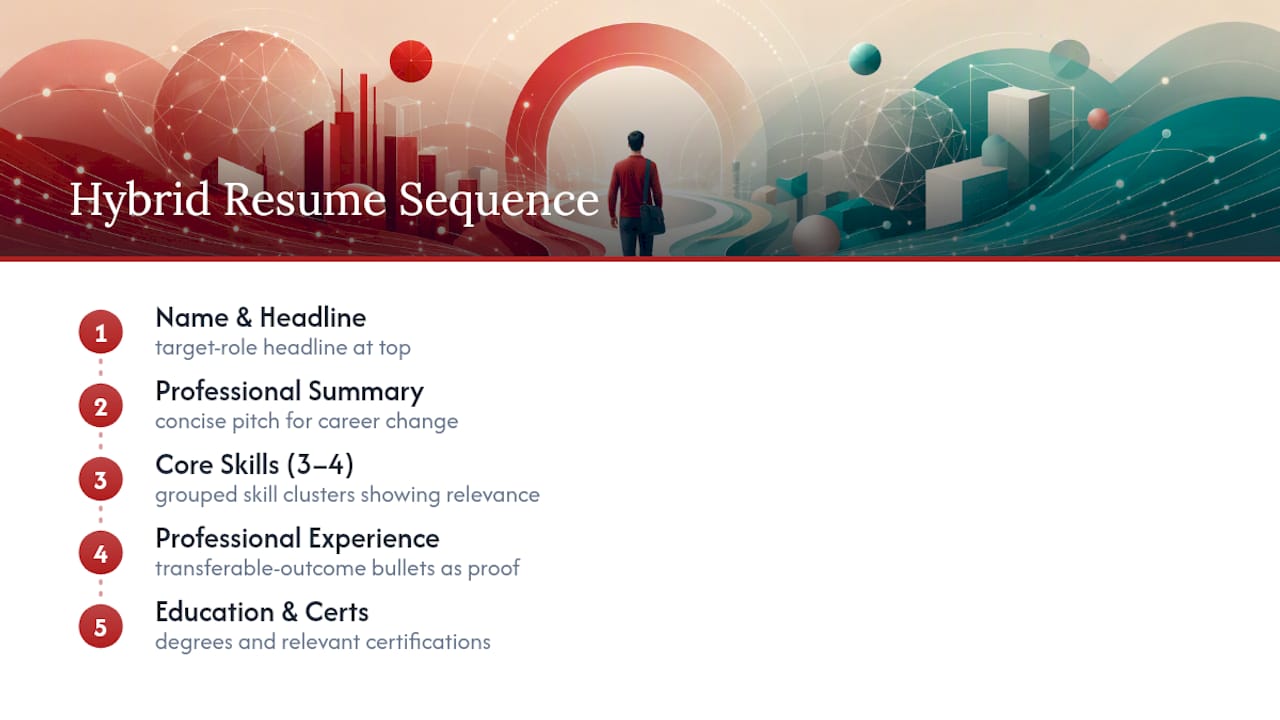
Google Rating 5.0 Based on 300+ reviews